Self-Storage AI Phone Answering: Is It Renting Right Units?
On this page
Last verified October 19, 2026. Vendor case studies cited below are promotional and are labelled that way. Rule citations are not legal advice.
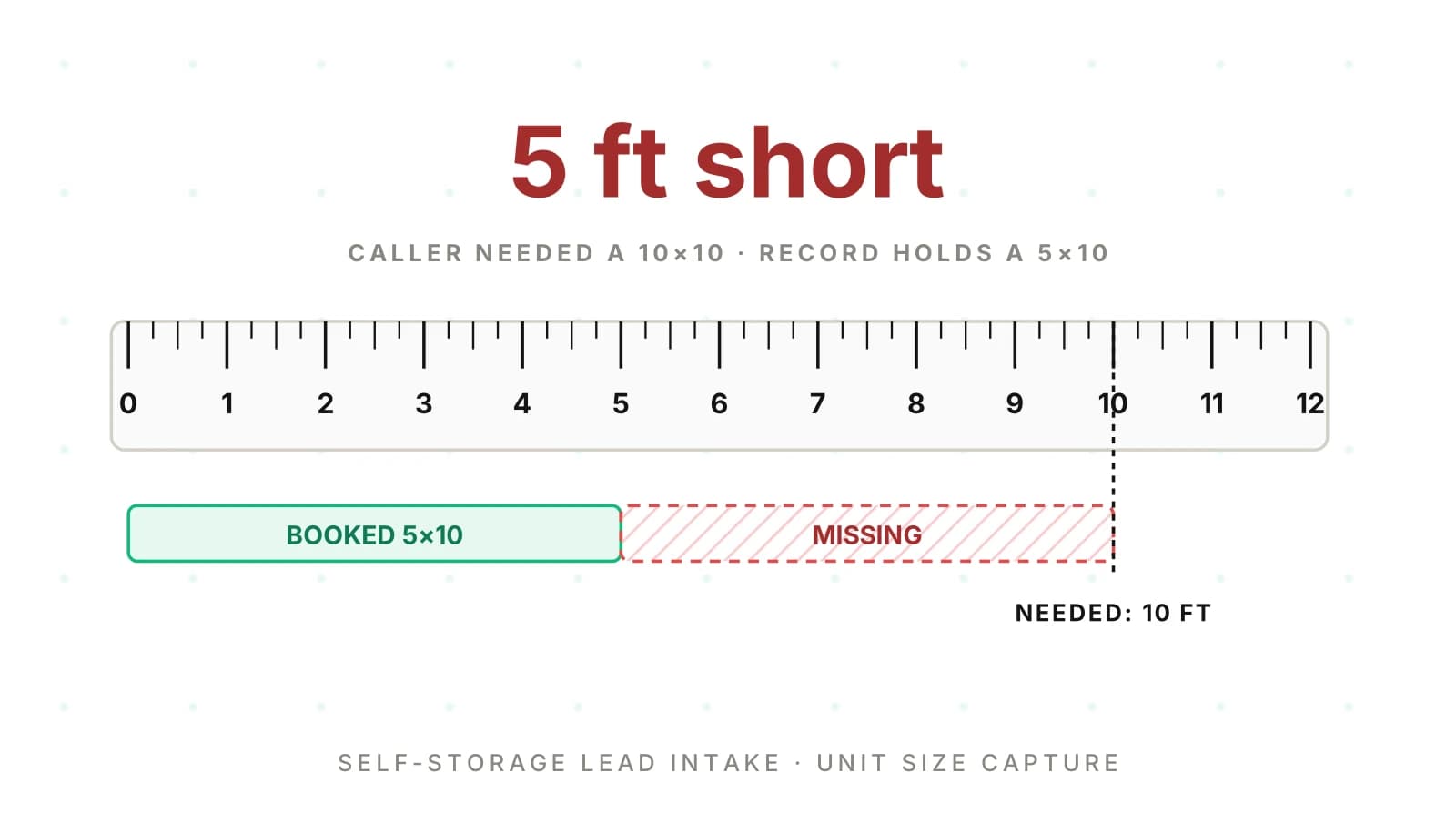
A caller says, "I need a ten by fifteen with climate control near the airport." Your AI receptionist for self storage answers warmly. The caller books a tour and hangs up happy. The record says 10x10, no climate control, and the wrong site. Nothing errored.
Self storage ai phone answering is a data-capture problem that uses a voice. Every call ends in a record that someone at a facility will act on. If the record is wrong, nobody sees it until the caller shows up.
Searches for an ai phone agent self storage operators can trust land mostly on vendor pages, not audits. This is for teams that run their own agent and care about self storage lead conversion, or tune one inside a facility management product. Reservation and promo errors have their own post in self-storage AI reservations. Collections and lien calls are in self-storage lien AI calls. This post stays at the front door: the first call from a prospect.
What a storage call really does
A prospect call looks like a conversation. Inside your system it is a short workflow. The caller states a need. The agent turns it into fields. The fields drive a lookup. The lookup returns units and rates. The agent speaks an answer, and then something is written back.
Here is the chain, with the failure that matters at each step.
1. Capture. Speech becomes size, features, location and date. Errors here are silent because everything downstream looks valid.
2. Lookup. The fields query inventory and pricing. A wrong field returns a real unit that is simply the wrong one.
3. Quote. The agent says a rate. The caller anchors on that number for the rest of the process.
4. Next step. A tour, a hold, a transfer or a callback task. This is where the lead either lives or disappears.
5. Write-back. The lead record lands in the management software. Staff trust it, because it came from a system.
Nobody reads the transcript at step 5. A manager opens the lead, sees "10x10, standard, North," and calls that prospect. The rental is likely lost.
A VP of operations at one large operator told its AI vendor that a single missed call could be worth between $2,000 and $4,000 to the business (Uniti customer story). It is a vendor-published estimate from one operator, so treat it as a signal, not a benchmark.
A vendor of self storage call answering says roughly 20% of inquiries come outside business hours (Inside Self-Storage, July 1, 2026). The author sells call management, so read it as directional. Night calls have no human to catch a mistake, so audit them first.
Nine intake errors that cost rentals
"Be accurate" is not testable. The grid below turns it into nine checks, each with a stored value you can compare to what the caller said.
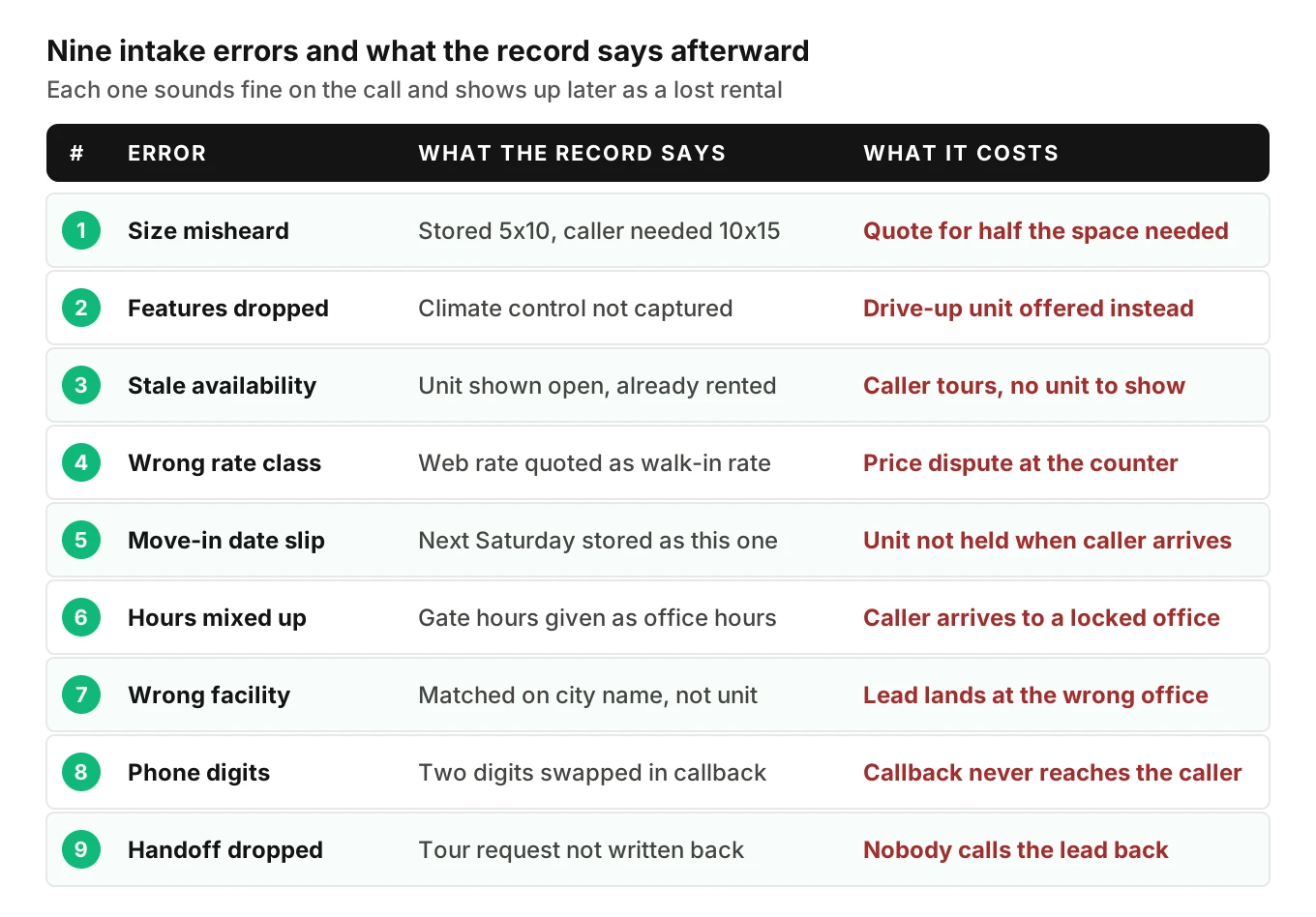
1. Size misheard or misread
Callers give dimensions ("ten by fifteen"), a contents list ("a two-bedroom apartment") or a feel ("something small"). Operators publish charts that map one to the other. One major operator's guide pairs a 5'x10' with a studio apartment and a 10'x15' with a two-bedroom home, and notes the sizes are approximate and vary by facility (Public Storage size guide).
That mapping is where agents drift. The caller never said "5x10." The agent inferred it, then stored it as if the caller had said it. Log whether each size was stated or inferred.
2. Features dropped
Climate control, a drive-up unit, first floor and power are filters. Callers mention them in a half-sentence. If the agent stores size and drops the filter, the lookup returns a cheaper standard unit, and the facility must honor the low rate or walk it back.
3. Stale availability
An agent reading a nightly export will offer units rented this morning. Live lookups avoid that but time out. The safe answer to a failed lookup is "let me have someone confirm," not a guess. See detecting silent tool failures for how to catch a tool call that failed while the agent kept talking.
4. Wrong rate class
Pricing has layers: web rate, street rate, promo rate, fees and protection add-ons. The agent must say which it quotes and whether fees are excluded. Promo wording lives in the reservation errors post. Here, test only that the agent names the rate class and matches the system price to the cent.
5. Move-in date slip
"Next Saturday," "the first" and "end of the month" resolve differently depending on the call date. Store the resolved date and the original phrase, and compare both.
6. Hours mixed up
Storage has two clocks: office hours and gate access hours. "Are you open?" can mean either. Answering office hours to someone dropping off boxes at 9 p.m. is wrong. Test both questions at every site.
7. Wrong facility
Callers say "the one by the airport." Store facility identity as an ID, not a name string. The routing section covers this.
8. Phone digits
A swapped digit in the callback number kills the lead. A healthcare study of phone-call extraction found the first-stage system got 12.9% of reference numbers wrong and 9.8% of group numbers wrong on live calls (arXiv 2506.05400). Those are insurance-benefit calls, not storage, so do not read them as your rate. They show how fragile spoken identifiers are.
9. Handoff dropped
The agent says "I'll have someone call you." No task is created, or it has a blank size field. This is a silent failure, and it is a write-back bug, not a speech bug.
Why speech makes these worse
Each error has a plain software cause. Speech adds noise on top. Four mechanisms matter.
Spoken numbers and dimensions. "Five by ten," "5 by 10," "5x10" and "five-ten" are the same unit. A speech-to-text engine may emit any of them. "Ten by fifteen" can be heard as "10 by 50" on a clipped line. The normalizer that turns this text into a size ID is a classic place for bugs. See STT entity accuracy and tool argument accuracy.
Phone audio and noise. Many prospects call from a truck cab or a driveway. Narrowband audio blurs "fifteen" and "fifty". Average word error rate hides this: a low WER can still mean one wrong digit in a phone number.
Accents and pace. Fast speakers drop words. Test varied accents and pace, as in accent robustness.
Self-corrections. "Ten by ten, no wait, ten by fifteen." Many agents store the first value. Endpointing and interruption settings decide which value you keep.
A cleaned-up transcript can read "10 by 15" when the audio was ambiguous. That is why transcript-only evaluation misses entity errors. Evalgent evaluates from the audio as well as the transcript, which matters when the failure is in how a number was heard.
A minimal grader for the record
You need a ground truth per test call and a function that compares the stored record to it. This sketch is simplified: it normalizes spoken sizes and compares fields.
import re

WORDS = {"five": 5, "ten": 10, "twelve": 12, "fifteen": 15,
         "twenty": 20, "twenty five": 25, "thirty": 30}

def parse_size(text):
    """Return (width, depth) in feet from 'ten by fifteen' or '5x10'."""
    t = text.lower().replace("×", "x").replace("-", " ")
    nums = r"(\d+|twenty five|five|ten|twelve|fifteen|twenty|thirty)"
    m = re.search(nums + r"\s*(?:x|by)\s*" + nums, t)
    if not m:
        return None
    a, b = (int(g) if g.isdigit() else WORDS[g] for g in m.groups())
    return tuple(sorted((a, b)))

def grade(call, truth):
    errors = []
    if parse_size(call["stored_size"]) != parse_size(truth["size"]):
        errors.append("size")
    for f in ("climate", "drive_up", "facility_id", "move_in"):
        if call.get(f) != truth.get(f):
            errors.append(f)
    if re.sub(r"\D", "", call["phone"]) != re.sub(r"\D", "", truth["phone"]):
        errors.append("phone")
    return errors
Run on the opening example, it returns `['size', 'phone']`. Compare structured fields, not prose, and compare to the caller's intent, not to what the agent said back.
Multi-site self storage call routing: pick the site by unit
A multi-site operator adds a tenth question: which building? One AI answers for many facilities. This is the multi-tenant problem: one prompt, many configurations, and leaks between them.
A vendor explainer on nearest-facility transfers describes the flow well. The agent captures unit size, rough location and timing. It checks each sister site's inventory through an API. It filters by distance and excludes sites that are full or under renovation. It then makes a warm transfer with a summary (JustCall). The same piece lists the failure modes: stale addresses or availability tags, no unit nearby, a manager who does not answer, and a caller trapped with no route to a person.
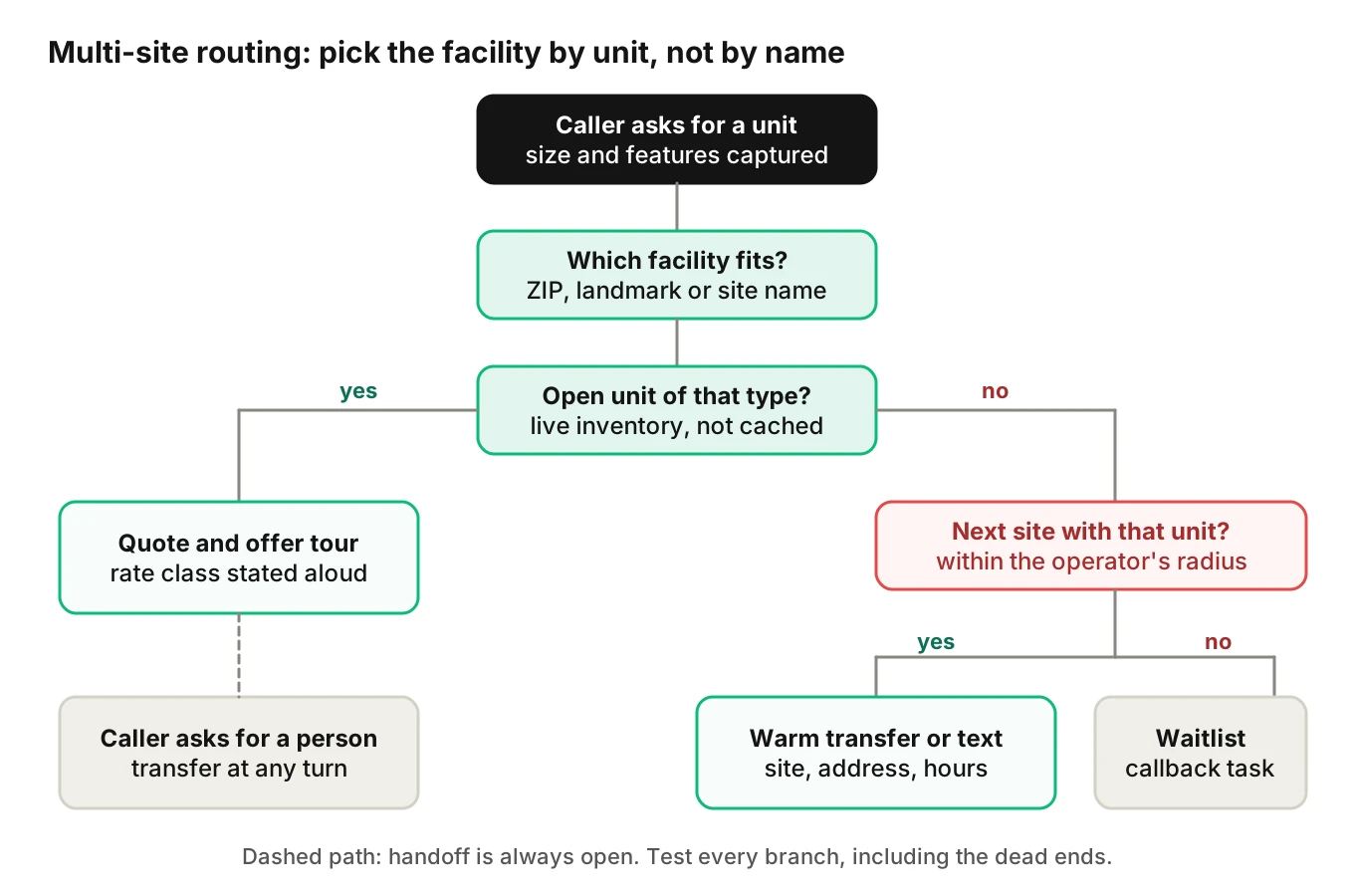
Four dead ends deserve a scenario each.
- Site named but full. The caller wants the Maple Street site. It has no 10x15. Does the agent say so, then offer the next closest site, or does it quote a unit that does not exist?
- Site not named. The caller gives a ZIP code that sits between two sites. Does the agent ask a follow-up or pick one silently?
- Ambiguous name. Test a caller who says only "the Main Street location."
- Transfer target busy. The manager line rings out. Does the call fall to a callback task with the full lead record, or does it drop?
Store the facility ID and who chose it, caller or agent.
Handoffs: what a person must take
An AI that tries to do everything loses rentals and creates risk. The Inside Self-Storage author names two request types that need people: an executor asking for access to a deceased tenant's unit, which needs documentation review, and account or payment requests, which need identity verification first (Inside Self-Storage). Lien questions belong with lien call testing.
Self storage phone sales calls have their own handoff triggers. Suggested set:
- The caller asks for a person, in any wording. Transfer at once.
- The caller wants a unit type the inventory does not list, such as a vehicle or boat space.
- The caller disputes a quoted price.
- The agent has asked for the same field twice and still lacks it.
A loop on "what size do you need?" is a failure. Exit after two tries. See escalation accuracy and handoff loop testing for test patterns. For tours, AI tour booking testing covers no-shows and wrong units; the slot logic carries over.
One vendor-published case study says its AI resolves "50, 60, 70% of calls" (Uniti). That counts calls resolved, not resolved correctly.
Consent and compliance at the phone layer
Three rule areas touch an inbound-lead agent. This is not legal advice; check with counsel for your states.
Call recording. A smaller group of states requires all-party consent to record. A Justia 50-state survey lists California, Florida, Illinois (generally), Maryland, Massachusetts, New Hampshire, Pennsylvania and Washington (generally) among them, with qualified cases for others (Justia). Disclose recording early and include out-of-state callers in tests.
Artificial voices on outbound. If your AI calls leads back, the FCC ruled on February 8, 2024 that AI-generated voices count as "artificial" under the TCPA (Mayer Brown summary). The rule itself is 47 CFR 64.1200: no calls using an artificial or prerecorded voice without the required consent, and telemarketing calls need prior express written consent. An inbound caller differs from a lead you call back, so decide which flows the agent may start.
Revocation. The FCC adopted new consent-revocation rules on September 30, 2026 and released them October 1, 2026 (FCC 26-67). They narrow "revoke-all" for informational calls and let callers name exclusive opt-out methods. They take effect 30 days after Federal Register publication, which had not happened as of October 7. Test that "stop calling me" ends the callback flow.
A scorecard with suggested thresholds
These thresholds are suggestions, not industry standards. Set your own from your cost of an error. Score each audited call on every field, then report per field, not one blended number.
| Field | What to compare | Suggested pass bar |
|---|---|---|
| Size | Stored size vs caller intent | 98% or higher |
| Features | Climate, drive-up, floor, power | 98% or higher |
| Facility ID | Stored site vs correct site | 99% or higher |
| Rate class and price | Spoken quote vs system price | 100% match, class stated |
| Move-in date | Resolved date vs caller intent | 98% or higher |
| Hours | Office vs gate hours, per site | 100% |
| Availability | Offered unit vs live inventory | 100%, no phantom units |
| Phone digits | Stored vs spoken number | 99% or higher |
| Handoff write-back | Task exists with full fields | 100% |
Two fields get a 100% bar on purpose. A phantom unit and a wrong price are promises, and a broken promise creates a dispute, not just a missed lead.
Also track three call-level rates: the share of calls that end with a real next step (tour, hold, transfer or callback task), the share transferred to a human, and the share that hit a loop. Our lead qualification metrics post gives the definitions. Define task success as "correct record plus next step," not "call completed."
Sample size: how many calls prove it
Teams ask for a number. The honest answer is a range. If you score n randomly chosen calls and find zero errors in a field, the 95% upper bound on the true error rate is roughly 3 divided by n (the "rule of three"). That is an illustrative statistic, and it assumes independent random calls.
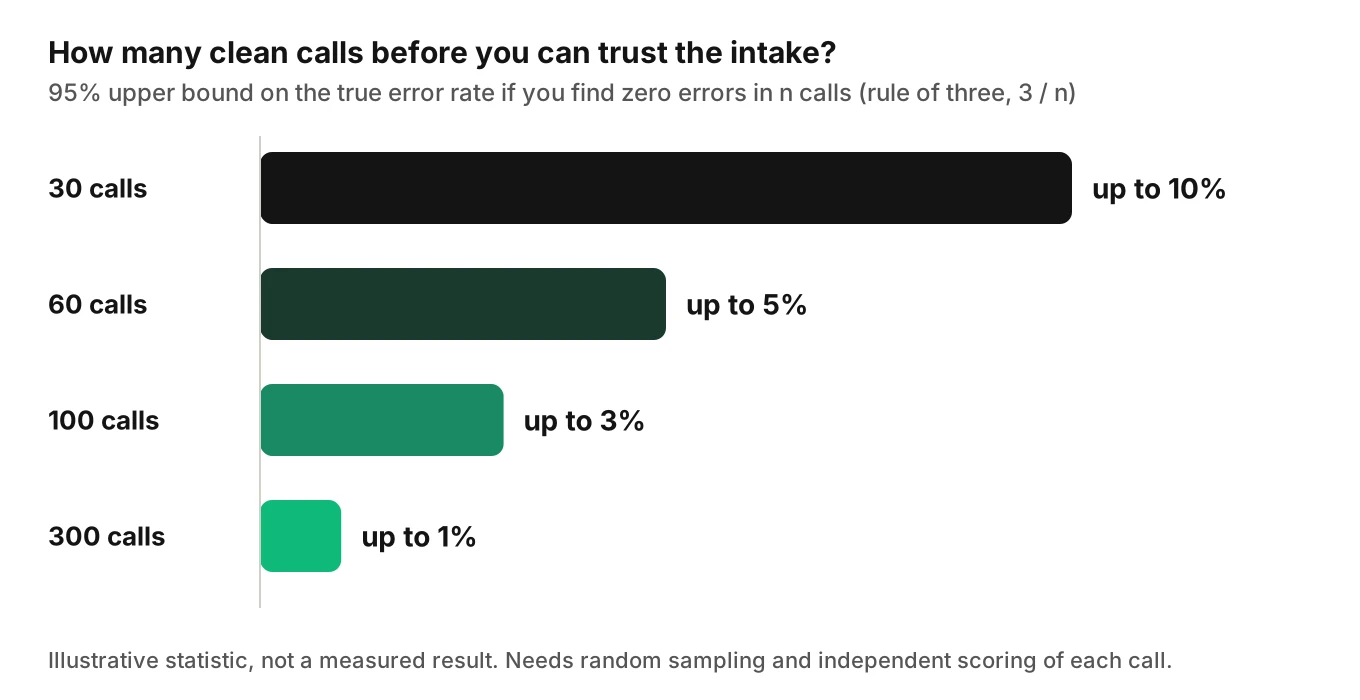
So 60 clean calls only tells you the true rate is probably under 5%. To claim under 1%, you need about 300 clean calls per field you care about. If you see 4 wrong sizes in 100 calls, the true rate is not exactly 4%. It could plausibly be 1% or 10%. More calls narrow it.
Sample by stratum. Pull extra from after-hours, multi-site and long calls, and report each stratum separately. Sampling live calls covers the method. Once scoring is defined, score every call.
How to audit self-storage AI lead intake in one week
You need call recordings, the lead records they created, and read access to inventory and rates.
1. Day 1: define ground truth. For each facility, export unit types, sizes, features, rate classes, office hours and gate hours. This is your answer key.
2. Day 1: pull the sample. Randomly select at least 100 calls from the last two weeks. Add 30 each from after-hours, multi-site transfers and calls over four minutes. Note the call ID and the lead record ID for each.
3. Day 2: listen and label intent. For each call, a person writes what the caller wanted: size, features, site, date, callback number. Do this from the audio, before looking at the record.
4. Day 3: compare to the record. Score all nine fields as pass, fail or not applicable. Mark every size as caller-stated or agent-inferred.
5. Day 3: check quotes and hours. Match each spoken price and hour claim to the answer key. Flag any quote with no stated rate class.
6. Day 4: audit handoffs. For every call that promised a tour, callback or transfer, find the task in your software. Check it exists, is complete and was acted on.
7. Day 5: write the failure log. Group errors by cause (speech, mapping, stale data, write-back, policy) and rank by cost.
8. Day 5: set the regression set. Turn each failed call into a replayable test, so the next prompt change is checked against it. Shipping prompt changes safely covers the release gate.
Testing before a change reaches every facility
A manual audit is a snapshot. The next prompt edit, a new site in the config or a speech-model update can undo it. Build repeatable scenarios from the nine errors crossed with caller conditions: a ten-by-fifteen request from a fast caller on a windy lot, with a self-correction halfway. A ZIP code between two sites.
Evalgent generates test scenarios from an agent's prompt and flows, including branches, policies and hard constraints. It runs them with caller profiles that vary accent, pace, interruptions, response delay, background noise and language, over phone, SIP or WebRTC. You can replay the same truck-cab call against every prompt version and see whether size capture changed. Custom metrics, such as "stored size equals caller intent," run on every call. Evalgent works with teams to set up evals for their first agent, so choosing which of the nine fields become custom metrics is part of that work.
In production, you push call recordings, and they are transcribed, mapped to scenarios and judged. Evalgent flags tool-call failures, latency spikes, PII leakage and policy failures, with fix recommendations. A failed rate lookup is exactly what becomes a wrong quote. For the release gate, see the AI phone agent go-live checklist. Use synthetic callers and test numbers, never real prospect data.
One cheap control belongs in the agent itself: read-back. "A ten by fifteen, climate controlled, at Maple Street. Is that right?" turns a silent error into a spoken one.
Frequently asked questions
How accurate is self storage ai phone answering?
It depends on the field. Greeting and hours questions are usually easy. Size, rate class, facility choice and callback digits fail more often because they need exact capture. No public benchmark covers storage, so measure your own: score a random sample of calls against the stored lead record, per field, not as one blended number.
What does a self-storage AI phone agent get wrong most often?
Silent record errors: a size inferred rather than stated, a dropped feature like climate control, a stale unit, a missing handoff task and a swapped phone digit. These rarely show in the transcript. Check them by comparing the stored lead to what the caller actually asked for, field by field.
How do I test a self-storage AI receptionist before going live?
Build scenarios from the nine intake errors and run them with varied caller conditions: accent, pace, noise, interruptions and self-corrections. Include multi-site routing, inventory timeouts and handoff paths. Replay the set on every prompt or model change, and gate release on the per-field pass bars you set.
Can AI quote self-storage unit prices over the phone?
Yes, if it reads the price from your live pricing system and names the rate class and any fees. The risk is a stale or wrong rate class. Test that every spoken quote matches the system price exactly, and that the agent hands off any price dispute to a person.
How does AI route calls between multiple self-storage locations?
A common design captures size, features and location, checks each site's live inventory, filters by distance and status, then transfers with a summary. Test full sites, ambiguous ZIP codes, duplicate site names and busy transfer targets. Store a facility ID, not a name, and log whether the caller or the agent chose the site.
When should a self-storage AI hand the call to a human?
Whenever the caller asks for a person, disputes a price, wants an unlisted unit type, or the agent has asked for the same field twice. Account, payment, estate-access and lien questions also belong with staff. Always leave a handoff open, and check that a task with full fields reaches your software.
Is it legal to record self-storage calls with an AI agent?
It depends on the states involved. Some, including California, Florida and Pennsylvania, require all-party consent, per a Justia survey. Disclose recording early in every call and test out-of-state callers. Outbound AI callbacks also fall under the TCPA and 47 CFR 64.1200. This is not legal advice.
How many calls should I audit to know if the AI is renting the right units?
At least 100 random calls, plus extra from after-hours, multi-site and long calls. Zero errors in 60 calls only bounds the true rate near 5%; in 300 calls, near 1% (rule of three, illustrative). Report each field separately, and automate scoring once the rubric is stable.
The bottom line
Self storage ai phone answering earns its keep only when the stored record matches the caller's request on size, features, site, price, date and callback number. Audit those fields from the audio and the record, set a pass bar per field, and replay failed calls before every change.
Related Articles
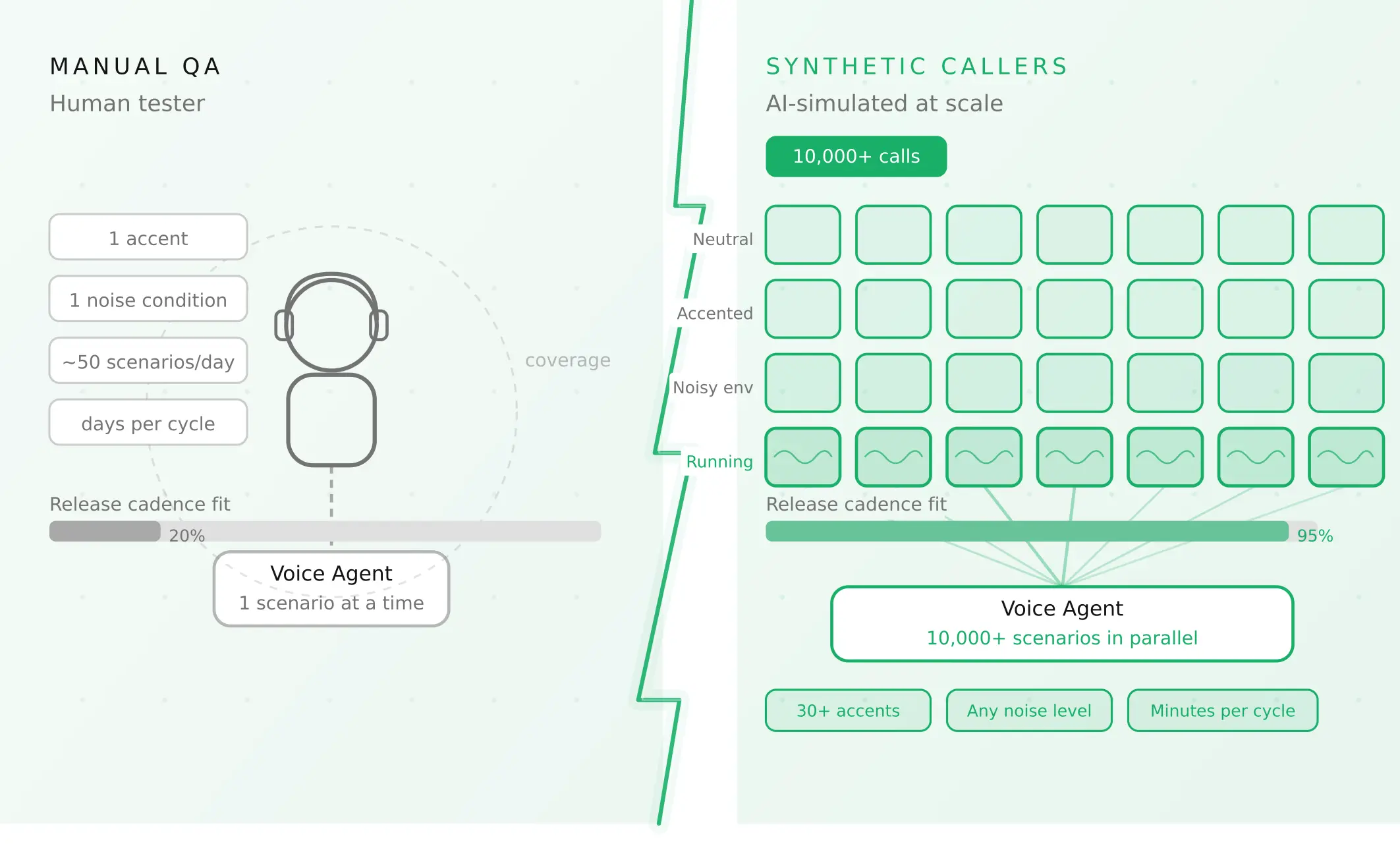
How to automate voice agent testing: synthetic callers vs manual QA
Learn how ai test automation replaces manual QA for voice agents. Compare synthetic callers vs human testers, with a 5-step framework to scale without hiring.
Read more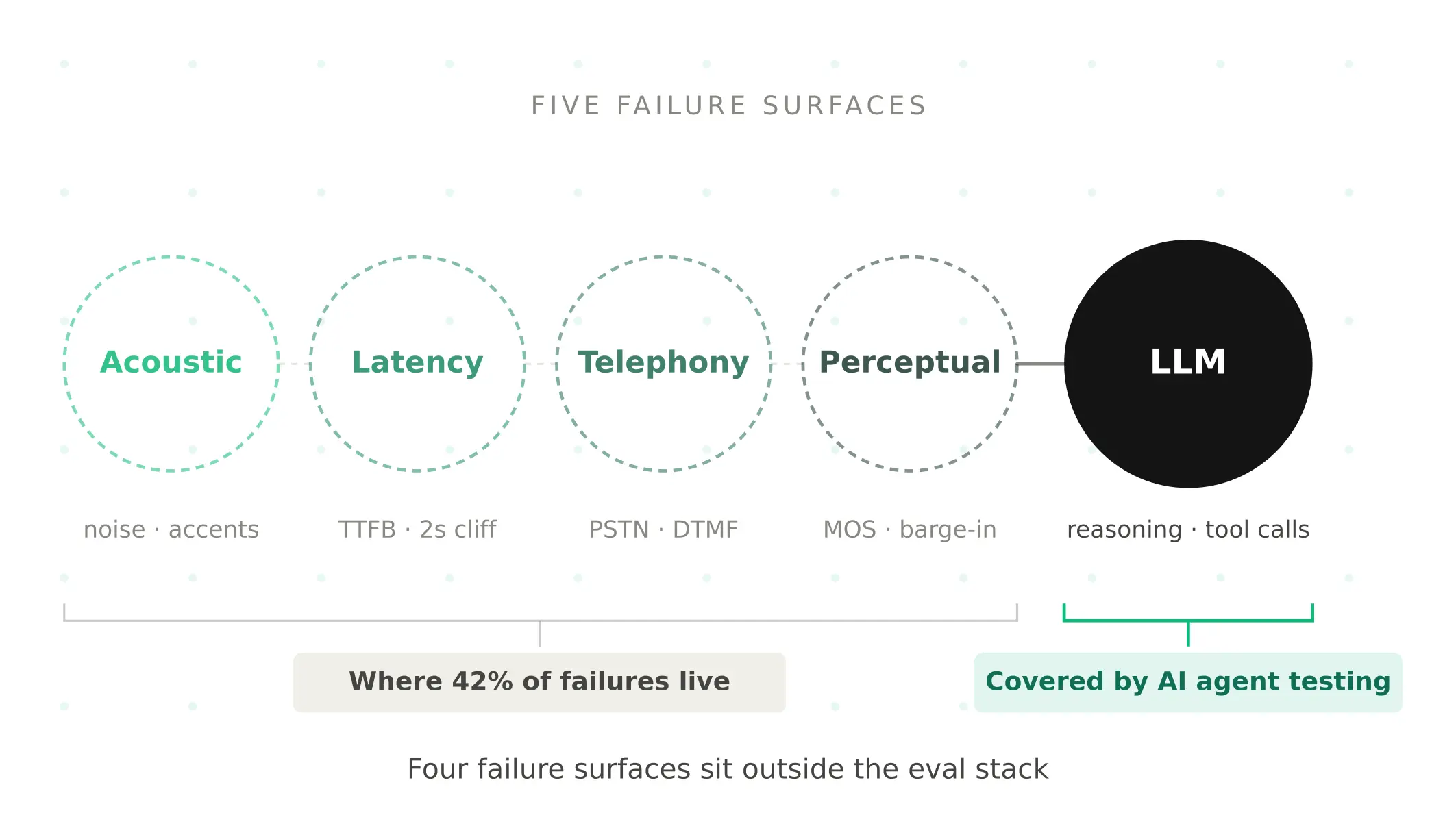
AI Agent Testing vs Voice Agent Testing: What General Tools Miss for Voice
AI agent testing measures text outputs. Voice agent testing measures behaviour through an acoustic pipeline. Five failure categories general tools miss.
Read more