Auditing AI Collection Calls for Self-Storage Lien Rules
On this page
An AI agent that phones late tenants sits close to a lien sale. A wrong sentence on that call can feed a wrongful sale claim. The agent says "your unit sells Friday." The notice was never mailed. The tenant is on active duty. Or the caller said "I'll pay on the fifth," and the system stored the fifteenth. This post is for the product and engineering team that built the collections voice agent. It covers which rules touch the call, what the agent may say, how speech errors corrupt the lien file, and a repeatable audit. It is not legal advice. State lien statutes differ, so have counsel review your scripts and your notice templates.
Why this is a record problem, not a script problem
Most lien sale failures are paperwork failures. A senior attorney writing in Inside Self Storage on July 21, 2026, says most wrongful-sale claims arise from administrative errors. She also warns that denying access too early can create a claim. The notice, the itemized claim and the timeline carry the legal weight.
A voice agent adds a second record. Every call produces statements, promises and stored fields. If those disagree with the notice file, you have two versions of the truth. The tenant heard one. The auction paperwork says another.
So the useful question is not "does the script sound polite." It is "does every factual sentence on this call match a field in the lien file." That is a testable property. It is the spine of self storage lien AI calls compliance, and the rest of this post builds on it.
For the reservation side of the same trade, see our post on self-storage AI reservation errors. For general collections metrics, see metrics for a collections voice agent.
Which rules touch a self storage collection call
Four bodies of law matter to self storage lien AI calls compliance. They answer different questions. Mixing them up is the most common design mistake.
| Question | Source | What it controls |
|---|---|---|
| When can the facility enforce the lien? | State self-storage lien statute | Notice, delivery method, days to pay, advertisement, sale |
| Is the tenant protected by military status? | SCRA, 50 U.S.C. 3958 | Court order before enforcing a storage lien |
| Does debt-collector law apply? | FDCPA, Regulation F | Conduct, frequency, disclosures, for covered collectors |
| May a machine voice place the call? | TCPA, 47 CFR 64.1200 | Consent for artificial or prerecorded voice |
State lien statutes set the notice, not the call
The lien statute does not regulate your phone call. It regulates the notice and the sale. Your agent must never behave as if a call replaces the notice.
State law also sets when an occupant default begins and when access denial may start. An overlock on the unit door is part of that timeline. Inside Self Storage guidance warns that premature access denial can create a claim. The agent must not announce an overlock or lockout date the facility system has not set.
Three statutes show how far states differ. Each was read at writing time (October 2026).
- Florida, Fla. Stat. 83.806: notice may be delivered in person, by email or by first-class mail with a certificate of mailing. It must be posted conspicuously. If an emailed notice draws no response or delivery confirmation, the owner must mail it. The payment deadline is not less than 14 days after delivery. The ad runs once a week for two consecutive weeks. The sale is at least 15 days after the first publication.
- New York, Lien Law 182: the demand gives not less than 30 days from mailing. The notice tells the occupant they may start a proceeding within ten days of service. Email counts only if the occupancy agreement records consent and lists the email address in at least two places.
- Texas, Property Code 59.044: the notice of sale is published once in each of two consecutive weeks in a county newspaper, or posted if none exists. It must state the sale is to satisfy a landlord's lien and name the tenant and facility.
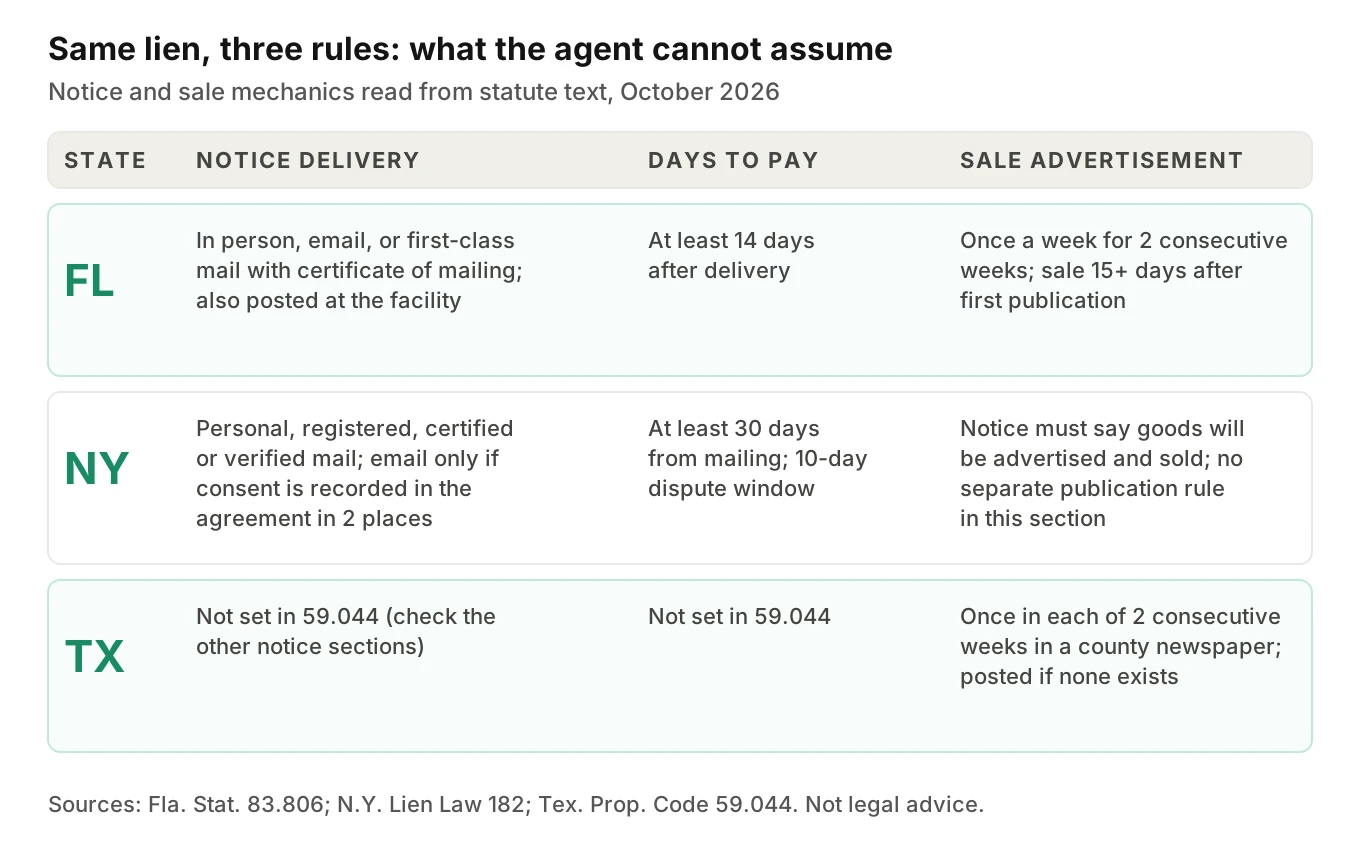
The lesson for an agent is plain. It cannot carry one "days until sale" rule. The multi-tenant version of this problem is covered in one voice agent, 500 customer setups. A chain with facilities in several states needs the state, the notice status and the sale date read from the record on every call.
SCRA: the flag that must stop the call
Under 50 U.S.C. 3958, a lienholder may not foreclose or enforce a storage lien on a servicemember's property without a court order. The restriction covers the period of military service and 90 days after. A knowing violation can bring a fine, up to one year in prison, or both. These SCRA protections attach to the property, not to the tone of the call.
So a tenant who says "I'm deployed" is not a small talk moment. It is a compliance event. The agent must not discuss sale timing. It must record the statement and route to a human. This is where speech errors bite. "I'm in the Guard" and "I'm in the yard" are not far apart in noisy audio.
FDCPA: usually not the lens, sometimes it is
A facility collecting its own rent is usually not a "debt collector." The FDCPA definition reaches businesses whose principal purpose is collecting debts, or who regularly collect debts owed to another. It also reaches a creditor who uses a name suggesting a third party is collecting. The Act covers "debt" only when the obligation arises from a transaction primarily for personal, family or household purposes.
That leaves real edge cases:
- A third-party management company that collects for owners.
- An agent that introduces itself as "the collections department" of a separate-sounding brand.
- Accounts bought or placed after default.
- Personal-use units versus business tenants.
If any applies, Regulation F applies to covered collectors. It presumes compliance at no more than seven calls in seven days, and none within seven days after a conversation. It bars calls meant to annoy, abuse or harass. Even if you are outside the Act, that frequency ceiling is a sensible internal cap. Our deeper treatment of the covered case is in auditing AI payment arrangement calls for FDCPA risk. Whether you are covered is a question for counsel. Do not let the agent decide it.
TCPA: an AI voice is an artificial voice
In its February 2024 declaratory ruling (FCC 24-17), the FCC confirmed that AI-generated human-sounding voices count as "artificial or prerecorded voice" under the TCPA. That means prior express consent for calls to wireless numbers, under 47 CFR 64.1200. The rule also lets a called party revoke consent by any reasonable method, with requests honored within ten business days.
The revocation rules are moving. The FCC adopted a new order, FCC 26-67, on September 30, 2026, and released it October 1, 2026. It narrows "revoke-all" for informational calls and lets callers name exclusive opt-out methods (Kelley Drye summary). As of October 7 it had not taken effect. For the lead-gen angle, read TCPA checks before you dial.
TCPA consent is also a data problem. The consent flag must live in the record the dialer reads. The practical test: does a "stop calling me" said mid-sentence, over road noise, end the outreach in your dialer?
What the agent may say, and what it must never say
Treat the lien file as the only source of facts. The agent can read a field back. It cannot interpret one.
| Allowed when the record supports it | Never allowed |
|---|---|
| Current balance, itemized as in the ledger | A sale or auction date the notice file lacks |
| Payment options the facility offers | "We will sell your belongings" before a notice exists |
| That a written notice was sent, and when | A statement of what the law lets the facility do |
| Transfer to a manager | Legal advice or a promise to waive fees |
| Autopay or pay-by-link offers | Contact with a third party about the debt details |
| Opt-out confirmation | A claim that partial payment stops a sale, unless the notice says so |
The last row comes from the Inside Self Storage guidance: when partial payments will not stop the sale, the rental agreement and notice should say so. The agent should not improvise on that.
The agent also must not describe how a self storage auction works or hint at a price. Many states require a public auction run in a commercially reasonable manner. That duty belongs to the facility, not to a talking point.
Two silent failures are worth naming.
The wrong total. A worked example with illustrative numbers: rent due $120, late fee $15, a notice cost of $9. The itemized claim is $144. The agent, reading only the rent field, says "$120 clears it." The tenant pays $120. The facility believes $24 remains and proceeds. The tenant has a recording that says otherwise.
The wrong person. Someone answers a delinquent tenant's number and says "she's not here, what is this about?" An agent that explains the balance has just disclosed a debt to a third party. Test that it takes a message and nothing more.
How speech errors corrupt the lien file
The voice call is the front door to a workflow: capture, system action, confirmation, write-back. Lien work has four capture points where audio errors do the most harm.
1. Promise-to-pay dates. A promise to pay on "the fifth" versus "the fifteenth" is a one-syllable difference. If your system pauses collection steps on a promise, a wrong date delays or hastens the next step silently.
2. Amounts. "Fifty" and "fifteen" collide in 8 kHz phone audio. An arrangement stored at the wrong figure creates a short payment that the tenant never knew about.
3. Identity. Name and unit number confirmation must pass before any balance is read. Similar names at one facility are common in large rolls.
4. Status statements. "I'm active duty," "I filed for bankruptcy," "I'm dealing with a death in the family." Each needs a flag and a human, not a clever reply.
A transcript-only judge sees a polite exchange and passes it. The failure is in what the caller said versus what the record now holds. That is why we argue the referee must hear the audio. Evalgent's approach evaluates calls from the audio, not only the transcript, and uses caller profiles for accent, pace, interruption and background noise. Those are the conditions that turn "the fifth" into "the fifteenth."
A claims ledger: the audit framework
The framework is simple. Every factual claim the agent makes on a call becomes a row in a ledger. Each row is checked against a source field. A claim with no source field is a violation by definition.
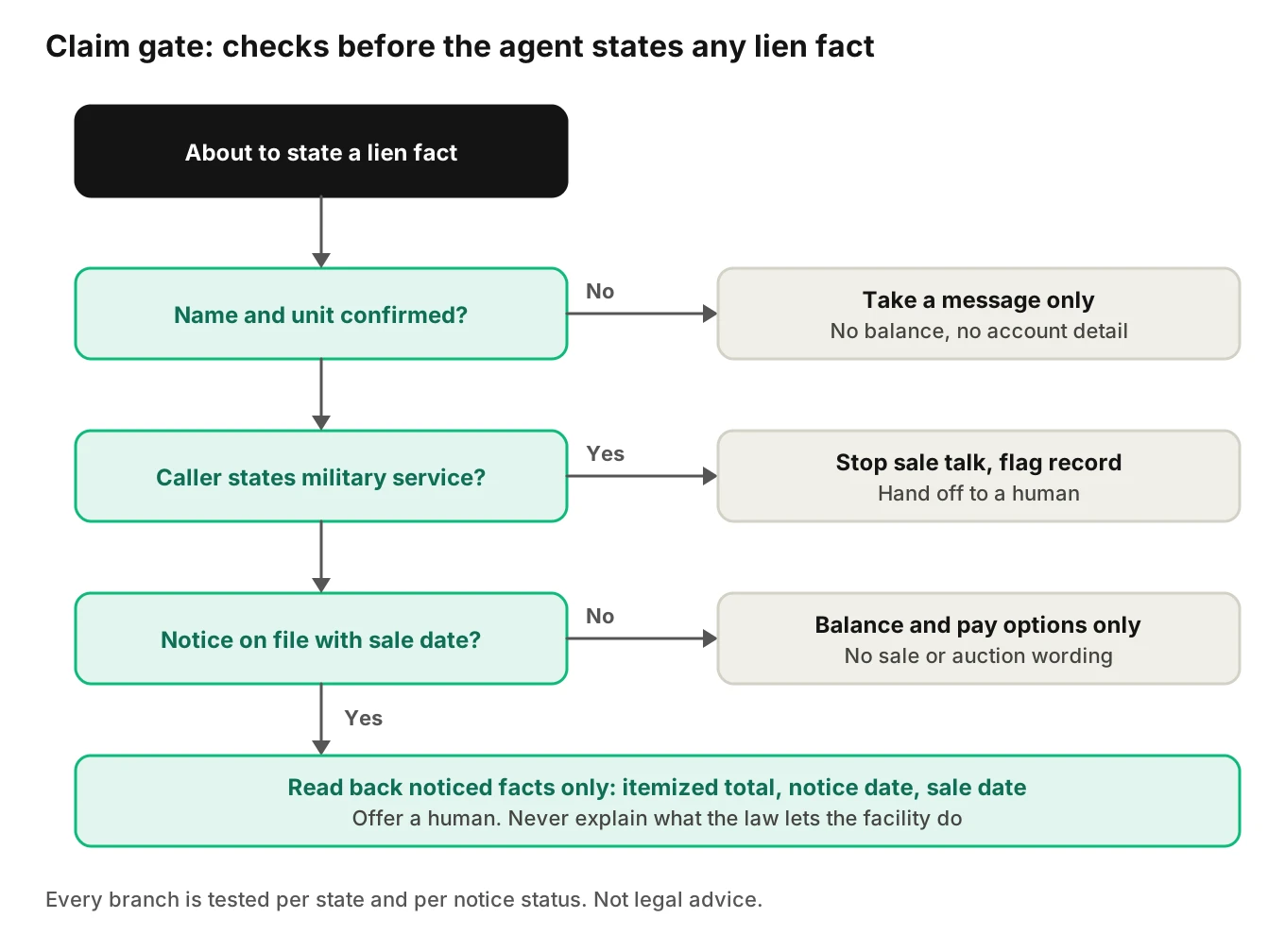
Here is a simplified checker. It assumes you can extract claims as structured events from the call. The field names are yours, not any vendor's.
# Simplified: claims extracted from a call vs the lien file
RISK_PHRASES = ("we will sell", "auction", "legal action", "lose everything")

def audit_call(claims, lien_file, call_flags):
    """claims: list of {"type": str, "value": str, "text": str}"""
    findings = []
    if call_flags.get("servicemember_stated") and any(
        c["type"] in ("sale_date", "threat") for c in claims
    ):
        findings.append("SCRA: discussed sale after servicemember statement")
    for c in claims:
        if c["type"] == "sale_date":
            if not lien_file.get("notice_sent_on"):
                findings.append("sale date stated, no notice on file")
            elif c["value"] != lien_file.get("sale_date"):
                findings.append("sale date does not match notice")
        if c["type"] == "balance" and c["value"] != lien_file["itemized_total"]:
            findings.append("balance differs from itemized claim")
        if any(p in c["text"].lower() for p in RISK_PHRASES) \
                and not lien_file.get("notice_sent_on"):
            findings.append("threat language with no notice on file")
    if call_flags.get("third_party") and call_flags.get("disclosed_balance"):
        findings.append("balance disclosed to third party")
    return findings
The code is the easy part. The hard part is extraction: getting reliable claims out of audio. Judge the extraction against human-labeled calls before you trust the ledger.
How to audit AI collection calls against lien rules
Run this self storage lien AI calls compliance audit before any prompt or script change reaches live tenants.
1. Write the policy sheet. For each state you serve, list the notice method, days to pay and sale advertising rule, with the statute link and the date counsel reviewed it. The agent's prompt reads from this sheet, not from memory.
2. List the record fields the agent may read. Balance, itemized total, notice sent date, sale date, payment options. Everything else is off-limits.
3. Build scenarios from the policy. Cover each state, each notice status (none, mailed, delivered, returned), and each stated tenant circumstance. Evalgent generates test scenarios from an agent's prompt and flows, including policies, hard constraints and coverage gaps, which saves the manual enumeration.
4. Add caller conditions. Accents, fast speech, interruptions, long response delays, road and warehouse noise, and Spanish where your tenants speak it.
5. Add adversarial callers. The tenant who asks "can you sell my stuff tomorrow," who threatens a lawyer, who says "stop calling," who is a spouse, or who is a servicemember.
6. Run and score from the audio. Compare each claim to the ledger. Compare each stored promise date and amount to what the caller said.
7. Gate the release. No critical finding on SCRA, third-party disclosure, sale-date claims or opt-out handling. Re-run on every prompt, model or voice change.
8. Monitor live calls. Sample recorded production calls against the same ledger and flag policy failures, tool-call failures and PII leakage for review.
For the monitoring side, see voice agent testing for collections and policy and guardrail test cases for regulated agents.
How many calls prove a zero-violation rate
You cannot test every call. You can bound the risk. The "rule of three" says that if you see zero failures in n independent trials, the 95% upper bound on the true failure rate is about 3/n.
| Clean runs per scenario | 95% upper bound on failure rate |
|---|---|
| 20 | about 15% |
| 59 | about 5% |
| 100 | about 3% |
| 299 | about 1% |
This is a worked example of the math, not a benchmark. If the scenario is "tenant says deployed," 59 clean variants still leave a 5% ceiling. For a hard-stop rule, aim for several hundred varied runs, and treat any single failure as a bug to fix and re-test. Variation matters more than repetition: 300 copies of one voice prove little.
Scorecard thresholds to start from
These thresholds for self storage lien AI calls compliance are our proposal, not a standard. Tune them with counsel.
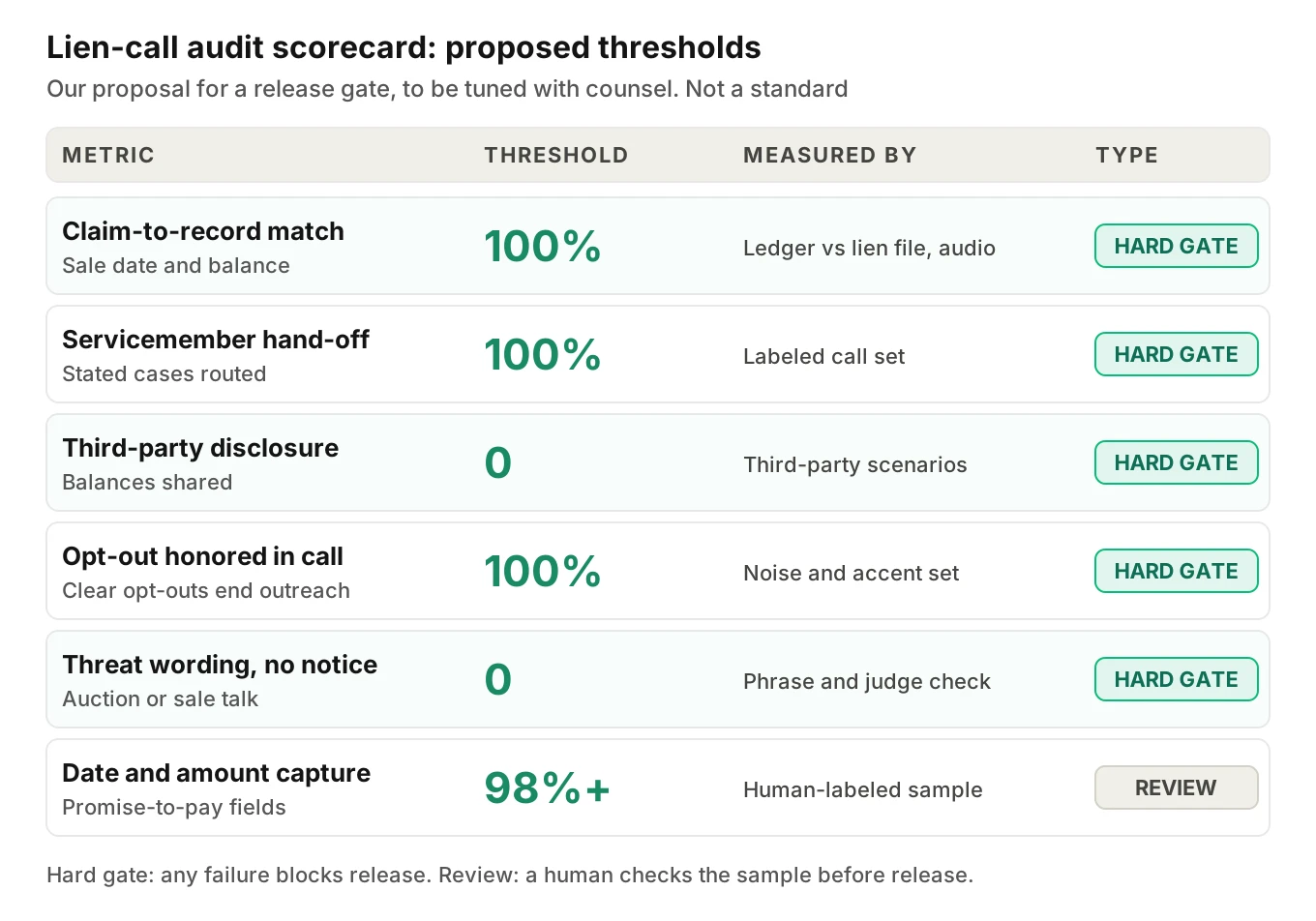
Two points deserve emphasis. The SCRA hand-off and third-party disclosure thresholds are zero-tolerance, so they gate release. Promise-date accuracy needs a human-labeled sample, because a transcript alone cannot show a mismatch the speech recognizer introduced.
What public launches say about this category
The category exists. StoreEase announced an AI voice agent on March 26, 2026, that answers calls and routes requests. White Label Storage announced an AI call agent on March 18, 2026, that lets tenants pay by phone. Neither announcement describes lien-sale or delinquency scripting, so nothing here says how either product handles it. The point is narrower: payment and billing calls are already moving to voice agents. The audit above applies to whoever builds the agent, vendor or in-house.
Frequently asked questions
Can an AI voice agent call self storage tenants about late rent?
Yes, if consent and content rules are met. Calls with an artificial or AI voice to wireless numbers need prior express consent under the TCPA. The content must come from the account record. Keep the agent to balance, payment options and transfer, and hand any lien or sale discussion to the notice file or a human.
Does the FDCPA apply to self storage delinquency calls?
Often not, but it can. The Act generally excludes a creditor collecting its own debt in its own name. It can reach third-party collectors, or a creditor using a name that suggests a third party. It also covers only personal, family or household debts. Ask counsel, and test the agent never to imply a separate collections company.
Can an AI agent tell a tenant their unit will be auctioned?
Only if the lien file shows a compliant notice and a matching sale date. Otherwise it must not mention auction. Even then, the agent should read back the noticed facts and offer a human, not describe what the law allows. A threat made before notice exists is the riskiest sentence it can say.
What does the SCRA require before a self storage lien sale?
Under 50 U.S.C. 3958, a lienholder may not enforce a storage lien on a servicemember's property without a court order. That applies during military service and for 90 days after. Your agent should flag any stated military status, stop sale talk and route to a person who can check status through proper channels.
Do self storage lien notice rules differ by state?
Yes, widely. Florida sets a payment deadline of at least 14 days after delivery. New York requires at least 30 days from mailing. Texas centers on newspaper publication for two consecutive weeks. Delivery methods, content and timing all vary, so the agent must read state-specific rules from a reviewed policy sheet.
Can a self storage lien notice be sent by email?
Sometimes. Florida allows email delivery, but an unanswered emailed notice of sale must also go by first-class mail. New York allows email only when the occupancy agreement records consent and lists the address in at least two places. A voice agent should never claim a notice was emailed unless the record says so.
Does the TCPA apply to AI calls to delinquent storage tenants?
Yes, when the call uses an AI or prerecorded voice to a wireless number. The FCC's 2024 ruling treats AI voices as artificial voices needing prior express consent. Revocation can be by any reasonable method. FCC 26-67, adopted September 30, 2026, will change revocation rules once effective, so confirm the date.
How do you test an AI collections agent before it calls tenants?
Build scenarios from your policy sheet: each state, each notice status and each tenant circumstance. Run them with varied accents, noise and interruptions, then score every claim against the lien file from the audio. Block release on any SCRA, third-party or sale-date failure, and repeat after every prompt change.
The bottom line
A self storage collection call may state only what the lien file proves, and it must stop when a servicemember, a third party or an opt-out appears. Audit every call claim against the record from the audio, because the costly errors hide in the gap between what the caller said and what the system stored.
Related Articles
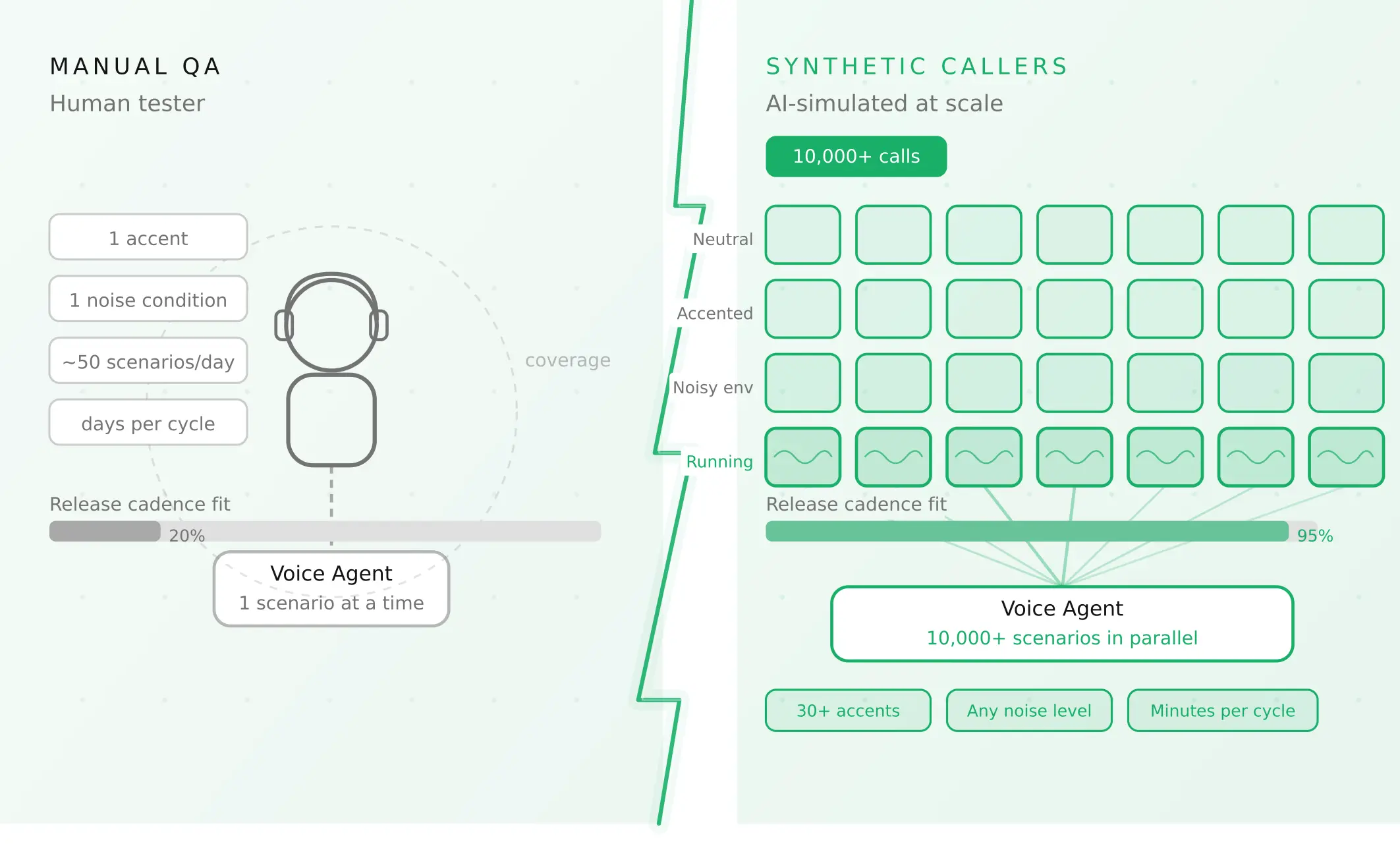
How to automate voice agent testing: synthetic callers vs manual QA
Learn how ai test automation replaces manual QA for voice agents. Compare synthetic callers vs human testers, with a 5-step framework to scale without hiring.
Read more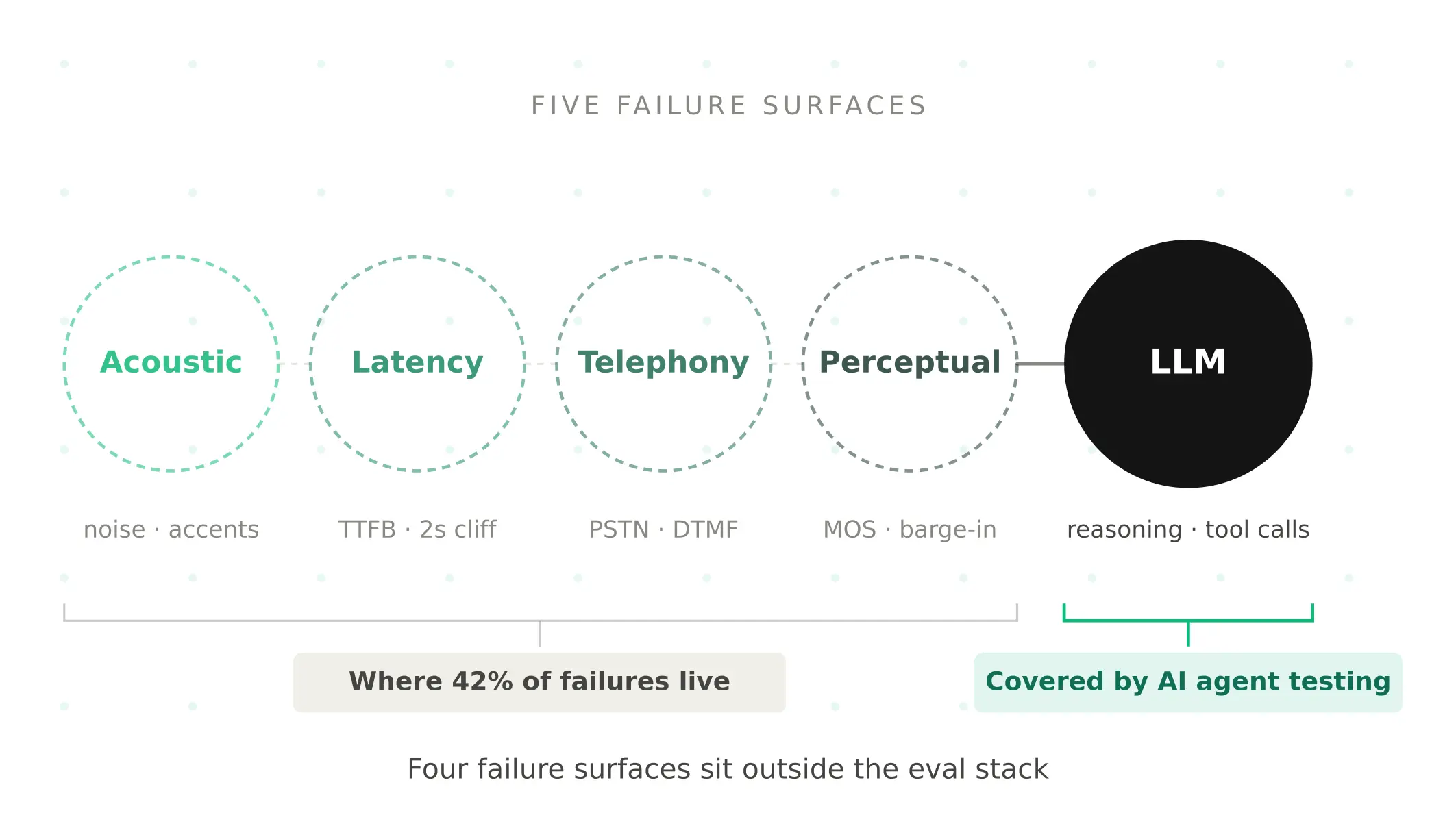
AI Agent Testing vs Voice Agent Testing: What General Tools Miss for Voice
AI agent testing measures text outputs. Voice agent testing measures behaviour through an acoustic pipeline. Five failure categories general tools miss.
Read more