Test your voice agent
How to Test for Handoff Loops in Voice Agents
# How to test for handoff loops in voice agents
> Quick answer: A handoff loop is when a voice agent transfers a caller in circles across agents, departments, or a human queue without ever reaching resolution. Test for it by forcing ambiguous routing and counting transfers per call. Check that context survives each hop. Enforce a hard max-handoffs guardrail that fails when it trips.
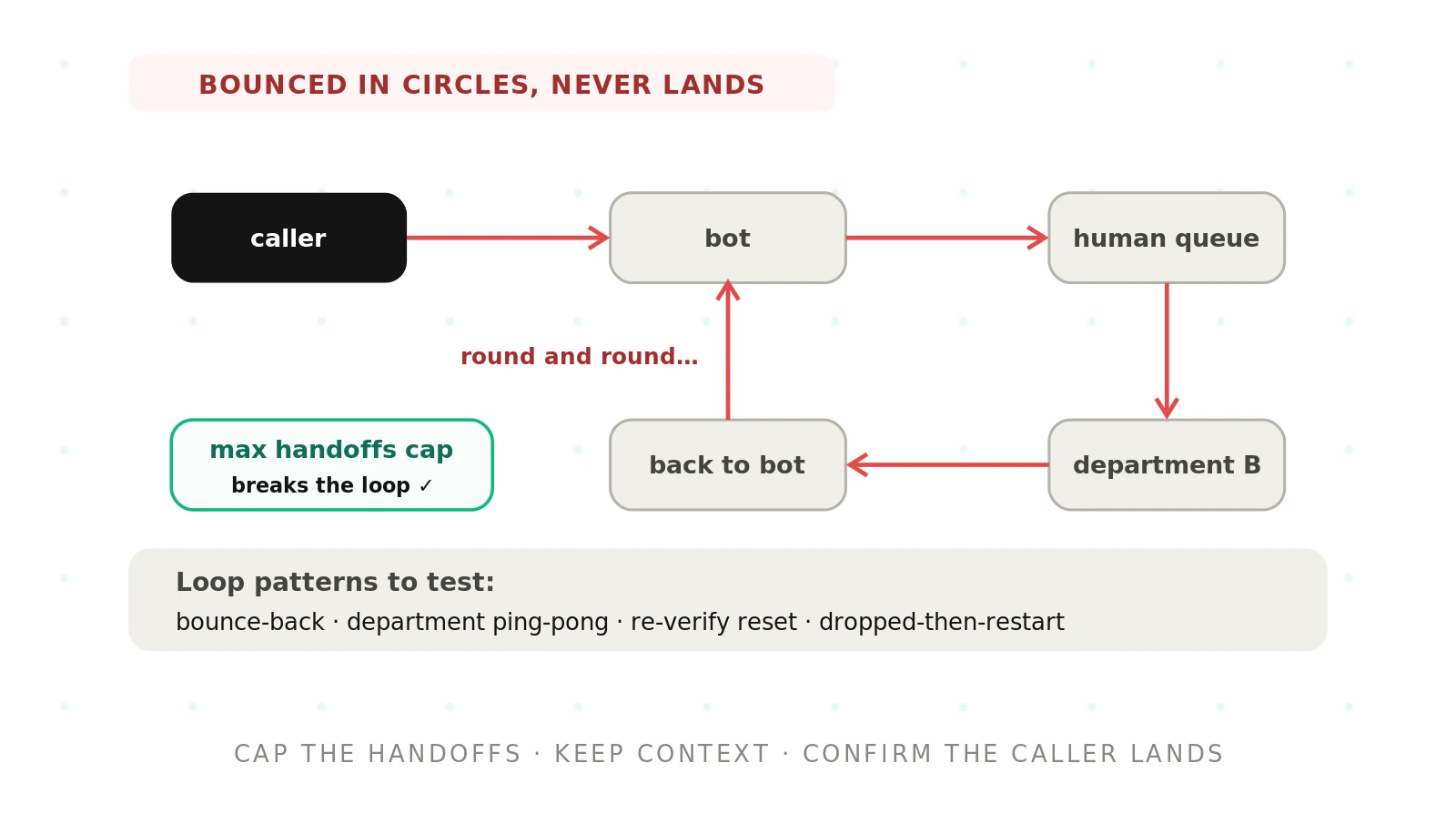
A caller with a simple problem gets bounced from the agent to the wrong department. Then back to the agent, up to a human queue, then dropped into the bot to start over. Nobody ever solves the problem. This is a handoff loop. It is one of the most damaging failures a voice agent can ship with, because every other metric can look healthy while it happens.
The loop is not a single bad transfer. It is a pattern of transfers that never converges on an outcome. That pattern is invisible to a test suite that only scores single turns or single handoffs. You have to test the whole journey and count the hops. Then set a ceiling that treats "still transferring" as a failure state. This guide shows how.
What a handoff loop actually is
A handoff loop is a control-flow failure, not a transcription or intent failure. The agent understood the caller, chose a route, and executed the transfer. It just chose a route that leads back to where the caller started.
> Handoff loop: a sequence of transfers in a voice agent that returns the caller to a prior state without progress, so the call cycles instead of resolving. It is the conversational form of an infinite loop in ordinary control flow.
The useful mental model comes from distributed systems. A deadlock is when two parties each wait for the other and nothing moves. A handoff loop is closer to a livelock. Everything keeps moving. Transfers keep firing and work keeps happening, but the system makes no forward progress. The caller feels motion without resolution. That is the tell.
It helps to model the agent's routing as a finite-state machine. Each state is a place the caller can be: with the bot, in a department queue, mid-transfer, with a human. Each handover is an edge between states. A loop is simply a cycle) in that graph with no exit toward "resolved." Testing for loops means proving that no realistic input drives the caller around a cycle.
Why handoff loops are different from the failures you already test
Teams that test escalation often assume they have covered handoffs. They have not. Three failures look similar and need separate tests.
The first is a missed escalation. The agent should have handed off and did not, so the caller is trapped with the bot. That is a timing and decision problem. It is covered in depth in our guide to escalation accuracy and handoffs. The handoff loop is the opposite: the agent hands off too readily, and the hops never stop.
The second is a multi-agent routing failure. Here one specialist agent sends work to the wrong specialist. That belongs to orchestration testing, covered in how to test multi-agent orchestration. A single bad route is a routing bug. A route that keeps returning to its origin is a loop.
The third is a plain dropped call. That is a reliability failure with a clear signal. A handoff loop is worse because it produces no error. Every transfer succeeds. The system reports a healthy chain of completed handovers while the caller quietly gives up.
The four handoff loop patterns
Most production loops fall into four shapes. Naming them helps, because each one feels different to the caller and needs a different test. The table below maps each pattern to the caller experience and to the specific test that catches it.
| Loop pattern | What the caller feels | How to test for it |
|---|---|---|
| Bounce-back | "I keep ending up back at the robot." Agent transfers to a human path, which returns the caller to the bot, which transfers again. | Force the transfer-triggering intent, then simulate the human path returning control. Assert the caller does not re-enter the same bot state a second time. |
| Department ping-pong | "Each department says it's not them." Caller is routed A to B to A because no department owns the intent. | Feed ambiguous or cross-department intents. Track the ordered list of destinations and fail on any repeated destination within one call. |
| Re-verify reset | "I've given my details four times." Every hop restarts identity verification and drops prior progress, so the call never advances. | Complete verification, trigger a handoff, and assert the next hop receives identity and does not re-prompt. Count verification prompts per call. |
| Dropped-then-restart | "It hung up and made me call back into the same maze." Handoff fails silently and the caller is dumped back to the top of the flow. | Inject a failing or timing-out transfer. Assert the fallback resolves or reaches a human, and never restarts the caller at the entry state. |
These are not exotic edge cases. They emerge from ordinary design choices. Overlapping department definitions, stateless verification, and fallbacks that default to "start over" all cause them. The point of testing is to surface them before a real caller does.
How to test for handoff loops
Testing for handoff loops is a repeatable procedure, not a one-time review. Follow these steps in order. Treat the transfer count as a first-class assertion, not a log line you read later.
1. Map every handoff path the agent can take. List each destination the agent can transfer to: departments, specialist agents, human queues, and the fallback route. Draw the transitions as a state machine. Any cycle in that diagram is a loop the agent can produce. Mark it as a required test case before you write a single scenario.
2. Write scenarios that force ambiguous and edge routing. Loops rarely appear on the happy path. They appear when an intent straddles two departments, when the caller's request changes mid-call, or when a required field is missing. Author caller scenarios that land in those gaps. Add scenarios that trigger each transfer path you mapped in step one.
3. Instrument every hop with a transfer counter. Attach a counter to each call and increment it on every handover, whatever the destination. Record the ordered sequence of destinations too. Without this, you cannot tell one legitimate transfer from a caller going around a cycle three times.
4. Assert a hard max-handoffs ceiling. Set a per-scenario limit on transfers. When the counter exceeds it, the run fails and the harness marks the case as a loop. This turns "still transferring" into a detectable failure state. A loop guard does the same for a runaway iteration: it catches the error rather than hanging.
5. Check that context survives every hop. After each transfer, assert that the receiving state has the caller's identity, verification status, stated intent, and prior progress. A hop that arrives empty forces a re-verify reset and feeds the loop. Score context completeness per hop, not just at the final handoff.
6. Replay the loop-prone cases on a schedule. Loops reappear when prompts, routing rules, models, or department definitions change. Add the loop scenarios to a suite that runs on every change and on a fixed cadence. A case that passed last week can regress silently after an unrelated edit to a routing prompt.
The discipline that makes this work is the counter plus the ceiling. Everything else finds candidate loops. The ceiling converts a subjective "this felt circular" into a hard, reproducible pass or fail.
Setting a hard max-handoffs guardrail
The max-handoffs guardrail is the single most important control here. It is a loop guard for conversations. Pick a number that reflects the most complex legitimate journey and add a small margin. Treat any call that exceeds it as a failure, in testing and in production.
> Max-handoffs guardrail: a fixed ceiling on the number of transfers allowed in a single call. When exceeded, the call is routed to a guaranteed human resolution rather than another automated hop.
A sensible ceiling is low. Most real calls resolve in zero, one, or two handoffs. A journey that needs a warm transfer to a specialist and then to a supervisor might legitimately reach three. Beyond that, the call is almost certainly cycling. Set the guardrail at three or four, tuned to your call types. That catches loops without punishing genuinely complex journeys.
The guardrail needs an escape hatch, not just a trip wire. When the ceiling is hit, the caller should land in a guaranteed human path that cannot transfer back into automation. This mirrors how a well-designed state machine has a terminal state with no outgoing edges. The aim of testing is to prove the escape hatch is reachable from every loop-prone scenario. It must actually terminate the cycle.
Verifying that context survives each hop
Re-verification is the quiet engine behind many loops. When identity and progress do not travel with the caller, each hop looks like a fresh call. The agent's logic then sends that "new" caller down the same path again. A call transfer that carries no state is a warm transfer in name only.
Test context survival explicitly. Complete verification in the scenario, trigger a handoff, and assert the receiving hop already holds the verified identity. Count how many times the caller is asked for the same information. More than once is a defect. Score every field of the handoff payload as present, partial, or missing. Then roll those scores up per hop.
Context loss also masks loops from your own dashboards. If each hop starts fresh, your analytics may record several short, tidy interactions instead of one long, circular ordeal. Testing on full call journeys, not isolated turns, is the only way to see the loop as the caller lived it. This is why journey-level voice agent evaluation matters more than turn-level scoring for this failure.
Where handoff-loop testing fits with your other tests
Handoff-loop testing sits alongside, not inside, your escalation and orchestration suites. Keep the boundaries clear so you are not testing the same thing three times or, worse, assuming one suite covers another.
Escalation accuracy asks whether the agent hands off at the right moment and only when it should. Our escalation guide covers that handoff behavior in detail. Orchestration testing asks whether agent-to-agent routing sends work to the correct specialist. Handoff-loop testing asks a different question: given that transfers happen, do they ever cycle without resolving? The same call can pass escalation timing and correct routing and still loop. The loop is a property of the sequence, not of any single decision.
If you are still deciding how these suites relate, our explainer on testing versus evaluation for voice agents draws the line between pass-or-fail checks and graded quality scoring. Handoff-loop detection is firmly a testing concern. A call either stays under the ceiling or it does not. There is a right answer, and the guardrail encodes it.
To make the scenarios realistic, ground them in your own call patterns. Loops cluster around the intents and department boundaries specific to your business, so generic test cases miss them. Building the suite from your production traffic, as described in benchmarking voice agents on your own data, surfaces the ambiguous routing that troubles your callers. General voice-agent testing practice is covered in our overview of AI voice agent testing.
Who should define the ceiling and label the loops
There is a conflict of interest baked into loop testing. The team that built the routing logic has an incentive to set the ceiling high. It can read a cycling call as "a few extra transfers." A missed loop looks like a tuning choice rather than a defect. That is exactly how loops survive into production.
An independent evaluator removes that incentive. A third party writes the loop scenarios with operations. It sets the max-handoffs ceiling with the business, not the build team. It labels cycling calls without a stake in the score. This is the broader case for independent voice AI evaluation: the failures that hide inside healthy-looking metrics are the ones an interested party is least likely to flag. Evalgent runs this kind of audit as an outside party, so the ceiling reflects the caller's tolerance, not the roadmap's.
Start with your highest-volume and highest-stakes intents. A loop on a billing dispute or an outage report costs far more trust than a loop on a low-stakes lookup. Test those paths first, set their ceilings tightest, and expand from there.
Frequently asked questions
What is a handoff loop in a voice agent?
A handoff loop is a sequence of transfers that returns a caller to a prior state without resolving the call. The agent bounces the caller between departments, a human queue, and itself, so the call cycles instead of ending. Every individual transfer succeeds, which is why the loop hides behind healthy handoff metrics and only shows up on full-journey testing.
How do you test for handoff loops in voice agents?
Map every transfer path as a state machine, then write scenarios that force ambiguous and edge routing. Attach a counter that increments on every hop and record the ordered destinations. Assert a hard max-handoffs ceiling that fails the run when exceeded, and check that identity and context survive each hop. Replay these cases on every change.
What is a good max handoffs limit for a voice agent?
Set the ceiling to the most complex legitimate journey plus a small margin. Most calls resolve in zero to two transfers, and a warm transfer to a specialist then a supervisor might reach three. A limit of three or four, tuned to your call types, catches loops without penalizing genuinely complex calls. Exceeding it should route to guaranteed human resolution.
How is a handoff loop different from a missed escalation?
A missed escalation is the agent failing to hand off when it should, so the caller is trapped with the bot. A handoff loop is the opposite: the agent transfers too readily and the hops never converge. One is a decision-timing failure; the other is a control-flow failure across the whole call. They need separate test cases and separate metrics.
Why does my voice agent keep transferring callers in circles?
Circular transfers usually come from overlapping department definitions, so no destination owns the intent, or from fallbacks that default to restarting the flow. Stateless verification makes it worse, because each hop treats the caller as new and re-routes them the same way. Map your transfer paths as a graph; any cycle without an exit toward resolution is a loop waiting to happen.
How do you detect when context is lost during a handoff?
Complete verification in a test scenario, trigger a transfer, and assert the receiving hop already holds the verified identity and stated intent. Count how many times the caller is asked for the same information across the call; more than once is a defect. Score each field of the handoff payload as present, partial, or missing, and roll those scores up per hop.
Can you test handoff loops without production call data?
Yes. You can author synthetic scenarios that force ambiguous routing, missing fields, and mid-call intent changes, then run them against the agent with a transfer counter and a ceiling. Production data makes the scenarios more realistic by revealing which intents and department boundaries actually cause trouble, but the core loop test runs on designed cases before any real caller is exposed.
How is a handoff loop different from a multi-agent routing failure?
A routing failure sends one transfer to the wrong specialist, which is a single incorrect edge. A handoff loop is a repeated cycle of transfers that returns the caller to a prior state, so it is a property of the sequence rather than one hop. Orchestration testing catches bad routes; loop testing catches routes that keep returning to their origin without resolving.
The bottom line
A handoff loop is a caller transferred in circles until they give up, and it hides behind handoffs that each look successful. Test for it by forcing ambiguous routing, counting transfers per call, verifying context survives each hop, and failing any run that breaks a hard max-handoffs ceiling.
Ready to find out where your agent traps callers in circles? Book a demo and Evalgent will test your handoff paths for loops as an independent third party.
Related Articles
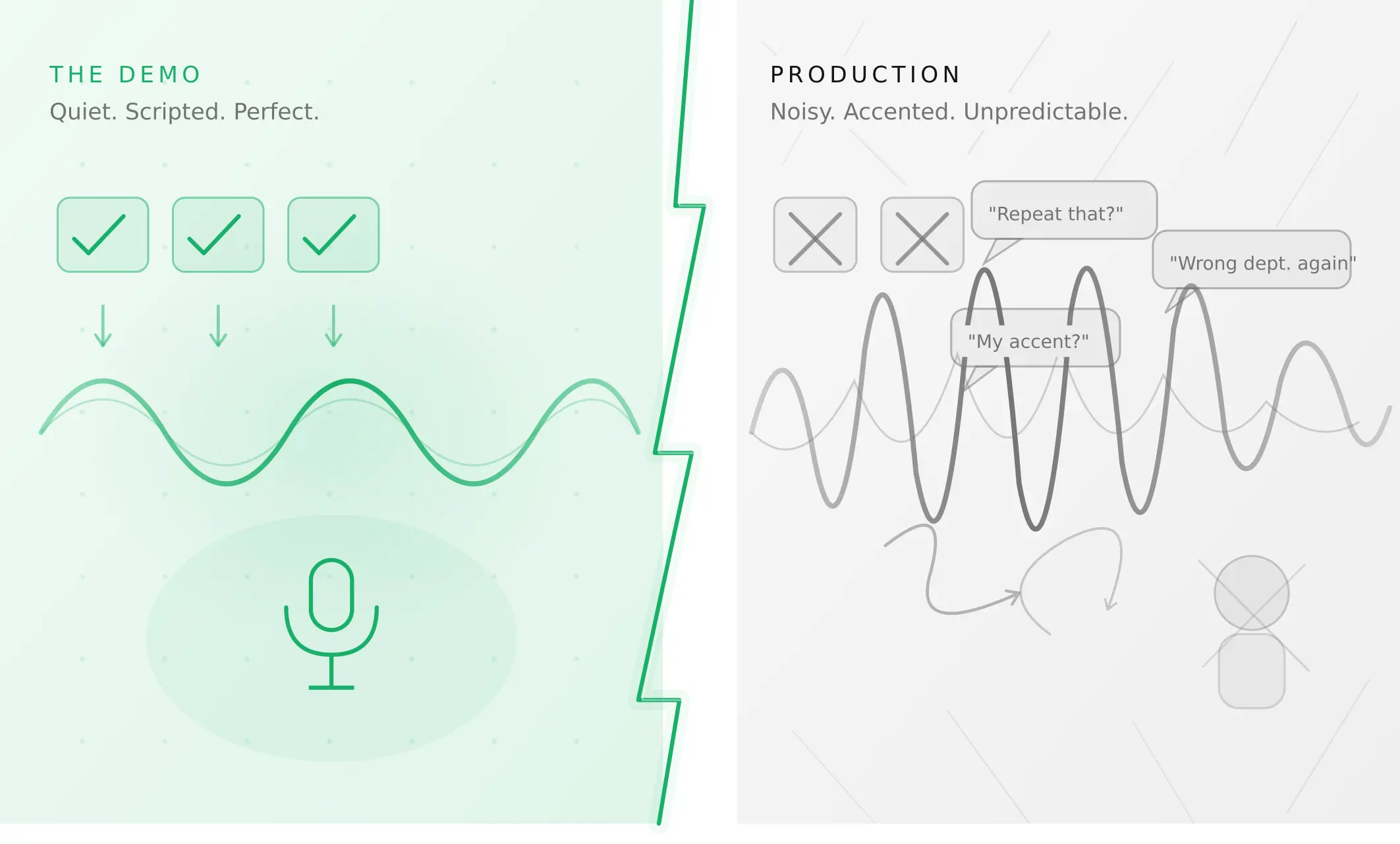
Why AI voice agents fail in production (and how to prevent it)
AI voice agents that ace demos still break in production. Learn the 5 root causes, how to test for each, and what production readiness actually means.
Read more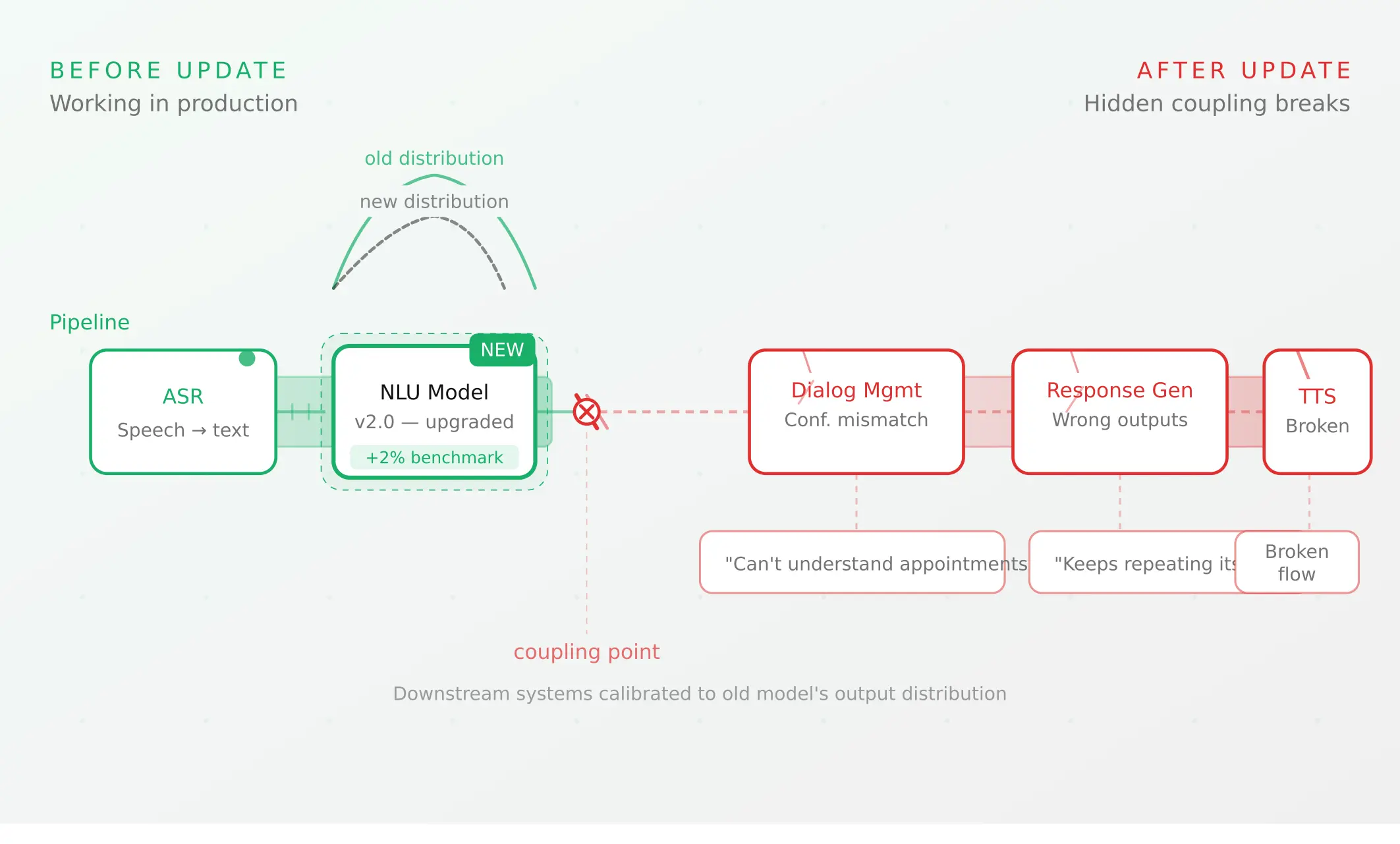
Voice agent regression testing: why LLM updates break production
LLM updates improve benchmarks but break voice agents in 5 predictable ways. How to detect and prevent regressions after every model or prompt change.
Read more