Test your voice agent
Metrics for a Lead Qualification Voice Agent
Most teams measure the wrong thing when they deploy a lead qualification voice agent. They count calls handled and minutes saved. Those numbers look impressive in a dashboard. But they say nothing about whether the agent made good decisions.
A lead qualification voice agent has one core job. It decides which leads are worth your sales team's time. Then it captures the data that lets sales act fast. Volume is a side effect, not the goal.
Think about what a bad qualification actually costs you. A wrongly qualified lead wastes an expensive sales rep's hour. A wrongly disqualified lead is revenue you will never see again. Both errors are silent. Neither shows up in a call-volume chart.
So the metrics that matter fall into two buckets. First, the accuracy of the agent's judgment. Second, the cleanliness of the data it hands off. This guide covers both, with target ranges you can adapt.
If you want the broader picture of voice-agent measurement, our voice agent metrics scorecard is the companion piece. This article narrows the lens to qualification specifically.
Why lead qualification is a judgment problem
Lead generation fills the top of your funnel with people of wildly varying intent. Some are ready to buy. Many are curious. A few are the wrong fit entirely.
Qualification is the filter. It separates the leads sales should chase from the ones that will burn time. A human does this by asking questions and reading signals. A voice agent must do the same, at scale, without a coffee break.
That makes qualification fundamentally a decision-accuracy problem. The agent listens, interprets intent, checks fit against your criteria, and rules a lead in or out. If the interpretation is wrong, everything downstream is wrong.
This is why raw throughput is a vanity metric here. An agent that qualifies 500 leads a day at 70% accuracy is worse than one that qualifies 200 a day at 95% accuracy. The second one protects your sales team's time. The first one poisons it.
Getting intent right is the hard part. If you want to understand how agents parse what a caller means versus the specific values they mention, read our guide on intent versus entity extraction. Qualification depends on both working together.
The six metrics that actually matter
Below are the core KPIs for a lead qualification voice agent. Each one answers a distinct question. Together they tell you whether the agent is doing its real job.
1. Qualification accuracy
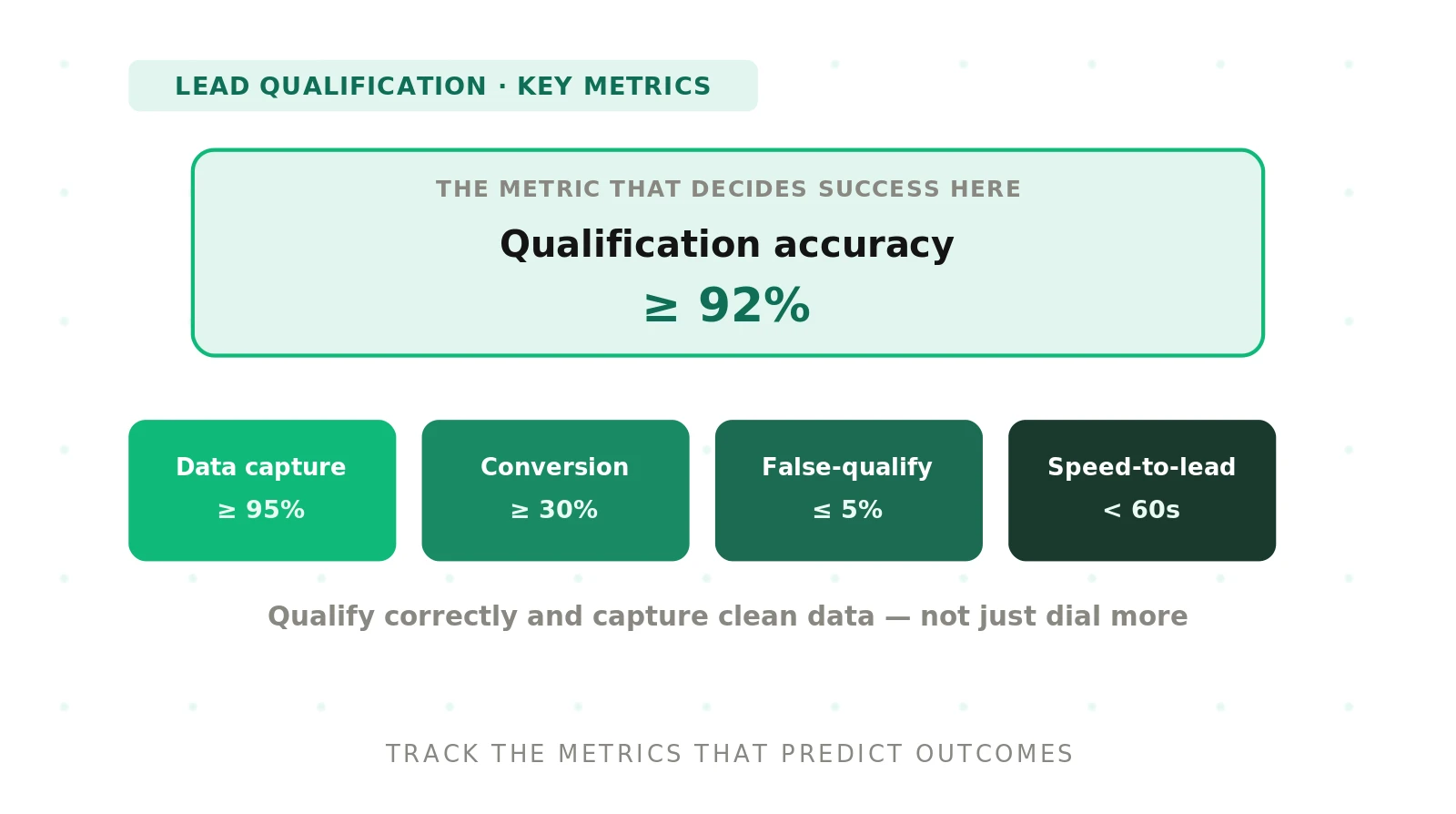
This is the headline metric. It measures how often the agent's qualify or disqualify decision matches what a trained human reviewer would decide. It is your single best signal of judgment quality.
Measure it against a labeled set of real calls. Have experienced sales staff score each call as correctly qualified, correctly disqualified, or wrong. Accuracy is the share the agent got right. A key performance indicator like this needs a stable, human-graded ground truth.
Target 90% or higher for a production agent. Below 85%, sales stops trusting the agent's verdicts. Trust, once lost, is expensive to rebuild.
2. False-qualification rate
Accuracy hides an asymmetry. Not all errors cost the same. A false qualification sends an unfit lead to sales, wasting a rep's time and eroding morale.
The false-qualification rate is the share of qualified leads that a human later judges unfit. This is the error your sales team feels most acutely. It is the number they will complain about first.
Keep it under 5%. Some teams tolerate slightly higher rates in exchange for catching more real opportunities. That trade-off is yours to tune, but measure it deliberately.
3. Data-capture accuracy
A correct decision is useless if the attached data is garbage. The agent must capture name, email, phone, budget, timeline, and stated intent cleanly. Sales acts on these fields within minutes.
Data-capture accuracy measures how many required fields are captured correctly and completely. Spellings matter. A misheard email means the follow-up never lands. Speech recognition errors, tracked through word error rate, directly hurt this metric.
Target 95% or higher on critical fields. Email and phone deserve confirmation prompts. A quick "let me read that back" is worth the extra ten seconds.
4. Booking or conversion rate
For many teams, qualification ends in a booked meeting. The booking rate measures the share of qualified leads that actually schedule time with sales. It links agent behavior to pipeline.
Treat this like classic conversion rate optimization. Small script changes move it meaningfully. Test the closing ask, the calendar friction, and the timing of the offer.
Ranges vary widely by industry and lead source. Establish your own baseline first, then improve against it. Chasing someone else's benchmark blindly is a mistake.
5. Speed-to-lead
Speed-to-lead is the time between a lead arriving and the agent engaging it. In inbound scenarios, seconds matter. Interest cools fast, and the first responder usually wins the deal.
A voice agent's advantage here is enormous. It never sleeps and never queues. It can engage a fresh lead the instant it lands, day or night.
Target under five minutes, and ideally under one minute for hot inbound. Measure the full path, including any routing delay before the agent picks up. Audio round-trip latency also matters; the ITU-T G.114 recommendation on one-way delay is a useful reference for conversational quality.
6. Handoff quality to sales
The last mile is the handoff. When the agent qualifies a lead, it passes a package to sales: the decision, the captured data, and the context. Handoff quality measures how usable that package is.
A clean handoff writes structured records into your customer relationship management system with no manual cleanup. A poor one dumps a raw transcript and forces the rep to re-interview the lead. That defeats the purpose.
Score handoffs on completeness, structure, and context. Did the rep have everything needed to open the conversation warm? For agents that route some leads to humans mid-call, our escalation guide covers the transfer mechanics in depth.
How to measure a lead qualification voice agent
Follow these steps to build a measurement program that reflects judgment quality, not just activity.
1. Define your qualification criteria explicitly. Write down what makes a lead qualified. Budget thresholds, timeline, decision authority, and fit. Vague criteria make accuracy impossible to score.
2. Build a labeled ground-truth set. Have experienced sales staff score 200 or more real calls as correctly qualified, disqualified, or wrong. This is your yardstick for every accuracy claim.
3. Instrument data capture separately. Log each required field per call and compare it to the truth. Track email, phone, budget, and intent independently, since each fails in different ways.
4. Split your error rates. Report false qualification and false disqualification as distinct numbers. The asymmetry between them drives every tuning decision you will make.
5. Time the full lead journey. Measure speed-to-lead from arrival to first meaningful engagement. Include routing delays, not just the agent's talk time.
6. Grade handoffs against sales usability. Ask reps whether each package let them start warm. Score completeness and structure, not just whether a record was created.
7. Re-run the suite on every change. Prompt edits, model swaps, and script tweaks all move these numbers. Regression testing catches silent drops before they reach production.
Target ranges at a glance
Use this table as a starting point. Adapt the ranges to your industry, lead source, and risk tolerance. The reasoning column explains why each target sits where it does.
| Metric | Target range | Why it matters |
|---|---|---|
| Qualification accuracy | 90%+ | Below this, sales stops trusting the agent's verdicts |
| False-qualification rate | Under 5% | Each false positive wastes an expensive rep's time |
| Data-capture accuracy | 95%+ on critical fields | Bad email or phone means the follow-up never lands |
| Booking or conversion rate | Beat your own baseline | Industry ranges vary; relative improvement is the signal |
| Speed-to-lead | Under 5 minutes | Interest cools fast; the first responder usually wins |
| Handoff completeness | 95%+ usable packages | Reps should start warm, not re-interview the lead |
A worked example
Picture a mid-market software company running an inbound qualification agent. It answers form-fill callbacks and web-chat voice requests. Over one week it handles 1,000 leads.
The agent qualifies 300 of them and disqualifies 700. On paper, that looks productive. But the raw counts tell you nothing about quality. You need the graded numbers.
A reviewer scores a random sample of 200 calls. The agent's decision matched the human verdict on 184 of them. That is 92% qualification accuracy, comfortably above the 90% bar.
Within the qualified group, 4% turned out to be unfit on review. That false-qualification rate is under the 5% ceiling. Sales is annoyed by roughly twelve bad leads that week, not sixty.
Data capture is the weak spot. Email accuracy sits at 91%, below the 95% target. Roughly one in eleven follow-ups bounces because of a misheard address. Adding a read-back confirmation prompt is the obvious fix.
Speed-to-lead averages 40 seconds, which is excellent. Booking rate on qualified leads is 34%. Nobody knows if that is good until they compare it to last quarter's baseline of 29%. It is up, so the script changes are working.
The lesson is simple. The volume looked fine from day one. The real story lived in accuracy, false positives, and a fixable email-capture leak. Only the judgment-and-data metrics surfaced it.
Common measurement mistakes
The first mistake is optimizing for qualification count. An agent rewarded for qualifying more leads will qualify marginal ones. Your false-qualification rate quietly climbs, and sales pays the bill.
The second is treating a transcript as a handoff. A transcript is raw material, not a decision package. Sales needs structured fields and a clear verdict, not a wall of text to re-read.
The third is skipping the human ground truth. Without labeled calls, accuracy is a guess. You cannot improve what you have not honestly measured against a real standard.
The fourth is measuring once and moving on. These metrics drift. A model update or a script tweak can shift accuracy overnight. Before you call an agent production-ready, check it against a defined production-readiness bar.
How this differs from outbound
Inbound qualification and outbound qualification share many metrics but weigh them differently. Inbound leads already raised a hand, so speed-to-lead dominates. Strike while intent is hot.
Outbound is a different beast. The agent must earn attention before it can qualify. Connection rate and early-drop rate join the picture. If you run outbound campaigns, our outbound sales voice agent metrics breakdown covers those extra dimensions.
Either way, the core truth holds. The value of a qualification agent is the quality of its decisions and the cleanliness of its data. Everything else is supporting cast.
Frequently asked questions
What is the single most important lead qualification voice agent metric?
Qualification accuracy is the headline number. It measures how often the agent's qualify or disqualify decision matches a trained human's judgment. If accuracy is low, every downstream metric becomes unreliable, and your sales team stops trusting the agent's verdicts entirely.
How is false qualification different from qualification accuracy?
Accuracy blends all error types into one figure. False-qualification rate isolates one specific error: passing an unfit lead to sales. That error wastes rep time and hurts morale most, so it deserves its own tracked number, kept under 5%.
What data fields should a qualification agent capture?
At minimum: name, email, phone, budget, timeline, and stated intent. Each field feeds the sales follow-up. Email and phone deserve confirmation read-backs, since a single misheard character means the follow-up message never reaches the lead at all.
What is a good speed-to-lead for a voice agent?
Aim for under five minutes, and under one minute for hot inbound leads. A voice agent's advantage is that it never queues or sleeps. Measure the full path, including routing delays, not just the agent's active talk time.
Why not just measure call volume?
Volume is a vanity metric for qualification. An agent handling 500 leads at 70% accuracy is worse than one handling 200 at 95%. The high-volume agent poisons your sales pipeline with bad decisions. Judgment quality matters far more than raw throughput.
How do I build a ground-truth set for accuracy scoring?
Have experienced sales staff label 200 or more real calls as correctly qualified, disqualified, or wrong. This human-graded set becomes your yardstick. Refresh it periodically so it reflects current lead sources and qualification criteria, not last year's assumptions.
What makes a handoff to sales high quality?
A clean handoff delivers a structured package: the decision, the captured fields, and useful context. It writes into your CRM without manual cleanup. A poor handoff dumps a raw transcript and forces the rep to re-interview the lead from scratch.
How often should I re-measure these metrics?
Continuously, and especially after any change. Prompt edits, model swaps, and script tweaks all move these numbers. Treat measurement as regression testing so a silent accuracy drop gets caught in staging rather than discovered by frustrated sales reps.
Measuring lead qualification agents with Evalgent
Evalgent is an independent testing and evaluation platform for voice agents. It turns the metrics above into a repeatable program, so qualification quality is measured rather than assumed. Five primitives make that possible.
Scenarios let you script realistic qualification calls, from eager buyers to time-wasters, so you test the judgment calls that matter. Profiles simulate different caller types, accents, and intents, exposing where the agent's interpretation breaks down.
Metrics capture qualification accuracy, false-qualification rate, data-capture completeness, speed-to-lead, and handoff quality in one place. Evaluations grade each run against your labeled ground truth, splitting error types so you see the asymmetry clearly.
Reviews put a human in the loop, letting sales staff confirm or correct verdicts and feed that judgment back into your scoring. Because Evalgent is vendor-neutral, you can compare agents fairly before committing. If you are still choosing a provider, pair this with our guide on how to evaluate voice agent vendors, then book a demo to see it on your own calls.
The bottom line
A lead qualification voice agent earns its keep through accurate judgment and clean data, not call volume. Measure the decisions and the handoff, and the pipeline value follows.
Related Articles
Why AI voice agents fail in production (and how to prevent it)
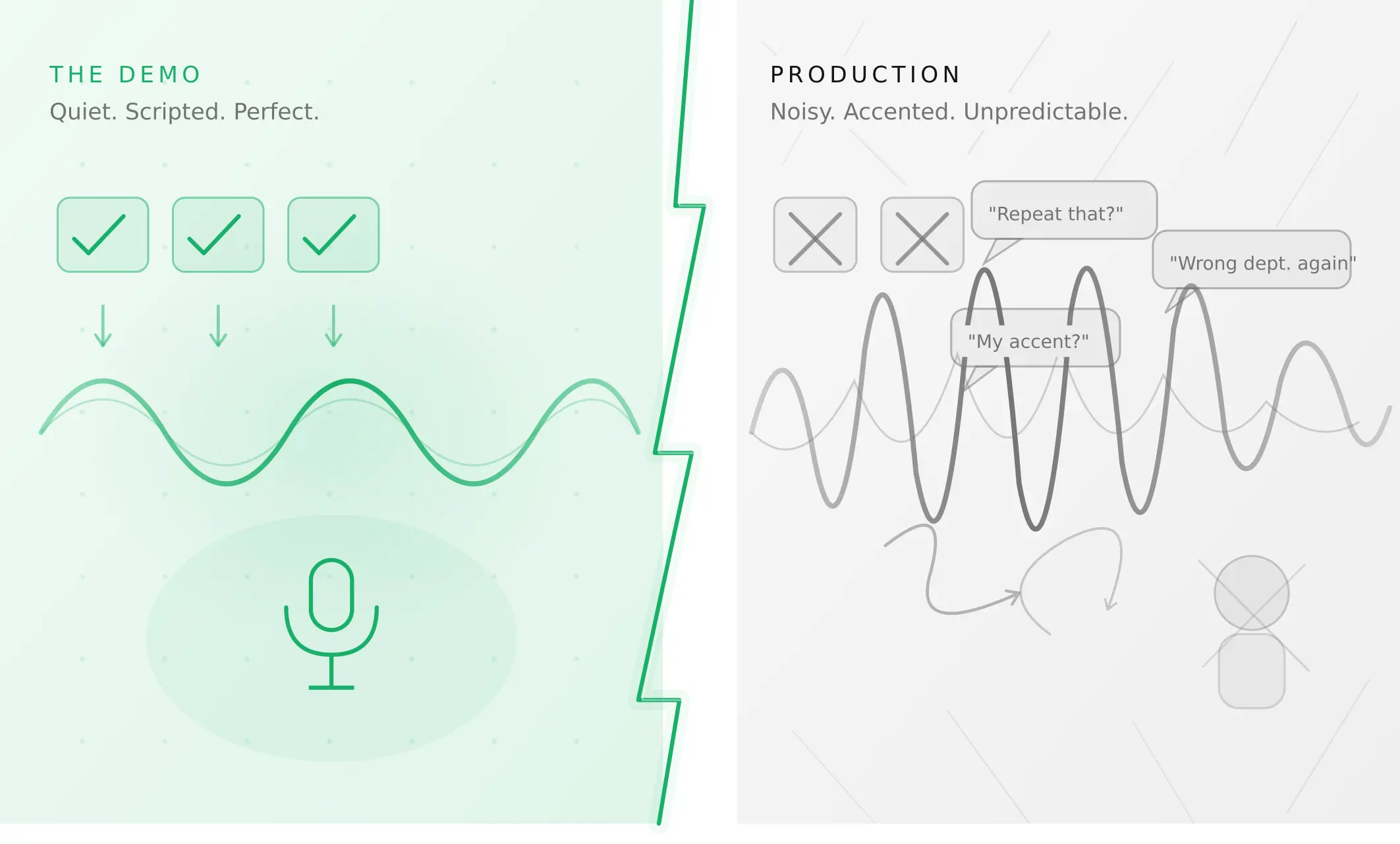
AI voice agents that ace demos still break in production. Learn the 5 root causes, how to test for each, and what production readiness actually means.
Read more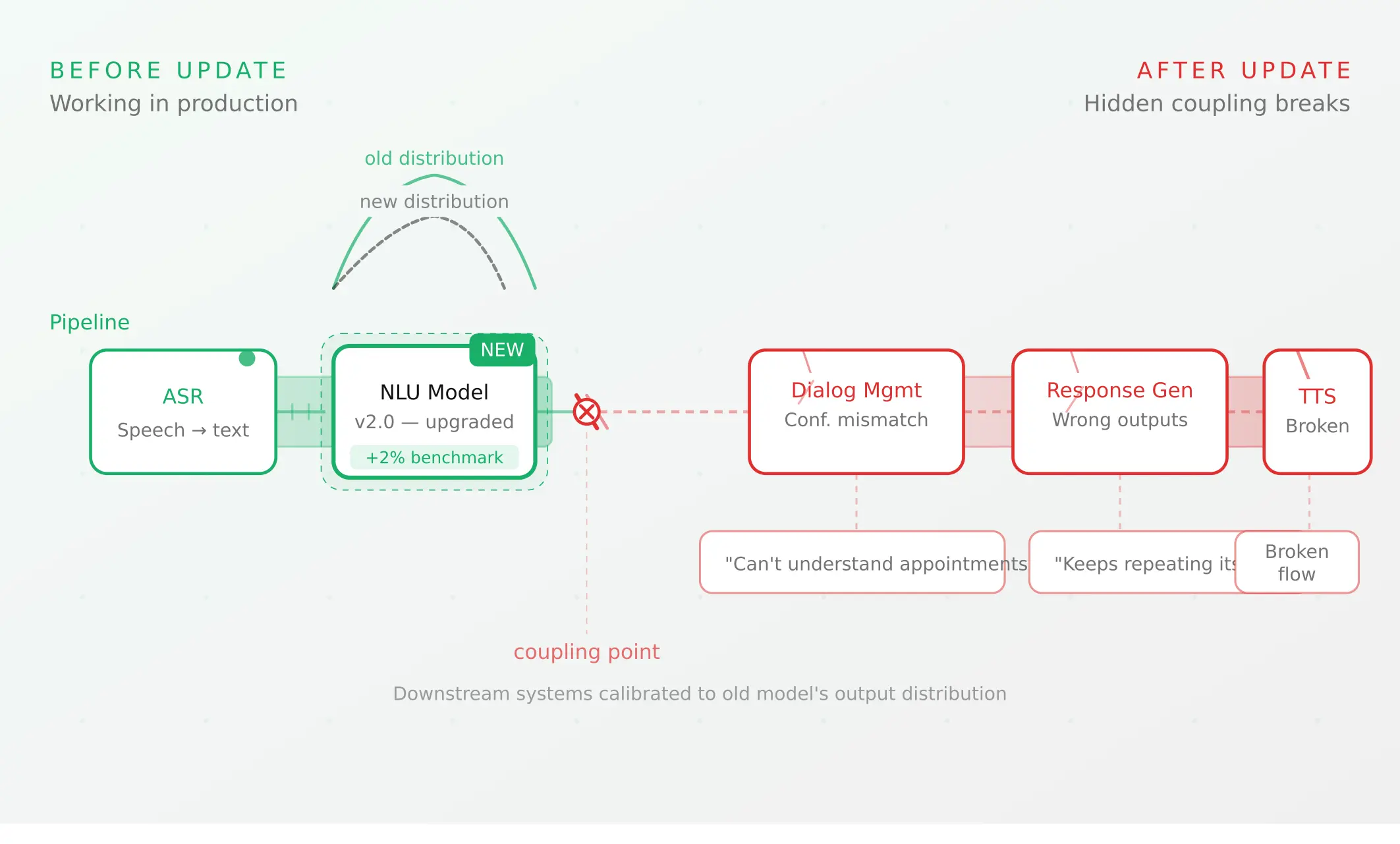
Voice agent regression testing: why LLM updates break production
LLM updates improve benchmarks but break voice agents in 5 predictable ways. How to detect and prevent regressions after every model or prompt change.
Read more