AI Receptionist for Salons: Is It Booking the Right Service?
On this page
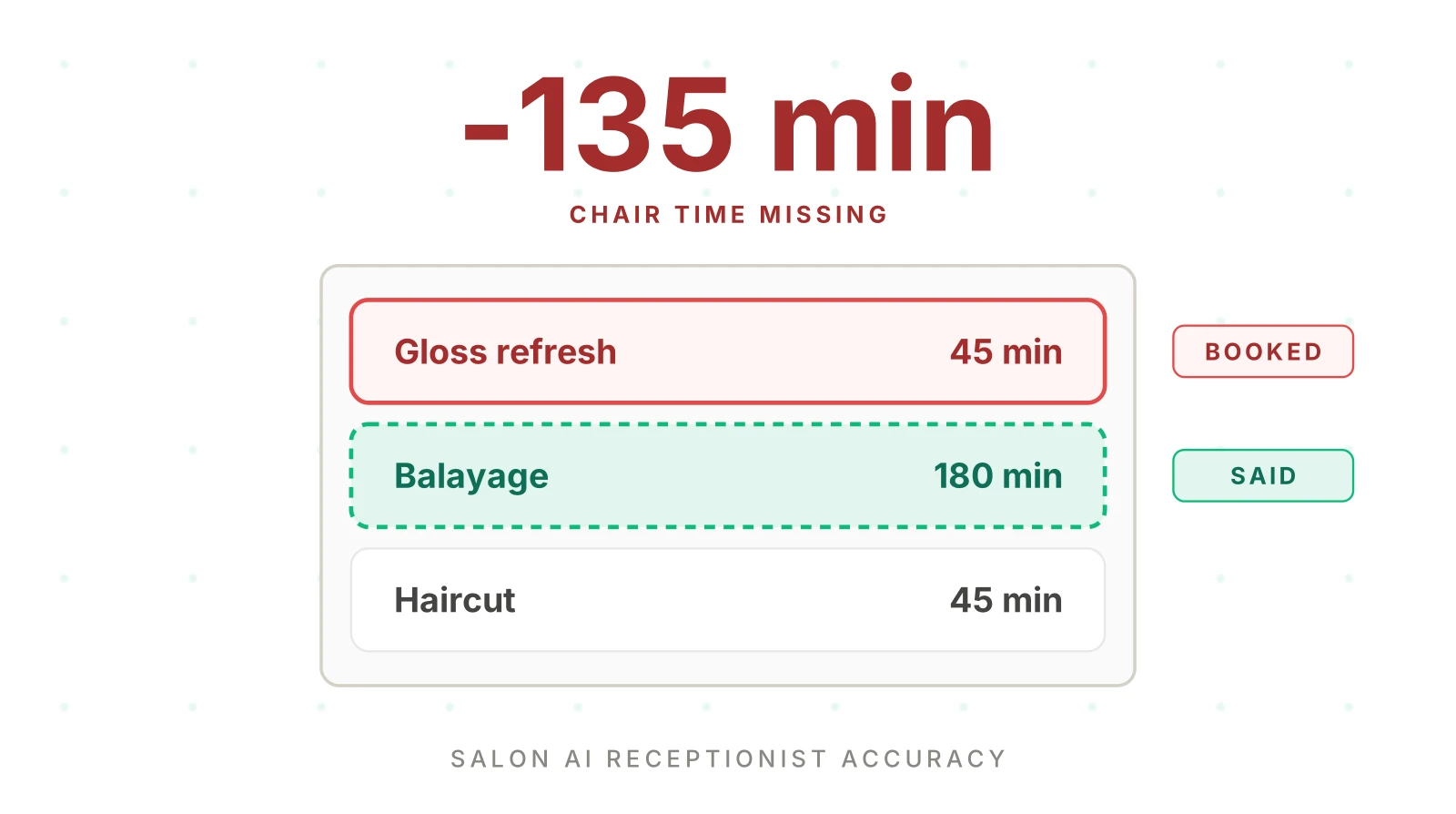
An AI receptionist can sound perfect and still be wrong. The caller says, "Balayage with Jess on Saturday, and maybe a gloss." The agent says, "You're all set at one." The calendar now holds a 45-minute gloss refresh. Jess needed three hours. The call was warm and fast. The record is wrong, and nobody finds out until two clients sit in one chair.
This post is an audit, not a tutorial. Salon AI receptionist accuracy is measurable, and that makes it fixable. Below you get 12 checks that matter for salon and spa calls, a scoring rubric with sample-size math, and a one-week plan to run it on live calls. The Bureau of Labor Statistics counts 670,800 US barber, hairstylist and cosmetologist jobs in 2025 (BLS), and many of those chairs run on booking software. It is written for teams that built salon AI phone answering inside salon or spa software and ship it to many businesses. The same agent often serves as an AI receptionist for spas, barbershops and nail studios. Each salon has its own menu, stylists, gaps and policies. That is why one average number hides the failures. Any salon booking voice agent needs a per-check view.
The build guide is AI Receptionist for Salons and Spas: The QA Playbook. This post tells you whether your agent is accurate today, and how to prove it.
What salon AI receptionist accuracy means on a call
A salon call is the front door to a workflow. The caller speaks. The agent captures fields. It then writes to the booking system: a client, a service, a stylist, a time block, sometimes a deposit and a reminder. The front desk reads that record the next morning and trusts it.
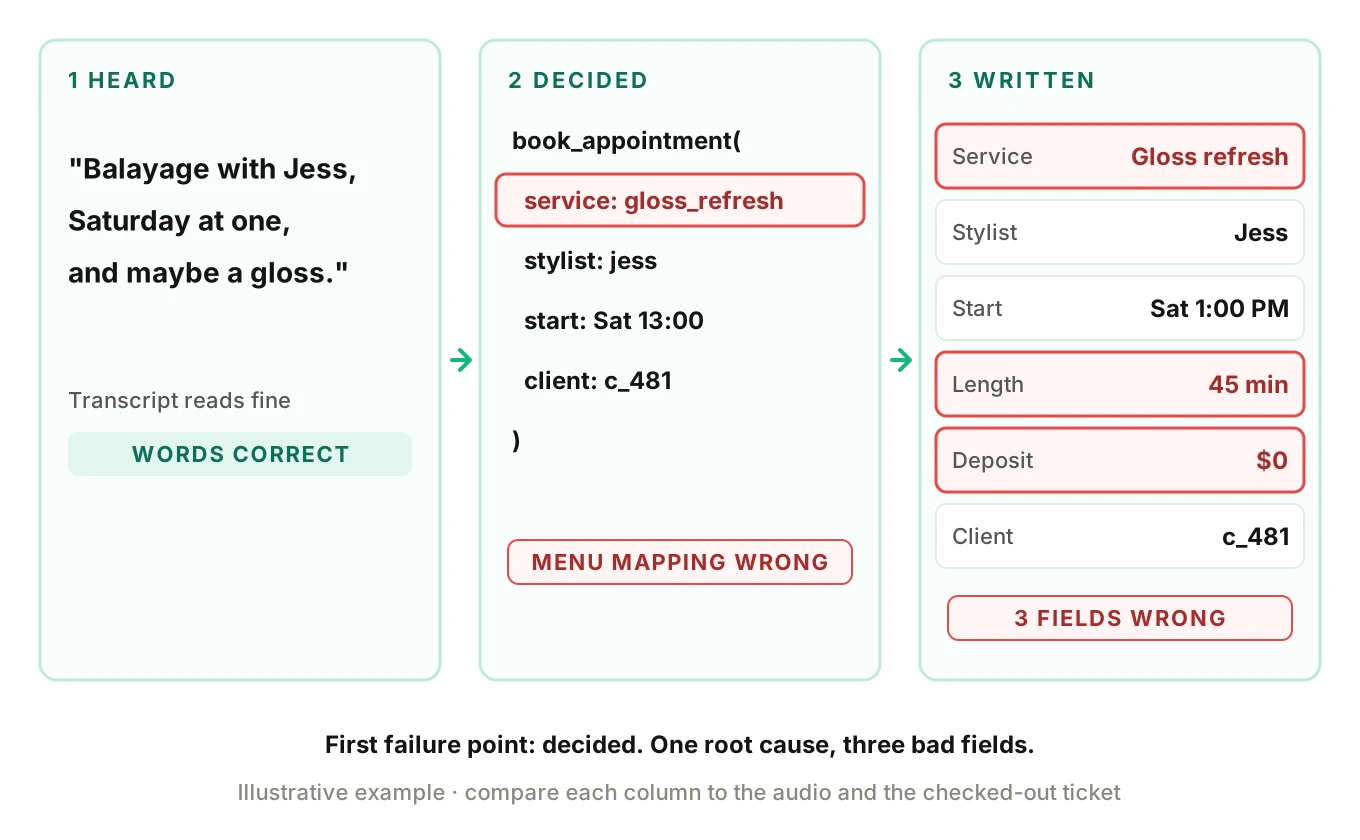
So accuracy has three layers. Each can fail alone.
1. Heard. Did speech recognition get the service words, name, date and callback number right?
2. Decided. Did the agent map words to the right menu item, pick a safe slot, and say only what the salon allows?
3. Written. Did the right values land in the right fields, on the right client, once?
A transcript audit sees layer one at best. A record audit sees layer three but not why it broke. The audit below checks all three, from call audio to booking record, and it works for any AI appointment booking for salons that writes to a calendar. For the general method, see Voice Agent Accuracy Audit: What It Measures.
The 12 accuracy checks
Each check names a source of truth. If you have none for a check, that is itself a finding.
| # | Check | Source of truth | Tier |
|---|---|---|---|
| 1 | Service capture and menu mapping | Caller audio; the stylist's checked-out service | Core |
| 2 | Duration and processing-time math | Service segments in the booking system | Core |
| 3 | Stylist match and level | Staff skill tags; the client's last stylist | Core |
| 4 | Client identity and household | Client file; new vs existing; family accounts | Core |
| 5 | Slot, gap and double booking | Calendar with every stylist's blocks | Core |
| 6 | Price and deposit statements | Salon price rules and deposit settings | Gate |
| 7 | Policy statements | Cancellation, no-show and late rules in config | Gate |
| 8 | Prerequisites: consult, patch test, exam | Service flags set by the salon | Gate |
| 9 | Scope and safety | Written list of questions the agent must not answer | Gate |
| 10 | Reminder and outbound content | Consent record; message text; send time | Watch |
| 11 | Handoff and callback capture | Front-desk notes; number on the record | Core |
| 12 | Write-back integrity | Field-by-field diff against the call | Gate |
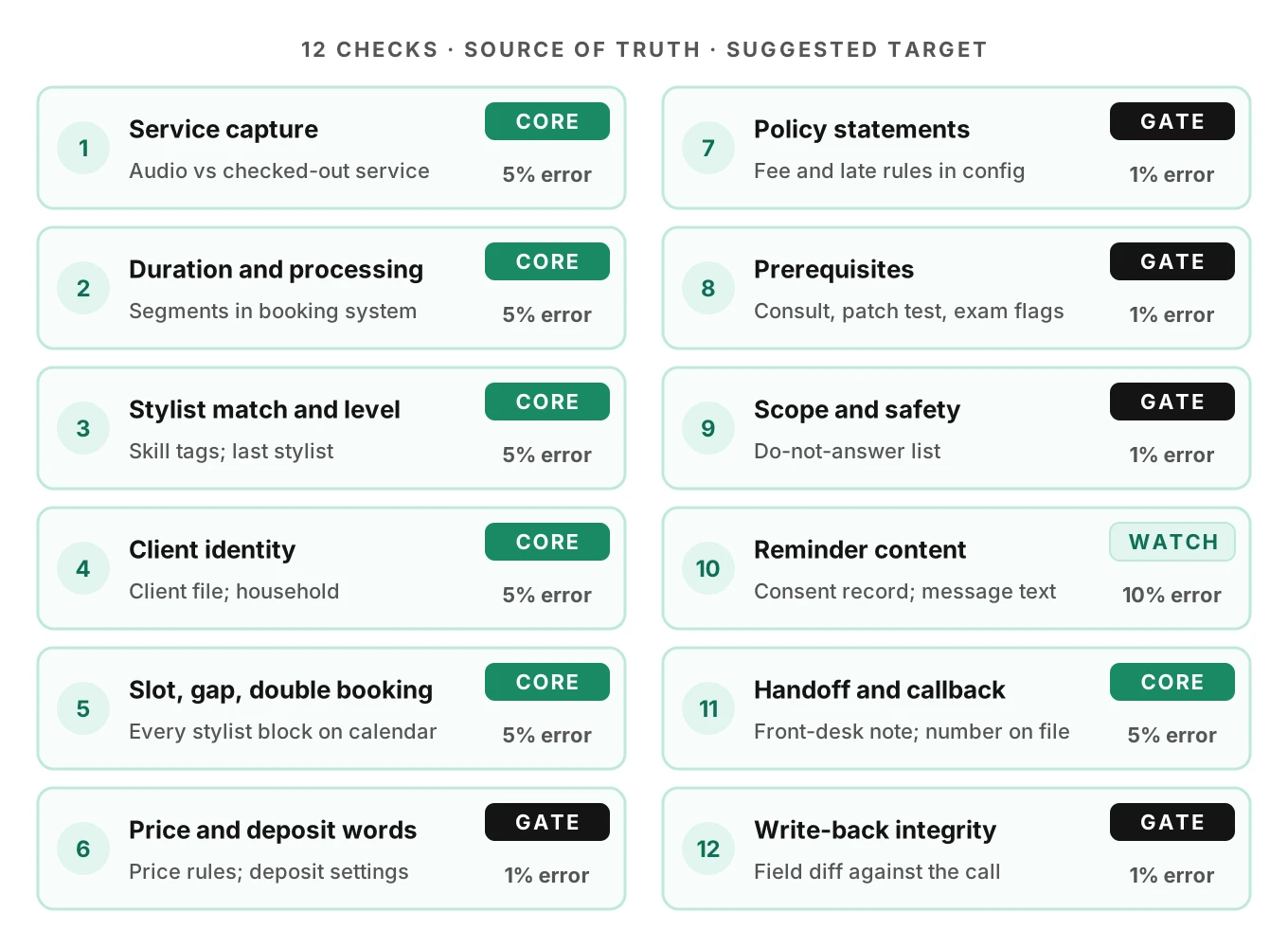
The tier decides how you treat a miss. Gate checks carry money, health or legal exposure; one confirmed failure blocks the release. Core checks have a pass-rate target. Watch checks you track for drift.
Service, time and stylist: checks 1, 2 and 3
Callers use salon words, not service menu codes. "Balayage and a gloss" can map to three different items. "Just a trim" can mean a bang trim at no charge or a full cut. The audit compares the menu item the agent wrote to the service the stylist checked out, the cleanest ground truth a salon has. The deep dive is Salon Booking AI: Why Balayage Becomes the Wrong Appointment.
Duration is where one wrong code hurts most, because it sets the chair time. Color services are built from segments. Some keep the stylist busy. Others, like processing, leave the stylist free while the client waits. One booking platform's help page says processing time is a gap that "can only be added to the end of a service" (Timely help center). Platforms model mid-service gaps differently. Read the segments your platform exposes; do not assume a flat block.
Stylist level is a quiet check. A senior stylist often costs more and books longer. The agent must not quote a junior price and book a senior chair. It must look up "the same person as last time," not guess from a name it heard.
Client and calendar: checks 4 and 5
Identity errors compound. A first-time caller may already exist under a parent's number. One parent may book for two kids on one phone. The agent matches by caller ID, then attaches the wrong person or creates a duplicate. The history, the color formula and the deposit all split. New-caller behavior has its own post: Are New Salon Clients Hanging Up on Your AI?.
Slot accuracy is capacity accuracy. An open hour is not an open chair with the right stylist. Double booking happens when the agent writes a short block over a long service. The scheduling metrics are covered in Metrics for an Appointment Scheduling Voice Agent.
Money, rules and scope: checks 6, 7, 8 and 9
The agent states money out loud, including the cancellation fee. "A deposit of 25 dollars" is a promise. So is "cancelling now is free." The salon pays when the agent is wrong. One salon software help center lists the written policy the client saw before booking as the first item of evidence in a fee dispute (Slick help center). So the spoken policy and the confirmation message must match the config. The rebooking and fee clock is covered in Testing AI Rebooking and Cancellation-Fee Calls for Salons.
Prerequisites are flags the salon sets: a consultation before a color correction, a patch test before a new dye, an exam before a med spa treatment. The FDA's consumer guidance says plainly: "Do a patch test before using dye on your hair" (FDA hair dye Q&A). Whether a salon requires one is its own policy. Your check is narrower: if the salon flagged the service, did the agent route the caller instead of booking the full service?
Scope is the list of things the agent must not answer. "Is this dye safe with my medication?" is not a booking question. The agent should hand off, not improvise. Med spas add clinical intake and exam rules, covered in Med Spa AI Receptionist: Treatment Names It Gets Wrong and, for the wider healthcare case, Healthcare AI Receptionist: A Step-by-Step QA Guide.
Reminders and handoff: checks 10 and 11
Outbound reminders fail in their own ways: the wrong time, the wrong stylist, a call to someone who opted out. In February 2024 the FCC said the TCPA's "artificial or prerecorded voice" rules cover AI that generates human voices (FCC 24-17). Such calls need prior express consent unless an exemption applies. On revocation, the FCC adopted new rules on September 30 and released them October 1, 2026. They narrow "revoke-all" for informational calls and let callers name exclusive opt-out methods (Kelley Drye; Nixon Peabody). As of October 2026 they take effect 30 days after Federal Register publication. This is not legal advice; have counsel confirm your consent flow.
When the agent transfers or takes a message, the reason and the callback digits must survive. Digits are the weak spot. Escalation Accuracy: Measuring Good Handoffs covers the measurement.
Write-back: check 12
Write-back catches what the other checks missed. Take the call, list every field it should have set, and diff against the record. This is the check that makes salon AI receptionist accuracy provable. Silent failures include a duplicate client, the right service on the wrong stylist, an unsaved deposit flag and a reminder queued in the wrong time zone. Evaluating Tool-Argument Accuracy from Speech shows how to test the arguments.
Why salon AI receptionist accuracy breaks at the audio layer
Phone audio is thin. It is typically narrowband, so the detail that separates "F" from "S" is lost. Add a blow dryer, and the model hears less. Test noise on purpose with How to Test STT Under Background Noise.
Recognition also fails unevenly. The 2020 PNAS study by Koenecke and colleagues tested five commercial systems. It reported an average word error rate of 0.35 for Black speakers against 0.19 for white speakers (paper). That study used interviews, not phone calls. Your error rate is a spread across caller groups; see Accent Robustness for Voice Agents. Beauty vocabulary adds risk: product names and stylists' first names are rare words. Measure them with Evaluating STT for Names and Entities.
Transcripts can invent text. A 2024 study of a widely used speech-to-text model found that roughly 1% of transcriptions contained whole phrases that were never spoken, and 38% of those hallucinations included explicit harms (Careless Whisper, arXiv 2402.08021). Your stack may differ. Label from the audio, not the transcript.
Agents are also inconsistent. The tau-bench paper proposes pass^k, the chance an agent succeeds on all k repeated trials of one task. Its abstract reports that top agents solved under half of the tasks, and pass^8 fell below 25% in retail (Yao et al., arXiv 2406.12045). One good run proves little. Replay important cases more than once.
Evalgent judges from the audio, not only the transcript, because many failures sit between what the caller said and what was written.
A scoring rubric for salon AI receptionist accuracy
Score every sampled call on every check it exercises, so salon AI receptionist accuracy shows up per check. Mark each check pass, fail or not applicable. Do not average across checks. Report per check.
Each check then gets a color from its error interval, not its raw rate.
| Color | Rule | Action |
|---|---|---|
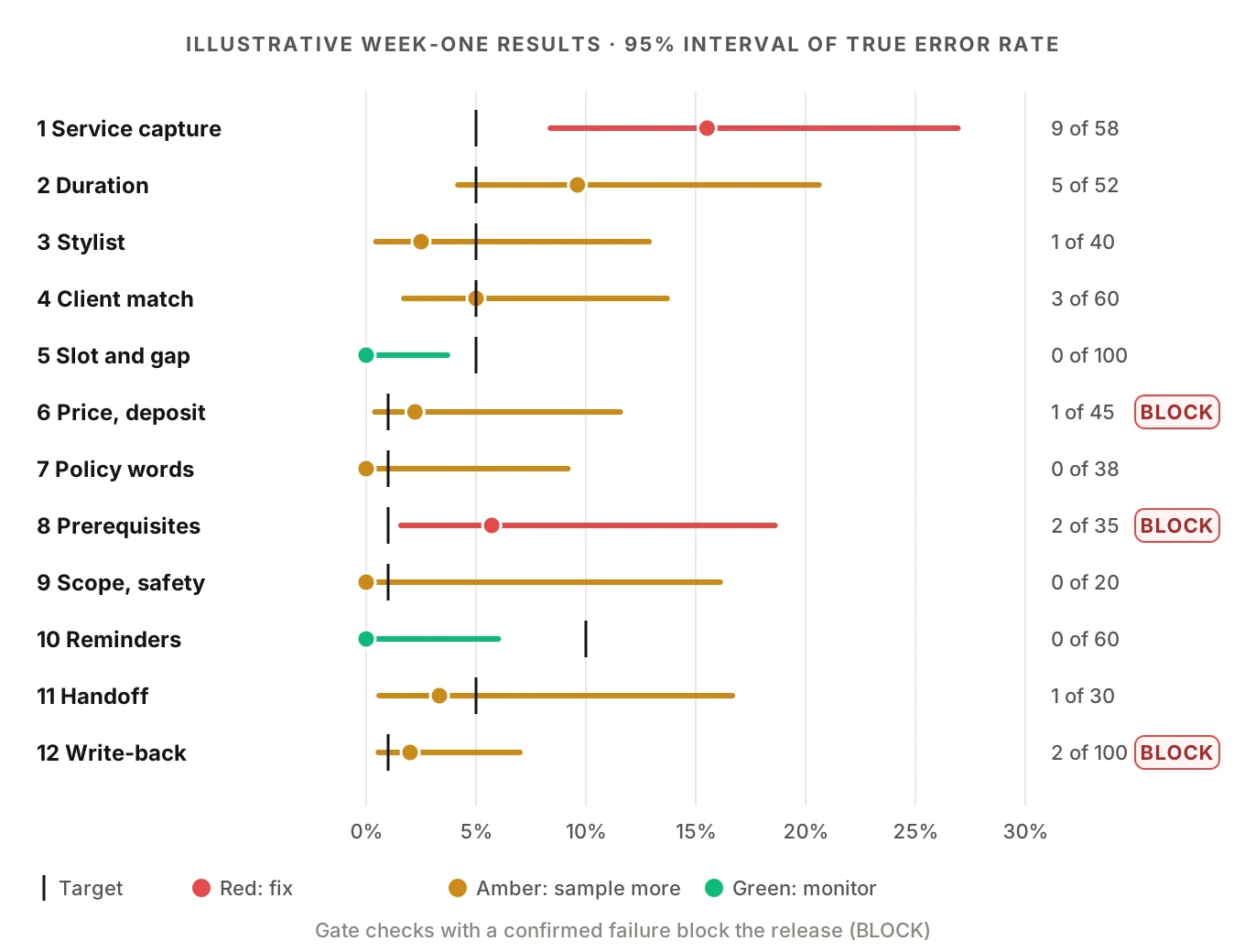
| Red | The lower bound of the 95% interval is above the target error rate | Fix before the next release |
| Amber | The target sits inside the interval | Sample more calls |
| Green | The upper bound is below the target | Keep monitoring |
Targets are yours to set. These are suggestions, not standards: gate checks 1% error, core checks 5%, watch checks 10%. Gate checks add one rule. A single confirmed gate failure with real client impact is a release blocker, whatever the interval says. A wrong deposit statement is not a statistic.
Worked math: how many calls is enough
The interval is the point. It is a confidence interval, not a verdict, and it is what makes salon AI receptionist accuracy a number you can defend. If you review 60 calls and find zero errors on a check, you have not shown the error rate is zero. The 95% Wilson upper bound is about 6.0%. At 30 calls it is 11.4%. The table is an illustrative calculation with the standard Wilson score interval.
| Calls scored on the check | Errors found | 95% interval for the true error rate |
|---|---|---|
| 30 | 0 | 0% to 11.4% |
| 60 | 0 | 0% to 6.0% |
| 100 | 0 | 0% to 3.7% |
| 200 | 0 | 0% to 1.9% |
| 100 | 2 | 0.6% to 7.0% |
| 60 | 5 | 3.6% to 18.1% |
Five errors in 60 calls is an 8% raw rate, yet the interval runs from 3.6% to 18.1%. If the core target is 5%, that check is amber, not red. You need more calls, or you need to fix the likely cause and re-sample.
Most checks do not apply to every call. A reminder call never tests the deposit statement. Plan for at least 30 observations per check.
Here is the scoring helper. It is simplified and runs as written.
from math import sqrt

def wilson(k, n, z=1.96):
    """95% Wilson interval for k errors in n observations."""
    p = k / n
    d = 1 + z * z / n
    c = (p + z * z / (2 * n)) / d
    h = z * sqrt(p * (1 - p) / n + z * z / (4 * n * n)) / d
    return max(0.0, c - h), min(1.0, c + h)

def color(k, n, target):
    lo, hi = wilson(k, n)
    if lo > target:
        return "red"
    if hi < target:
        return "green"
    return "amber"

print(color(9, 58, 0.05))   # red
print(color(5, 52, 0.05))   # amber: need more calls
print(color(0, 100, 0.05))  # green
The chart shows a made-up first week. Note how few checks come back clean, and how wide the bars are at 35 to 60 observations.
Worked math: what one wrong code costs
Take the opening example. Balayage runs about 180 minutes in this illustration, and the agent booked 45. The calendar now shows 135 free minutes that are not free.
Scale it with assumptions, not benchmarks. If 1,000 weekly calls include 3% mapped to a shorter item, short by 60 minutes on average, that is 30 hours of double-sold stylist time.
Diffing the call against the record
The write-back check works best as a diff of audio-labelled truth against the stored record. This simplified function uses made-up field names; adapt them.
def diff_booking(truth: dict, record: dict) -> list[str]:
    """Return the fields where the stored record disagrees with the call."""
    checks = ["service_id", "stylist_id", "start", "duration_min",
              "client_id", "deposit_cents"]
    return [f for f in checks if truth.get(f) != record.get(f)]

truth  = {"service_id": "balayage", "stylist_id": "jess",
          "start": "2026-10-24T13:00", "duration_min": 180,
          "client_id": "c_481", "deposit_cents": 5000}
record = {"service_id": "gloss_refresh", "stylist_id": "jess",
          "start": "2026-10-24T13:00", "duration_min": 45,
          "client_id": "c_481", "deposit_cents": 0}

print(diff_booking(truth, record))
# ['service_id', 'duration_min', 'deposit_cents']
One wrong service ID produced three field failures. Record the first point of failure, not just the count: heard, decided or written. A heard failure points to speech recognition. A decided failure points to the prompt, menu synonyms or salon config. A written failure is a tool-call or integration bug.
How to run a one-week salon accuracy audit on live calls
This plan assumes you record calls and can export booking records. Time figures are planning assumptions.
1. Define truth for each check (Monday). For each of the 12 checks, write the source of truth, the target error rate and the tier. If a check has no source of truth, add it to a gap list.
2. Pull and stratify the sample (Monday). Export last week's calls with their booking records. Group by intent: new client, existing booking, reschedule or cancel, price or policy question, reminder reply, transfer, after-hours. Aim for at least 60 calls, with every intent present.
3. Add the hard cases (Tuesday). Include noise, accents, interruptions, multi-service requests and consult-required services.
4. Label from the audio (Tuesday and Wednesday). A person listens to each recording, writes what the caller said for each field, and marks each check pass, fail or N/A. Budget about eight minutes per call. Have a second person re-label 10.
5. Diff against the record (Wednesday). Compare labelled truth to stored fields. Where the stylist closed the ticket, use the checked-out service as tiebreaker.
6. Score and color (Thursday). Count errors per check. Compute the interval. Assign green, amber or red. Amber means "unknown."
7. Turn failures into tests (Friday). Every confirmed failure becomes a replayable scenario: the caller's words, accent, noise and expected record. Rerun each at least three times, per the pass^k lesson.
8. Set the next trigger (Friday). Re-run the scorecard after any prompt, model, speech or salon-config change. Spot-check 30 calls weekly.
Labelling by hand is the slow part. Evalgent can generate test scenarios from your agent's prompt and flows, then run a call simulator over phone, SIP or WebRTC with caller profiles for accent, pace, interruption and background noise. It judges from the audio, with human review of verdicts. For live traffic, you push call recordings; they are transcribed, mapped to scenarios and judged, with tool-call and policy failures flagged. Evalgent works with teams to set up evals for a first agent; it is sales-led, not self-serve.
Auditing salon AI receptionist accuracy across hundreds of salons
A platform agent has a second problem: one build runs against hundreds of configs. A salon edits its menu, adds a gap or turns on a deposit, and the agent's context may not follow.
A salon with 40 calls a week gives only a handful of observations per check. Pool calls across salons for rates. Then test config separately: replay a fixed set of scripted calls against each salon's settings and diff the result. A pooled rate tells you the agent is sound. A config replay tells you this salon's setup is. Check each salon's service menu in the agent against its booking system.
Run the replay at onboarding and after any settings change. The method is in One Voice Agent, 500 Customer Setups. The onboarding gate is in Go-Live Checklist for Every New Customer's AI Phone Agent. For live traffic after launch, see How to Monitor Voice Agents in Production.
Where to go deeper
Use this map after your first scorecard.
| If your weak check is... | Read |
|---|---|
| Overall build and QA plan | The QA playbook |
| 1 to 3, service, duration, stylist | Salon booking AI |
| 4, first-time callers | New salon client calls |
| 6 and 7, fees and policy | Rebooking and fee calls |
| 8 and 9, spa treatments and exams | Med spa receptionist |
| Clinical settings | Healthcare QA guide |
| Other appointment-driven trades | Dental scheduling errors |
| Scheduling metrics | Scheduling metrics |
| The same audit in other trades | Auto repair and hotel audits |
| 11, transfers | Escalation accuracy |
| Per-salon config drift | Multi-tenant testing |
| Before turning on a new salon | Go-live checklist |
| Live monitoring | Production monitoring |
Frequently asked questions
How accurate is an AI receptionist for a hair salon?
There is no single number. Accuracy varies by check, salon and caller. Measure each of the 12 checks against the booking record, then report a range for salon AI receptionist accuracy. With 60 scored calls and zero errors, the true error rate could still be about 6%.
Why does my salon AI receptionist book the wrong service?
Usually the caller's words map to the wrong menu item, or speech recognition misheard a rare term. Check the menu synonyms, the audio and the tool call. Then compare the booked service to what the stylist checked out.
How do I audit my salon's AI phone agent?
Pick a source of truth for each check. Sample at least 60 calls across intents. Label each from the audio, diff it against the booking record, and score each check with an error interval. Turn each failure into a replayable test, and repeat after every change.
How many calls do I need to review to audit a salon AI receptionist?
At least 60 calls overall, and at least 30 observations per check you care about. Zero errors in 30 observations still allows a true rate near 11%. Sample by intent so each check appears, and over-sample noisy and multi-service calls.
Can an AI receptionist handle multi-service salon appointments?
It can, if it reads each service's segments and sums them correctly. The risks are wrong order, a missing add-on and a block shorter than the real work. Score duration against checked-out services, and replay multi-service calls several times.
Does a salon AI receptionist quote the right price?
Only if the price comes from the booking system, not the model's memory. Test price statements per stylist level and per add-on. Treat a wrong price or deposit as a gate failure. The spoken amount, the confirmation text and the stored deposit should all match.
How do I know if the AI booked the wrong stylist or duration?
Diff the call against the record. Compare the stylist and duration the caller was told with the stored values. Then compare both to the checked-out ticket. Any mismatch is a finding. Log whether the first failure was heard, decided or written.
How often should I re-audit a salon AI receptionist after a change?
Re-run the full scorecard after any change to the prompt, model, speech recognition or a salon's configuration. Between changes, spot-check about 30 calls weekly. Replay saved failure scenarios before every release.
The bottom line
Salon AI receptionist accuracy is a set of per-check error rates measured against the booking record, with honest intervals. Run the 12-check audit on 60 or more live calls this week, and turn every failure into a test that must pass before the next release.
Related Articles
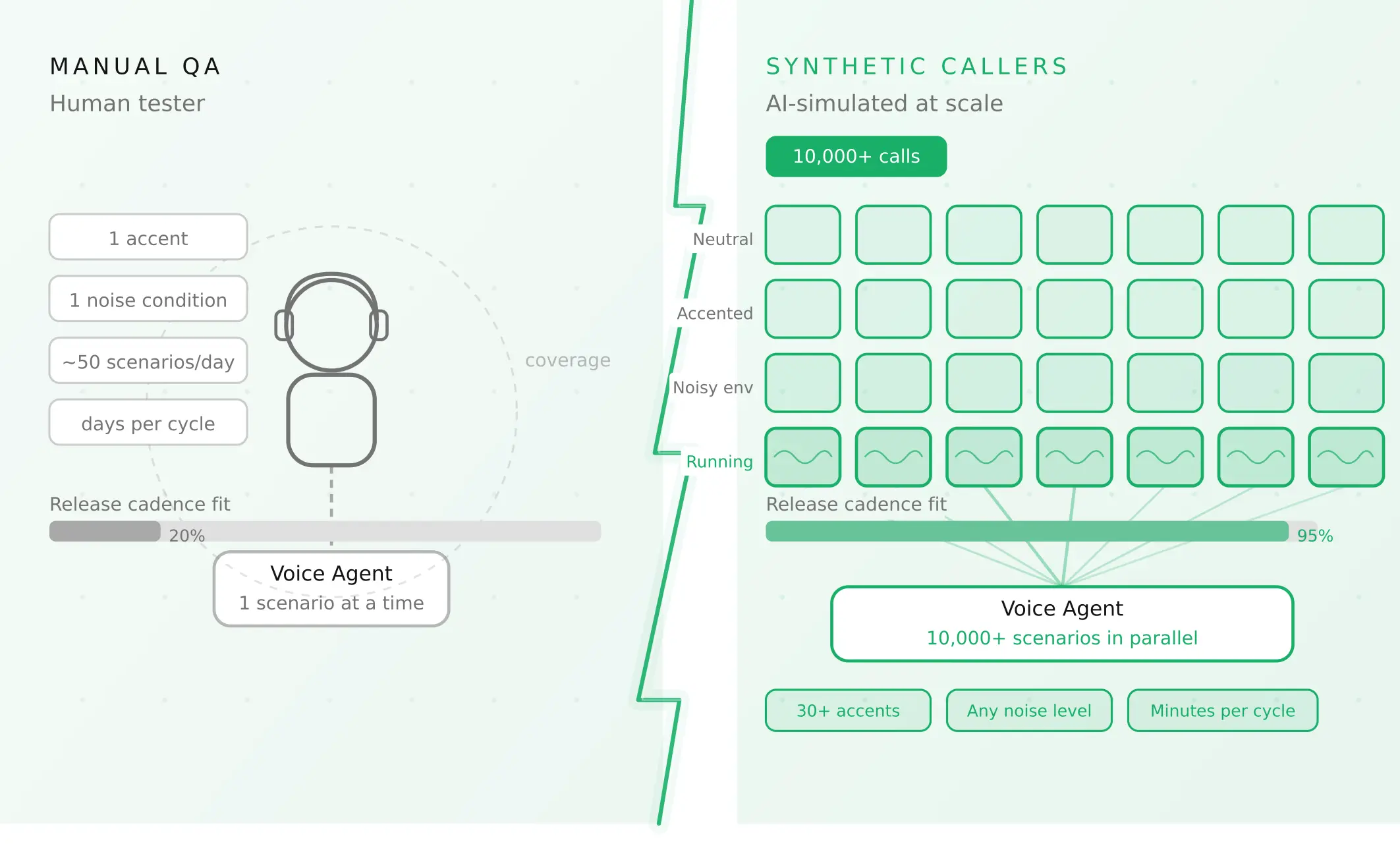
How to automate voice agent testing: synthetic callers vs manual QA
Learn how ai test automation replaces manual QA for voice agents. Compare synthetic callers vs human testers, with a 5-step framework to scale without hiring.
Read more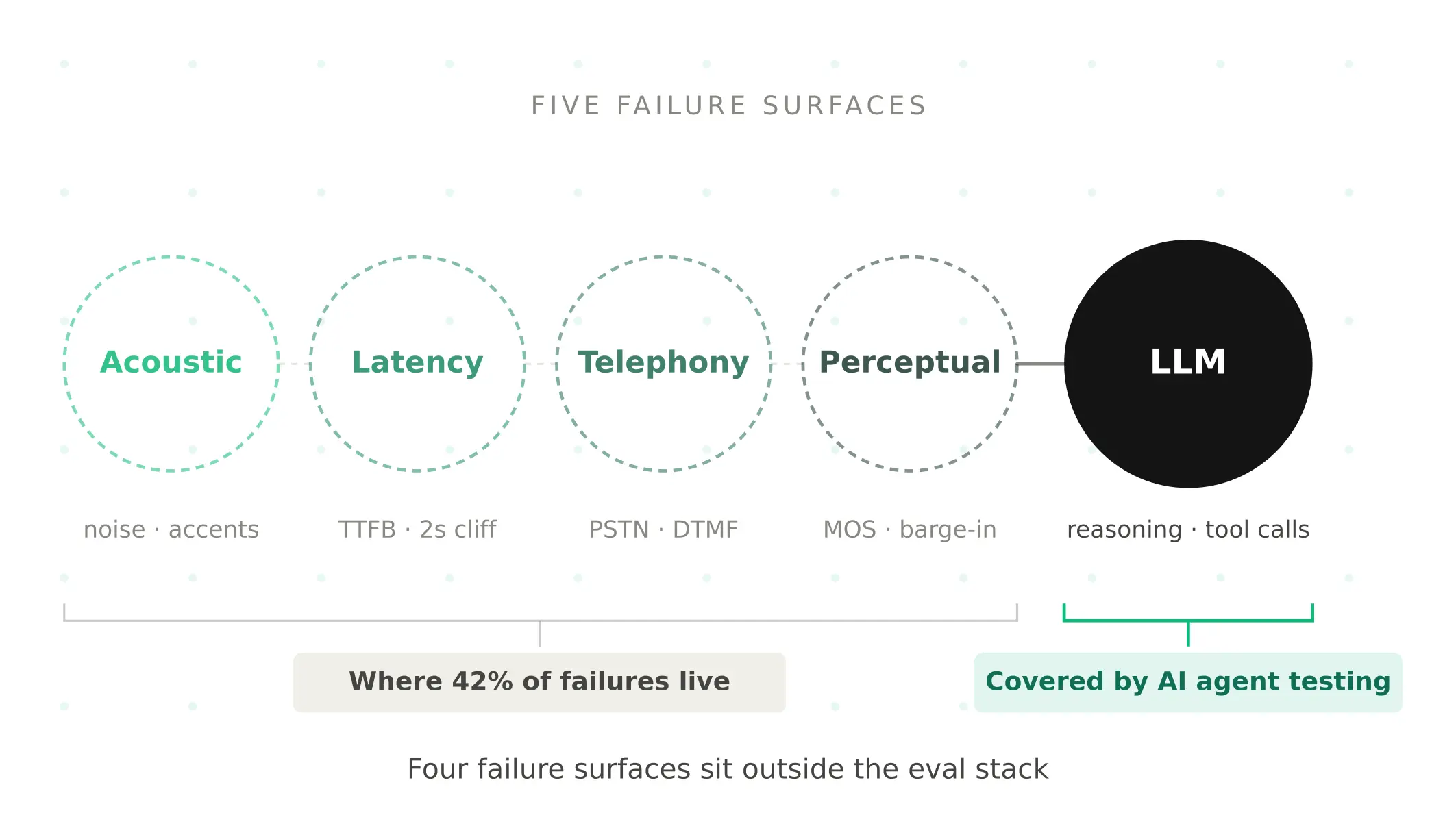
AI Agent Testing vs Voice Agent Testing: What General Tools Miss for Voice
AI agent testing measures text outputs. Voice agent testing measures behaviour through an acoustic pipeline. Five failure categories general tools miss.
Read more