Are New Salon Clients Hanging Up on Your AI? How to Check
On this page
Last verified October 19, 2026. Vendor pages were read on that date. Illustrative numbers are labelled as such.
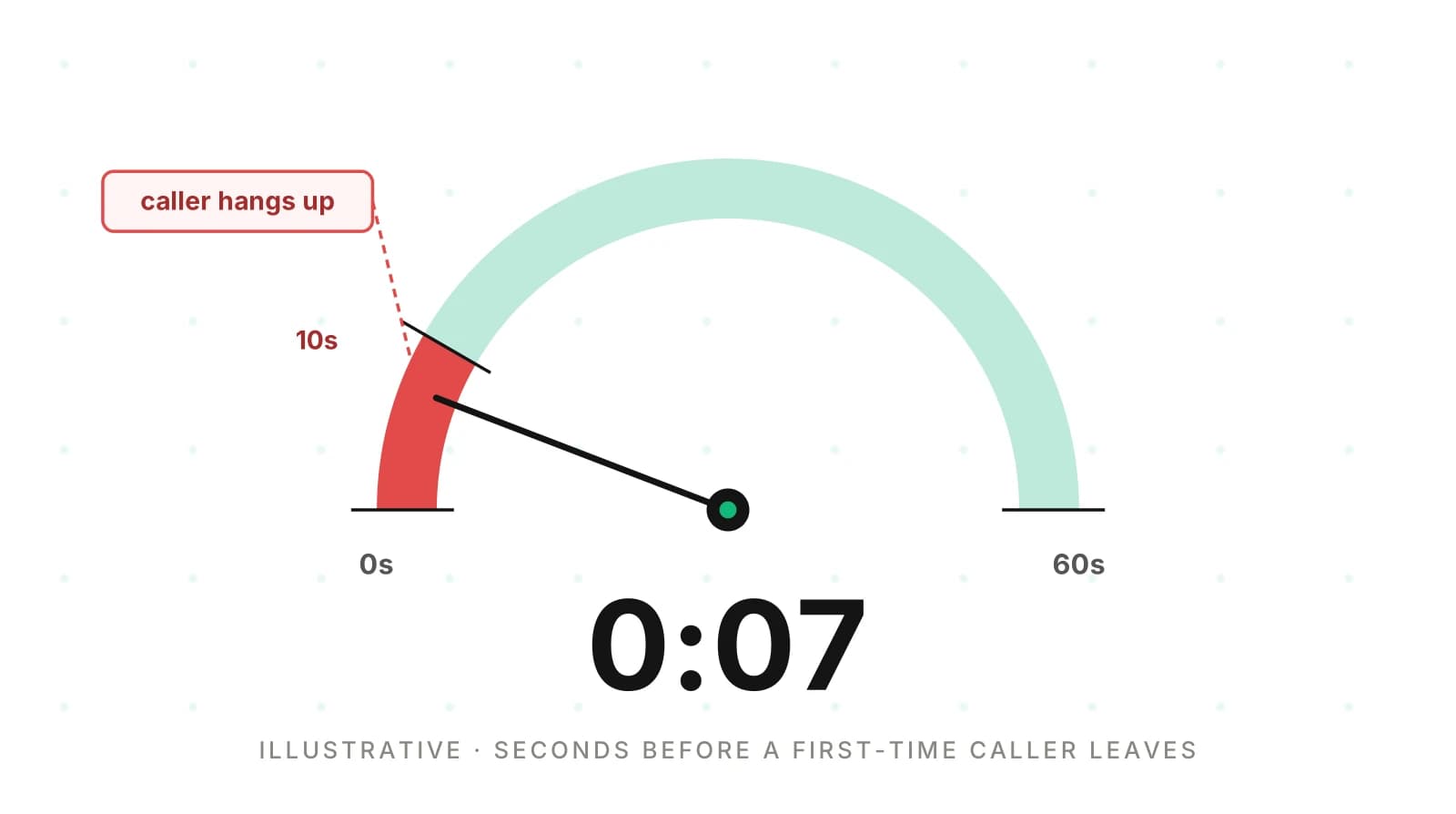
Salon AI new client calls are the hardest calls your voice agent takes. The caller has no booking history, no profile and no patience. Your agent has about ten seconds to sound useful. Existing clients forgive a clumsy greeting. First-time callers just hang up, and nothing in your dashboard says why.
This post is for teams that built AI phone answering for hair salons and other beauty businesses inside their own software. It covers where each first-time client leaves, how to measure it from call logs, and what to test before a prompt change ships. The sister post on rebooking and cancellation-fee calls covers existing clients. This one covers the first contact.
Why salon AI new client calls behave differently
Most new client phone calls differ from rebooking calls in one way. A rebooking call arrives with a caller ID that matches a client record. The agent knows the name, the last service and the stylist. A first call arrives with a phone number and nothing else.
That changes four things.
1. No context to lean on. The agent cannot say "welcome back." It has to earn trust from the first sentence.
2. The caller is comparing. Many first-time callers are phoning two or three salons. A slow or confusing call is cheap to abandon.
3. The questions are heavier. The agent must learn the service, hair history, stylist preference and any allergy or consult need. That is a lot to ask a stranger.
4. Write-back creates a record. A hang-up halfway through can leave a half-made client record, a lost lead, or a duplicate.
Two earlier guides cover the AI receptionist for salons QA playbook and why balayage becomes the wrong appointment. This post asks the question they skip: where do new callers leave?
What the platforms say, and what nobody publishes
Salon missed calls get the headlines. Those are calls nobody answered. This post covers calls that were answered and then abandoned.
Salon software vendors describe the front-door job in similar terms. As of October 2026, GlossGenius says its Reception product "answers your calls and texts 24/7 and books clients in seconds." It also lists "Greets clients and understands their needs" for new clients. Zoca describes its agent as replying to new messages "through text, chat, or voice" and guiding them toward a booking.
Those are product descriptions, not performance data. The pages I read show no first-call drop-off figures, and I found no public benchmark for them. Treat any "we recover X% of calls" claim as unverified until you see the denominator.
The practical point is simple. Nobody can hand you a standard hang-up rate for salon AI new client calls. Measure your own, per stage, across your own salons.
The five places new callers leave
Think of the first call as a path with five exits. Each exit is a drop-off point you can log. The windows below are illustrative, because every agent paces differently.
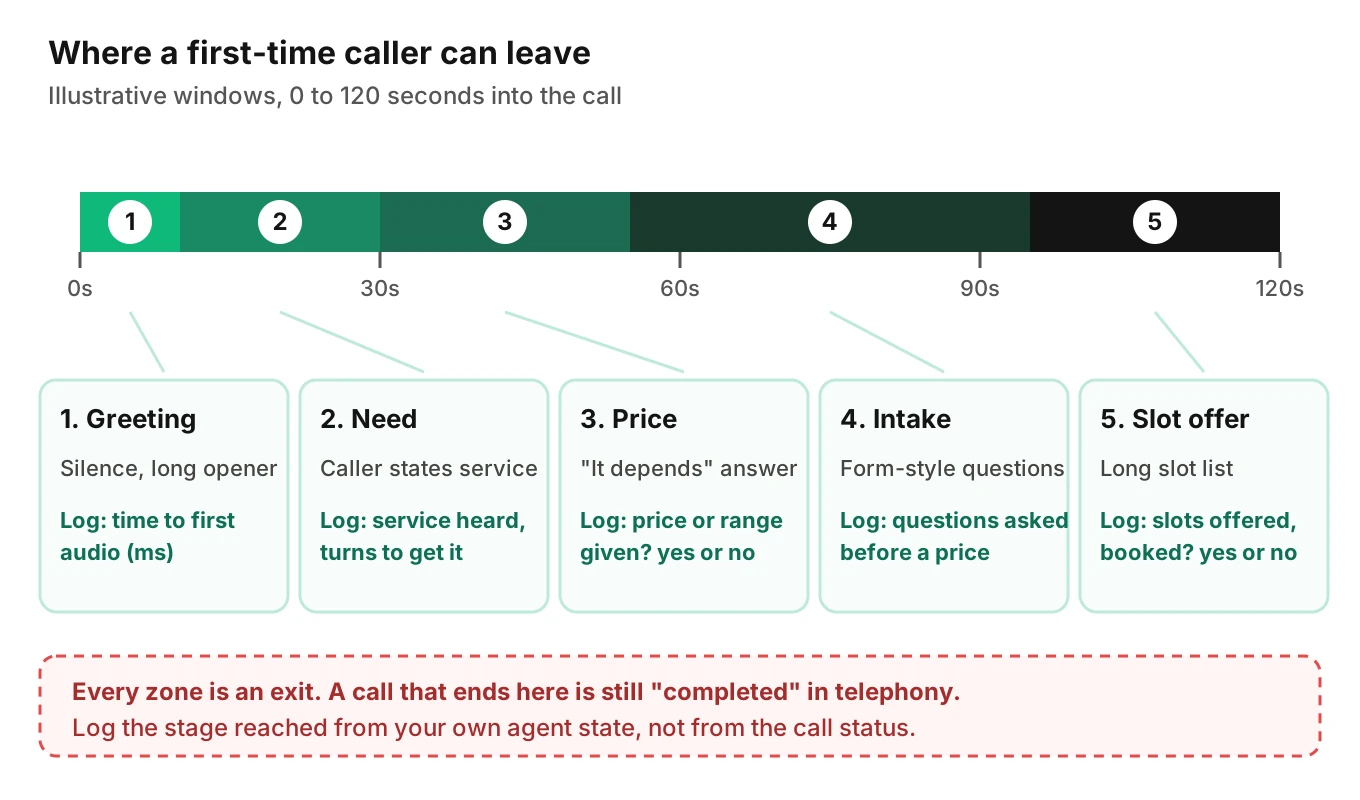
Exit 1: the greeting
The caller hears silence, a long preamble or a robotic opener. They hang up before the agent finishes. Two things drive it.
The first is delay. People expect turns to follow each other fast. Stivers and colleagues compared conversations in ten languages and found a cross-language mean gap of about 208 ms. A voice agent that waits a full second to speak is far outside that rhythm. Our guide to time to first audio shows how to measure it.
The second is length. A greeting with the salon name, AI disclosure, recording notice and a menu can run past ten seconds.
Exit 2: the identity moment
Some callers ask "Am I talking to a real person?" Others work it out from the cadence. Either moment can end the call.
Luo and colleagues studied chatbot disclosure and reported that disclosing the chatbot's identity before the conversation cut purchase rates by more than 79.7%. Their abstract also says a later disclosure timing can soften that effect. That study measures purchases, not salon bookings. Do not copy the number into a forecast. Use it as a reason to test disclosure wording and timing on your own calls.
Counsel owns the disclosure decision. Your tests own the question of what happens to completion when it changes.
Exit 3: the price wall
First-time callers often open with "How much for a cut and color?" If the agent answers with "It depends" and a string of questions, many will leave. If it quotes a wrong or stale price, the damage comes later, at the chair.
Price answers are per-salon configuration. In a multi-tenant product, a stale service menu in one salon is invisible in your aggregate numbers. See how to QA hundreds of customer setups.
Exit 4: the intake wall
This is the most fixable leak, and the heart of salon lead intake. The agent starts asking before it has given anything back. Name, spelling, email, hair history, allergies, referral source, all in a row.
Every question has a cost. The caller who wanted a price now answers a form. Ask only what the next action needs. Name and phone for the booking. The service. Then the questions that change what you book, such as color history for a color service.
Exit 5: the slot offer and the confirmation
The agent offers a time the caller cannot take, offers it in a confusing way, or reads a long list of slots. A caller who says "Saturday morning" and hears "Tuesday at 2" often gives up. This is where a stray first-time client slips away. The booking mechanics are covered in voice agent testing for appointment scheduling. Here the question is only whether the caller stayed.
Worked example: where 100 first-time calls go
The funnel below is a worked example with illustrative numbers. It is not a benchmark. It shows why per-stage logging matters for any booking funnel.
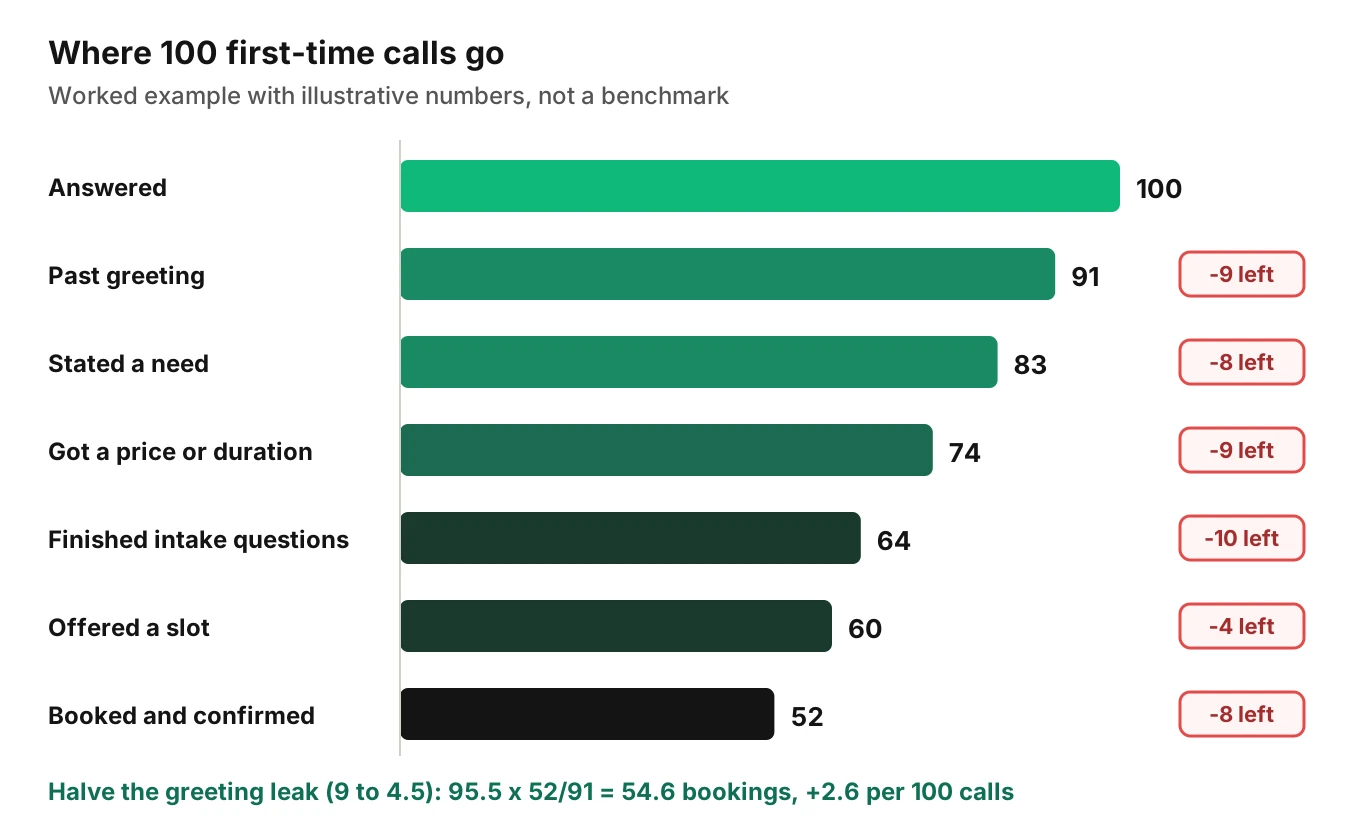
| Stage reached | Callers left | Stage leak |
|---|---|---|
| Answered | 100 | none |
| Past greeting | 91 | 9 |
| Stated a need | 83 | 8 |
| Got a price or duration | 74 | 9 |
| Finished intake questions | 64 | 10 |
| Offered a slot | 60 | 4 |
| Booked and confirmed | 52 | 8 |
The booking rate is 52 percent, and no single stage explains it. A dashboard showing only "booked or not" hides all six leaks. Early fixes also compound. Suppose you halve the greeting leak from 9 to 4.5. The downstream conversion from the greeting to a booking is 52 / 91, about 57 percent. So 95.5 callers pass the greeting, and 95.5 x 0.571 is about 54.6 bookings. That is 2.6 extra bookings per 100 calls from one greeting change.
Measure hang-ups from call logs
Salon call abandonment needs no new infrastructure to measure. You need three fields per call and one rule.
1. How far the call got. Record the last stage the agent reached, from your own agent state. The five stages above are enough.
2. How the call ended. Record who ended it and why: caller hang-up, agent transfer, agent end, error or timeout. Check what your framework and telephony layer actually report. Do not assume.
3. Timing. Record the time to first agent audio and the call length.
The telephony layer gives you the basics. Twilio's Call resource has statuses such as `completed`, `no-answer`, `busy` and `failed`, and a `Duration` field in seconds. It is empty for calls that were never answered. Note what that means: a caller who hangs up during your greeting is still a `completed` call. The status alone will not reveal the hang-up.
The rule is to define "new-client hang-up" before you count. A workable definition is: a call from a number with no client record, where the caller ended the call before a booking or a transfer. Our guide to measuring abandonment rate goes deeper on definitions.
Here is a simplified classifier. It assumes your own logs already carry the stage and the ending.
from collections import Counter
from math import sqrt

STAGES = ["greeting", "need", "price", "intake", "slot", "confirmed"]

def wilson(k, n, z=1.96):
    """95% interval for a rate. Works for small n."""
    if n == 0:
        return (0.0, 0.0)
    p = k / n
    d = 1 + z * z / n
    c = p + z * z / (2 * n)
    m = z * sqrt(p * (1 - p) / n + z * z / (4 * n * n))
    return ((c - m) / d, (c + m) / d)

def hangup_by_stage(calls):
    """calls: dicts with is_new, last_stage, ended_by, booked."""
    new = [c for c in calls if c["is_new"]]
    leaks = Counter(
        c["last_stage"] for c in new
        if c["ended_by"] == "caller" and not c["booked"]
    )
    out = {}
    for s in STAGES[:-1]:
        reached = sum(
            1 for c in new
            if STAGES.index(c["last_stage"]) >= STAGES.index(s)
        )
        out[s] = {
            "reached": reached,
            "left_here": leaks[s],
            "rate": wilson(leaks[s], reached),
        }
    return out
Run it on pooled calls from a cohort of salons, not one salon.
How many calls you need
Salon AI new client calls are low volume per salon. A single salon may take 10 to 15 new-client calls a week. That is far too few to see a stage-level change.
Here is the sample-size math for comparing two hang-up rates. For 80 percent power and a 5 percent significance level, a rough formula is:
n per group = 15.7 x p x (1 - p) / d squared
where p is the average of the two rates and d is the gap. Suppose a greeting change should cut hang-ups from 20 percent to 15 percent. Then p is 0.175 and d is 0.05. That gives 15.7 x 0.1444 / 0.0025, about 907 calls per group.
You need roughly 1,800 first-time calls to see that difference in a before and after test. At 12 calls per salon per week, that is 150 salon-weeks. So pool by cohort. Group salons by shared setup, such as the same service menu template or the same region, and test the change on a slice.
Small samples still help for listening. Thirty hang-up calls across five or six salons show the failure patterns. The numbers say where to look. The audio says why.
The intake order: ask less, and in a better order
The intake script is a design choice you can test. Compare two orders.
| Order A: form first | Order B: value first |
|---|---|
| Name, spelling, phone | Service the caller wants |
| Service wanted | Price range or duration |
| Hair history | Name and phone (from caller ID where possible) |
| Allergies | Questions that change what you book |
| Offer a slot | Offer a slot |
Order B hands something back before it asks for more. Neither order is proven better for your callers. That is the point of testing it. Run both on a cohort and compare the stage leaks.
Two details deserve a check in either order.
Phone number capture. The caller ID may be a landline, a desk phone or a spouse's cell. Asking "Is this the best number to text?" is cheap. Skipping it creates a client record with a number that cannot receive the confirmation.
Name capture. Unusual spellings and accents break names first. Test names spelled aloud, with accents, and check the stored result. See accent robustness.
Consult-required services and the wrong-slot problem
Some first visits should not be booked as the service the caller asked for. A color correction, a big change in color, extensions or a first visit for a client with a sensitive scalp may need a consultation first. Each salon decides which ones. Your agent must apply that per-salon rule, not guess.
Allergy and patch-test questions need extra care. The FDA's hair dye guidance tells consumers to "do a patch test on your skin every time before dyeing your hair" and warns that a reaction is still possible after a clean skin test. That page speaks to consumers, not to salon policy. Whether and when a salon requires a patch test is the salon's own rule. The agent should state that rule as configured and never improvise medical-sounding advice.
The routing logic has three decisions before any slot is offered.
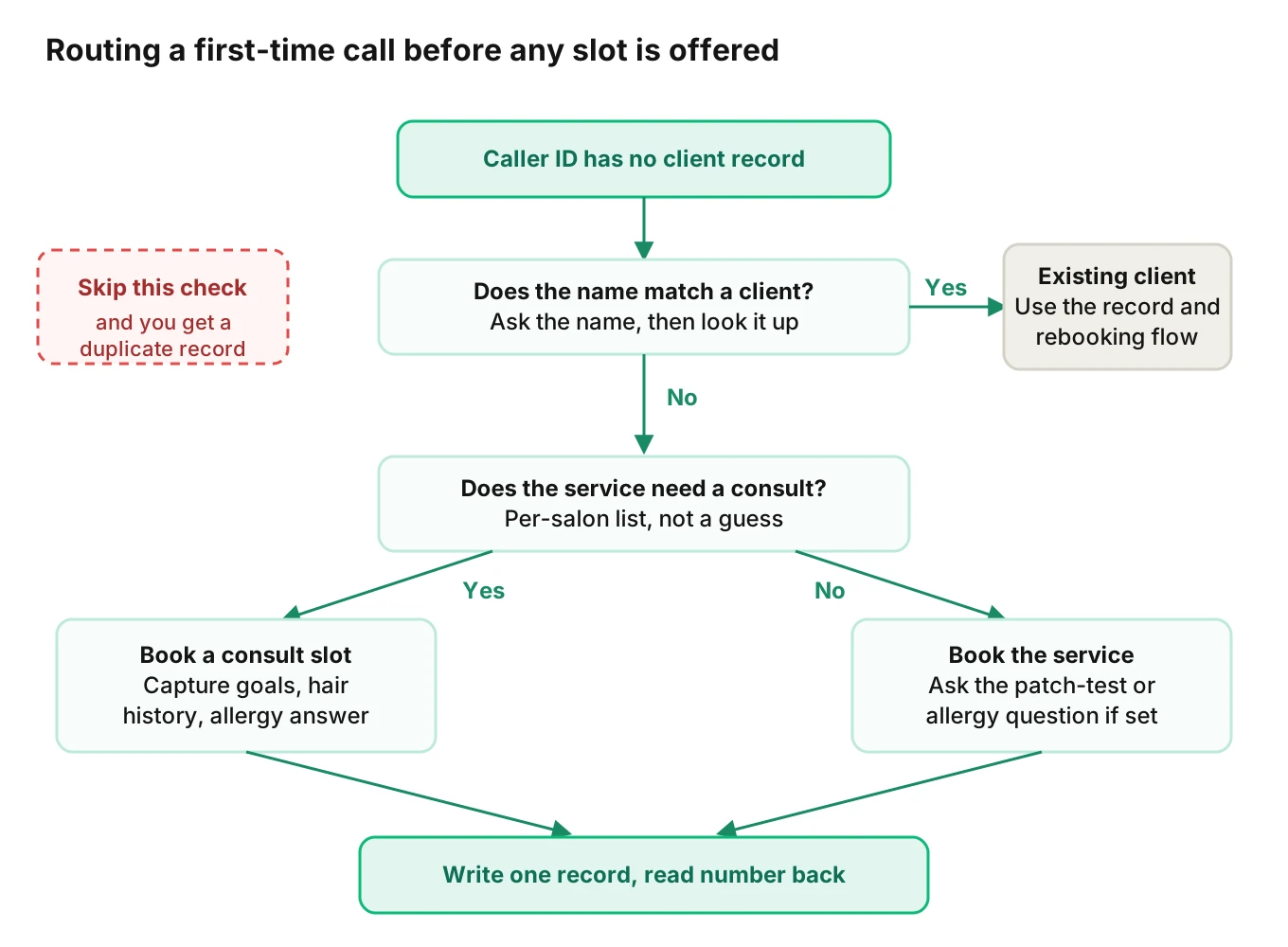
The first decision is the quiet one. A caller who looks new may be an existing client calling from another phone. If the agent treats them as new, it may apply new-client pricing or consult rules to a regular. It may also create a duplicate client record that splits their history in two. Ask for a name and use it to check for a match before writing anything.
The silent corruptions after a first call
A hang-up is a visible failure. These are not.
| Failure | What the record shows | Who finds out |
|---|---|---|
| Duplicate client | Two profiles, split history | The stylist, at the next visit |
| Wrong phone number | Confirmation text never arrives | The client, at the no-show |
| Full service booked, consult needed | A 3-hour slot on the wrong day | The stylist, at the chair |
| Allergy note dropped | Blank intake field | Nobody, until a reaction |
| Half-made lead | Name with no service | Nobody |
The half-made lead deserves a policy. If a caller leaves after giving a number, decide whether your product keeps that lead. Whether you may contact that person depends on consent rules, so ask counsel.
Monitor the first call in production
Pre-launch tests catch what you thought of. Production calls catch the rest. A useful monitoring view for first-time callers has five panels:
- Hang-up rate by stage, pooled by cohort.
- Time to first agent audio, p50 and p95.
- Share of calls where the caller asked for a human.
- New-client records created versus matched to existing clients.
- Consult-required requests booked as a consult, not a full service.
Evalgent approaches this from the audio rather than the transcript alone. In production monitoring, customers push call recordings, which are transcribed, mapped to scenarios and judged. The platform flags tool-call failures, latency spikes and policy failures, with fix recommendations. Metrics include latency, interruptions, talk share, turn count and call end reason. You can also define custom metrics that run on every call. A custom metric like "intake questions asked before a price was given" fits this use well. Our wider guide to monitoring voice agents in production covers the setup.
Recording brings a legal duty. California's Penal Code section 632 makes it an offense to intentionally record a confidential communication without the consent of all parties. A first offense can carry a fine of up to $2,500 per violation. If your salons span states, plan for the strictest rule and put the notice in the greeting. This is not legal advice. Ask counsel how your notice and the AI disclosure should be worded and ordered. Then test that the real greeting carries the call recording notice. Also test the voicemail fallback. A caller sent to voicemail after a failed transfer may hang up instead of leaving a message.
A test matrix for first-time callers
Before a prompt change ships, run a small matrix of caller behaviours against the real phone path. Evalgent generates scenarios from the agent's prompt and flows, and lets you set caller profiles: accent, speech pace, interruption level, response delay, background noise and language. Evalgent works with teams to set up evals for their first agent. Its simulator reaches the agent by phone, SIP or WebRTC, in English, Spanish, French, German and Hindi or Hinglish.
| Scenario | Condition | Pass looks like |
|---|---|---|
| Price shopper | Opens with "How much for a color?" | Gives a range or duration before intake |
| Interrupts the greeting | Speaks over the opener | Stops, listens, answers |
| "Are you a robot?" | Asks mid-intake | Answers honestly, call continues |
| Needs consult | Asks for a big color change | Books the consult, not the full service |
| Existing client, new phone | Gives a known name | Matches the record, no duplicate |
| Noisy caller | Car or street noise | Confirms name and number back |
| Spanish speaker | Starts in Spanish | Switches or hands off cleanly |
| Hesitant caller | Long pauses | Waits, does not talk over |
Run each row several times, since voice calls vary. Score the stage reached, not only the booking.
How to audit new-client hang-ups in one week
1. Define the population. Pull calls from numbers with no client record. Exclude spam and wrong numbers by the rules you set.
2. Add the three fields. Capture the last stage reached, who ended the call and the time to first audio. Back-fill from recordings if logs lack them.
3. Pool by cohort. Group salons by shared setup so each group reaches a useful sample.
4. Compute leaks per stage. Use the classifier above. Rank stages by leak size, with intervals.
5. Listen to 30 hang-ups. Pick calls across at least five salons and tag the cause: delay, greeting length, identity, price, intake or slot.
6. Check per-salon config. For the worst salons, compare the service menu, consult rules and hours the agent used against the salon's real ones.
7. Change one thing. Shorten the greeting, reorder intake or fix a menu. Never bundle changes.
8. Re-test before shipping. Run the matrix above on the new version, then compare the stage leaks on a cohort slice.
For pre-launch, use the go-live checklist. For intake metrics in a regulated setting, see healthcare intake metrics. For outcomes, see first contact resolution.
Frequently asked questions
Why do new clients hang up on salon AI receptionists?
Usually for one of five reasons: a slow or long greeting, the moment they realise it is an AI, no price answer, too many intake questions, or a slot offer they cannot take. Which one dominates depends on your agent. Log the stage reached at hang-up, then listen to a sample to find the cause.
How do I measure hang-up rate on new client salon calls?
Define a new client as a number with no client record. Log the last stage reached and who ended the call. Count calls where the caller ended before a booking or transfer, divided by calls that reached each stage. Pool salons by cohort, since one salon has too few calls.
What should a salon AI ask a new client first?
Ask what service they want, because the answer drives everything else. Give a price range or duration next if the salon allows it. Then take name and phone, and only then the questions that change the booking, such as color history. Test this order against a form-first order on your own calls.
Should a salon AI say it is an AI at the start of the call?
Your counsel decides what you must disclose. For wording and timing, test it. One study of chatbot-driven purchases found disclosure before the conversation cut purchases by more than 79.7 percent, though that is a different setting. Measure completion on your own calls and change one variable at a time.
How long should a salon AI take to answer a new caller?
No published standard exists for salon calls. Human turn-taking research found a mean gap of about 208 ms across ten languages, so a long pause feels unnatural. Measure your time to first audio at p50 and p95, set a budget, and watch hang-ups in the first ten seconds.
How does a salon AI handle services that need a consultation?
Each salon should configure which services need a consult, and the agent should apply that list. It should book the consult slot, not the full service, and record the caller's goals and hair history. Test it with requests such as a major color change or extensions, and check what was booked.
How many calls do I need to review to find drop-off problems?
For listening, about 30 hang-up calls across five or six salons will reveal the common patterns. For measuring a change, a drop from 20 to 15 percent needs about 900 calls per group at 80 percent power. Pool salons by cohort to get there.
Can a salon AI record new client calls legally?
It depends on the state. California's Penal Code section 632 makes recording a confidential communication without all-party consent an offense, with a first-offense fine up to $2,500 per violation. Plan for the strictest state you serve, and put the notice in the greeting. This is not legal advice, so ask counsel.
The bottom line
Salon AI new client calls fail in the first ten seconds and at the intake wall, and a final booked-or-not number hides both. Log the stage each first-time call reached, pool salons by cohort, and test one change at a time before it reaches every salon.
Related Articles
How to automate voice agent testing: synthetic callers vs manual QA
Learn how ai test automation replaces manual QA for voice agents. Compare synthetic callers vs human testers, with a 5-step framework to scale without hiring.
Read more
AI Agent Testing vs Voice Agent Testing: What General Tools Miss for Voice
AI agent testing measures text outputs. Voice agent testing measures behaviour through an acoustic pipeline. Five failure categories general tools miss.
Read more