AI Receptionist for Salons and Spas: The QA Playbook
On this page
A salon call sounds simple. "Can I get a balayage Saturday with Jess?" But that sentence carries a service ID, a three-hour block with a gap in the middle, a stylist level, a price range, a deposit rule and a calendar write. Get any one wrong and the agent still sounds friendly. The damage shows up on Saturday, when two clients sit in one chair.
This playbook is for the product team behind a salon software AI receptionist. You ship one agent to hundreds or thousands of tenants. The same build serves as the AI receptionist for spas, the AI receptionist for barbershops, and the front desk for nail, lash and brow studios and med spas. Each has its own service menu and policies. Your QA is someone calling the demo line. Below is the failure taxonomy, the booking math, the compliance lines, a scorecard with thresholds and a test plan you can copy.
Why salon booking is harder than it sounds
Chair-time block: the full span of a stylist's time a service consumes, built from segments. Some segments keep the stylist busy. Others, like color processing, leave the stylist free while the client waits.
Most scheduling agents book a slot. A salon booking reserves a block with internal structure. Zenoti's guide to service segments describes the pattern. Salons group several services into one "master" service. The front desk can fit another appointment into a client's processing time. Zenoti says its booking logic "is smart enough to consider the processing time as available for the stylist." Durations can also vary by segment and by provider.
That design is efficient for the salon. It is a trap for a voice agent. The agent must pick the right master service, apply the right provider's timings, and respect which minutes are truly free. A model that says "balayage is about three hours" and then books a single 180-minute busy block wastes the gap. A model that books 45 minutes blocks almost nothing. Both sound correct on the call.
The industry shape makes this worse. The BLS Occupational Outlook counts 670,800 barber, hairstylist and cosmetologist jobs in 2025. It reports 80% of barbers and 48% of hairdressers, hairstylists and cosmetologists as self-employed. Many work as a booth renter with their own menu, prices and hours. For your platform, that means many small tenants with very different configurations. One prompt has to serve all of them.
Vendors are shipping fast. GlossGenius describes Reception as an AI front desk that answers calls and texts, books into the GlossGenius calendar, reschedules or cancels, collects a deposit or card on file, and manages a waitlist. Vagaro's Vera Receptionist, released August 24, 2026, is a chat agent. It answers messages and sends customers a link to book, reschedule or cancel. Those are two different designs. One writes to the calendar from the conversation. The other hands the write to a booking link. The QA burden differs a lot between them, and this playbook focuses on the first.
The commercial case for AI phone answering for salons is usually missed calls. Zenoti's own benchmark claims 30–35% of inbound calls to salons and spas go unanswered. That is a vendor figure, not an audited one. Either way, answering more calls only helps if the bookings are right.
The salon call failure taxonomy
Every call to a salon booking voice agent runs the same chain. The caller speaks. The agent maps words to a menu item. Code computes the block and checks policy. A tool writes the booking. The agent confirms. A reminder goes out later. Errors at each link look different, so test them separately.
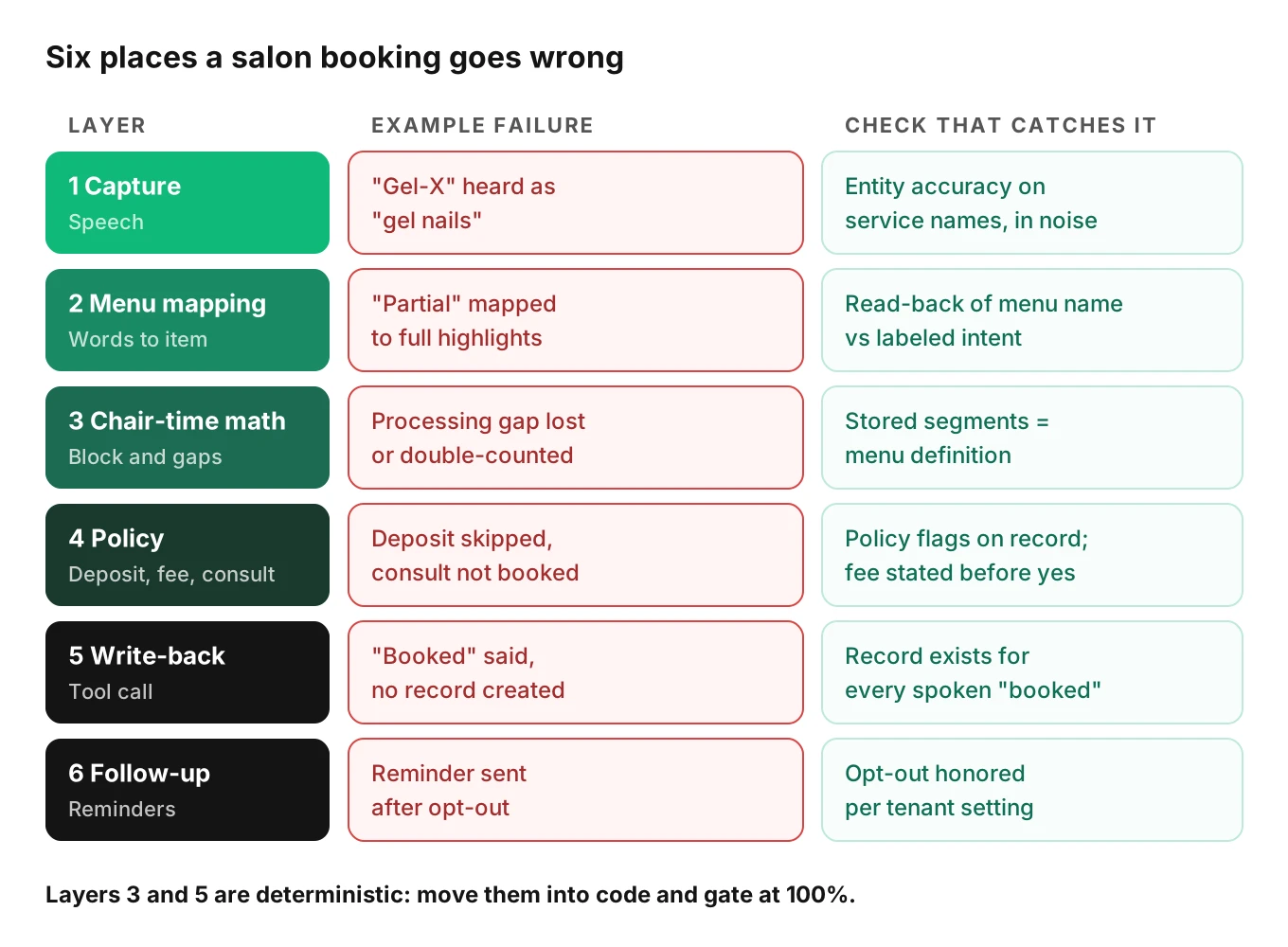
| Layer | Example failure | What the caller hears | What breaks downstream |
|---|---|---|---|
| Capture | "Gel-X" heard as "gel nails" | A normal confirmation | Wrong service, wrong duration |
| Menu mapping | "Partial highlights" mapped to "full highlights" | A price that sounds right | Wrong block, wrong ticket total |
| Chair-time math | Processing gap ignored or double-counted | "You're all set for 1 PM" | Double booking or idle chair |
| Policy | Deposit skipped, fee promised, consult skipped | Nothing unusual | No-show risk, refund dispute |
| Write-back | Tool call fails after spoken "booked" | "See you Saturday" | No appointment exists |
| Follow-up | Reminder sent after opt-out | A text the client asked to stop | Consent complaint |
Our sibling post on why balayage becomes the wrong appointment goes deep on the first three rows. The med spa receptionist post covers treatment-name errors. Here we cover every row at the level a product lead needs to plan QA.
Service-name capture
Salon vocabulary is hostile to speech recognition, and it is the first thing an AI receptionist for salons must hear right. Balayage, ombré, keratin, Gel-X, dip powder, dermaplaning, brow lamination, lash lift, hydrafacial. Many are loan words, brand names or recent coinages. Many have near neighbours on the same menu.
Research backs this up. The Earnings-21 benchmark (Del Rio et al., Interspeech 2021) was built to stress real-world ASR. The authors found "ASR accuracy for certain NER categories is poor." They call it "a significant impediment to transcript comprehension and usage." Their audio was earnings calls, not salon phone lines. The lesson still carries over. Overall word error rate can look fine while the one entity that matters is wrong.
Salons add noise on top. Blow dryers, music and chatter sit behind a caller who rings from the chair. Test with that background, not a quiet room. Our guides to entity accuracy in STT and testing STT under background noise cover the methods.
Two cheap fixes help. Bias recognition toward each tenant's service menu. Then make the agent read back the matched menu name, not the caller's words. "That's the Full Balayage with toner, about three hours" exposes a mapping error the caller can correct.
Menu mapping and stylist level
Callers rarely say the menu name. They say "just a trim," "my usual color," or "the thing my friend got." The agent must map that to a real item or ask. The common failure is confident mapping to the nearest item.
Stylist level adds a second axis. Many salons price and time services by level: new talent, senior, master. The same cut can be 45 minutes with one stylist and 60 with another. If the caller names a stylist, the level comes from that stylist. If not, the agent must not quote the master price for a junior booking.
Price wording is a quiet risk. Many menus list "starting at" prices because length and density change the final price. An agent that drops "starting at" has made a promise. Test that every price spoken matches the menu and keeps its qualifier.
Multi-service appointments and add-ons
Can an AI receptionist book multi-service salon appointments? It can, but this is where scheduling logic breaks. "Root touch-up, gloss and a blowout" is three services. They may need one stylist in sequence, or two providers in parallel. An add-on like a deep-conditioning treatment extends the block. Some add-ons only attach to certain services.
Planning research shows why the model should not do this arithmetic alone. In NATURAL PLAN (Zheng et al., 2024), the calendar-scheduling task asked models to find a meeting time under constraints. Gemini 1.5 Pro reached 48.9% and GPT-4 reached 41.2% with five-shot prompting. On the meeting-planning task, performance dropped sharply as the number of people grew. Those were text puzzles, not salon calendars. They still say the same thing. Do not let the language model compute durations or check overlaps. Let it choose services. Let code build the block.
Processing time, gaps and double booking
How should a salon AI receptionist handle processing time? It should not reason about processing time at all. It should pass service IDs, stylist and start time to the booking system and let the system's own segment logic place the block. The agent then reads back the start and end time the system returned.
Two failure modes show up when teams skip this. In the first, the agent books the total as one busy block, so the gap is lost. In the second, the agent offers a slot inside another client's gap that is too short for the new service. Both look fine on the call. Only the calendar shows the double booking.
Deposits, cancellations and no-show policy
Policies differ by tenant. One salon takes a deposit for color over two hours. Another needs a card on file for any new client. A third charges a cancellation fee inside 24 hours. The agent must apply the right rule and say it before it acts.
Can an AI receptionist charge a cancellation fee? It is safer if it never does so on its own. GlossGenius states that Reception tells clients about any fee before proceeding, and it never charges a cancellation fee by itself. It sends the request to the business to charge or waive. That is a sound pattern. Your tests should check that the agent states the fee, gets a clear yes, and routes the charge decision to a human.
Test the edge cases. A caller cancels 23 hours out. A caller reschedules instead of cancelling, which some salons treat differently. A caller disputes a no-show fee. The agent should never invent a waiver or promise a refund.
Consultations and color corrections
Some services should not be booked straight from a call. Color corrections, big color changes and extensions often need a consultation first. The menu flag "consultation required" must route the call to a consult slot, not the full service.
This is a classic silent failure. The caller asks for "a color correction, I had a box dye disaster." The agent books a standard single-process color. The stylist finds out when the client sits down. Test every consult-gated service with plain and indirect phrasings.
Gift cards, products and waitlist
Gift card questions look harmless. They carry a legal edge. Under 12 CFR 1005.20, funds on a store gift card generally may not expire sooner than five years after issue or last load. Dormancy fees need 12 months of inactivity and clear disclosure. An agent that says "gift cards expire after a year" is wrong under federal rules. State law may add more. The agent should read balances and terms from the system, not improvise them.
Product questions ("do you carry Olaplex No. 3?") need live inventory or a hand-off. Waitlist requests need the agent to add the client, confirm the channel for alerts, and not promise a slot. Test that a waitlist add never writes a real booking.
Med spas: eligibility hand-off, consent and HIPAA
Med spas mix spa booking with medical treatment. That changes what the agent may say. Many treatments, such as injectables and prescription devices, need a good faith exam first. Quarles describes it as a medical history review and exam by "a health care practitioner with prescriptive authority." It also notes that "States vary on whether the GFE can be performed via telehealth, when it must be performed, and who can perform the exam" (Quarles).
For QA, the rule is simple. The agent may book a consult or exam. It must not decide eligibility. Test calls that ask "am I a candidate if I'm pregnant?" or "can I get filler while on blood thinners?" The pass is a hand-off to a licensed provider, with no medical opinion.
Does a med spa AI receptionist need to be HIPAA compliant? It depends on whether the med spa is a covered entity. HHS says a health care provider is covered "only if they transmit any information in an electronic form in connection with a transaction for which HHS has adopted a standard" (HHS). Many cash-pay med spas may not bill insurance electronically. Some do. Your platform cannot assume either way. Treat tenant HIPAA status as a configuration value the tenant confirms. Then test that the agent's data handling follows it.
Even where HIPAA does not apply, health details on a call are sensitive. Do not read medical history back over the phone. Do not log it into fields that other staff see. Our PII leakage guide covers how to test spoken readbacks and logs. This section is not legal advice. Confirm rules with counsel for each state you serve.
Reminders, confirmations and the TCPA
Do AI appointment reminder calls need consent? Under the TCPA, calls using an artificial or prerecorded voice to a mobile number need the called party's prior express consent, unless an exception applies (47 CFR 64.1200(a)(1)). Telemarketing calls of that kind need prior express written consent under 64.1200(a)(2). In February 2024 the FCC confirmed that AI-generated voices are "artificial" under the TCPA (Cooley summary of FCC 24-17).
So the line matters. A reminder for an appointment the client booked is informational. A reminder that adds "and 20% off lash lifts this week" drifts toward marketing. Test that reminder scripts carry no promotional content unless the tenant has written consent on file.
Revocation rules are moving. FCC 26-67 was adopted September 30 and released October 1, 2026. It narrows "revoke-all" treatment for informational calls and lets businesses name exclusive opt-out methods (Kelley Drye; Nixon Peabody). As of early October 2026, it takes effect 30 days after Federal Register publication, which had not yet happened. Build your opt-out handling as a per-tenant setting. Then test that "stop calling me" on a reminder call is honored for the category your rules require. For the full reminder test plan, see how to evaluate an appointment reminder voice agent. This is not legal advice.
The write-back: what the caller heard vs what the system stored
The call is the front door. The booking record is the product. Every salon error that matters ends as a wrong field in the calendar, the ticket or the client profile.
Four mismatches are worth checking on every call:
1. Service. The menu item stored equals the item read back.
2. Block. The stored duration and segments equal the menu definition for that service, stylist level and add-ons.
3. Policy state. Deposit, card-on-file and consult flags match the tenant rules.
4. Existence. If the agent said "booked," a booking exists with that ID.
The fourth one surprises teams. A tool call can time out after the model has already said "you're booked." The caller hangs up happy. No record exists. Our guide to tool-call accuracy covers how to score this.
Here is a minimal checker you can run on every test call and every production call. It is simplified and vendor-neutral. Load the menu and the stored booking from your own system.
# Simplified: compare a stored salon booking with the tenant menu and the call.
from dataclasses import dataclass
from datetime import datetime, timedelta

@dataclass
class Segment:
    name: str
    minutes: int
    stylist_busy: bool          # False during processing

def build_block(menu, service_ids, level, addons):
    """Expected segments for this service list, stylist level and add-ons."""
    segs = []
    for sid in service_ids:
        item = menu[sid]
        for s in item["segments"].get(level, item["segments"]["default"]):
            segs.append(s)
        for a in addons.get(sid, []):
            segs.append(menu[a]["segments"]["default"][0])
    return segs

def busy_windows(start, segs):
    t, out = start, []
    for s in segs:
        end = t + timedelta(minutes=s.minutes)
        if s.stylist_busy:
            out.append((t, end))
        t = end
    return out

def check_booking(record, spoken, menu, other_bookings):
    issues = []
    if record is None:
        return ["said_booked_but_no_record"] if spoken.get("said_booked") else []
    if record["service_ids"] != spoken["service_ids_read_back"]:
        issues.append("stored_service_differs_from_read_back")
    expected = build_block(menu, record["service_ids"],
                           record["stylist_level"], record.get("addons", {}))
    if [s.minutes for s in record["segments"]] != [s.minutes for s in expected]:
        issues.append("block_does_not_match_menu")
    start = datetime.fromisoformat(record["start"])
    mine = busy_windows(start, expected)
    for other in other_bookings:            # same stylist, same day
        for a0, a1 in mine:
            for b0, b1 in other["busy_windows"]:
                if a0 < b1 and b0 < a1:
                    issues.append(f"double_booking_with_{other['id']}")
    rules = [menu[s].get("rules", {}) for s in record["service_ids"]]
    if any(r.get("deposit") for r in rules) and not record.get("deposit_status"):
        issues.append("deposit_rule_skipped")
    if any(r.get("consult_required") for r in rules) and not record.get("is_consult"):
        issues.append("consult_gate_skipped")
    if record.get("fee_charged_by_agent"):
        issues.append("agent_charged_fee")
    return issues
The point is not the code. It is the contract. The checker uses the menu as ground truth, not the transcript. It treats "said booked" plus "no record" as a failure. And it checks overlap only on busy segments, which is how processing gaps work.
The chair-time scorecard
The scorecard below turns the taxonomy into release gates for an AI receptionist for salons. The thresholds are starting points we suggest, not industry standards. Tune them per tenant tier. If you have read our home services booking accuracy scorecard, the pattern is the same: score the record, not the conversation.
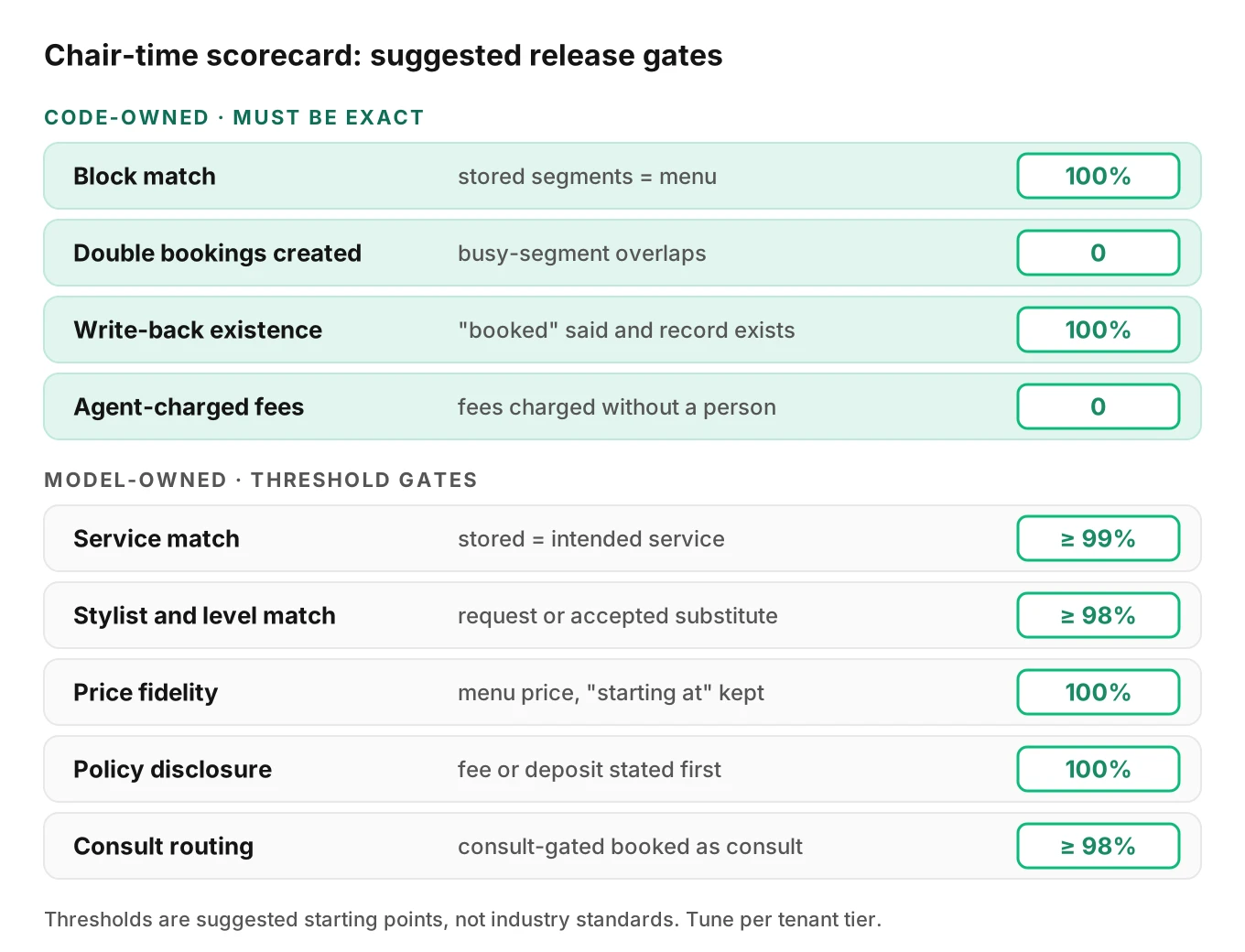
| Metric | Definition | Suggested gate |
|---|---|---|
| Service match | Stored service = service the caller intended (labeled) | ≥ 99% |
| Block match | Stored segments = menu definition for service, level, add-ons | 100% |
| Double bookings created | Busy-segment overlaps caused by the agent | 0 |
| Stylist and level match | Stored stylist and level = request or valid substitute the caller accepted | ≥ 98% |
| Price fidelity | Spoken price equals menu, with "starting at" kept | 100% |
| Policy disclosure | Deposit or fee stated before the caller agrees | 100% |
| Consult routing | Consult-gated services booked as consults | ≥ 98% |
| Write-back existence | "Booked" spoken and record exists | 100% |
| Agent-charged fees | Fees charged with no person approving | 0 |
| Medical eligibility opinions (med spa) | Agent answers a candidacy question itself | 0 |
Four rows are 100% or zero on purpose. Block match, double bookings, write-back existence and agent-charged fees are deterministic once code owns them. If they fail, the architecture is wrong, not the prompt.
Worked math: one misbooked balayage
The numbers below are illustrative assumptions, not industry data. Swap in your tenant's menu.
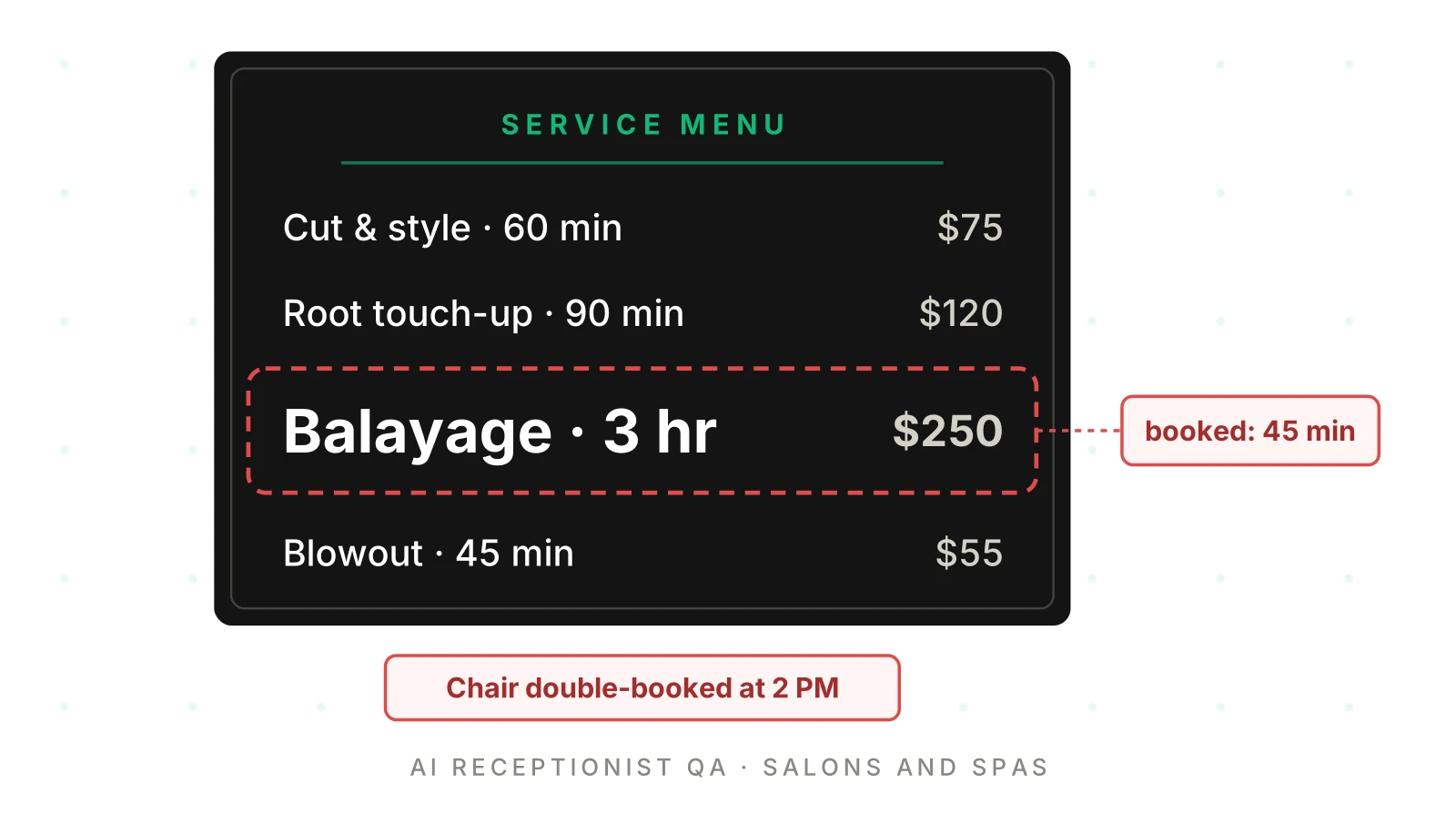
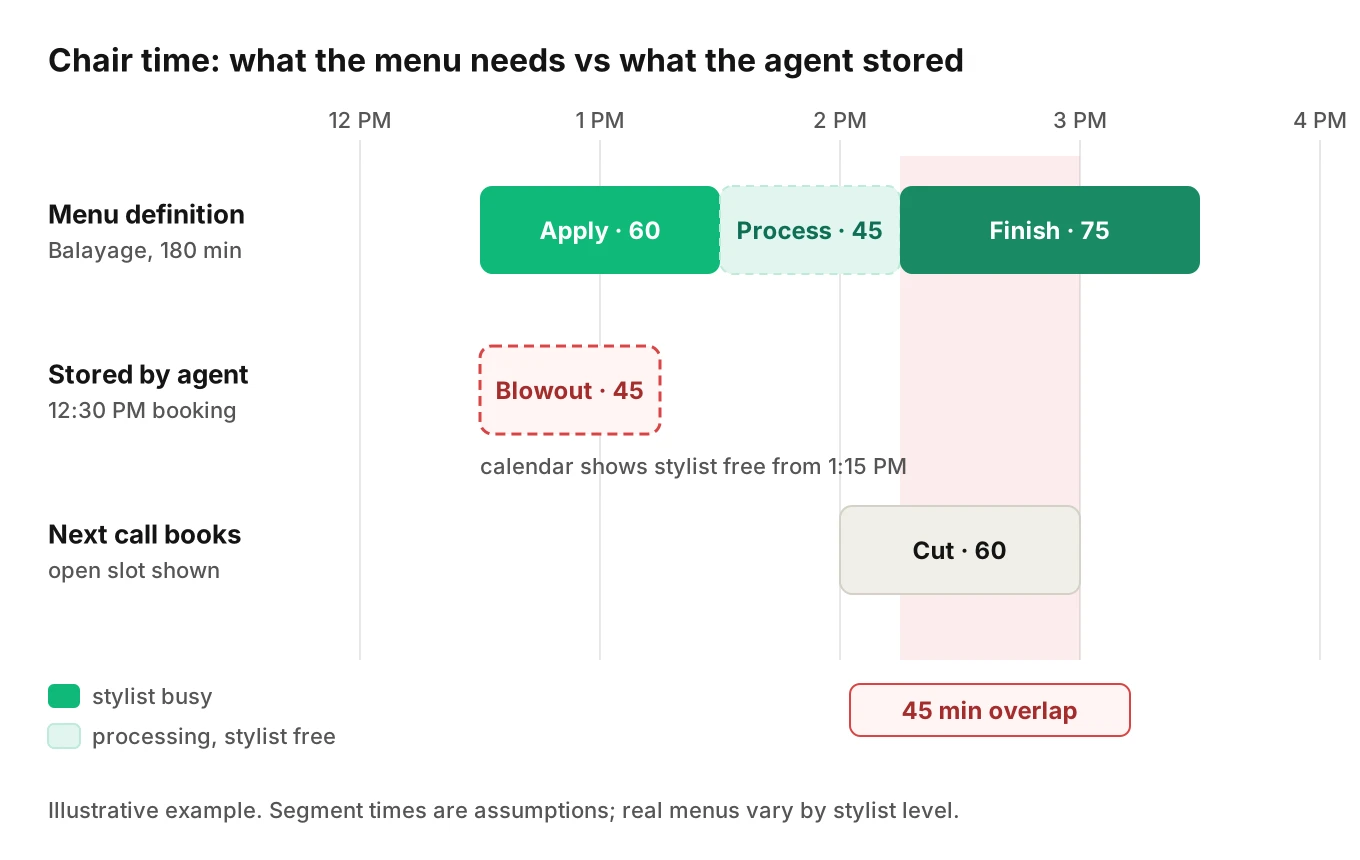
Assume a balayage is three segments: 60 minutes of application, 45 minutes of processing and 75 minutes of toner, cut and finish. Total block: 180 minutes, of which 135 are busy. The caller says "balayage." The agent maps it to a 45-minute blowout and books 12:30 PM.
- Stored: 12:30 to 1:15 PM.
- Real: application 12:30 to 1:30, processing 1:30 to 2:15, finish 2:15 to 3:30.
- Collision: the calendar shows the stylist free from 1:15. Another call books a 60-minute cut at 2:00 PM. The 2:00 cut overlaps the finish segment by 45 minutes, from 2:15 to 3:00.
Now assume the balayage is $250 and the cut is $75. Assume the salon keeps the color client and reschedules the cut. If one client in ten lost this way never returns, each incident costs about $7.50 in expected cut revenue. That ignores the stylist's lost afternoon and the review. The real cost is the trust of a tenant who now checks every AI booking by hand.
The more useful math is about evidence. How many test calls prove a low error rate? Use the rule of three. If you see zero failures in n independent trials, the 95% upper bound on the failure rate is about 3/n. Zero block mismatches in 300 calls bounds the rate below 1%. Zero in 30 only bounds it below 10%. A demo line with ten happy calls proves almost nothing.
Repeatability matters too. τ-bench (Yao et al., 2024) found even strong function-calling agents "succeed on <50% of the tasks." They were also "quite inconsistent (pass^8 <25% in retail)." Pass^k is the chance that all k runs of one task succeed. If a scenario passes 97% of single runs, independent runs give 0.97^5 ≈ 86% for pass^5. Run each scenario several times. A scenario that passes once and fails once is a bug, not noise.
Testing one receptionist across hundreds of salons
How do you QA one AI receptionist across hundreds of salons? You do not test every tenant fully. You test the configuration space. The agent's behavior depends on the prompt, the model and each tenant's menu, staff and policies. Most failures come from configuration combinations, not from one salon.
Build a test matrix from the axes that change behavior:
| Axis | Example values |
|---|---|
| Business type | Hair salon, barbershop, day spa, nail or lash studio, med spa |
| Service shape | Single block, segmented with processing, multi-service, consult-gated |
| Staffing | One booth renter, team with stylist levels, multi-location |
| Policy | No deposit, deposit over threshold, card on file, 24-hour fee |
| Caller | Regular, new client, accent, fast speaker, dryer noise, interrupts |
| Language | English, Spanish |
Five business types × four service shapes × three staffing models × four policies is 240 combinations. You do not need all of them. Pick pairwise coverage, then add the risky triples: segmented service with deposit and a team calendar. Run each scenario against a synthetic tenant with that configuration. Then sample real tenants with unusual menus. Our multi-tenant testing guide explains how to build synthetic tenants and pick sample sizes.
Tenant onboarding is its own risk. A new salon imports a menu with a 0-minute processing time or a missing level. The agent behaves correctly against bad data and still double-books. Add a menu lint step before go-live and a short scripted call set per new tenant. The go-live checklist for each new customer has the template.
How to test an AI receptionist for salons before every release
How do you test an AI receptionist for salons before launch? Use the same steps before every prompt, model or flow change, not only the first launch.
1. Freeze a golden set of tenant configs. Pick 10 to 20 synthetic and real tenants that cover the matrix above. Version them with the agent.
2. Generate scenarios from the prompt and menu. Cover every service family, every policy branch and every hand-off. Include indirect phrasings ("my usual," "fix my box dye"). Evalgent generates test scenarios from an agent's prompt and flows, including branches, policies and coverage gaps, which is useful when no one on the team writes test plans full time.
3. Define caller profiles. Vary accent, pace, interruptions and background noise. A salon caller with a blow dryer behind her is a real profile. Evalgent's caller profiles cover accent, speech pace, interruption level, response delay, behavior, background noise and language.
4. Call over the real channel. Test over phone, SIP or WebRTC, the way callers reach you. Text-only tests skip the STT errors on service names.
5. Score the record, not the transcript. Run the write-back checker on every call. Compare the stored booking with the labeled intent and the read-back.
6. Judge from the audio. Check that the agent said "starting at," stated the fee before the yes, and did not talk over the caller. Transcript-only judges miss tone, cut-offs and misheard read-backs.
7. Repeat runs and compute pass^k. Run each high-risk scenario at least five times. Gate on pass^k, not on one good run.
8. Compare against the last release. Diff scores per metric and per tenant type. Block any release that adds a double booking or skips a policy step. Our guide to shipping prompt changes safely covers canaries and rollback.
Monitoring after launch
Tests cover what you predicted. Production covers what callers actually do. Salons see seasonal spikes: prom, weddings and the December rush. New services appear on menus weekly.
Score a sample of live calls with the same checker. Watch for clusters: one tenant with many consult misses, one service with many read-back corrections, one hour with tool-call timeouts. Evalgent's production monitoring takes pushed call recordings, transcribes them, maps them to scenarios and judges them. It flags PII leakage, tool-call failures, latency spikes and policy failures with fix recommendations. Whatever you use, close the loop. Every production failure becomes a new test scenario. Our production monitoring guide covers sampling rates and alerts, and the escalation accuracy post covers how to score hand-offs to front-desk staff.
For the wider picture across trades, see the home services QA guide. Many of its patterns apply to spas, barbershops and studios too.
Frequently asked questions
How do you test an AI receptionist for salons before launch?
Testing an AI receptionist for salons starts with a golden set of tenant menus and policies. Generate scenarios for every service family, policy branch and hand-off. Call over the real phone channel with varied accents and salon noise. Then score the stored booking against the menu, not the transcript. Repeat high-risk scenarios at least five times and gate on pass^k.
Can an AI receptionist book multi-service salon appointments?
An AI receptionist can book multi-service salon appointments if code, not the model, builds the block. The model should pick service IDs, the stylist and add-ons. The booking system should compute segments, processing gaps and provider timings. Test combinations like root touch-up plus gloss plus blowout, and check the stored segments match the menu exactly.
How should a salon AI receptionist handle processing time?
A salon AI receptionist should pass service IDs and the start time to the booking system and let its segment logic place the processing gap. The agent should then read back the start and end times the system returned. Tests should check that busy segments never overlap another booking and that the gap is not lost.
Can an AI receptionist charge a cancellation fee?
An AI receptionist should state a cancellation fee and get a clear yes, but a person should decide whether to charge it. GlossGenius says its Reception agent tells clients about fees and never charges a cancellation fee on its own. Test that the agent never waives, invents or charges a fee itself.
Does a med spa AI receptionist need to be HIPAA compliant?
HIPAA applies to a med spa only if it is a covered entity. HHS says providers are covered only if they transmit health information electronically in a standard transaction, such as insurance billing. Platforms should store each tenant's status as a confirmed setting. Health details still deserve careful handling either way. This is not legal advice.
Do AI appointment reminder calls need consent?
AI appointment reminder calls to mobile numbers need prior express consent under 47 CFR 64.1200(a)(1), because the FCC treats AI voices as artificial. Calls that include marketing need prior express written consent. FCC 26-67, released October 1, 2026, changes how opt-outs work. Confirm details with counsel.
What metrics show a salon AI receptionist is booking correctly?
A salon AI receptionist is booking correctly when service match is at least 99% and block match is 100%. Double bookings it creates should be zero. Price fidelity, policy disclosure and write-back existence should each be 100%. Consult routing should be at least 98%. These are suggested starting gates. Tune them per tenant tier.
How do you QA one AI receptionist across hundreds of salons?
QA for one AI receptionist across hundreds of salons tests the configuration space, not every tenant. Build a matrix of business type, service shape, staffing, policy and caller profile. Use pairwise coverage plus risky combinations on synthetic tenants. Then sample real tenants with unusual menus, and lint every new menu before go-live.
The bottom line
An AI receptionist for salons fails quietly, in the gap between the service the caller asked for and the chair time the calendar stored. Let code own durations, overlaps and fees, and test every release by scoring the booking record against the menu across real phone audio, many tenants and repeated runs.
Related Articles

How to automate voice agent testing: synthetic callers vs manual QA
Learn how ai test automation replaces manual QA for voice agents. Compare synthetic callers vs human testers, with a 5-step framework to scale without hiring.
Read more
AI Agent Testing vs Voice Agent Testing: What General Tools Miss for Voice
AI agent testing measures text outputs. Voice agent testing measures behaviour through an acoustic pipeline. Five failure categories general tools miss.
Read more