Salon Booking AI: Why Balayage Becomes the Wrong Appointment
On this page
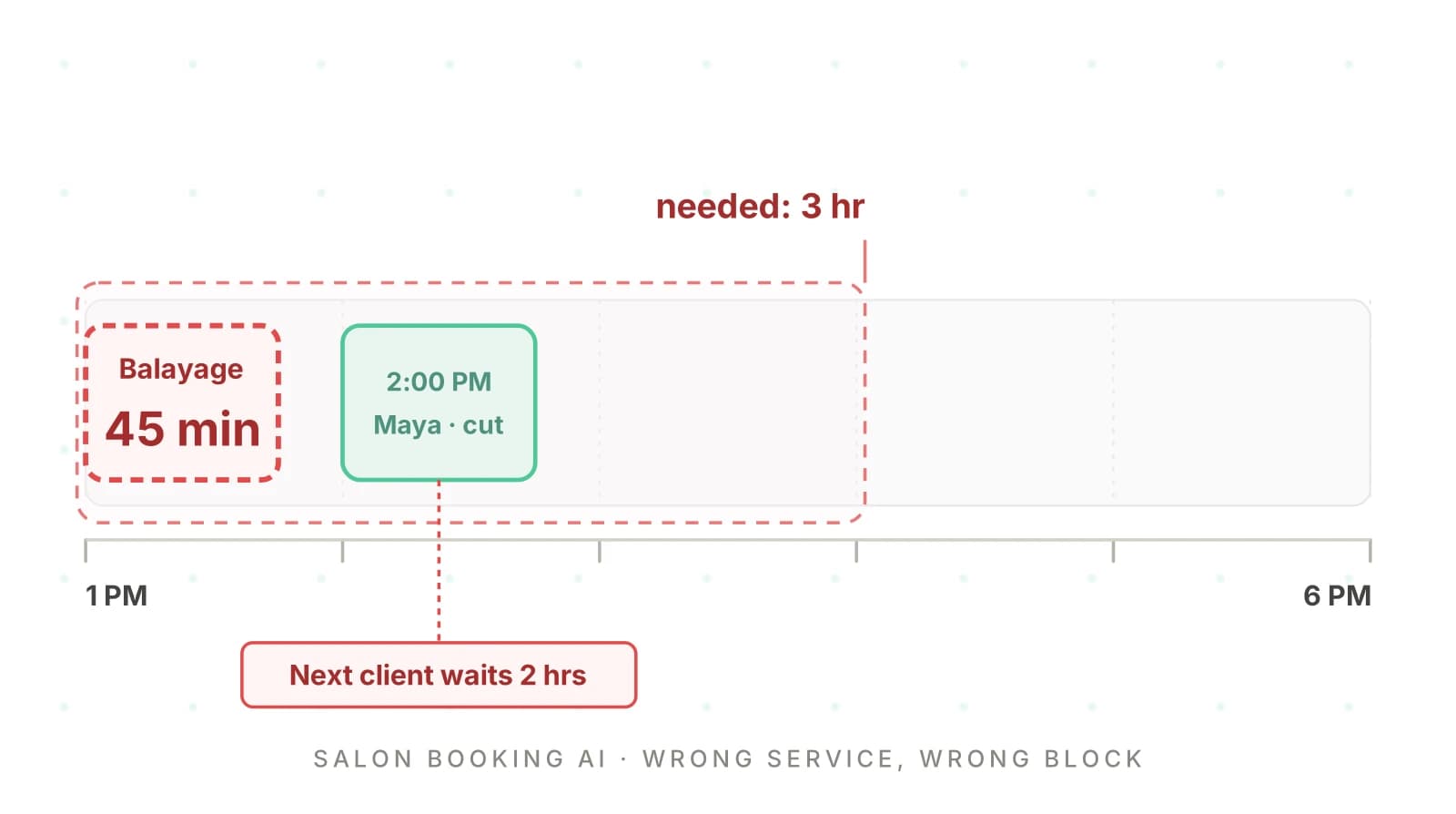
A client calls a salon on a Tuesday morning. "Hi, I'd like to book balayage with Jess. Maybe a gloss too, I'm not sure." The agent is friendly and fast. It offers 1:00 PM Thursday and confirms. The calendar now shows "Balayage Gloss Refresh · 45 min." Jess's next client, Maya, is booked for a 2:00 cut. On Thursday the balayage client sits down at 1:00. Jess needs about three hours for a full balayage. Maya either waits or goes home. The price the agent quoted was for the gloss, not the color. Nobody heard a mistake on the call, because the words were right. The menu code was wrong.
This post is for product teams at salon software companies that run one voice agent across hundreds or thousands of salons. That is a shipped category now. GlossGenius says its Reception product "actually books appointments onto your GlossGenius calendar in real time" and checks "your services, prices, staff schedules, and open slots" (GlossGenius Reception). Boulevard's help center describes an AI Receptionist that handles "booking and managing appointments" and notes it "is currently in beta" (Boulevard help center). Once the agent writes to the book, a near-miss on a service name becomes a broken afternoon. For the full salon QA playbook, start with our AI receptionist for salons pillar. This post goes deep on one failure: the wrong service.
What a salon booking AI call actually writes
A booking call is the front door to a four-step workflow. Each step can fail while the call sounds fine.
1. Capture. The agent hears the service, the stylist, the date and any extras.
2. Act. It resolves the words to a service code, checks rules, and searches open slots.
3. Confirm. It reads back the service, time, price and any deposit.
4. Write back. It creates the appointment in your salon booking software, with duration, stylist and notes.
Service resolution: the step where caller words ("partial balayage, maybe a toner") become one or more menu codes with a duration, price and skill requirement. It is where most salon booking errors start, and a transcript review never sees it.
Here is what one booking record holds and what each field drives.
| Field | Example value | Drives | Cost when wrong |
|---|---|---|---|
| Service code | COLOR-BAL-FULL | Duration, price, skill tag | Wrong block length, wrong quote |
| Add-ons | Toner, bond treatment | Extra minutes, product use | Overrun, missed revenue |
| Duration pattern | 75 / 45 / 60 min | Chair and gap scheduling | Overbooked chair or idle stylist |
| Stylist | Jess, senior colorist | Skill match, price tier | Unqualified stylist, wrong price |
| Prerequisites | Consult, patch test | Whether booking is allowed | Service refused on the day |
| Deposit | Card on file or link | No-show protection | Lost slot on a long service |
| Client match | Existing profile | History, formulas, notes | Duplicate client, lost formula |
The confirm step is the only part a transcript shows. The tool call that created the appointment holds the real answer. Our guide to tool argument accuracy from speech covers that layer in general. Salon menus add their own traps.
Why "balayage" becomes the wrong appointment
There are three separate causes. They stack.
Callers use salon words, not menu codes
Clients don't speak in menu codes. They say what they saw on social media, or what their last stylist called it. Salons name services their own way too. One salon's "Lived-In Color" is another's "Balayage." One lists "Partial Foil," another "Half Head Highlights."
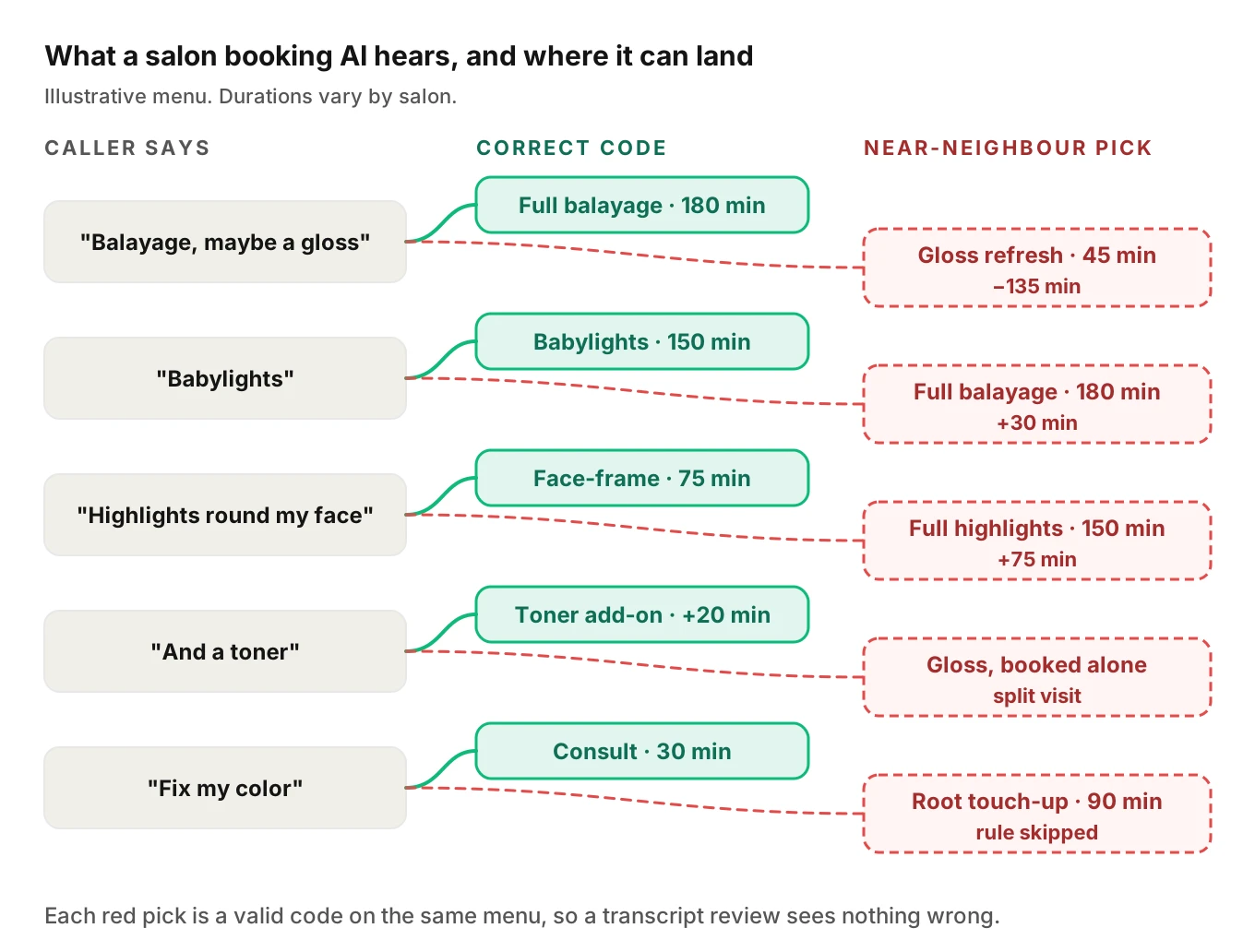
The hard cases are not mishearings. They are near neighbours on the same menu.
| Caller says | Likely intended | Common wrong pick | Why it slips |
|---|---|---|---|
| "Balayage and maybe a gloss" | Full balayage + toner | Balayage gloss refresh | Last-mentioned noun wins |
| "Babylights" | Fine full highlights | Balayage | Both read as "blonde, soft" |
| "Just some highlights around my face" | Face-frame / partial | Full highlights | "Highlights" matches first |
| "Ombré, like last time" | Client's prior formula | New ombré service | History ignored |
| "A toner" or "a gloss" | Add-on to color | Standalone gloss | Add-on booked alone |
| "Partial" vs "full" | Depends on the head | Whichever was said last | Spoken correction lost |
| "Fix my color" | Color correction (consult) | Root touch-up | Skips consult rule |
A wrong pick is worse than a refusal, because the caller has no menu to check against. Our med spa sibling post shows the same pattern with treatment names. Our pool service post shows it with equipment model suffixes.
The audio is harder than it sounds
Phone audio is narrowband. Salon calls add their own noise. A 2021 study measured sound levels of 71–76 dBA inside working hair salons (Environmental Health Insights, 2021). That matters when a client rebooks from the front desk, with dryers and music under every word.
Accent gaps are real too. Koenecke et al. tested five commercial ASR systems. They found an average word error rate of 0.35 for Black speakers and 0.19 for white speakers (Koenecke et al., PNAS 2020). Salon clients are a broad population. Your accuracy number means little if one caller group carries most of the errors. Our guides on background noise testing and accent robustness cover setup.
Beauty vocabulary is rare in training data
"Balayage," "babylights," "Olaplex" and "ombré" are loanwords and brand names. Generic models see them rarely. Research on contextual biasing says this can be improved, with care.
- Biasing lists help. Sun et al. at Meta reported 17.8% relative WER improvement from biasing lists and few-shot examples for named entities (arXiv 2309.00723). Your salon's menu is that list.
- Revision with context helps more. Trinh et al. cut named-entity WER by up to 30% relative with an LLM revision step using phonetic and semantic context (arXiv 2506.10779).
- Lookahead biasing goes further. Selvakumar et al. reported up to 50.34% relative named-entity WER improvement on LibriSpeech (arXiv 2512.17657). Benchmarks are clean read speech, so expect less on phone calls.
The practical tool today is keyterm prompting. Deepgram's keyterm prompting works with Nova-3 and Flux and caps keyterms at "500 tokens per request" (Deepgram docs). The docs suggest focusing on the most important 20–50 terms. They also flag a quiet gotcha. Weight syntax like `term:0.15` or a comma-joined list does not raise an error. The whole value is treated as one literal term, so nothing gets boosted. Build the list per salon, from its live menu. Then test that it actually boosts. Our STT entity accuracy guide explains how to score it.
Better ASR alone won't fix this. "Balayage gloss refresh" was transcribed perfectly in our opening example. The failure was in resolution.
The duration oracle: modelling processing time
A wrong service code is not only a naming error. It is a wrong block on the calendar. Color services are the hard case, because their time is not one solid block.
How booking systems split a color service
Booking software already models this. Square splits a service into three parts. "Initial duration is the time needed to set up before a service (e.g. applying color)." "Processing duration is the time needed to allow the initial step to set." "Final duration is the time needed to complete service (e.g. rinse hair, apply treatment)" (Square support). Square says this lets "clients book during downtimes of existing appointments." Timely describes processing time as a gap "which allows the staff member to see another client" (Timely help).
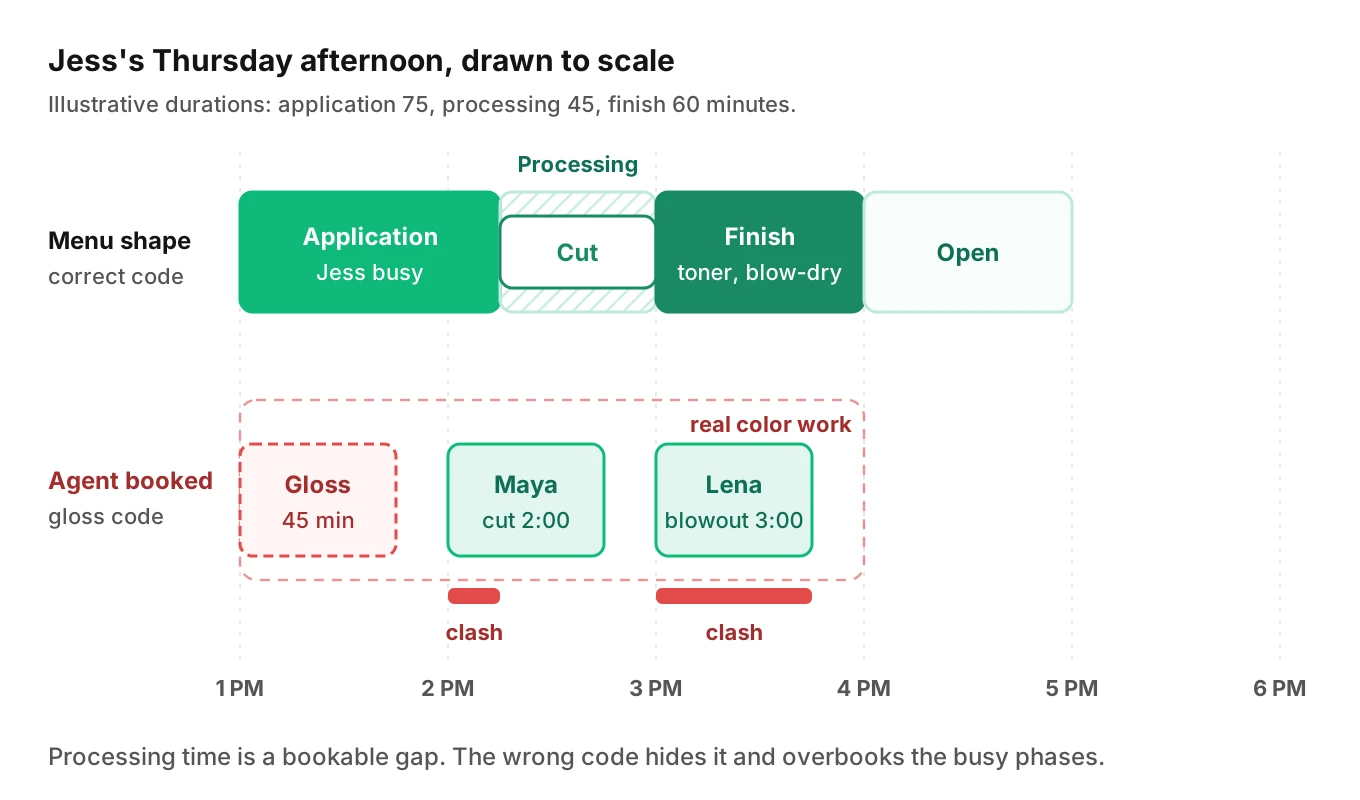
So a booking has a shape, not just a length. A correct agent must write the shape the menu defines. It must also leave gaps open for the stylist to fill.
Worked example: what one wrong code costs
The numbers below are an illustrative menu, not a real salon's.
| Service | Initial | Processing | Final | Total | Stylist busy |
|---|---|---|---|---|---|
| Full balayage | 75 min | 45 min | 60 min | 180 min | 135 min |
| Balayage gloss refresh | 15 min | 20 min | 10 min | 45 min | 25 min |
| Women's cut | 45 min | 0 | 0 | 45 min | 45 min |
The agent books the gloss refresh at 1:00 PM. The system believes Jess is free from 1:45. It books Maya's cut at 2:00.
Here is what really happens. The balayage needs Jess from 1:00 to 2:15 for application. Processing runs 2:15 to 3:00. Jess finishes from 3:00 to 4:00. Maya's 2:00 cut lands in the application phase. The only legal gap is 2:15 to 3:00. That works only if nothing runs over.
The calendar error is 180 − 45 = 135 minutes of under-booked chair time. That error moves every later booking in that chair. It also hides the real gap, so no one can sell it. And the quoted price was for a 45-minute service.
The reverse error costs money quietly. Book a gloss as a full balayage and the stylist sits idle for over two hours. No one complains, so no one notices.
The oracle itself
A duration oracle is a test-side function. Given the caller's true intent, it returns the expected service codes, their order and the shape of the booking. You compare what the agent wrote against it. It is cheap to build, because your platform already holds every salon's menu.
# Simplified sketch: score a booking against a duration oracle.
from dataclasses import dataclass

@dataclass
class Shape:
    code: str
    initial: int      # minutes, stylist busy
    processing: int   # minutes, stylist free
    final: int        # minutes, stylist busy

def oracle(intent, menu):
    """intent: list of true service codes in the order the caller meant."""
    order = sorted(intent, key=lambda c: menu[c]["sequence_rank"])  # e.g. color before cut
    return [Shape(c, **menu[c]["shape"]) for c in order]

def score_booking(booked, expected):
    errors = []
    if [b.code for b in booked] != [e.code for e in expected]:
        errors.append("service_code_or_order")
    for b, e in zip(booked, expected):
        if (b.initial, b.processing, b.final) != (e.initial, e.processing, e.final):
            errors.append(f"shape_mismatch:{b.code}")
    total_delta = sum(e.initial + e.processing + e.final for e in expected) \
                - sum(b.initial + b.processing + b.final for b in booked)
    return {"pass": not errors, "errors": errors, "underbooked_min": total_delta}
Run it on every simulated call. Report under-booked minutes as well as pass rate. A 10-minute toner miss and a 135-minute balayage miss are not the same failure.
Rules the agent must enforce before it books
The right code is necessary but not enough. Many salon services carry rules. The agent must check them before it writes, not after.
Stylist level and skill tags
Salons tier stylists by level and price, and tag who does color, extensions or correction work. "Balayage with anyone on Saturday" must only return stylists tagged for balayage. A junior stylist booked for a color correction is a refund waiting to happen. The same pattern shows up in trades. Our HVAC wrong-tech post covers skill-tag routing for technicians.
Consultation-required services
Some services can't be booked cold. Color corrections, big transformations and extensions often need a consult first. That is a salon's policy, so it must live in the tenant's config, not in the prompt. The test is simple. Ask for a consult-gated service and check that the agent books the consult, not the service.
Patch tests for color
Hair color carries an allergy risk. The FDA tells consumers to "do a patch test on your skin every time before dyeing your hair" (FDA, Hair Dyes). The FDA names p-phenylenediamine (PPD) as an ingredient "implicated more prominently" in allergic reactions. UK industry guidance says to apply the test "48hrs before using the product" and to repeat it "each and every time you colour your hair" (thefactsabout.co.uk). Health Canada describes reading a skin test after 24 hours (Health Canada).
Guidance and product instructions differ, so the agent should not give advice. It should follow the salon's own rule. If the salon requires a patch test 48 hours ahead, the agent must not book color for tomorrow without one on file. This is a safety rule and a policy rule, not medical advice.
Multi-service ordering
"Cut and color" has an order. Most salons color before the cut. A bond treatment goes with the color. A blowout comes last. Booked in the wrong order, the stylist reshuffles on the day. Boulevard's own blog says AI can "optimize the service sequence to account for how long each lasts" (Boulevard blog). Your tests must check that it does.
Deposits for long services
Long color services are where no-shows hurt most. GlossGenius says Reception "follows your deposit, card on file, and cancellation policies" (GlossGenius Reception). Test that the agent asks for the deposit only where the salon's policy says so. Prefer sending a secure payment link by text over reading card digits aloud. Then check recordings for card numbers anyway. Our PII leakage guide shows how.
| Rule | Where it lives | Test case | Pass condition |
|---|---|---|---|
| Skill tag | Staff profile | "Babylights with anyone" | Only tagged stylists offered |
| Stylist level | Price tier | "Balayage with Jess" | Jess's price quoted |
| Consult required | Service config | "Fix my box dye" | Consult booked, not correction |
| Patch test | Service config + client record | New client, color in 24 hrs | Patch test offered first |
| Sequence | Menu sequence rank | "Cut, then color" | Color booked before cut |
| Deposit | Policy | Full balayage | Deposit link sent, no digits spoken |
How to test salon booking AI before every prompt change
Every prompt or menu-mapping change ships to every salon at once. Test it against menus, not just conversations. Here is the process.
1. Export each salon's service menu as a synonym set. For every service, list the code, the shape, the skill tag and the rules. Add the caller phrases that should map to it. Seed them from booking notes and call transcripts. Mark near neighbours explicitly, such as "balayage" vs "balayage gloss refresh."
2. Write intent scenarios, not scripts. Each scenario holds a true intent and a messy way of saying it. Include corrections ("full, sorry, partial"), add-ons said last, and "like last time." Generate them from your agent's flows and the menu. Evalgent generates test scenarios from an agent's prompt and flows, including branches, policies and coverage gaps.
3. Cross scenarios with caller profiles. Vary accent, speech pace, interruptions and background noise. Add salon noise for front-desk rebooks. Use fast talkers, since service lists get said in one breath. Evalgent's caller profiles cover accent, pace, interruption level, response delay, behaviour, noise and language.
4. Call the agent the way clients do. Reach it over the phone network, SIP or WebRTC, not a text harness. Narrowband audio is where "babylights" and "balayage" collide.
5. Score the write-back with the duration oracle. Check service codes, order, shape, stylist and rules. Record under-booked and over-booked minutes per failure.
6. Check the read-back and the quote. The agent should say the service name and price from the resolved code. A read-back of the caller's own words proves nothing.
7. Gate the release per salon. Block the change if any salon's service-resolution accuracy drops. Averages across tenants hide one salon's broken menu. Our multi-tenant testing guide and prompt change guide cover the rollout.
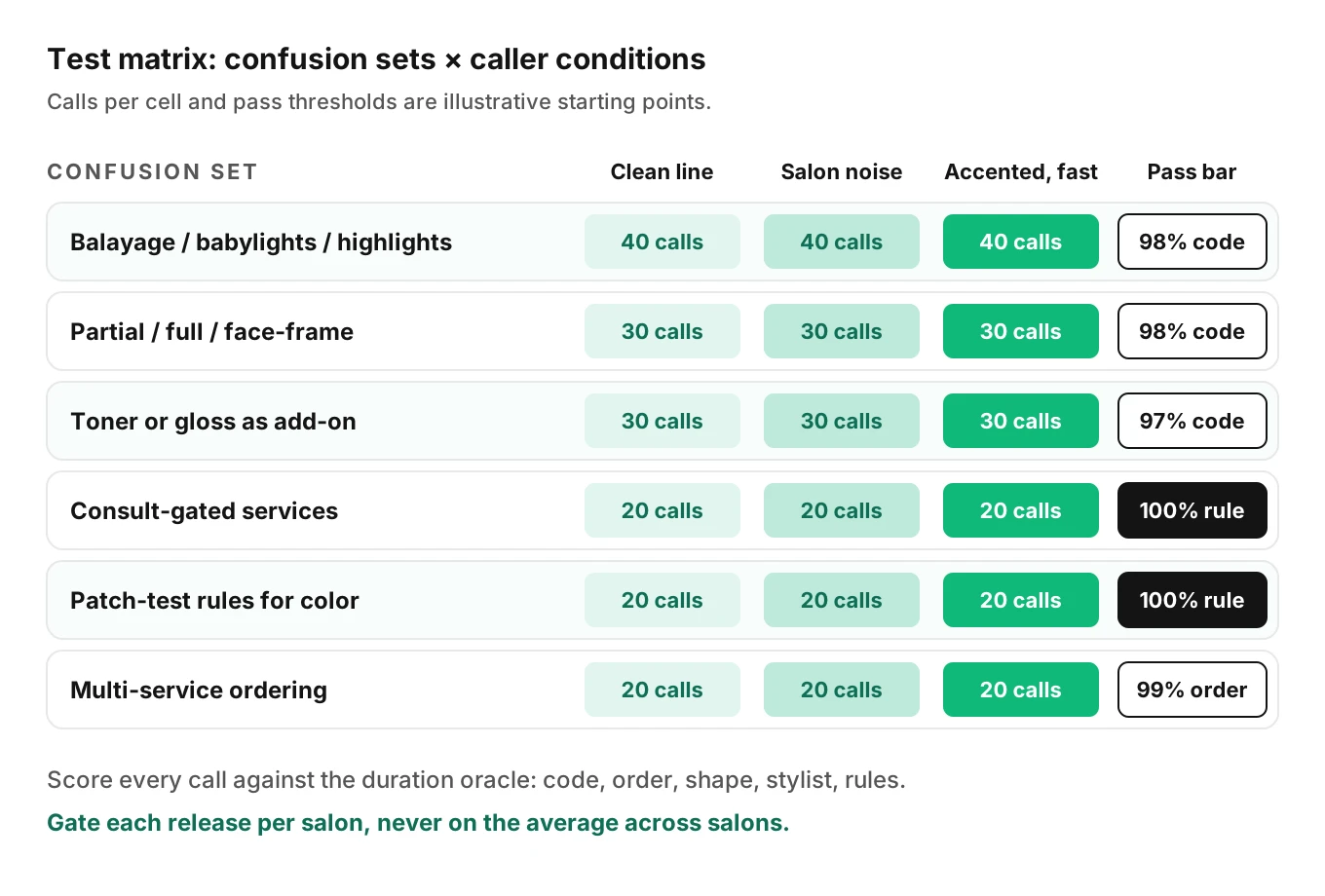
Here is a sample matrix with illustrative thresholds. Set yours from your own risk tolerance.
| Confusion set | Clean line | Salon noise | Accented, fast | Pass threshold |
|---|---|---|---|---|
| Balayage / babylights / highlights | 40 calls | 40 calls | 40 calls | 98% code accuracy |
| Partial / full / face-frame | 30 | 30 | 30 | 98% |
| Toner / gloss as add-on | 30 | 30 | 30 | 97% |
| Consult-gated services | 20 | 20 | 20 | 100% rule compliance |
| Patch-test rules for color | 20 | 20 | 20 | 100% rule compliance |
| Multi-service ordering | 20 | 20 | 20 | 99% sequence accuracy |
Rule cases get 100% thresholds for a reason. A consult skipped once is a real client harmed once. Our appointment scheduling testing guide covers dates and slot conflicts, which sit underneath all of this.
Monitoring booked vs checked-out service
Pre-release tests catch known confusions. Production shows the ones you missed. Salons give you a free ground truth: the checkout ticket.
At checkout, the stylist rings up what was actually done. Compare it with what the agent booked. Define the metrics clearly.
- Service mismatch rate = AI-booked appointments where the checked-out service code differs from the booked code ÷ AI-booked appointments that reached checkout.
- Duration error = actual chair minutes − booked minutes, per appointment. Track the distribution, not the mean.
- Rule miss rate = AI bookings later flagged for a missing consult, patch test or skill tag ÷ AI bookings with that rule.
Some mismatch is normal. Clients change their minds in the chair. So stratify. Compare AI-booked appointments against those booked online or by staff. If AI bookings mismatch at twice the staff rate, the gap is the agent.
Sample size matters. To estimate a 5% mismatch rate within ±2 points at 95% confidence, use n = 1.96² × p(1 − p) ÷ E². That is 3.8416 × 0.0475 ÷ 0.0004 ≈ 456 checked-out appointments per salon segment. Pool small salons by menu type, not across your whole base.
Then close the loop. Pull the recording for every mismatch and label the cause: mishearing, wrong resolution, rule miss or client change. Each cause has a different fix. Evalgent's production monitoring works this way. Teams push call recordings, and Evalgent transcribes them, maps them to scenarios and judges them from the audio. It flags tool-call failures, policy failures and PII leakage, with fix recommendations. Our scheduling metrics guide lists the wider metric set.
Frequently asked questions
Can AI book hair color appointments?
AI can book hair color appointments when it resolves the request to the right menu code, duration shape and stylist. GlossGenius says its Reception books onto the salon calendar in real time. The risk is near-neighbour services like balayage versus a gloss refresh. Test with each salon's menu and compare booked services with what was checked out.
Why does salon booking AI book the wrong service?
Salon booking AI books the wrong service because caller words rarely match menu names. "Balayage and maybe a gloss" can resolve to a 45-minute gloss refresh. Corrections said mid-sentence, add-ons said last and salon-specific names cause most errors. Rare beauty vocabulary and noisy phone audio add mishearings on top.
How do you test a salon booking AI?
Test a salon booking AI with intent scenarios built from each salon's menu, crossed with caller profiles for accent, pace and salon noise. Call it over the phone, not a text harness. Score the written booking against a duration oracle for codes, order, shape and stylist. Gate every release per salon, not on an average.
How should an AI handle processing time in salon bookings?
An AI should write the processing-time shape the menu defines: initial, processing and final durations. Square and Timely both model processing time as a gap the stylist can fill. The agent must leave that gap bookable and never double-book the active phases. Check the shape, not only the total length.
Should an AI receptionist book a patch test before hair color?
An AI receptionist should follow the salon's own patch test rule, not give advice. The FDA says to patch test before every dye use. UK industry guidance says 48 hours before colouring. If the salon requires a test on file, the agent must check the client record before booking color.
Can AI match clients to the right stylist level?
AI can match clients to the right stylist level when staff profiles carry skill tags and price tiers. The agent should only offer stylists tagged for the requested service. Test requests like "balayage with anyone Saturday" and confirm no untagged stylist is offered. Check that the quoted price matches the chosen stylist's tier.
Should salon booking AI take deposits?
Salon booking AI should take deposits only where the salon's policy requires them, often for long color services. GlossGenius says Reception follows the salon's deposit and card-on-file policies. Prefer sending a secure payment link by text. Then scan recordings to confirm no card digits were spoken or stored.
How do you measure salon booking accuracy?
Measure salon booking accuracy by comparing AI-booked service codes with checked-out service codes. Track service mismatch rate, duration error and rule miss rate. Compare AI bookings against staff bookings to separate agent errors from client changes. About 456 appointments per segment estimate a 5% rate within two points.
The bottom line
Salon booking AI fails when it books the right words as the wrong service. Test service resolution, duration shape and booking rules per salon, then check every AI booking against what was rung up at checkout.
Related Articles

How to automate voice agent testing: synthetic callers vs manual QA
Learn how ai test automation replaces manual QA for voice agents. Compare synthetic callers vs human testers, with a 5-step framework to scale without hiring.
Read more
AI Agent Testing vs Voice Agent Testing: What General Tools Miss for Voice
AI agent testing measures text outputs. Voice agent testing measures behaviour through an acoustic pipeline. Five failure categories general tools miss.
Read more