Test your voice agent
Metrics for an appointment scheduling voice agent
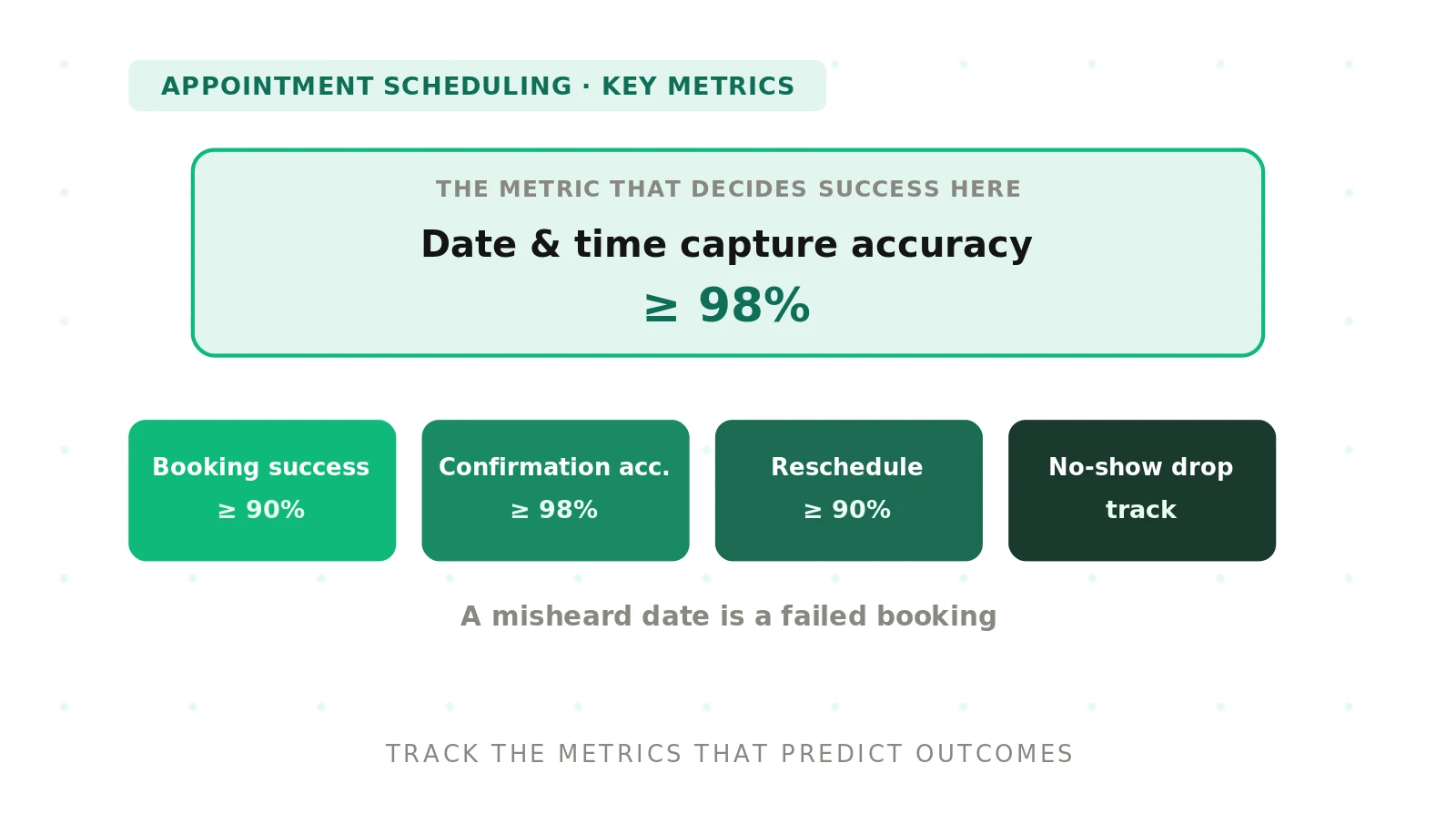
A scheduling agent has one job that a caller actually cares about. It has to turn "next Tuesday afternoon" into an exact calendar entry. Every other quality — warm tone, fast responses, natural phrasing — is secondary to getting that slot right. So the metrics that matter here are not generic call-quality scores. They measure booking correctness, and they punish a single misheard digit harder than any other voice use case.
Appointment scheduling voice agent metrics: the key performance indicators that measure whether a booking voice agent captures the right date, time, and action, writes it to the calendar correctly, confirms it, and reduces downstream no-shows.
This is a metrics post. It defines each KPI, gives adaptable targets, and works a full example. It does not cover how to build the test suite behind these numbers — for that, see the appointment scheduling testing guide. For the general metric framework across all voice use cases, start with the voice agent metrics scorecard.
Why entity accuracy is the make-or-break metric
Most voice metrics tolerate small errors. A support agent that phrases an answer awkwardly still resolves the issue. A scheduling agent does not have that slack. The output is a structured record: a date, a time, a provider, an action. One wrong field breaks the whole booking.
That structured output is why entity accuracy dominates here. A caller says "the fifteenth," the agent hears "the fiftieth," and the booking is wrong or fails. A caller says "2 p.m.," the agent writes "2 a.m.," and the appointment is useless. These are number and date entities, and they are exactly the tokens that speech recognition gets wrong most often. A low overall word error rate can still hide a high error rate on digits. Our word error rate guide explains why dates carry outsized risk.
The distinction that matters is intent versus entity. Getting the intent right — "the caller wants to book" — is the easy half. Getting the entities right — which date, which time, which provider — is where scheduling agents fail. Our intent versus entity guide draws that line clearly. For a scheduling agent, entity accuracy is not one metric among many. It is the metric the others depend on.
The core metrics that matter
Six metrics carry most of the signal for a scheduling agent. Each one isolates a different way a booking can go wrong. Track them per scenario type, not just as one blended average, so you can see where errors cluster.
Booking success rate
Booking success rate: the share of calls where the caller's requested action — book, reschedule, or cancel — was completed correctly, end to end. This is the headline key performance indicator for a scheduling agent.
A call counts as a success only when the final calendar state matches what the caller asked for. A pleasant call that booked the wrong day is a failure. Measure it against caller intent, not against whether the agent claimed success. Segment it by action, because booking, rescheduling, and canceling fail at different rates.
Date-and-time capture accuracy
This is the entity metric, and it is the one to watch first. It measures whether the agent resolved the spoken date and time to the exact value the caller meant. A misheard date is a failed booking, so this metric sits upstream of booking success. If capture accuracy drops, booking success drops with it.
Measure it as a standalone number. Drive the full range of expressions — relative ("next Friday"), partial ("the 15th"), colloquial ("end of the month"), and cross-timezone — and assert each resolves to the correct absolute value. Timezone errors are their own failure class, so track them separately.
Slot and calendar accuracy
Capturing the right date is not the same as writing it correctly. Slot accuracy measures whether the calendar action actually landed the right entry: the correct slot created, the correct existing appointment moved, the correct one removed. It also covers conflict handling — no double-bookings.
Measure it at the tool level, not from the transcript. A silent tool-call failure says "you're all set" but saves nothing. It is invisible in the conversation, and only argument-level checks catch it.
Reschedule and cancellation handling
Booking is the clean path. Reschedules and cancellations are where calendar state corrupts. Rescheduling requires finding the right existing appointment and writing a correct new one — two chances to fail. Cancellation requires removing the right entry without touching others.
Measure these as their own success rates, separate from new bookings. An agent can book cleanly and still duplicate appointments on every reschedule. Report the two paths distinctly so a weak one is not hidden by a strong booking number.
Confirmation accuracy
Confirmation accuracy: whether the agent's spoken read-back of the date, time, and action matches what it actually wrote to the calendar. This is the last line of defense before a mis-parse becomes a missed appointment.
A correct confirmation lets the caller catch an error the agent made. Measure whether the read-back happened, and whether it matched the committed action. Reading times back cleanly matters too — "10:15" spoken as "ten fifteen," not "ten point one five."
No-show reduction
No-show reduction is the business outcome that justifies the agent. It measures the change in missed-appointment rate after the agent handles reminders, confirmations, and easy rescheduling. Unlike the correctness metrics above, this one is measured in production over weeks, not in a test batch.
Attribute it carefully. Compare cohorts handled by the agent against a baseline, and hold seasonality constant. A reminder that points at the wrong appointment can raise no-shows, so this metric depends on confirmation accuracy holding up.
A worked example: a clinic booking line
Consider a scheduling agent for a multi-provider clinic. It books, reschedules, and cancels across several calendars, and it makes reminder calls the day before. Here is how the metrics read on a representative 1,000-call evaluation batch, and what each number tells you.
Date-and-time capture accuracy comes back at 94%. That sounds high until you trace it downstream. Of the 6% mis-captured, most were relative dates ("a week from Thursday") and cross-timezone requests. Every one of those became a wrong or failed booking. So booking success rate lands at 91% — capped by capture accuracy, plus a few tool-call failures on top.
Slot accuracy is 96% on new bookings but only 88% on reschedules, where the agent occasionally duplicated the appointment instead of moving it. Confirmation accuracy is 97%, and the read-back caught several mis-parses before they committed — without it, booking success would have been lower. In production, the reminder calls cut the clinic's no-show rate from 18% to 11% over the first month.
The lesson: the single number to fix first is reschedule slot accuracy at 88%. It is the lowest correctness gate, it strands real callers, and it drags the blended booking number down. The 94% capture accuracy is the next lever, because it caps everything above it.
Targets you can adapt
Targets depend on stakes. A dental cleaning that is easy to rebook tolerates more error than a booking tied to a specialist's limited availability. Treat the ranges below as starting points, then tighten them for high-stakes bookings. These pair with a broader production readiness bar before you go live.
| Metric | What it measures | Starting target | Tighten when |
|---|---|---|---|
| Date-and-time capture accuracy | Spoken date/time resolved to exact value | ≥ 97% | Hard-to-rebook or specialist slots |
| Booking success rate | Requested action completed correctly | ≥ 93% | High cost per missed appointment |
| Slot and calendar accuracy | Correct entry written, no double-booking | ≥ 98% | Shared or tightly booked calendars |
| Reschedule / cancellation handling | Right entry changed, no duplicates | ≥ 95% | Frequent changes in your call mix |
| Confirmation accuracy | Read-back matches committed action | ≥ 98% | Any irreversible or costly booking |
| No-show reduction | Drop in missed-appointment rate | ≥ 30% relative | Reminders are the agent's main value |
Two notes on reading these. First, capture accuracy and confirmation accuracy are set higher than booking success on purpose — they are the upstream and downstream guards, so they must be stricter than the number they protect. Second, no-show reduction is a relative target against your own baseline, not an absolute rate, because starting no-show rates vary widely by clinic type.
How to build a scheduling metrics scorecard
Turning these definitions into a working scorecard takes a repeatable process. Follow these steps.
1. List the actions your agent owns. Book, reschedule, cancel, confirm, remind. Only measure paths the agent actually handles. A metric for a path it never runs is noise.
2. Pick the metric per action. Map each action to its correctness metric from the section above. Reschedules and cancellations get their own success rates, separate from new bookings.
3. Isolate date-and-time capture as a standalone metric. Because it caps everything above it, measure it on its own before booking success. This tells you whether errors come from hearing or from writing.
4. Set targets by stakes, not by vanity. Use the table above as a floor. Raise capture and confirmation targets above booking success, since they guard it on both sides.
5. Assert at the tool level, not the transcript. Every booking metric must check the actual calendar payload. Trusting the agent's "you're all set" hides silent tool-call failures.
6. Segment by scenario type. Report per action and per date-expression class — relative, partial, cross-timezone. A blended average buries the cohort that is failing.
7. Add the production outcome. Track no-show reduction against a baseline over weeks. It is the metric that proves the agent earned its place, and it connects the test suite to a business result.
Correctness gates, not gradual scores
One framing matters for every metric here. Scheduling metrics are gates, not gradual dials. An agent that is right 95% of the time still strands one caller in twenty with a wrong or missing appointment. Those callers do not experience an average. They experience a missed appointment.
So treat these as pass/fail thresholds you gate releases on. This matches a structured risk approach like the NIST AI Risk Management Framework. Do not average booking accuracy against tone or latency into one happy score. An agent can be fast, warm, and within the latency budgets that keep speech natural. It still fails the only test that matters if it books the wrong day.
How these fit alongside experience metrics
Correctness is the floor, not the whole picture. Once bookings are reliably right, experience metrics tell you whether callers will keep using the line. Customer satisfaction captures how the call felt, and a scheduling analog of first-call resolution — booking completed without a callback or human handoff — captures efficiency.
Keep the order straight. Experience metrics only count once correctness is solid. A delightful call that booked the wrong slot is not a partial win. When you evaluate vendors on these numbers, our vendor evaluation guide shows how to compare them on your own call data rather than a demo.
Measuring appointment scheduling voice agent metrics with Evalgent
Evalgent is an independent platform for testing and evaluating voice agents, and it measures the metrics above on realistic calls rather than clean demos. Because Evalgent is independent of the vendors that build agents, the numbers reflect how the agent behaves under real caller variation, not a staged best case.
The platform works through five primitives. Scenarios cover relative and ambiguous dates, reschedules, cancellations, cross-timezone bookings, and taken slots. Profiles vary how callers speak dates and numbers, plus accent and background noise, since a misheard "fifteenth" becomes a wrong booking. Metrics assert booking success, date-and-time capture, slot accuracy, and confirmation match against the targets you set. Evaluations run the whole suite as automated batches before every release. Reviews let you replay a mis-booked call and inspect the exact calendar payload the agent sent.
To see these metrics measured on your own booking flow, book a demo.
The bottom line
For a scheduling agent, entity accuracy is the metric everything else rides on. Track booking success, date-and-time capture, slot accuracy, reschedule handling, confirmation, and no-show reduction as correctness gates — and set the upstream guards stricter than the number they protect.
Frequently asked questions
What metrics matter for an appointment scheduling voice agent?
The core metrics are booking success rate, date-and-time capture accuracy, slot and calendar accuracy, reschedule and cancellation handling, confirmation accuracy, and no-show reduction. Date-and-time capture accuracy matters most, because a misheard date becomes a failed booking. Track each metric per action and per date-expression type, and treat them as pass/fail gates rather than a single blended score.
What is a good booking success rate for a voice agent?
A reasonable starting target is at least 93% of calls completing the requested action correctly, measured against caller intent rather than the agent's own claim of success. Tighten it toward 97% or higher when a missed appointment is costly or hard to rebook. Booking success is capped by date-and-time capture accuracy, so raise capture targets first.
How do you measure date and time accuracy in a voice agent?
Drive the full range of expressions — relative, partial, colloquial, and cross-timezone — and assert each resolves to the correct absolute date and time. Measure it as a standalone metric, upstream of booking success, since it caps everything above it. Track timezone errors separately, because they book the right clock time in the wrong zone and look correct in the transcript.
How do you measure no-show reduction from a voice agent?
Compare the missed-appointment rate for cohorts the agent handled against a baseline period, holding seasonality constant. Express it as a relative drop, such as no-shows falling from 18% to 11%. Measure it in production over weeks, not in a test batch. It depends on confirmation accuracy, since a reminder pointing at the wrong appointment can raise no-shows instead.
What is slot accuracy for a scheduling voice agent?
Slot accuracy measures whether the calendar action wrote the correct entry: the right slot created, the right existing appointment moved, the right one removed, with no double-booking. Measure it at the tool level using the actual calendar payload, not from the transcript. A silent tool-call failure, where the agent says "you're booked" but nothing saved, only shows up in argument-level checks.
How do you measure confirmation accuracy?
Confirmation accuracy checks whether the agent's spoken read-back of the date, time, and action matches what it actually committed to the calendar. Measure both that a read-back occurred and that it matched the written record. Set the target high, at 98% or above, because confirmation is the last chance to catch a mis-parse before it becomes a missed appointment for the caller.
What KPIs should a booking voice agent hit?
A booking agent should hit high date-and-time capture accuracy, around 97% or more, a booking success rate near 93% or higher, slot accuracy near 98%, strong reschedule and cancellation handling, and confirmation accuracy at 98% or above. In production, aim for a meaningful relative drop in no-shows. Set the upstream and downstream guards stricter than booking success itself.
How do you set targets for a scheduling voice agent?
Set targets by stakes. Easy-to-rebook appointments tolerate more error than specialist slots or irreversible bookings. Start from published ranges, then raise capture and confirmation targets above booking success, since they guard it on both sides. Treat every metric as a correctness gate you release against, and segment targets by action so a weak reschedule path is not hidden.
Related Articles
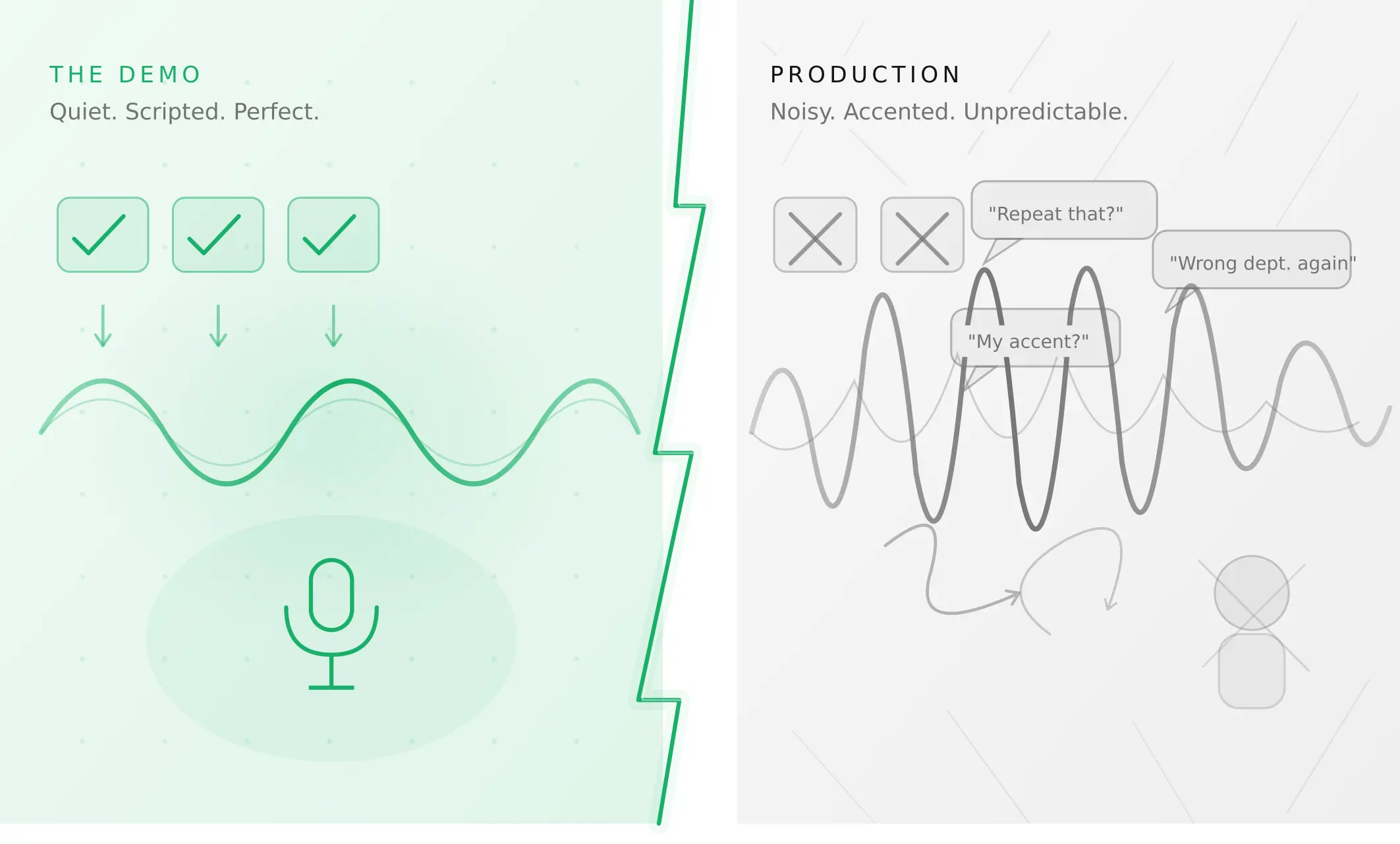
Why AI voice agents fail in production (and how to prevent it)
AI voice agents that ace demos still break in production. Learn the 5 root causes, how to test for each, and what production readiness actually means.
Read more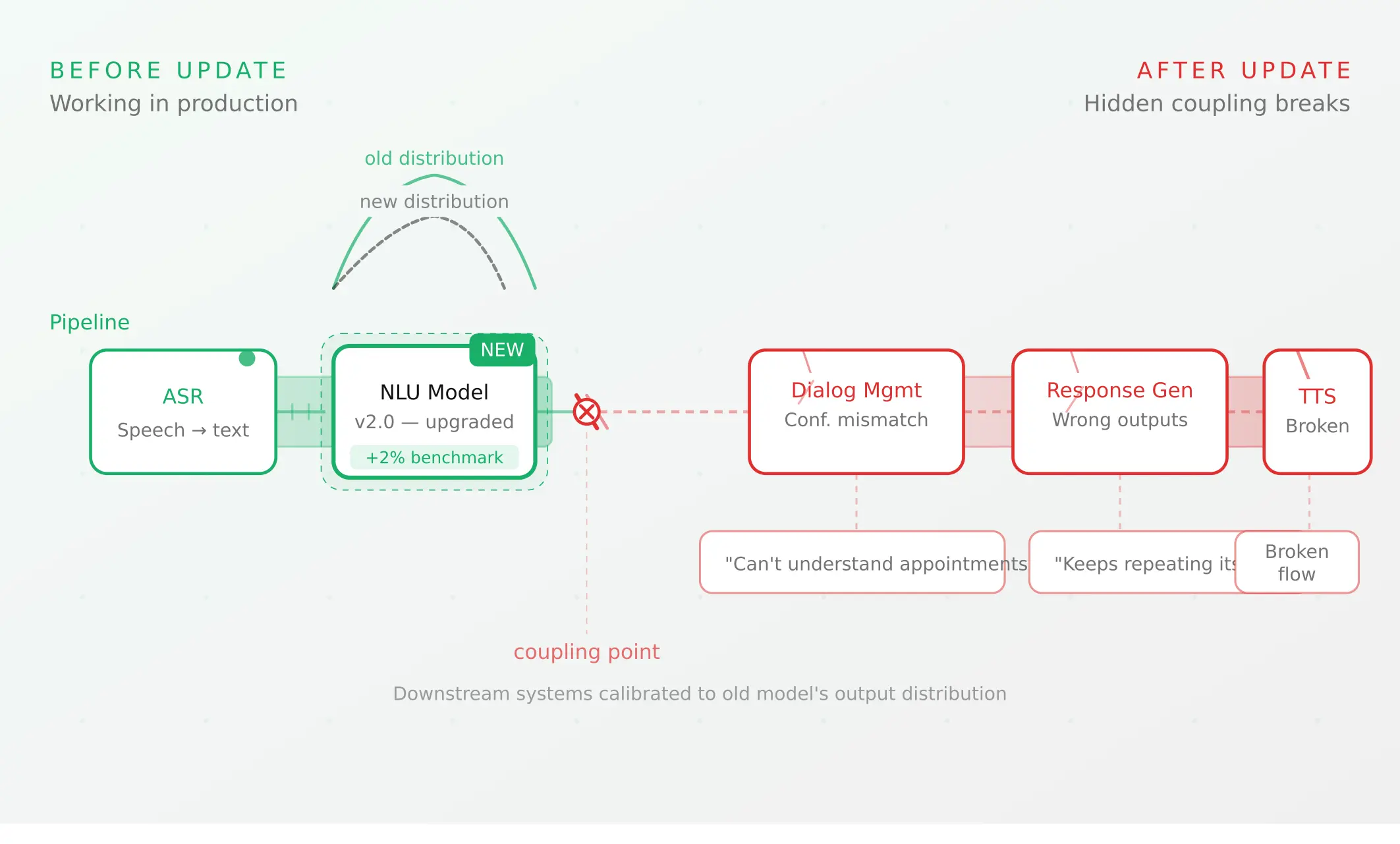
Voice agent regression testing: why LLM updates break production
LLM updates improve benchmarks but break voice agents in 5 predictable ways. How to detect and prevent regressions after every model or prompt change.
Read more