Dental AI Receptionist: 6 Scheduling Errors to Catch
On this page
Last verified October 19, 2026, against the Open Dental appointments API documentation, the ADA emergency definitions, the IADT avulsion guideline and the CMS adopted-standards list. Software details change, so re-check them against your own practice management system. This is not legal or medical advice.
A dental AI receptionist rarely fails by saying something strange. It fails by booking something plausible. These AI dental receptionist errors rarely show up in transcripts. The voice sounds fine. The confirmation text goes out. Then a patient arrives for a 60-minute visit and finds a 20-minute hole in the day.
This post is for the team that built a dental voice agent inside a larger product, or runs one across many practices. Every prompt change reaches live callers, and testing is mostly by hand. Dental AI receptionist scheduling breaks in six ways. We cover the mechanism behind each and a test matrix you can copy. For the wider healthcare QA process, start with our healthcare AI receptionist QA guide.
Why dental scheduling breaks differently from other booking
A salon books a service. A restaurant books a table. An AI receptionist for dentists books a clinical event with five hidden constraints. The visit needs a procedure, a length, a provider, a room and often an insurance check.
The caller says "I need a cleaning." Your agent must turn that into an appointment type, a duration, a provider and an operatory. Each step can go wrong without any error message.
Three facts about the write-back make this worse.
1. The system accepts almost anything. Open Dental's documentation says only three fields are required to create an appointment through its API: the patient, the operatory and the date and time. Everything else has a default.
2. Defaults are silent. If you send no pattern and no appointment type, the appointment is 20 minutes. The API returns 201 Created either way.
3. Success is not correctness. The API documentation lists no rule for checking whether the time fits the procedure. That check belongs to your agent.
So the transcript can look perfect while the record is wrong. Dental appointment scheduling AI should be graded on the saved record. Our post on voice agent testing for appointment scheduling makes the same point.
Open Dental is one example of practice management software, used here because its docs are public. Check your own system's defaults.
Error 1: the procedure heard as the wrong appointment length
"Cleaning" is not one appointment. It can mean a preventive prophylaxis, a periodontal treatment or a recall visit that bundles an exam and X-rays. They take different chair time and bill under different codes.
The ADA's CDT code set separates them. Aetna's dental clinical policy bulletin shows the split. It describes scaling and root planing (D4341, four or more teeth per quadrant) as "therapeutic, not prophylactic, in nature". It calls this "distinctly different from a dental prophylaxis (CDT code D1110)". The same bulletin notes a usual maximum of two quadrants per appointment.
Take a caller who says, "I need a deep cleaning on the left side." An agent keyed on "cleaning" may book the standard hygiene slot. The patient needs a perio visit. The hygienist runs late all afternoon.
The mechanism
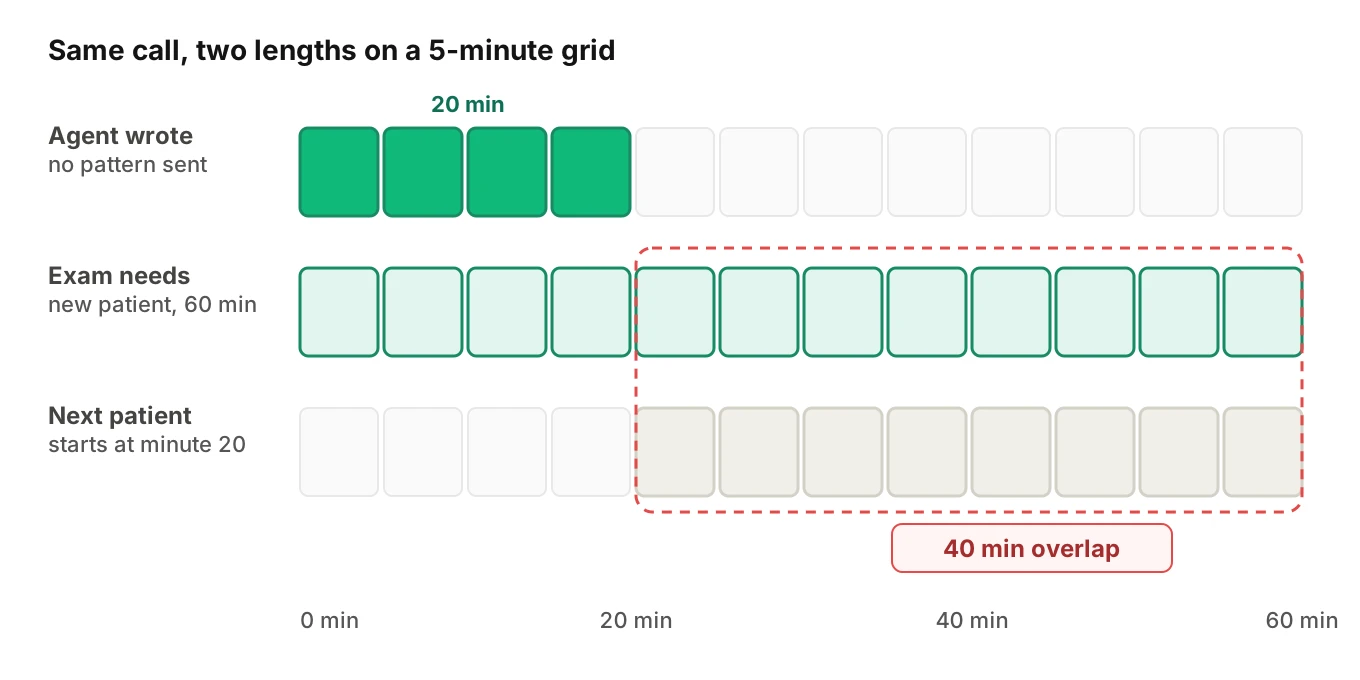
Open Dental stores length as a pattern: a string of `X` and `/` characters, each one a 5-minute cell. The default is `/XX/`, which is four cells or 20 minutes. If your agent sends no pattern, a 60-minute exam silently becomes a 20-minute block.
A worked example, labelled illustrative:
| Item | Cells | Minutes |
|---|---|---|
| Default pattern `/XX/` | 4 | 20 |
| New patient exam, assumed | 12 | 60 |
| Silent shortfall | 8 | 40 |
If three such bookings land in one day, two hours of the schedule are wrong.
What to test
- Say "cleaning," "deep cleaning," "checkup," "my teeth feel rough" and "the gum treatment my hygienist mentioned." Record the appointment type and pattern sent each time.
- Ask for slots by the full appointment length. Open Dental's slot search takes a `lengthMinutes` argument that ignores shorter gaps. Confirm the agent passes the real length, not a constant.
Error 2: a new patient treated as existing, or the reverse
New patients need longer visits, more forms and often a different provider. Existing patients need none of that. A wrong flag changes the schedule and the paperwork. Mixing up a new patient exam and a hygiene appointment is the classic case.
Open Dental has an `IsNewPatient` field on appointments. It defaults to false. According to the docs, if you set it true and the patient has no completed procedures, the patient's first-visit date is set to the appointment date. If your agent never sets it, every new patient looks like a returning one.
The harder problem is identity. The caller says, "I came in a few years ago." Is that a new patient or an inactive one? The patient status values in the API include `Patient`, `NonPatient`, `Inactive`, `Archived`, `Deceased` and `Prospective`. A caller who left in 2021 might be any of them in your records.
Two failure shapes show up. A duplicate chart appears when the agent fails to match and creates a new record. A wrong match books against a similar name. That is a privacy problem, not only a scheduling one.
Open Dental's own patient API advice is to search by last name, first name and birthdate together to ensure uniqueness. An agent that searches by phone number alone will find families, not people. See the family section below.
What to test
- Callers with the same last name and phone number but different first names.
- A spelled surname with a heavy accent or noise on the line. STT often errs on names. Our post on voice agent accent robustness covers how to build those test calls.
Error 3: insurance captured for the wrong person, or not at all
The caller says "I have Delta." That is not a plan. A dental office needs the carrier, the subscriber's name and birthdate, the member ID, the group number and the patient's relationship to the subscriber.
Insurance eligibility hinges on not mixing up patient and subscriber. A child is often covered under a parent's plan. If the agent stores the child's name and birthdate against the member ID, the eligibility check fails or returns the wrong person.
HIPAA adopted the ASC X12N 270/271 version 5010 transaction for eligibility and benefit verification. CMS lists it among its adopted standards. A 270 request needs identifying data in exact form, so a wrong digit in a member ID will usually fail the lookup.
Speech makes this worse. Member IDs mix letters and digits. A caller reads "B as in boy" over a mobile line, and one wrong character breaks the lookup.
The scoping decision
Decide what your agent does with the data. There are three levels.
| Level | Agent behaviour | Risk |
|---|---|---|
| Capture only | Reads back carrier, subscriber and ID, saves them for staff | Low |
| Verify | Runs the eligibility check, reports status to staff | Medium |
| Quote benefits | Tells the caller what is covered | High |
We suggest capture only for most teams. Telling a caller their cleaning is "covered" is a promise the plan may not honour. The Aetna bulletin says each plan defines what it covers and which services have caps or limits. An agent cannot know that from a spoken member ID.
What to test
- Read the member ID back. Do the agent's digits match the caller's, character by character?
- "It's under my husband." Does the subscriber differ from the patient?
- A caller who asks, "Will this be covered?" The agent should decline and hand off.
Error 4: wrong provider, or no hygienist
Dental visits often involve two people: a hygienist who does the cleaning and a dentist who does the exam. Open Dental carries both on an appointment: `ProvNum` for the main provider and `ProvHyg` for the hygienist. `ProvNum` defaults to the patient's primary provider. `ProvHyg` defaults to zero, meaning none.
Open Dental's slot search takes a `ProvNum` and an operatory, and the docs say most users specify both. A hygiene visit that needs a dentist exam partway through has a different shape than a single-provider slot.
What goes wrong:
- The caller says "I see Dr. Patel." The agent books Dr. Patel for a cleaning, but Dr. Patel does not do hygiene.
- The caller says "anyone is fine." The agent picks the provider with the most open time, who does not treat children.
The fix is a rule table the agent cannot override: which appointment types need which provider roles, and which providers take which patients. The table differs per practice. Our post on multi-tenant voice agent testing covers testing one prompt across many customers.
What to test
- A named dentist for a hygiene-only visit.
- "Whoever is available" for a procedure only one provider performs.
- A child patient and a dentist who does not see children.
Error 5: an emergency booked as routine
This error can cause real harm. A caller says "my son knocked his front tooth out." The agent offers next Thursday at 2 PM. Time matters for this injury.
The International Association of Dental Traumatology's 2020 guideline on avulsed permanent teeth says that "immediate replantation of the avulsed tooth is the best treatment at the place of the accident." It says ligament cells are likely non-viable once extra-oral dry time passes 60 minutes. Patients should see a dentist immediately. Next Thursday is the wrong answer.
The ADA separates emergency from urgent dental care. As reproduced by the Colorado Dental Association, ADA guidance describes dental emergencies as "potentially life threatening" and gives examples such as uncontrolled bleeding, and cellulitis or swelling "that potentially compromise the patient's airway". Urgent care covers severe pain from pulpal inflammation, abscess with localized swelling, a fractured tooth causing pain and dental trauma with avulsion or luxation.
Swelling can be an urgent abscess or an airway emergency. A voice agent cannot judge which, so the design must be conservative.
A routing design
Your agent should not diagnose. It should recognize trigger phrases and route by a script your dentists approve. This structure is a starting point, not clinical guidance.
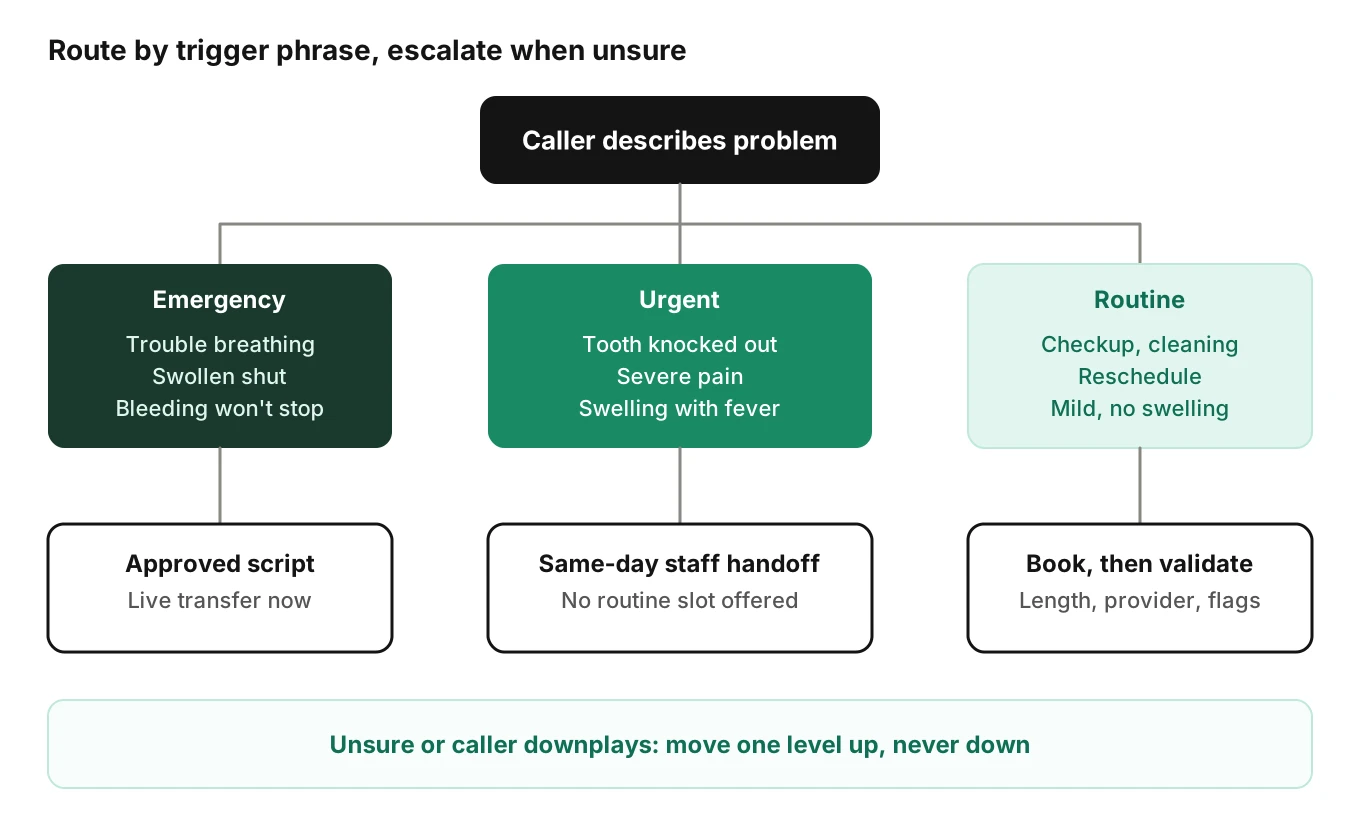
Three rules make this testable:
1. Trigger phrases go to a human fast. "Can't breathe," "swollen shut," "won't stop bleeding," "knocked out." Test the time from phrase to transfer.
2. When unsure, escalate. A false alarm costs a minute of staff time. A missed emergency costs far more.
3. Never reassure. "That's probably fine" is a clinical judgement. The agent should not make it.
For after-hours handling and the line between nurse and 911, see our post on after-hours triage AI. Your dentists and counsel own the final script. This is not medical advice.
What to test
- Pain described mildly ("it's a bit sore") and severely ("worst pain of my life") in the same call.
- A trigger phrase said mid-sentence, over background noise, or with an interruption.
- A caller who downplays: "It's probably nothing, but my cheek is swollen and I feel hot."
Error 6: a family call collapsed into one patient
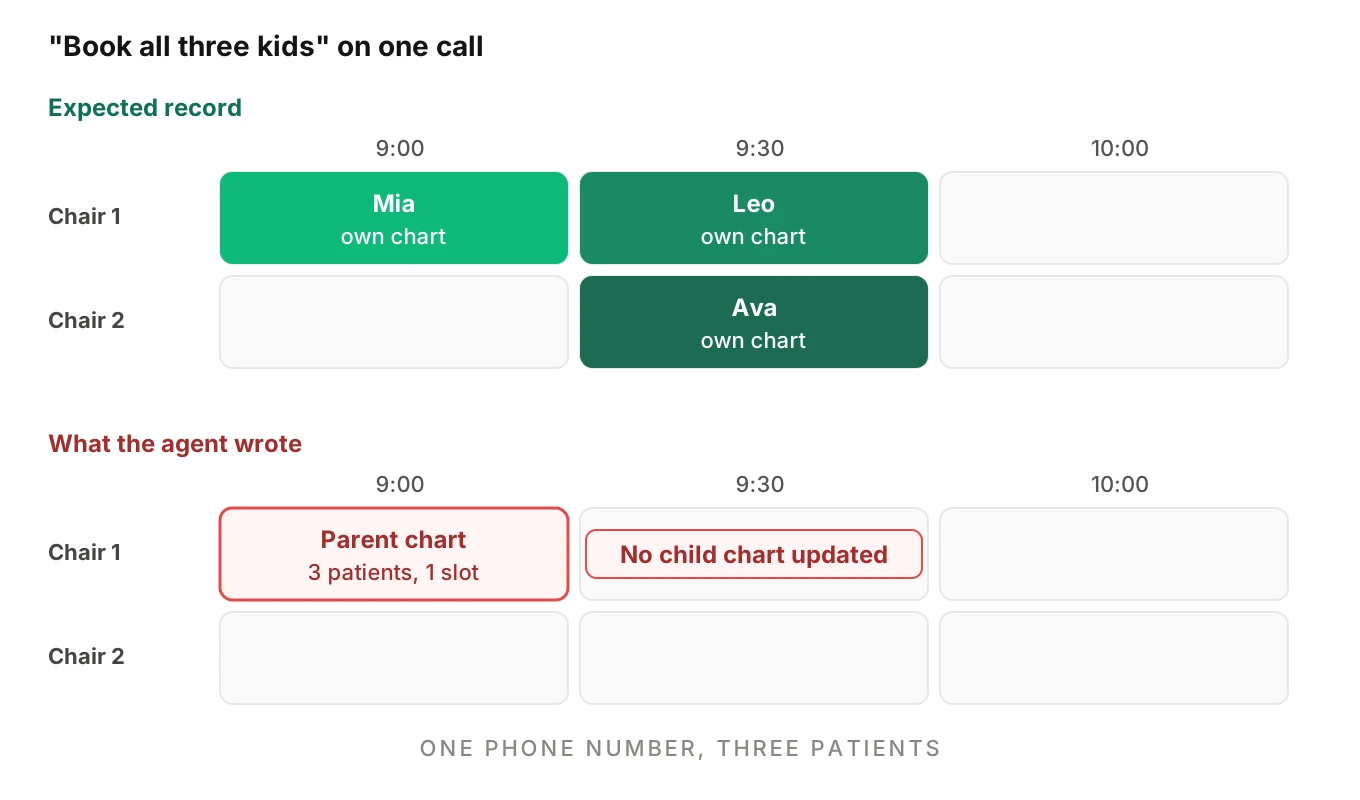
Parents book for children. Spouses book for each other. One call can mean three patients, three charts and three time slots.
Open Dental ties a family together through a guarantor, defined as the head of household's patient number. Families often share one phone number. So a search by phone number can return several people. The agent must ask who the visit is for, every time.
The failure patterns:
- One chart for all. The agent books three kids against the parent's chart.
- Spread-out slots. The agent books three visits hours apart when the parent needed them together.
- Wrong disclosure. The agent reads out one family member's details to another caller.
The disclosure rule matters. Under 45 CFR 164.502(g)(3), a parent is generally treated as the personal representative of an unemancipated minor, with listed exceptions. Under 164.510(b), a covered entity may share information with a family member involved in the individual's care, within limits when the person is not present. Whether your agent may confirm an adult's appointment to their spouse is a legal question for your counsel. Build the agent to default to the stricter answer and hand off.
What to test
- "I need to book the kids." The agent must ask how many, names and birthdates.
- Three children with different appointment types, such as a cleaning, a filling and a first visit.
- A request for "back to back" or "all at the same time."
A test matrix you can copy
Run each row as scripted calls. Grade the booking record, then the voice.
| Error | Scenario example | Pass check in the record | Suggested threshold |
|---|---|---|---|
| 1. Length | "Deep cleaning, left side" | Perio type, pattern length matches policy | 100% on type, 0 default patterns |
| 2. New vs existing | Returning after 4 years | Correct chart or one new chart, flag set | 0 duplicate charts |
| 3. Insurance | ID read with letters | Subscriber, relationship, ID exact | 100% exact match on ID |
| 4. Provider | Named dentist, hygiene visit | Role-valid provider in both fields | 0 role violations |
| 5. Emergency | "Tooth knocked out" | Transfer or script, no routine slot | 100% escalation |
| 6. Family | "Book all three kids" | Three charts, three slots | 0 cross-chart bookings |
The thresholds are suggestions. Set your own with your clinical lead. Emergency routing and wrong-chart bookings deserve a hard gate.
Sample-size math
Suppose you run 60 scripted calls for one error class and see zero failures. A common approximation, the "rule of three," puts the 95 percent upper bound on the true failure rate at about 3 divided by 60, or 5 percent. To claim under 1 percent you need roughly 300 clean calls in that class. This is an illustrative calculation. It assumes calls are independent, which they are not if one prompt drives all of them.
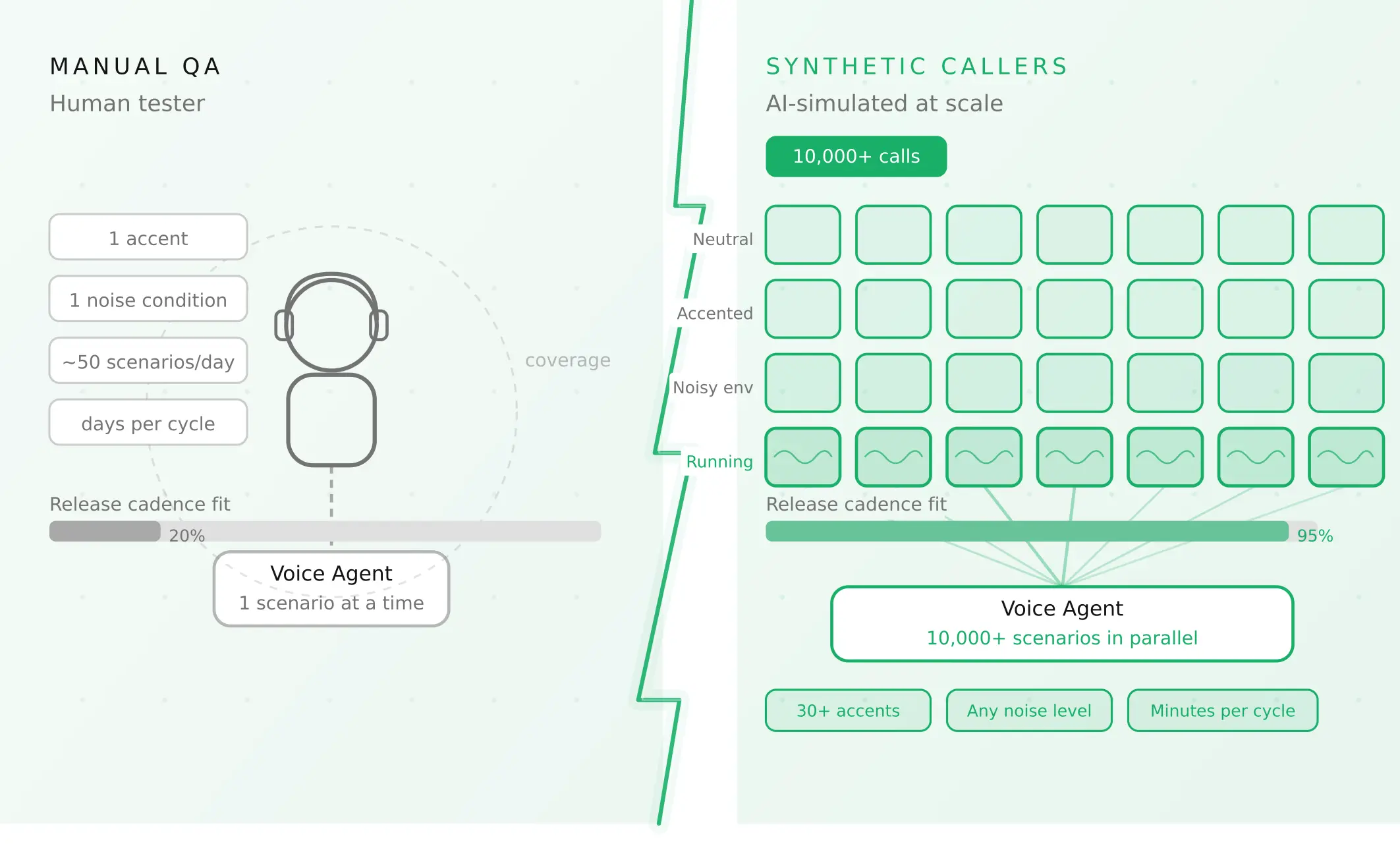
Vary accents, pace, noise and interruptions inside each class. Six classes by five caller profiles at 12 calls each is 360 calls. Running those by hand is the bottleneck.
How to test a dental AI receptionist before go-live
Dental voice agent testing works best as a release gate. Follow this order.
1. Freeze the contract. List every field your agent writes: patient, operatory, time, pattern, provider, hygienist, new-patient flag, note. Mark which have no safe default.
2. Build a sandbox practice. Use fake patients, two dentists, a hygienist and several operatories. Include a family of four and a duplicate-name pair.
3. Script the calls. Write each matrix scenario with its target record. Add a caller profile: accent, pace, noise, interruptions.
4. Run, then read the record. Call over the production phone path. Compare each saved appointment to the expected values, field by field.
5. Add a validator in code. Reject a write that breaks policy before it reaches the system. A simplified sketch follows.
6. Gate each change. Re-run the matrix on every prompt, model or tool change. Block release on any hard-gate failure.
# Simplified pre-write validator. Field names follow Open Dental's
# documented appointment fields; adapt to your own system.
REQUIRED_HYGIENE = {"prophy", "perio_maint"}
MIN_CELLS = {"new_patient_exam": 12, "prophy": 8, "perio_scaling": 12}

def validate_booking(apt, patient, policy):
    errors = []
    kind = apt.get("type_key")
    if kind is None:
        errors.append("no appointment type: would fall back to default /XX/")
    cells = len(apt.get("pattern", "/XX/"))
    if kind in MIN_CELLS and cells < MIN_CELLS[kind]:
        errors.append(f"pattern {cells*5} min below policy for {kind}")
    if patient["status"] != "Patient" and not apt.get("is_new_patient"):
        errors.append("non-active patient booked without new-patient flag")
    if kind in REQUIRED_HYGIENE and not apt.get("prov_hyg"):
        errors.append("hygiene visit with no hygienist")
    if apt.get("prov") not in policy["providers_for"][kind]:
        errors.append("provider not allowed for this type")
    return errors  # empty list means safe to write
The policy table is yours to fill, and the cell counts are placeholders. A validator catches structural errors. It cannot catch a misheard member ID or a missed trigger phrase. Those need audio-level tests.
Evalgent generates test scenarios from an agent's prompt and flows, including branches and hard constraints. It runs them as simulated callers over phone, SIP or WebRTC with set accents, pace, interruptions and noise. It judges from the audio as well as the transcript, which matters for names, digits and trigger phrases heard through noise. Evalgent works with teams to set up evals for their first agent; it is not self-serve.
What to watch after launch
Live calls show what pre-launch tests missed. Dental phone answering AI should be scored on every call, not a sample.
- Type and length. A rise in untyped or short bookings means the agent stopped sending types.
- Duplicate-chart rate. Count new charts created for callers whose phone number matches an existing chart.
- Emergency-phrase miss rate. Review calls with trigger words that ended in a routine slot.
- Tool-call failures. A failed write followed by a spoken "you're all set" is the worst case.
Evalgent's production monitoring takes call recordings, transcribes them, maps them to scenarios and judges them. It flags PII leakage, tool-call failures, latency spikes and policy failures with fix recommendations. For the metrics themselves, see our guides to appointment scheduling voice agent metrics and healthcare intake voice agent metrics. If you are comparing vendors, our patient scheduling vendor evaluation lists questions to ask.
Outbound recall calls add risks such as held slots and wrong guarantors. We cover those in dental recall AI calls. Before any launch, use the AI phone agent go-live checklist.
Frequently asked questions
Can an AI receptionist book dental appointments correctly?
Yes, when the booking is checked against policy before it is written. A dental AI receptionist can book cleanly for simple visits. Errors cluster in appointment length, provider choice, new-patient flags and families. Test those with scripted calls and grade the saved record, not the spoken transcript.
How does a dental AI receptionist know how long an appointment should be?
It should not guess. A dental AI receptionist needs a table mapping each appointment type to a length, sent with every booking. In Open Dental's API, an unspecified pattern defaults to 20 minutes. Your agent must send the right type or pattern, and a validator should reject short bookings.
How do you test a dental AI receptionist before going live?
Build a sandbox practice with fake patients, providers and operatories. Script calls for each of the six error classes across accents, noise and interruptions. Place them over the production phone path. Compare each saved appointment to the expected record. Repeat on every prompt, model or tool change before release.
Should a dental AI receptionist verify insurance on the call?
Capturing the details is safer than verifying or quoting benefits. Have the agent read back the carrier, subscriber, relationship and member ID, then save them for staff. A plan defines what it covers and its limits, so the agent should not tell callers a procedure is covered.
How should a dental AI receptionist handle a dental emergency?
It should follow a script your dentists approve, recognize trigger phrases and hand off to a person quickly. It should not diagnose or reassure. When unsure, escalate. This is not medical advice, and your clinical team owns the script.
Can a dental AI receptionist book several family members at once?
It can, if it asks who each visit is for and keeps one chart per person. A shared phone number and guarantor link family members, so the agent must collect each name and birthdate. Test three-child calls with mixed appointment types.
How does a dental AI receptionist tell a new patient from an existing one?
It should search by last name, first name and birthdate together, not by phone number alone. Then it checks the patient's status. A person who left years ago may be inactive. The agent sets the new-patient flag only after the chart check, and avoids creating duplicate charts.
Does a dental AI receptionist need to be HIPAA compliant?
A dental practice is generally a HIPAA covered entity, so the rules apply to the practice and its vendors. What a vendor must sign or do is a legal question for your counsel. Evalgent makes no HIPAA compliance claims. This is not legal advice.
The bottom line
A dental AI receptionist does not fail loudly, so you have to read what it wrote into the schedule. Test the six errors on the booking record, gate every change, and keep monitoring live calls.
Related Articles
How to automate voice agent testing: synthetic callers vs manual QA
Learn how ai test automation replaces manual QA for voice agents. Compare synthetic callers vs human testers, with a 5-step framework to scale without hiring.
Read more
AI Agent Testing vs Voice Agent Testing: What General Tools Miss for Voice
AI agent testing measures text outputs. Voice agent testing measures behaviour through an acoustic pipeline. Five failure categories general tools miss.
Read more