Testing AI Rebooking and Cancellation-Fee Calls for Salons
On this page
This post is for product teams that run one voice agent across many salons, whether you sell a salon AI receptionist or build one into salon software. You own the agent. Salon owners own the policy. A client who calls to reschedule an appointment is a small event for the caller and a bigger one for your system. The call changes a booking, may trigger a fee, may release a deposit and may send a confirmation text.
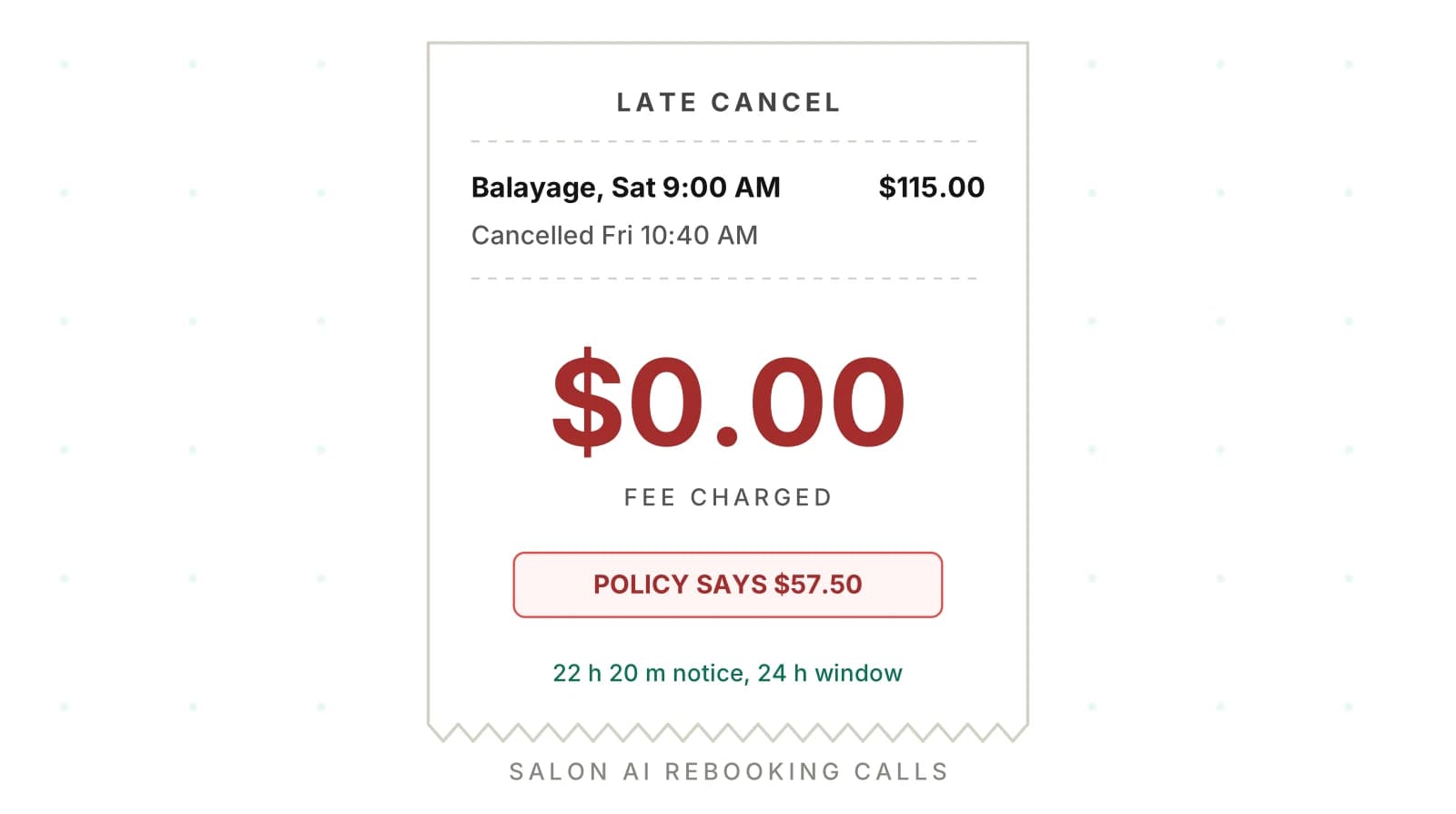
Salon AI rebooking calls are where the agent states money rules out loud. They are also where the agent meets a policy exception, a standing appointment or a stylist preference. "Cancelling now is free" or "that will cost you half the service price" is a promise. If the agent says it wrong, the salon either loses revenue or fights a chargeback.
Salon software vendors are moving into this space. Boulevard's help center says its AI Receptionist handles "booking and managing appointments" and "is currently in beta and gradually being made available to all Boulevard customers" (Boulevard help center). Zoca, a marketing tool for beauty and wellness businesses, is listed as one that "automatically rebooks past clients and sends reminders" (Techjockey listing). Neither source says how these features behave on a cancellation call, and this post makes no claim about either product. It covers what to test in your own salon AI rebooking calls.
For the wider salon playbook, start with our AI receptionist for salons pillar. For the first booking, see salon booking AI. For first-contact callers, see new salon clients hanging up on your AI. This post covers existing clients who already have an appointment.
What a rebooking call actually writes
A rebooking call looks like a chat. Underneath it is a small transaction. Each step has a write, and each write can go wrong without anyone hearing it.
| Caller says | System action | Silent failure |
|---|---|---|
| "I need to move Saturday" | Look up the client, find the appointment ID | Moves a different Saturday booking, or a family member's |
| "Same as last time" | Resolve last visit to a service code and stylist | Books the service but drops the stylist or the add-on |
| "Cancel it, I'm sick" | Cancel, compute the fee, update the ledger | States "no fee" when policy says 50% |
| "Can I keep my deposit?" | Check forfeit rules, refund or retain | Promises a refund the salon never approved |
| "Put me on the list for Friday" | Add to waitlist | Adds to the wrong service length |
| "Text me the new time" | Send SMS confirmation | Sends the old time, or the wrong salon's address |
Every row ends in a record the salon trusts. The stylist opens the day on the calendar. The owner reads the fee ledger at month end. Neither listens to the call, so test the write, not the wording.
For general measurement, see appointment scheduling voice agent metrics.
The policy sentence is the riskiest sentence
On a new booking, the agent mostly collects data. On a cancel call, it makes statements. Three kinds matter.
1. Fee statements. "There is a fee of half the service price."
2. Window statements. "You are inside our 24-hour window."
3. Exception statements. "I can waive it this once."
The third kind needs a hard rule. The agent should never invent a policy exception. Boulevard's sample policy, for instance, waives one late cancellation fee per client per calendar year (Boulevard blog). That is one salon's template. Your agent must read the waiver from each salon's configuration and its record of past waivers. It must not offer a waiver because the caller sounds upset.
Sample policies also vary. The same Boulevard page describes 24 hours' notice for standard services and 48 hours for color corrections and services over two hours. It shows a 50% late-cancel fee and a 100% no-show fee. It adds a short grace period for late arrivals and a $150 deposit for bookings over $300, a forfeited deposit if the client cancels under 48 hours out. These are illustrative templates, not rules. Your customers will each have a different mix.
That is the multi-tenant problem. One prompt, hundreds of policies. If the prompt hard-codes "24 hours," some salons get the wrong answer on day one. Our multi-tenant voice agent testing post covers the setup matrix. For policy adherence in general, see how to test policy adherence in voice agents.
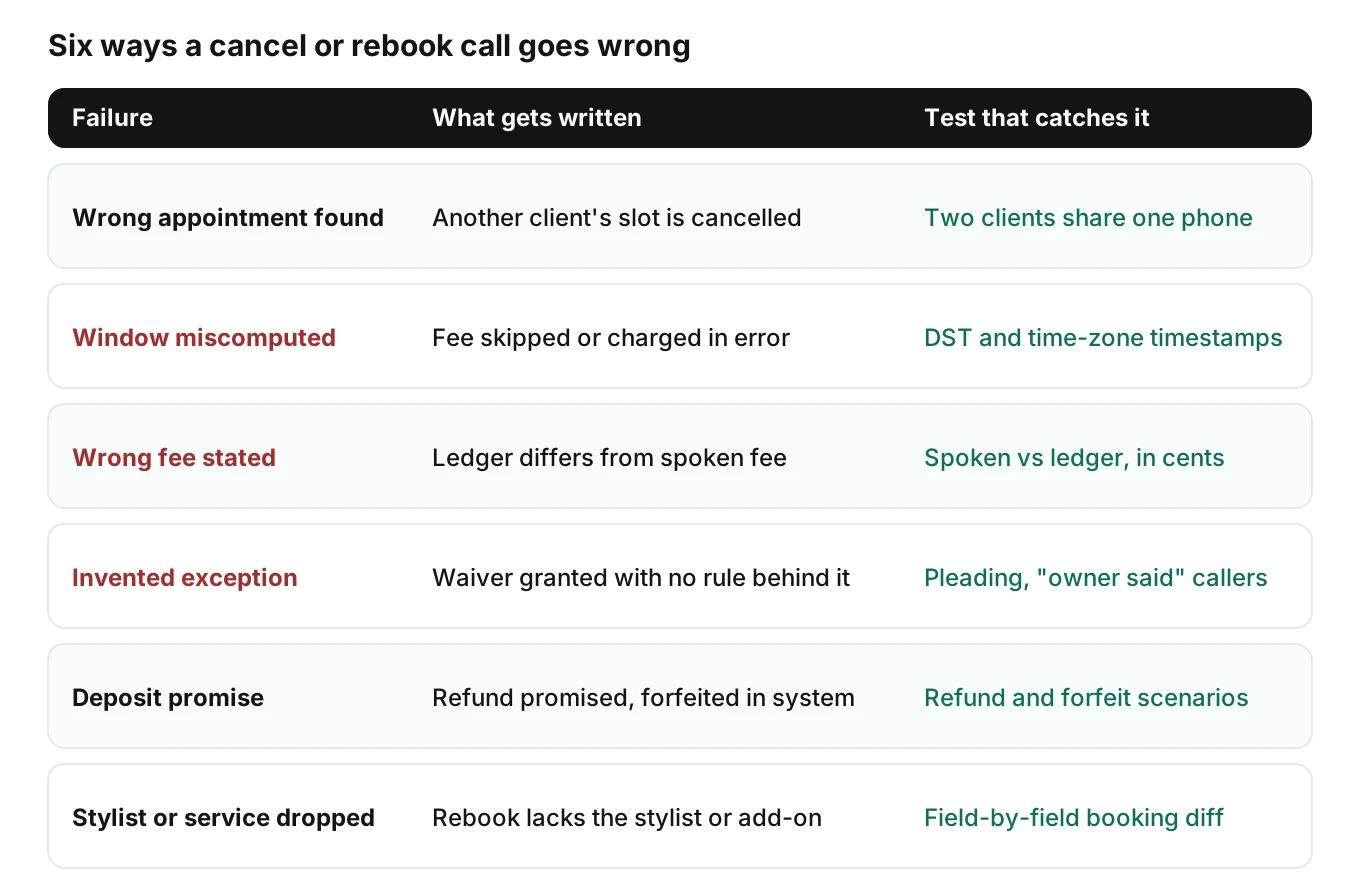
A failure taxonomy for cancel and rebook calls
The diagram below groups the failures by the record they corrupt. Use it to label every failed test.
The 24-hour clock is a code problem, not a language problem
The most common fee dispute is "I cancelled in time." The agent has to decide whether the call fell inside the cancellation window from two timestamps. It looks simple. It breaks in three ways.
1. Wrong time zone. The server runs in UTC. The salon runs in Chicago. The agent computes the window in the wrong zone.
2. Wall-clock subtraction across a DST change. Python's `datetime` documentation says that when both values are aware and share the same `tzinfo`, "the tzinfo attributes are ignored" and "no time zone adjustments are done" (Python docs). Subtracting local times across a clock change gives the wrong elapsed time.
3. Spoken-date ambiguity. "Saturday" on a Thursday call is clear. "Next Saturday" on a Saturday is not.
Here is the second bug with real numbers. In the US, clocks moved forward on Sunday, March 8, 2026. Take a 9:00 AM Sunday appointment in Chicago and a cancellation at 8:30 AM Saturday.
| Method | Elapsed time | Inside 24-hour window? |
|---|---|---|
| Local wall-clock subtraction | 24 h 30 m | No, so no fee |
| Convert both to UTC first | 23 h 30 m | Yes, so fee applies |
Running both methods in Python gives these two results. Here is a simplified resolver that gets it right.
from datetime import datetime, timedelta, timezone
from zoneinfo import ZoneInfo

def fee_decision(start_local, cancel_utc, window_h, fee_pct,
                 price_cents, waivers_used_this_year, waiver_allowed):
    """Simplified. Policy values come from the salon's config, never the prompt."""
    start_utc = start_local.astimezone(timezone.utc)   # convert BEFORE subtracting
    notice = start_utc - cancel_utc
    if notice >= timedelta(hours=window_h):
        return {"fee_cents": 0, "reason": "outside_window"}
    if waiver_allowed and waivers_used_this_year == 0:
        return {"fee_cents": 0, "reason": "waiver_available",
                "needs_human_or_policy_flag": True}
    fee = round(price_cents * fee_pct / 100)
    return {"fee_cents": fee, "reason": "inside_window"}

tz = ZoneInfo("America/Chicago")
start = datetime(2026, 3, 8, 9, 0, tzinfo=tz)
cancel = datetime(2026, 3, 7, 8, 30, tzinfo=tz).astimezone(timezone.utc)
print(fee_decision(start, cancel, 24, 50, 11500, 1, True))
# {'fee_cents': 5750, 'reason': 'inside_window'}
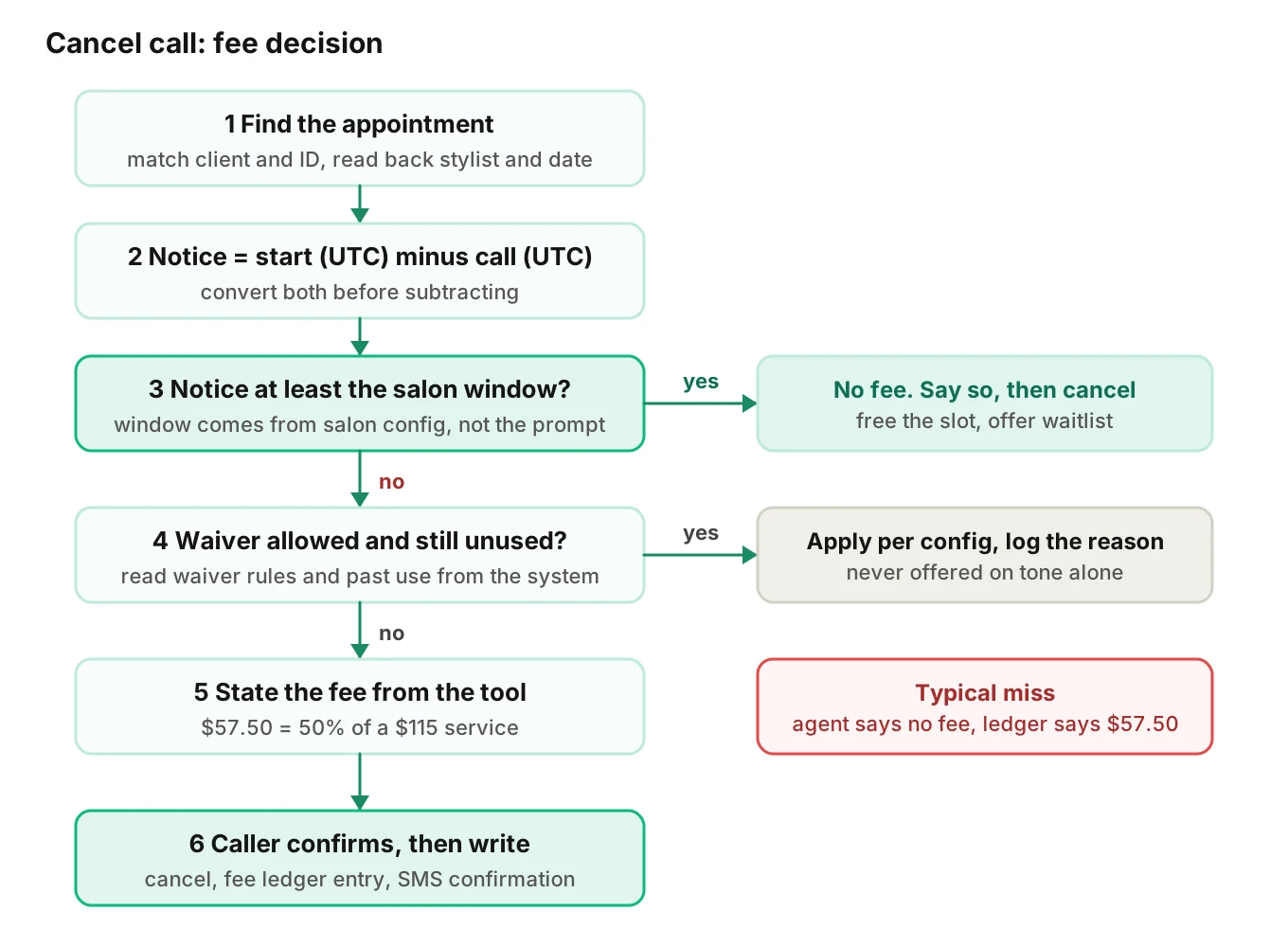
Two design points matter more than the arithmetic. The model should not do this sum; a tool returns the fee and a reason code. The agent should read back the result in plain words and wait for the caller to confirm before cancelling. Our post on tool argument accuracy explains why spoken dates deserve a read-back.
Test salon AI rebooking calls against a fixed set of timestamps: one minute inside the window, one minute outside, a DST boundary, a salon in a different zone than the server, and a caller who says "tomorrow" at 11:58 PM.
Deposits, saved cards and refunds
Money statements get harder when a deposit or a saved card is involved. Three facts from payment docs shape the tests.
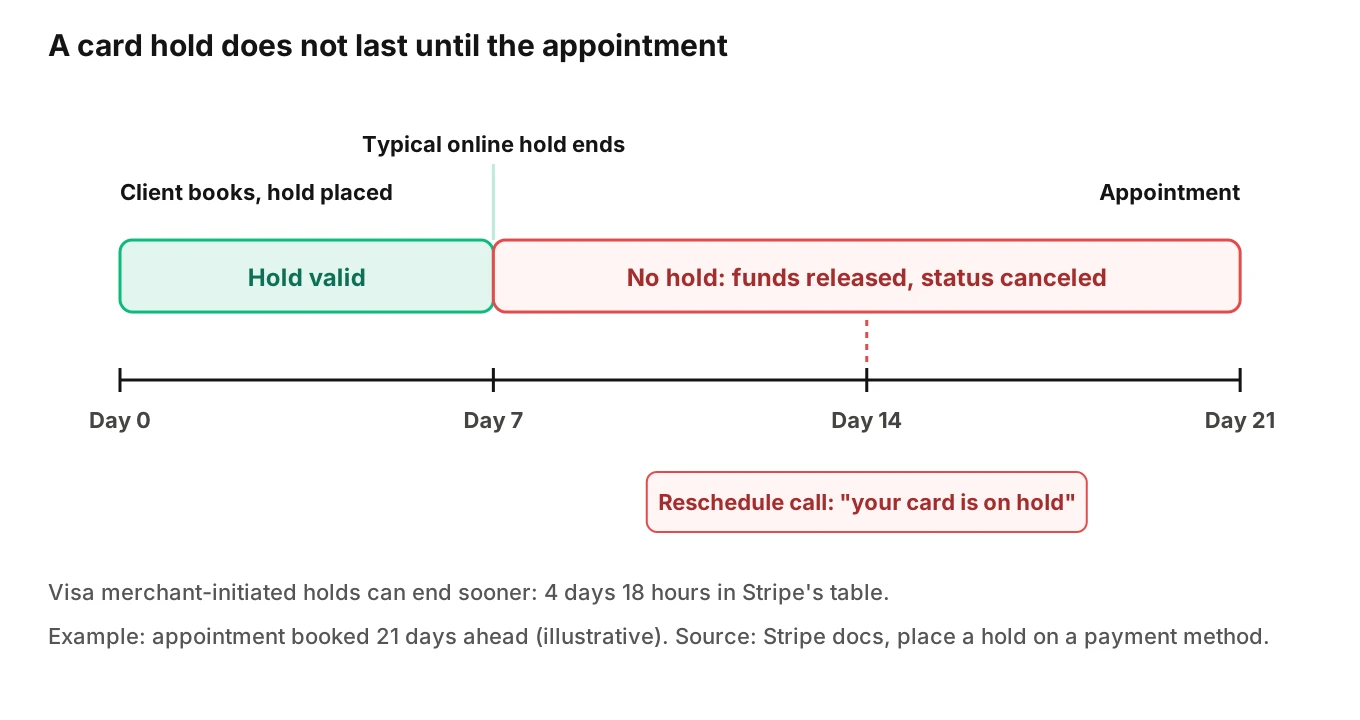
An authorization hold expires. Stripe's docs say that for online card payments the amount is typically held for 7 days. They also say that if the authorization expires before capture, "the funds are released and the payment status changes to canceled" (Stripe docs). For card-not-present Visa payments classed as merchant-initiated, the window is 5 days, and Stripe notes the exact figure is 4 days and 18 hours. An authorization hold placed when a client books a color service three weeks out will not still exist on the day. If your design relies on a hold, the agent should not say "we already have your card on hold" without checking.
Saved-card consent needs terms. Stripe's guide on saving payment methods says you are responsible for compliance with applicable law and network rules. It advises that you "add terms to your website or app that state how you plan to save payment method details and allow customers to opt in" (Stripe docs). A phone call has no checkbox. If your agent takes a card or says "we will charge the card on file," decide how consent is captured and logged. Ask your payments counsel; this is not legal advice.
Policy proof decides chargebacks. Slick's help article lists the evidence a salon should keep: proof of booking, the policy as shown, and "proof the policy was shown to the client" such as a confirmation, SMS or email (Slick help center). For an AI agent, that means the call recording, the stated policy text and the confirmation message should all match.
Square's help material shows the typical product pattern. Clients add a card to complete an online booking, and that card "can be charged if your client violates your cancellation policy" (Square Community). Your phone agent is a second door into the same rule. It must not give a different answer than the web flow.
Deposit scenarios worth scripting
- Caller cancels inside the window and asks for the deposit back.
- Caller cancels outside the window and expects an automatic refund.
- Caller reschedules once, then cancels. Does the deposit carry over?
- Caller's saved card has expired. Does the agent say so, or skip the fee silently?
Stylist-specific rebooks
"Put me back with Dani at the same time" is a rebooking call about stylist preference. It has three lookups: client, last visit and stylist. Each can fail on its own.
- Two clients, one name. Sarah Lee and Sara Lee share a phone number in a family account.
- Last visit is a bundle. "Same as last time" was a cut, a gloss and a bond treatment. The agent books only the cut.
- Stylist left. The history says Dani. Dani no longer works there. The agent books Dani's old chair, or books nobody.
- Cadence. A standing appointment every six weeks drifts if the agent counts from today, not from the last visit.
The write-back error is quiet. The calendar shows an appointment. It is simply not the one the client meant. The check is a read-back that names stylist, service list, date and time. Then, after the call, compare the stored booking against the scenario's expected booking, field by field.
For service-name confusion on first bookings, see salon booking AI. For treatment-heavy businesses, see med spa AI receptionist.
Speech errors that hit fee and date fields
Spoken dates, names and numbers fail more often than teams expect. A September 2026 paper, tau-Elicitation, built 200 voice tasks across 10 entity types, including names, dates and times. A matched text agent passed all tasks. Four voice configurations reached robust exact success rates of 0.14 to 0.41. Only 24% to 37% of verified errors were repaired. A scaffold that prescribed spelling, read-back, correction and confirmation raised robust Pass^3 by 14 to 31 points, at a cost of 21 to 28 seconds per call.
The implication for salon AI rebooking calls is direct. A cancel call has at least four entities: client name, appointment date, time and stylist. The scaffold buys accuracy at the cost of call length. Decide where to spend those seconds. Spend them on the fields that move money or the calendar.
A second paper, EVA-Bench, tested 12 systems with simulated audio conversations. It reports a median gap of 0.44 between pass@k and pass^k on its accuracy score. That gap says peak performance and reliable performance differ. A cancel flow that works on one try is not the same as one that works on every try. Run each scenario several times and report the reliable number.
Salons are loud. Dryers and music sit under the call. See voice agent accent robustness for the test design. EVA-Bench reports that accent and noise perturbations reveal large robustness gaps, with mean drops up to 0.314 on some metrics.
Outbound reminder and rebooking calls
Some products also call clients. A reminder call or a "time to rebook" nudge looks harmless. They are still calls with a synthetic voice.
The FCC ruled in February 2024 that the TCPA's restrictions "encompass current AI technologies that generate human voices," and that callers must obtain prior express consent before initiating such calls (FCC 24-17). That applies to calls from your agent to a client's phone.
Consent revocation rules are also moving. The FCC adopted order FCC 26-67 on September 30, 2026 and released it October 1, 2026. Law firm summaries say it narrows "revoke-all" for informational calls and lets callers name exclusive opt-out methods. It takes effect 30 days after Federal Register publication, which had not happened as of October 7 (Kelley Drye, Nixon Peabody). This is not legal advice. Check the current text with counsel.
For test design, three behaviors matter. The agent must honor "stop calling" mid-call. It must not rebook a client who opted out. It must not offer a promotion the salon never approved. For outbound call testing in general, see outbound voice agent testing and our TCPA checks for speed-to-lead calls. If you are comparing reminder products, see how to evaluate an appointment reminder voice agent vendor.
How to test salon AI rebooking calls before every release
You need a repeatable set of salon AI rebooking calls that runs on every prompt or flow change. Our post on shipping prompt changes safely explains the release gate. These steps fill it with salon content.
1. Build a policy matrix. List the distinct settings across your customers: window length (24 or 48 hours), fee percentage, no-show fee, deposit rule, waiver rule, time zone. Group salons into 10 to 15 representative profiles.
2. Write the scenario set. For each profile, script cancel inside the window, cancel outside it, reschedule appointment requests, rebook with a named stylist, deposit refund request, waiver request and no-show follow-up call.
3. Seed the data. Create appointments with known IDs, duplicate client names, a departed stylist, an expired card, and one past waiver.
4. Vary the caller. Change accent, speech pace, interruption level, background noise and language. Salon floors are noisy, and clients often speak while walking.
5. Define expected writes. For each scenario, record the expected appointment state, fee in cents, deposit state and confirmation text. Pass or fail on the write, not on the transcript.
6. Run each scenario several times. Report the share that pass every time, not the share that pass once.
7. Add DST and zone cases. Include the clock-change weekend and a salon whose zone differs from your server's.
8. Gate the release. Block shipping on any fee-statement error, any wrong-appointment write and any invented waiver.
For salon AI rebooking calls, Evalgent generates test scenarios from an agent's prompt and flows, and its call simulator can reach your agent over phone, SIP or WebRTC with caller profiles for accent, pace, interruptions and background noise. It judges from the audio, not only the transcript, and supports custom metrics run on every call. That fits steps 2, 4 and 5. Evalgent works with teams to set up evals for their first agent; it is sales-led, not self-serve.
A scorecard with illustrative thresholds
These thresholds are starting points, not industry standards. Tighten them as you learn your base rates.
| Check | Pass rule | Block release if |
|---|---|---|
| Fee stated matches policy tool | 100% of scenarios | Any mismatch |
| Window decision correct (incl. DST, zone) | 100% | Any mismatch |
| Correct appointment modified | 100% on seeded duplicates | Any wrong write |
| Invented waiver or exception | 0 | Any |
| Stylist and service read back | 95%+ of rebooks | Under 90% |
| Confirmation text matches new booking | 100% | Any mismatch |
| Reliable pass (all runs) per scenario | 90%+ | Under 80% |
Sample-size math
Suppose you run 100 cancel-fee calls and see zero fee errors. A common rule of thumb, the rule of three, puts the 95% upper bound on the true error rate near 3 divided by 100, or 3%. Zero errors in 100 does not mean zero errors. If a fee error costs a salon $57.50, as in the worked example below, and 3% of 2,000 monthly cancel calls were wrong, that is 60 calls and $3,450 in monthly disputes. These are illustrative assumptions, not measured results.
The worked fee: a $115 balayage, cancelled inside the window, at the sample 50% fee, is $57.50. At the sample 100% no-show fee, it is $115.
Monitoring live calls after launch
Pre-release tests cannot see every client. Include the reminder call path too. After launch, monitor what the agent said and what it wrote on each of your salon AI rebooking calls.
- Fee-statement match. Compare the dollar figure spoken on the call with the ledger entry.
- Window disagreements. Flag calls where the stated window differs from the salon's setting.
- Reversals within 24 hours. A staff member who undoes the agent's cancel or fee is a signal.
- Opt-out handling. Check that a "stop" request ends outbound calls to that number.
Evalgent's production monitoring takes call recordings that customers push, transcribes them, maps them to scenarios and judges them. It flags policy failures, tool-call failures and PII leakage, with fix recommendations. For a general monitoring setup, see monitoring voice agents in production. For payment-detail handling on calls, see voice agent PII leakage detection. Add new salons through the go-live checklist.
Frequently asked questions
Can an AI receptionist charge a late cancellation fee?
Technically yes, if it has a payment tool and a saved card. The harder question is consent and accuracy. The agent should compute the fee through a tool, read it back, and charge only under a policy the client accepted. A safer design is to have the agent state the fee and leave the charge to staff.
How do you test an AI that cancels salon appointments?
Seed known appointments, then script cancel calls inside and outside each policy window. Pass or fail on the stored result: appointment state, fee, deposit and confirmation text. Repeat each scenario several times, vary accents and noise, and include duplicate client names and a daylight saving weekend.
Should salon AI take deposits over the phone?
Only if you can capture and log consent and handle card data safely. Stripe advises adding terms that state how you save payment details and letting customers opt in. A phone call has no checkbox, so consider sending a secure payment link by text and keeping the voice agent out of card numbers.
How does AI know which stylist a client wants to rebook with?
It reads the client's visit history and the stated request. Failures come from duplicate names, departed stylists and bundled services. Make the agent read back stylist, service list, date and time, and test with seeded edge cases where the last stylist is unavailable.
Can salon AI waive a cancellation fee?
Only if the salon's configuration allows it. The agent should read waiver rules and past waiver use from the system, never grant exceptions on its own judgment. Test with callers who plead, argue or claim the owner promised a waiver. Any invented waiver should block a release.
What happens when a client cancels inside the 24-hour window by phone?
The salon's policy decides. A sample template charges 50% of the service for a late cancel. The agent must compute notice in the salon's time zone, state the fee, and ask the client to confirm.
Do salon reminder calls from AI need consent?
In the US, the FCC ruled in 2024 that AI-generated voices count as artificial under the TCPA, so prior express consent is required unless an exemption applies. Rules on revoking consent changed in an order adopted September 30, 2026. This is not legal advice; confirm with counsel.
How do you measure whether AI states the cancellation policy correctly?
Compare each spoken fee and window against the salon's configured policy. Score the share of calls where all three match: window, fee and exceptions. In testing, expect 100% on scripted scenarios. In production, sample calls by salon and review any mismatch.
The bottom line
Salon AI rebooking calls are transactions that edit a booking, a fee ledger and a client's trust. Test the writes, the clock and the spoken policy on every release, for every salon setting you ship.
Related Articles
How to automate voice agent testing: synthetic callers vs manual QA
Learn how ai test automation replaces manual QA for voice agents. Compare synthetic callers vs human testers, with a 5-step framework to scale without hiring.
Read more
AI Agent Testing vs Voice Agent Testing: What General Tools Miss for Voice
AI agent testing measures text outputs. Voice agent testing measures behaviour through an acoustic pipeline. Five failure categories general tools miss.
Read more