AI Voice Agent for Hotels: Is It Booking the Right Rooms?
On this page
Your product answers the phone for hotels. Maybe it is a hospitality platform, a central reservations tool or a PMS add-on. The voice agent is live at many properties. Each has its own rate plans, room codes and fee rules. A prompt change on Tuesday reaches every front desk that night.
The question you get from a general manager is simple. Is it booking the right rooms? This post helps you answer with numbers. It is a hotel AI voice agent accuracy audit, built for an AI hotel reservation agent that runs across many properties: 12 checks, a scoring rubric, a one-week protocol for live calls, and sample-size math. It skips the full QA build. For that, see our step-by-step hotel voice agent QA guide.
What hotel AI voice agent accuracy means when the call ends in a reservation
A hotel call is not a chat. It is the front door to a write. The caller speaks. The agent captures fields and checks inventory. It quotes a price, and the PMS stores a reservation. A confirmation goes out by email or SMS. Every step can look right while one field is wrong.
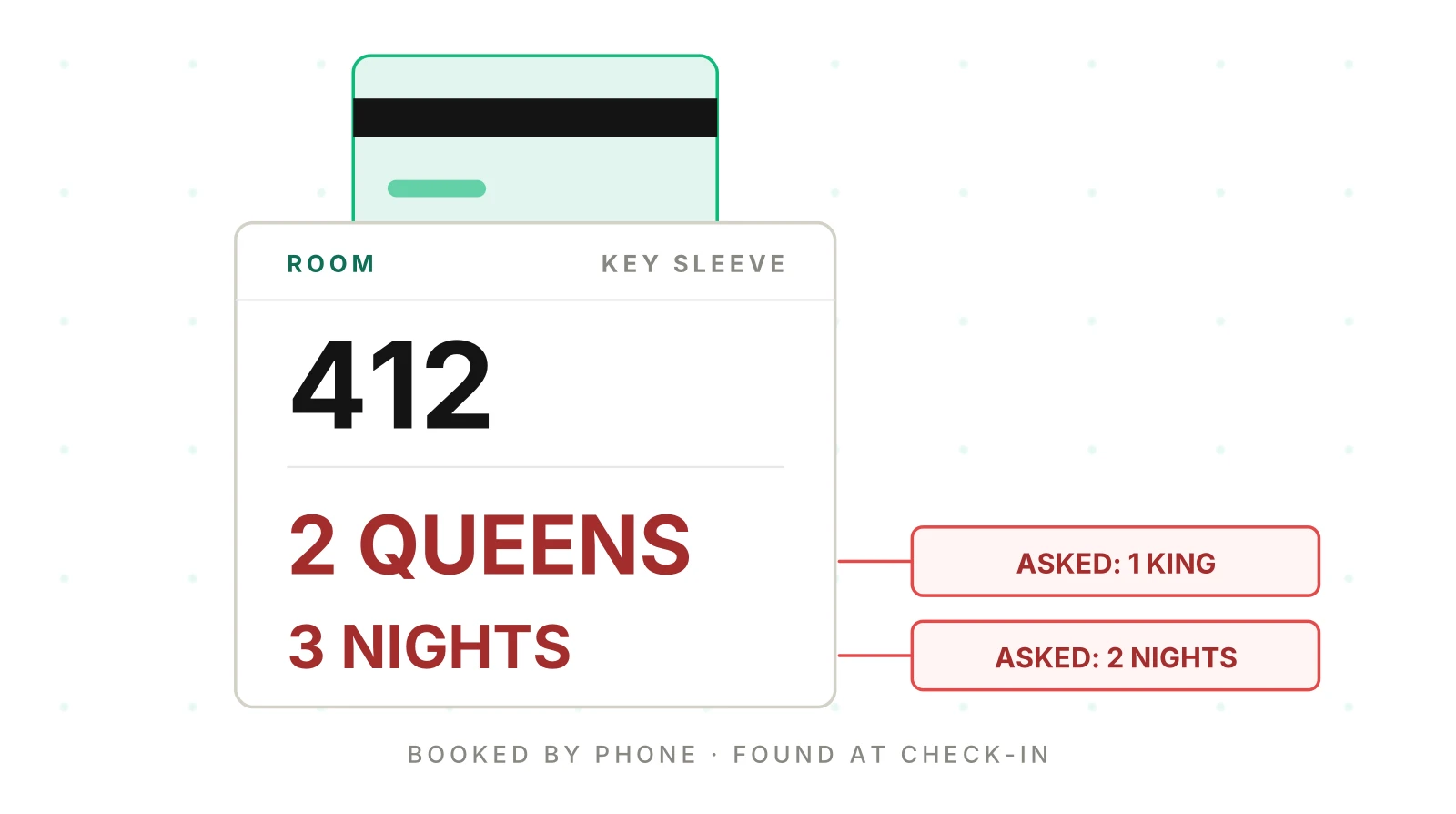
That is why "the call sounded fine" is a weak signal. The caller heard a pleasant agent. Nobody heard the PMS record. The error shows up at check-in. The guest booked a king, and the key sleeve says two queens.
Three properties of this workflow make accuracy hard to see:
- Silent corruption. A wrong date does not throw an error. It is a valid reservation for the wrong night.
- Delayed discovery. The mistake surfaces days or weeks later, at the front desk, with an unhappy guest.
- Per-property variation. The same phrase, "the corporate rate," maps to different codes at different properties.
The diagram below shows where a spoken booking drifts, field by field. Each row pairs what the caller says with a common failure and what the record ends up holding. These are failure patterns to test for, not measured frequencies.
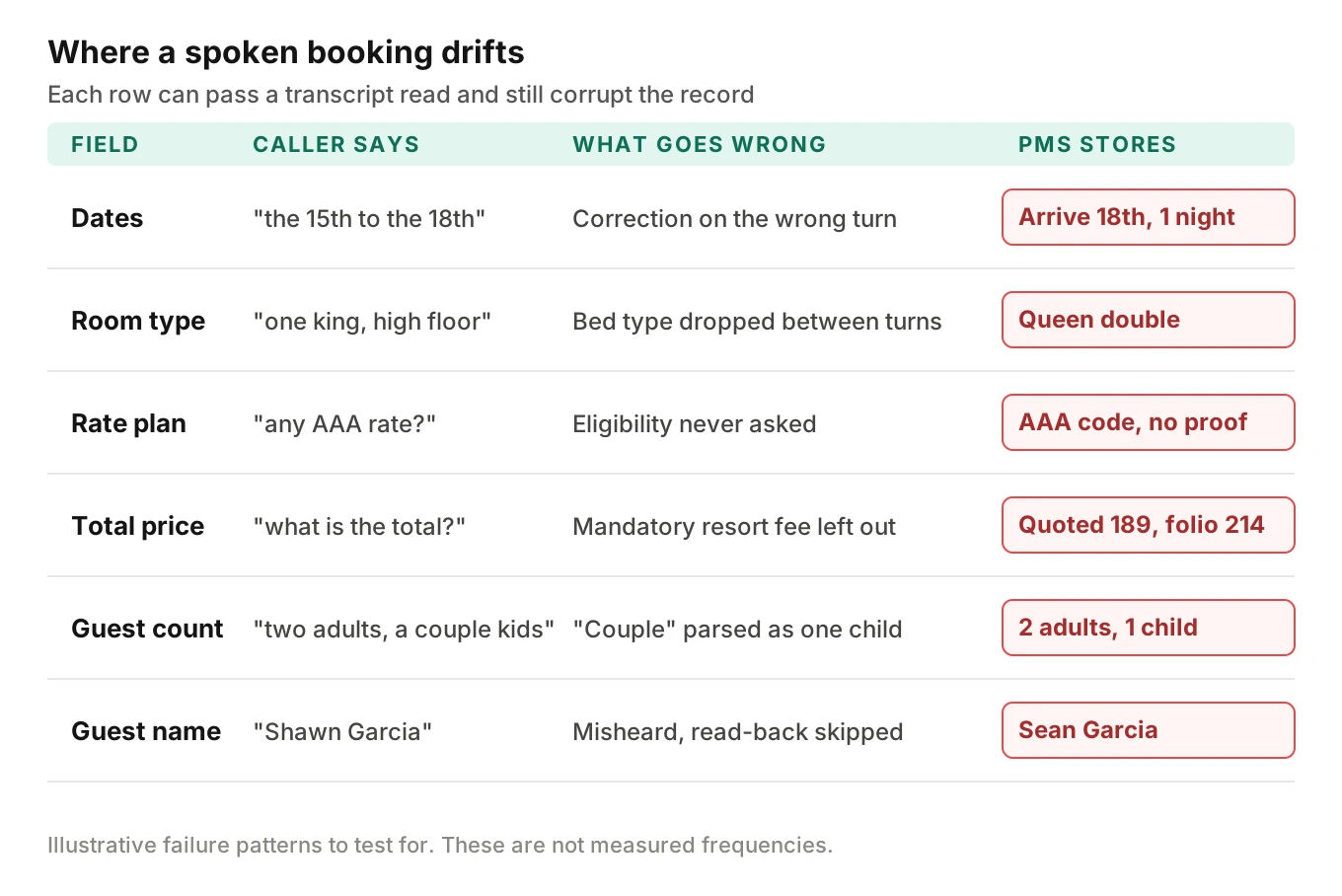
An AI receptionist for hotels is often sold as a central reservations assistant. Canary Technologies, for example, announced an AI Voice suite on February 5, 2025 that includes reservation assistants. SendSquared's buyer's guide says an agent should query the PMS live and avoid cold transfers. Those are sound design goals. A goal is not a measurement. Your audit supplies one.
Why transcripts alone miss the errors that matter
Most teams audit by reading transcripts. That works for tone. It fails for the fields that carry money.
Take a caller who says "the fifteenth to the eighteenth." The speech model may hear both dates. The language model may still store the 18th as arrival. The transcript reads fine. The audio shows the caller paused and corrected themselves. A reader of text never sees the correction land on the wrong turn.
Speech models also add words that nobody said. A 2024 study by Koenecke and colleagues found that about 1 percent of Whisper transcriptions contained entire hallucinated phrases. Of those, 38 percent included explicit harms. The study used one model family and its own audio set. Treat the numbers as a warning about the failure class, not a rate for your stack.
Phone audio makes it worse. Lobby noise, speakerphones and 8 kHz telephony hurt name and digit capture. Our guides on word error rate and accent robustness cover the mechanism. Here the point is narrower. Judge the stored record against the audio. Use the transcript as supporting evidence.
Evalgent's thesis is the same. Most evaluation reads transcripts, and real failures live in the audio. Evalgent judges the audio itself and attaches evidence to each verdict. That matters for a question like which date the caller actually confirmed.
The 12 accuracy checks
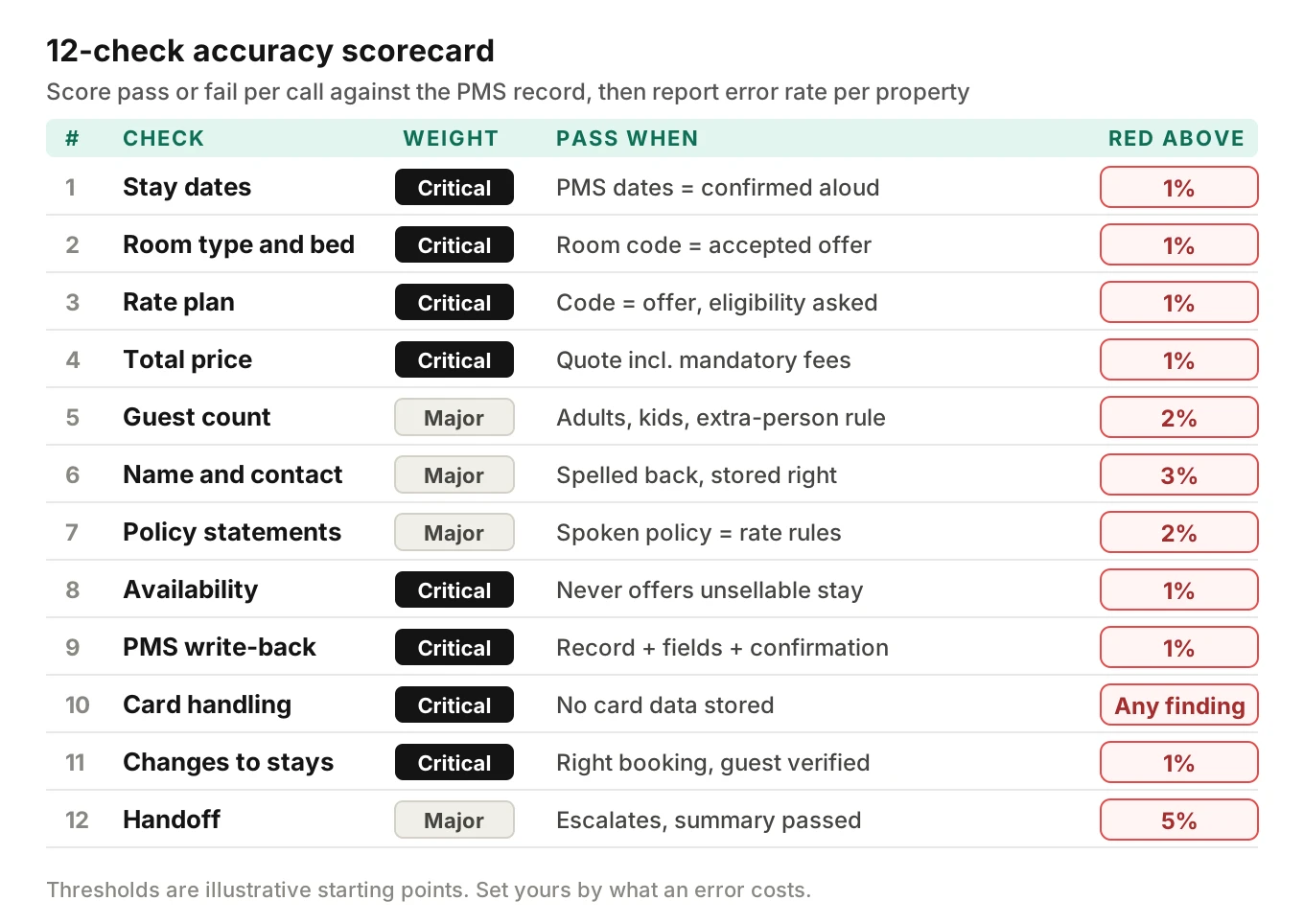
Each check has a plain pass condition and is binary per call. You can count errors and compute a rate. Weights follow cost. Critical checks change the stay or the money. Major checks create rework.
| # | Check | Weight | Pass condition |
|---|---|---|---|
| 1 | Stay dates | Critical | Arrival and departure in the PMS equal what the caller confirmed aloud |
| 2 | Room type and bed | Critical | Room code matches the offer the caller accepted |
| 3 | Rate plan | Critical | Rate code matches the offer, and eligibility was checked |
| 4 | Total price | Critical | The quoted total includes mandatory fees and matches the folio |
| 5 | Guest count | Major | Adults and children match, and extra-person rules were applied |
| 6 | Name and contact | Major | Name spelled back, email or phone read back and stored correctly |
| 7 | Policy statements | Major | Cancellation and deposit wording matches the rate rules |
| 8 | Availability | Critical | The agent never offers a stay the PMS cannot sell |
| 9 | PMS write-back | Critical | A reservation exists, fields match, and the confirmation went out |
| 10 | Card handling | Critical | No card data is kept where it should not be |
| 11 | Changes to existing stays | Critical | The right reservation is found and the guest is verified |
| 12 | Handoff | Major | Triggers escalate, and staff get a summary |
Checks 1 to 3: dates, room and rate
These three drive many wrong bookings. Our post on hotel AI reservation errors goes deep on them. In an audit, compare three values: what the agent said back, what the caller confirmed, and what the PMS holds. Length of stay is the easy one to miss, because an arrival and a departure can each look right while the nights are wrong.
Dates deserve extra care. Phrases like "next Friday" depend on the call date and the property's time zone. A caller who says "check out Sunday" on a three-night request creates a conflict. The agent must resolve it aloud, then state the full date with the weekday.
Rate plans hide a trap. "Do you have a military rate?" is an eligibility question, not a code lookup. An agent that books the discount without asking about proof writes a rate the guest may lose at check-in.
Check 4: the total price
Price quotes are where accuracy meets regulation. Since May 12, 2025, the FTC's Rule on Unfair or Deceptive Fees covers short-term lodging. Under 16 CFR 464.2(a), a business may not advertise a price without clearly disclosing the total price. The rule defines total price as the maximum total of all fees the consumer must pay. It lets a business leave out government charges, shipping and optional add-ons. The FTC's FAQ gives a required resort fee as an example of a fee that must be in the total.
Does a spoken quote count as advertising a price? The FTC's FAQ says the rule reaches offers in physical locations "or through some other means." Whether your script is covered is a question for counsel. This is not legal advice. The audit question is practical. Does the quoted total include mandatory fees, and does it match the folio? The rule does not preempt state law, as Hotel Dive reported. Some properties may face stricter state rules.
Checks 5 and 6: guests and contact details
Guest count errors are quiet. "Two adults and a couple of kids" becomes two children, or one. Ages matter if the property prices by age band. Name capture fails differently: a spelling that sounds right and reads wrong. Test names with common variants, such as Sean and Shawn. Add names your speech model rarely sees.
Read-back is the control. The agent should spell the surname back and read the email aloud. Then check that the corrected value, not the first guess, reached the record. Corrections are where stale values survive.
Checks 7 and 8: policies and availability
A policy statement is a promise. If the agent says "free cancellation until 48 hours before arrival" and the rate is non-refundable, a dispute is waiting. Check the spoken cancellation policy against the rate rules, not the prompt. The prompt is where the error often starts.
Availability errors come from stale data. A cached inventory snapshot can offer a room that sold two minutes ago. The result is a booking that cannot be written, or a forced overbook. Compare each offered stay with PMS availability at call time. Count every mismatch.
Check 9: write-back
This check separates a demo from a product. After the call, does a reservation exist? Do its fields match the confirmed values? Did the confirmation reach the address the caller gave? Count three failures separately: no record, wrong fields, and no confirmation number sent. Hotel call monitoring helps, because tool-call failures can be flagged on every call, not only in samples.
Check 10: card handling
Many calls end with a card. Card data in a recording or transcript store can widen your PCI scope. CampusGuard's summary of PCI Security Standards Council telephone guidance says the card security code can never be stored after authorization. It also says pause-and-resume recording is not 100 percent accurate, so verify it. DTMF masking and secure payment links are the usual alternatives.
Your audit rule is zero tolerance. Search transcripts and audio stores for 13 to 19 digit runs and for spoken security codes. One hit is a finding. Confirm the exact scope rules with your assessor, since this post is not compliance advice.
Check 11: changes to existing stays
Modifying a reservation adds two risks. The agent may find the wrong booking, and it may skip verification. A last name and a date can match two guests at a busy property. Test with look-alike records, such as two Garcias arriving the same weekend. Confirm the agent asks for something that separates them, like the confirmation number.
Check 12: handoff
Some calls should not stay with the agent. A group block, an accessibility need, a complaint or a safety issue belongs with staff. Our post on guest request routing covers where each type should land. Score two things. Did the agent escalate when a trigger appeared? Did staff get a summary? SendSquared's guide calls a cold transfer, where the caller repeats everything, a failure. A warm transfer passes the context. A group block is the classic case: it needs a person, not a script.
A scoring rubric you can copy
Score each call per check as pass, fail or not applicable. A call with no card step has no check 10. Then compute the error rate per check.
These starting thresholds are illustrative defaults, not an industry standard:
| Weight | Green | Amber | Red |
|---|---|---|---|
| Critical | 1% or fewer | Above 1%, up to 3% | Above 3% |
| Major | 2% or fewer | Above 2%, up to 5% | Above 5% |
| Card handling | 0 findings | Not used | Any finding |
Set your own lines by what an error costs. Slice every number by property. An average hides the one property whose rate table is broken. Our post on multi-tenant voice agent testing explains how to build per-customer slices.
One headline number still helps. The share of calls with zero critical failures resembles task success rate. Report it beside the per-check rates, never instead of them.
How to run a one-week accuracy audit on your live calls
You need call recordings, the PMS records they created, and one reviewer for a few hours a day. The steps fit one property or a small group.
1. Day 1: define the unit and the sample frame. One unit is one completed call that ended in a booking, a change or a quote. Exclude voicemail and wrong numbers. Pull every eligible call from the past 7 days per property.
2. Day 1: stratify. Split the frame by call type (new booking, modification, rate inquiry), by time of day and by any caller-language flag. Sample at least 100 calls per property, drawn randomly inside each stratum. Keep every call that ended in a handoff or an error flag.
3. Day 2: join calls to records. For each sampled call, fetch the PMS reservation or the absence of one. Build a row with the confirmed values from the audio and the stored values.
4. Days 2 to 3: label. A reviewer listens to the field-bearing segments, not the whole call. Mark each of the 12 checks pass, fail or not applicable. Record the exact wrong value and the turn where it went wrong.
5. Day 4: double-label a slice. Have a second reviewer label 20 percent of the calls. Compute agreement per check. If two people disagree often on a check, its pass rule is vague. Rewrite it.
6. Day 4: compute rates and intervals. Use the code below. Report each rate with a confidence interval, per property and overall.
7. Day 5: classify root causes. Tag each failure as speech capture, language-model reasoning, tool call, stale data or prompt policy. The fix depends on the layer.
8. Days 6 to 7: fix, then replay. Change one thing at a time. Replay the failing scenarios against the new version before it ships, and re-sample next week.
A simplified scoring script follows. It assumes one CSV row per call with `property` and one `1/0/NA` column per check, where `1` is pass:
import csv, math
from collections import defaultdict

CHECKS = ["dates","room","rate","price","guests","contact",
          "policy","availability","writeback","card","change","handoff"]

def wilson(k, n, z=1.96):
    if n == 0:
        return (0.0, 0.0)
    p = k / n
    d = 1 + z * z / n
    c = (p + z * z / (2 * n)) / d
    h = z * math.sqrt(p * (1 - p) / n + z * z / (4 * n * n)) / d
    return (max(0.0, c - h), min(1.0, c + h))

fails = defaultdict(lambda: defaultdict(int))   # property -> check -> fails
seen  = defaultdict(lambda: defaultdict(int))   # property -> check -> applicable

with open("audit_rows.csv", newline="") as f:
    for row in csv.DictReader(f):
        for c in CHECKS:
            v = row[c]
            if v == "NA":
                continue
            seen[row["property"]][c] += 1
            fails[row["property"]][c] += (v == "0")

for prop in seen:
    for c in CHECKS:
        n, k = seen[prop][c], fails[prop][c]
        if n:
            lo, hi = wilson(k, n)
            print(f"{prop:12} {c:12} {k}/{n}  {k/n:5.1%}  CI {lo:5.1%}-{hi:5.1%}")
Sample size: how many calls prove a rate
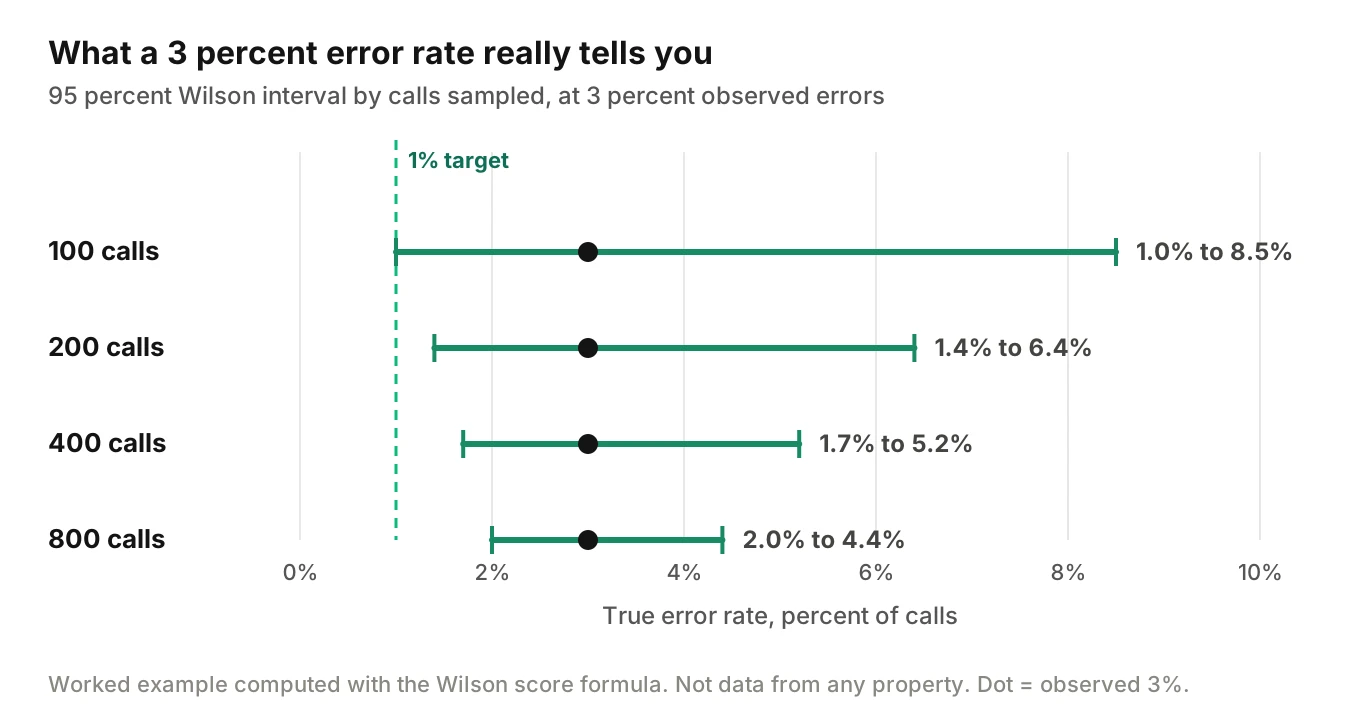
A rate from 40 calls is a rumor. The interval is the honest part. The table and chart use a worked example, not data from any property. Assume a 3 percent error rate on a critical check. The 95 percent Wilson interval follows at each sample size.
| Calls sampled | Observed errors | 95% Wilson interval |
|---|---|---|
| 100 | 3 | 1.0% to 8.5% |
| 200 | 6 | 1.4% to 6.4% |
| 400 | 12 | 1.7% to 5.2% |
| 800 | 24 | 2.0% to 4.4% |
At 100 calls you cannot tell a 1 percent problem from an 8 percent one. At 400 you can say the rate is probably above 1.7 percent. If your red line is 3 percent, you need roughly 400 calls per property to separate it from a tolerable rate. That is why monitoring every call beats a weekly sample for rare, costly errors.
Rare critical events need another method. To show fewer than 1 wrong write-back per 1,000 calls, a sample cannot do it. Compare every call with its record. The rule of three gives the scale. Zero failures in n calls gives a 95 percent upper bound near 3 divided by n. So 300 clean calls only show the rate is probably under 1 percent.
Hotel voice AI testing before you ship a change
Hotel AI booking errors found in an audit have already happened. A pre-release test stops the next regression. Write scenarios that force each failure. A date correction mid-call. A room change after hearing the price. A non-refundable rate with a caller asking for free cancellation. Two guests with one surname. A speakerphone caller with a long name.
Evalgent generates test scenarios from the agent's prompt and flows. It runs them with caller profiles that vary accent, pace, interruptions, response delay and background noise, over phone, SIP or WebRTC. A custom metric fits this audit well. "The quoted total included the resort fee" can run on every call, with audio evidence behind each verdict and human review of the results.
Pair that with the go-live checklist so every prompt change faces the same scenarios. Our post on why voice agents fail in production lists nine failure layers for the root-cause tags in step 7.
Where to go deeper: the hotel and travel cluster
This hub stays at audit level. Each neighbour goes deep on one slice. Pick the next read by the failure you found.
| If your audit found problems with... | Read | What it covers |
|---|---|---|
| The full QA build for a hotel agent | Hotel voice agent QA guide | Step-by-step test plan from setup to go-live |
| Wrong dates, rate codes, room types | Hotel AI reservation errors | The three fields that corrupt most reservations |
| Requests landing with the wrong team | Guest request routing | Housekeeping, maintenance and front-desk routing |
| Vacation rental guests and access | Vacation rental phone support | Door codes, Wi-Fi and house rules |
| Direct booking rules for rentals | Vacation rental direct booking | Minimum stays, fees and rule errors |
| Late-night emergencies | Vacation rental emergency calls | Lockouts and urgent escalation |
| Itinerary changes by phone | AI travel agent by phone | Change accuracy across bookings |
| Disruptions and rebooking | Travel disruption calls | Monitoring calls during cancellations and delays |
| Calls to airlines on a traveler's behalf | AI calls to airlines | What to test when the agent is the caller |
| Tours and activities | Tour booking tests | No-shows, ID checks and wrong units |
| Event and venue bookings | Party booking for venues | Add-ons and date errors |
| Choosing a vendor | Travel booking vendor evaluation | A bake-off method for travel agents |
| Choosing a reservations vendor | Reservations vendor evaluation | Scoring reservation agents side by side |
For the metrics layer, see hallucination rate and task success rate.
Frequently asked questions
How accurate are AI voice agents for hotel reservations?
Hotel AI voice agent accuracy depends on the property, the agent and the call mix. No public benchmark covers it. Measure your own: score a sample of calls against the PMS records. Treat any critical check above about 1 percent error as a fix-first item, and slice results per property.
How do I audit my hotel AI voice agent's bookings?
Pull a random sample of completed calls, fetch the matching PMS reservations and compare confirmed values with stored values. Score the 12 checks as pass or fail. Compute error rates with confidence intervals per property, tag root causes, fix one thing at a time and re-sample the next week.
What errors do hotel AI voice agents make most often?
No audited public data ranks them. The recurring risks are wrong dates, room types and rate codes, price quotes that omit mandatory fees, misheard names, and reservations that fail to write back. Your audit shows which of these hits your properties, and which layer causes it.
How many calls do I need to sample?
For a 3 percent observed error rate, 100 calls give an interval of about 1.0 to 8.5 percent. 400 calls narrow it to about 1.7 to 5.2 percent. Sample at least 100 per property for a first pass, and monitor every call for rare critical errors.
Does the FTC fees rule apply to a hotel AI phone agent?
The rule covers short-term lodging and requires clearly disclosing the total price, including mandatory fees such as a required resort fee (16 CFR 464.2). Whether a spoken phone quote counts as advertising a price is a legal question for your counsel. This is not legal advice.
Can a hotel AI voice agent take credit card numbers safely?
It can, if you design for it. Card security codes can never be stored after authorization, and recorded audio or transcripts can widen PCI scope. Options include DTMF masking and secure payment links. Search your stores for card-like digit runs, and confirm the design with your assessor.
How do I test a hotel AI voice agent before changing the prompt?
Write scenarios that force each of the 12 failures: mid-call date corrections, non-refundable rates with free-cancellation requests, look-alike guest names and noisy lines. Run them against the old and new versions with varied caller profiles. Ship only if no critical check regresses.
When should a hotel AI hand off to a human?
Hand off on group blocks, accessibility needs, complaints, safety issues, VIP guests and any call where verification fails or the caller asks for a person. Pass a summary so the guest does not repeat themselves. Score both the trigger and the summary in your audit.
The bottom line
Hotel AI voice agent accuracy means the PMS reservation matches what the caller agreed to, so audit the record, not the conversation. Score the 12 checks per property, sample enough calls to trust the interval, and fix critical errors before the next prompt change ships.
Related Articles
How to automate voice agent testing: synthetic callers vs manual QA
Learn how ai test automation replaces manual QA for voice agents. Compare synthetic callers vs human testers, with a 5-step framework to scale without hiring.
Read more
AI Agent Testing vs Voice Agent Testing: What General Tools Miss for Voice
AI agent testing measures text outputs. Voice agent testing measures behaviour through an acoustic pipeline. Five failure categories general tools miss.
Read more