Open door for builders.
How to Evaluate an Appointment Reminder Voice Agent Vendor
# How to evaluate an appointment reminder voice agent vendor
Quick answer
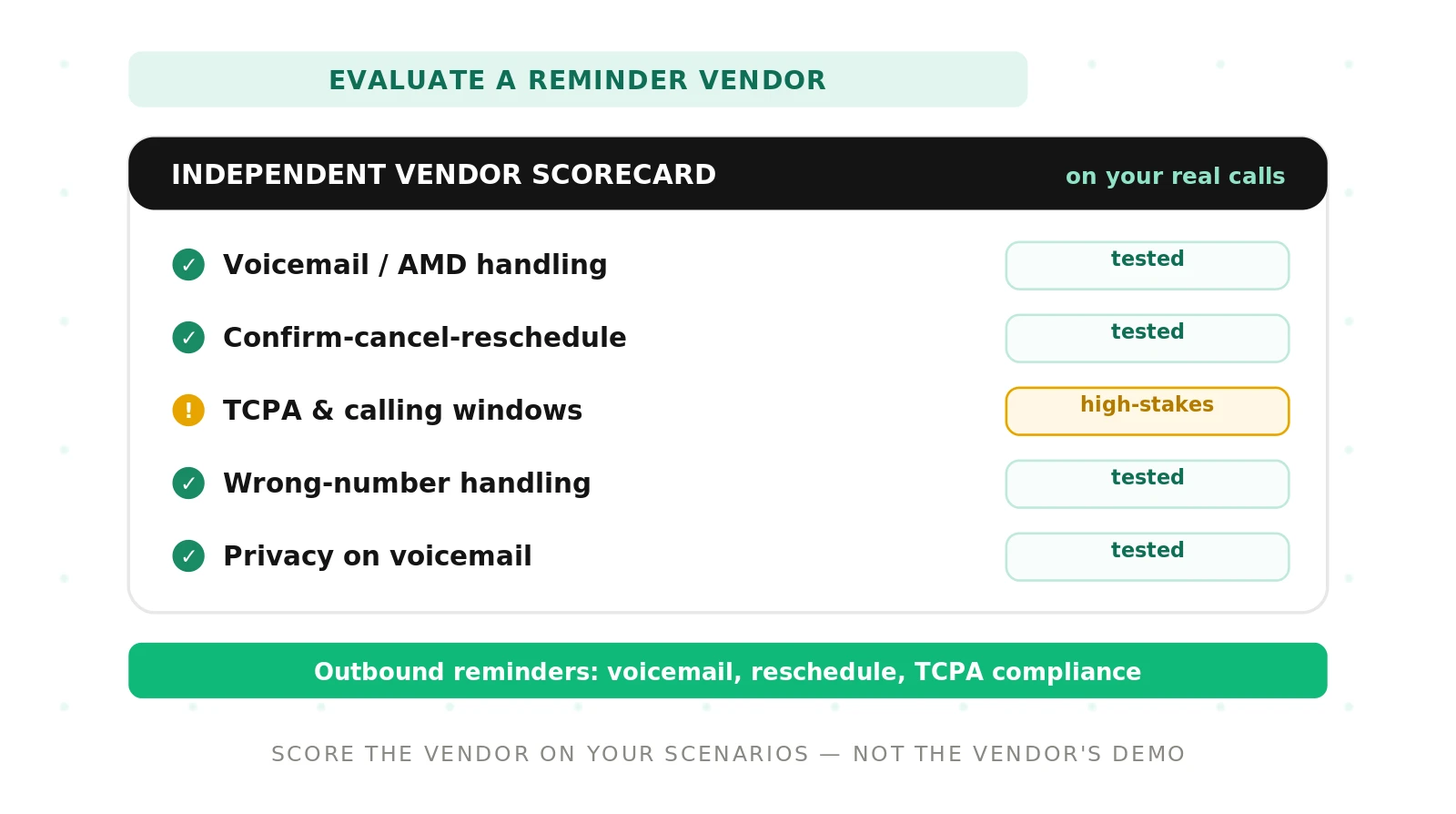
To evaluate an appointment reminder voice agent vendor, run your own outbound calls through each vendor. Test voicemail and answering-machine detection, TCPA and calling-window compliance, wrong-number handling, and confirm-cancel-reschedule capture. Score every vendor on the same recorded scenarios, not on a demo.
Appointment reminders are an outbound calling problem. That makes them different from inbound patient scheduling, where the caller dials you. Here the agent dials out. It may reach a person, a voicemail, a wrong number, or a machine. Each path has its own failure modes and its own compliance rules.
Most teams pick a reminder vendor from a polished demo. The demo shows a clean, cooperative human answering on the first ring. Your real calls do not look like that. This guide gives you a way to evaluate vendors on the calls you will actually place. It builds on our how to evaluate voice agent vendors pillar, applied to the outbound reminder case.
Why outbound reminders are a different evaluation problem
An inbound scheduling agent waits for a caller. An outbound reminder agent starts the call. That single difference changes almost everything you test.
First, the agent rarely reaches the person it wants. It hits voicemail, a spouse, a coworker, or a dead line. So detection and routing matter more than smooth chat. Second, outbound calls are regulated. The FCC's rules under the TCPA govern prerecorded and autodialed calls, consent, and opt-outs. A reminder program that ignores them creates real legal exposure.
Third, the reminder carries private information. An appointment time, a clinic name, or a service can be sensitive. Leaving those details with the wrong person is a privacy failure. So the agent must confirm identity before it discloses anything.
> Answering-machine detection (AMD): the process a dialer uses to decide whether a call was answered by a live person or a machine. AMD drives whether the agent talks or leaves a message.
For the inbound side of this use case, see our guide to testing an appointment scheduling voice agent. This post stays on outbound reminders only.
What to test in an appointment reminder voice agent
A demo will not surface these behaviors. You have to force them. Build scenarios that push each dimension to its edge, then score what the agent does. The table below gives you a starting rubric: the dimension, what to test, the pass bar, and the red flag to watch.
| Dimension | What to test | Pass bar | Red flag |
|---|---|---|---|
| Voicemail / AMD handling | Live pickup, voicemail, and slow "hello" pickups | Correct branch on 95%+ of calls; no talking over the beep | Speaks to a machine as if human; cuts off mid-greeting |
| Confirm / cancel / reschedule capture | Yes, no, and "move it to Thursday" via speech and DTMF | Intent and new slot captured correctly on 95%+ of clear replies | Logs a cancel as a confirm; drops the reschedule time |
| TCPA / calling-window compliance | Calls outside allowed hours; missing consent flag | No call placed outside window; honors consent state | Dials at 7am local; ignores a missing consent record |
| Wrong-number handling | "Who is this?" and "you have the wrong number" | Confirms identity first; ends politely without disclosing | Reads the appointment to a stranger; loops or argues |
| Privacy on voicemail | Message left when identity is unconfirmed | Generic callback message only; no sensitive detail | States clinic, procedure, or time on an unverified line |
| Retry / do-not-call | No answer, then an opt-out request | Retries within policy; suppresses on opt-out and DNC | Re-dials a DNC number; retries past the set limit |
Each row is a test you can script and repeat. The pass bars are examples; set your own from your risk tolerance and volume. What matters is that every vendor faces the identical scenarios, scored the same way.
Voicemail and AMD are the make-or-break path
On many reminder programs, most calls reach voicemail, not a person. So AMD accuracy drives the whole program. A false "live" decision means the agent talks to a beep and wastes the call. A false "machine" decision means a real person hears a canned message.
Test both errors. Send known-live numbers and known-voicemail numbers. Include slow pickups and long personal greetings, which fool weak AMD. Then check what message the agent leaves. It should be short, compliant, and free of private detail.
Capture accuracy for confirm, cancel, and reschedule
The point of the call is a decision. Did the patient confirm, cancel, or reschedule? The agent must capture that cleanly, by speech and by DTMF keypad entry.
Test noisy replies. Test "yeah, that works" and "no, I can't make it." Test a reschedule with a new day and time. Then check the write-back. A reschedule that lands as a plain confirm is a silent, expensive error. Our appointment scheduling metrics guide covers slot and read-back accuracy in depth.
Wrong numbers and "who is this"
Outbound dialing hits wrong numbers often. The agent should verify identity before it says anything private. If the person is not the patient, it should end the call politely. It must never read the appointment to a stranger.
Test the awkward openers. "Who is this?" "How did you get this number?" "Wrong number." A good agent stays calm, confirms nothing it should not, and exits. A bad one argues, loops, or leaks detail. If it loops, our guide on repetition loops shows what to watch for.
Compliance, retries, and do-not-call
Reminder calls sit inside a compliance frame. Calling windows limit when you may dial. Consent state controls whether you may call at all. Opt-out and do-not-call requests must be honored at once, and forever.
Map your program to a recognized control set, such as the NIST AI Risk Management Framework. Then test the edges. Try a number flagged as do-not-call. Try a call scheduled outside the window. Try an opt-out mid-call. The agent should suppress, stop, and record every one.
How to run an appointment reminder voice agent vendor evaluation
Run the same process for every vendor. The discipline is what makes the comparison fair.
1. Define the reminder scenarios and outcomes. List the call types you place and what a good outcome is for each. Include live pickup, voicemail, wrong number, reschedule, and opt-out.
2. Build one shared outbound test set. Assemble fixed numbers and personas that cover every dimension in the table. Use the same set for all vendors.
3. Set consent and calling-window rules up front. Write down allowed hours, consent states, and DNC handling. These are pass-or-fail gates, not scored dimensions.
4. Place the same calls on every vendor. Dial the identical scenarios through each candidate. Differences should come from the agent, not the test.
5. Score capture and compliance from recordings. Review each call. Mark AMD branch, capture accuracy, privacy, and any compliance breach. Do not accept vendor-reported numbers.
6. Compare confirmation rate and projected no-show reduction. Roll the scores up per vendor. Weight the dimensions by your risk and volume.
7. Decide and document. Record why the winner won. Keep the evidence for your RFP and contract file.
This mirrors the bake-off logic in our pillar, tuned for outbound. Treat vendor scoring like an A/B test: same inputs, measured outputs, one variable changed.
Measuring confirmation rate and no-show reduction
Two numbers decide whether a reminder program pays off. Confirmation rate is the share of reached contacts who confirm, cancel, or reschedule. No-show reduction is the drop in missed appointments after the program launches.
Confirmation rate is easy to inflate. A vendor can count any answered call as a "contact." Define it tightly. Count only calls where the right person made a clear decision the system captured correctly. That is the number that ties to outcomes.
No-show reduction is the business case. Measure it against a baseline, ideally a holdout group. Do not credit the agent for people who would have shown up anyway. This is closer to a controlled experiment than a report card, and it links to broader customer satisfaction goals.
Watch containment too. If the agent hands too many calls to staff, the savings shrink. Our containment rate guide explains how to read that number without gaming it. And build these targets into a shared metrics scorecard so every vendor is judged the same way.
Set the numbers in your contract. A clear service-level agreement turns "the agent is good" into a measurable promise. Tie penalties to the gates that matter most, such as compliance breaches and privacy leaks.
Where an independent evaluator fits
You can run this evaluation yourself. Many teams do, and the pillar shows how. But scoring hundreds of outbound calls, across voicemail, wrong numbers, and reschedules, is slow and easy to bias toward the incumbent.
That is the gap Evalgent fills. We are an independent, third-party evaluator. We build outbound reminder scenarios on your flows, including voicemail, wrong-number, and reschedule paths. We place the same calls through each vendor. Then we score capture, compliance, privacy, and AMD from the recordings, with a pass-or-fail bar you agree on in advance.
Because we do not sell a reminder agent, we have no reason to favor one. That neutrality is the point of independent voice AI evaluation. We also run adversarial checks, the way our red-team audit does, to find privacy leaks and compliance misses before your callers do. For handoff quality, we lean on the patterns in our escalation guide and our work on dead air.
The output is a scorecard you can defend to compliance, procurement, and leadership. Book a demo to see an outbound reminder evaluation on your own flows.
Frequently asked questions
How do you evaluate an appointment reminder voice agent vendor?
Place your own outbound calls through each vendor on identical scenarios. Test voicemail and AMD handling, wrong numbers, reschedule capture, and compliance. Score every call from the recording, using the same rubric for all vendors. Decide on measured results, not the demo.
How do you test voicemail detection in a voice agent?
Send known-live and known-voicemail numbers, plus slow pickups and long greetings that fool weak detection. Check that the agent branches correctly and never talks over the beep. Then confirm the voicemail message is short, compliant, and free of private appointment detail.
What compliance rules apply to outbound reminder calls?
Outbound reminders fall under the TCPA, which the FCC enforces. It governs prerecorded and autodialed calls, prior consent, calling windows, and opt-outs. Do-not-call requests must be honored immediately and kept. Map your program to a recognized control framework, and test each rule on real calls.
How do you measure no-show reduction from reminder calls?
Measure missed appointments before and after launch, ideally against a holdout group that gets no calls. Credit the agent only for the difference. Do not count people who would have shown up anyway. This controlled comparison gives you the real business case for the program.
How should a reminder agent handle a wrong number?
It should confirm identity before disclosing anything. If the person is not the patient, it ends the call politely and reveals no appointment detail. Test openers like "who is this" and "wrong number." A good agent exits calmly; a bad one argues, loops, or leaks private information.
What should a reminder agent leave on voicemail?
When identity is unconfirmed, it should leave only a generic callback message. That means a name and number to call, with no clinic, procedure, or appointment time. Stating sensitive detail on an unverified line is a privacy failure. Test this path with every vendor you consider.
How do you test reschedule capture in a voice agent?
Give the agent a reschedule request with a new day and time, by both speech and keypad. Add noise and casual phrasing like "move it to Thursday." Then check the write-back. A reschedule logged as a plain confirm is a silent error that costs you a filled slot.
How do you run an outbound reminder voice agent bake-off?
Build one shared test set covering live pickup, voicemail, wrong number, reschedule, and opt-out. Set consent and calling-window gates first. Place the same calls through each vendor. Score capture, compliance, and privacy from recordings. Weight the dimensions by your risk, then document why the winner won.
The bottom line
An appointment reminder vendor lives or dies on the calls it makes when no cooperative human answers. Evaluate every vendor on your own outbound scenarios, including voicemail, wrong numbers, and reschedules, and score compliance and privacy as pass-or-fail gates.
Related Articles
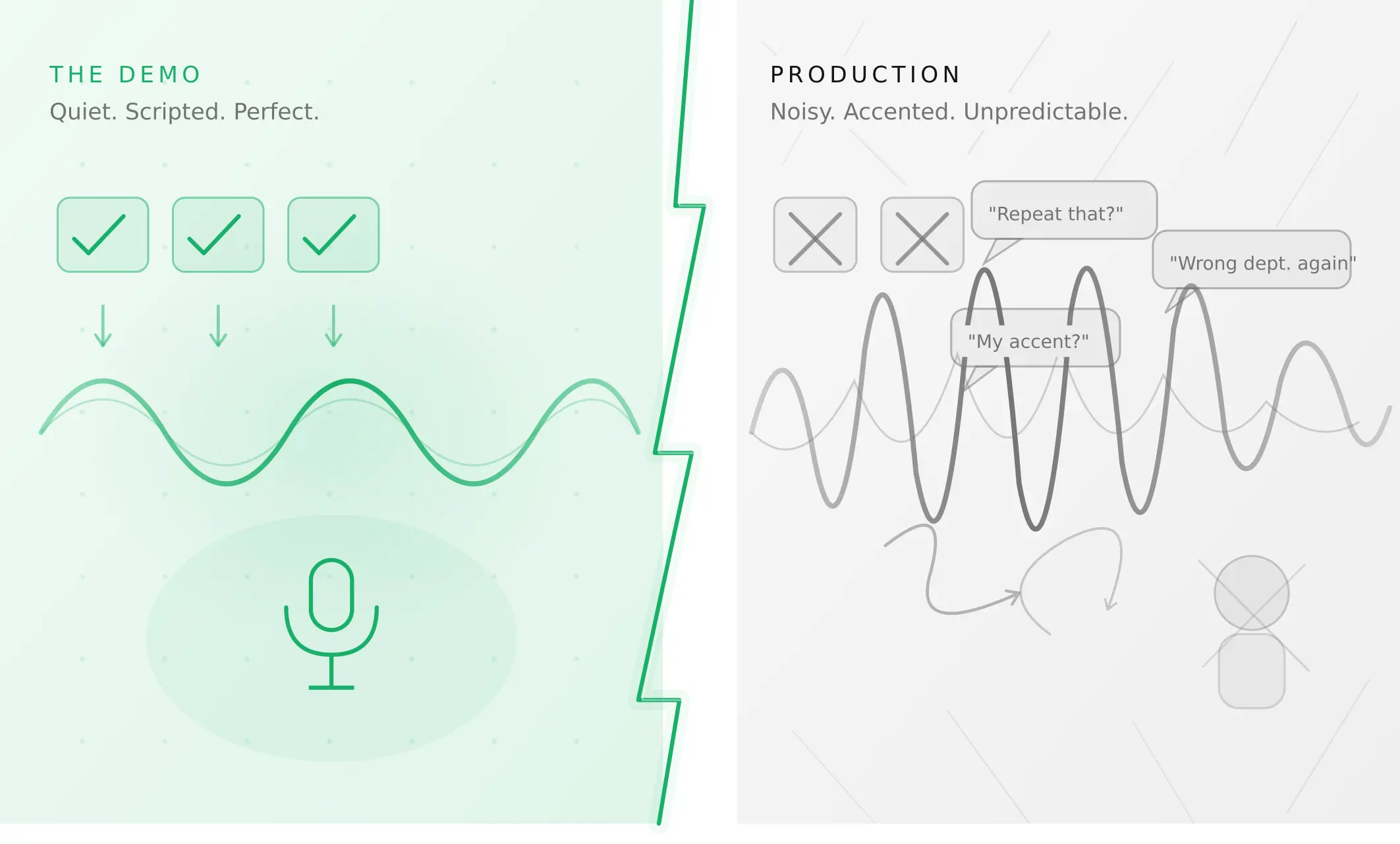
Why AI voice agents fail in production (and how to prevent it)
AI voice agents that ace demos still break in production. Learn the 5 root causes, how to test for each, and what production readiness actually means.
Read more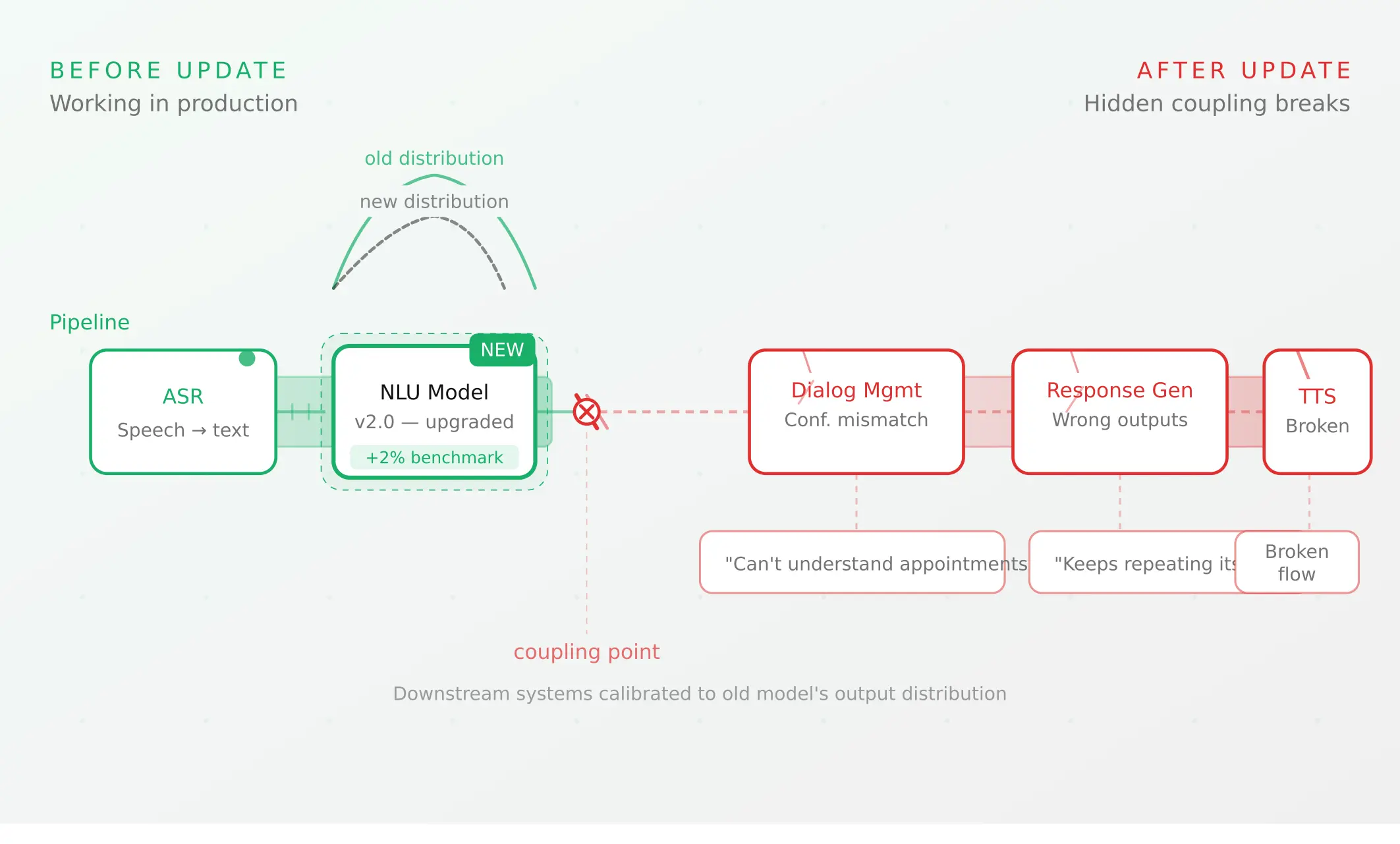
Voice agent regression testing: why LLM updates break production
LLM updates improve benchmarks but break voice agents in 5 predictable ways. How to detect and prevent regressions after every model or prompt change.
Read more