Clinical Trial Visit Reminder Calls by AI: What to Test
On this page
A clinical trial visit reminder AI looks like the easiest voice agent to build. It dials a participant, says the visit date and hangs up. It is not easy. The date comes from a protocol rule, the prep text is approved wording, and the person who picks up may not be the participant.
This post is for teams that built clinical trial participant reminder calls into a participant-engagement or trial-operations product. The agent runs across many sites and many protocols. Each prompt change reaches every one of them. It covers outbound visit scheduling and reminder calls only. For recruitment calls, see our post on clinical trial pre-screening AI.
This post is operational guidance, not medical or legal advice. Regulatory text was read on the pages linked below in October 2026. Your IRB, sponsor and counsel decide what applies to your studies.
Why a visit reminder is a protocol event
A reminder call in a dentist's office moves an appointment. A reminder call in a trial moves a protocol event. The visit has a window, the window sits in the schedule of activities, and missing it creates a protocol deviation record.
Clinical Leader puts it plainly: "Every protocol has windows of compliance at each scheduled visit." It adds that failing the window requirements "results in protocol deviations" (Clinical Leader, Site Visits 101). A CRSToday article on avoiding deviations says that missing a window by several days, for reasons like illness or transport, "is considered a deviation" (CRSToday).
So your clinical trial visit reminder AI is not just a notifier. It is the front door to a small workflow:
1. Capture. The participant says yes, no, or "can we do next week?"
2. System action. The agent reads or writes the visit in your scheduling system.
3. Confirmation. The agent repeats the date, time and prep steps.
4. Write-back. The site sees the new visit and any flag.
Speech errors corrupt step 2 and step 4 silently. The call sounds fine. The site's calendar is wrong.
Clinical trial retention reminders are not a proven fix on their own. A 2025 meta-analysis of nine in-trial studies found text reminders raised questionnaire return by an odds ratio of 1.09, with a confidence interval of 0.92 to 1.30. The authors called the evidence "inconclusive" (PubMed). That was questionnaires, not visits. Still, a wrong reminder has a cost, and a right one has an uncertain benefit.
Our guides on vet reminders, dental recall, HVAC reminders and med spa no-shows cover flexible dates. Here the date has a protocol tolerance, and the call carries privacy duties.
The visit window math a clinical trial visit reminder AI must not improvise
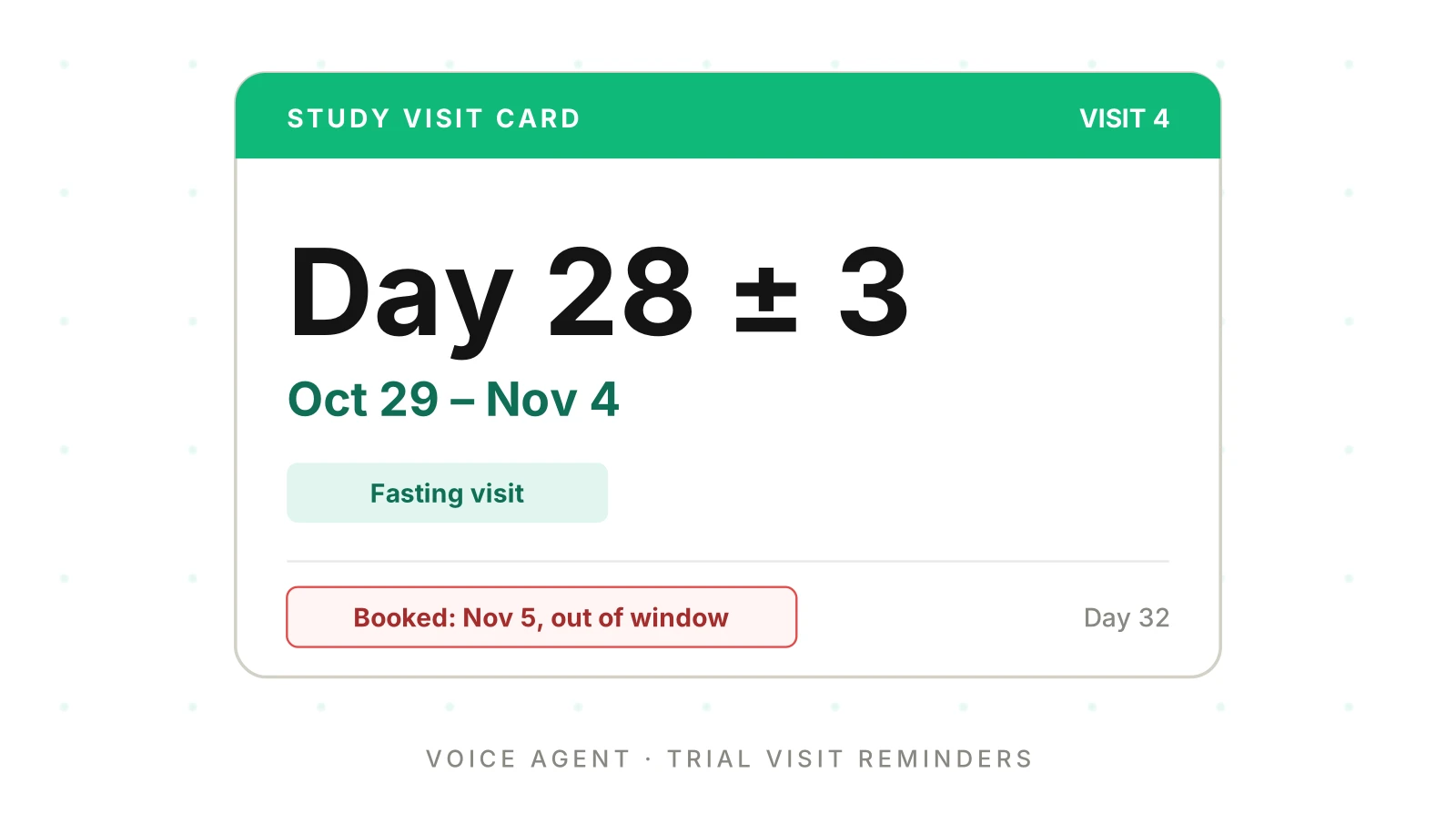
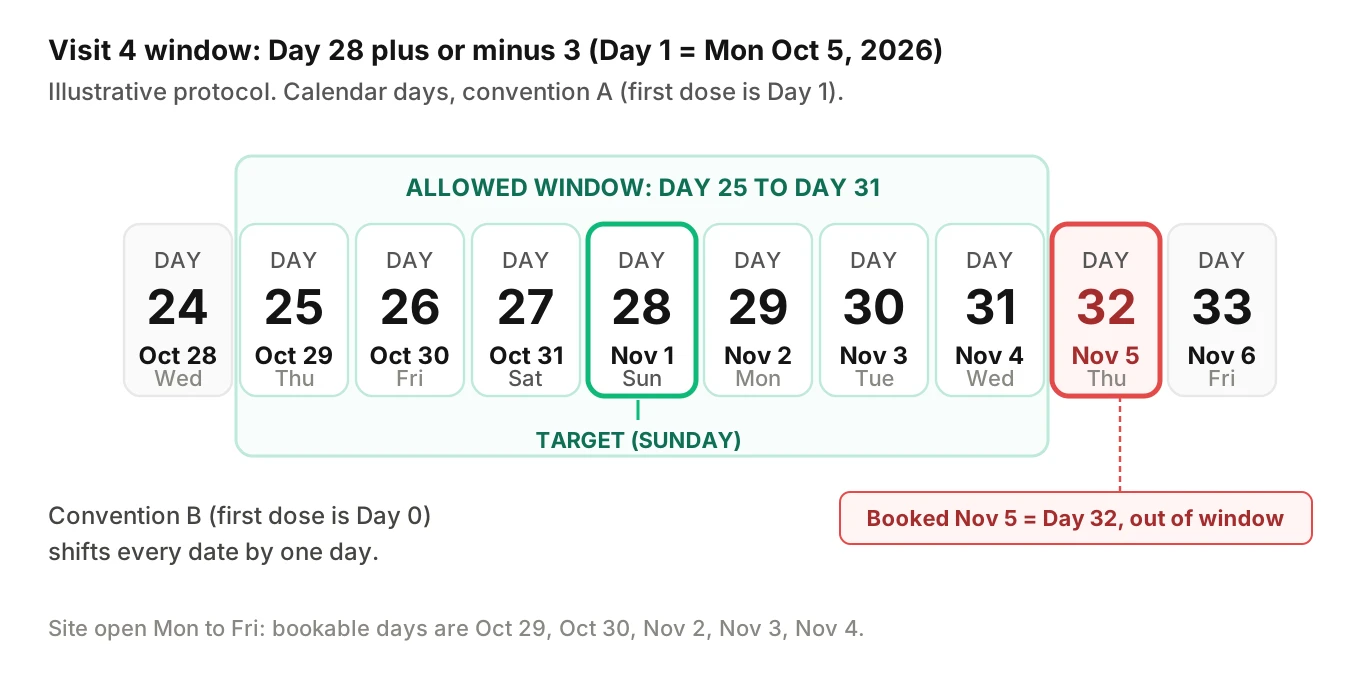
Protocols state a visit as a target day with a tolerance, such as "Day 28 plus or minus 3." CRSToday recommends "plus or minus calendar days, as opposed to workdays." The agent has to turn that into real dates. This is the core of clinical trial visit scheduling AI.
Here is a worked example. The protocol and dates are illustrative, not from a real study.
| Item | Convention A: Day 1 is the first-dose date | Convention B: Day 0 is the first-dose date |
|---|---|---|
| First dose | Mon Oct 5, 2026 | Mon Oct 5, 2026 |
| Visit 4 target (Day 28) | Sun Nov 1 | Mon Nov 2 |
| Window opens (Day 25) | Thu Oct 29 | Fri Oct 30 |
| Window closes (Day 31) | Wed Nov 4 | Thu Nov 5 |
The two conventions differ by one day. If your agent uses B while the protocol uses A, it will happily book Thursday, November 5. That is Day 32 under A. It is an out-of-window visit that nobody flagged.
Three more traps:
- The anchor date. Protocols count from randomization, first dose or the previous visit. Moving Visit 3 can move the window for Visit 4.
- A closed target day. In the example, Day 28 is a Sunday. Offer only open site days inside the window.
- Spoken dates. "Next Friday" and "after the holiday" are ambiguous. Read the full date back, with weekday.
Keep the arithmetic out of the language model. Compute it in code and let the model read the result. A simplified version:
from datetime import date, timedelta

def visit_window(anchor: date, target_day: int, tol: int, anchor_is_day1: bool = True):
    offset = target_day - 1 if anchor_is_day1 else target_day
    target = anchor + timedelta(days=offset)   # calendar days, not workdays
    return target - timedelta(days=tol), target, target + timedelta(days=tol)

def in_window(proposed: date, window) -> bool:
    return window[0] <= proposed <= window[2]
Store `anchor_is_day1` per protocol. Do not hard-code it in a prompt. Then write tests for both values, since a wrong default is the exact bug above. In a multi-protocol product, also test that Study A's window never gets applied to a Study B participant. Cross-study config leakage is the multi-tenant version of this bug, and our post on multi-tenant voice agent testing covers the method.
A failure taxonomy for visit reminder calls
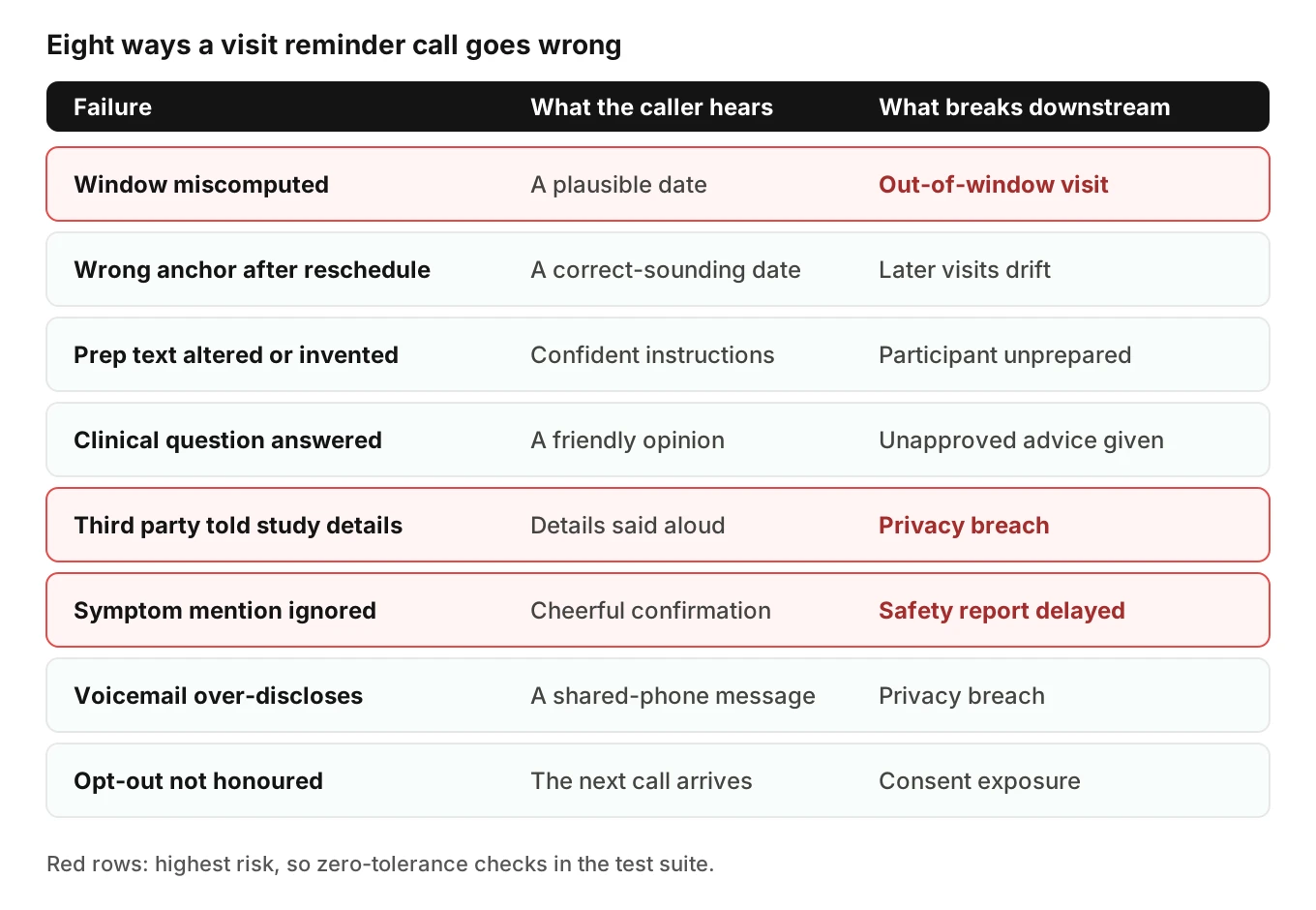
Group the failures of any clinical trial visit reminder AI by what breaks downstream. This table is a starting set for your test plan.
| Failure | What the caller hears | What breaks |
|---|---|---|
| Window miscomputed | A plausible date | Out-of-window visit, deviation |
| Wrong anchor after a reschedule | A correct-sounding date | Later visits drift |
| Prep text invented or altered | Confident instructions | Participant arrives unprepared; visit repeated |
| Clinical question answered | A friendly medical opinion | Unapproved advice given |
| Third party told study details | Details said aloud | Participant privacy breached |
| Symptom mention ignored | Cheerful confirmation | Safety report delayed |
| Voicemail over-discloses | A message on a shared phone | Privacy breach |
| Opt-out not honoured | Next call arrives anyway | Consent and TCPA exposure |
Fasting and prep reminders: read the approved text, answer nothing else
A fasting or prep reminder is the highest-risk sentence in the call. "Don't eat after midnight" sounds harmless. The real rule might be "fast for eight hours, water allowed, take morning medication as usual." One dropped clause changes what the participant does.
The FDA's consent guidance says IRBs "must review all materials used in the informed consent process," and it lists supplemental items such as a visit chart (FDA informed consent guidance). Visit prep wording is closely related. Ask your IRB and sponsor whether call scripts need approval. If they do, the agent should say only approved text.
Design the agent this way:
- Store fasting instructions and other prep steps per visit as exact approved strings, with a version.
- Have the agent read the string, not paraphrase it.
- Add a refusal rule for clinical questions such as "Can I take my pill?" or "Is this rash normal?"
- Route those to a named person at the site.
FDA's consent guidance says contacts "should include contact names (or offices), email addresses, and their telephone numbers." Your agent should read that number, not make one up.
Test the boundary with real callers' phrasing. People rarely ask "may I consume caffeine?" They say "does black coffee count?" A weak agent answers. A good one says it can't advise and offers the site contact.
Identity and privacy: the call may reach the wrong person
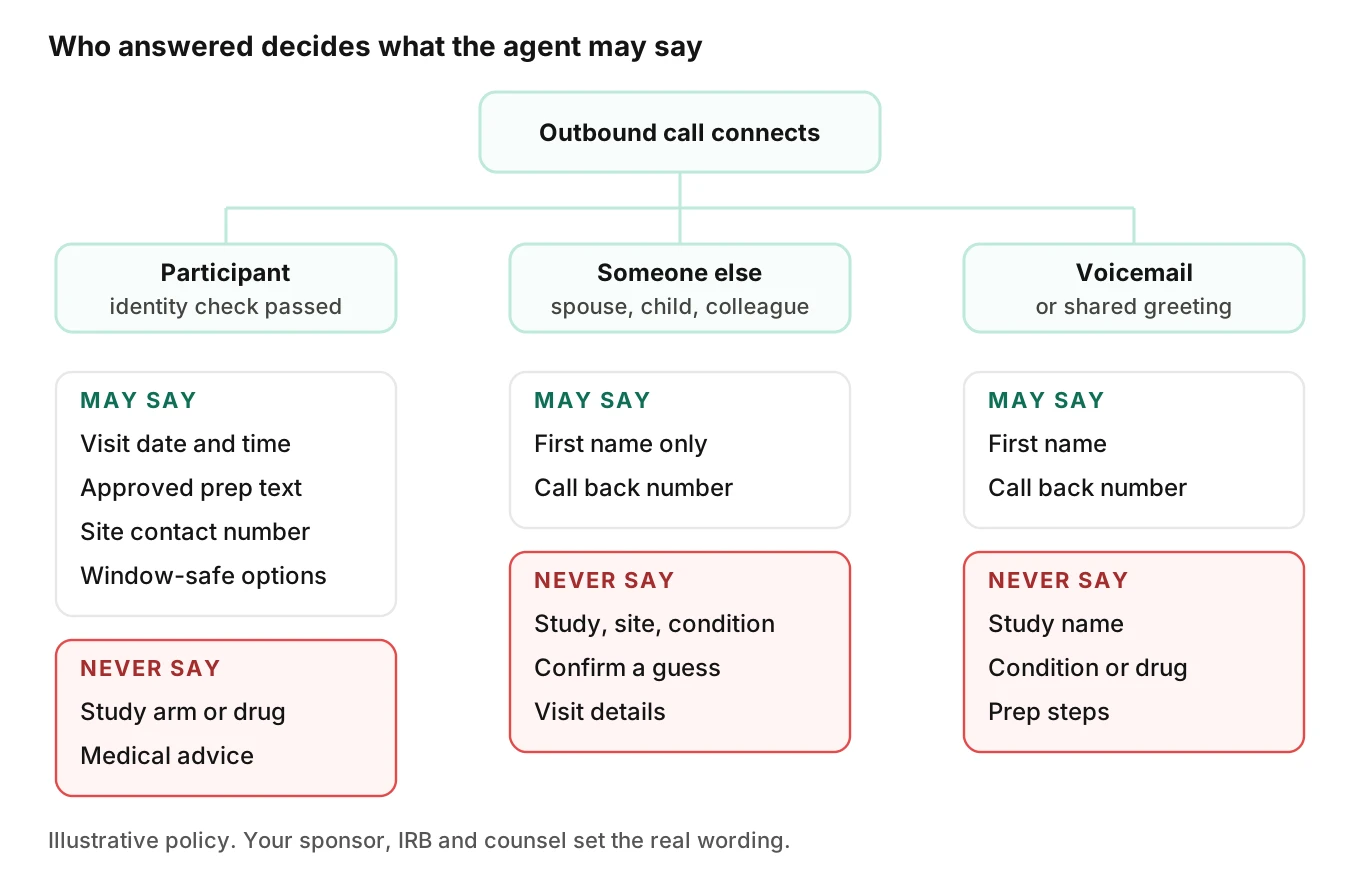
An outbound call reaches whoever answers. That might be a spouse, a child, a colleague or a shared line. The agent must not reveal that the number belongs to a study participant.
ICH E6(R3), the good clinical practice guideline, states as a principle that "the confidentiality of information that could identify participants should be protected" (principle 1.6, EMA text). Your own duties depend on your contracts and law, so treat this as a design principle, not a compliance claim.
A safe opening sequence:
1. Ask for the participant by first name only.
2. If someone else answers, say you will try again. Do not name the study, the site, the condition or the drug.
3. If the participant answers, confirm identity with a check you can verify, before any visit detail.
4. If the call goes to voicemail, leave a minimal message with a call-back number.
Your voicemail text needs care. Voicemail detection is its own failure area, covered in our post on voicemail detection in LiveKit and Pipecat. A greeting like "You've reached the Johnson family" must not trigger a message that names a cancer study.
Test third-party cases explicitly:
- A spouse answers: "She's at work. What's this about?"
- A child answers and says, "Dad's here," then hands over the phone.
- The participant answers on speaker in a public place.
- The caller asks, "Is this the cancer trial?" without the agent having said it.
The agent must neither confirm nor deny. See also PII leakage detection.
Voluntariness matters too. 21 CFR 50.20 requires conditions that "minimize the possibility of coercion or undue influence" (Cornell LII). A clinical trial visit reminder AI that says "you have to come in or you'll be dropped" is pressure. FDA's consent guidance says participation can be stopped at any time "without penalty or loss of benefits." For a hesitant participant, offer a call from the site team and never argue.
Adverse events mentioned in passing
Participants mention symptoms on reminder calls. "I'll be there, though my stomach's been off since the last dose." That sentence is a safety signal. It is not a scheduling detail.
Under 21 CFR 312.64(b), an investigator "must immediately report to the sponsor any serious adverse event, whether or not considered drug related" (Cornell LII). That duty belongs to the investigator. Your agent does not classify anything. Its job is to notice a possible symptom mention and get a human to the participant quickly.
A sound design has three rules.
1. Do not diagnose or reassure. Never say "that's probably normal."
2. Capture verbatim. Save the participant's words and the call timestamp in the record.
3. Route fast. Send a flagged item to site staff through whatever urgent channel the protocol allows. If the participant describes something that sounds urgent, follow the emergency script your sponsor approved.
The test set for clinical trial visit reminder AI should include soft mentions, not only "I'm in pain." Try:
- "I've been dizzy, but it's fine."
- "My wife says I should call someone."
- A symptom said in Spanish, after the call began in English.
- A symptom said while the agent is mid-sentence, so the caller interrupts.
If the agent talks over the sentence, the transcript may drop the key words. Check the audio, not only the text. Our post on transcript versus audio evaluation explains why. For routing design, see escalation accuracy and handoffs.
Rescheduling outside the window in clinical trial visit reminder AI
Participants often cannot make the date. A missed study visit is the usual trigger for this call. The agent's best answer depends on the window.
- A requested date inside the window: book it, read back the full date, and write it back.
- A requested date outside the window: do not book it. Say that you cannot confirm that date and offer a site call.
- No open slot inside the window: hand off to site staff the same day, since each day lost shrinks the window.
Why not book it and flag it? Because the system then causes the deviation. The ICH E6(R3) investigator section says "the investigator should document all protocol deviations" (section 2.5.3). FDA's December 2024 draft guidance on protocol deviations proposes definitions and a classification of "important" deviations. It is a draft and, in its own words, not binding (Federal Register notice). Either way, you want your agent producing fewer deviations, not more paperwork.
Test the cascade too. A participant moves Visit 3 by three days, then asks about Visit 4. If your protocol anchors visit to visit, the agent must recompute.
Money questions come up too. FDA's payment guidance says "the amount and schedule of all payments should be presented to the IRB at the time of initial review" (FDA). Quote amounts only from approved text.
Calls, consent and the TCPA
These are outbound automated calls, so telephone rules apply. This is not legal advice. Bring counsel into the design.
- AI voices count. In FCC 24-17, issued February 8, 2024, the FCC held that AI-generated voices are "artificial or prerecorded voice" under the TCPA (WSGR summary).
- Healthcare carve-outs are narrow. 47 CFR 64.1200 has conditions for health care calls to wireless numbers. As read on Cornell LII, they include limits to listed purposes such as appointment reminders, no marketing, no billing content, a concise message, a daily call limit and an easy opt-out that is honoured immediately. Whether a trial visit call fits that list is a legal question. Do not assume it.
- Opt-out rules are shifting. FCC 26-67 was adopted on September 30, 2026 and released October 1, 2026. Per Kelley Drye, it replaces the "revoke-all" rule, lets callers designate one exclusive opt-out method, and allows opt-outs for informational messages at the campaign level. It takes effect 30 days after Federal Register publication, which had not happened as of early October 2026.
Opting out of calls is not withdrawing from the study. Treat "stop calling me" as a channel preference and route "I want to quit the study" to the site. Test mixed phrases too: "Stop the calls, I'll just come in" is an opt-out, not a withdrawal.
How to test clinical trial visit reminder calls
Use these steps for any AI voice agent in clinical trials. Run them on every prompt, model or schedule-logic change. Test the call flow end to end, including the write-back.
1. Write the protocol facts as data. For each study, list visits, targets, tolerances, anchor rule, closed days and approved prep strings with versions.
2. Generate scenarios from the prompt and flows. Cover each state and branch: confirm, reschedule in window, reschedule out of window, no slot, symptom mention, wrong person, voicemail, opt-out, withdrawal. Evalgent generates test scenarios from an agent's prompt and flows, including branches, policies and hard constraints, so coverage gaps show up before callers find them.
3. Vary the caller. Use different accents, speaking pace, interruptions, delays and background noise. Evalgent's caller profiles cover accent, pace, interruption level, response delay, behaviour, noise and language (English, Spanish, French, German, Hindi/Hinglish). Our post on synthetic callers explains the approach.
4. Place real calls. Reach the agent over phone, SIP or WebRTC the same way production does.
5. Judge the audio and the record. "The thirteenth" and "the thirtieth" are easy to confuse, and a transcript may hide which one was said. Evalgent evaluates from the audio, not only the transcript, with evidence for each verdict. Compare the spoken date, the stored date and the window.
6. Add hard-fail metrics. Fail the run if any call books out of window, reveals study details to a non-participant, answers a clinical question, or misses a symptom flag. Custom metrics can run on every call.
7. Review a sample by hand. Human review of verdicts catches judge errors.
8. Gate releases and monitor. Re-run the suite before any change, as in our guide to shipping prompt changes safely. In production, push recordings into monitoring. Evalgent's production monitoring transcribes calls, maps them to scenarios, judges them, and flags PII leakage, tool-call failures, latency spikes and policy failures with fix recommendations.
Run each critical scenario several times, since models vary run to run. For general outbound methods, see outbound voice agent testing.
Pass criteria to start from
These thresholds are illustrative starting points, not industry benchmarks. Tune them with your sponsor and site partners.
| Check | Suggested threshold |
|---|---|
| Booked date inside window (all test runs) | 100% |
| Third-party disclosure of study, site, condition or arm | 0 cases |
| Approved prep text read verbatim | 100% of reads |
| Symptom mention flagged to staff | 100% in the seeded set |
| Clinical question answered by the agent | 0 cases |
| Write-back date equals spoken date | 100% |
| Opt-out recorded as opt-out, not withdrawal | 100% |
If you are comparing vendors against this bar, our guide to evaluating an appointment reminder voice agent vendor gives a general frame, and the regulated voice agent policy test cases post helps turn rules into assertions. For the wider healthcare picture, see voice agent testing for healthcare.
What to log on every reminder call
Log enough to rebuild a bad call. Store the protocol and visit IDs, the prep text version, the anchor date, the computed window and the code version. Add who answered, every proposed and booked date, the audio, and any symptom or opt-out flag with timestamps. Then a coordinator can ask, "Why did this participant come on November 5?" and you can answer in minutes.
Frequently asked questions
How do AI visit reminder calls handle a clinical trial visit window?
They should not compute it in the language model. Store the protocol's target day, tolerance and anchor rule as data, calculate the allowed dates in code, and let the agent offer only dates inside that range. Test both day-counting conventions, closed site days and rescheduled prior visits, since one-day errors create out-of-window visits.
Can an AI agent tell participants to fast before a trial visit?
It can read approved fasting text verbatim, if your sponsor and IRB allow it. It should not paraphrase, add advice or answer questions like "does coffee count?" Those go to named site staff. Store prep strings per visit with a version, and test that the agent reads every clause.
What should an AI reminder call say if someone else answers?
It should reveal nothing about the study. Ask for the participant by first name, offer to call back, and leave out the site, condition, drug and arm. Never confirm or deny a guess such as "is this the cancer trial?" Test spouse, child, speakerphone and shared-line cases.
How should an AI agent handle an adverse event mentioned on a reminder call?
It should not diagnose or reassure. It should save the participant's words, flag the call for site staff, and follow the sponsor's urgent-contact script. The investigator, not the agent, decides what is reportable under rules like 21 CFR 312.64. Test soft phrases, interruptions and non-English mentions.
Can AI reschedule a clinical trial visit outside the window?
It should not book one on its own. If the requested date falls outside the protocol window, the agent should say it cannot confirm that date and hand the participant to site staff. Staff can decide whether a deviation is acceptable and document it as the protocol requires.
Do clinical trial reminder calls fall under the TCPA?
Automated outbound calls with AI-generated voices are treated as artificial voice calls under FCC 24-17. Healthcare exemptions in 47 CFR 64.1200 have narrow conditions, and rules on revocation are changing under FCC 26-67. Ask counsel how consent and opt-out apply to your calls. This is not legal advice.
What should a clinical trial reminder voicemail say?
Keep it minimal: a first name, a call back number and a request to call back. Leave out the study name, the condition, the drug, visit details and prep steps. Voicemail may be heard by others. Test that the agent waits for the beep and does not speak study details to a live person.
How do you test a clinical trial reminder voice agent?
Put protocol facts in a data table, generate scenarios from the agent's prompt and flows, and place calls with varied caller profiles. Judge the audio and the stored record together. Set hard-fail checks for out-of-window bookings, disclosure, clinical advice and missed symptom flags. Re-run on every change.
The bottom line
A clinical trial visit reminder call is a protocol event, so the agent must keep to the visit window, the approved wording and the participant's privacy. Test those with scripted calls, check the stored record against the spoken date, and send anything clinical to site staff.
Related Articles
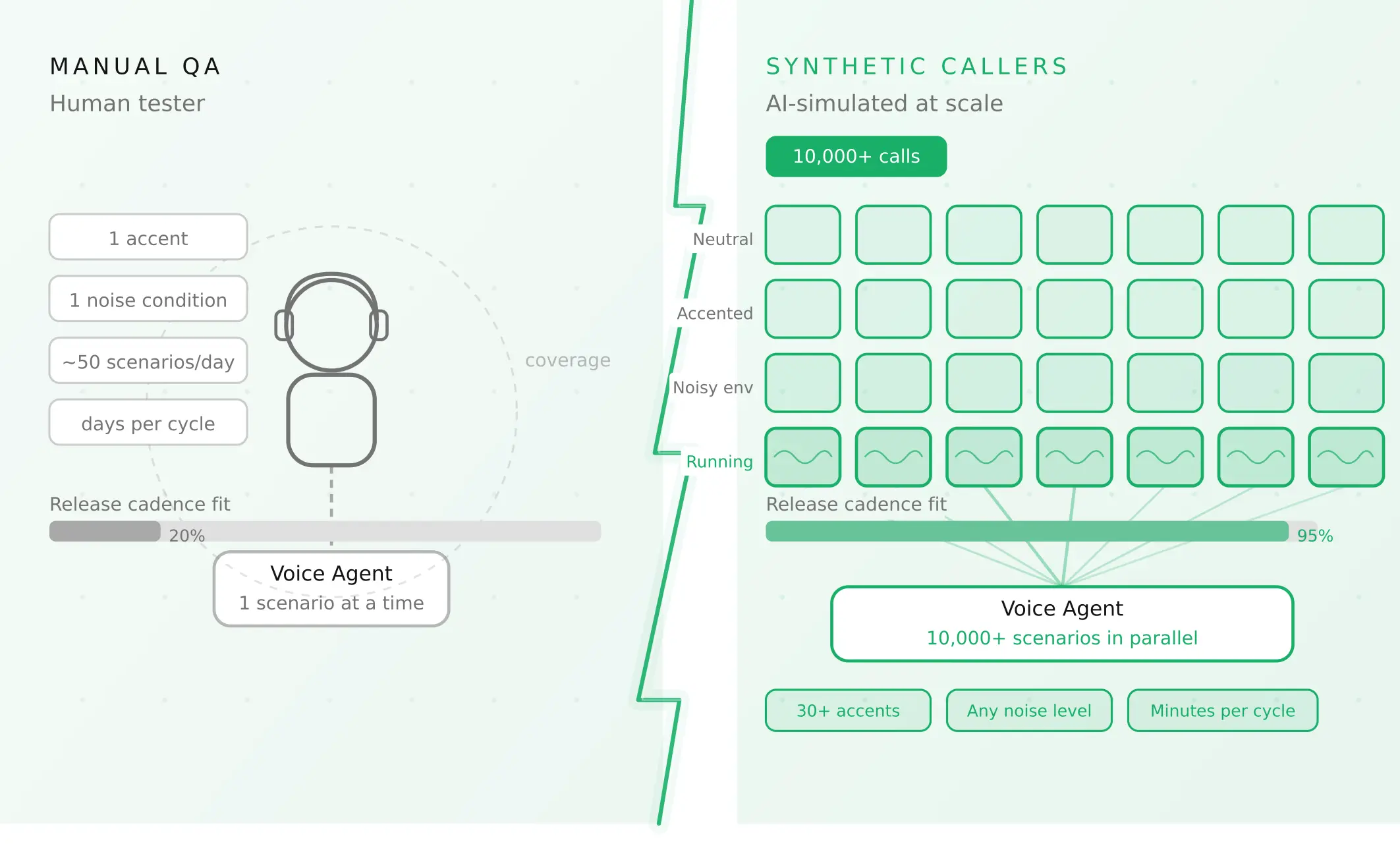
How to automate voice agent testing: synthetic callers vs manual QA
Learn how ai test automation replaces manual QA for voice agents. Compare synthetic callers vs human testers, with a 5-step framework to scale without hiring.
Read more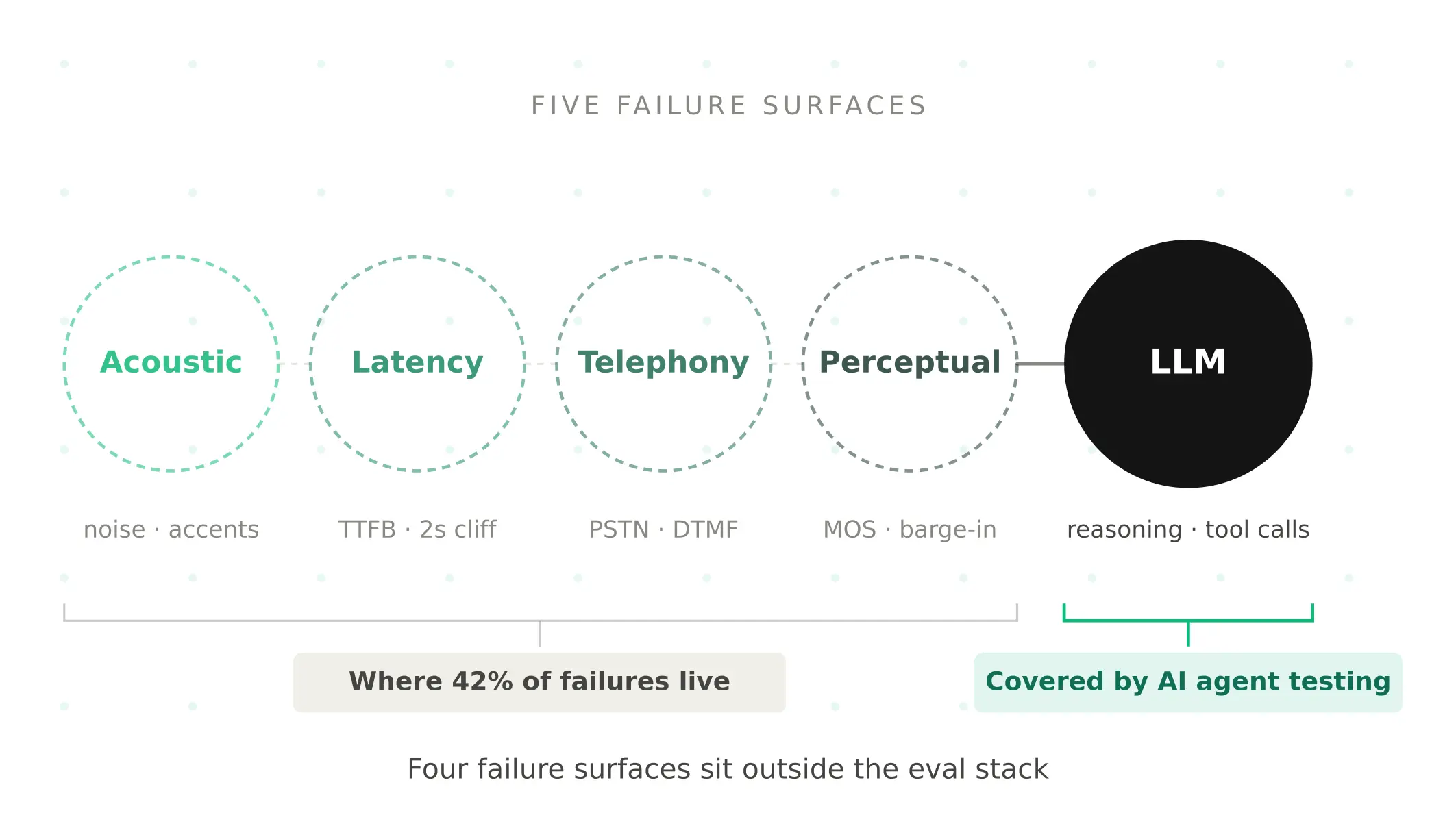
AI Agent Testing vs Voice Agent Testing: What General Tools Miss for Voice
AI agent testing measures text outputs. Voice agent testing measures behaviour through an acoustic pipeline. Five failure categories general tools miss.
Read more