Voice agent testing for healthcare: HIPAA, safety, and reliability
On this page
A voice agent in healthcare is not a convenience feature. It talks to patients about appointments, refills, and symptoms, and it handles some of the most sensitive data that exists. A failure is not a bad customer experience — it can be a privacy breach or a safety event. That raises the bar for testing well above a typical support bot. Evalgent tests healthcare agents against exactly these stakes, and this guide walks through what that means.
Healthcare voice agent testing: the practice of verifying that a patient-facing voice agent handles protected health information correctly, stays within safe clinical boundaries, escalates urgent cases, and completes tasks like scheduling reliably.
Why healthcare voice agents are harder to test
A general support agent can afford a wrong answer now and then. A healthcare agent cannot afford a privacy leak or an unsafe response even once. Three things make the testing harder.
First, every call may involve protected health information. Names tied to conditions, appointment reasons, medications — all of it is PHI under HIPAA, and how the agent speaks it, stores it, and logs it is regulated. Second, the agent operates near clinical boundaries it must not cross. It can share appointment times; it must not diagnose or advise. Third, the caller is often anxious, unwell, or elderly, so the agent has to handle distress, confusion, and accents while staying accurate.
None of this shows up in a happy-path demo. It shows up on the real calls, which is why testing has to reproduce them deliberately. Our guide on why voice agents fail in production covers the general version of this gap; healthcare simply raises the cost of each failure.
HIPAA and PHI: what testing has to prove
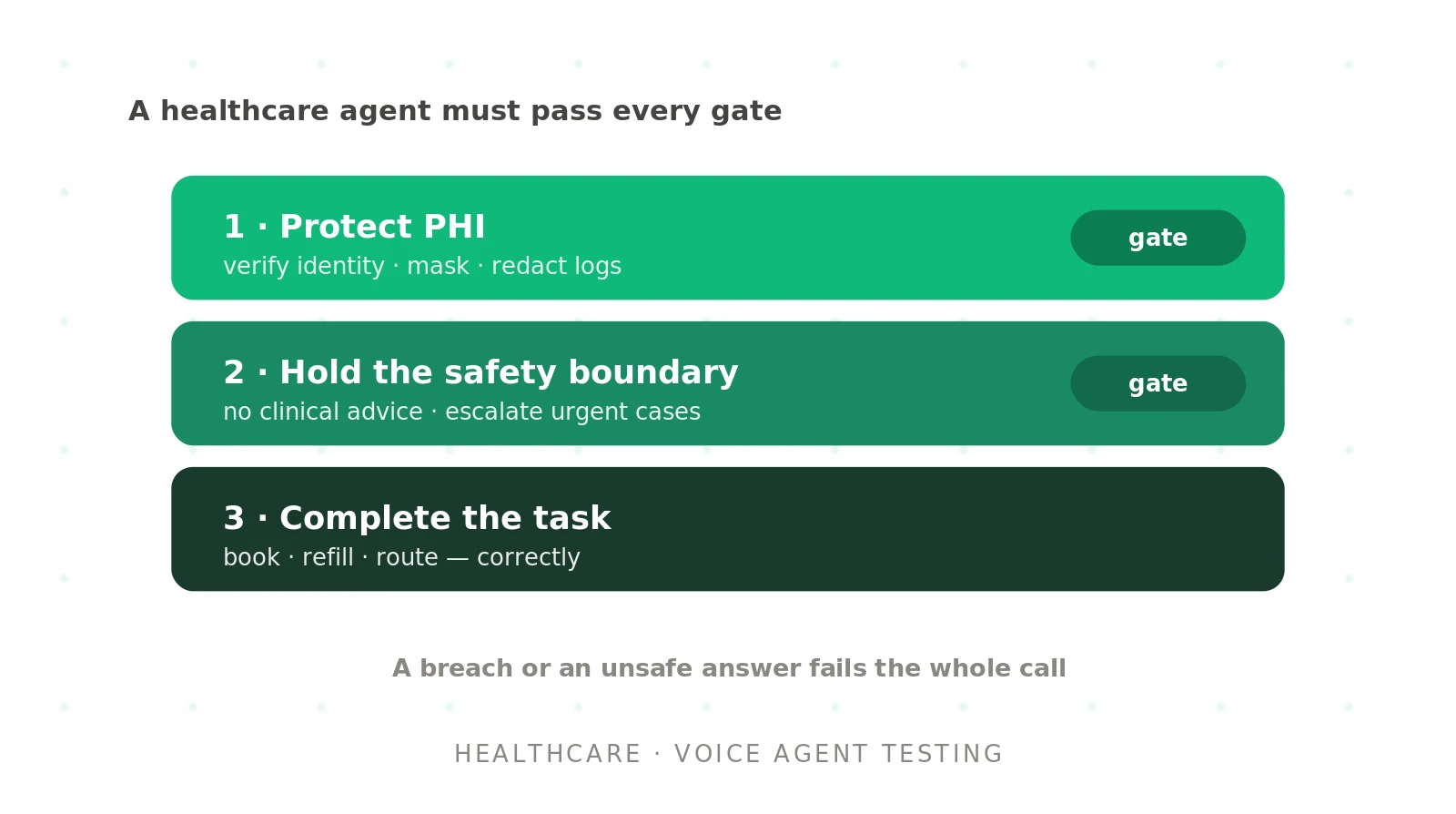
The first job of healthcare voice agent testing is proving the agent protects health information. HIPAA governs how PHI is used, disclosed, and stored, and a voice agent touches all three. Testing has to assert the right behavior, not assume it. The official HHS HIPAA guidance sets the framework; your tests turn it into checks.
Concretely, the agent should verify identity before sharing any PHI, confirm sensitive details with masked values rather than reading them in full, and never let one patient's information surface in another call. Transcripts and logs must redact PHI rather than store it in plain text. Each of these is a testable assertion, and each belongs in a release gate. Our PII handling guide covers the mechanics that apply directly here.
Consent and disclosure matter too. If calls are recorded, the agent may need to say so. If it collects information, it should collect only what the task needs. Data minimization is not just good practice — it shrinks the surface area of any breach.
The clinical safety boundary
The second job is safety. A healthcare voice agent sits next to clinical decisions it is not licensed to make, and the line between helpful and harmful is exactly where testing must focus.
The agent can confirm an appointment, explain how to request a refill, or route a caller to a nurse line. It must not diagnose, recommend a treatment, or interpret symptoms. The dangerous failure is a confident, out-of-scope answer — a hallucinated reassurance to a patient describing a serious symptom. Testing has to drive those exact situations and assert the agent defers and escalates rather than advising. Our hallucinations guide shows how to catch invented answers; in healthcare, that catching is a safety control.
Escalation is the other half of the boundary. When a caller describes an emergency, asks something clinical, or becomes distressed, the agent should hand off cleanly to a human with full context. Testing must confirm the handoff fires on the right triggers and passes what the clinician needs. The escalation guide covers how to test that handoff so it never traps a patient who needs a person.
The healthcare scenarios you must test
Vertical testing means testing the calls the vertical actually receives. For a healthcare agent, a strong scenario set covers the common tasks and the edges where they break.
| Scenario | What it tests |
|---|---|
| Book, reschedule, cancel an appointment | Correct calendar action, date and time handling |
| Prescription refill request | Right routing, identity check, no clinical judgment |
| Symptom or emergency mention | Safe deferral and immediate escalation |
| Insurance or coverage question | Accurate routing, no unlicensed advice |
| Identity verification | PHI released only after the caller is verified |
| Distressed or elderly caller | Patience, clarity, and correct handling under stress |
Each of these should run across accents and noise, because a clinic's callers are diverse and often calling from difficult environments. A scenario that only works for a clear, calm speaker has not been tested for the real patient population.
Metrics that matter in healthcare
The metrics that define a good healthcare agent are not the same as a sales bot's. Task completion still matters, but safety and compliance metrics sit above it.
Track PHI-safe behavior as a pass-or-fail gate: was identity verified before disclosure, were sensitive values masked, were logs redacted. Track escalation accuracy: did urgent and clinical cases hand off correctly, and did routine ones stay contained. Track scheduling accuracy: did the booking action match what the patient asked for, down to the date and time. And track containment carefully — a high containment rate is good only if it never comes at the cost of a patient who needed a human.
Treat the compliance and safety metrics as binary release gates. A dip is a blocker, not a discussion, because the downside is a breach or a harmed patient, not a lower score.
How to test a healthcare voice agent
The method mirrors general testing but with safety and compliance as non-negotiable gates.
Start by mapping the tasks and the boundaries: what the agent may do, and what it must never do. Turn each into scenarios, including the unsafe prompts it must refuse. Build patient profiles that vary age, accent, distress, and line quality, so the agent faces the real caller base. Assert behavior at the level that matters — identity checked, PHI masked, escalation fired, booking correct — not just that the transcript sounds caring. Run the suite as automated calls before every release, and re-run it after any prompt, model, or knowledge-base change, since each can reintroduce an unsafe or non-compliant path.
Common failure modes in healthcare agents
These are the failures that recur in patient-facing agents, and the ones worth building tests around first.
| Failure | Why it is dangerous | Test for it |
|---|---|---|
| PHI read aloud or logged raw | Privacy breach under HIPAA | Assert masking and redaction |
| Out-of-scope clinical answer | Patient safety risk | Assert deferral and escalation |
| Missed emergency escalation | A patient in need is trapped | Assert urgent handoff triggers |
| Wrong appointment action | Missed or double-booked care | Assert booking matches intent |
| Poor handling of distress | Erodes trust, misses urgency | Test distressed-caller profiles |
After-hours calls and safe routing
Much of a healthcare agent's value is handling calls when the clinic is closed, and that is also where the risk concentrates. After hours, there is no human immediately behind the agent, so its routing decisions carry more weight.
Testing has to cover the after-hours paths explicitly. A caller with a routine request should be handled or scheduled. A caller describing an urgent symptom must be routed to the right resource — a nurse line, an on-call service, or instructions to seek emergency help — without the agent attempting clinical judgment. The failure to avoid is an agent that quietly books a next-week appointment for someone describing an emergency.
Drive after-hours scenarios across urgency levels and assert the routing matches the severity. Confirm the agent never downgrades an urgent case to a routine one, and never substitutes clinical guidance for escalation. Because the human safety net is thinnest after hours, these routing assertions are among the most important tests a healthcare agent has to pass.
Testing healthcare voice agents with Evalgent
Evalgent is built to test exactly this combination of compliance, safety, and reliability. Scenarios reproduce real patient calls — scheduling, refills, symptom mentions, and the unsafe prompts the agent must refuse. Profiles vary patient age, accent, distress, and line quality, so the agent is tested against the real population, not a calm demo caller. Metrics encode PHI-safe behavior, escalation accuracy, and scheduling correctness as pass-or-fail gates with thresholds you set. Evaluations run the whole suite as automated batches of synthetic callers before each release. Reviews let your clinical and compliance teams replay any call with audio, transcript, and metrics together, which is where safety sign-off actually happens.
The result is a healthcare agent you can defend to a compliance officer and a clinician at once: privacy protected, safety boundaries held, and tasks completed. For the broader discipline, see the AI voice agent testing pillar.
Conclusion
Healthcare voice agent testing is where privacy, safety, and reliability stop being separate concerns and become one release gate. The agent must protect PHI, stay inside its clinical boundary, escalate urgent cases, and still get the appointment right.
Test the compliance and safety behaviors as hard gates, across a realistic patient population, before any release. In healthcare, the cost of shipping an untested agent is measured in breaches and patient harm, not in a lower metric.
Frequently asked questions
How do you test a healthcare voice agent?
Map the tasks the agent may do and the boundaries it must never cross, then build scenarios for both, including unsafe prompts it must refuse. Test across patient profiles that vary age, accent, and distress. Assert PHI is protected, urgent cases escalate, and bookings match intent, and run the suite as a release gate before every deployment.
Is a voice agent HIPAA compliant?
A voice agent is not automatically HIPAA compliant; compliance depends on how it handles protected health information. It must verify identity before disclosure, mask sensitive values, redact logs, isolate patient data, and operate under the right agreements. Testing proves these behaviors hold on real calls, turning HIPAA requirements into concrete, repeatable checks you can gate releases on.
How do you test a medical voice agent for safety?
Drive scenarios where a caller mentions symptoms, an emergency, or asks for clinical judgment, and assert the agent defers and escalates instead of advising. Safety testing focuses on the boundary the agent must not cross. Combine it with hallucination testing, since a confident, out-of-scope answer to a patient is the core safety risk to catch.
What should a healthcare voice agent escalate?
It should escalate any emergency, any request for clinical judgment or diagnosis, and any caller in clear distress, as well as explicit requests for a person. The handoff should reach the right human — a nurse line or clinician — with full context. Testing must confirm these triggers fire reliably and never leave an urgent caller stuck.
How do you test PHI handling in a voice agent?
Run scenarios where callers provide health information, then assert the agent verifies identity before sharing anything, confirms with masked values rather than reading them in full, and that stored transcripts and logs redact PHI. Also test that one patient's data never appears in another session. Treat any leak as a release-blocking failure.
Can a voice agent do medical triage?
A voice agent can collect information and route calls, but it should not perform clinical triage or give medical advice unless explicitly designed and governed for it. The safe pattern is to gather details and escalate to a licensed human for any clinical judgment. Testing should assert the agent stays within that boundary under pressure.
What metrics matter for healthcare voice agents?
Beyond task completion, the key metrics are PHI-safe behavior, escalation accuracy, and scheduling correctness, treated as pass-or-fail gates. Containment matters only if it never traps a patient who needs a human. Because the downside is a breach or a safety event, compliance and safety metrics are release blockers rather than numbers to optimize gradually.
How do you test appointment scheduling for a clinic?
Run scenarios for booking, rescheduling, and canceling, and assert the calendar action matches exactly what the patient asked, including the correct date, time, and provider. Test edge cases like ambiguous dates, timezone confusion, and no availability. Vary caller accent and line quality, since a clinic's patients rarely call from quiet, ideal conditions.
Related Articles
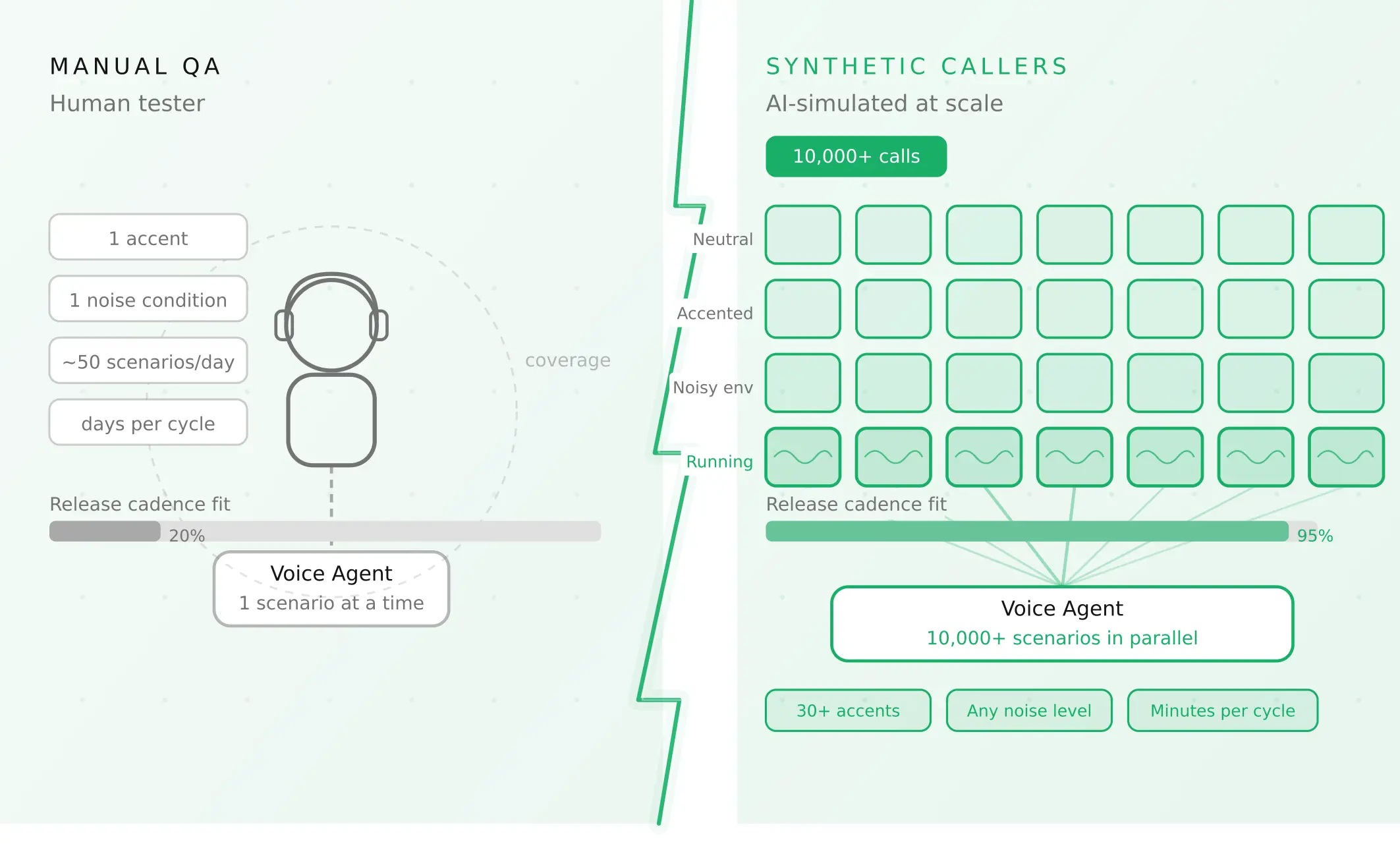
How to automate voice agent testing: synthetic callers vs manual QA
Learn how ai test automation replaces manual QA for voice agents. Compare synthetic callers vs human testers, with a 5-step framework to scale without hiring.
Read more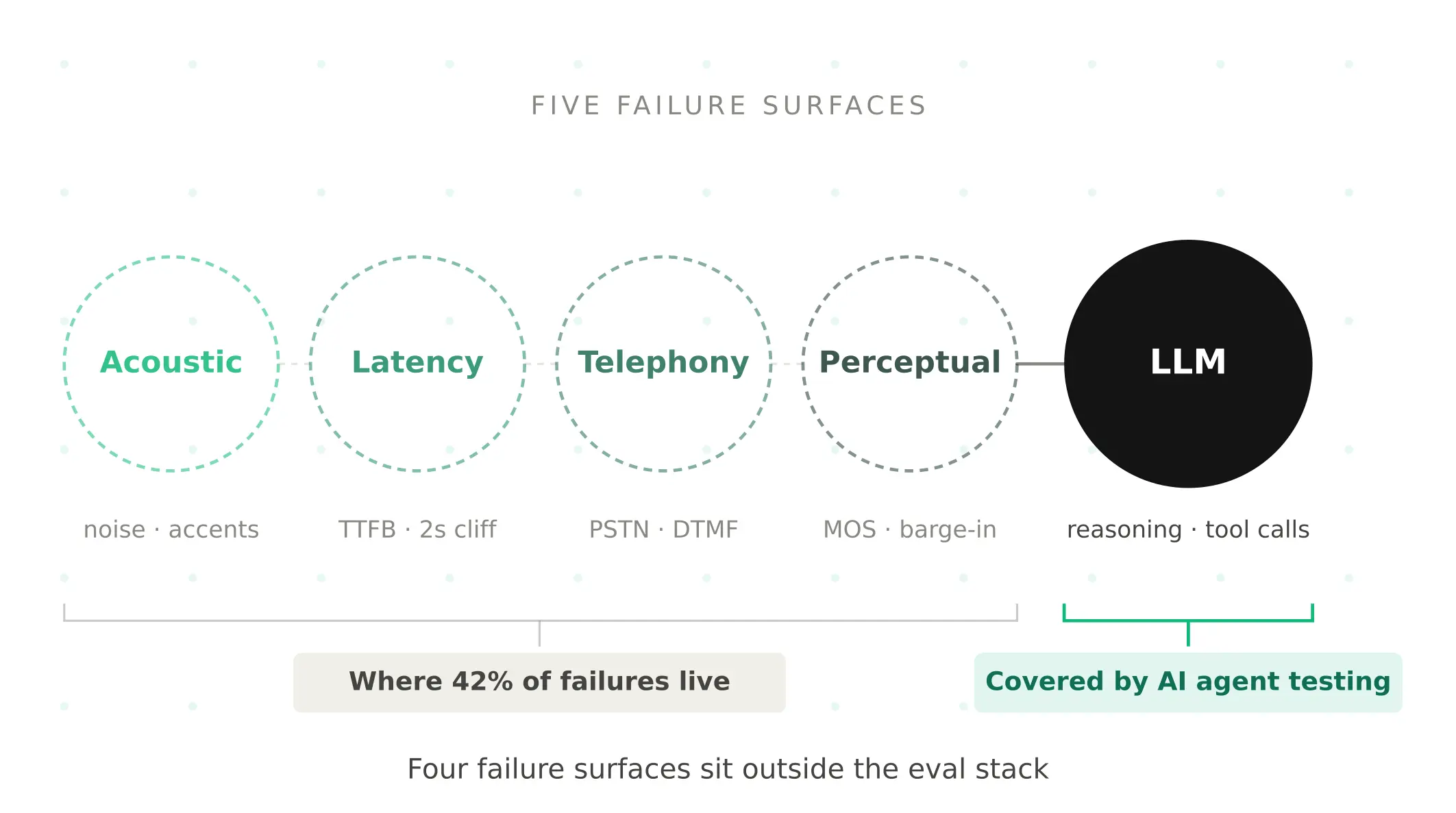
AI Agent Testing vs Voice Agent Testing: What General Tools Miss for Voice
AI agent testing measures text outputs. Voice agent testing measures behaviour through an acoustic pipeline. Five failure categories general tools miss.
Read more