Vet Reminder Calls AI: Wrong Pet, Wrong Vaccine Errors
On this page
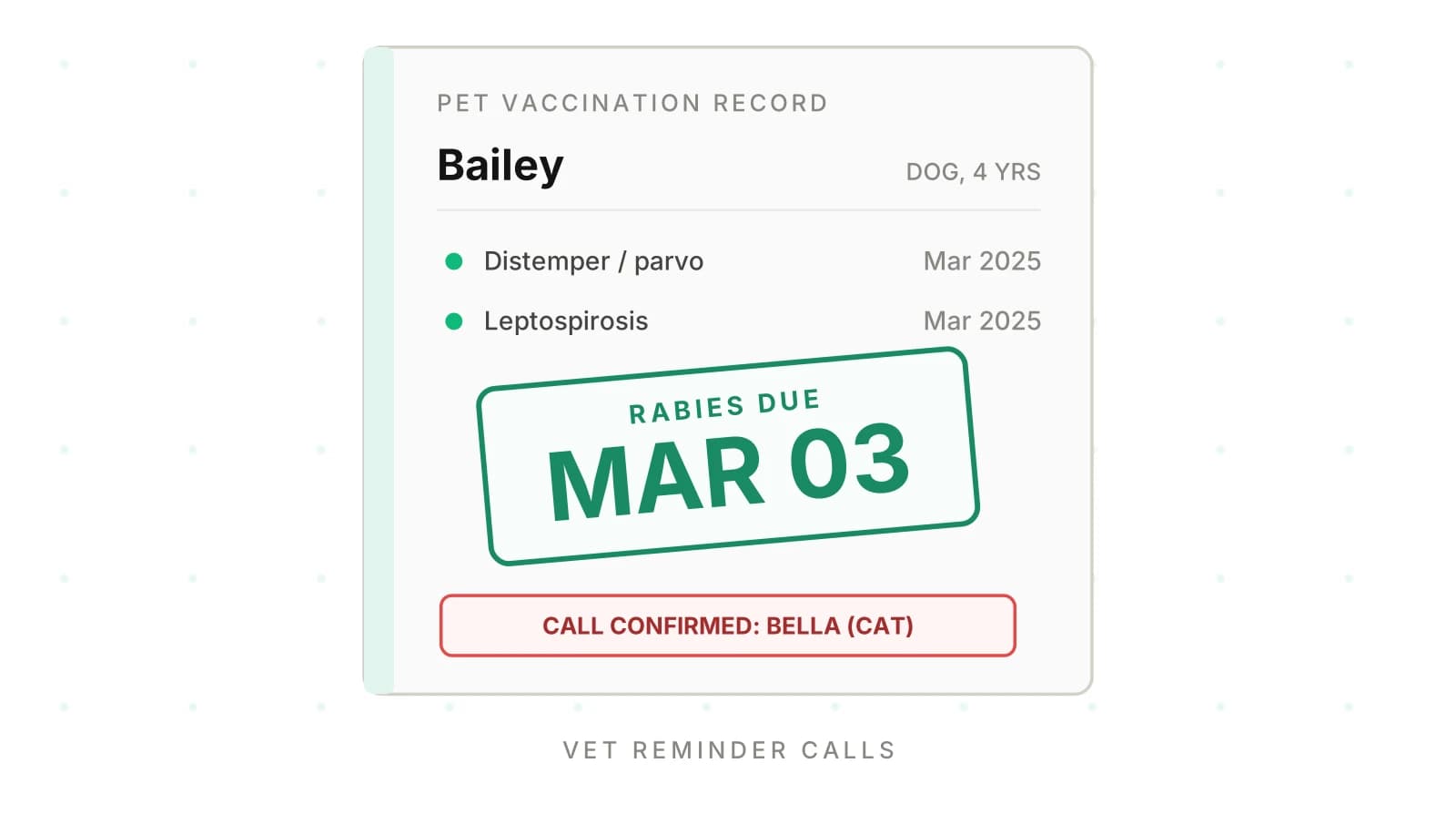
Say your product runs an AI voice agent for veterinary clinics. Each clinic has its own clients, pets and vaccine rules. The agent calls Maria about "Bailey." Maria has two dogs and a cat. One of them is overdue for rabies. Which one did the call confirm, and what did it write back?
This post covers veterinary appointment reminder calls and the vaccine, boarding and wellness-plan calls around them. It does not repeat inbound triage, which our veterinary AI receptionist post covers. For the same reminder pattern in other trades, see dental recall calls and HVAC reminder calls. Nothing here is veterinary or legal advice. Vet reminder calls AI teams ship are only as good as the record they write back.
What a vet reminder call writes back
A reminder call looks like a notification. It is a small transaction. The agent finds a client, picks a pet, states a fact, takes an answer and writes a result. In a vet clinic that record is three levels deep.
| Level | Example | What goes wrong |
|---|---|---|
| Client (owner) | Maria Alvarez, mobile number | Wrong person answers; number shared with a spouse or neighbour |
| Patient (pet) | Bailey, dog, 4 years | Wrong pet named; two pets with similar names |
| Due item | Rabies booster, due on a date | Wrong vaccine, wrong date, wrong species rule |
| Outcome | Booked, declined, call back, opt-out | Written to the client instead of the patient |
Most practice management software stores reminders on the patient and contacts on the client. Your agent sits across that join. A "confirmed" flag can land on the wrong pet, and the right pet is never reminded.
The call is the front door to an agentic flow: pull the due list, dial, confirm identity, state the item, book, write back. Our reminder vendor evaluation guide covers the vendor side. Here we cover the pet-specific failures.
Wrong pet in a multi-pet household
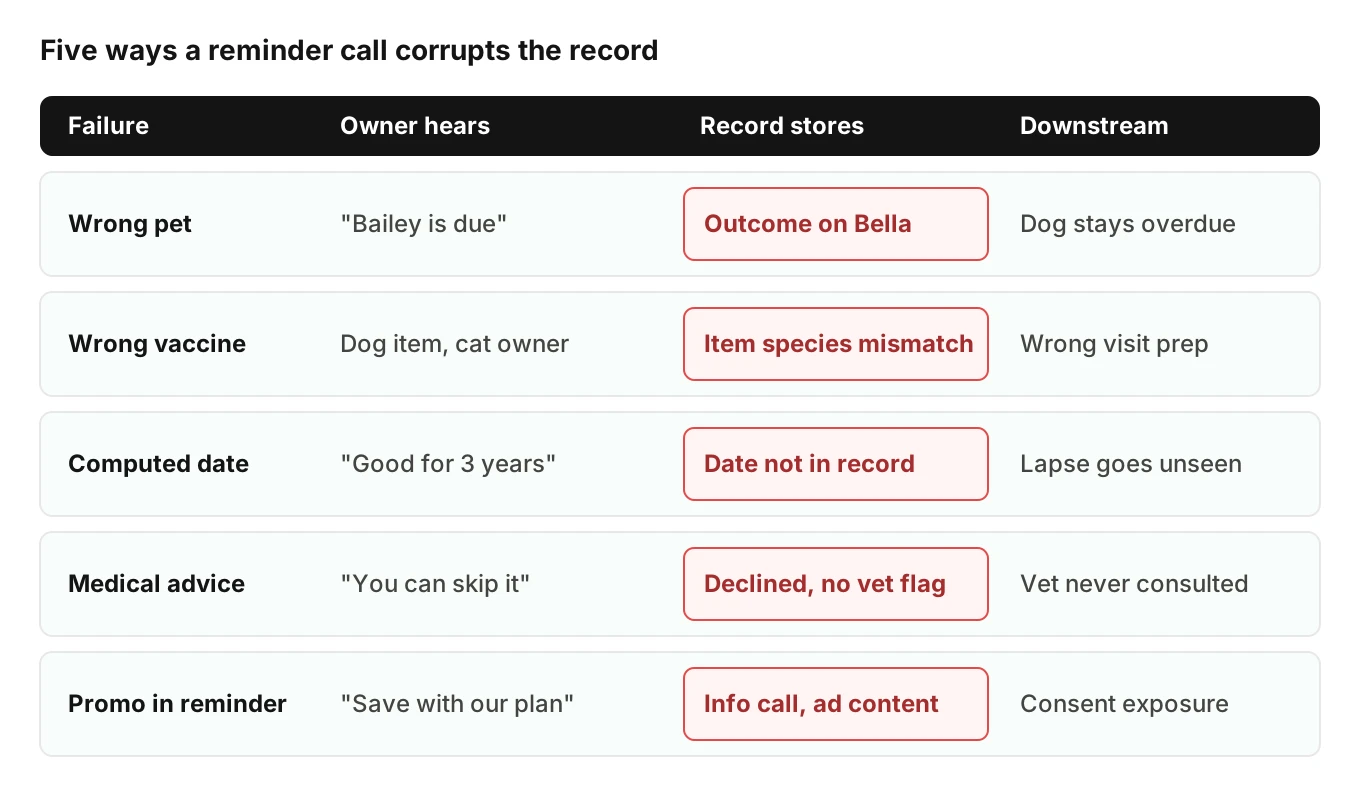
This is the highest-impact failure. A household with a dog and a cat gets one call. The agent says "Bailey is due for a booster." The record holds Bailey the dog and Bella the cat.
That "yes, right" from the owner is weak evidence. Owners agree to the wrong pet while driving, when a child answers or when they expect another call.
Common patterns to test:
- Similar names. Bailey and Bella, Max and Maxine, Luna and Lola. Speech recognition can swap them.
- Name shared across species. A dog and a cat both named Milo.
- Pet name is also a person name. "Charlie," "Sam," "Ruby." The agent may hear an owner name.
- Species not stated. "Bailey is due for a booster" with no "your dog" leaves room for a mismatch.
- Deceased or transferred pets. The record still lists a pet that died. The agent says "Biscuit's checkup is due." This is a customer-experience failure, not a data one.
The fix is mechanical. Name pet and species every time: "your dog, Bailey." Add age or last visit when two pets could match. Write "confirmed" only after the owner accepts a unique identifier. Test with scripted callers who answer "yes" to everything.
Who answered: owner identity before pet details
An outbound call reaches whoever picks up. That may be a partner, a teenager or a pet sitter. The reminder names a pet and a health item, so identity comes first.
The agent should confirm the right household before stating details. It must handle "this is her husband" and "she isn't here" without leaking vaccine status. On a wrong number it records a bad-number outcome against the client, not the pet. Otherwise the same number is dialled again tomorrow.
Test five cases: right person, spouse taking a message, child answering, wrong number and voicemail. A recording can be heard by anyone, so the voicemail wording must follow the practice's policy. Assert it.
Vaccine names, species rules and due dates
Vaccine names the agent must not improvise
Vaccine reminder calls for pets depend on exact names. Clinics shorten them, and shorthand varies. AAHA's canine guidelines list core vaccines as distemper, adenovirus, parvovirus, parainfluenza (marked "+/-"), leptospira and rabies. The page notes leptospirosis was added as a core vaccine in a 2024 update (AAHA 2022 canine guidelines). For cats, the AAHA/AAFP task force recommends FHV-1, FCV, FPV, rabies and FeLV, with FeLV core for kittens and young adult cats under one year (AAHA/AAFP 2020 feline guidelines).
What this means for a voice agent:
- Say the name the practice uses on its paperwork. Keep a spoken-name field beside the clinical code.
- Never tell a cat's owner about a canine-only vaccine, or the reverse.
- Do not call a rabies vaccine "required." Rabies requirements can exist at local, state and provincial levels, and the AAHA page says the rules of the jurisdiction where the animal lives generally apply (AAHA rabies page). The agent should say "due according to your record" and let the clinic answer legal questions.
- Spoken Latin and acronyms are error-prone for speech recognition. Test "leptospirosis," "Bordetella" and "FVRCP" with accented callers.
Due dates: read them, never compute them
The agent should read the booster due date from the vaccine record. It should not derive one from the last visit. Due dates depend on product and age.
AAHA says a rabies booster is recommended one year after the initial vaccination "regardless of the formulation." After that, licensed canine rabies vaccines come in 1-year and 3-year duration-of-immunity versions, and local law may set the interval (AAHA rabies page). For adult cats, the feline guideline gives 3-year revaccination for the injectable combination vaccine and annual revaccination for the intranasal version.
Illustrative example: a dog gets a first rabies vaccine on March 3, 2025. The booster is due March 3, 2026. The next date depends on whether the clinic used a 1-year or 3-year product. An agent that "knows" three years may tell a one-year-product owner the dog is covered for two more years. A correct agent reads the stored date and says nothing about duration.
Test the date handling directly:
- Due date is today, yesterday or six months ago.
- Date falls on a weekend or a clinic holiday.
- Record shows "overdue" but the owner says it was done at another clinic.
- Owner asks "is it still good if it is a week late?" This is clinical, so the agent hands off. AAHA's page says benefits outweigh risks "in most cases" when vaccines are overdue or unknown. That is guidance for veterinarians, not a voice script.
What the agent must not say
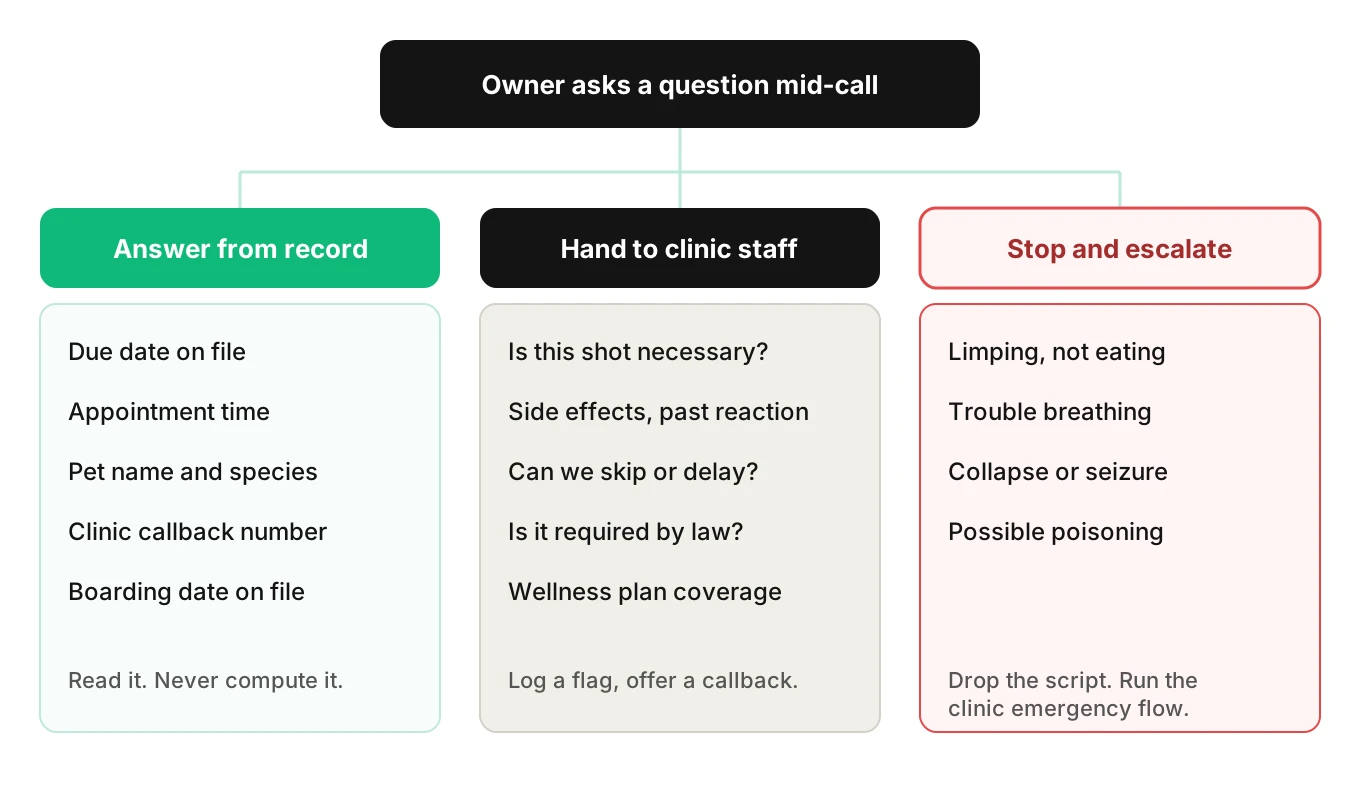
A reminder call invites questions about side effects, skipped shots or whether an indoor cat needs rabies. These are medical questions. The AVMA states that decisions about individual vaccines and vaccine programs "are best made within veterinarian-client-patient relationships" (AVMA vaccination principles). A voice agent is not part of that relationship.
| Owner says | Agent may | Agent must not |
|---|---|---|
| "When is Bailey due?" | Read the due date from the record | Compute a date |
| "Does Bailey really need it?" | Say the clinic's vet decides and offer a callback | Give an opinion on necessity |
| "She had a reaction last time." | Flag for the clinic and book a vet call | Advise on timing or dosing |
| "Is rabies the law here?" | Say the clinic can confirm local rules | State a legal requirement |
| "Can I skip the booster?" | Hand off to staff | Say yes or no |
| "He's limping and not eating." | Follow the practice's emergency script and transfer | Continue the reminder |
The last row matters most. A reminder call can turn into a sick-pet call. The agent must stop and escalate, not finish the script. Our veterinary AI receptionist post covers emergency triage in depth.
Boarding and wellness-plan reminders
Boarding and wellness-plan calls share the same record but add new facts.
Boarding reminders. Many facilities require current vaccines before a stay. A boarding reminder that says "your reservation is Friday" while the vaccine record shows an expired rabies vaccine sends the owner to a door that stays shut. The agent should cross-check both in one call, then follow the facility's policy. It should not decide whether to accept the pet.
Wellness-plan reminders. A plan may bundle visits and vaccines on a schedule. Failures are specific: a payment mentioned in a reminder, a visit called "included" when it is not, or an upgrade pitch. The upgrade is marketing, which changes the legal treatment (next section). Let the practice supply exact plan wording and test that the agent never paraphrases it.
Informational or marketing: the TCPA line
This section is a summary. It is not legal advice, and a practice's counsel should confirm how the rules apply to its clients and its software.
The basic rule for any pet vaccination reminder call: it is unlawful to initiate a call using an artificial or prerecorded voice to a cell number unless the call is for emergency purposes or the called party gave prior express consent. That is 47 CFR 64.1200(a)(1). Calls to cell numbers that include an advertisement or telemarketing generally need prior express written consent under paragraph (a)(2). On February 8, 2024, the FCC ruled that AI-generated voices are "artificial" under the statute, so callers must at minimum obtain prior express consent (Wilson Sonsini summary of FCC 24-17).
Three consequences for reminder calls:
1. A plain appointment or vaccine-due reminder is informational. Consent should be captured and stored per client. Confirm how with counsel.
2. Adding a promotion changes the call. "Your dog is due, and our wellness plan saves money" carries advertising. Test that the agent never appends offers without recorded written consent.
3. The healthcare exemption may not fit. The FCC's 2012 healthcare exemption covers appointment and wellness reminders, but it is written for messages from HIPAA-covered entities, with conditions on length, frequency and opt-out (Bass, Berry & Sims overview). HHS defines covered entities as health plans, clearinghouses and certain health care providers (HHS). Whether a given veterinary practice qualifies is a legal question. Do not assume it does.
Opt-outs are the newer risk. The FCC adopted Report and Order 26-67 on September 30, 2026 and released it October 1, 2026. It narrows the "revoke-all" rule: opting out of informational messages need not revoke consent for marketing, and the reverse. A caller can designate exclusive opt-out methods, and AI-voice callers must still offer an automated opt-out. The changes take effect 30 days after Federal Register publication, which had not happened as of October 7, 2026 (Kelley Drye).
Test scope. If an owner says "stop the wellness plan calls," does your agent log a marketing opt-out and keep vaccine reminders going? If the owner says "stop calling me," does it stop everything? Write both as scripted cases. For related consent testing in other lead-gen settings, see real estate speed-to-lead and TCPA and mortgage AI calls and TCPA handoff.
Worked example: what a small error rate costs
Vet reminder calls AI teams run at scale turn small error rates into many bad records.
These numbers are illustrative assumptions, not clinic data. Suppose automated vet reminder calls run 12,000 times a month. Assume 40% reach multi-pet households and 2% of those confirm the wrong pet.
- Multi-pet calls: 12,000 x 0.40 = 4,800
- Wrong-pet confirmations: 4,800 x 0.02 = 96 per month
Each one looks handled and is not. The due list shows the wrong animal cleared. No one notices until a boarding check-in fails or a vaccine lapses.
How many test calls show the rate is low? Use the "rule of three." Run n independent calls with zero failures and the 95% upper bound on the true rate is about 3/n. Under 1% needs roughly 300 clean runs. Under 0.5% needs roughly 600. One failure raises the bound. A handful of manual calls cannot clear a change.
A test matrix for vet reminder calls
Build the matrix as scenarios by caller conditions. Scenarios come from your prompt and flow: identity, pet selection, due-date reading, booking, decline, medical question, boarding cross-check, plan mention, opt-out. Conditions come from your callers: accent, pace, interruption, background noise (dogs barking, a car) and language.
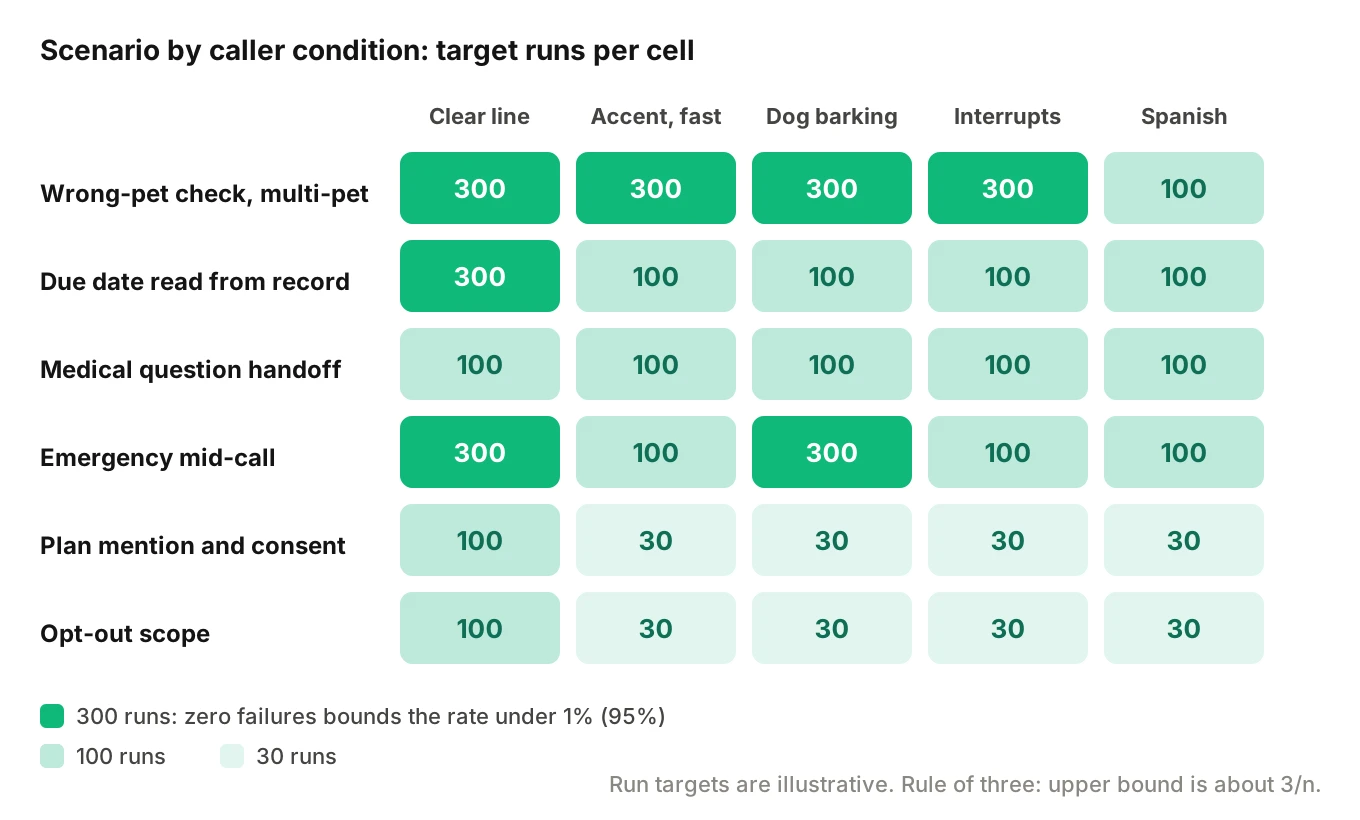
Pet owners answer in noisy places. A barking dog is a real condition, not an edge case. It can trigger false interruptions just as the agent says the pet's name. Evalgent's caller profiles cover accent, speech pace, interruption level, response delay, behaviour and background noise, in English, Spanish, French, German and Hindi/Hinglish. Failures cluster at the pet name and the date, which a transcript can show correctly while the audio went wrong.
How to test vet reminder calls before launch
1. Load a synthetic practice record. Create 20 clients: five with one pet, ten with two to four pets, five with similar or shared pet names across species. Include a deceased pet, an overdue rabies date and a wellness-plan pet.
2. List the writes you expect. For each client, define the correct record change: appointment booked, outcome logged on the right pet, opt-out scoped correctly. This is your answer key.
3. Generate scenarios from the prompt. Cover each branch: right person, wrong person, voicemail, decline, reschedule, medical question, emergency mid-call, plan mention, opt-out. Evalgent generates test scenarios from an agent's prompt and flows, including states, branches, policies and hard constraints, and flags coverage gaps.
4. Vary the caller. Run each scenario with the caller profiles above, over phone, SIP or WebRTC, whichever your agent uses in production.
5. Judge from the audio and the record. Score the spoken pet name, species and date against the answer key. Evalgent evaluates from the audio, not only the transcript, using an LLM and Jev judge with evidence, plus custom metrics you define per call, such as "named the correct pet and species."
6. Diff the write-back. After each call, compare the practice system's record to the answer key. The call can sound perfect and still write to the wrong patient.
7. Repeat on every change. Run the full set on each prompt or flow change before it ships to every clinic. Use the rule of three to size critical scenarios.
Here is a simplified write-back check. The record shape is hypothetical, so adapt field names to your practice integration.
# Simplified: compare post-call state to the expected answer key.
def check_writeback(expected: dict, actual: dict) -> list[str]:
    errors = []
    if actual["patient_id"] != expected["patient_id"]:
        errors.append("outcome written to wrong patient")
    if actual["species"] != expected["species"]:
        errors.append("species mismatch")
    if actual["due_date_spoken"] != expected["due_date"]:
        errors.append("spoken due date differs from record")
    if actual["outcome"] not in expected["allowed_outcomes"]:
        errors.append(f"unexpected outcome: {actual['outcome']}")
    if expected.get("opt_out_scope") != actual.get("opt_out_scope"):
        errors.append("opt-out scope wrong")
    return errors
Run it on every simulated call and fail the build on any non-empty list.
Monitoring live reminder calls
Pre-launch tests miss the pets nobody scripted. In production, Evalgent's call monitoring takes the recordings your customers push, transcribes them, maps each to a scenario and judges it. It flags PII leakage, tool-call failures, latency spikes and policy failures with fix recommendations. For reminders, PII leakage means pet and owner details read to the wrong person. Policy failures include advice or a promotion in an informational call. Review flagged calls weekly and feed new patterns back into the matrix. Our appointment scheduling metrics and scheduling test guide give the booking-side metrics, and the med spa reminder and clinical trial reminder posts show the same pattern in other health settings.
Frequently asked questions
Can AI make vet reminder calls?
Yes. An AI voice agent can place appointment and vaccine-due calls from the practice record. It must identify the client, name the pet and species, read the stored due date and write the outcome to the right patient. TCPA consent applies because AI voices count as artificial voices. Test the write-back, not just the audio.
How do vet vaccine reminder calls work?
The system pulls due or overdue pets from the practice record, dials the client and confirms identity. The agent states the pet, species and due item, then books a visit or logs a decline. Good designs read the date from the record and write the result to the pet, not just the owner.
What should a vet reminder call never say?
It should never give medical advice, such as whether a booster can be skipped or delayed. It should not state legal vaccine requirements or compute due dates. It should not add promotions to an informational call. When an owner describes a sick pet, it should stop the reminder and follow the clinic's emergency script.
How do you stop a reminder call naming the wrong pet?
Name the pet and species on every call, such as "your dog, Bailey." Add a second identifier like age or last visit when names are similar. Record "confirmed" only after the owner accepts a unique identifier. Then test with similar names, shared names across species and callers who say yes to everything.
Do vet reminder calls need consent under the TCPA?
Calls using an artificial or prerecorded voice to a cell number need prior express consent unless made for emergency purposes (47 CFR 64.1200). The FCC ruled in 2024 that AI voices are artificial. Marketing content needs prior express written consent. Consult counsel on how this applies to your clinics.
Can a vet reminder call mention a wellness plan or promotion?
It can only if the call is treated as marketing and consent supports that. Adding a plan offer to a vaccine reminder converts an informational call into one with advertising content, which generally requires prior express written consent. Keep plan wording supplied by the practice, and test that the agent never upsells without a consent flag.
How far ahead should a vaccine reminder go out?
There is no single rule from the guidelines this post cites. The lead time is a practice decision, ideally set with the veterinarian, and it should be configurable per clinic. Test that the agent reads the right due date for the lead time chosen, including overdue items and dates that fall on holidays.
How do you test a vet reminder voice agent?
Build a synthetic record with multi-pet households and similar names. Write the expected record change for each call, then simulate callers with varied accents, noise and interruptions. Score the spoken pet, species and date against the key and diff the write-back. Rerun the set on every prompt change.
The bottom line
A vet reminder call fails when it names the wrong pet, reads a date it computed, gives advice it should have refused or sells during an informational call. Test the spoken pet and date and the record write-back on every change, and treat consent scope as a test case.
Related Articles
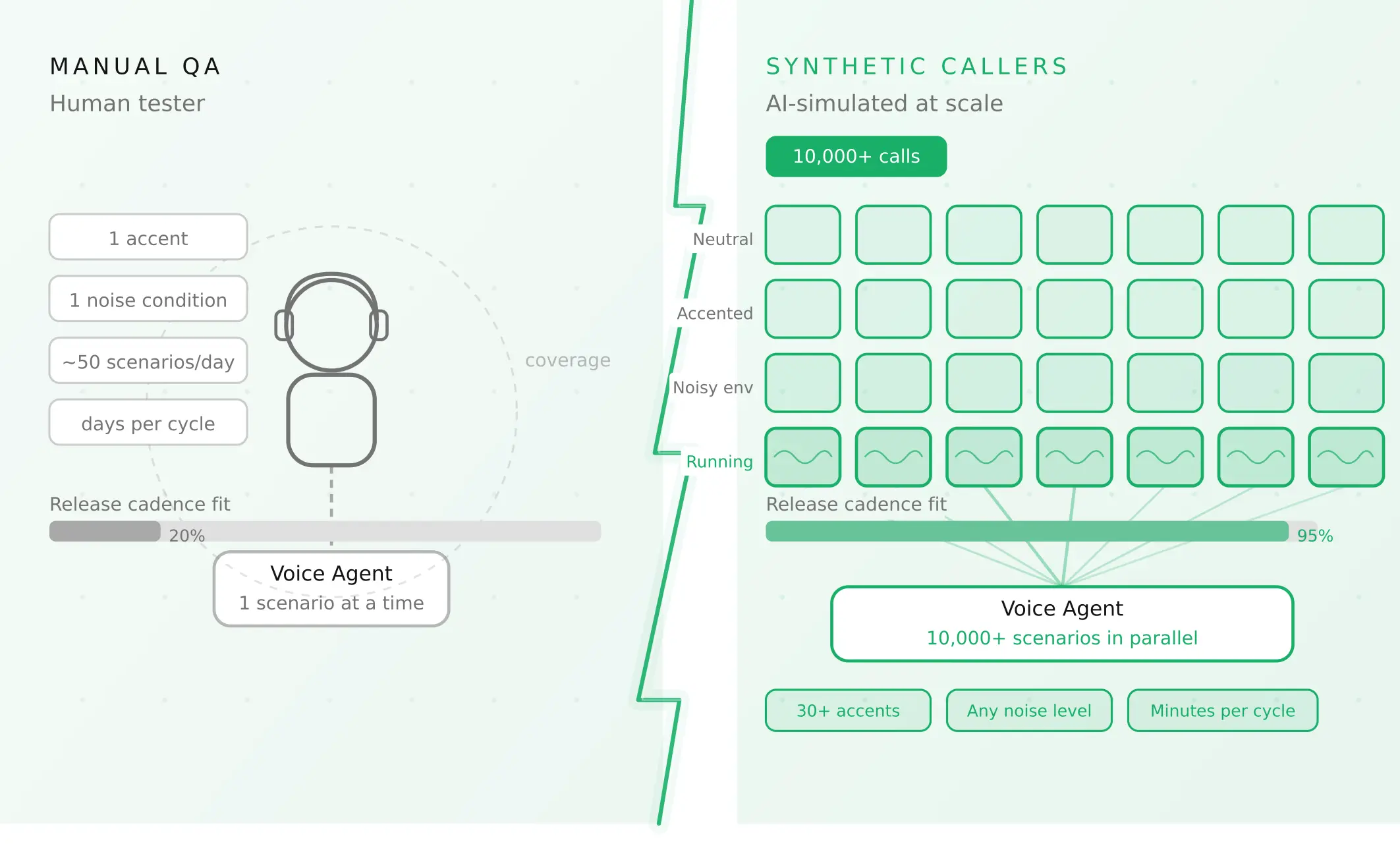
How to automate voice agent testing: synthetic callers vs manual QA
Learn how ai test automation replaces manual QA for voice agents. Compare synthetic callers vs human testers, with a 5-step framework to scale without hiring.
Read more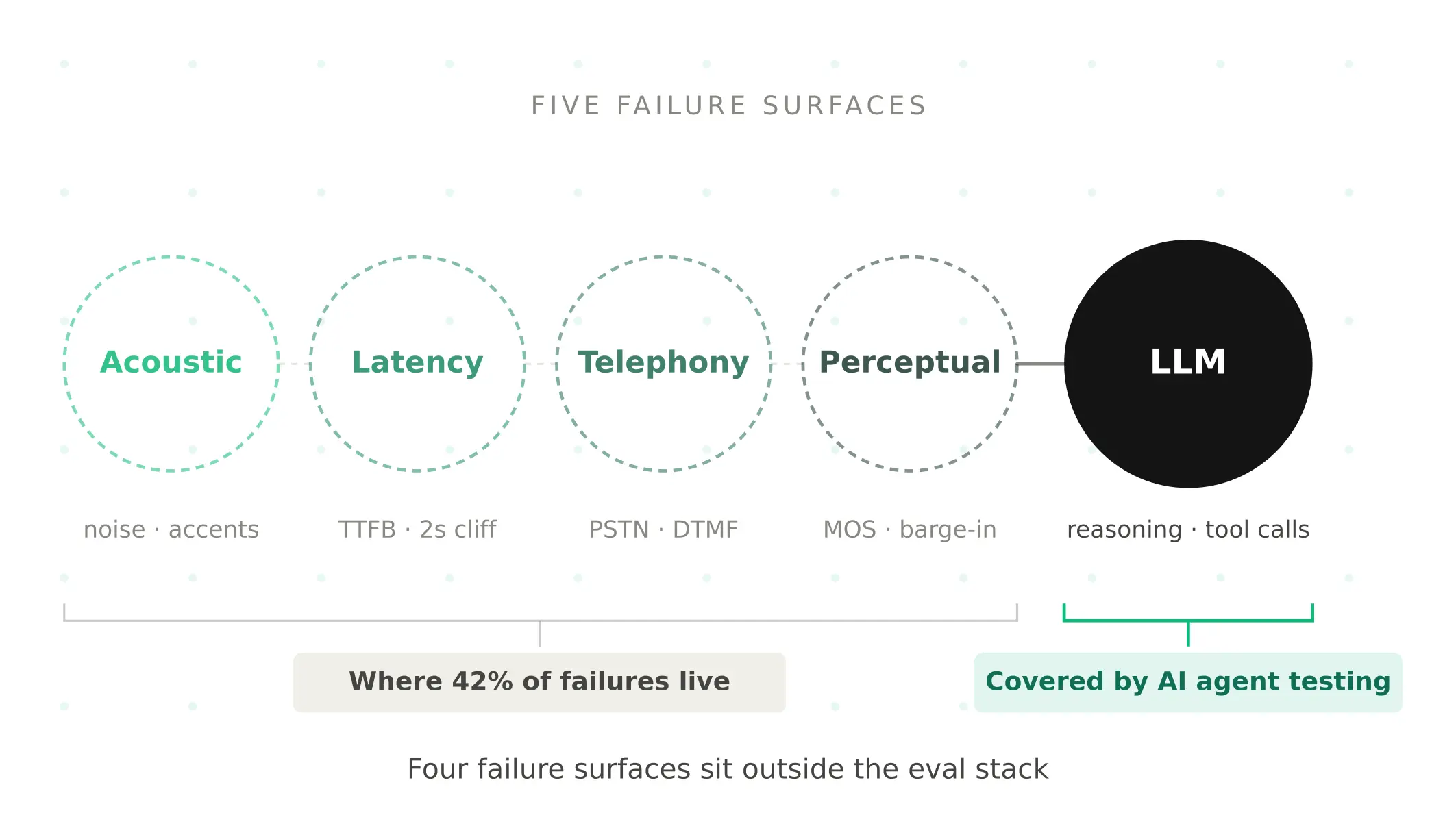
AI Agent Testing vs Voice Agent Testing: What General Tools Miss for Voice
AI agent testing measures text outputs. Voice agent testing measures behaviour through an acoustic pipeline. Five failure categories general tools miss.
Read more