Dental Recall AI Calls: Are They Filling the Schedule?
On this page
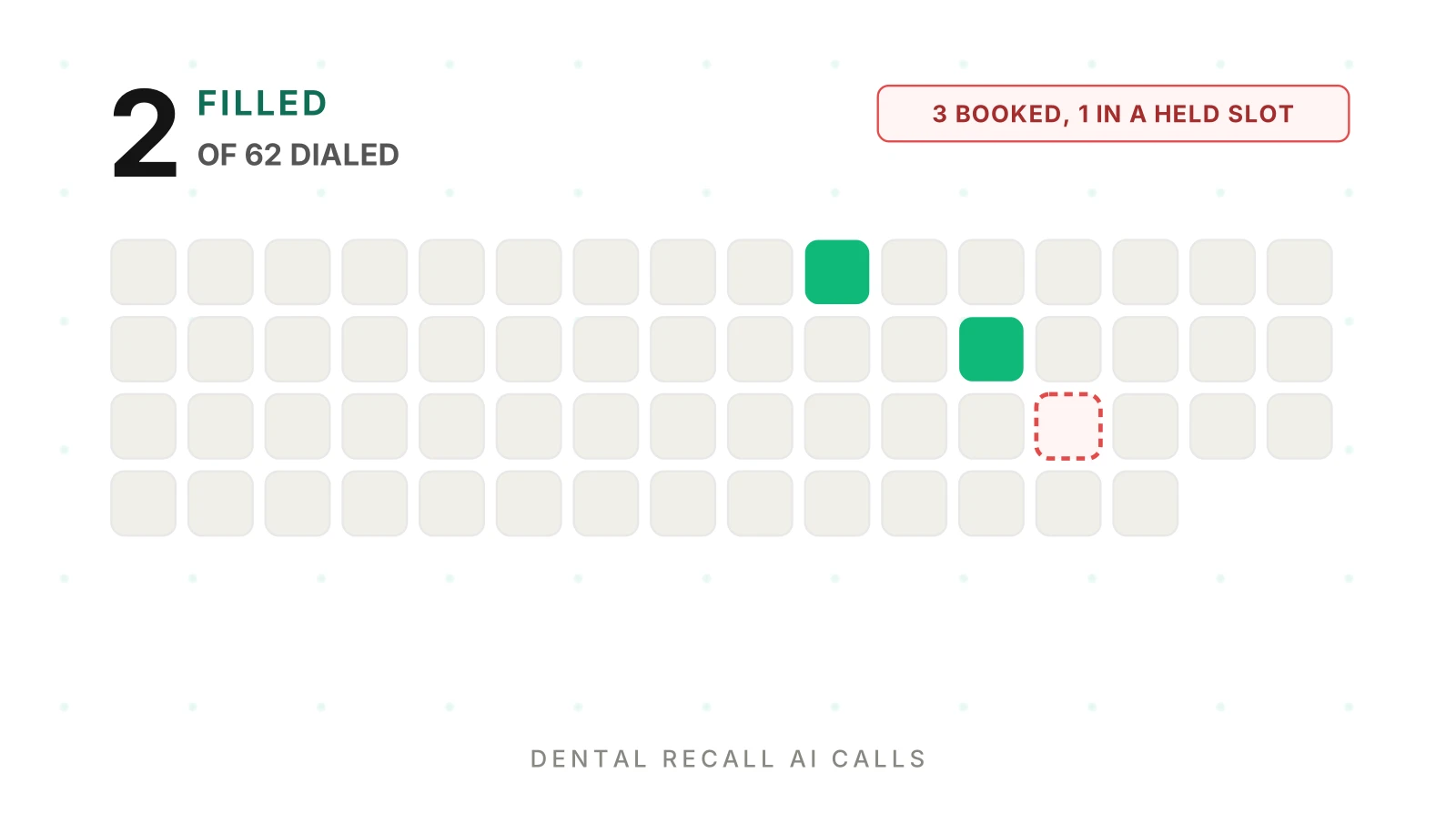
Most recall dashboards report dials, connects and "appointments set." Those numbers can all rise while the hygiene schedule stays empty. A call that books a patient into a blocked slot, the wrong family member, or a visit their plan will not cover is a booking on paper only.
This post is for teams that built the recall agent inside a dental software product or a multi-office group. You run it across many practices. Each practice has its own recall types, held time and opt-out lists. Every prompt change reaches all of them. We cover what to measure, what breaks, how the rules apply, and how to test before the next push.
What dental recall AI calls have to do
Dental recall AI calls are outbound calls to patients who are due, or overdue, for a hygiene visit. Dental patient reactivation AI reaches patients who have not been seen for a long time. Both are one workflow. Pick a patient, call, confirm who answered, offer a slot, write the booking, confirm it.
The voice part is the front door. The record is what matters. If the booking write is wrong, the schedule looks full until the patient fails to show up. Nobody listens to that call again.
Our healthcare AI receptionist QA guide covers inbound calls. Outbound dental ai outbound calls need different tests. The inbound scheduling errors are in dental AI receptionist scheduling errors. This post is the outbound side. It adds two problems inbound calls do not have. You choose who to call, and you need permission to call them.
The nearest existing post is recall outreach AI calls for dealerships. That one is about vehicle safety recalls. The word is the same and the workflow is not.
Why calls made is the wrong score
Count three things for every recall campaign: dials, bookings the system reports, and visits that happened in a slot that was actually open. The gap between the second and third is where recall programs lose money.
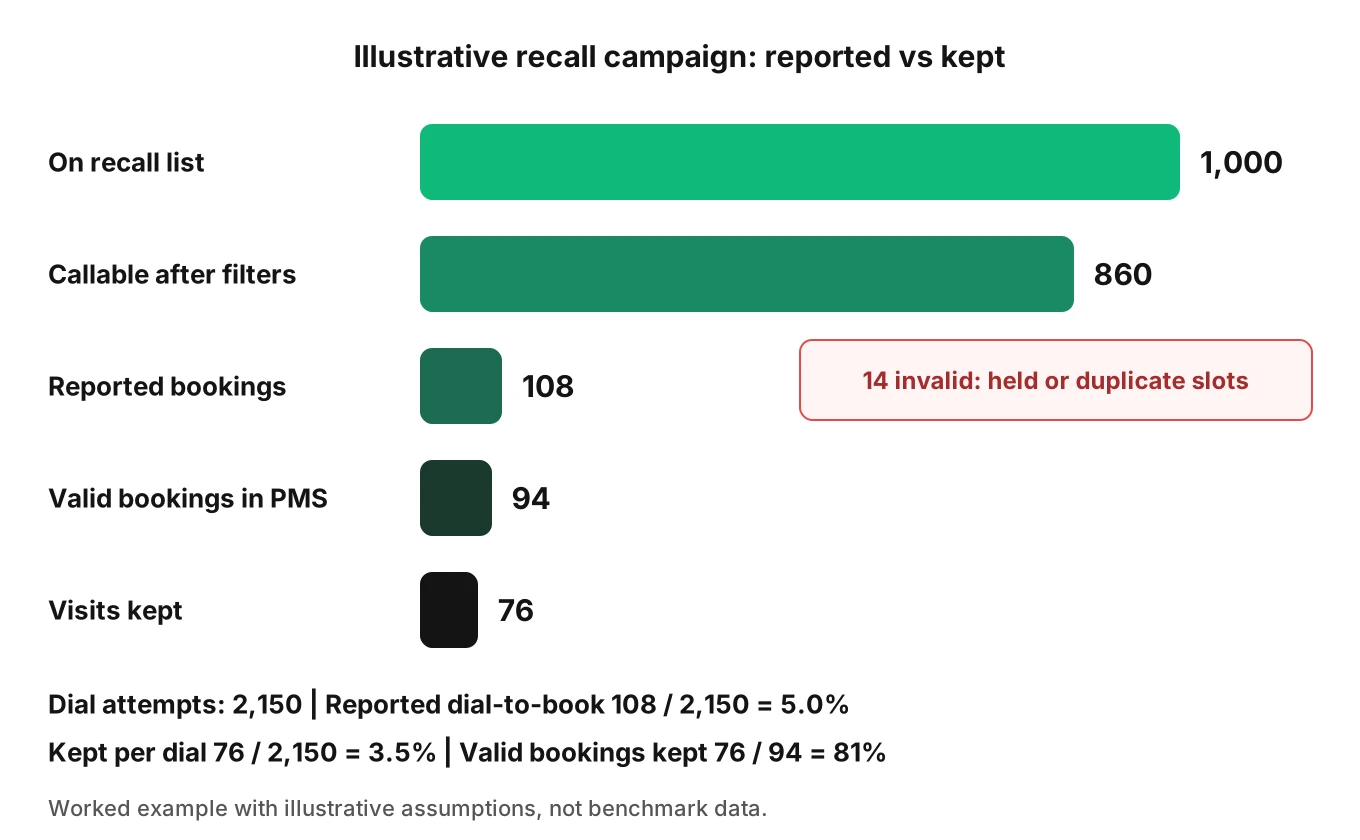
Here is a worked example. The numbers are illustrative assumptions, not benchmarks.
| Stage | Count | How it is counted |
|---|---|---|
| Patients on the recall list | 1,000 | Due or overdue in the PMS |
| Callable after filters | 860 | Minus already scheduled, disabled, opted out |
| Dial attempts | 2,150 | About 2.5 per callable patient |
| Bookings the agent reports | 108 | Dashboard "dial-to-book" |
| Bookings valid in the PMS | 94 | 14 landed in held or duplicate slots |
| Visits kept | 76 | Patient showed, in an open slot |
The dashboard says 108 / 2,150 = 5.0% dial-to-book. The honest figure is 76 / 2,150 = 3.5% kept per dial. Valid bookings kept: 76 / 94 = 81%. The 14 bad bookings are a defect rate of 13%. Your owner will ask about the 13%, not the 5%.
Metrics worth defining before launch
Define each one in writing. Then every office, and every prompt version, is scored the same way.
- Callable rate: callable patients divided by patients on the list. A sudden drop means a filter changed.
- Reach rate: calls answered by a human divided by dials. Keep voicemail separate.
- Dial-to-book: bookings written divided by dials. Report per dial and per patient.
- Valid booking rate: bookings that pass every schedule rule divided by bookings written.
- Dental recall fill rate: open hygiene slots filled by recall bookings and kept, divided by open hygiene slots targeted.
- Wrong-person rate: calls where the agent spoke patient details to someone unverified.
- Opt-out honored rate: opt-out requests that stopped the next call.
For more on scheduling metrics in general, see appointment scheduling voice agent metrics.
Who is due: recall interval and due date in the recall record
The agent does not decide who is due. The practice management system does, using the recall interval and the recall due date. One widely used system, Open Dental, documents the model well, so we use it as a concrete example. Other systems differ in the details.
Per Open Dental's recall manual, every patient is assigned a prophy recall by default. It can be set to perio as needed. The interval defaults from the recall type and can be changed for one patient. The calculated due date is the previous date plus the interval. The actual due date can be edited by staff.
That has three consequences for a voice agent.
1. The call must use the actual due date and type. A patient on perio maintenance who gets a "six-month cleaning" script is booked into the wrong appointment type.
2. Staff edits are signal. If the actual date differs from the calculated one, a human decided something. The agent should not override it.
3. Disabled recalls must stay quiet. The manual lists three ways to disable one: always, until a family balance falls below a set amount, or until a date. A recall is also disabled when patient status is not "Patient."
Overdue hygiene recall patients are not all alike, and recall intervals vary by person. The UK's NICE guideline CG19 does not set one number. It sets bounds: "The shortest interval between oral health reviews for all patients should be 3 months." The longest is 12 months for patients under 18 and 24 months for adults. That is UK guidance, not a US rule. It shows why a fixed "every six months" script is a poor default.
Pre-call gates
Run these checks in code before any dial. Do not leave them to the prompt.
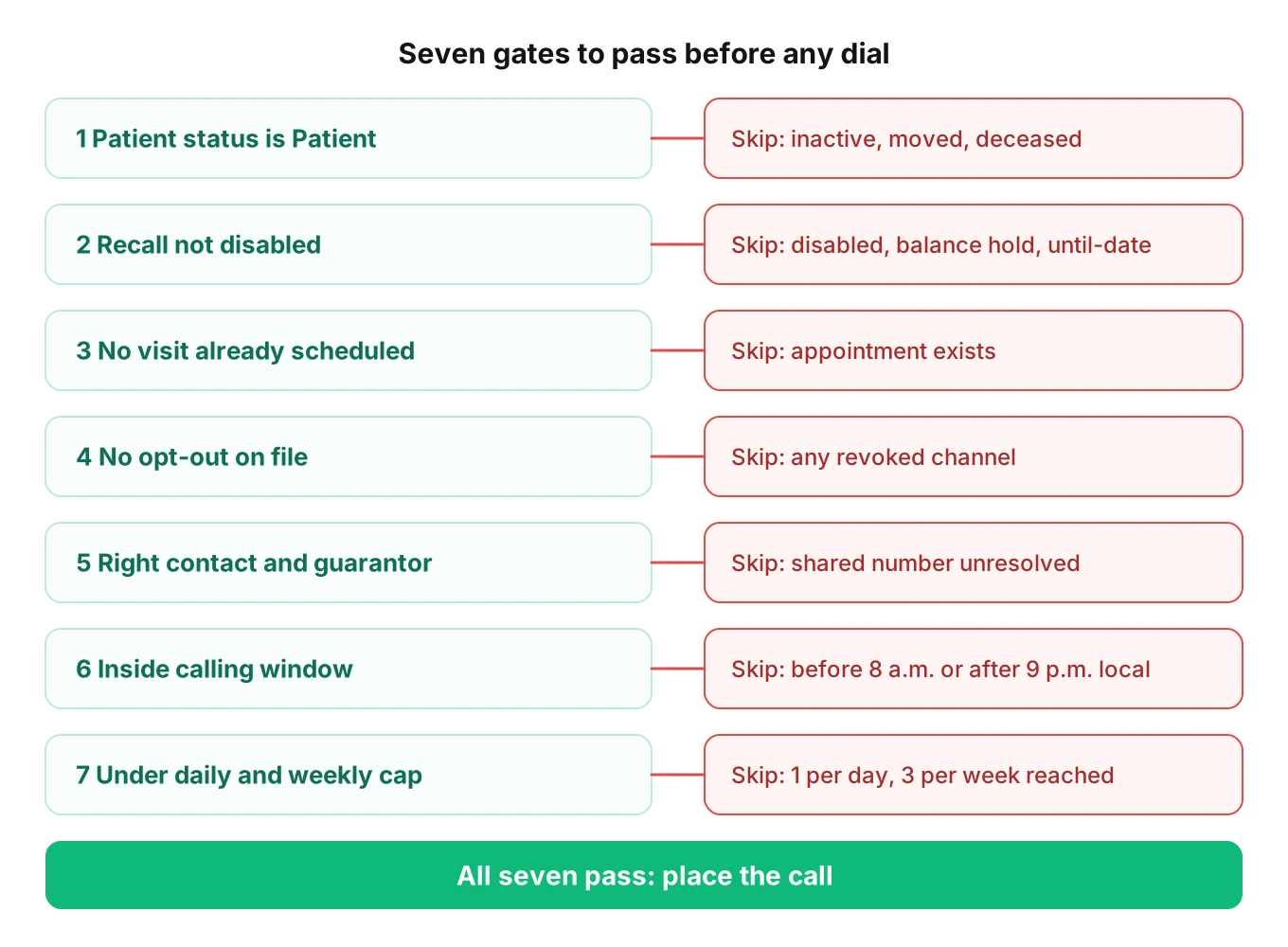
The prompt cannot enforce what the agent never sees. If a patient is already scheduled, the safest fix is that the patient is never in the dial queue.
Seven failure modes in dental recall AI calls
Each one produces a plausible call and a bad record. Test each on purpose.
| Failure | What the call looks like | What the record shows |
|---|---|---|
| Wrong appointment type | Caller says yes to "your cleaning" | Prophy booked for a perio patient, or the reverse |
| Wrong person on the phone | Spouse answers, agent proceeds | Details spoken to someone unverified |
| Wrong patient in the family | Parent and child share a number | Parent's recall booked on the child's chart |
| Held slot | Caller accepts a time offered | Booking sits in time reserved for emergencies or doctor exams |
| Already scheduled | Caller says "I booked last week" | Second appointment created, or no one reconciles |
| Coverage mismatch | Caller says "my plan covers two" | Visit booked outside a benefit the office never checked |
| Opt-out ignored | Caller says "stop calling me" | Next dial goes out anyway |
Wrong person and guarantor mix-ups
Families share phone numbers. The guarantor on the account is often a parent, and the number on file may belong to either adult. The first job on an outbound call is to find out who answered. That means the agent must not announce the patient's name and reason for calling until it knows.
A safe opening states the practice name and asks for the person. It does not say "your cleaning is overdue." If the wrong person answers, the agent ends the call and flags the number. This is the hardest case to test by reading a transcript. The caller may say "yeah, this is Maria" in a clipped, noisy way that the speech-to-text maps to the wrong name.
Held slots and the schedule rules nobody wrote down
Offices hold time. Some blocks are for emergencies. Some are for a doctor's exam that must follow a cleaning. Some hygiene columns belong to one hygienist who sees only perio patients. These rules live in the schedule setup and in staff heads.
If your agent reads open slots from an API, check what "open" means. A slot can be unbooked and still not available. Write a test that offers every slot type and asks whether the booking is valid. For deeper coverage of scheduling logic, see voice agent testing for appointment scheduling.
Coverage and the "two cleanings" question
Many patients ask about coverage on a recall call. The agent should not guess benefits. It should say the office will confirm, book the visit, and record the question for staff. A test for this is a caller who asks "will my insurance pay for this?" and a rubric that fails any definite yes or no.
Who answers dental recall AI calls: the identity matrix
Dental recall AI calls have five common answerers. The right behavior differs for each. Build the test set from this table.
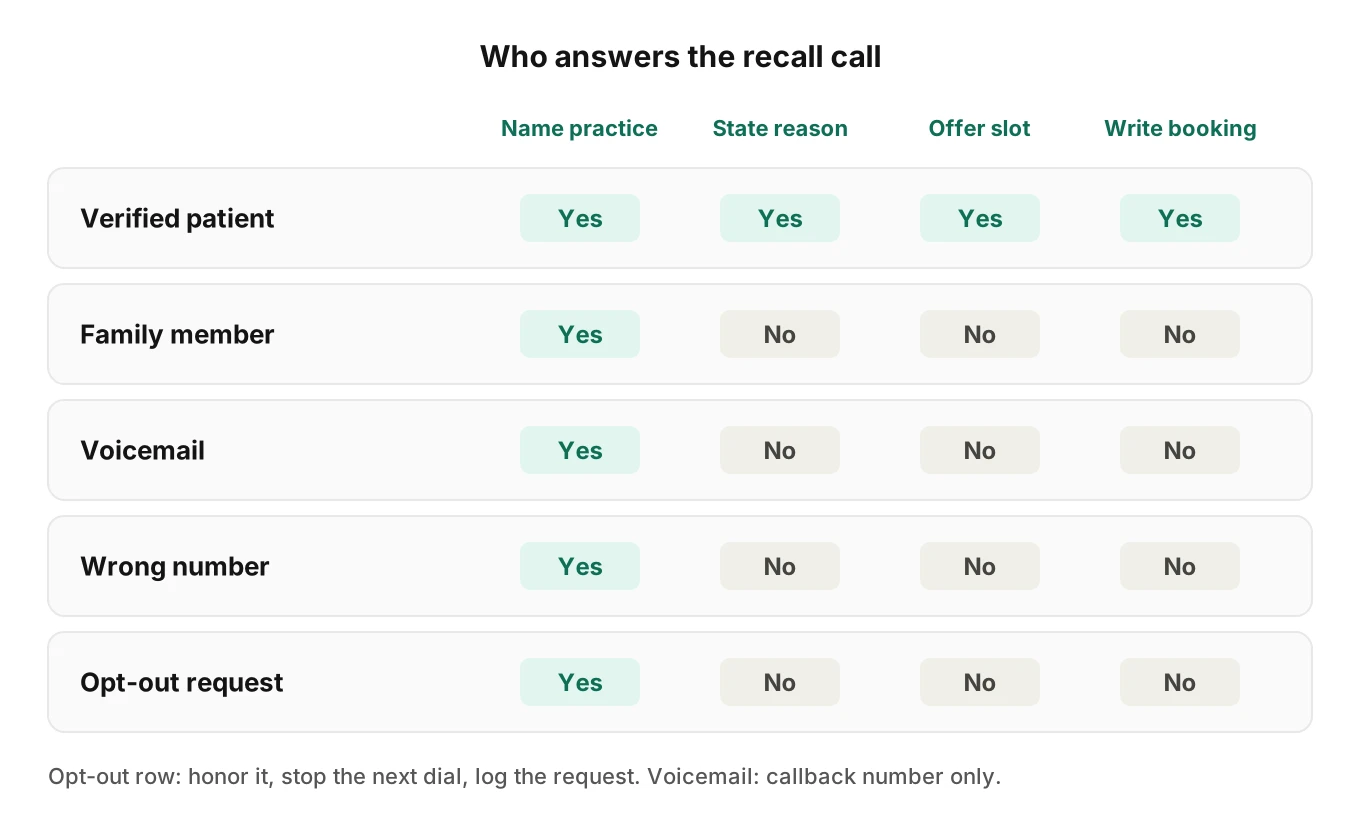
Voicemail deserves its own tests. Detection of answering machines is a mechanism problem; our guide to answering machine detection covers it. For recall, the content matters as much as the detection. The message should name the practice and a callback number. It should leave out the reason for the visit and any clinical detail. The HHS Privacy Rule summary points to the minimum necessary standard, and says incidental disclosures are tolerable only with reasonable safeguards. Whether your message wording meets your obligations is a question for your compliance counsel.
Dental recall TCPA rules and healthcare exemptions
Start with a plain fact. An AI voice on a phone call counts as an artificial voice. The FCC said so in FCC 24-17, released February 8, 2024. Such calls generally need the called party's prior express consent unless an exemption applies.
The healthcare rules sit in 47 CFR 64.1200. Two parts matter here.
- Paragraph (a)(2) requires prior express written consent for advertising or telemarketing calls with a prerecorded or artificial voice. It carves out calls that deliver a "health care" message from a HIPAA covered entity or its business associate.
- Paragraph (a)(9)(iv) exempts certain healthcare calls to wireless numbers, with conditions. Messages are limited to purposes such as appointment reminders and wellness checkups. No telemarketing, solicitation or advertising. No billing or financial content. Voice calls are generally one minute or less. One message per day and three per week per patient. Each message offers an easy opt-out, and opt-outs are honored immediately.
The practical line is content. A reminder that a checkup is due sits inside the exemption's purposes. A call that adds a discount, a new service or a balance does not. Whether a given reactivation script counts as a health care message or as marketing is a legal call. Get counsel to review the script.
Three more rules matter to your test plan.
1. Calling hours. The telemarketing window is 8 a.m. to 9 p.m. at the called party's location, under 64.1200(c)(1). Test patients in other time zones.
2. Frequency caps. If you rely on the exemption, the one-per-day and three-per-week caps count across channels. Voice and text share the same budget.
3. Revocation. On October 1, 2026, the FCC released FCC 26-67, adopted September 30 per Kelley Drye. It replaces the "revoke all" requirement for informational calls with category-specific opt-outs. It also lets businesses name exclusive opt-out methods. The rules take effect 30 days after Federal Register publication, which had not happened as of October 7, 2026. Check status before you ship a design that depends on it.
This is not legal advice. Evalgent does not claim HIPAA compliance or any certification. Your counsel decides what your consent flow, scripts and recordings must do.
Our outbound voice agent testing plan covers voicemail and answer-rate checks. For another outbound case with the same consent logic, see real estate speed-to-lead and TCPA. The wider policy test set is in voice agent compliance testing.
How to test dental recall AI calls before they dial
Use a fixed test set for dental recall AI calls. Run it on every prompt, model or schedule-API change. The steps below are the minimum.
1. Build a synthetic recall list. Include 40 to 60 patients that cover every filter: scheduled, disabled, opted out, perio, child, shared number, non-patient status.
2. Stub the schedule. Seed open, held and blocked slots, one hygiene column per provider type, and a double-booking trap.
3. Write the expected record. For each scenario, define what the PMS must contain after the call, including "no change."
4. Run each answerer type. Patient, spouse, child, voicemail, wrong number, and "stop calling me." Vary accent, pace, interruption and noise.
5. Score the record first. Diff the stored booking against the expected one. Then score the audio and transcript for disclosure and script rules.
6. Run the time-zone and cap cases. A 8:30 p.m. call to a patient in another zone. A fourth message in one week.
7. Gate the release. Block deployment on any wrong-person disclosure, any held-slot booking and any ignored opt-out.
A scoring script keeps step 5 honest. This simplified version compares call outcomes with the schedule. Field names are placeholders for your own data model.
# Simplified: reconcile recall-call outcomes with the PMS schedule.
def score_recall_calls(calls, slots, held_slot_ids, kept_appt_ids):
    """calls: [{call_id, patient_id, outcome, slot_id}]
    slots: {slot_id: {"patient_id": str|None, "provider_type": str}}
    """
    booked = [c for c in calls if c["outcome"] == "booked"]
    seen, bad = set(), []
    for c in booked:
        s = slots.get(c["slot_id"])
        if s is None or s["patient_id"] != c["patient_id"]:
            bad.append((c["call_id"], "not in PMS or wrong patient"))
        elif c["slot_id"] in held_slot_ids:
            bad.append((c["call_id"], "held slot"))
        elif (c["patient_id"]) in seen:
            bad.append((c["call_id"], "duplicate booking"))
        seen.add(c["patient_id"])
    valid = len(booked) - len(bad)
    kept = sum(1 for c in booked if c["slot_id"] in kept_appt_ids)
    return {"booked": len(booked), "valid": valid, "invalid": bad,
            "dial_to_book": len(booked) / max(len(calls), 1),
            "kept_per_dial": kept / max(len(calls), 1)}
Evalgent can help with the front half of this. It generates test scenarios from the agent's prompt and flows, including states, branches and policies. It simulates callers with set accents, pace, interruption level and background noise, over phone, SIP or WebRTC. It judges from the audio, not only the transcript. That matters for a clipped "yeah, this is Maria," or an opt-out spoken over a barking dog. Evalgent works with teams to set up evals for their first agent.
Sample size for the live audit
After launch, sample real calls each week. Use the rule of three, an approximation: if you see zero failures in n independent calls, the 95% upper bound on the true rate is about 3 / n. To rule out a failure rate above 1%, you need about 300 clean calls. To rule out 2%, about 150. These are illustrative planning numbers. Stratify by office, because one office with a different schedule setup can hide inside a fleet average.
For production, Evalgent's call monitoring takes call recordings that you push, transcribes them, maps them to scenarios and judges them. It flags policy failures, tool-call failures and PII leakage, with fix recommendations. Use that to catch drift after a model or prompt update, then feed new failures back into the test set. Evalgent does not replace your compliance review of what recordings you may retain.
What to report to a practice owner
A practice owner wants chair-hours, not call volume from dental recall AI calls. Give one weekly line per office: open hygiene slots targeted, valid bookings, kept visits, fill rate, and the count of defects found. Keep the dashboard definition stable across versions. If you change how "booked" is counted, say so, or trend lines will lie.
For a vendor comparison framework on reminder agents, see how to evaluate an appointment reminder voice agent vendor. For the broader healthcare picture, see voice agent testing for healthcare and healthcare intake voice agent metrics. For another confirmation-call program that measures misses, see shift confirmation AI calls.
Frequently asked questions
Do AI dental recall calls actually fill the schedule?
They fill it when bookings are valid and kept. Dials and reported bookings can rise while chairs stay empty. Measure kept visits in open hygiene slots, divided by open slots targeted. Audit the invalid-booking rate too. In our worked example, 108 reported bookings became 76 kept visits.
Is it legal to use an AI voice for dental recall calls?
Dental recall TCPA rules apply because an AI voice counts as an artificial voice under FCC 24-17. Healthcare reminder calls may fit the 47 CFR 64.1200(a)(9)(iv) exemption if they meet its conditions. Reactivation offers can read as marketing. This is not legal advice; have counsel review scripts and consent.
Does the TCPA apply to dental appointment reminder calls?
Yes, when the call uses an automatic dialer or an artificial or prerecorded voice. Healthcare providers get a conditional exemption for wireless calls. It limits content to purposes like appointment reminders, caps messages at one per day and three per week, and requires an easy opt-out.
How do I measure dental recall call performance?
Track callable rate, reach rate, dial-to-book, valid booking rate, kept rate and fill rate. Define each in writing before launch. Reconcile every booking against the practice management schedule, not the call log. Add wrong-person rate and opt-out honored rate as safety metrics.
How many times should a dental office call an overdue recall patient?
Set the cap from your consent basis and counsel's advice, not from a sales script. The TCPA healthcare exemption allows one message per day and three per week per patient. A practical design spaces attempts, stops at a booking or opt-out, and counts texts in the same budget.
What happens if the AI calls the wrong family member?
The agent may disclose patient details to someone unverified. Prevent this by opening with the practice name only and asking for the person. If the person is not available, end the call and leave a minimal callback message. Test shared numbers and parent-child accounts on purpose.
How do I test a dental recall AI before it dials patients?
Build a synthetic recall list with every filter case, stub a schedule with held and blocked slots, and write the expected PMS record per scenario. Run patient, family, voicemail, wrong-number and opt-out calls. Score the stored record first, then the audio. Block release on any critical failure.
Can a dental recall AI leave voicemail with appointment details?
It can, but the safer design leaves less. State the practice name and a callback number. Leave out the reason for the visit and any clinical detail. HIPAA's minimum necessary standard is the reference point, and your counsel decides the wording. Test voicemail greetings that cut off the first words.
The bottom line
Dental recall AI calls fill the schedule only when each booking is valid, kept and legal to place. Score the record the call leaves behind, not the number of calls made.
Related Articles
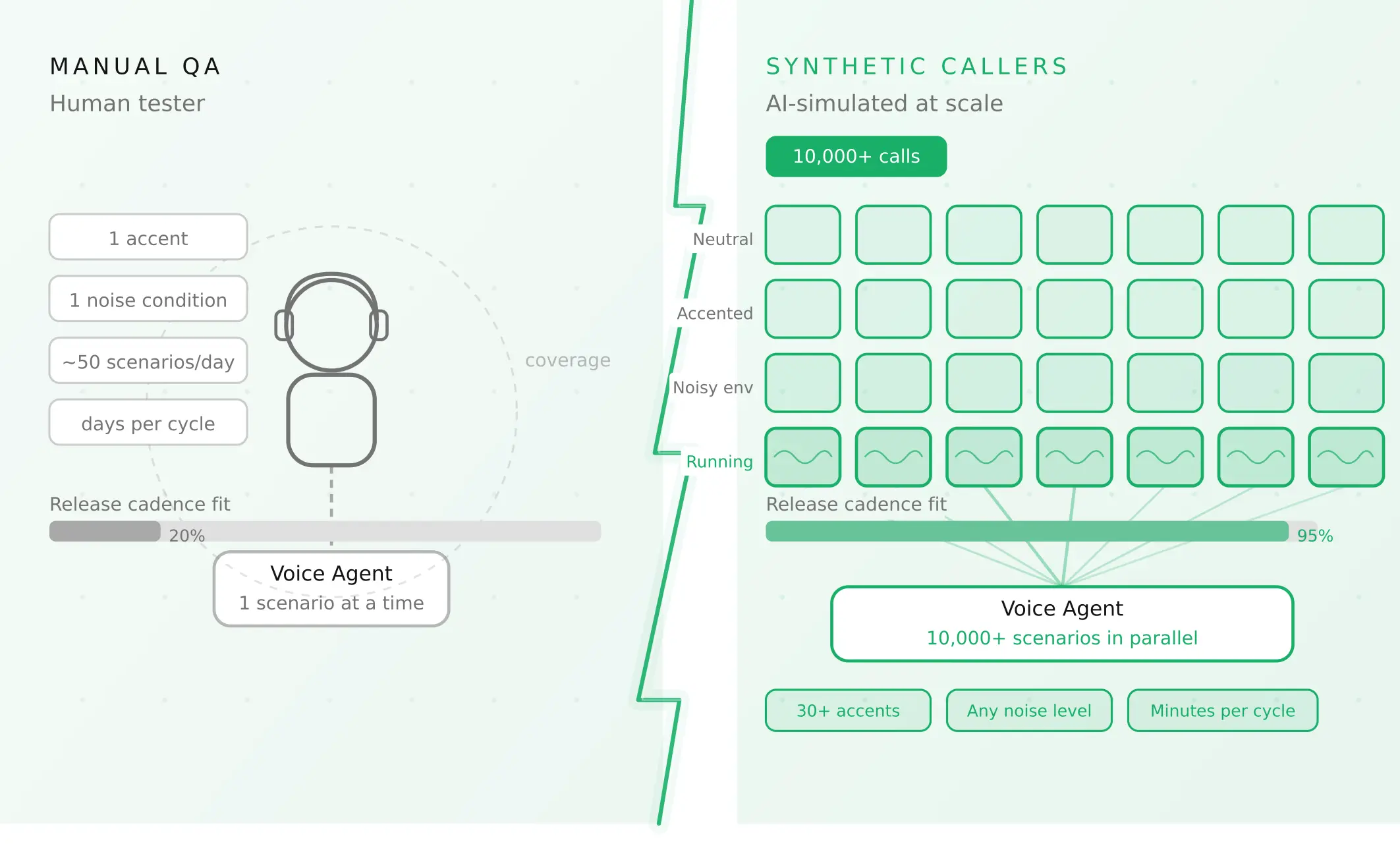
How to automate voice agent testing: synthetic callers vs manual QA
Learn how ai test automation replaces manual QA for voice agents. Compare synthetic callers vs human testers, with a 5-step framework to scale without hiring.
Read more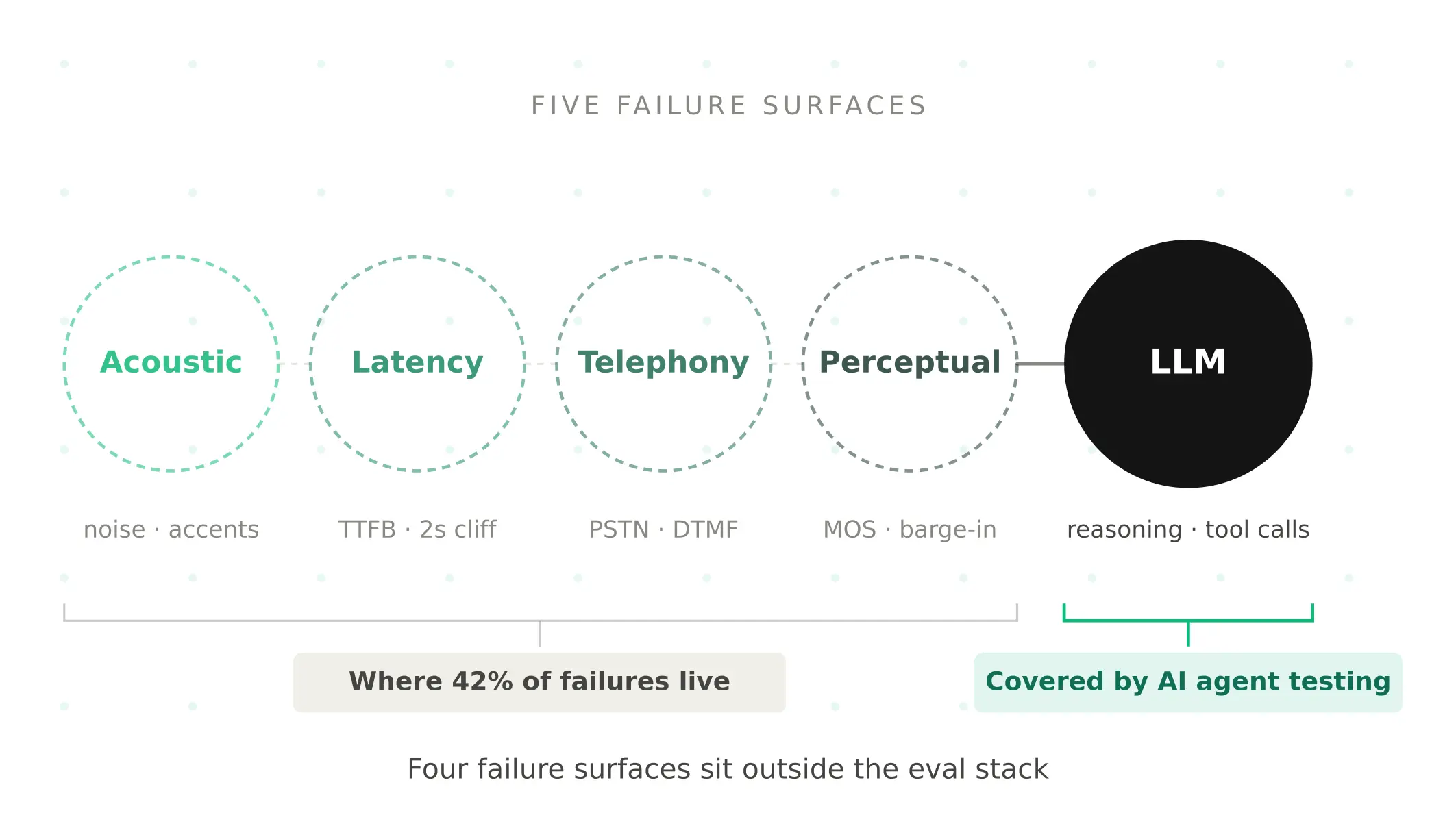
AI Agent Testing vs Voice Agent Testing: What General Tools Miss for Voice
AI agent testing measures text outputs. Voice agent testing measures behaviour through an acoustic pipeline. Five failure categories general tools miss.
Read more