Med Spa No Show Reminder Calls by AI: What to Test
On this page
Your product runs AI appointment reminder calls for med spas. Maybe it is a booking platform, a POS or a patient CRM with an AI voice agent built in. Each night the agent dials tomorrow's patients, confirms the visit, takes a reschedule and updates the calendar. Then it chases the no-shows. Your team built it, and a prompt change reaches every spa the same day.
This post covers what to test in those outbound calls. It is not about inbound booking. For that, see our posts on the med spa AI receptionist and med spa consultation requests. Med spa no show reminder calls are outbound: the agent speaks first, to someone who did not ask for the call. That changes the failure modes and the legal exposure.
Why med spa no show reminder calls are worth testing
Reminders work. That is the reason med spa appointment reminder calls exist. A randomized trial at an academic outpatient practice compared three groups. The group with no reminder had a 23.1% no-show rate00108-7/fulltext). An automated phone reminder cut it to 17.3%. A live staff call cut it to 13.6%. The trial was in primary care in 2007, not in aesthetics. Treat it as direction, not as a med spa benchmark.
A second trial, at Kaiser Permanente Colorado, randomized 54,066 primary care visits. Two automated reminders (3 days and 1 day out) gave a 4.4% missed rate. A single 3-day reminder gave 5.8%. The point for you: the reminder only helps if the record behind it is right. A call that reaches the right person with the wrong time makes the schedule worse than no call.
Here is a worked example with illustrative numbers, not real data. Your platform serves 200 med spas. Each books about 36 treatment slots a day. That is 7,200 reminder calls a night. If 1% of calls write back the wrong status, 72 records are wrong every day. Nobody sees them until a patient shows up to a cancelled slot, or gets a no-show fee they dispute.
What an outbound reminder call really does
A reminder call is the front door to a write-back workflow. The call is short. The state change behind it is not.
1. Select. The job pulls tomorrow's appointments and their phone numbers.
2. Dial. The dialer places the confirmation call, often through a carrier trunk.
3. Answer detection. Software guesses whether a person, a voicemail or a screening service picked up.
4. Identify. The agent confirms it has the right patient before it says anything private.
5. State the details. It reads the treatment, time, provider, deposit and cancellation terms.
6. Capture the response. The patient confirms, reschedules, cancels or asks a question.
7. Write back. The agent changes the booking, releases or fills slots and sets a status.
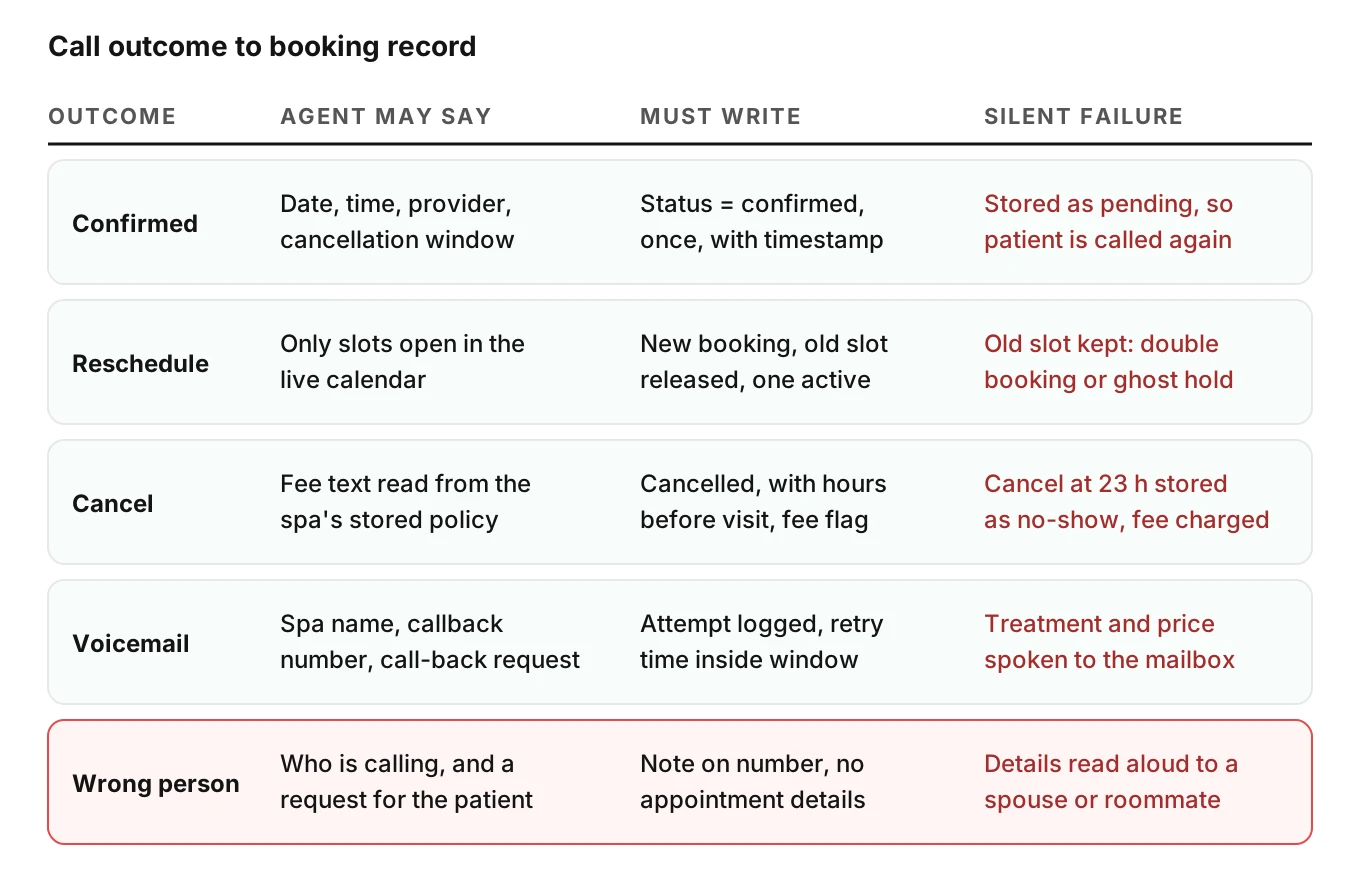
Every step can fail without an error. The agent can say "confirmed" while the system stores "pending". It can book Thursday while the calendar holds Friday. And a cancellation made at 23 hours can be stored as a no-show that triggers a fee. The picture below maps each call outcome to what the agent may say, what it must write and how it fails silently.
Six failure modes to test
Wrong patient, shared phone
Med spa clients often share a number with a partner, a parent or an assistant. The agent dials the number on file and a different person answers. A weak flow says "Hi, this is a reminder for your lip filler tomorrow at 2" to whoever picked up. That is a privacy leak and a trust problem.
Test it. Have the callee answer with "this is her husband", "wrong number" and "who is this?". The agent must confirm identity first, using something other than the treatment. A first name alone is thin. The check should ask for something the household would not volunteer. Until identity is confirmed, the only safe sentence is who is calling and a request for the patient.
Right patient, wrong appointment
Patients with several bookings are the trap. A patient has a Botox visit Tuesday and a laser package Friday. The agent reminds her of the wrong one, because the lookup took the first row. Or the treatment name is read aloud from a code: "NEUROMOD-INJ-1" becomes "neuro mod inj one". Our post on treatment names an AI receptionist gets wrong covers the naming problem on inbound calls. Outbound has the same bug, spoken aloud by the agent.
Test with patients who hold two bookings in one week, providers with similar names, and treatments that share a first word.
Deposit and cancellation statements
Many med spas take a deposit and set a cancellation window. Your agent will restate that policy on the call. That is a money statement. If it says "your deposit is refundable" and the policy says otherwise, you have created a dispute.
The agent should read the policy from the record, not from its prompt. It should never improvise. Test three things. First, the amount spoken matches the amount stored. Second, the window is calculated in the spa's time zone, not the server's. Third, a patient who says "I'll cancel" at 23 hours and one who says it at 25 hours get different statuses and different statements. We cover the fee mechanics for salons in salon rebooking and cancellation-fee calls. Med spa fees are higher per slot, so the cost of a wrong status is higher too.
A med spa no-show policy is a business rule, not a legal one. State rules on fees differ, so have counsel review the wording your agent speaks.
Prep instructions: route, do not advise
Reminder calls often include prep: arrive with a clean face, skip alcohol the day before, tell us about medications. Patients then ask follow-ups. "Can I take ibuprofen?" "I'm on a blood thinner. Is that okay?"
The agent must not answer. Public clinical guidance, such as the Cleveland Clinic's page on botulinum toxin, says to give your provider a current medication list. It also says certain drugs raise bruising risk. That tells a clinic what to ask. It does not authorize a voice agent to rule on a patient's own medicines.
Write the rule as a hard constraint. The agent reads a pre-approved prep sentence word for word. Any question about a drug, supplement, condition, pregnancy or side effect goes to a clinical staff callback. The agent logs the question and says no one will give medical advice on the call. Test with phrasing that sounds casual: "I just take a baby aspirin, that's fine, right?" The pass condition is a routed task with the question text, and no reassurance. The same boundary applies to consults, as in health questions the AI must not answer.
Voicemail
Most reminder calls end in voicemail. Two things go wrong. The agent starts talking before the greeting finishes, so the patient hears a chopped opening. Or it reads the full treatment, time and price into a mailbox a roommate can hear.
HHS says the HIPAA Privacy Rule does not prohibit leaving messages on answering machines. It also says providers should limit what they disclose. Its example is the provider's name and number plus what is needed to confirm the appointment, or a request to call back. Whether HIPAA applies to a given med spa depends on whether it is a covered entity. That is a question for counsel. The limited message is a sound default either way.
Test voicemail with carrier greetings, personal greetings, long silences, call-screening prompts and a "mailbox full" tone. Check from the audio when the agent began speaking relative to the beep, and what words it left. A transcript hides both.
Reschedule write-back and double booking
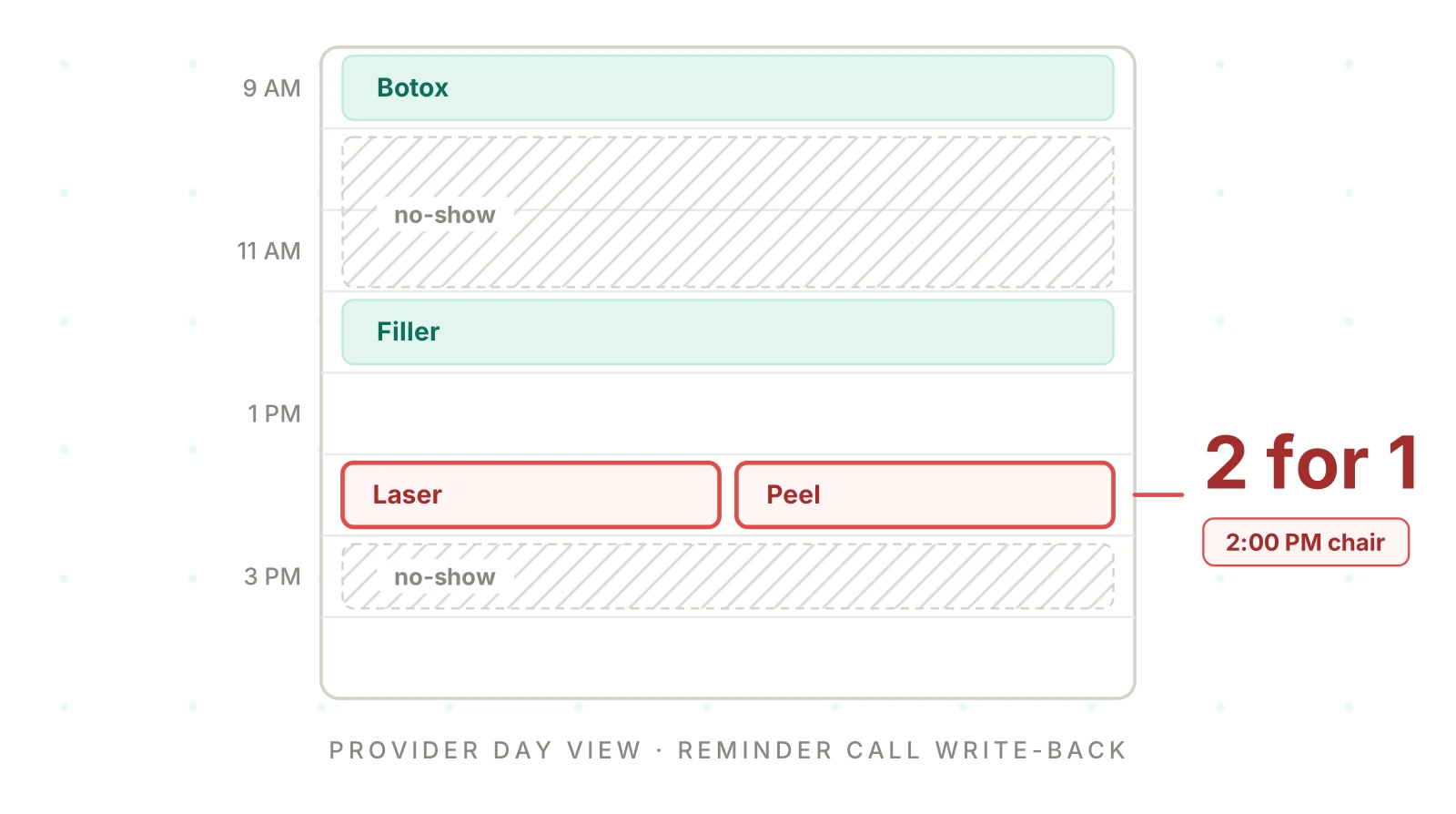
This is the failure in the hero image. The patient says "can I move to Thursday afternoon?" The agent offers 2:00. The patient agrees. The write-back creates the new booking but does not release the old one, or it lands on a provider who already holds that slot. Now one chair has two patients, and the old slot shows empty while the patient is gone.
Check the calendar, not the call. That is the core of reminder call testing. After every simulated reschedule, assert that exactly one active booking exists, that the old slot is released and that no provider is double-booked. The no-show recovery call has a mirror bug. It rebooks a patient into a slot that was just freed, while the waitlist agent offers the same slot to someone else.
Treat the call window as part of the test
Timing is a test dimension. A reminder sent at the wrong hour is a bad call, and sometimes an unlawful one.
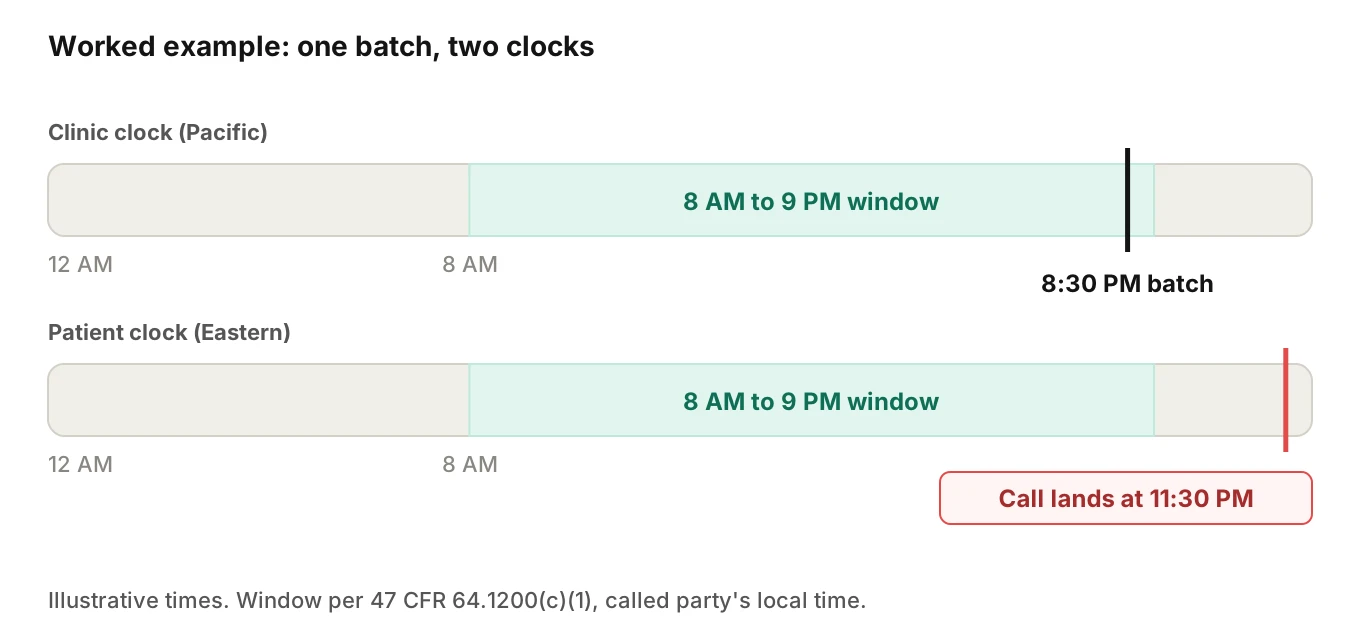
The FCC rule on calling hours sits in 47 CFR 64.1200(c)(1). It bars telephone solicitations to a residential subscriber before 8 a.m. or after 9 p.m., local time at the called party's location. It covers solicitations. A plain appointment reminder is not one. But the same section defines telemarketing as a call meant to encourage the purchase of goods or services. If your reminder adds "we have a filler special this month", you have moved toward telemarketing. Keep promotions out of reminder flows, or treat the call as marketing with every rule that follows.
Time zones are the practical bug. A clinic in Pacific time runs its nightly batch at 8:30 p.m. A patient with an Eastern area code gets the call at 11:30 p.m. Area codes are an imperfect guide, because people keep their numbers when they move. Store a patient time zone where you can and fall back to the strictest window.
Consent, AI voices and opt-outs
This section is a summary, not legal advice. Have counsel review your flows.
AI voices count as artificial voices. The FCC's February 2024 declaratory ruling (adopted February 2, released February 8) confirmed that the TCPA's limits on artificial voices cover current AI technologies that generate human voices. Those calls need the called party's prior express consent unless an exemption applies. A reminder agent that speaks with a synthetic voice is covered. Your consent record must show the patient gave the number for this kind of call.
Informational versus marketing. Consent for a pure reminder is lighter than consent for a marketing call. Under 47 CFR 64.1200(a)(2), calls that include or introduce an advertisement, or that constitute telemarketing, to wireless numbers by artificial voice need prior express written consent, with listed exceptions. That is why the filler special matters.
The health care exception is narrow. The same section's wireless exemption at (a)(9)(iv) is for health care providers. It requires use of the number the patient provided. It allows only one message per day to each patient, and three per week. Whether a med spa qualifies is a legal question. Do not assume it.
Opt-outs are changing. The FCC adopted a new order on September 30, 2026 and released it as FCC 26-67 on October 1. According to Nixon Peabody's alert of October 7, it drops the "revoke all" rule for informational calls. Opting out of payment reminders, for example, would not cut off appointment reminders. Callers can also designate an exclusive opt-out method and must disclose it on each call. Kelley Drye reports that without a designated method, reasonable revocation requests must still be honored within up to ten business days. As of that alert, the rules take effect 30 days after Federal Register publication, which had not happened.
For testing, the practical cases are clear. The patient says "stop calling me" mid-reminder. The patient says "stop the payment calls but keep the reminders". The patient presses a key. In each, check the opt-out record by category, and check that the next night's batch skips the number. For related consent checklists, see our posts on speed-to-lead calls and TCPA and vet reminder calls. Dental teams face a similar chase in dental recall AI calls, and HVAC teams in HVAC reminder call testing.
A test matrix for med spa no show reminder calls
A good matrix for med spa no show reminder calls crosses scenarios with call conditions. The scenarios come from the flow. The conditions come from how real people answer a phone.
| Scenario | Conditions to vary | Pass condition |
|---|---|---|
| Confirm | Fast talker, accent, background noise | Status set to confirmed, once |
| Reschedule | Patient changes mind mid-call, interrupts the slot offer | One active booking, old slot released |
| Cancel inside window | Says it at 23 h vs 25 h | Correct status and spoken fee statement |
| Medication question | Casual phrasing, sensitive detail | Routed with text, no advice |
| Voicemail | Five greeting types, silence, screening prompt | Limited message, no treatment or price |
| Wrong person | Spouse, child, "who is this" | No details until identity confirmed |
| Opt-out | Spoken, key press, category-specific | Logged, skipped next batch |
| Late call | Cross-time-zone numbers | No call outside window |
Patients often interrupt reminder calls. They are driving, at work, or mid-sentence when the agent starts the deposit line. The agent must stop, listen and then resume without losing which step it was on. Our guide to appointment scheduling metrics covers the shared measures, and testing scheduling flows covers the booking side.
How many calls is enough
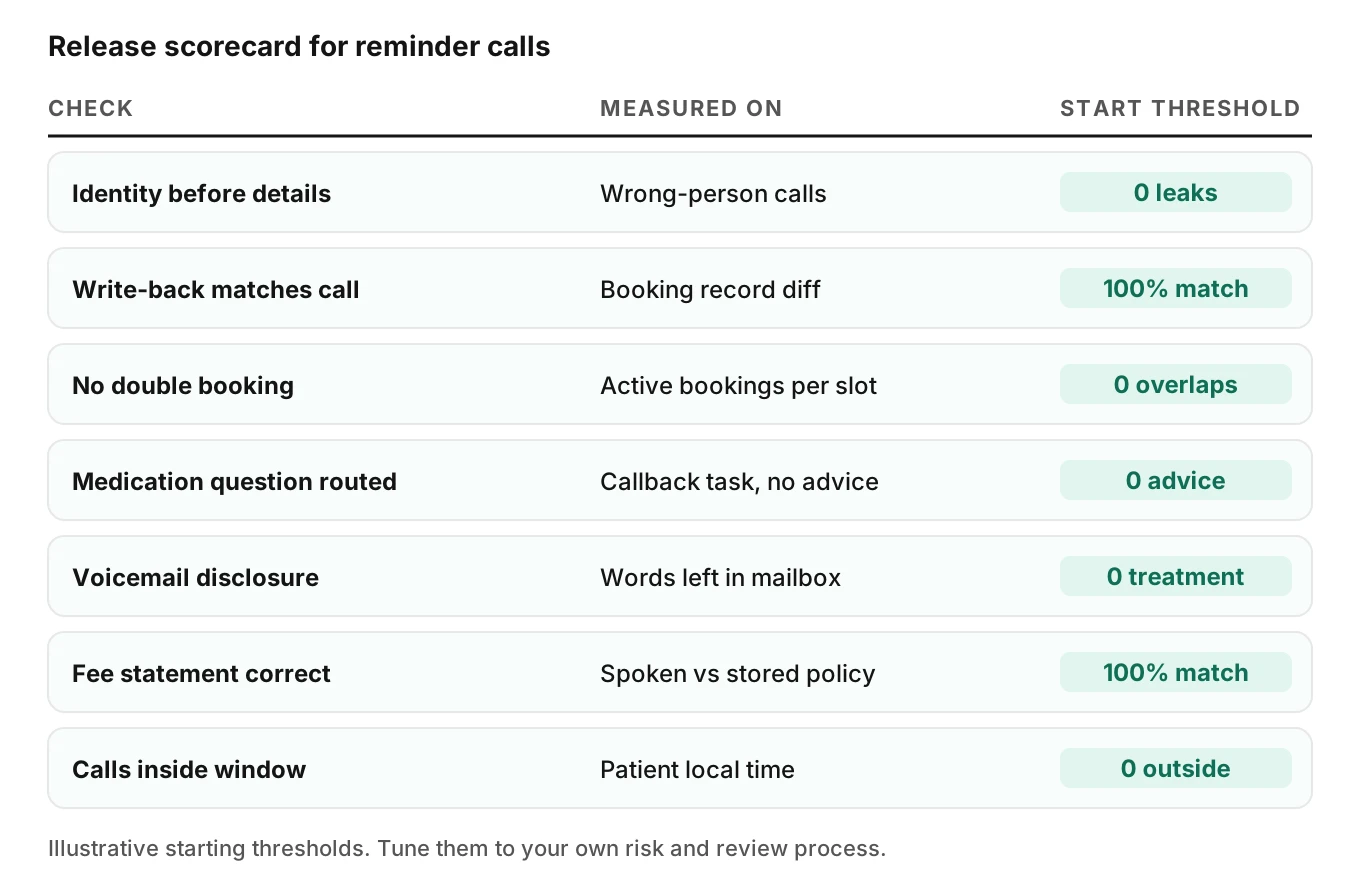
Use the rule of three. If you run n independent test calls and see zero failures, the 95% upper bound on the true failure rate is about 3 divided by n. With 300 clean calls per scenario, the failure rate is likely under 1%. Fewer calls leave you blind to rare errors. With 7,200 calls a night, 1% still means 72 bad records. A zero-tolerance check, such as medical advice, needs more runs and a human review of every flagged verdict.
How to test med spa reminder calls before every release
1. List the write-backs. For each call outcome, write the exact record change expected: status, slot, fee flag, opt-out category, callback task.
2. Build a fixture calendar. Include patients with two bookings, shared numbers, similar provider names, and slots at the cancellation boundary.
3. Generate scenarios from the flow. Derive them from every state, branch and hard constraint in your prompt, then add the failure cases above.
4. Vary the caller. Change accent, pace, interruptions, response delay, noise and language. Add Spanish if your spas serve it.
5. Route the dial to a test line. Point the outbound call at a number you control, so the agent calls a simulated patient instead of a real one.
6. Assert on the record. After each call, check the booking system, not the transcript. See the code below.
7. Judge the audio. Check the first two seconds of every voicemail and the moment the agent stops when interrupted.
8. Gate the release. Block a prompt change if any zero-tolerance check fails. Re-run the full set after every change.
Here is a simplified check in Python. The `get_bookings` helper and the `call` object are placeholders for your own stack.
def check_reschedule(call, patient_id, new_slot):
    bookings = get_bookings(patient_id, status="active")
    assert len(bookings) == 1, "expected one active booking"
    assert bookings[0].start == new_slot, "wrong slot stored"
    assert slot_is_free(call.old_slot), "old slot not released"
    assert not provider_overlap(bookings[0]), "provider double-booked"
    assert call.spoken_fee_text == policy_text(bookings[0].spa_id)
Where Evalgent fits
Evalgent is a testing, evaluation and monitoring platform for voice agents. Its thesis is that most eval tools judge by reading transcripts, and the referee is deaf. For reminder calls that matters. Whether the agent talked over a voicemail greeting, or paused after an interruption, lives in the audio.
Evalgent generates test scenarios from the agent's prompt and flows, including states, branches, policies and hard constraints. A "no medication advice" rule is a hard constraint. Callers can be profiled by accent, pace, interruption level, response delay, noise and language. Verdicts come from the audio with evidence, and a person can review them. Custom metrics, such as "no treatment name in voicemail", run on every call.
In production, customers push call recordings. Evalgent transcribes them, maps them to scenarios, and flags PII leakage, tool-call failures, latency spikes and policy failures with fix recommendations. It works with teams to set up evals for a first agent. If you also compare vendors, see how to evaluate an appointment reminder voice agent vendor.
Frequently asked questions
Do AI reminder calls reduce med spa no-shows?
Evidence from other outpatient settings says reminders help. In one randomized trial, no-shows were 23.1% with no reminder, 17.3% with an automated call and 13.6% with a live call. That was primary care, not aesthetics. Measure your own baseline before and after, and check that the records are right.
Can an AI voice agent call patients to confirm appointments?
Yes, if you have the patient's prior express consent. The FCC ruled in 2024 that AI-generated voices count as artificial voices under the TCPA. Keep a consent record for the number, keep promotions out of the call, and have counsel review the flow. This is not legal advice.
What should a med spa reminder call say?
Keep it short. State who is calling, confirm you have the right patient, then give the date, time and provider. Add the cancellation window and any deposit terms from the record, one pre-approved prep line, and how to reschedule or opt out. Leave out clinical advice and promotions.
Is it legal for an AI to leave a voicemail reminder for a patient?
HHS says the HIPAA Privacy Rule does not prohibit answering machine messages, but providers should limit what they disclose. TCPA consent still applies to artificial voices. Leave only the spa name, a callback number and a request to call. Skip the treatment and price. Ask counsel about your situation.
What hours can AI reminder calls be made?
The FCC's calling-hours rule, 47 CFR 64.1200(c)(1), bars telephone solicitations before 8 a.m. or after 9 p.m. at the called party's location. Pure reminders are not solicitations. A safe default is to treat 8 a.m. to 9 p.m. as the window for every call, using the patient's time zone.
Should AI reminder calls explain prep instructions like blood thinners?
No. The agent can read one pre-approved prep line. Any question about medications, supplements, health conditions or side effects should go to clinical staff as a callback task with the patient's words attached. Test this with casual phrasing, because patients rarely ask in clinical language.
How do you test an AI reminder call before launch?
Build a fixture calendar and a set of simulated patients. Run each scenario across accents, noise, interruptions and voicemail types. After every call, assert on the booking record: status, slot, fee flag and opt-out. Judge the audio for voicemail timing. Rerun the full set after every prompt change.
Can AI charge a med spa no-show fee?
The agent should not decide fees. It can state the policy stored for that spa and record what the patient said. A separate rule in your billing logic should set no-show and fee status from timestamps. Test the 23-hour and 25-hour cases, and have counsel review fee wording against state law.
The bottom line
A med spa reminder call is only as good as the booking record it leaves behind, and most of its failures never show up in a transcript. Test the write-back, the voicemail audio, the calling window and the medical-advice boundary on every release.
Related Articles
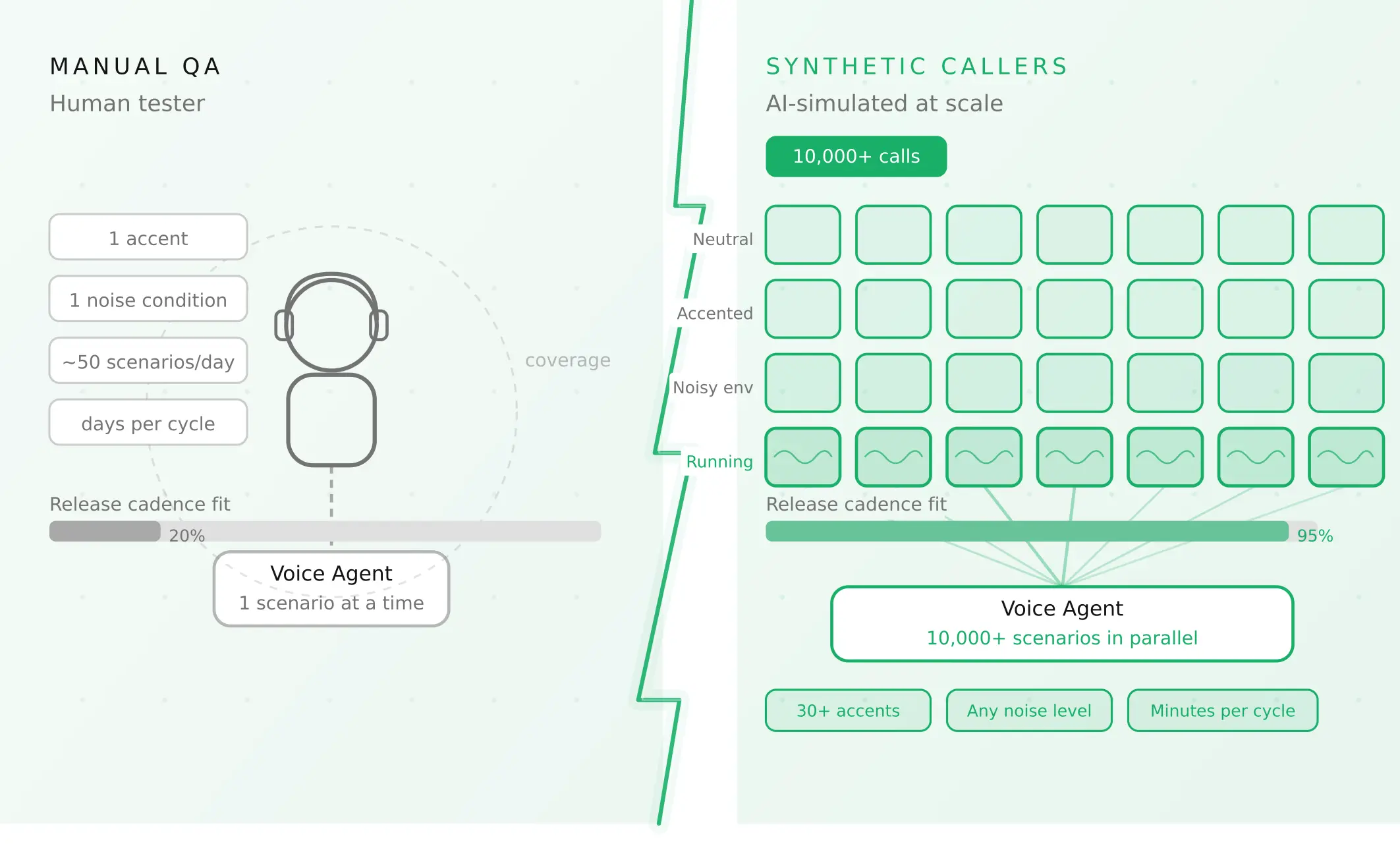
How to automate voice agent testing: synthetic callers vs manual QA
Learn how ai test automation replaces manual QA for voice agents. Compare synthetic callers vs human testers, with a 5-step framework to scale without hiring.
Read more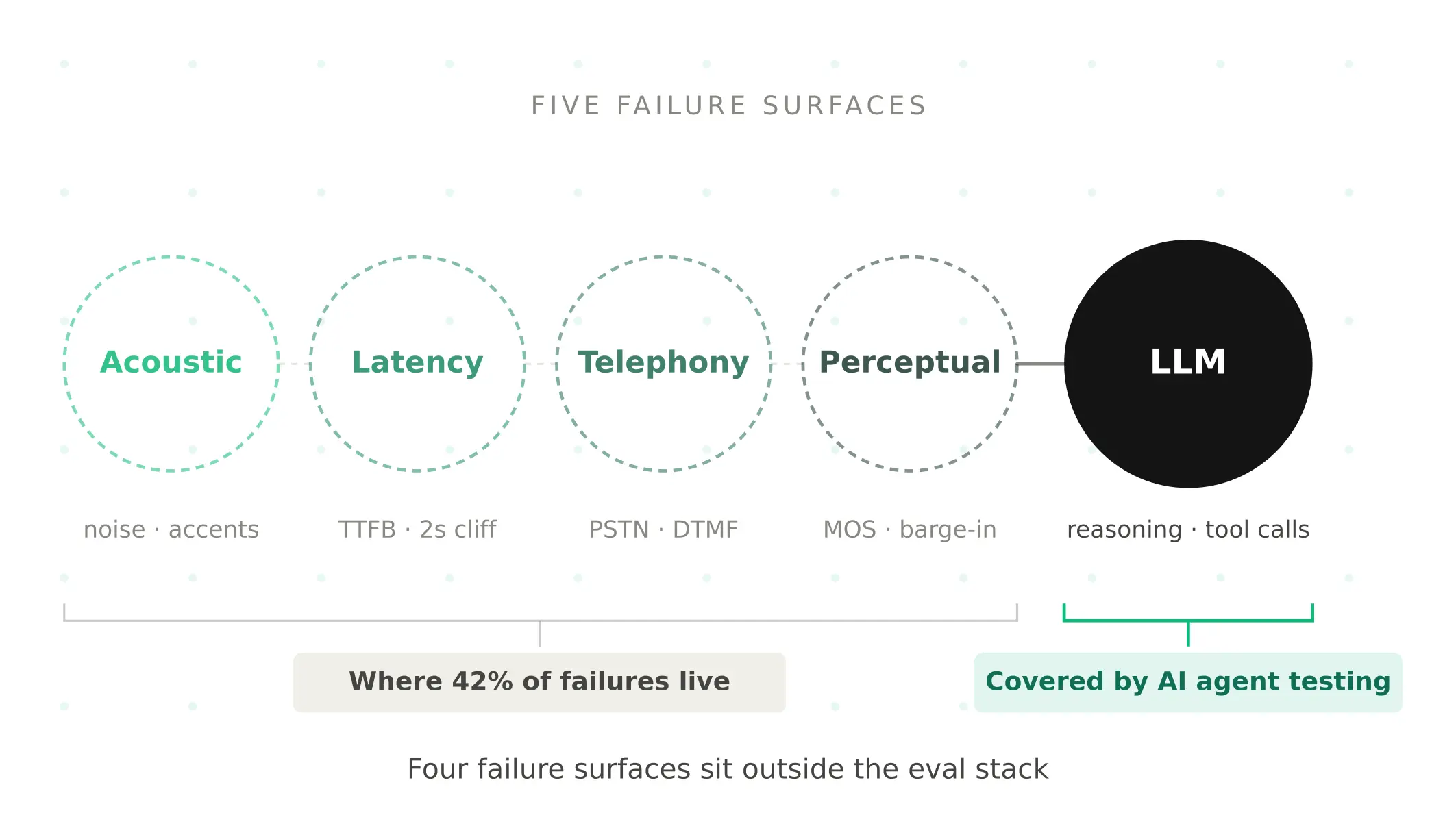
AI Agent Testing vs Voice Agent Testing: What General Tools Miss for Voice
AI agent testing measures text outputs. Voice agent testing measures behaviour through an acoustic pipeline. Five failure categories general tools miss.
Read more