Build vs Buy Voice Agent Observability
On this page
Most posts on this question compare a licence to a salary. That misses the real cost. A system nobody owns decays quietly, and a vendor that cannot see your tool results explains little. This build vs buy voice agent observability guide is the decision, with costs and ownership.
For the capability checklist, read the voice agent observability buyer checklist. It is not repeated here. For storage, ingest and audio numbers, see voice agent observability cost per minute. Sources were opened on November 23, 2026. Every dollar figure below is made up for the arithmetic. Nothing is a price quote.
What voice agent observability has to include
A call is long, two-sided and crosses a carrier, speech-to-text, a model, tools and speech output. The definition post covers why. Any path, built or bought, must deliver these pieces.
| Piece | What it must do | Kind |
|---|---|---|
| Telemetry ingest | Accept spans, logs and metrics from the agent | Commodity |
| Storage and retention | Keep each data type for its own time | Policy |
| Correlation | Join telephony, STT, LLM, tools and TTS on one call ID | Voice-specific |
| Recording linkage | Open the audio at the right moment of a trace | Voice-specific |
| PII masking | Mask before storage, and prove it | Policy |
| Dashboards | Show outcomes, latency and cost by vendor | Commodity |
| Alerting | Page on caller harm, not noise | Policy |
| Root cause and clustering | Group failures into causes | Voice-specific |
| Access control and audit | Limit who sees content, log who did | Policy |
That split is the whole decision. The commodity half is cheap to build and cheap to buy. The voice-specific half is where build projects stall and where vendors differ. Policy pieces are decisions on either path: event schema, retention, data residency, PII redaction and trace sampling.
The build-cost model
For build vs buy voice agent observability, write the build cost with your own variables. Keep one-time and yearly costs apart.
Build cost over N years = W x c + N x (m x Y + S + o x Y)
- W is engineer-weeks to build the first usable version.
- c is the loaded cost of one engineer-week.
- Y is the loaded cost of one engineer-year.
- m is the share of an engineer spent maintaining it each year.
- S is yearly storage and compute.
- o is the on-call and incident share of an engineer, per year.
The maintenance share is the variable people skip. Google's SRE book defines toil as work that is "manual, repetitive, automatable, tactical" and "scales linearly as a service grows" (Google SRE book, eliminating toil, read November 23, 2026). A homegrown dashboard that needs weekly fixes is toil.
On-call burden is the second skipped variable. The same book says the minimum for a single-site on-call rotation is eight engineers (Google SRE book, being on-call, read November 23, 2026). That is guidance for large teams. A team of four will not run a healthy rotation for a side pipeline. Put a number on o even if it is small.
Worked example, illustrative
These inputs are made up. Use your own.
| Input | Illustrative value |
|---|---|
| W, engineer-weeks to build | 12 |
| c, loaded cost per engineer-week | $4,000 |
| Y, loaded cost per engineer-year | $200,000 |
| m, maintenance share | 0.25 |
| S, storage and compute per year | $6,000 |
| o, on-call and incident share | 0.05 |
The arithmetic, checked in Python:
| Line | Calculation | Result |
|---|---|---|
| Build, one time | 12 x $4,000 | $48,000 |
| Maintenance per year | 0.25 x $200,000 | $50,000 |
| Storage and compute per year | given | $6,000 |
| On-call per year | 0.05 x $200,000 | $10,000 |
| Running cost per year | 50,000 + 6,000 + 10,000 | $66,000 |
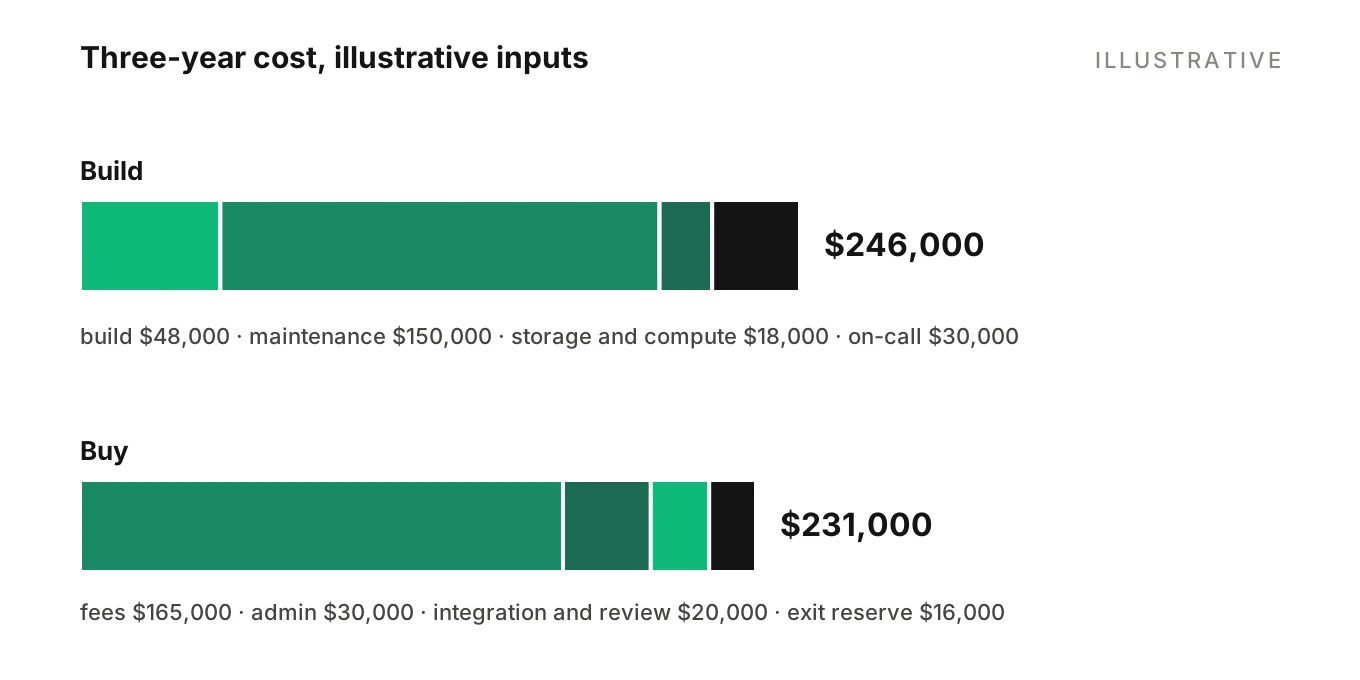
| Three-year total | 48,000 + 3 x 66,000 | $246,000 |
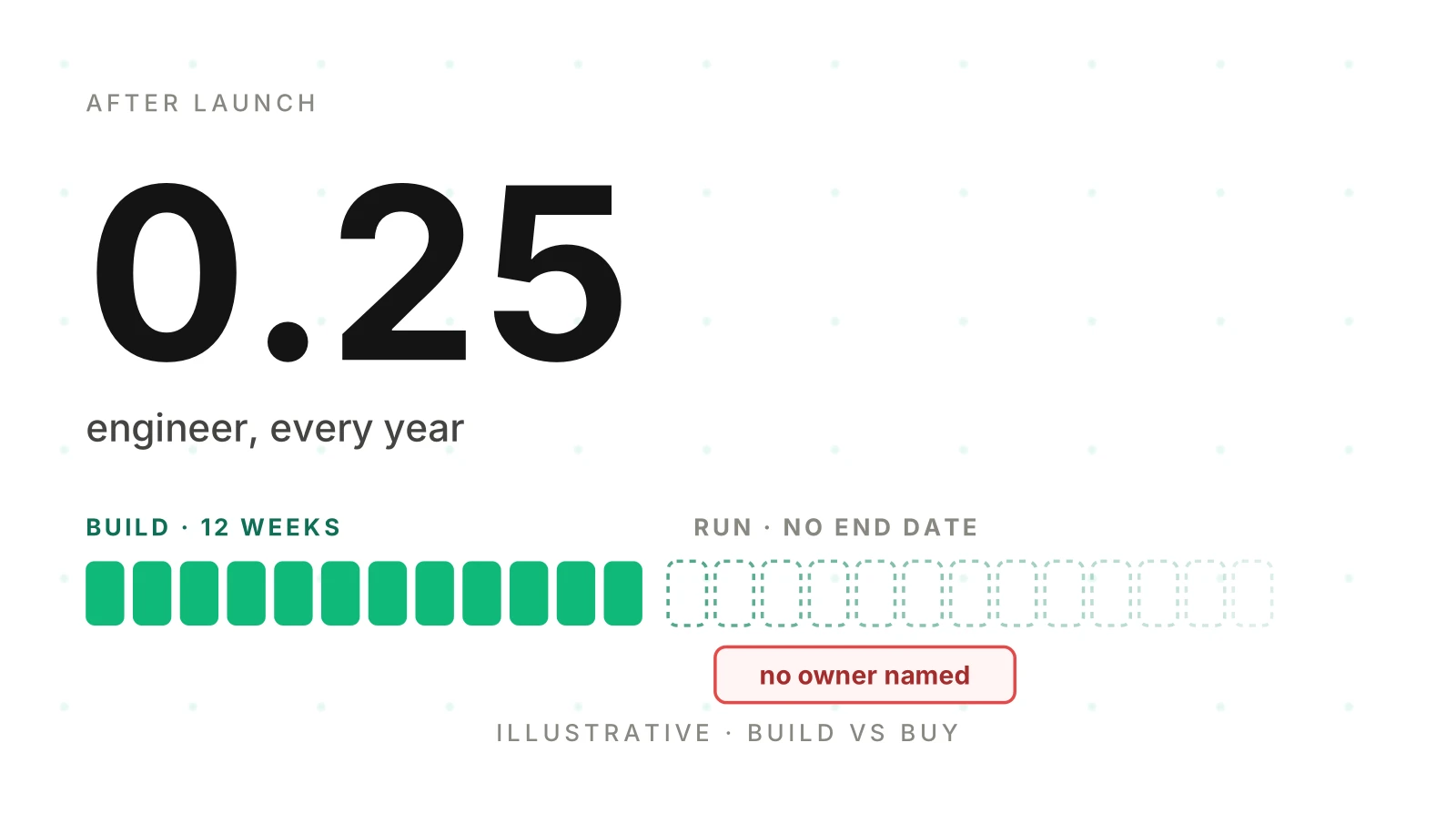
Year one costs $114,000. By year three, running cost is $198,000 of the $246,000. The build week count matters less than the yearly share.
How sensitive is the answer?
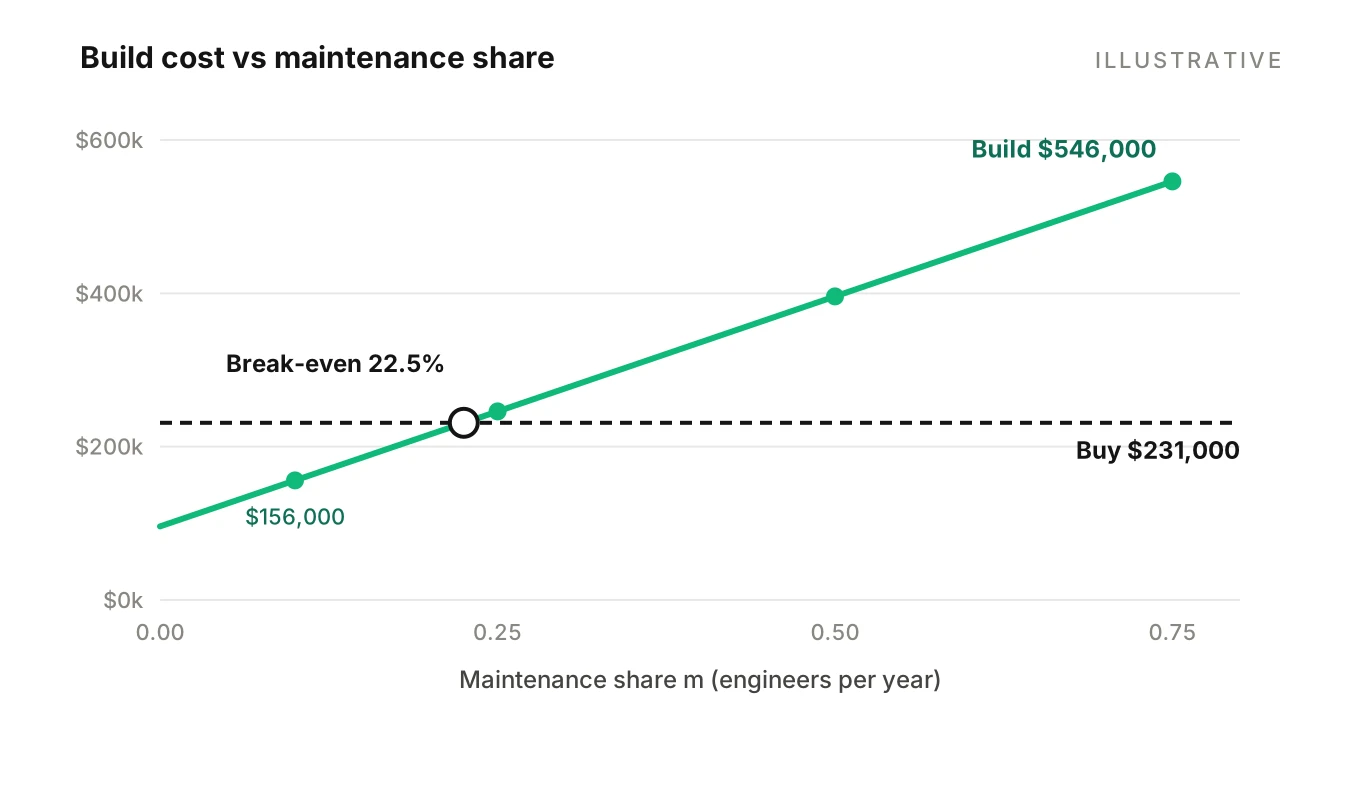
Hold everything else fixed and change m. At 0.10 the three-year build total is $156,000. At 0.25 it is $246,000. At 0.50 it is $396,000. Ask who fixes the dashboard when a provider changes its output.
The buy-cost model
Buying trades build weeks for integration weeks, and adds costs the build path never has.
Buy cost over N years = N x (F + a x Y) + (I + P) x c + E x c
- F is the yearly licence or usage fee.
- a is the share of an engineer who administers it.
- I is integration weeks: instrumentation, mapping and first dashboards.
- P is procurement and security-review weeks, across your team and theirs.
- E is exit weeks: the work to export your data and move away.
Include E even when you do not plan to leave. It is your vendor lock-in price. Ask how data leaves and in what format. A vendor that cannot answer has told you something.
Worked example, illustrative
| Input | Illustrative value |
|---|---|
| F, yearly fee | $55,000 |
| a, admin share | 0.05 |
| I, integration weeks | 3 |
| P, procurement and review weeks | 2 |
| E, exit weeks | 4 |
| Line | Calculation | Result |
|---|---|---|
| Fees over three years | 3 x $55,000 | $165,000 |
| Administration | 3 x 0.05 x $200,000 | $30,000 |
| Integration and review | (3 + 2) x $4,000 | $20,000 |
| Exit reserve | 4 x $4,000 | $16,000 |
| Three-year total | 165,000 + 30,000 + 20,000 + 16,000 | $231,000 |
Year one costs $85,000. At these made-up inputs, buy is $15,000 cheaper over three years, and faster to a first insight. The break-even is a yearly fee of $60,000. Or hold the fee at $55,000 and the break-even maintenance share is 22.5%. Below that share, building wins on cost. Above it, buying wins. Your numbers will differ. The point is that you can compute the line yourself.
Cost is not the only axis. A cheaper path with no failure clustering for a year is not cheaper. The matrix below adds the other factors.
The middle path: OpenTelemetry, a general backend, custom analysis
The third option is neither. Instrument with an open standard, send data to a general backend, and write the voice-specific analysis yourself.
OpenTelemetry describes itself as "vendor- and tool-agnostic, meaning that it can be used with a broad variety of observability backends", and adds that "OpenTelemetry is not an observability backend itself" (OpenTelemetry, what is OpenTelemetry, read November 23, 2026). That makes instrumentation the safest part to own. The OpenTelemetry voice agents guide shows the spans.
The Collector sits between your agent and the backend. It is a "vendor-agnostic implementation of how to receive, process and export telemetry data" (OpenTelemetry Collector, read November 23, 2026). It can send to more than one destination, which helps when you switch. See the Collector post for masking and routing.
For the backend, three general tools, stated neutrally and as of November 23, 2026:
- Grafana Tempo. Its page calls it "an open source, easy-to-use, and high-scale distributed tracing backend" that can ingest OpenTelemetry (Grafana Tempo).
- Datadog. Its docs describe a standard OpenTelemetry pipeline that exports over OTLP, and direct OTLP ingestion (Datadog OpenTelemetry docs).
- Langfuse. Its docs say it "can receive traces on the
/api/public/otel(OTLP) endpoint" (Langfuse OpenTelemetry). Self-hosting needs several parts, including PostgreSQL and ClickHouse (Langfuse self-hosting).
I did not compare them. They are general tools with their own pricing and limits. Read their pages before choosing.
The middle path covers ingest, storage and dashboards. Correlation, recording alignment and failure clustering stay yours. The cost formula is the build formula, with S replaced by a backend fee and W cut to the custom parts. Among voice agent observability tools, this is the one that needs the most ownership.
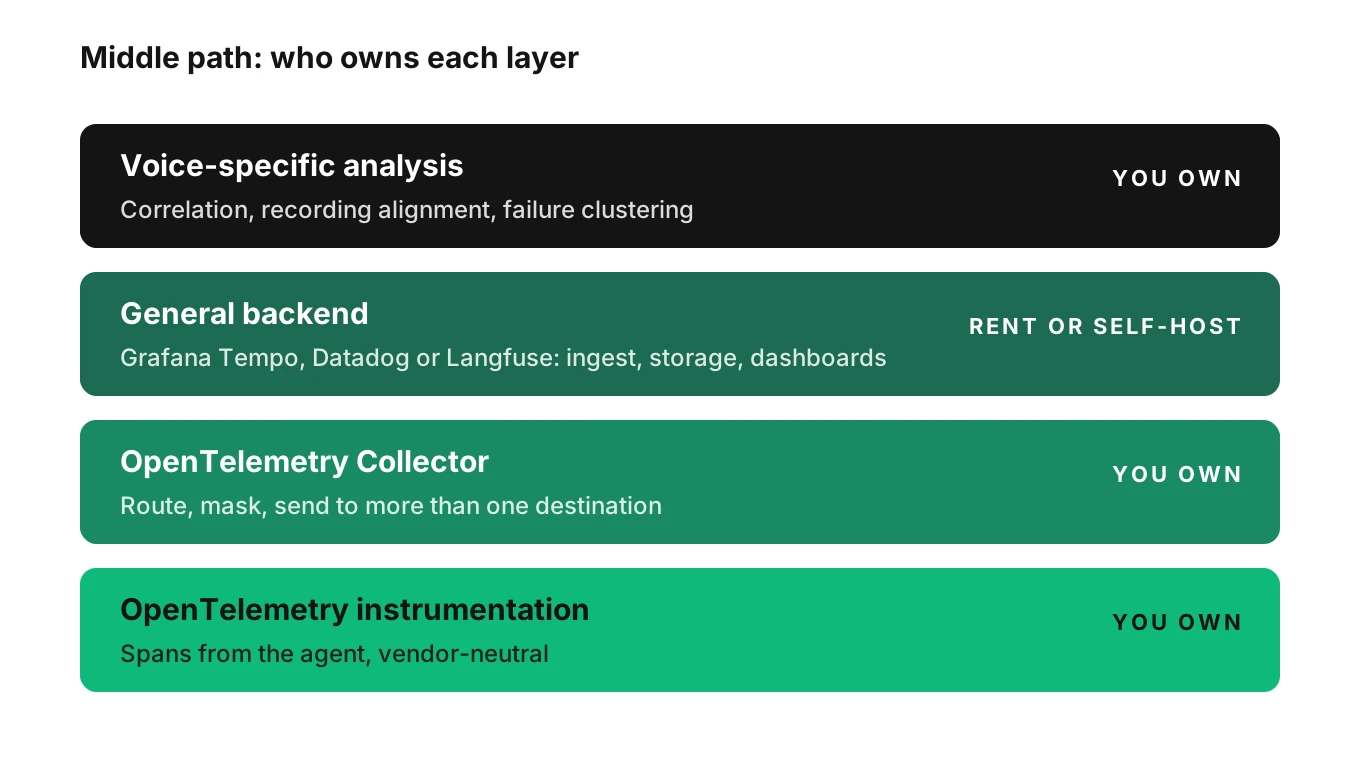
Two traps. General backends see spans, not call outcomes. And the custom analysis becomes the half-built system nobody owns if it has no owner. See LLM observability for voice agents.
Decision matrix
This is the build vs buy voice agent observability matrix. Score your own situation row by row. No row decides alone.
| Factor | Leans build | Leans middle path | Leans buy |
|---|---|---|---|
| Team size | Many engineers, spare capacity | A few engineers who know OTel | Two or three engineers, all on product |
| Call volume | Very high, steady | Moderate, growing | Low to moderate, spiky |
| Regulated data | Strict, own the controls | Need control, some vendor review | Review is possible, vendor passes it |
| In-house observability skills | Strong | Some | Little |
| Time to first insight | Months are fine | Weeks | Days |
| Failure clustering needed | Can write it | Will write a first version | Want it out of the box |
If most rows land in one column, you have your answer. If they split, the middle path is usually the honest fit. Volume cuts both ways: at very high volume a usage fee can dominate, and regulated data is a reason to ask where data lives, not to build by default.
Signs to build
Building is right more often than vendors admit. Choose it when these hold.
- You already run observability for other services, with an owner and a rota.
- Your data must stay inside your own environment and review rules out a vendor.
- A first version only needs traces, latency and a few dashboards.
- You can name the engineer who owns it in year two.
The last point is the test. If you cannot name the owner, you are not choosing to build. You are choosing to start something.
Signs to buy
- You have no observability owner and no spare engineer.
- You need answers in days, after an incident or before a launch.
- Your questions are "why did these calls fail" and "which cause is biggest", not "is the service up".
- A failed call has to be explained to someone outside engineering.
Evalgent Monitor is one example at the monitoring end. It is live production call monitoring that flags problems with fix recommendations. The alerting post and the monitoring overview show what to expect from any product here.
Signs to switch
Treat the first choice as a lease, not a marriage.
- Build to buy. The maintenance share keeps growing, the owner leaves, or on-call burns the same two people.
- Buy to build. Fees exceed the cost of an owned pipeline, or the vendor cannot take a field you need.
OpenTelemetry instrumentation lowers the exit cost in every direction.
Risks of each path
Building. The main risk is a half-built system nobody owns. It works for six months, then a provider changes a field and the dashboard breaks. Another is silent gaps: the dashboard looks complete but a layer is missing. A third is building ingest well and never reaching clustering, so you see failures and cannot explain them.
Buying. The main risk is a vendor that cannot see your tool results. If a tool returns a wrong value and the vendor sees only transcript and timings, it shows a symptom and no cause. Another is lock-in: history in a format you cannot export. A third is review: procurement can take longer than the build would have.
Middle path. The risk is carrying both a backend bill and a custom codebase. Keep the custom part small and named.
How to decide in one week
Run this as a short, bounded exercise.
1. List what you need - mark each piece in the first table must, should or nice for the next twelve months.
2. Pick your variables - write down W, m, S, o, F, I, P and E, each with a range.
3. Run both formulas - compute three-year totals at low, middle and high values, and find the break-even maintenance share.
4. Score the matrix - fill the six rows with real answers, not preferences.
5. Name an owner - for build or the middle path, write down who owns it in year two. No name means no build.
6. Test with one real call - take a failed call and see which path explains it. Compare against the buyer checklist.
7. Set a review date - decide in six months whether the choice holds, and write the trigger for switching.
Questions to ask any vendor
These are the questions to ask a voice agent observability vendor, Evalgent included.
- Data export. Can I export every call record in an open format, without a ticket?
- OpenTelemetry in and out. Can I send OpenTelemetry data from any stack, and send the same data to a second backend?
- Retention and region. Do I set how long each data type is kept and where it is stored?
- Masking. Is personal data masked before storage, and how do I test it?
- Undetermined handling. When data does not support a verdict, does the tool say so, or guess?
- Coverage gaps. Does it show which calls and layers it could not see?
- Media path. Does it sit in the live audio path? A tool that does can add latency or risk to a call.
- Tool results. Can it see what my tools returned, or only that a tool was called?
- Access, audit and exit. Who sees call content, is access logged, and what happens to my data when I leave?
Here is how Evalgent answers the media-path, undetermined and coverage questions. Evalgent Observe, which is launching, is never in the media path. It works with any stack through OpenTelemetry plus an upload path for call details. It shows "undetermined" and coverage gaps instead of hiding them. Failures are clustered into root causes, and traces explain why a call failed. At this stage it works at the outcome level, and native connectors for named platforms are planned. To test those answers against your own calls, you can book a walkthrough.
For failure grouping, the method matters more than the tool: see how to cluster voice agent failures and the testing, monitoring and observability model. For recording, see recording consent. The wider stack question is in build vs buy for the voice agent stack.
Frequently asked questions
Should we build voice agent observability in house?
Build in house when you already run observability with an owner and a rota, your data cannot leave your environment, and a first version needs only traces and dashboards. Name the year-two owner first. If nobody can be named, choose the middle path or buy.
How much does it cost to build voice agent observability?
It depends on your variables. The cost is build weeks times weekly cost, plus yearly maintenance, storage and on-call. In this post's made-up example, 12 build weeks and a quarter of an engineer give $246,000 over three years. Replace every input with your own estimate.
Is OpenTelemetry enough for voice agents?
No. OpenTelemetry is for generating, exporting and collecting telemetry, and it is not a backend itself. You still need storage, dashboards, correlation across the call path, recording linkage and failure analysis. It does make switching easier, which is why it suits every path.
Can I use Datadog, Grafana or Langfuse for voice agents?
Each documents OpenTelemetry ingest. They are general tools. Aligning recordings and clustering failures into causes remains yours. Read each product's pages for current limits.
What is the biggest hidden cost of in-house voice agent observability?
The maintenance share of an engineer after launch. Build weeks are visible and finite. Ongoing fixes, schema changes, on-call and requests from support are neither. In this post's example, the three-year total rises from $156,000 to $396,000 as the share goes from 0.10 to 0.50.
What is the biggest risk of buying voice agent observability?
A vendor that cannot see your tool results, or cannot export your data. Both leave you with symptoms and no cause, or with history you cannot move. Ask about export format, OpenTelemetry in and out, and what the tool sees of your tool calls before signing.
When should we switch from build to buy?
Switch when the maintenance share keeps growing, the owner leaves, on-call burns the same people, or you need clustering you will not write. Write the trigger down at the start. A review every six months keeps the decision honest.
What are the questions to ask a voice agent observability vendor?
Ask about data export, OpenTelemetry in and out, retention, region, masking, undetermined cases, coverage gaps, the media path, and whether it sees tool results. Ask what happens to your data when you leave.
The bottom line
Build when you can name who owns it in year two, and buy when you need failure causes faster than you can write the analysis. Compute both with your own variables, keep OpenTelemetry instrumentation on every path, and revisit the choice every six months.
Related Articles
How to automate voice agent testing: synthetic callers vs manual QA
Learn how ai test automation replaces manual QA for voice agents. Compare synthetic callers vs human testers, with a 5-step framework to scale without hiring.
Read more
AI Agent Testing vs Voice Agent Testing: What General Tools Miss for Voice
AI agent testing measures text outputs. Voice agent testing measures behaviour through an acoustic pipeline. Five failure categories general tools miss.
Read more