Test your voice agent
Build vs buy your voice agent stack
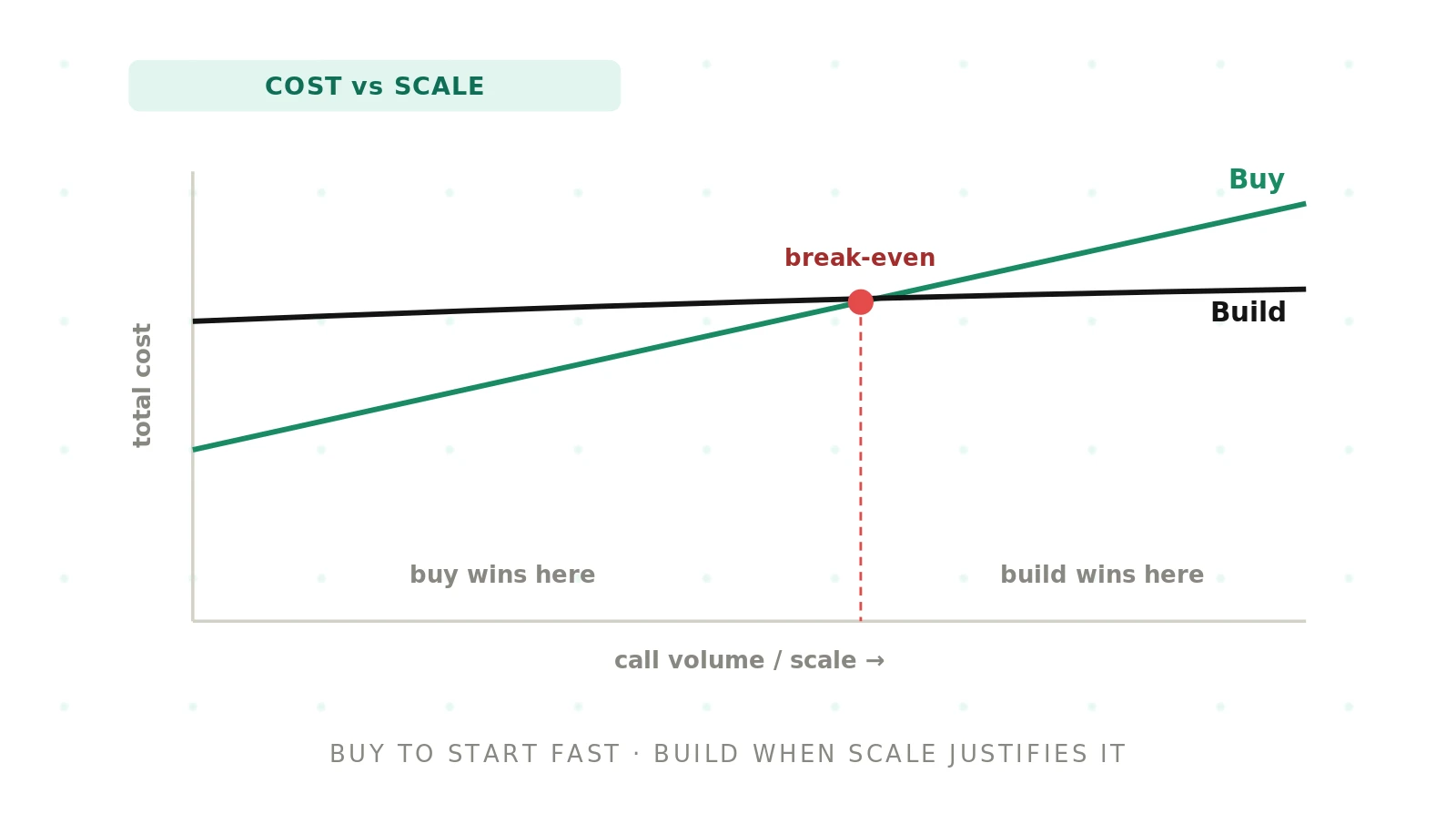
> Quick Answer: Buy an all-in-one platform when speed matters and volume is modest. Build your own stack when scale, control, or margin make the engineering worth it. Most teams should buy first, then revisit as call volume grows and per-minute costs start to dwarf salaries.
Every voice AI team faces the same fork early. Do you assemble the pieces yourself, or pay a platform to hand you a working system? It sounds like a technical question. It is really an economic one. The right answer depends on your volume, your margins, your team, and how fast you need to launch.
This post is about the whole-stack decision. Not which orchestration approach to run, and not what the pieces are. It is the strategic call: build the entire thing, or buy it assembled. The trade-offs are real, and they move as you grow.
What "build" and "buy" actually mean here
"Buy" means adopting an all-in-one platform. One vendor gives you speech-to-text, a language model, text-to-speech, telephony, and orchestration in a single package. You configure it, connect your data, and ship. The plumbing is someone else's problem.
"Build" means assembling those pieces yourself. You pick a transcription engine, a language model, a voice synthesizer, a telephony provider, and you write the orchestration that binds them. You own the wiring, the latency budget, and the failures.
This is the classic make-or-buy decision applied to voice AI. Firms have weighed it for a century across every industry. The logic is old. The stack is new.
If you are still mapping the components, the voice agent stack guide breaks down what each layer does. This post assumes you know the layers. Here we weigh whether to own them.
The economics behind the decision
Start with the money, because that is what really drives the call. Buying trades a higher per-unit price for near-zero build cost. Building trades heavy upfront engineering for a lower marginal cost at scale. The crossover point decides which wins.
Total cost of ownership, not sticker price
The headline number misleads. A platform's per-minute rate looks expensive next to raw component pricing. But raw components hide the cost of the engineers who wire them together and keep them running. Total cost of ownership counts all of it.
Buying folds infrastructure, maintenance, and upgrades into one line item. Building spreads those across salaries, on-call rotations, and the slow tax of technical debt. Neither is free. The question is which bucket costs you less at your volume.
Our breakdown of what a voice agent actually costs walks through the line items most teams forget. Read it before you model either path. The hidden costs usually decide the outcome.
Where the crossover sits
At low volume, buying almost always wins. The build effort dwarfs the runtime savings, so paying a premium per minute is cheap. Your engineers are better spent on the product, not the plumbing underneath it.
At high volume, the math flips. When you run millions of minutes, a few cents of margin per minute compounds fast. That margin can fund a whole platform team and still leave savings. Scale is what justifies the build.
The crossover is not a fixed number. It moves with your margins, your team's cost, and how much the platform charges. Model it with real numbers. Do not trust a vendor's slide or a blog's rule of thumb, including this one.
The dimensions that actually matter
Cost is the loudest factor, but it is not the only one. Four others shape the decision, and any one of them can override the spreadsheet. Weigh them against your own situation, not a generic ranking.
Time to market
Buying is fast. You can launch in weeks because the hard integration is done. Building is slow, because latency budgets, failovers, and edge cases take months to get right. Time to market is often the deciding factor for early teams.
If you are racing a competitor or validating an idea, speed usually beats savings. A platform lets you learn from real calls now. You can always rebuild later, once you know what you are actually building toward.
Control and flexibility
Building gives you control. You choose each component, tune each latency budget, and swap any layer when a better one appears. Buying constrains you to the platform's choices, its roadmap, and its limits. That constraint is fine until it is not.
Voice quality lives in the details. The ITU-T G.114 recommendation sets a one-way latency budget of 150 milliseconds for natural conversation. Hitting that reliably at scale sometimes demands control a platform will not give you. If it does, building earns its keep.
Engineering burden
A built stack is a permanent commitment. Someone owns the latency regressions, the model upgrades, the provider outages, and the 3 a.m. pages. That team never disbands. Buying outsources most of that burden to the vendor, for a price.
Be honest about your team. Do you have the people to run this? Will you still have them in two years? A stack no one maintains decays fast. Under-resourced builds often cost more than the platform they replaced.
Vendor lock-in
Buying trades independence for convenience. When one vendor owns your whole stack, switching later is painful and expensive. Vendor lock-in is a real cost, even when it never shows up on an invoice.
Building reduces lock-in at the component level, but adds it at the integration level. Your custom orchestration becomes its own dependency. Our piece on voice AI vendor lock-in covers how to keep either path portable. Design for exit from day one.
Build vs buy across the dimensions that decide it
The table below compares the two paths on the factors that move the decision. No path wins every row. The right choice is the one that wins the rows you weigh most heavily.
| Dimension | Build your own stack | Buy an all-in-one platform |
|---|---|---|
| Upfront cost | High engineering investment | Low, mostly configuration |
| Marginal cost at scale | Low per minute once built | Higher per-minute rate |
| Time to market | Months to a solid launch | Weeks to first calls |
| Control over components | Full, swap any layer | Limited to platform choices |
| Engineering burden | Permanent, needs a team | Mostly the vendor's problem |
| Latency tuning | Fine-grained, you own it | Bounded by platform limits |
| Vendor lock-in | Low per component | High at the platform level |
| Best fit | High volume, tight margins | Early stage, fast validation |
Read the table as a starting frame, not a verdict. Your weights differ from the next team's. A regulated enterprise values control; a seed-stage startup values speed. Score the rows that matter to you.
How the answer shifts as you grow
The build-vs-buy call is not permanent. It is a decision you revisit as your volume, team, and margins change. What is right at launch is often wrong at scale, and vice versa. Plan for the shift instead of being surprised by it.
Early on, buy. You need to validate the product and learn from real callers. Speed and low upfront cost matter more than per-minute margin. The platform premium is trivial against the value of launching now.
As volume climbs, the premium stops being trivial. Per-minute costs start to rival, then exceed, the salaries of a small platform team. That is the signal to model a build seriously. Not to build yet, but to run the numbers honestly.
A hybrid path often bridges the two. Many teams buy the platform, then peel off the one layer where control or cost hurts most. The managed vs self-hosted orchestration decision is usually where that first peel happens. It is the natural halfway house.
Whatever you choose, measure the return on investment at each stage. A build only pays off if the savings are real and the quality holds. Our guide to voice agent ROI shows how to model that honestly, including the failed calls most models ignore.
How to decide between building and buying
Work through these steps in order. Each one narrows the choice with a real number, not a gut feeling. By the end, the decision usually makes itself. If it does not, the numbers were too close to matter, so buy and revisit.
1. Estimate your realistic call volume. Project minutes per month for the next two years. Volume drives everything else. Be conservative, because inflated projections make builds look far better than they are.
2. Model total cost of ownership for both paths. Count salaries, infrastructure, maintenance, and the platform premium. Include the engineers a build truly needs. Compare full annual cost, not per-minute rates in isolation.
3. Find your crossover point. Calculate the volume where build savings overtake build cost. If you are well below it, buy. If you are well above it, model a build in detail.
4. Score the non-cost dimensions. Rate time to market, control, engineering burden, and lock-in for your situation. Weight them by what your business actually needs. Sometimes one row overrides the entire spreadsheet.
5. Audit your team honestly. Confirm you have the people to build and, harder, to maintain a stack for years. A build no one can sustain is a liability, not an asset.
6. Pick the reversible option first. When it is close, buy. Buying is easier to walk back than a half-finished build. Keep your data and logic portable so a future build stays open.
7. Set a review trigger. Define the volume or margin threshold that forces a re-evaluation. Revisit on schedule, not on impulse. The right answer changes, so your decision process should too.
Why the decision fails without evaluation
Here is the trap. Both paths can produce an agent that looks fine in a demo and falls apart on real calls. A cheap built stack with poor quality has negative real ROI. A pricey platform that resolves nothing is worse. Cost only matters next to quality.
You cannot compare build and buy on price alone. You have to compare them on outcomes: resolution, escalation, latency, and containment across realistic callers. The path that resolves more calls per dollar wins. Everything else is a proxy.
That is why evaluation sits underneath this whole decision. Before you commit to either path, you need to know how each one actually performs. Our guide to evaluating voice agent vendors shows how to test both on the same terms. Measure before you commit.
Making the build-vs-buy call with Evalgent
The build-vs-buy decision only holds up if you measure both paths on the same quality bar, because a cheaper stack with worse outcomes is not actually cheaper. Evalgent is where that measurement happens, independently of whichever path you lean toward. Scenarios define the real calls you route to a candidate stack, so you compare build and buy on the same work rather than on demos. Profiles vary accents, behaviour, and difficulty, so a resolution rate holds across the callers you serve, not just the easy ones. Metrics score resolution, escalation, latency, and containment against custom thresholds, so cost per resolved call is comparable across both paths. Evaluations run these as automated batches before you commit, so the decision rests on data, not a vendor slide. Reviews let your team hear the failed and escalated calls, where the real difference between a built stack and a bought one lives. If you want to weigh build against buy on outcomes you can trust, book a demo.
The bottom line
Buy first when speed and low volume favor it, and build only when scale and margin clearly justify the engineering. Whichever path you pick, measure both on real outcomes, because the cheaper stack is only cheaper if it actually resolves the call.
Frequently asked questions
Should I build or buy my voice agent stack?
Buy first if your volume is modest or you need to launch fast. An all-in-one platform gets you calling in weeks. Build only when your call volume is high enough that per-minute savings clearly outweigh the engineering cost and the permanent burden of maintaining the stack yourself.
When does building a voice agent stack become worth it?
Building pays off at high volume, where a few cents of margin per minute compound into real money. The crossover comes when per-minute platform costs start to rival the salaries of a small platform team. Model your own numbers, because the threshold moves with margins, team cost, and platform pricing.
What is the total cost of ownership of a voice agent stack?
It includes far more than per-minute rates. Count engineering salaries, infrastructure, maintenance, on-call rotations, model upgrades, and technical debt for a build. For a platform, count the premium plus configuration effort. Comparing sticker prices alone misleads, because the hidden operational costs usually decide which path is actually cheaper.
Is it cheaper to build or buy a voice agent?
It depends entirely on volume. At low volume, buying is cheaper because build effort dwarfs runtime savings. At high volume, building can be cheaper because low marginal cost compounds. The crossover point decides it. Find yours by modeling total cost of ownership for both paths across two years of projected minutes.
How long does it take to build a voice agent stack?
Expect months, not weeks, for a production-grade stack. Wiring the components is fast; hitting reliable latency, handling failovers, and covering edge cases is slow. Buying an all-in-one platform gets you to first calls in weeks. If time to market is critical, that gap alone often decides the build-vs-buy question.
Does building my own stack avoid vendor lock-in?
Partly. Building reduces lock-in at the component level, since you can swap any layer. But your custom orchestration becomes its own dependency, and rebuilding it is costly. Buying concentrates lock-in in one platform. Either way, keep your data and logic portable, and design for an exit from the first day.
Can I switch from buying to building later?
Yes, and many teams do. Buying is the reversible option, so start there and revisit as volume grows. A hybrid step often comes first: keep the platform but peel off the one layer where cost or control hurts most. Set a volume or margin trigger that forces a scheduled re-evaluation.
How do I compare build and buy fairly?
Compare them on outcomes, not price. Run the same realistic calls through both, then measure resolution, escalation, latency, and containment across varied callers. The path that resolves more calls per dollar wins. Price alone is a trap, because a cheap stack that resolves nothing has negative real return on investment.
Related Articles
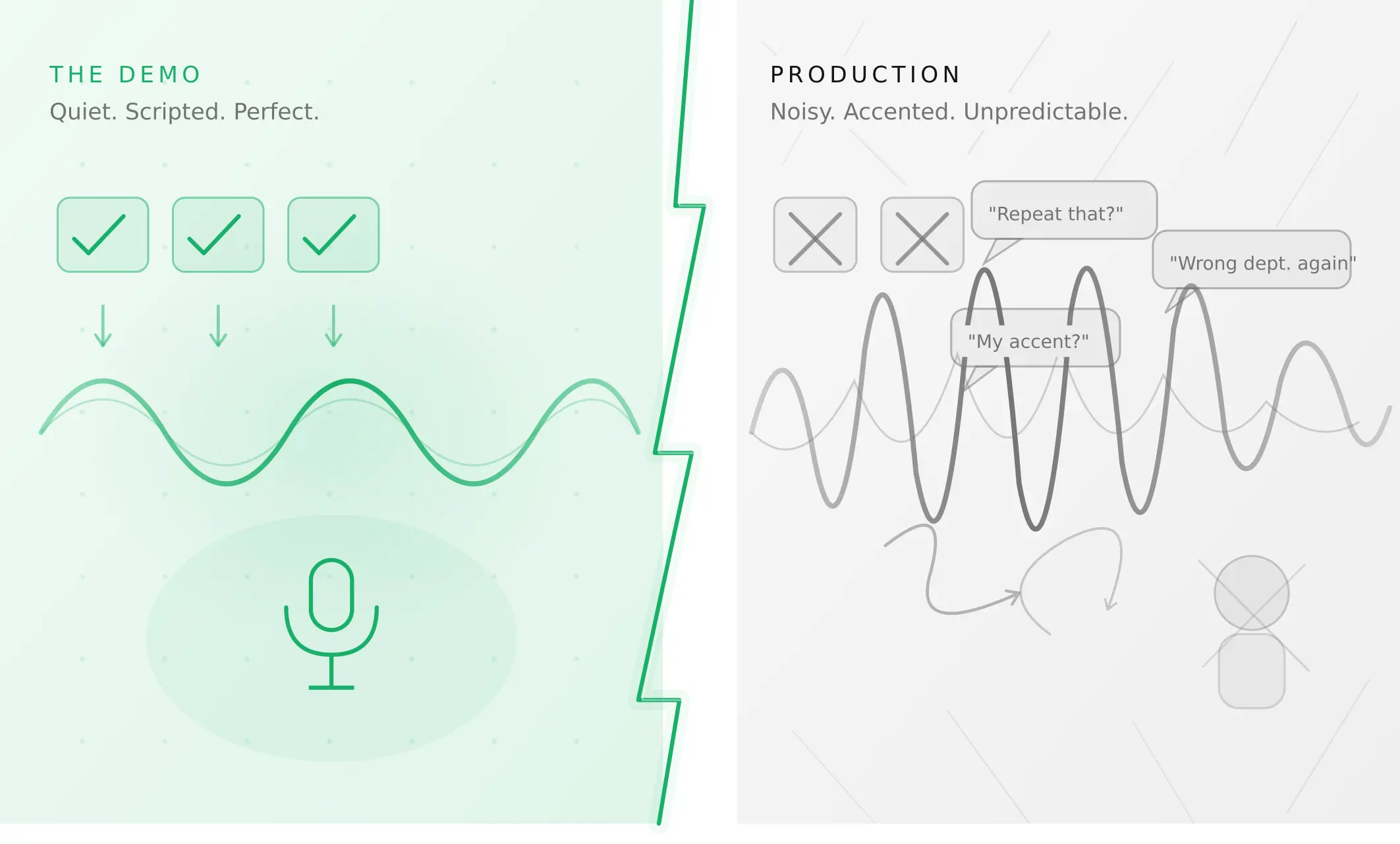
Why AI voice agents fail in production (and how to prevent it)
AI voice agents that ace demos still break in production. Learn the 5 root causes, how to test for each, and what production readiness actually means.
Read more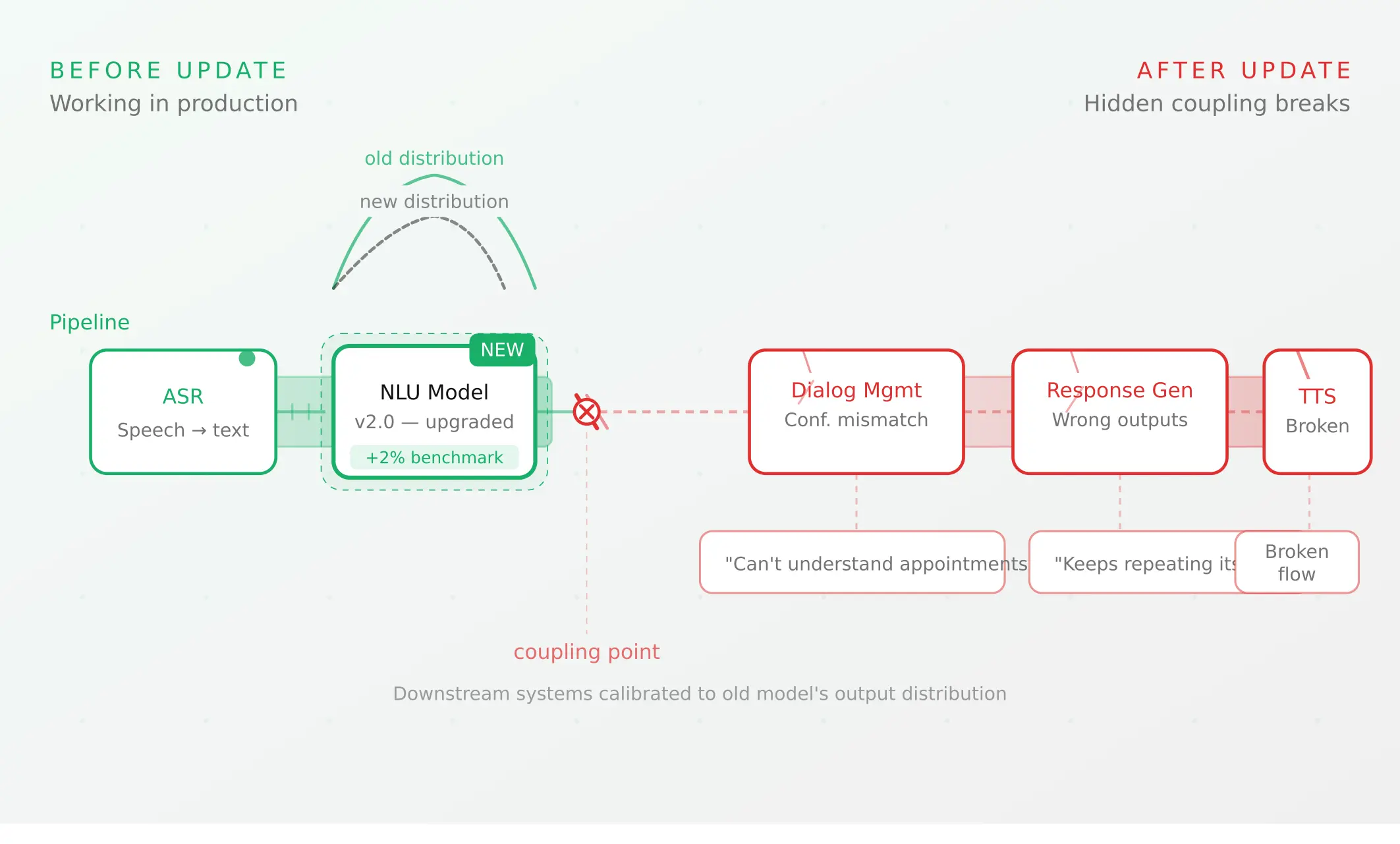
Voice agent regression testing: why LLM updates break production
LLM updates improve benchmarks but break voice agents in 5 predictable ways. How to detect and prevent regressions after every model or prompt change.
Read more