Voice Agent Data Residency: Where Call Data and Traces Can Live
On this page
A caller dials a number. One vendor transcribes the audio, a second runs the model and a third speaks the reply. The recording lands in a bucket and a trace lands in a log backend. A support engineer opens the account later.
Each step has a location, and they rarely match. This is general information, not legal advice. Your counsel decides what applies to your calls.
This post is about voice agent data residency for teams that run their own agent. It explains the words people mix up, maps one call hop by hop, and shows what vendor docs promise. It ends with a review checklist and what a telemetry Collector can do for traces.
Residency, sovereignty and transfer are different questions
People use these terms as if they were one. They are three questions. These are working definitions, not legal ones.
Data residency: where data is stored at rest. A recording in a regional bucket is a residency fact.
Data localisation or sovereignty: a rule or policy that data must stay in a country, or stay under that country's legal control. It is a requirement, not a storage fact.
Cross-border transfer: data moving to, or being made available in, another country. A model call that sends text to another region is a transfer even if nothing is saved there.
A vendor can truthfully say your data is stored in one region and still process it in another. That gap is the main trap. We use three questions through the post:
- Stored: where does it sit at rest?
- Processed: where does it run, even briefly?
- Accessed: who can read it, and from where?
What GDPR Chapter V and India's DPDP Act say
We opened two primary texts on November 21, 2026 and cover only what we read. This is general information, not legal advice.
GDPR Chapter V, Articles 44 to 49
Chapter V of Regulation (EU) 2016/679 is titled "Transfers of personal data to third countries or international organisations."
- Article 44: a transfer happens only if the chapter's conditions are met, including for onward transfers.
- Article 45(1): a transfer may take place where the European Commission has decided the third country, territory or sector ensures an adequate level of protection.
- Article 46(1): without such a decision, transfer needs appropriate safeguards and enforceable rights for data subjects. Article 46(2)(c) lists Commission-adopted standard data protection clauses as one safeguard.
- Article 48: a third-country court order to transfer data is enforceable only if based on an international agreement, such as a mutual legal assistance treaty.
- Article 49(1): without adequacy or safeguards, a transfer needs one of the listed conditions, such as explicit consent after being told the risks.
Chapter V is written as conditions on transfers, not as a rule about where data sits. Whether remote access from abroad counts as a transfer is a question for counsel. We did not open guidance on it.
For adequacy, we read the European Commission's own adequacy decisions page on November 21, 2026. It says a decision lets data flow from the EU, plus Norway, Liechtenstein and Iceland, to that country without further safeguards. The list of recognised countries moves.
One scope note matters for vendors. For the United States, the page recognises commercial organisations participating in the EU-US Data Privacy Framework. So adequacy can cover part of a country. Ask which entity you contract with, and recheck the page before you rely on it.
India's DPDP Act 2023, section 16
India's Digital Personal Data Protection Act, 2023 (Act 22 of 2023, assent August 11, 2023) has a short section 16, "Processing of personal data outside India." We read the official text on indiacode.nic.in.
Section 16(1) says the Central Government may, by notification, restrict a Data Fiduciary's transfer of personal data for processing to a notified country or territory outside India. Read plainly, transfer is not barred by default. We did not search for notifications under this section, so check the current position.
Section 16(2) says the section does not restrict any Indian law that gives a higher degree of protection or restriction on transfer. Other laws can be stricter. We opened none, so we cannot say which apply.
The Government of India notified the Digital Personal Data Protection Rules, 2025 as G.S.R. 846(E), dated November 13, 2025. MeitY lists it as published November 14, 2025, and a corrigendum followed in December 2025. We read Rule 1 on commencement. It says Rules 3, 5 to 16, 22 and 23 start eighteen months after publication. We could not read the English wording of the transfer rule, so we do not describe it. Read it yourself or ask counsel.
Where one voice call can land
Each row is a place data can be stored, processed or accessed. The regions are illustrative, not a real deployment.
| Hop | What lands there | Illustrative region | The question to ask |
|---|---|---|---|
| Telephony carrier | Number, caller ID, call records, audio in transit | A | Where are call records kept? |
| Speech-to-text | Caller audio, partial and final transcripts | B | Which endpoint? Is audio kept? |
| LLM | Transcript text, prompt, tool results | B | Where does inference run? |
| Text-to-speech | Reply text, generated audio | C | Same region as the LLM? |
| Recording storage | Full call audio, sometimes stereo | A | Which bucket region? |
| Trace and log backend | Spans, transcripts in attributes, tool payloads | B | Is the region fixed per project? |
| Evaluation tools | Replayed calls, transcripts, scores | C | Is test data kept apart? |
| Support access | Screens, exports, shared logs | D | Who reads it, from where? |
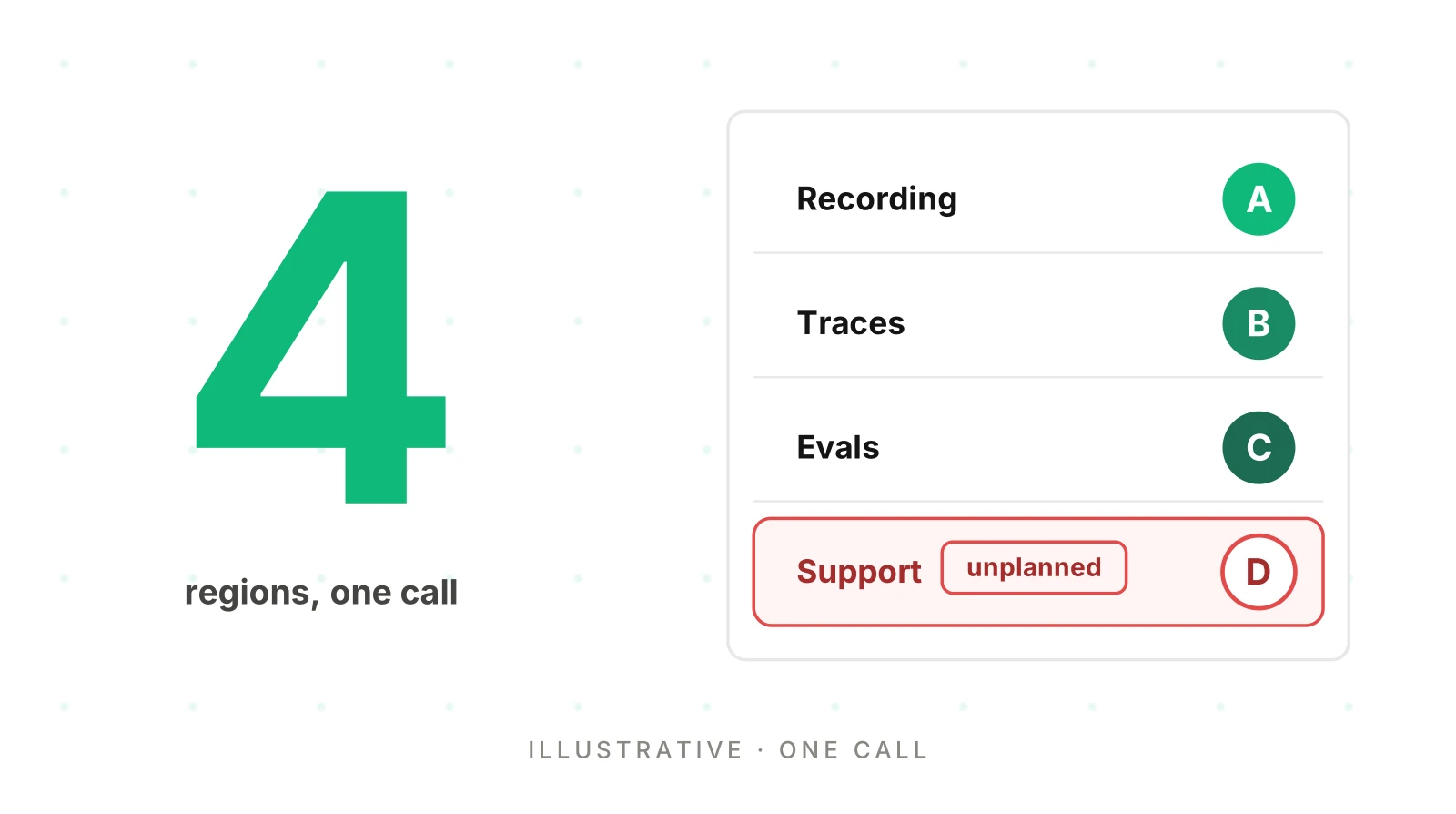
In this made-up call, data touches four regions. Each vendor had its own default.
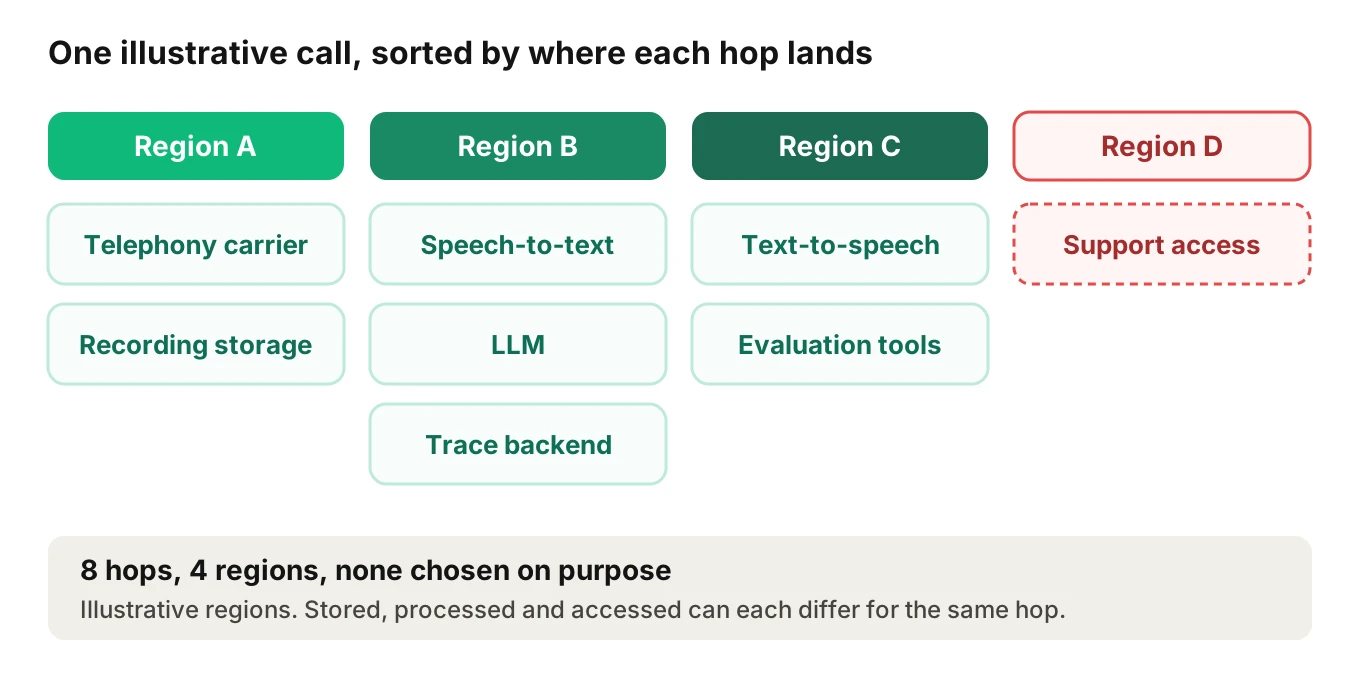
Three hops cause most of the surprise.
Models. Speech-to-text, LLM and text-to-speech are often three vendors. They may not offer the same regions, so a text reply can cross a border between the LLM and the voice.
Traces. Spans often carry transcript text and tool arguments. Our post on what to log on each call lists the fields. Where to mask them is in PII redaction in logs and traces.
Support and evaluation. These are the quiet copies. A shared link, a CSV export and a replay of a bad call all leave the main store.
On-prem keeps a hop inside your boundary. See on-prem speech-to-text and on-prem text-to-speech for the trade-offs.
Stored, processed, accessed: what vendor docs say
We read two vendors' own docs on November 21, 2026. We name them to show how the wording works. This is not a ranking, and the pages may change. A voice agent data residency answer should cover all three questions.
A telephony provider. Twilio's regions page says every workload is processed in some Region. With a target Region configured, it says workload data will only be stored within that Region. The stored data it lists includes call records, event logs, SIP call logs and recordings if enabled. It says not all products are available outside the US1 default.
The same page adds caveats. Some required administrative and billing infrastructure sits outside the isolation. Phone numbers, routing configuration, billing and usage records, and Console users are shared across Regions. It also says that, during an initial rollout phase, it does not guarantee all data stays in the selected Region. Ask the vendor which categories fall outside.
A voice and speech provider. ElevenLabs' data residency page says standard storage is in the U.S. It offers isolated environments in the EU, India and Singapore. Storage happens in the selected location, but processing may still occur elsewhere, including by affiliates and subprocessors, for support and for content moderation. EU customers can restrict processing to the EU with Zero Retention Mode, though optional integrations may process data outside it. The page says residency is an Enterprise-only feature.
The lesson is the pattern, not the vendors. Both pages separate storage from processing. Both list exceptions.
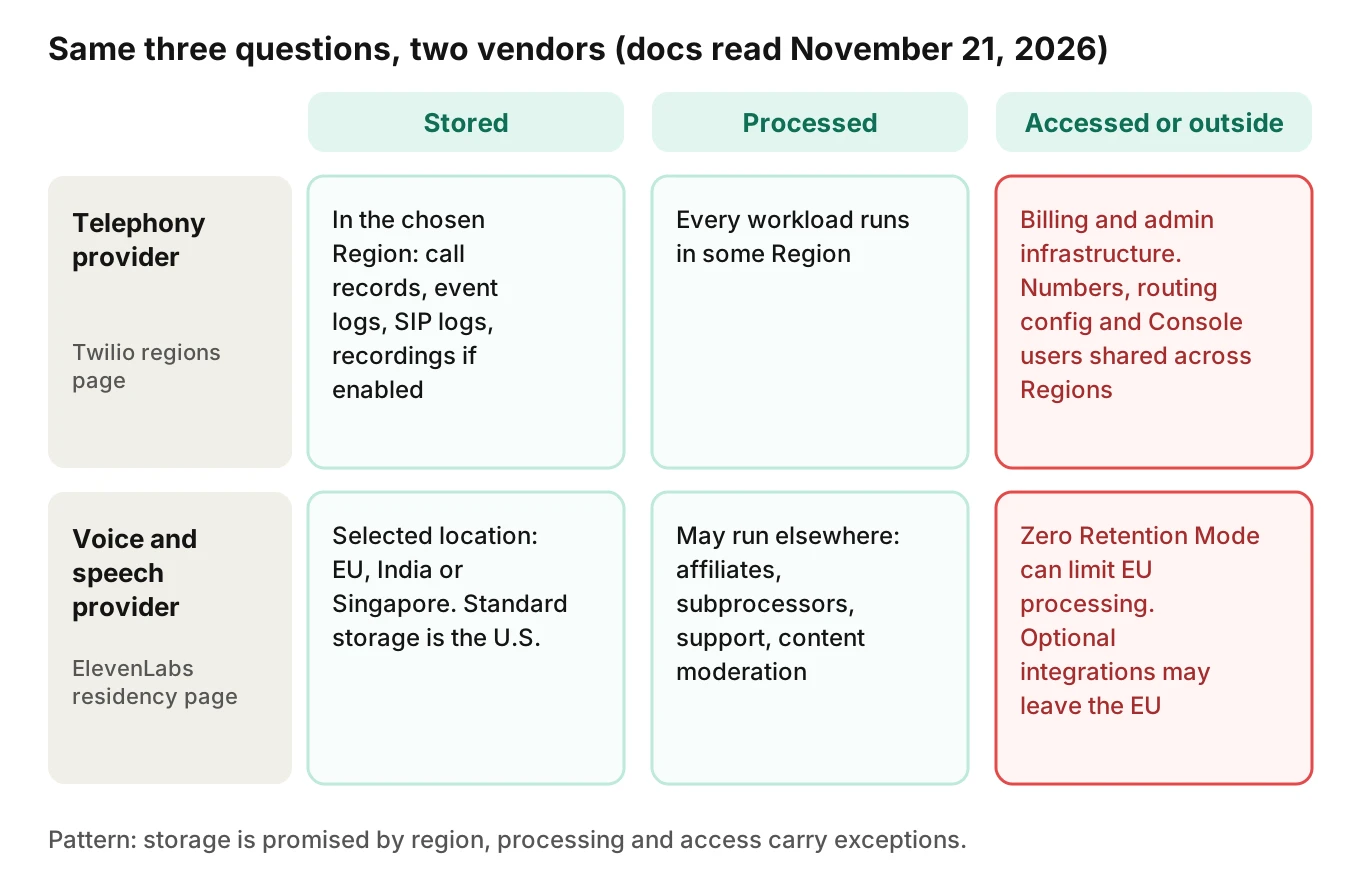
Map each vendor phrase to one question. "Stored in region X" answers residency only. "Zero retention" says nothing is kept, not where it runs.
Copies you forget: backups, caches, queues and support
Voice agent data residency is only as good as the least visible copy.
- Backups and replicas. A store can replicate to another region. Ask for the backup and disaster recovery region in writing.
- Caches. Ask whether recording playback is cached outside the storage region.
- Queues and buffers. A sender that cannot reach its backend may hold data on disk. That is data at rest where the sender runs.
- Support exports. Logs pasted into tickets and CSVs travel outside any pipeline.
- Model logging. Ask whether the model API logs requests, and where. Prompts carry caller text.
- Subprocessors. Each one is another location. Ask for the list and for change notices.
A fixed vendor region makes moving costly, as our post on voice AI vendor lock-in explains. Recording rules depend on the caller's location, covered in recording consent for AI voice agents.
What an OpenTelemetry Collector can do to keep traces in-region
Traces are the easiest copy to control, because you own the pipeline. A Collector helps in three ways, within its docs as read on November 21, 2026.
Run one gateway per region. The gateway deployment docs describe agents sending to a single OTLP endpoint, with the endpoint provided per cluster, per data center or per region. Each agent sends to its own region's endpoint, and that gateway exports to a backend in the same region. Nothing crosses, so no routing logic is needed.
Route by a resource attribute. The routing connector README says it routes logs, metrics or traces to pipelines based on resource attributes, using OTTL conditions. Its default action is move, and copy lets one record reach several pipelines. Records that match no condition go to default_pipelines, and so do records whose condition errors when error_mode is unset. Its signals are all listed as alpha.
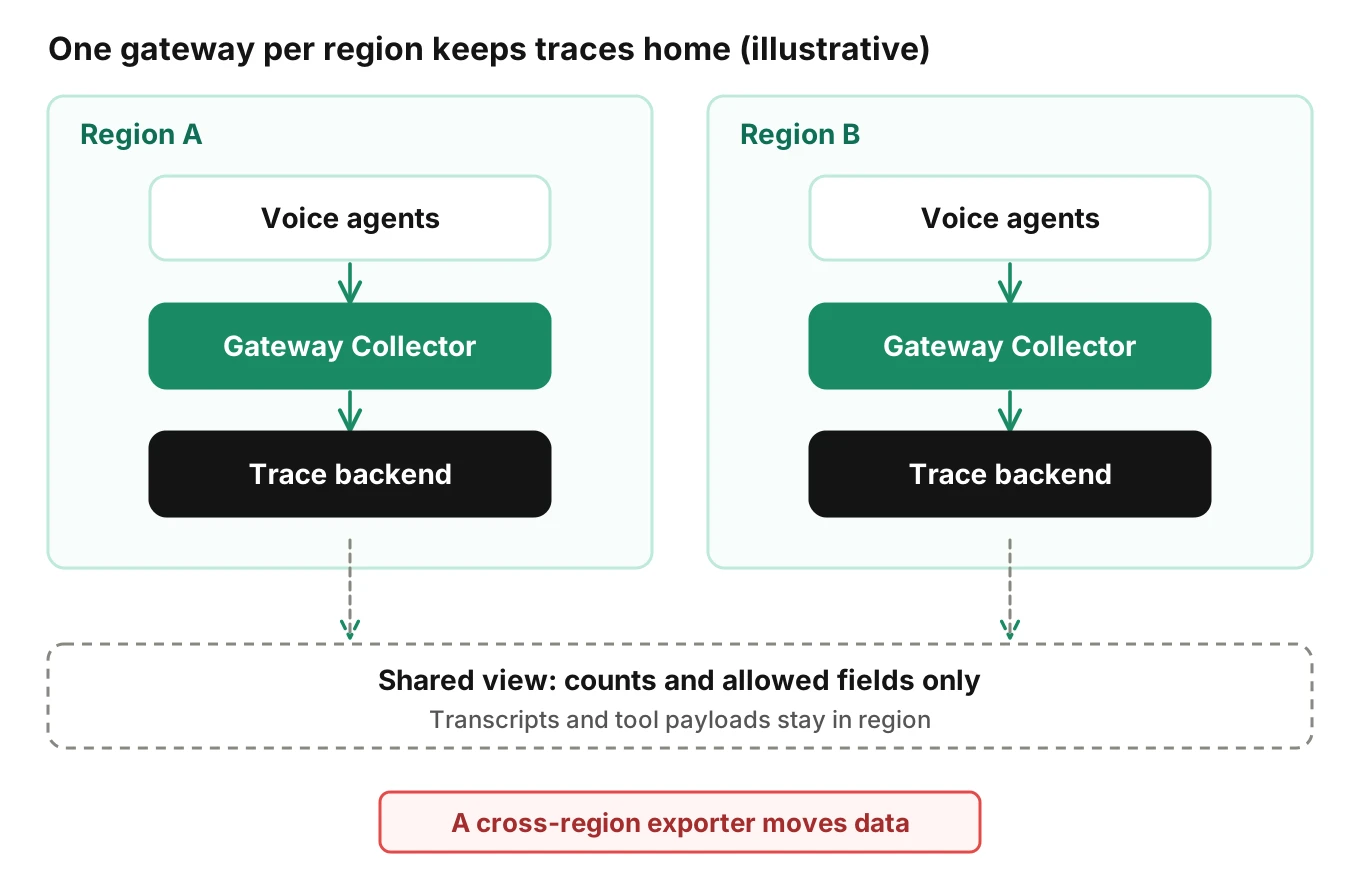
That default is the risk. If an agent forgets the attribute, its data lands in the default pipeline. Point the default at the strictest in-region pipeline. This is our design advice, not a documented guarantee.
Which attribute? OpenTelemetry's cloud resource conventions define cloud.region as the geographical region within a cloud provider, with development stability. That is where the emitter runs, not where the customer lives. For tenant residency, use your own attribute. This simplified sketch uses an illustrative name, voice.data_region:
connectors:
  routing:
    default_pipelines: [traces/region-a]
    table:
      - condition: resource.attributes["voice.data_region"] == "region-b"
        pipelines: [traces/region-b]

service:
  pipelines:
    traces/in:
      receivers: [otlp]
      exporters: [routing]
    traces/region-a:
      receivers: [routing]
      exporters: [otlp_grpc/backend-a]
    traces/region-b:
      receivers: [routing]
      exporters: [otlp_grpc/backend-b]
The sketch omits receiver and exporter definitions. One catch: the routing Collector is itself a processing location. If it runs in region A and routes region B's data, that data passed through A. Per-region gateways avoid this.
Cut what leaves before it leaves. Redaction and allow lists belong before any export. Our Collector post covers routing and redaction. A shared view can carry counts and a short allow list.
A Collector controls only what flows through it. An SDK that exports straight to a vendor bypasses it. Sampling decides how much data each region holds, so read trace sampling for voice agents first.
How to run a voice agent data residency review
Work through these steps for each vendor and each hop. Keep the answers in one sheet.
1. List every hop - Write the eight hops from the table for your own stack. Add any others, such as a CRM write-back.
2. Mark what each hop sees - Audio, text, caller ID, tool payloads. A hop that sees only metrics is lower risk.
3. Name your constraints - Customer contracts, sector rules and the laws counsel says apply. Note the caller's country.
4. Ask three questions per vendor - Stored where, processed where, accessed by whom and from where. Get answers in writing, with a date.
5. Get the subprocessor list - Ask for each location and the change-notice period.
6. Ask about copies - Backups, caches, logs, support exports and model retention. Get the disaster recovery region.
7. Pick regions deliberately - Choose one home region per customer group. Prefer one region across speech, model and voice, or document the exception.
8. Check the transfer basis, then test - Ask counsel which mechanism covers each cross-border hop. Then place test calls through each regional entry point, read the provider's own records, and repeat after every vendor change.
Use this with the voice agent vendor security review and the voice agent compliance audit. For the whole stack, see our observability buyer's checklist.
Where Evalgent fits
Evalgent's Observe and Monitor products take call data from your stack in OpenTelemetry format and an upload path. They never sit in the media path. On privacy, the headline is this: you choose the data region. The details of your setup belong in a conversation, not in this post.
Evalgent's call simulator reaches your agent over phone, SIP or WebRTC. A simulated caller can dial each regional entry point in turn, so you test routing without real customer speech. You then check your own provider and trace records.
Evalgent Monitor also flags PII leakage in production calls, which helps you find personal data where it should not be. It does not decide where your data may live. To talk through a residency test plan, book a demo.
Frequently asked questions
What is voice agent data residency?
It is where call data is stored at rest, including recordings, transcripts, traces and logs. It does not say where data is processed or who can read it. A vendor can store data in one region and still process or support it from another, so ask about all three.
What is the difference between data residency and data sovereignty?
Residency is a fact about storage location. Sovereignty, or localisation, is a requirement that data stay in a country or under its legal control. A regional bucket can meet residency while an overseas team still reads the data. These are working definitions, not legal ones.
Is a cross-border transfer the same as storing data abroad?
No. A transfer can happen with no storage at all. Sending a transcript to a model in another region is a transfer even if nothing is saved. Counsel decides which rules apply. This is general information, not legal advice.
What does GDPR Chapter V say about transfers?
Articles 44 to 49 set conditions for transfers to third countries. A transfer can rely on an adequacy decision under Article 45, appropriate safeguards under Article 46, or a listed derogation under Article 49. Article 48 covers third-country court orders. It sets transfer conditions, not a storage location rule.
Does India's DPDP Act ban sending data abroad?
Not by default, as we read section 16. The Central Government may restrict transfer to countries it notifies. Section 16(2) says other Indian laws that protect more or restrict more still apply. Check current notifications and sector rules with counsel.
Where do voice agent traces and logs end up?
In whichever backend your telemetry exports to, plus any buffers on the way. Spans often carry transcript text and tool arguments. Run one Collector gateway per region, redact before export, and check that nothing exports straight to a vendor, bypassing the Collector.
What should I ask a voice vendor about data location?
Ask where data is stored, where it is processed, and who can access it from where. Get the answers in writing, with a date. Then ask about backups, caches, support exports, model retention and the subprocessor list with locations.
Can an OpenTelemetry Collector keep traces in one region?
It can help. A gateway per region keeps data in that region. The routing connector can route by resource attribute, but unmatched records go to the default pipelines, and the routing Collector itself processes the data. A Collector controls only what flows through it.
The bottom line
Ask every hop where data is stored, processed and accessed, keep traces in-region with per-region gateways, and treat a vendor's single region label as the start of the review. This is general information, not legal advice.
Related Articles

How to automate voice agent testing: synthetic callers vs manual QA
Learn how ai test automation replaces manual QA for voice agents. Compare synthetic callers vs human testers, with a 5-step framework to scale without hiring.
Read more
AI Agent Testing vs Voice Agent Testing: What General Tools Miss for Voice
AI agent testing measures text outputs. Voice agent testing measures behaviour through an acoustic pipeline. Five failure categories general tools miss.
Read more