Voice Agent Data Retention: How Long to Keep Recordings, Transcripts and Traces
On this page
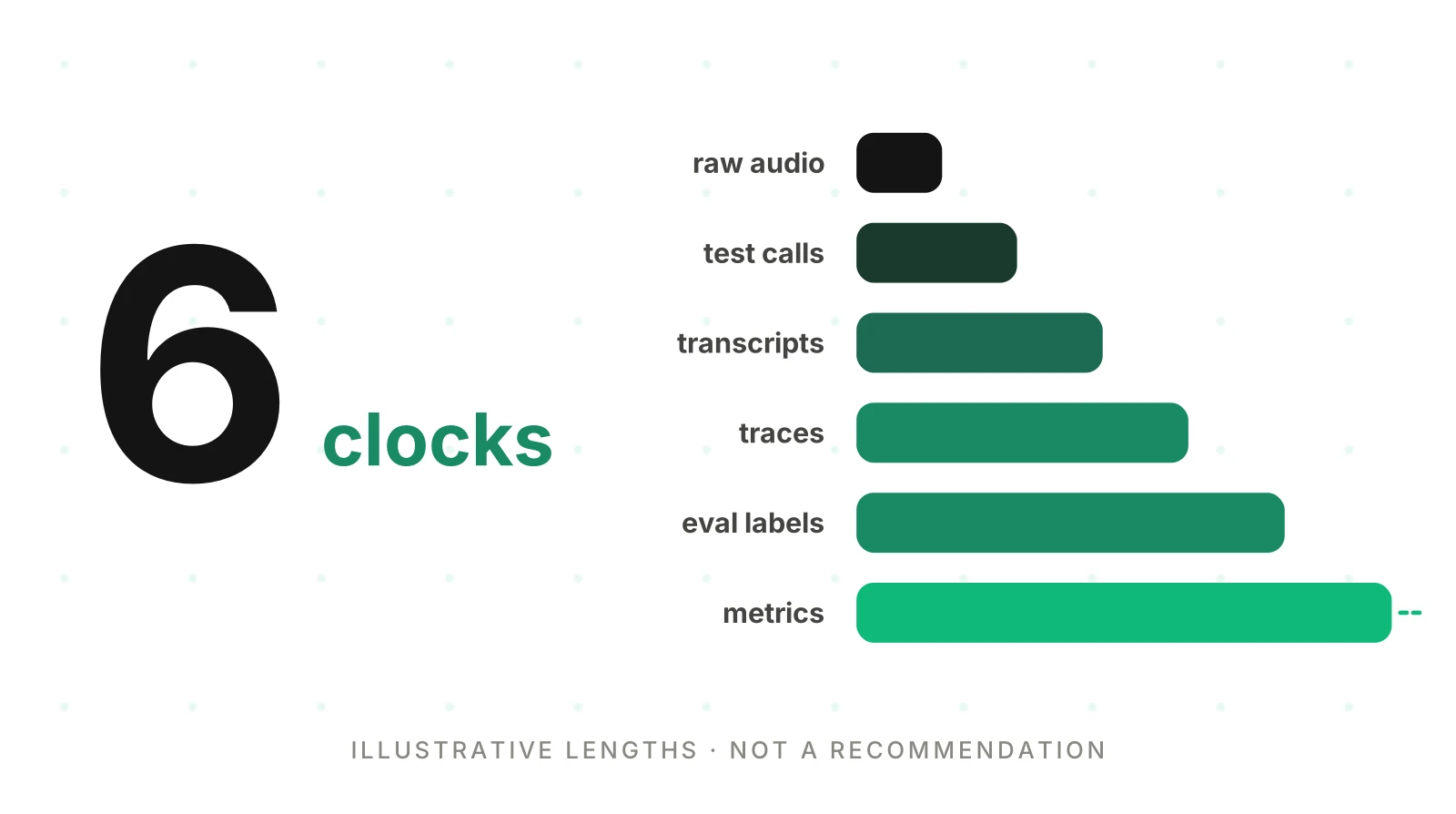
Your voice agent produces six kinds of data on every call. Most teams keep all six for the same time, usually "until the bucket gets expensive." That stores personal data nobody needs. It also leaves no answer when a customer asks how long you keep their call.
This post helps you decide voice agent data retention one data type at a time. It gives you a decision table, a tiering model, notes on holds and deletion requests, and a deletion test. It does not give a number of days. The right number depends on your purpose, contracts and rules.
This is general information, not legal advice. We opened each rule below on November 21, 2026 and quote only what we read. Your counsel decides what applies to you.
Neighbouring posts cover other questions. PII redaction in logs and traces is about what to mask before storage. Recording consent is about whether you may record. What to log lists the fields. This post asks how long each stored thing should live, and what ends it.
The principle: keep data only as long as the purpose needs
Retention starts with purpose. You keep a recording for disputes, a transcript for audit, a trace for root cause and a metric for trends. When the purpose ends, so does the reason to keep the data.
GDPR writes this as storage limitation. Article 5(1)(e) requires personal data to be "kept in a form which permits identification of data subjects for no longer than is necessary" for the purposes of processing. It allows longer storage only in narrow cases the Article lists. Read it on EUR-Lex.
India's Digital Personal Data Protection Act, 2023 points the same way. Section 8(7) says a Data Fiduciary shall, "unless retention is necessary for compliance with any law for the time being in force", erase personal data when consent is withdrawn "or as soon as it is reasonable to assume that the specified purpose is no longer being served, whichever is earlier". Read the Act on India Code. Timing matters: the commencement notification G.S.R. 843(E), dated November 13, 2025, brings sections 7 to 17 into force eighteen months after publication. That is about May 2027. The Rules were notified the same day as G.S.R. 846(E). We could not read their English text on the day, so we leave their specifics out.
Two ideas follow. Purpose sets the clock. And a clock needs a written owner.
Six data types, six different clocks
Voice agent data retention covers six families of data. Each has its own purpose and risk.
| Data type | Typical purpose | Main risk of keeping it | Can it be reduced instead of deleted? |
|---|---|---|---|
| Recordings | Disputes, quality review, replay | Voice and every spoken detail, hard to mask | Rarely. Delete, or keep a short clip |
| Transcripts | Review, audit, training sets | Names, numbers and health details in plain text | Yes. Redact, then keep |
| Traces and spans | Root cause, latency work | Free-text attributes and tool arguments | Yes. Strip content, keep timing and IDs |
| Metrics | Trends, alerts, reporting | Low, if no caller identifier is attached | Already reduced |
| Evaluation labels | Regression sets, judge calibration | Often point back to a real call | Yes. Detach from the call |
| Test-call data | Pre-release checks | Real data leaks into test runs | Yes, and it is usually synthetic |
Metrics are kept longest because they carry the least. A count of caller-ended calls says nothing about who called. If you sample traces, see why you cannot sample failures away.
Hot, cold, delete: tiering by data type
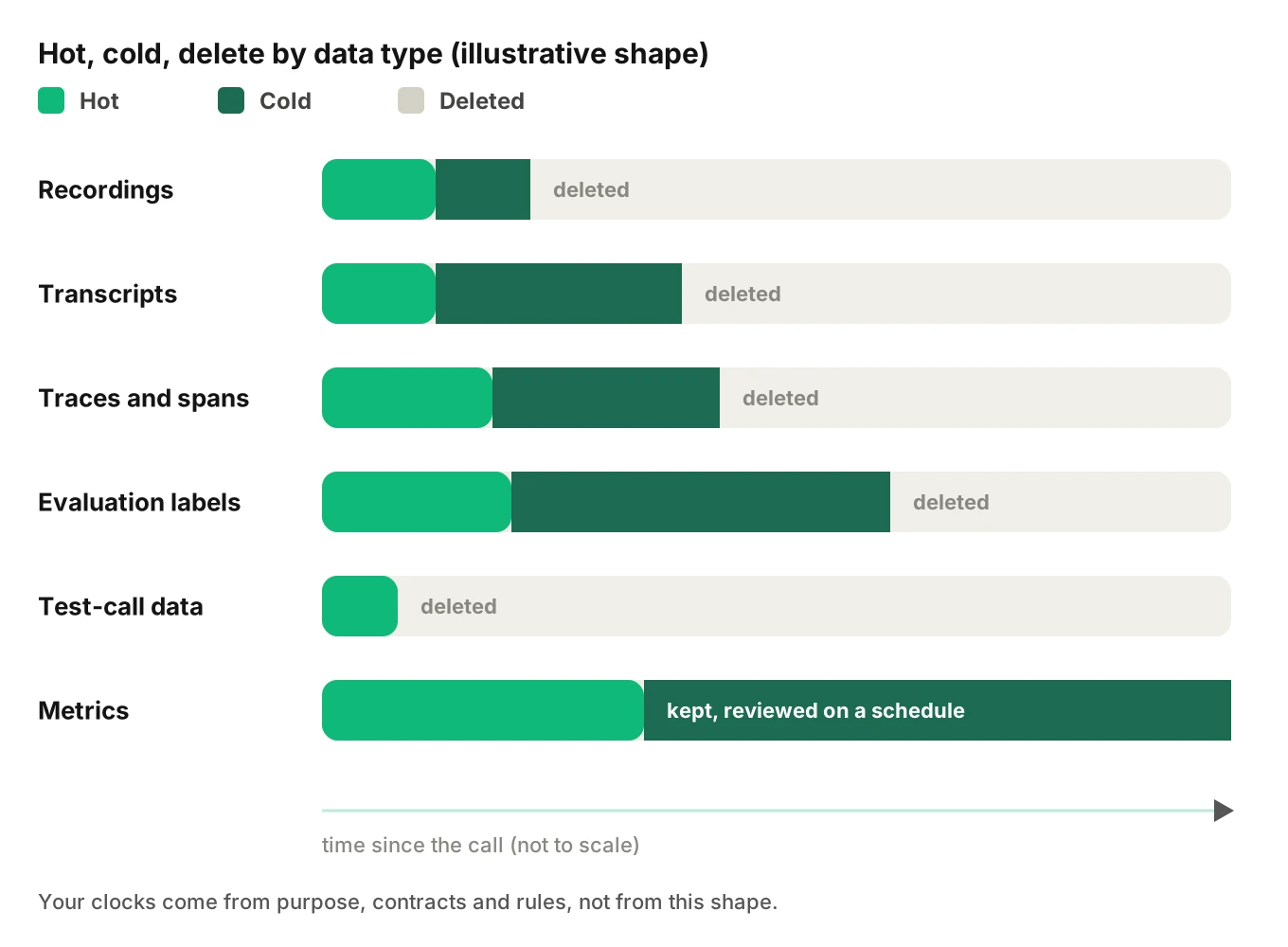
Hot data is queryable now. Engineers debug from it, so it is fast and expensive. Cold data is cheaper and slower. You keep it for audit and replay, and few people open it. Deleted data is gone from every copy.
Tiers help cost, but they help risk more. A transcript with names is a liability in the hot tier. Redact it or lock it away once debugging is done.
The mechanics are routine. Amazon S3 Lifecycle has transition actions, which "define when objects transition to another storage class", and expiration actions, which "define when objects expire" (documentation). Our guide to linking recordings to traces suggests the same shape: raw audio shortest, metrics longest, every copy deleted together.
Order matters. Derive the aggregate before you delete the raw record, because you cannot compute it afterwards. Run the roll-up job ahead of the expiry job, and test that order.
Storage grows with the window you choose. This is illustrative arithmetic, not advice. Assume 10,000 calls a month at 4 minutes each and 1 MB per minute of audio. That is 40 GB a month. Stock equals monthly volume times months kept: 2 months holds about 80 GB, and 24 months about 960 GB. A metrics row is a few kilobytes. That ratio is why audio gets the shortest clock.
Vendors hold copies too. Twilio's recording API documentation says recording metadata is "kept after deletion for a retention period of 40 days", and deleted media "cannot be recovered". OpenAI's data controls page says abuse monitoring logs are "retained for up to 30 days", and Zero Data Retention needs prior approval. Both were read November 21, 2026 and can change. Add each vendor to your schedule. Our vendor security review lists what to ask.
A voice agent retention schedule table with decision questions
Answer these questions for each data type, then write the result into your schedule. We give questions, not numbers, on purpose.
| Data type | Decision questions | Tier plan to consider | Deletion trigger to define |
|---|---|---|---|
| Recordings | Which named purpose needs the audio itself? Does a rule or contract require it? Who can open it, and is every open logged? | Short hot window for review, then delete or a locked cold store | End of purpose, or request, unless a hold applies |
| Transcripts | Is the raw text needed, or is a redacted copy enough? Do training sets reuse it? | Raw hot briefly, redacted copy longer | Redaction date, then end of purpose |
| Traces and spans | Do spans carry free text or tool arguments? Which fields debug a failure? | Full detail hot, content stripped in cold | Strip date, then end of purpose |
| Metrics | Does any row carry a caller identifier? Which reports need history? | Long-lived hot or cold aggregates | Review on a fixed schedule |
| Evaluation labels | Does a label point to a real call? Is the call still needed to explain it? | Keep the label, detach or redact the source | When the source call is deleted |
| Test-call data | Is the data synthetic? Could a real number appear in a run? | Short life, no cold tier | Test run closed |
Add one column yourself: the owner. A schedule with no owner is a wish.
What you must keep versus what you may keep
Must keep is data a rule or contract requires you to hold. May keep is data you hold for your own purpose. Only the second list is fully yours to shorten. In regulated sectors, a keep rule is often narrower than people think. Read the text.
Take HIPAA. 45 CFR 164.316(b)(1) requires covered entities and business associates to "maintain the policies and procedures implemented to comply with this subpart in written (which may be electronic) form", and a written record of actions, activities or assessments that the subpart requires. Paragraph (b)(2)(i) says to "retain the documentation required by paragraph (b)(1) of this section for 6 years from the date of its creation or the date when it last was in effect, whichever is later". Read it on eCFR, which showed the text current as of July 10, 2026. That six-year period covers documentation. It is not a retention period for call recordings or medical records, and the paragraph mentions neither. Whether a recording counts as protected health information is a question for counsel.
The privacy laws above follow the same pattern. GDPR Article 17(3)(b) lets you keep data "for compliance with a legal obligation which requires processing by Union or Member State law". The DPDP Act's section 8(7) carves out retention "necessary for compliance with any law".
Voiceprints have their own destruction rules in some US states. Our voiceprint and BIPA post covers them. We did not reopen those statutes or the PCI DSS standard here, so we state no numbers. If your agent takes card details, our compliance audit guide and PII leakage post explain why card data should not reach logs.
Keep a short "must keep" register: rule, record covered, owner and a link to the primary text. Disclosure evidence, such as the clip and timestamp from our AI disclosure post, belongs there if counsel says it must be kept.
Legal holds: when deletion has to stop
A legal hold pauses deletion for specific data because a dispute or investigation is expected. US Federal Rule of Civil Procedure 37(e) addresses electronically stored information "that should have been preserved in the anticipation or conduct of litigation" and is lost (Cornell LII). We say nothing about consequences, which turn on facts. GDPR Article 17(3)(e) lets you keep data "for the establishment, exercise or defence of legal claims".
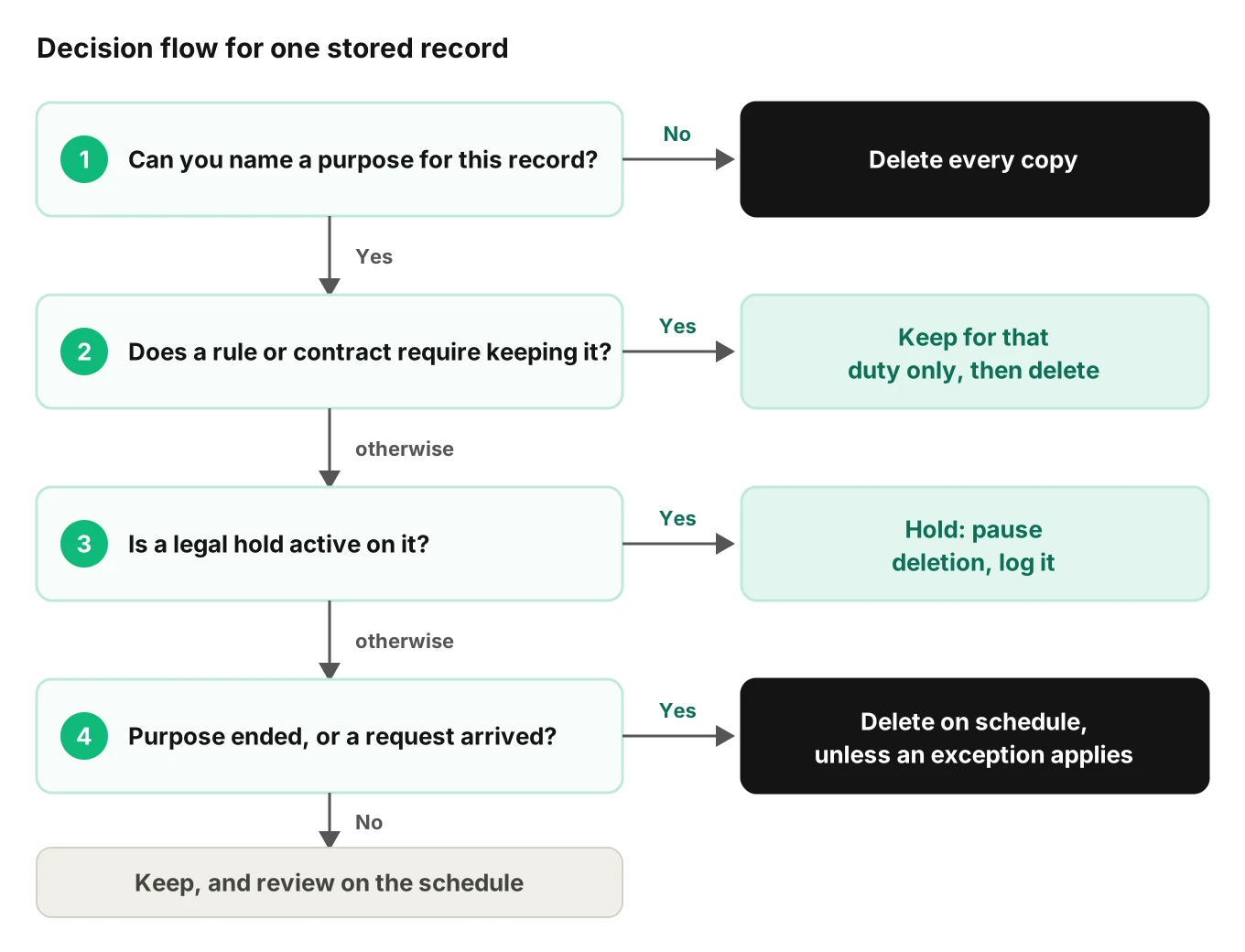
Design the hold as a flag that beats the schedule.
- Scope it narrowly. Hold by call IDs, tenant or date range, not "everything."
- Make every expiry job check it. Read the flag before deleting anything.
- Cover every copy. A hold on the recordings that misses the transcripts protects nothing.
- Limit who sets and releases it. Log both with a reason.
- Catch up on release. Data past its clock is deleted on the next run.
Test it. Hold a test call, pass its expiry, and confirm the data survives. Release the hold and confirm deletion.
Deletion requests: one request, many copies
A caller may ask you to delete their data. Under GDPR, Article 17(1) gives the data subject the right to obtain erasure "without undue delay" on listed grounds. One ground is that the data "are no longer necessary in relation to the purposes for which they were collected or otherwise processed". Article 12(3) sets the response clock: "in any event within one month of receipt of the request", which "may be extended by two further months where necessary".
DPDP Act section 12(3) says the Data Fiduciary "shall erase her personal data unless retention of the same is necessary for the specified purpose". The text we read continues with a legal-compliance limb. Section 12 takes effect eighteen months after November 13, 2025.
Article 17(3) lists exceptions, including the two quoted earlier. If one applies, tell the requester and keep only what it covers. The hard part is the fan-out: one call leaves copies in many places.
| Copy | Why it gets missed | What to do |
|---|---|---|
| Recording and recorder backups | Object versioning keeps old copies | Delete all versions, and record what you cannot reach |
| Transcript store and search index | The index outlives the row | Delete from both |
| Trace backend and log pipeline | Free text in span attributes | Search by call ID and caller token |
| Evaluation sets and labels | A label copies the transcript | Delete or detach the label |
| Vendor copies (speech, model, telephony) | Vendor clocks differ from yours | Request deletion, note each vendor's stated period |
| Exports and analyst spreadsheets | Nobody owns them | Prohibit them, or register them |
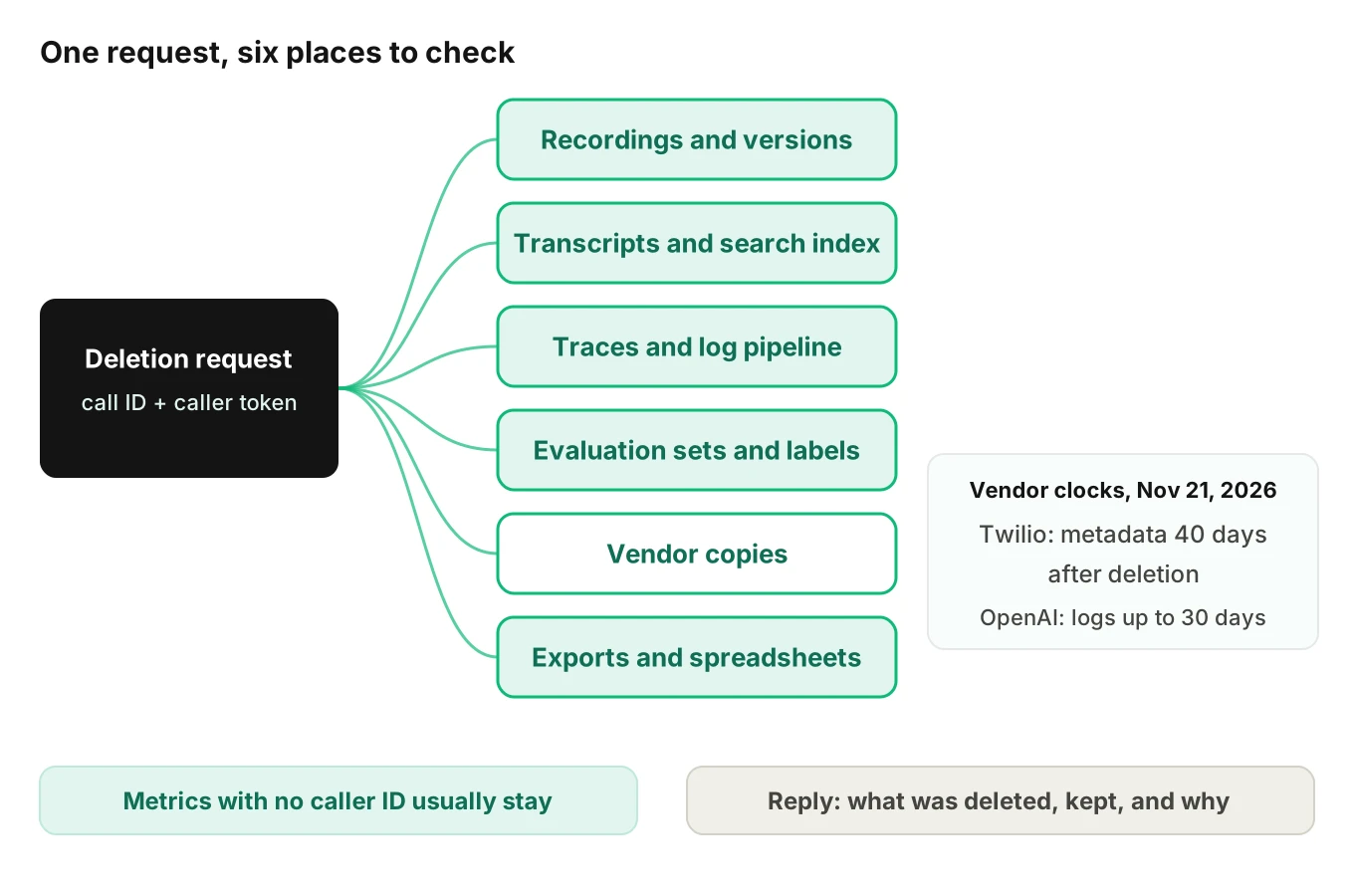
Make deletion work by call ID and by a hashed caller identifier. Our what to log guide recommends both. Mask the caller, not the call, as the redaction post says, so the join keys survive the request. Metrics with no caller identifier usually stay. Check with counsel that yours really identify nobody.
Tell the requester what you deleted, what you kept and why. Log it. That log is personal data too, so give it a clock.
Where Evalgent fits
Evalgent's Observe and Monitor take call data from your stack in OpenTelemetry format and through an upload path, and they never sit in the media path. On privacy, the headline is short. Retention is yours to control, personal data is masked on arrival, a metrics-only mode exists, access is logged, and you choose the data region. A metrics-only mode fits the "keep aggregates longest" idea in this post. A vendor's defaults never replace your own voice agent data retention schedule.
Test calls are data too. Evalgent Reviews replay test calls with audio and transcript together, so a test-call set needs the same questions as production. If you want to see how that fits your agent, book a demo.
How to write your voice agent data retention schedule
1. Inventory every data type and copy - List recordings, transcripts, spans, logs, metrics, labels and test calls. Include vendors and exports. You cannot schedule a copy you have not found.
2. Name the purpose for each - Write one sentence per data type saying why you keep it. If you cannot, plan to delete it.
3. Build the must-keep register - For each entry, record the rule, the record, the owner and a link to the primary text. Have counsel confirm it.
4. Choose tiers and clocks - Decide hot, cold and delete per data type, using the decision questions above. Keep raw content shortest and aggregates longest.
5. Write the roll-up before the expiry - Compute metrics and strip or redact content first. Then expire the raw record.
6. Add holds and deletion handling - Build the hold flag, the by-call-ID deletion path and the requester reply. Cover vendors.
7. Test, log and review - Make a test call with a unique fake phrase. Run expiry, then search every store, backup and vendor console for it. Repeat with a hold and a deletion request, as in the PII leakage post. Treat a failure as an incident and route it through alerting.
A schedule row can be this small:
data_type:      transcript
purpose:        review and audit of agent answers
owner:          head of AI
tiers:          raw hot -> redacted cold -> deleted   // periods set with counsel
must_keep_rule: none, or link to register entry
vendor_copies:  speech provider, model provider
last_tested:    date of last seeded deletion test
Frequently asked questions
How long to keep call recordings from a voice agent?
No single number fits. It depends on your purpose, contracts and rules. Name why you keep audio, set the shortest window that serves it, and delete every copy when it ends. Add exceptions for holds and required records only after counsel confirms them.
What is a good transcript retention policy?
Separate raw text from redacted text. Keep raw transcripts briefly, then redact or delete. Keep redacted copies only for a named purpose, such as audit. Write down the owner, clocks and deletion path, and test that deletion reaches search indexes and exports.
How long should you keep voice agent logs and traces?
Keep full-detail traces while engineers debug from them, then strip free text and tool arguments. Timing, IDs and error codes can live longer because they carry less personal data. Trace retention follows the same rule as other data: a purpose, a clock and a tested deletion job.
Should you keep metrics longer than raw recordings?
Usually yes. Call counts, latency and end reasons carry little personal data when no caller identifier is attached. Compute them before you delete raw records. Confirm with counsel that your aggregates identify nobody, since a stray identifier makes a metric personal data again.
What is a legal hold for call recordings?
A legal hold is a flag that pauses deletion when a dispute or investigation is expected. A legal hold for call recordings should be narrow, logged and checked by every deletion job. It must cover transcripts, traces and vendor copies, and it ends only when released.
How do you delete call recordings on request?
Find every copy by call ID and caller token: recordings, transcripts, indexes, traces, evaluation sets and vendor stores. Delete or detach each, note any exception you rely on, and reply within the time your rules set. Under GDPR Article 12(3), that is one month, extendable where necessary.
Does HIPAA set a retention period for call recordings?
The text we read does not. 45 CFR 164.316(b)(2)(i) requires six years for documentation: policies, procedures and records of required actions. It does not mention recordings. Whether a recording is protected health information is for counsel. This is general information, not legal advice.
What belongs in a voice agent retention schedule?
For each data type: purpose, owner, tiers, deletion trigger, must-keep rule, vendor copies and last test date. Add a register of required records with links to the primary text. Review it when your products, markets or rules change.
The bottom line
Set voice agent data retention per data type, write the schedule down, and make tiers, holds and deletion real in code, with raw content shortest and metrics longest. This is general information, not legal advice.
Related Articles

How to automate voice agent testing: synthetic callers vs manual QA
Learn how ai test automation replaces manual QA for voice agents. Compare synthetic callers vs human testers, with a 5-step framework to scale without hiring.
Read more
AI Agent Testing vs Voice Agent Testing: What General Tools Miss for Voice
AI agent testing measures text outputs. Voice agent testing measures behaviour through an acoustic pipeline. Five failure categories general tools miss.
Read more