Test your voice agent
Voice Agent Testing Checklist: What to Verify Before Launch
A voice agent that nails the demo will still find new ways to fail on its first real call. The demo used clean audio, a cooperative tester, and the happy path; production brings accents, background noise, interruptions, out-of-scope questions, and callers actively trying to break it. The gap between those two is where launches go wrong — and a pre-launch checklist is how you close it before a caller does.
This is that checklist. It walks through every layer you need to verify before a voice agent goes live, in the order that matters, with the specific checks under each. It is deliberately practical: a list you can run against your own agent, gate your launch on, and re-run on every change. It sits under our AI voice agent testing pillar, and it is built to catch the exact failures that make agents break in production.
Why a pre-launch checklist matters
A demo is a curated success. It proves the happy path works under ideal conditions, which is the one scenario production is least likely to deliver. The voice AI deployment gap is the predictable distance between "it worked when I tried it" and "it works for the callers I can't control."
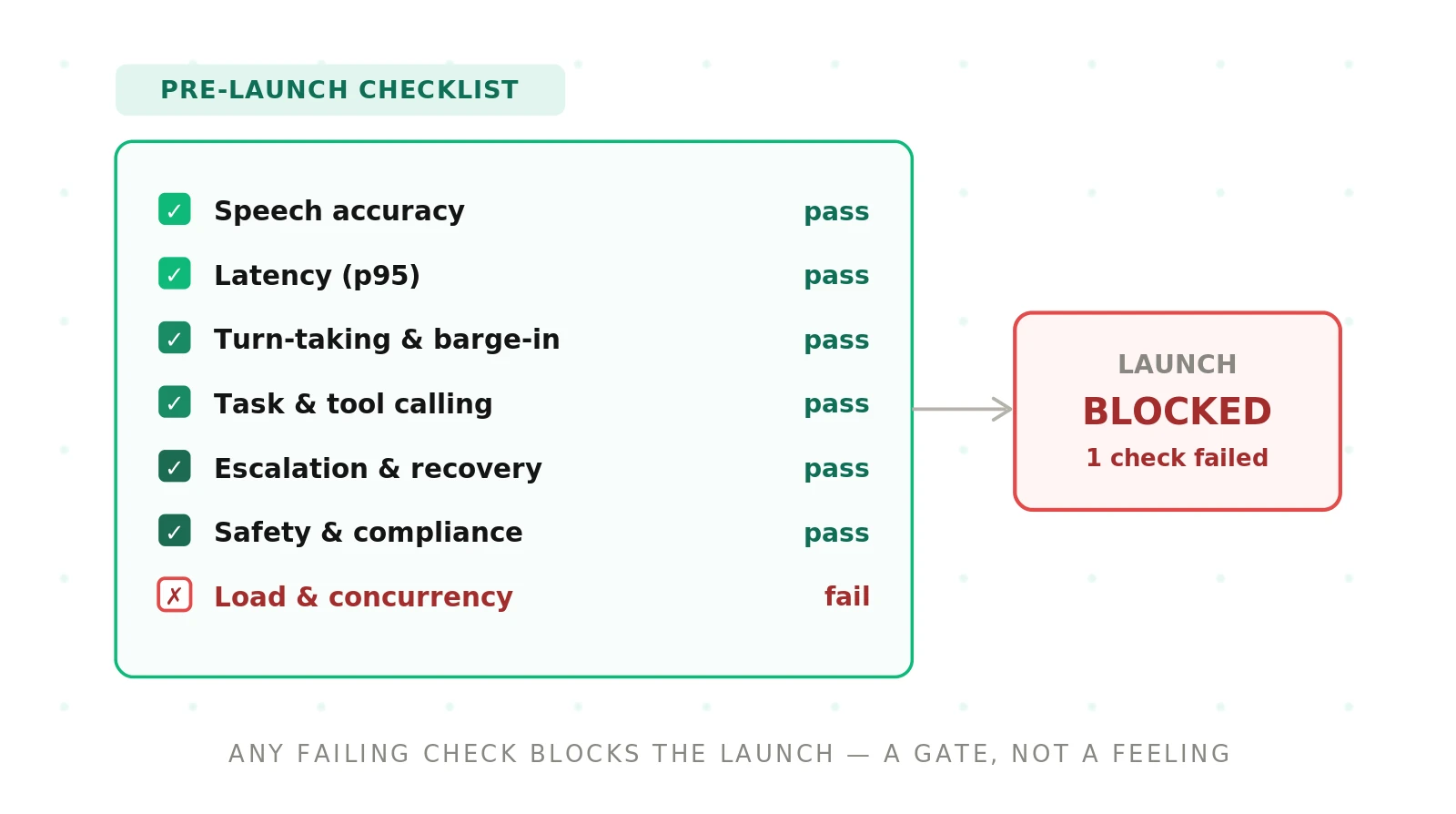
A checklist turns launch readiness from a feeling into a gate. Instead of "the agent seems good," you get a defensible answer to "is it ready?" It is a set of checks that either pass or fail, run on the conditions real callers create. It also makes readiness repeatable: the same checklist that clears the first launch guards every change after it, so the tenth prompt edit does not quietly reintroduce a bug the first launch fixed.
How to test a voice agent before launch
Run these checks in order. Each is a gate: a failure blocks the launch until it is fixed, not a note to revisit later.
1. Verify speech recognition accuracy — Confirm the agent transcribes real callers correctly, weighting critical entities like names, dates, and dollar amounts, and test across accents, speaking pace, and background noise, not just clean audio.
2. Measure latency at the tail — Check time to first audio and turn latency at p90 and p95, not the average, since the slow calls are what feel broken.
3. Test turn-taking and interruptions — Confirm the agent stops when the caller interrupts, treats a short pause as thinking time rather than a cue to repeat, and does not talk over the caller.
4. Confirm task and tool-calling success — Verify the agent takes the right actions and that the backend side effect actually happened, not just that the transcript reads correctly.
5. Check escalation and recovery — Confirm the agent hands off to a human under the right conditions and recovers gracefully when it mishears, a tool fails, or the caller is confused.
6. Validate voice output quality — Listen for natural pacing, correct pronunciation of names and numbers, and no dead air mid-answer.
7. Test safety, guardrails, and compliance — Confirm the agent refuses out-of-scope requests, resists prompt injection, protects sensitive data, and follows the policies your industry requires.
8. Load-test at expected concurrency — Re-run the critical checks under the call volume you expect at peak, since accuracy and latency both degrade under load.
9. Confirm monitoring is ready — Verify you can observe, sample, and score live calls before the first real one lands, so failures surface fast.
10. Set thresholds and gate the launch — Attach a pass/fail threshold to every check above and block the launch on any failure, then save the passing run as your regression baseline.
Speech recognition and understanding
The transcription layer is where errors begin, because everything downstream reasons over what the agent thought it heard. Measure word error rate, but do not stop there. A single misheard digit in an account number, or a wrong date, can fail a task that a good aggregate WER would call a pass. So weight critical entities separately. Our WER guide covers the metric in depth.
The checklist here: test transcription across a range of accents and dialects your callers actually have, at different speaking speeds, and against realistic background noise — a car, a call center, a busy street. Confirm the agent extracts the right intent and entities from the transcript, since a perfect transcription routed to the wrong intent still fails the call.
Latency and responsiveness
Callers experience timing as quality. A pause before the agent replies reads as the agent freezing, even when the eventual answer is perfect. Human sensitivity to conversational delay is well established: the ITU-T G.114 telephony standard puts the comfortable one-way limit at 150ms, and callers notice delay long before it becomes unworkable.
Verify time to first audio and total turn latency at the tail — p90 and p95 — because the average hides the calls that felt broken. Our reduce latency guide covers the levers. Re-check latency under load, since it grows with concurrency, and confirm the agent never goes silent mid-answer, the dead air failure that reads as a dropped call.
Turn-taking, interruptions, and recovery
This is the layer text-based products never have, and the one that most separates a natural agent from a broken one. Confirm the agent yields the floor the moment a caller starts speaking — the barge-in behavior — rather than talking over them. Check that a brief silence is treated as thinking time, not a trigger to repeat the question.
Recovery is the other half. Confirm the agent confirms rather than guesses on anything that matters, like a name or an amount, and that it has a graceful path when it mishears, when a tool call fails, or when the caller goes off-script. And confirm escalation works: the agent must hand off to a human under the conditions you define, which our escalation guide details.
Task success, tools, and safety
Beyond hearing and speaking, the agent has to actually do the job — and do it safely. Two checks matter most here.
First, task and tool-calling success. Confirm the agent takes the correct action and that the real side effect happened: the appointment was booked, the payment was recorded, the ticket was created. A transcript that reads correctly while the backend never changed is a silent failure that passes a naive test.
Second, safety and guardrails. Confirm the agent refuses out-of-scope requests, resists prompt injection and attempts to extract its instructions, and protects sensitive data — the PII handling checks. Guardrails are best enforced outside the model so behavior is provable, a distinction our guardrails vs evals guide draws. For regulated industries, align these checks with a recognized framework such as the NIST AI Risk Management Framework.
Demo testing vs pre-launch testing
The contrast is the whole reason the checklist exists.
| Dimension | Demo testing | Pre-launch checklist |
|---|---|---|
| Audio | Clean, controlled | Accents, noise, real lines |
| Caller | Cooperative tester | Adversarial, confused, off-script |
| Coverage | Happy path | Edge cases and failures |
| Scale | One call at a time | Load and concurrency |
| Outcome | "It seemed to work" | Pass/fail gate with thresholds |
| Repeatable | No | Yes — re-run on every change |
Load, monitoring, and gating the launch
Two checks are easy to skip and expensive to miss. Load: re-run the critical checks at your expected peak concurrency, because a 300ms response can stretch past a second under load and break the call rhythm — the discipline our stress testing guide covers. Monitoring: confirm you can observe and score live calls before the first real one, so production failures surface immediately, which is the job of observability built on standards like OpenTelemetry.
Then gate. Attach a threshold to every check — a WER ceiling, a latency ceiling, a task-success floor — and make a failure block the launch automatically, part of the broader move toward evaluation-driven development. Save the passing run as a baseline so future regressions show up as a drop from known-good, and re-run the whole checklist on every change, not just before the first launch.
Running the checklist with Evalgent
Evalgent turns this checklist into an automated, repeatable gate. Scenarios reproduce the real calls each check needs — happy paths, edge cases, interruptions, and adversarial callers — so the checklist runs against what production will actually bring. Profiles vary caller accent, pace, and line quality across those calls, so a clean-audio pass cannot hide the cohorts that struggle. Metrics encode every check — transcription accuracy, latency percentiles, task success, escalation, safety — with the thresholds you set, so the result is a clear go or no-go. Evaluations run the whole checklist as automated batches of synthetic callers, at concurrency, before launch and again on every change. Reviews let you replay any failing call with audio, transcript, and metrics, so a no-go comes with the evidence to fix it.
The result is a launch decision you can defend: not "the demo looked good," but "the agent passed every check on the calls it will actually get." For the underlying discipline, see the voice agent evaluation guide.
The bottom line
A voice agent testing checklist is what turns launch readiness from a feeling into a gate. Verify speech accuracy, latency, turn-taking, task and tool success, escalation, safety, and load — each on realistic calls, each with a threshold.
Run it before the first launch, gate the release on the results, and re-run it on every change. A demo tells you the happy path works; the checklist tells you the agent is ready for the callers you cannot control, which is the only readiness that matters once you go live.
Frequently asked questions
What should a voice agent testing checklist include?
A complete checklist covers speech recognition accuracy, latency at the tail, turn-taking and interruption handling, task and tool-calling success, escalation and recovery, voice output quality, safety and compliance, and load at expected concurrency. Each item should have a pass/fail threshold and be run on realistic calls across accents and noise, so launch readiness becomes a gate rather than a judgment call.
How do you test a voice agent before launch?
Run realistic scenarios over real audio, covering accents, background noise, interruptions, and out-of-scope requests. Measure each layer separately — transcription, latency, task success, escalation, safety — against thresholds you set in advance. Load-test at expected concurrency, confirm monitoring is ready, and gate the launch on the results. Save the passing run as a baseline and re-run on every change.
Why isn't a successful demo enough to launch a voice agent?
Because a demo is a curated success under ideal conditions — clean audio, a cooperative tester, the happy path. Production brings accents, noise, interruptions, and callers trying to break the agent, none of which a demo exercises. The checklist tests those conditions on purpose, so you learn where the agent fails before a real caller does rather than after.
What metrics should you check before launching a voice agent?
Check word error rate weighted for critical entities, time to first audio and turn latency at p90 and p95, task success rate, escalation accuracy, and a safety pass rate for refusals and policy adherence. Avoid vanity metrics like total calls handled. Attach a threshold to each and treat any failure as a launch blocker, not a note to revisit later.
How do you test voice agent latency?
Measure time to first audio — the pause before the agent speaks — and total turn latency, reporting both at percentiles like p90 and p95 rather than the average, since the tail is what callers feel. Test on realistic audio and re-measure under expected concurrency, because latency grows under load. Treat the initial pause as the primary responsiveness metric with a hard ceiling.
How do you test a voice agent for safety and compliance?
Confirm the agent refuses out-of-scope requests, resists prompt injection and attempts to extract its instructions, and protects sensitive caller data. For regulated industries, align checks with a recognized framework and verify policy adherence directly. Enforce guardrails outside the model where possible so behavior is provable, and treat any safety failure as a hard launch blocker rather than a tunable preference.
How often should you run a voice agent testing checklist?
Run the full checklist before the first launch, then re-run it on every change — every prompt edit, model swap, or configuration update — because regressions creep in with each one. Gate releases on the result and keep the passing run as a regression baseline. In production, sample and score live calls continuously so new failure modes surface between checklist runs.
What's the difference between testing and monitoring a voice agent?
Testing happens before and around a release: you run scenarios against the agent to verify it works before callers reach it. Monitoring happens in production: you observe and score real calls to catch failures the test set missed and track drift over time. You need both — testing gates the launch, monitoring confirms reality agrees once the agent is live.
Related Articles
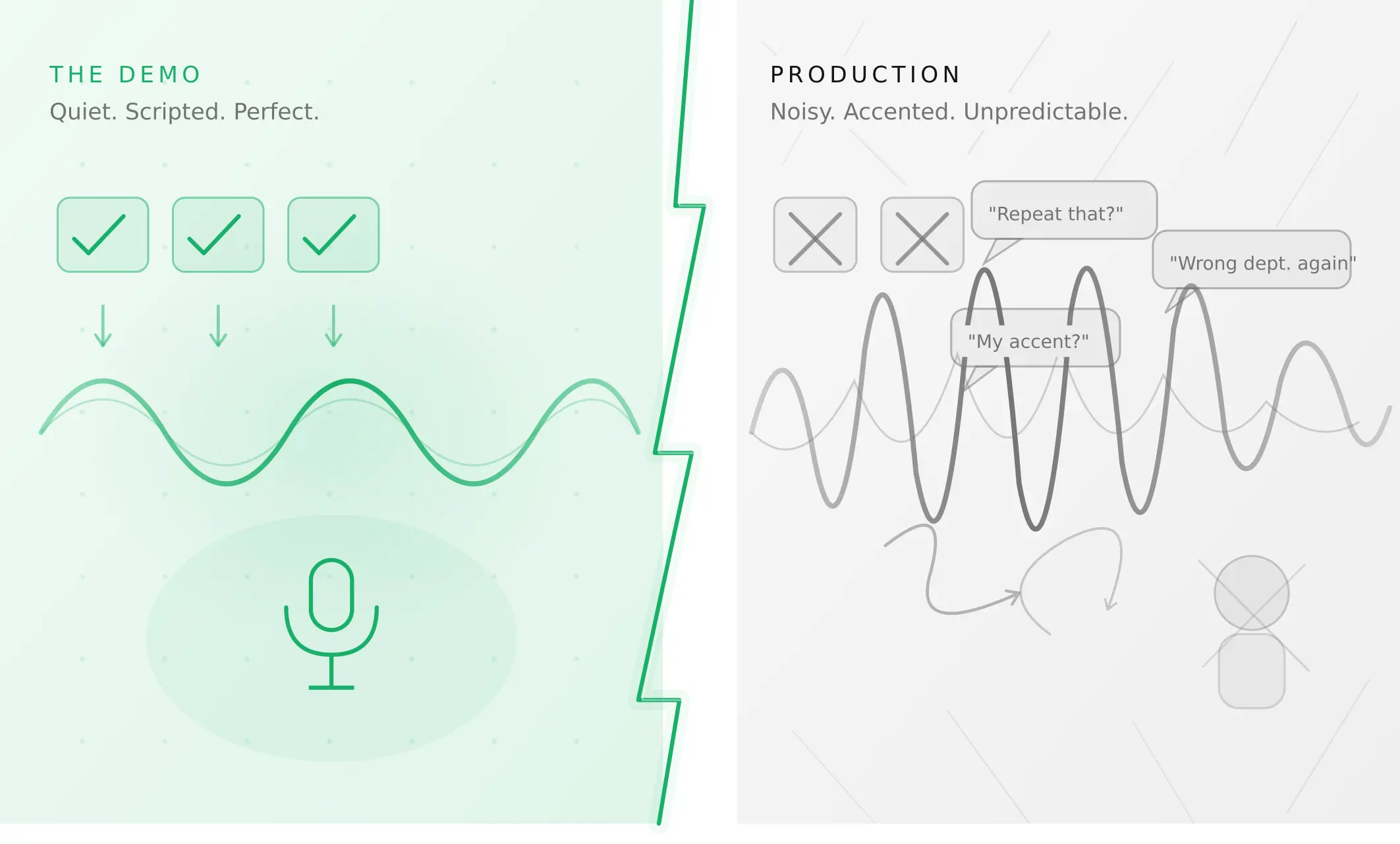
Why AI voice agents fail in production (and how to prevent it)
AI voice agents that ace demos still break in production. Learn the 5 root causes, how to test for each, and what production readiness actually means.
Read more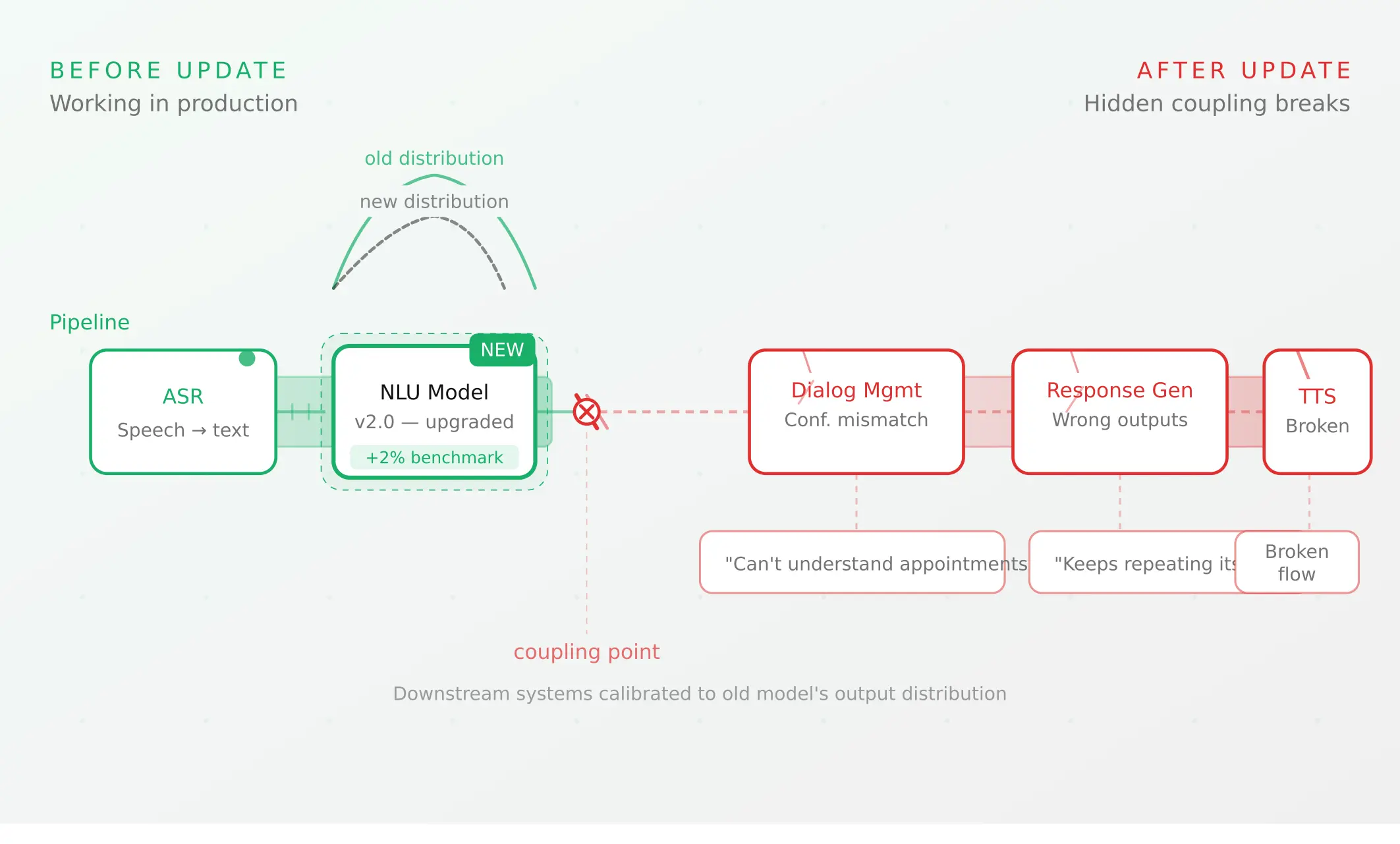
Voice agent regression testing: why LLM updates break production
LLM updates improve benchmarks but break voice agents in 5 predictable ways. How to detect and prevent regressions after every model or prompt change.
Read more