How to validate a voice agent before deployment: an 8-gate checklist
On this page
Every voice agent works in the demo. That is what a demo is for. The gap between "it worked when I tried it" and "it works for real callers" is where launches go wrong, and closing it is the job of pre-deployment validation. Validation is not another run-through of the happy path — it is a deliberate gate that tries to break the agent the way production will, and gives you a clear go or no-go before a single real caller is exposed. Evalgent is built to run that gate, and this guide lays out what it should check.
Pre-deployment validation: a go/no-go release gate that verifies a voice agent meets defined thresholds for accuracy, latency, task completion, failure handling, and load under realistic conditions, before it goes live.
Why a passing demo is not validation
A demo is a curated success: a clear speaker, a quiet room, a happy-path request, and a friendly tester who does not interrupt. Production is none of those things. Real callers speak with accents over noisy lines, interrupt mid-sentence, change their minds, ask out-of-scope questions, and occasionally try to break the agent on purpose.
The reason so many agents pass a demo and fail in production is that the demo never tested the conditions that break them. Our piece on why voice agents fail in production covers those failure modes in depth — this guide is the other side of that coin: not why they fail, but how to validate that yours will not, before you ship. Validation exists precisely because a passing demo tells you almost nothing about production readiness.
What validation actually checks
Validation is a defined set of gates, each with a threshold, run against realistic calls. The point is coverage: every dimension that can break in production should have a check before launch. This is the pre-release discipline that mature software has always used, adapted to voice — the same idea as the validation stages in a software release life cycle.
| Gate | What it verifies |
|---|---|
| Transcription accuracy | Word error rate holds on noisy, accented audio |
| Latency | p95 response time stays within budget under load |
| Task completion | Callers actually reach their goal across scenarios |
| Failure handling | Barge-in, tool calls, and errors behave correctly |
| Adversarial resistance | Prompt injection and hostile callers are handled |
| Escalation | Hand-off to a human fires on the right triggers |
| Load / concurrency | Latency and errors hold at expected call volume |
| Compliance | Required disclosures and data handling are correct |
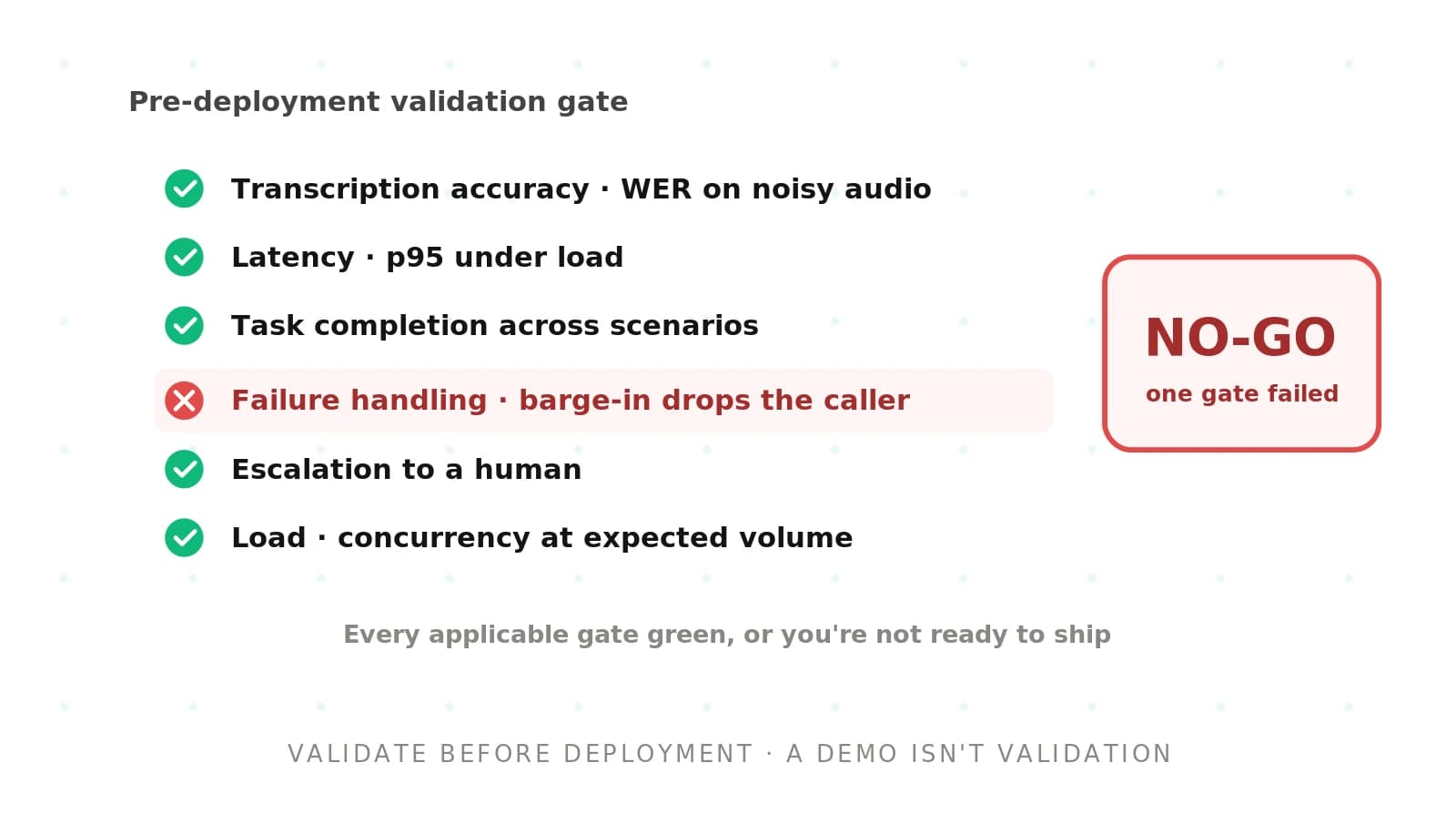
Not every gate applies to every agent — a food-ordering bot has different compliance needs than a healthcare line — but the ones that apply to yours are non-negotiable. A gate you skip is a failure mode you are choosing not to see until a caller finds it.
Set thresholds and make it a gate
A checklist is only a gate if it can say no. That means each check needs a threshold defined before you test, and a rule that a failure blocks launch rather than starting a debate.
Decide, in advance, what "good enough" means for your use case: the acceptable word error rate on your audio, the p95 latency ceiling, the minimum task-completion rate, the compliance checks that are pass-or-fail. Then treat a breach as a no-go. The discipline is in deciding the thresholds when you are calm and objective, not negotiating them under launch-day pressure when the temptation is to wave a failing gate through. Latency in particular deserves a hard ceiling, since it is the difference between an agent that feels human and one that feels broken — our latency guide covers where to set it.
How to validate: run the calls you will actually get
The method is to reproduce production before production reproduces itself. Validation is only as good as how closely your test calls resemble real ones.
1. Map the scenarios — List the tasks and edge cases real callers will bring, including the ones that break agents.
2. Vary the callers — Test across accents, pace, noise, and emotional state, not one clean voice.
3. Drive realistic calls — Run the scenarios as automated calls over real audio, including interruptions and corrections.
4. Measure outcomes — Record task completion, latency percentiles, accuracy, and failure handling, not just whether it replied.
5. Test under load — Re-run at your expected concurrency, since latency and errors change at scale, a point our stress testing guide develops.
6. Apply the gate — Compare every result to its threshold and issue a clear go or no-go.
Validation is not a one-time event
The first validation is the hardest, but it is not the last. Every change to the prompt, the model, the knowledge base, or a provider can reintroduce a failure the last validation caught, so the gate has to run again. An agent validated in March is not a validated agent in June if it has changed since.
This is why the first validation should also establish a baseline. Save the passing results as the reference your future changes are measured against, so a regression shows up as a drop from a known-good run rather than a surprise in production. Validation and regression testing are the same gate, run once before launch and again on every change. And because no pre-launch test is perfect, the last validation gate is confirming that production monitoring is in place to catch what testing missed — escalation must work, and so must the ability to see when it does not.
Common validation mistakes
A few mistakes quietly turn a validation gate back into a demo, and they are worth naming so you can avoid them.
The first is validating on clean audio. A pass on a quiet, clear voice tells you nothing about the noisy, accented calls that actually break agents, so validation has to use production-like audio or it is theater. The second is soft thresholds: if a failing gate can be waved through under launch-day pressure, it is not a gate at all, just a report. The third is validating only the happy path, skipping the interruptions, out-of-scope questions, and adversarial inputs that are exactly where agents fail — the easy calls were never the risk. The fourth is treating validation as one-time, so an agent that changed after launch keeps running on a stale approval no one revisited. And the fifth is validating the agent but never confirming that monitoring is ready to catch what validation missed; no pre-launch test is perfect, so the gate should end by verifying you will actually see production failures when they happen.
Avoid these, and validation does its real job: a clear, defensible go or no-go grounded in the calls the agent will actually get, rather than a green checkmark that hides the ones it will not survive.
Validating a voice agent with Evalgent
Evalgent runs the pre-deployment gate as one automated pass. Scenarios reproduce the real tasks and edge cases, including the adversarial ones, so validation tests what production will actually bring. Profiles vary caller accent, pace, noise, and emotional state across those calls, so a clean-audio pass cannot hide the cohorts that struggle. Metrics encode every gate — accuracy, latency percentiles, task completion, failure handling, escalation, compliance — with the thresholds you set, so the result is a clear go or no-go rather than a vibe. Evaluations run the whole gate as batches of synthetic callers, at concurrency, before launch. Reviews let you replay any failing call with audio, transcript, and metrics, so a no-go comes with the evidence to fix it.
The result is a launch decision you can defend: not "the demo looked good," but "the agent passed every gate on the calls it will actually get." The passing run also becomes your regression baseline. For the failure modes behind the gates, see why voice agents fail in production, and for the wider discipline the AI voice agent testing pillar.
Conclusion
Validating a voice agent before deployment is a go/no-go gate, not a final demo. Define the thresholds for accuracy, latency, task completion, failure handling, and load in advance, run realistic calls against them, and block launch on any failure.
A demo that works tells you the happy path works. Validation tells you the agent is ready for the callers you cannot control — which is the only readiness that matters once you go live.
Frequently asked questions
How do you validate a voice agent before deployment?
Run a go/no-go gate rather than another demo. Define thresholds for accuracy, latency, task completion, failure handling, and load, then drive realistic calls — across accents, noise, interruptions, and edge cases — and measure the outcomes against those thresholds. Test under expected concurrency, and block launch if any gate fails. Save the passing run as your regression baseline.
What should you test before launching a voice agent?
Test transcription accuracy on noisy and accented audio, latency at p95 under load, task completion across scenarios, failure handling like barge-in and tool calls, adversarial resistance to prompt injection and hostile callers, escalation to a human, load at expected concurrency, and any compliance requirements. Each check needs a threshold, and a failure on an applicable gate should block the launch.
What is a voice agent go-live checklist?
A go-live checklist is the set of gates a voice agent must pass before deployment, each with a defined threshold: accuracy, latency, task completion, failure handling, adversarial resistance, escalation, load, and compliance. It is only a real checklist if a failed item blocks launch. The value is deciding the thresholds in advance and treating a breach as a no-go, not a discussion.
How do you know a voice agent is ready for production?
It is ready when it passes every applicable validation gate on realistic calls — not when the demo looks good. Readiness means accuracy holds on real audio, latency stays within budget under load, callers complete their tasks, failures are handled gracefully, escalation works, and compliance checks pass. Because a passing demo tests only the happy path, readiness has to be measured against production-like conditions.
What thresholds should a voice agent pass before launch?
The thresholds depend on your use case, but define them in advance: an acceptable word error rate on your audio, a p95 latency ceiling, a minimum task-completion rate, and pass-or-fail compliance checks. Set them when you are objective, not under launch-day pressure. The exact numbers matter less than the discipline of treating a breach as a no-go rather than negotiating it away.
How do you test a voice agent before go-live?
Reproduce production: run your real scenarios and edge cases as automated calls over real audio, varying accent, pace, noise, and caller behavior, including interruptions and adversarial inputs. Measure task completion, latency percentiles, accuracy, and failure handling, then re-run under expected concurrency. Compare everything to your thresholds and issue a clear go or no-go before exposing real callers.
Why is a passing demo not enough to launch?
Because a demo is a curated success — clean audio, a happy-path request, a cooperative tester — while production brings accents, noise, interruptions, out-of-scope questions, and callers trying to break the agent. The conditions that fail an agent are exactly the ones a demo omits. Validation exists to test those conditions before launch, which a demo, by design, never does.
How do you gate a voice agent release?
Attach a threshold to every validation check and make a failure block the release automatically, rather than leaving it to judgment. Run the full gate — accuracy, latency, task completion, failure handling, escalation, load, compliance — as an automated pass before launch and again on every change. Save the passing results as a baseline so future regressions show up as a drop from known-good.
Related Articles
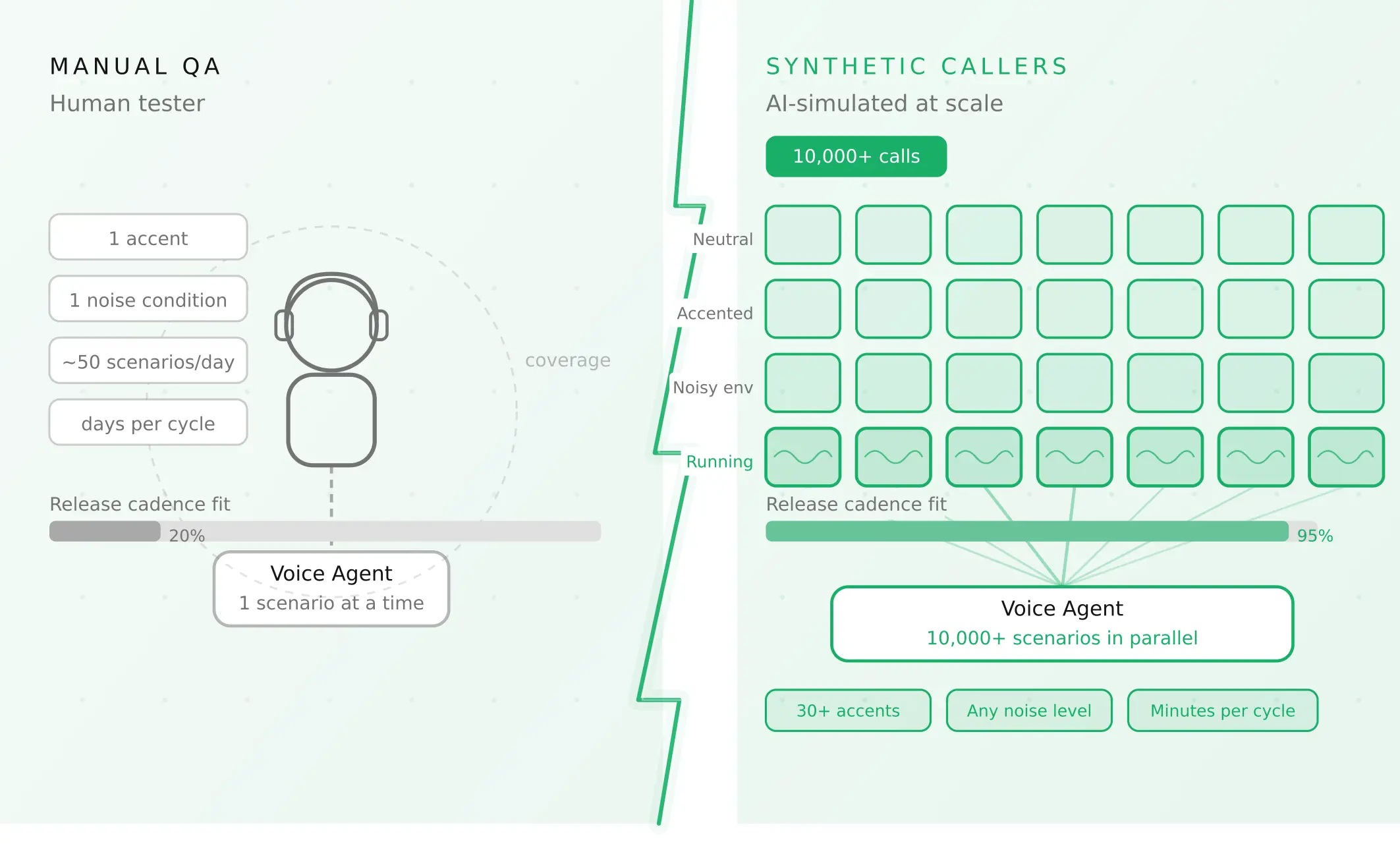
How to automate voice agent testing: synthetic callers vs manual QA
Learn how ai test automation replaces manual QA for voice agents. Compare synthetic callers vs human testers, with a 5-step framework to scale without hiring.
Read more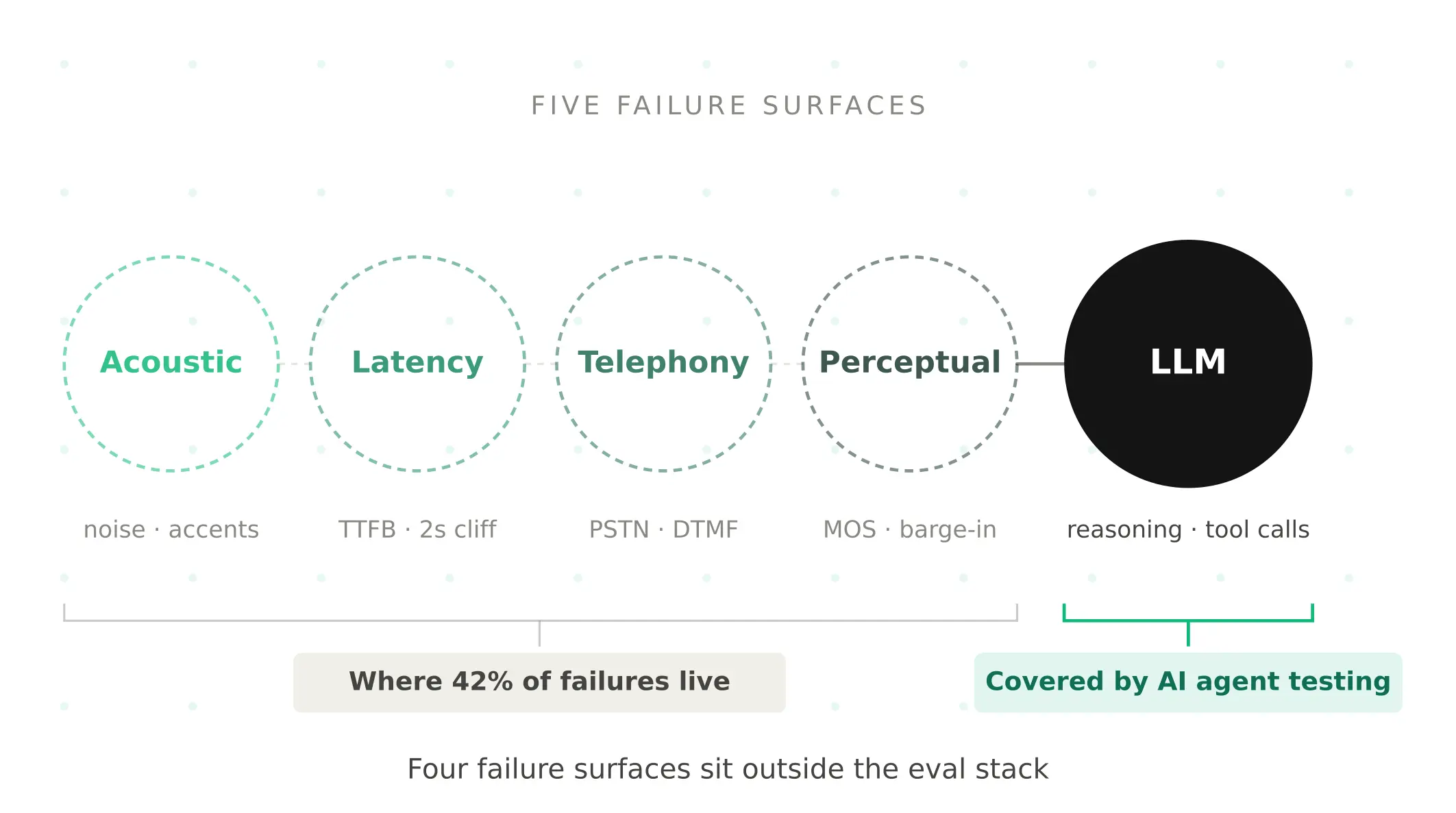
AI Agent Testing vs Voice Agent Testing: What General Tools Miss for Voice
AI agent testing measures text outputs. Voice agent testing measures behaviour through an acoustic pipeline. Five failure categories general tools miss.
Read more