How to fix barge-in and interruptions in AI voice agents
On this page
Real conversations are full of interruptions. People cut in, change their mind, and say "mm-hm" while listening. An agent that cannot handle this feels robotic and frustrating. Evalgent tests interruption handling on realistic calls. Here is why barge-in breaks and how to fix it.
Barge-in: the ability of a caller to interrupt the agent mid-speech and have the agent stop talking and start listening, the way a person yields when interrupted.
What broken barge-in sounds like
These are the symptoms callers hit:
- The agent keeps talking over the caller who is trying to interrupt.
- It stops mid-word every time the caller says "yeah" or "okay."
- It cuts off awkwardly, then loses its place in the conversation.
- It hears its own audio and interrupts itself.
- After an interruption, it ignores what the caller actually said.
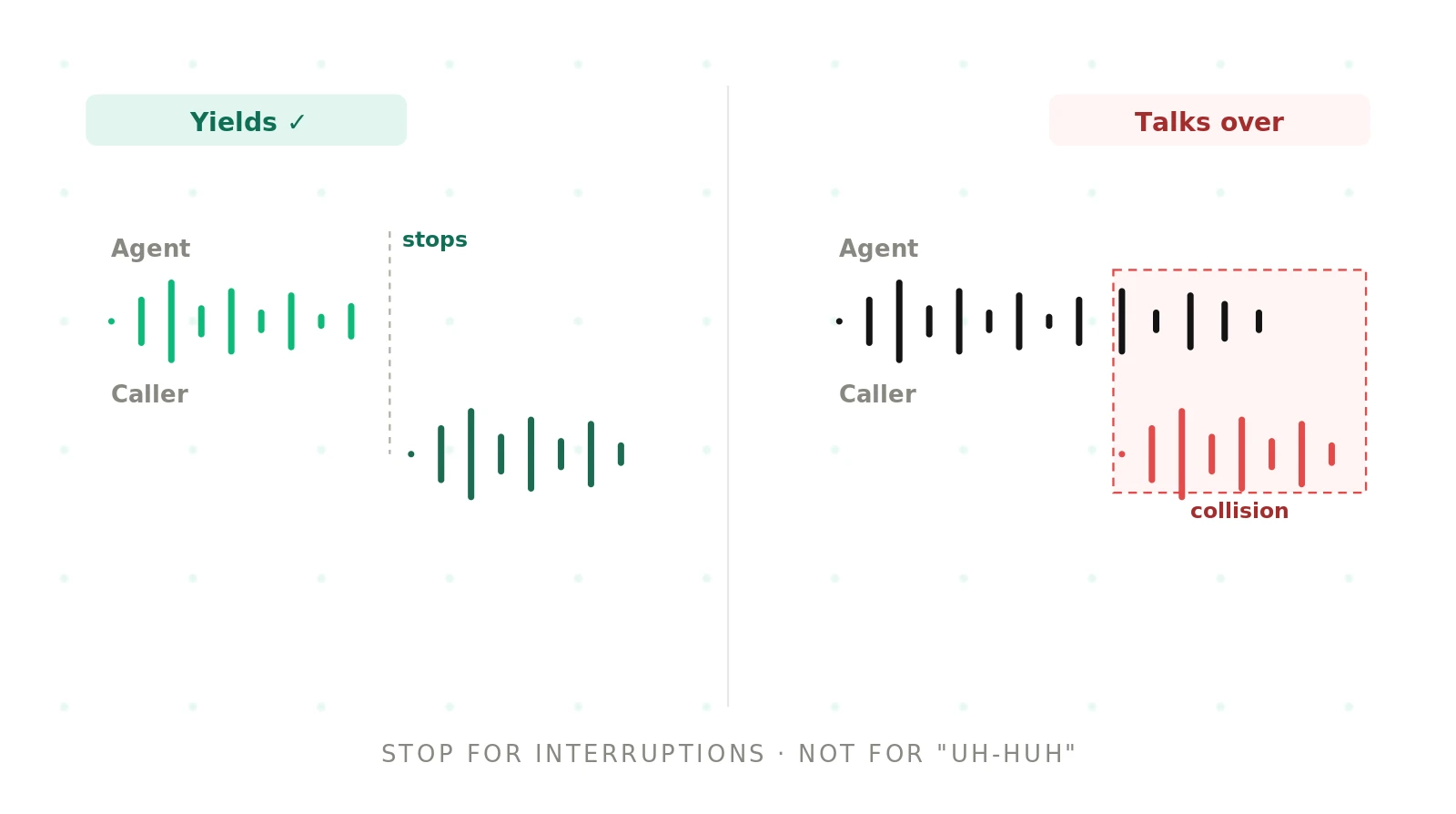
The failure is a talk-over. When two voices collide and neither yields, the call stops working.
Why barge-in fails
Barge-in is a timing and audio problem. The agent has to detect real speech, decide whether it is an interruption or a backchannel, and stop cleanly. The table maps each cause to what you hear and how to fix it.
| Cause | How it shows on a call | Fix |
|---|---|---|
| Half-duplex pipeline | Agent cannot listen while speaking | Use a full-duplex setup so it hears the caller mid-reply |
| VAD threshold too high | Ignores the caller trying to interrupt | Lower the voice-activity threshold so real speech triggers a stop |
| VAD threshold too low | Stops for every backchannel and noise | Raise the threshold; classify backchannels separately |
| No echo cancellation | Interrupts itself on its own audio | Add acoustic echo cancellation on the input |
| No backchannel handling | Treats "uh-huh" as a full interruption | Distinguish backchannels from real turn-taking |
| Slow stop | Keeps talking a beat after the caller cuts in | Cut the audio fast on a confirmed interruption |
How to test barge-in in AI voice agents
1. Script interruptions — Write scenarios where the caller cuts in mid-reply and assert the agent stops.
2. Add backchannels — Include "uh-huh" and "okay" while the agent talks, and assert it keeps going.
3. Measure time-to-stop — Track how fast the agent yields after a real interruption.
4. Test under noise — Run background noise and echo so false triggers surface.
5. Check recovery — Confirm the agent uses what the caller said after cutting in, not its old script.
6. Tune and re-run — Adjust VAD and echo settings, then re-test both interruptions and backchannels together.
A worked example
A team lowered their voice-activity threshold to fix an agent that talked over callers. It worked — but now the agent stopped every time a caller said "mm-hm" while listening, breaking its flow. The two failures pull in opposite directions. The fix was not one threshold but a backchannel classifier: stop for real interruptions, keep talking through acknowledgements. Only testing both cases together caught the regression.
Fixing barge-in with Evalgent
Evalgent tests interruption handling on realistic calls, both directions at once. Scenarios script real interruptions and backchannels, so you catch talk-overs and over-stopping in the same suite. Profiles vary caller voice, pace, and noise, since barge-in behaves differently across speaking styles and lines. Metrics track barge-in success and false-stop rate with thresholds you set. Evaluations run the suite as batches of synthetic callers before release. Reviews let you replay a collision and hear exactly when the agent should have yielded. On the architecture behind this, see full-duplex voice agents and cascading vs speech-to-speech.
The bottom line
Barge-in fails in two opposite directions: talking over the caller, and stopping for every acknowledgement. Tune voice-activity detection, add echo cancellation and backchannel handling, and test interruptions and backchannels together so fixing one does not break the other.
Frequently asked questions
What is barge-in in a voice agent?
Barge-in is the ability of a caller to interrupt the agent while it is speaking and have the agent stop and listen. It mirrors how people yield when interrupted. Without it, the agent talks over the caller, which makes the conversation feel robotic and quickly frustrates people who are trying to correct or redirect it.
Why does my voice agent talk over the caller?
Usually because the pipeline is half-duplex, so the agent cannot listen while it speaks, or the voice-activity threshold is set too high to detect the interruption. A slow stop also causes talk-over, where the agent keeps speaking for a beat after the caller cuts in. Full-duplex audio and a faster stop fix most cases.
Why does my voice agent stop when I say "uh-huh"?
Its voice-activity detection is too sensitive and treats backchannels — "uh-huh," "okay," "right" — as full interruptions. These acknowledgements mean "keep going," not "stop." The fix is a backchannel classifier that distinguishes them from real turn-taking, so the agent holds its turn through acknowledgements and only yields to genuine interruptions.
How do you test barge-in on a voice agent?
Script scenarios where the caller interrupts mid-reply and assert the agent stops, and separately include backchannels and assert it keeps talking. Measure time-to-stop after a real interruption, run the tests under noise and echo, and confirm the agent acts on what the caller said after cutting in.
What is the difference between barge-in and turn-taking?
Turn-taking is the normal handoff of who speaks when each side finishes. Barge-in is the special case where the caller starts before the agent has finished, forcing the agent to yield mid-speech. Good turn-taking handles clean handoffs; good barge-in handles the messier, overlapping ones that fill real conversations.
Does echo cancellation affect barge-in?
Yes. Without acoustic echo cancellation, the agent can hear its own outgoing audio and treat it as caller speech, interrupting itself or mis-triggering. Echo cancellation on the input keeps the agent from reacting to its own voice, which is essential for reliable barge-in on speakerphone and telephony lines.
How fast should a voice agent stop when interrupted?
As close to immediate as possible — a stop within a couple hundred milliseconds of a confirmed interruption feels natural. A longer delay produces a talk-over, where both voices continue and the caller has to repeat themselves. Track time-to-stop as a metric, and test it under real audio conditions, not just clean input.
Do speech-to-speech models handle barge-in better?
Often, yes. Native speech-to-speech models are typically full-duplex and can listen while speaking, which makes barge-in more natural than a strict cascading pipeline. But they still need testing, since sensitivity and backchannel handling vary. Architecture helps, but it does not remove the need to verify interruption behavior on real calls.
Related guides
How to test tool calling in AI voice agents
Tool calling fails when a voice agent picks the wrong function, fills bad arguments, or acts silently. Learn how to test tool calling and catch it.
How to reduce latency in AI voice agents
Voice agent latency is the pause before the agent replies. Learn what drives it, what a good target is, and how to reduce latency without losing quality.