Voice Agent Kill Switch and Canary Releases
On this page
Sources opened November 5, 2026: Google's SRE Workbook on canarying releases and alerting on SLOs, Martin Fowler's feature toggles article, OpenFeature's flag evaluation spec, evaluation context docs and Python SDK docs, Twilio's call-modification tutorial, LiveKit's server lifecycle docs, AWS's reliability pillar and the SEC's Knight Capital order. Worked examples are labelled illustrative.
A prompt change ships on Tuesday. By night, one tool is writing the wrong delivery window into a few hundred customer records. Nobody has complained yet. What do you do in the next ten minutes?
If the answer is "revert and redeploy," you have a rollback, not a voice agent kill switch. A voice agent kill switch works in seconds, at the smallest scope that stops the damage, and leaves callers somewhere safe. A canary keeps the fault small in the first place. This post covers what to switch off, what callers get, flags that survive a flag outage, canary sizing and drills.
Kill switch vs canary release: two controls, two jobs
A canary limits who a change can hurt. A voice agent kill switch limits how long it hurts them. Google's SRE Workbook defines the first: "We define canarying as a partial and time-limited deployment of a change in a service and its evaluation." Martin Fowler's toggle article covers the second. Ops toggles control operational behaviour. He notes that systems often keep "a small number of long-lived" kill switches.
The two controls fail differently. A canary fails by being unrepresentative, so a bad change slips through on a quiet tenant. A kill switch fails by being unreachable. The flag service is down, the on-call person lacks access, or nobody knows which flag does what.
Neither fixes damage already done. A kill switch stops new bad writes. Undoing old ones is a rollback action.
Why "we can always redeploy" is not a plan
In 2012, Knight Capital's software sent millions of orders in 45 minutes. The firm lost over $460 million, per the SEC's administrative order. The order says "Knight also did not have procedures in place to halt SMARS's operations in response to its own aberrant activity." A voice agent is not a trading system, and its failures are slower. The shape is the same. A fault is live on part of the fleet, nobody can stop it, and the cost grows each minute.
What to switch off: the five-scope ladder
Pick scopes by what you can name in a flag. Each rung below is broader than the one above it. Pull the narrowest rung that stops the damage.
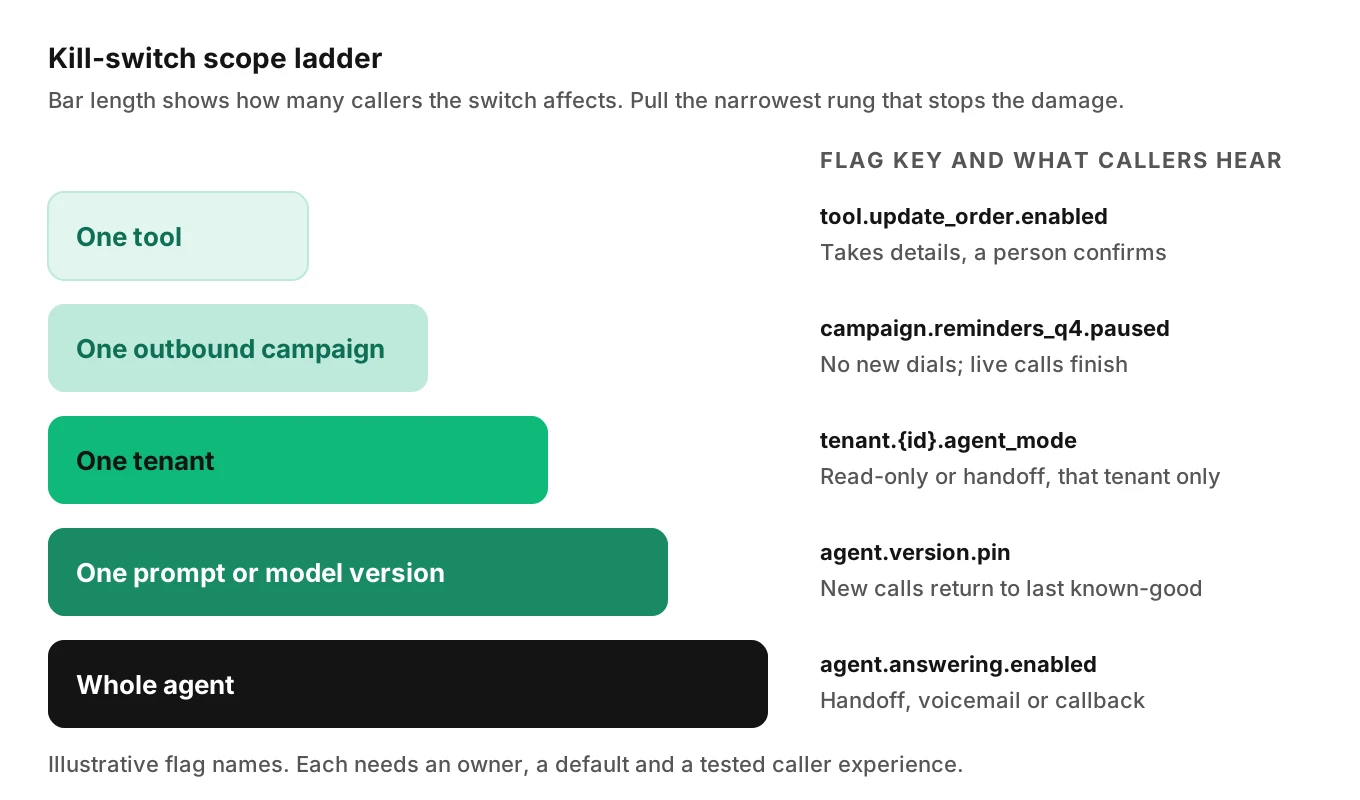
| Scope | Example flag key | Typical trigger | What callers get | Who may pull |
|---|---|---|---|---|
| One tool or action | `tool.update_order.enabled` | Wrong-record rate on one write | Agent takes details, says a person will confirm | On-call engineer |
| One outbound campaign | `campaign.reminders_q4.paused` | Bad script or bad list | No new dials; calls in flight finish | On-call engineer |
| One tenant | `tenant.{id}.agent_mode` | Tenant-specific data or mapping fault | Read-only or handoff for that tenant only | On-call engineer |
| One prompt or model version | `agent.version.pin` | Regression after a release | Traffic returns to the last known-good version | Release owner or on-call |
| Whole agent | `agent.answering.enabled` | Compliance, safety or data exposure | Handoff to staff, voicemail or callback | Named incident lead |
Three rules keep the ladder usable. Name flags for what they stop, such as `tool.update_order.enabled`, not `kyle_new_flow_v2`. Give every flag an owner, a default and a documented caller experience. If you cannot say what callers hear, you have a toggle, not a voice agent kill switch. And pull the narrowest rung that works. A permissions model that separates read tools from write tools makes the "one tool" rung cheap. Each multiplier in the blast radius post should have a rung that cuts it.
What callers get when it is off
"Off" is not silence. A dead line is a worse outcome than a wrong answer for many callers. Decide the degrade mode per scope, write the script, and test it. This is graceful degradation: a voice agent safe fallback for each rung, never a dead line.
| Mode | What it does | Good for | Watch for |
|---|---|---|---|
| Tool disabled, agent continues | Agent still answers, takes details, promises a callback | One failing write tool | Callers who expect the action to happen |
| Read-only mode | Lookups work; changes are refused or queued | Suspected data corruption | Agent offering an action it can no longer perform |
| Handoff to human staff | Transfer to staff or a queue | Whole-agent pull, tenant fault | Staff capacity and after-hours coverage |
| Voicemail or callback capture | Records name, number, reason | After hours, handoff overload | Capture quality; see alphanumeric capture |
| Pin to last good version | Routes new calls to the prior prompt and model | Release regressions | Schema drift between old prompt and new tools |
The script must match the disabled capability. If `update_order` is off but the prompt still says "I'll update that now," the agent will promise and fail. Swap in a prompt variant for that mode. Handoff quality has its own failure modes: see escalation accuracy and handoff loops.
The handoff capacity trap
Handoff is safest for callers and riskiest for staff. Illustrative example: a tenant gets 120 calls an hour at peak and the agent resolves 70%, so humans see 36. Pull the whole agent and they face 120, over three times the load. Phones ring out. The switch protected the records and broke the experience.
Plan the degrade path by volume. Use callback capture above a queue threshold. Pull one tool instead of the agent when you can.
Keep a second kill path outside the agent
Your agent's own stack may be what is broken, so keep a path outside it. Say your agent reaches the phone network through Twilio. Its tutorial on modifying calls in progress says "To end a phone call by your choice, pass a `completed` status to a `CallSid` in progress." It also says "You can choose to redirect a `Call` to another URL that responds with your requested TwiML." The request needs the call's SID. Keep a live list of active call ids. Other carriers have equivalents. Rehearse yours. This is your voice agent emergency stop when the agent itself is broken.
Voice agent feature flags that still work when the flag service does not
Fowler warns that "needing to roll out a new release in order to flip an Ops Toggle is unlikely to make an Operations person happy." So flags change at runtime. Then ask what the agent does when it cannot read one. The OpenFeature specification says "Flag evaluation calls must always return the default value in the event of abnormal execution." The default you hardcode runs during a flag outage. Choose each one deliberately.
| Flag | Default if unreadable | Why |
|---|---|---|
| `tool.update_order.enabled` | `False` (fail closed) | A write you cannot confirm is allowed should not run |
| `tool.lookup_order.enabled` | `True` | Reads are low-risk and callers need them |
| `agent.answering.enabled` | `True` | A flag outage should not take the whole agent offline |
| `agent.version.pin` | Last known-good version id | A new, unreviewed version should not win by accident |
Fail closed for writes and open for answering. One global default gets one of them wrong.
Evaluate per call, and again at every write
OpenFeature's evaluation context carries the data used to decide a flag. Its docs say "The targeting key should contain a string uniquely identifying the subject." Use the tenant id as the targeting key. Pass the number, campaign id and prompt version as attributes. The docs tie targeting keys to percentage-based rollouts, which your canary needs.
A call lasts minutes, so a flag read once at call start misses a kill pulled at minute two. Evaluate at call start to pick the prompt variant and tools. Evaluate again right before each write tool runs. The second check makes the switch work on live calls. Below is a simplified sketch with the OpenFeature Python SDK.
from openfeature import api
from openfeature.evaluation_context import EvaluationContext

client = api.get_client()

def write_allowed(tool: str, tenant_id: str, call_id: str) -> bool:
    ctx = EvaluationContext(
        targeting_key=tenant_id,
        attributes={"call_id": call_id, "tool": tool},
    )
    # Default False: if the flag cannot be read, the write does not run.
    return client.get_boolean_value(f"tool.{tool}.enabled", False, ctx)

async def update_order(call, args):
    if not write_allowed("update_order", call.tenant_id, call.id):
        return {"status": "deferred", "say": "A teammate will confirm that change."}
    return await orders_api.update(args)
The SDK docs show `get_boolean_value("v2_enabled", False)` with a default, and a context built from `targeting_key` and `attributes` passed as the third argument to `get_string_value`. The docs do not show a context on `get_boolean_value` itself, so confirm that call against the version you pin. The tool returns a spoken instruction, not an exception. Write-back then records a deferred action.
Keep a registry
A short registry beats flags scattered through code. This is an illustrative format, not a product feature.
flags:
  tool.update_order.enabled:
    owner: orders-team
    default_if_unreadable: false
    caller_experience: "Takes details; says a teammate will confirm."
    who_may_flip: [oncall]
    last_drilled: 2026-10-22
  agent.answering.enabled:
    owner: ai-platform
    default_if_unreadable: true
    caller_experience: "Transfers to the tenant's front desk line."
    who_may_flip: [incident_lead]
    last_drilled: 2026-09-30
A flag nobody has flipped in six months is a flag nobody can vouch for.
Voice agent canary release cohorts: tenant, number and hour
The Google SRE Workbook says a canary "should be sizeable and last long enough to be representative of the overall deployment." It also says "We strongly advise running only one canary deployment at a time." Overlapping canaries make failures hard to attribute.
Its example: with a 5% canary, "we serve 20% errors for 5% of traffic, resulting in a 1% overall error rate."
A voice agent staged rollout can be sliced four ways. By tenant is easy to explain and to kill, but weak when call mixes differ. By number or route gives even coverage across caller types. By hour keeps the canary in business hours, when staff can respond. By outbound wave sends 1% of a list, holds, checks, then continues. See outbound voice agent testing.
The trap in voice is the sample. A canary cut to 5% of a tenant that takes 40 calls a day yields two calls. Two calls tell you nothing.
Worked math: how many calls before you proceed
Use the "rule of three," a standard approximation. With zero failures in n independent trials, the 95% upper bound on the failure rate is about 3/n. This is a statistical rule of thumb, not a result from the sources above. It assumes calls are independent.
| Calls with zero wrong records | 95% upper bound on wrong-record rate |
|---|---|
| 30 | about 10% |
| 100 | about 3% |
| 150 | about 2% |
| 300 | about 1% |
Thirty clean calls is not evidence when a wrong record costs money. Gate by calls, not clock time: "hold until 150 calls with zero wrong records" beats "hold for an hour." Group low-volume tenants or run longer.
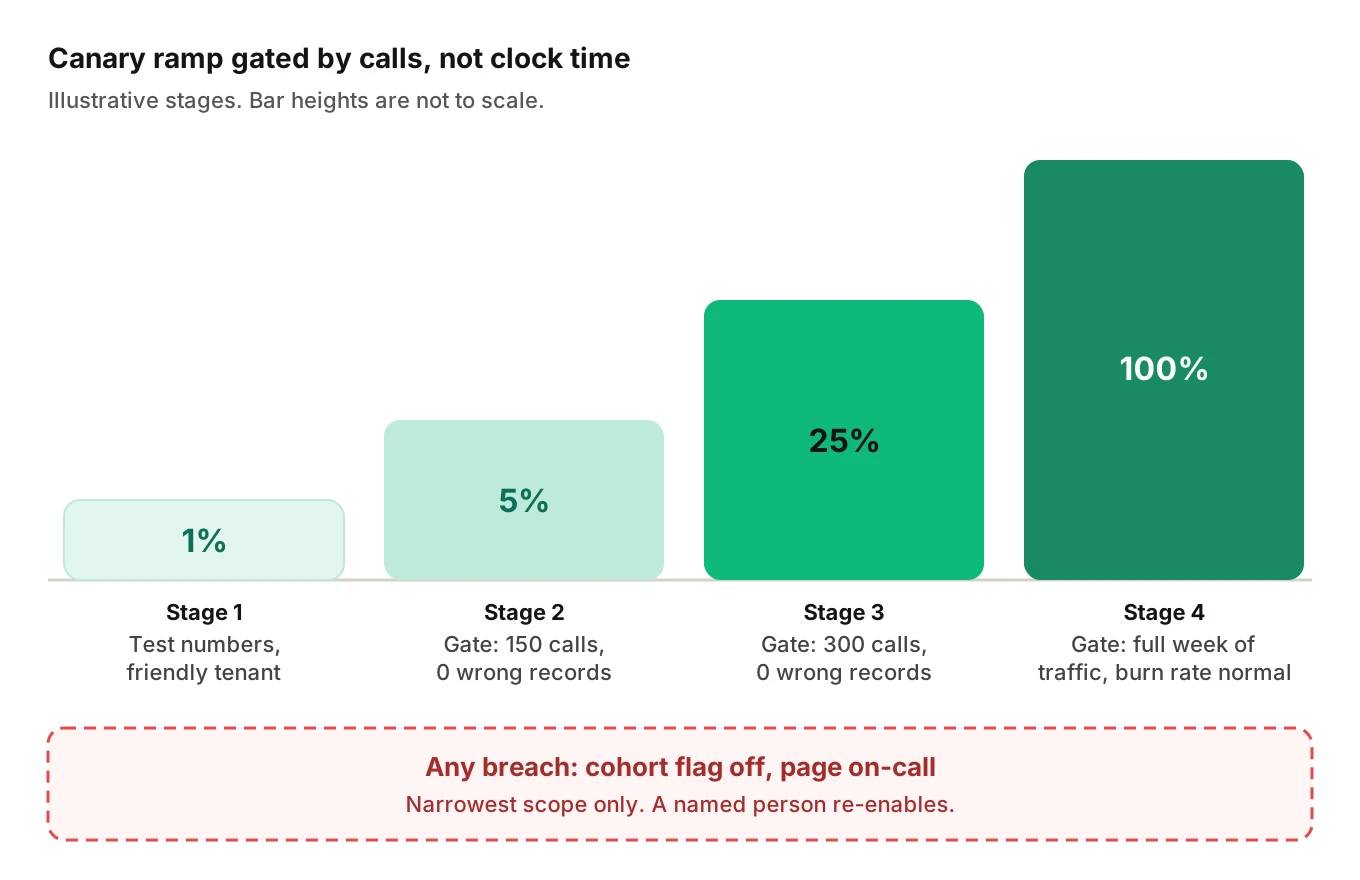
The ramp is illustrative. Each gate checks volume (enough calls), coverage (accents, languages, long calls, interruptions, write paths) and signals (nothing newly red). The SRE Workbook advises selecting "the top few metrics," perhaps no more than a dozen. Start with wrong-record rate from write-back checks. See post-call write-back testing. Add tool-call failure rate, handoff rate and a latency percentile.
Automated halt triggers
A human watching a dashboard is too slow at 3 a.m. Tie halt rules to the cohort flag. For alert design, see voice agent SLOs for targets and error budgets, and monitoring voice agents in production for the signals.
Two hooks are worth wiring to the flag.
- Burn rate. The SRE Workbook defines it as "how fast, relative to the SLO, the service consumes the error budget." Its starting alert for a 99.9% SLO pages at a burn rate of 14.4 over a 1-hour window, with a 5-minute short window. That spends 2% of the budget. Treat it as a starting shape.
- Wrong-record rate. For an agent that writes to other systems, this is the better signal. SLOs about availability and latency can stay green while the agent writes wrong dates into every record.
For a bad canary the Workbook says "we should pause and roll back the deployment, or perhaps contact a human to help troubleshoot the issue." Let automation take the cheap, reversible step, halting the cohort. That halt is a voice agent circuit breaker scoped to one slice of traffic. A person decides the rest.
Four rules keep auto-halts safe. Halt the narrowest scope: a canary breach flips the cohort flag, not `agent.answering.enabled`. Never auto-enable; re-enabling needs a named person. Alert on the halt itself. Hold the ramp when data is thin.
In-flight calls: finish, drain or cut
When you pull a switch, some callers are mid-sentence. You have three options per scope.
| Option | Behaviour | Use when |
|---|---|---|
| Let finish | New calls get the safe path; live calls complete | The fault is in new-call logic, not live behaviour |
| Gate at the next write | Live calls continue, but write tools are blocked | Data corruption; the most common choice |
| Cut | End or redirect live calls through the carrier | Safety, compliance or data exposure |
"Gate at the next write" is why the per-write flag check above matters. It stops damage on live calls without hanging up on people.
Deploys raise the same question. LiveKit's server lifecycle docs say agent servers "gracefully drain active LiveKit sessions before shutting down." That page gives no drain timeout. Our post on running LiveKit agents on Kubernetes covers draining. A drain waits for calls to finish. A voice agent kill switch stops them writing.
Testing the switch itself
An untested voice agent kill switch is a belief. AWS's reliability pillar says "Game days simulate a failure or event to verify systems, processes, and team responses." It adds "The purpose is to actually perform the actions the team would perform as if an exceptional event happened." Run a game day for every flag.
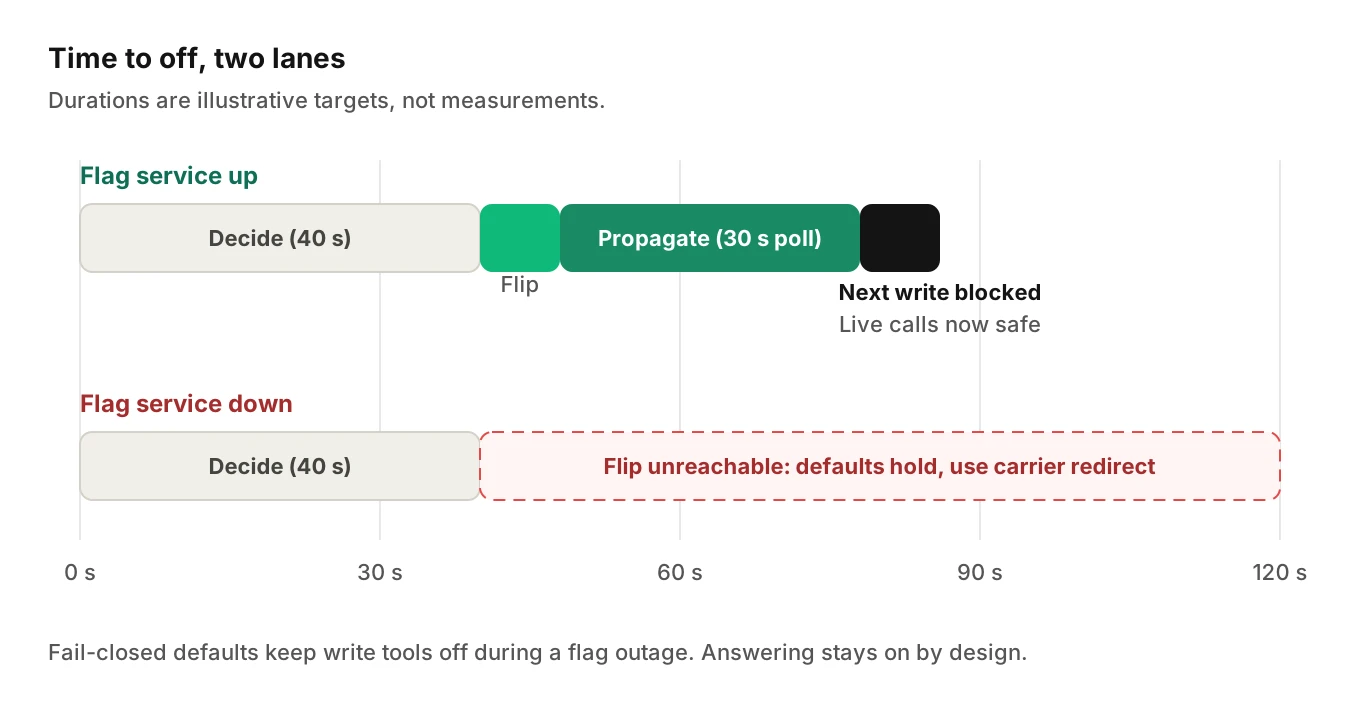
Measure time to off: from the decision to pull the switch to the moment the last live call is blocked from writing. Split it into decide, flip, propagate and in-flight block. The second lane shows the flag service down: you cannot flip anything, and only fail-closed defaults protect you. Durations in the figure are illustrative targets, not measurements.
Two things catch most teams out. Many flag clients cache or poll, so a 30-second poll means a 30-second floor. And the on-call person may lack flag permissions, or the flag UI may sit behind the failing login. Test credentials, not just code.
How to run a kill-switch drill
Run this quarterly, and after any change to flags or the voice stack. Use a staging tenant or test numbers first, then a real tenant at low-traffic time with notice. A staging environment makes step one safe.
1. Pick one scope from the ladder and one failure. For example, `update_order` writes the wrong delivery window.
2. Inject the fault in staging. Use a stub that returns wrong data, or a prompt variant that picks the wrong slot. Confirm that monitoring sees it.
3. Start the clock when the incident lead says "pull it." Record the time. Name the person who flips. They must use their own credentials.
4. Flip the flag. Note when the flag UI confirms and when the agent's logs show the new value.
5. Place calls during the flip. Use simulated callers. One should start before the flip and attempt a write after it. One should start after the flip.
6. Check what callers heard. Listen to the audio. The degrade script should match the disabled capability, with no "I'll update that now."
7. Check the records. No write should land after the block. Defer-queue entries should be readable by humans.
8. Repeat with the flag service unreachable. Block the flag provider's network path and confirm the defaults apply as designed.
9. Rehearse the carrier-level redirect on a test call, then record time-to-off per phase and update `last_drilled`.
Pass criteria are yours to set. A reasonable start: new calls take the safe path within your propagation window, no write lands after the block on any live call, and callers hear a sensible message every time.
Who may pull it, and who may turn it back on
Make pulling easy and re-enabling deliberate. On-call engineers flip narrow scopes without asking. The whole-agent switch has a named owner and a backup. Log who flipped what and why. After a halt, rerun the failing scenarios. Then ramp again through the canary stages. Versioning is in shipping prompt changes safely. A kill between two steps of a saga can leave partial state. See workflow testing.
Where testing tools fit
Evalgent generates test scenarios from the agent's prompt and flows. It runs simulated callers with set accents, speech pace, interruptions, background noise and language over phone, SIP or WebRTC. It evaluates from the audio, so it can check the spoken degrade script in each mode. In production, it takes the recordings your team pushes and maps them to scenarios. It flags tool-call failures, PII leakage, latency spikes and policy failures with fix recommendations. That gives halt rules a sharper signal. Evalgent works with teams to set up evals for their first agent; it is not self-serve.
This is one post in a series on voice agents wired into products. Later in this series, system-specific posts cover calendars, CRMs and payments. Related reading: integration testing and end-to-end testing.
Frequently asked questions
What is a voice agent kill switch?
It is a runtime flag that disables part or all of a live voice agent without a deploy. Good ones work at several scopes, such as a tool, tenant, campaign or prompt version. They also define what callers hear when the capability is off, such as a handoff, a callback or a read-only mode.
What is the difference between a kill switch and a canary release?
A canary limits how many callers a change reaches. A voice agent kill switch limits how long a fault keeps hurting them. A canary is a time-limited partial rollout with evaluation. A voice agent kill switch is a standing control you can flip at any time. You need both, and the canary flag is often the voice agent kill switch.
How do I use feature flags to roll out a voice agent change?
Give each change its own feature flag, target it by tenant id or number, and expose it to a small cohort first. Hold the ramp until enough calls pass your checks. Use call counts, not clock time. Remove the flag once the change is fully rolled out, but keep the long-lived kill switches.
What should a voice agent do when the kill switch is on?
It should never go silent. Pick a safe degrade mode per scope: tool disabled, read-only, handoff to a human, voicemail or callback capture, or a pinned older version. Write the script, match it to the disabled capability, and test it with audio.
What should the flag default be if the flag service is down?
Choose per flag. The OpenFeature spec says evaluation calls return the supplied default on abnormal execution. So write tools should default to off, while answering and read-only lookups should default to on. Never rely on a single global default for every flag.
How big should a voice agent canary be?
Big enough to be representative, and measured in calls. As a rule of thumb, zero failures in 150 calls bounds the failure rate near 2% at 95% confidence. A 5% slice of a small tenant may give you two calls. Group tenants or extend the hold in that case.
How do I stop calls that are already in progress?
Check the flag before each write tool runs, so live calls stop writing. To end or redirect live calls, use your carrier's call-control API. Twilio's tutorial describes redirecting a call to new TwiML or ending it with a completed status. You need the call id.
How often should we test the kill switch?
Drill each flag on a schedule, such as quarterly, and after any change to flags, permissions or the voice stack. Record time to off and who could actually flip it. AWS describes game days as simulating a failure to verify systems, processes and team responses.
The bottom line
A voice agent kill switch only counts if it works at the narrowest useful scope, hands callers a safe path and still functions when the flag service is down. A canary only counts if it holds for enough real calls to mean something, and a drill is the only proof that either one works.
Related Articles

How to automate voice agent testing: synthetic callers vs manual QA
Learn how ai test automation replaces manual QA for voice agents. Compare synthetic callers vs human testers, with a 5-step framework to scale without hiring.
Read more
AI Agent Testing vs Voice Agent Testing: What General Tools Miss for Voice
AI agent testing measures text outputs. Voice agent testing measures behaviour through an acoustic pipeline. Five failure categories general tools miss.
Read more