Tutoring Center AI Receptionist: Trial Classes and Pricing
On this page
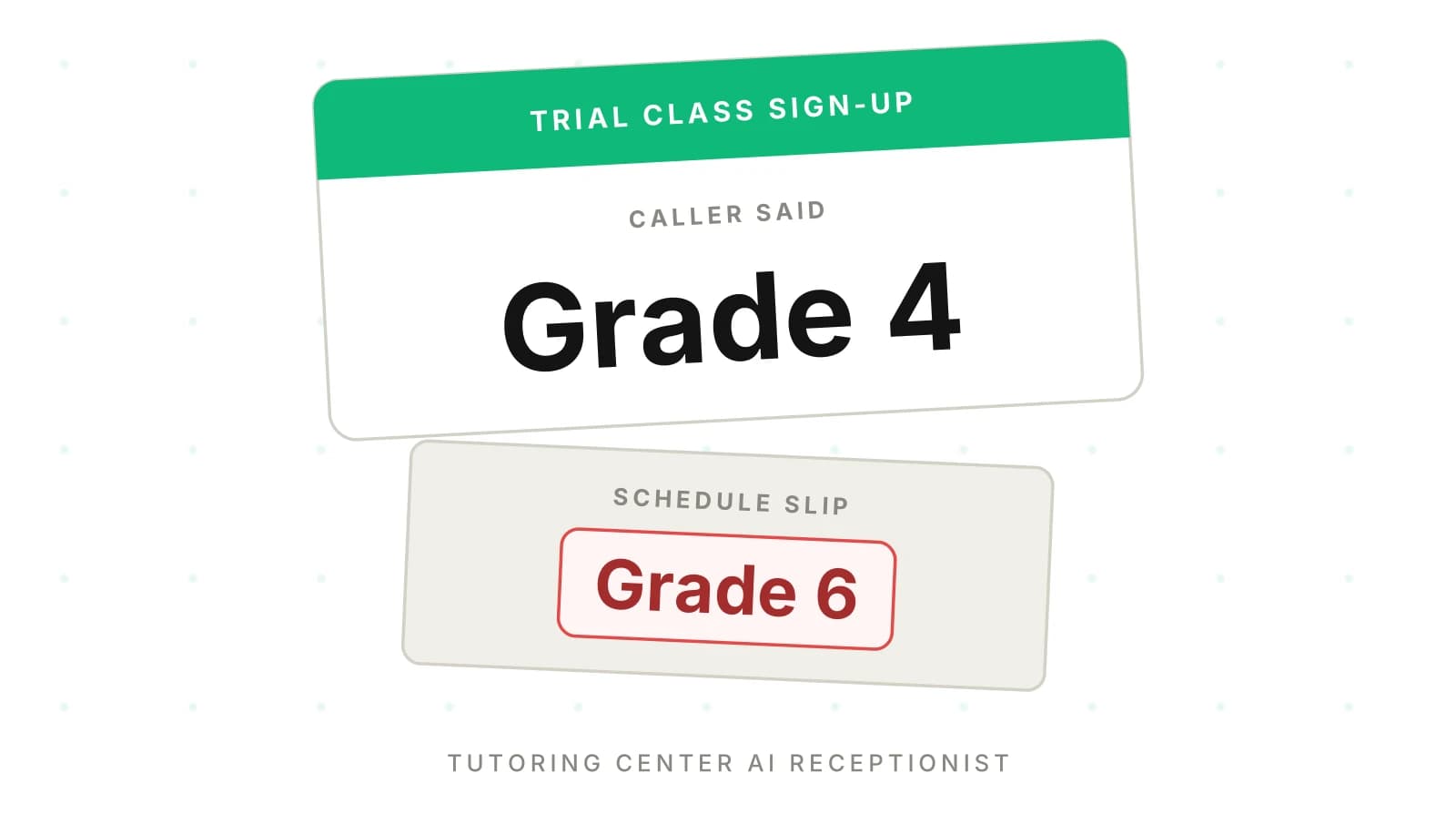
A parent calls a tutoring center at 7:40 on a Tuesday evening. She says her daughter is in fourth grade and wants a trial class in math on Saturday morning. The agent sounds warm and confirms a slot. The transcript reads fine. Then the Saturday coach opens the roster and finds a sixth-grade pre-algebra session with the wrong worksheet pile.
This post is for the product lead or engineer whose team built a tutoring center AI receptionist into a larger product, such as enrollment software or a franchise operations platform. The agent answers calls for many centers at once. Every prompt change reaches all of them. This guide covers AI phone answering for tutoring centers. It shows where calls break, what the law says about children's data on a phone line, and how to test the booking record.
Not legal advice. The legal notes below are plain-language readings of primary sources. Have counsel confirm how they apply to your product.
Why a tutoring call is harder than a salon booking
A salon call has one person: the caller books for herself. A tutoring call has at least two. The parent talks and the child is the subject of the booking. Sometimes a teenager calls alone. Sometimes two siblings share one call. The record has to keep those people apart.
The booking itself is also wider than a time slot. A salon booking maps to a service and a stylist. A tutoring booking maps to a grade, a subject, a session type, a group size, a location and a price. We covered the salon version in Salon Booking AI and the broader playbook in AI Receptionist for Salons and Spas. Gym AI Receptionist covers class booking with waitlists. What is new here is the child.
The call is the front door to a workflow. The agent captures details, creates a trial booking, sends a confirmation text and writes a note the coach reads. A speech error lands in all three places. Nobody sees it until Saturday.
Understood lists what parents should ask a tutoring provider: schedule, session length, rate, extra fees for materials or assessments, and the cancellation and make-up policy. Your agent will hear those questions on every call, and each has a wrong answer that sounds right.
Where the booking record goes wrong
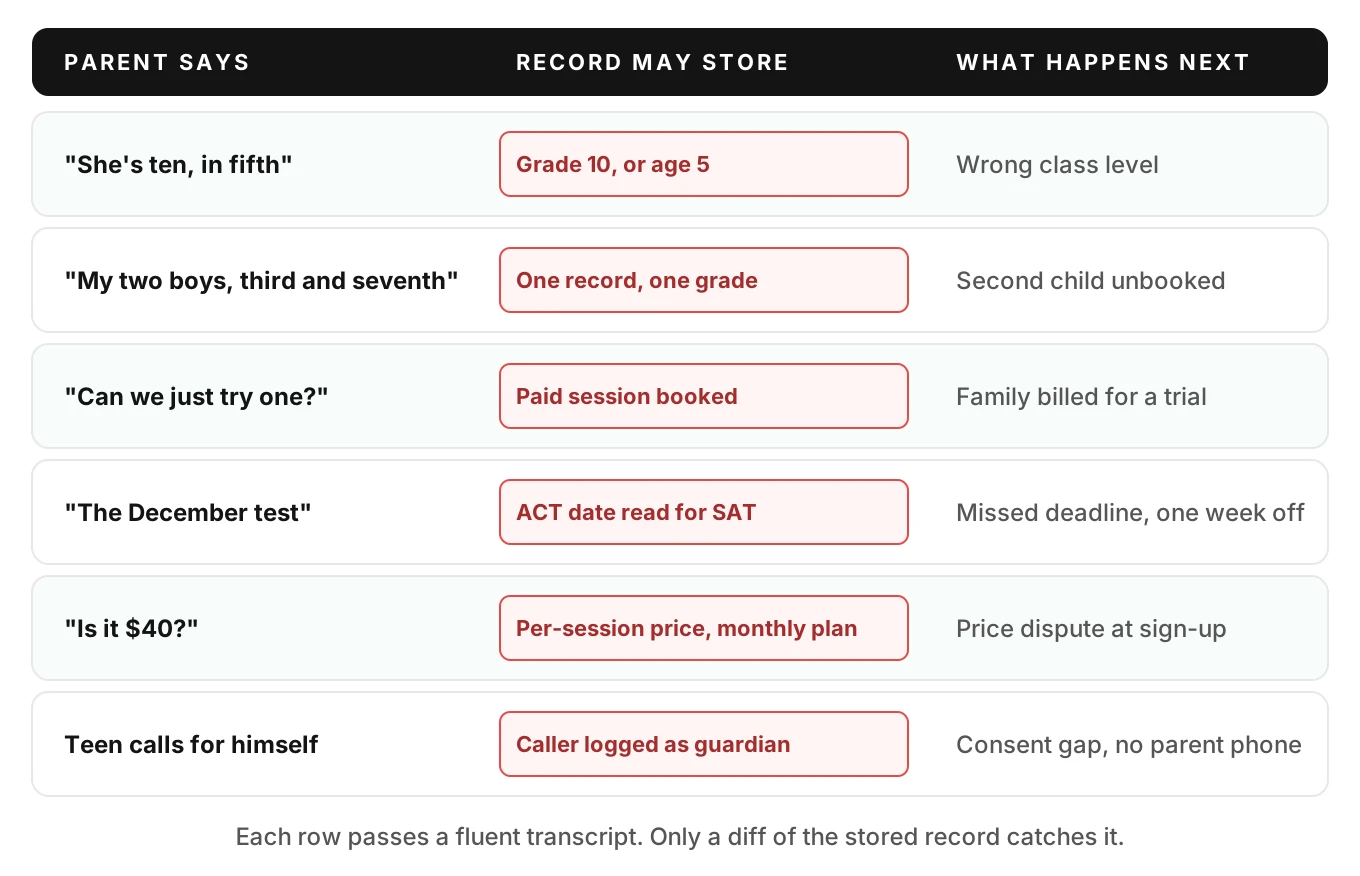
Most failures are small and quiet. Here are the ones worth a test case each.
Grade level, age and school year. A parent says "she's ten, in fifth." The agent stores grade 10, or age 5. Numbers play several roles in one call: grade, age, hour, price and session count. "Fourth grade" and "four thirty" share a word. Timing bites too. "Going into sixth" means different things in August and in November.
Subject names. Parents say "math" when the center sells pre-algebra, Algebra 1 and geometry as separate tracks. They say "reading" for phonics, comprehension and English language arts. A good agent asks one narrowing question. A bad one picks the first match.
Caller role. The caller can be a parent, a student, a grandparent or a nanny. A student who calls to book a class for himself may not be allowed to. The agent should record who called, not only who the class is for.
Multiple children. "My two boys" is one call and two bookings with two grades. The failure is a merged record: one child, two grades, or the second child's subject overwritten.
Trial class versus paid session. In tutoring center trial class booking, a trial session, a diagnostic assessment and a paid first session often sit in different calendars. Booking the wrong one means the family pays, or the center gives away a seat.
Test-prep dates. A test prep center AI hears callers who mix up the test date, the registration deadline and the class start. They also mix up SAT and ACT. As of November 2026, the College Board lists an SAT on Saturday, December 5, 2026, with a regular registration deadline of November 20. ACT lists a December 12 test. Its regular registration deadline, November 6, has passed, and late registration runs through November 29. A parent who says "the December test" could mean either. The agent must ask which exam, then read the right date.
Slots. Tutoring center scheduling mixes after-school slots, a weekend slot and holiday hours, each on its own rules.
Makeup and cancellation. The cancellation policy often differs by session type. A makeup session may exist for a paid class and not for a trial.
The numbers: how field errors compound
A booking record has several fields that must all be right. Suppose six matter: child grade, subject, session type, slot, location and guardian phone number. If each field is right 97% of the time and errors are independent, the share of fully correct records is 0.97 to the sixth power, or 83.3%.
That is an illustrative assumption, not a measured rate. Still, the arithmetic shows why spot checks mislead. A single field looks fine at 97%. The record is wrong one time in six.
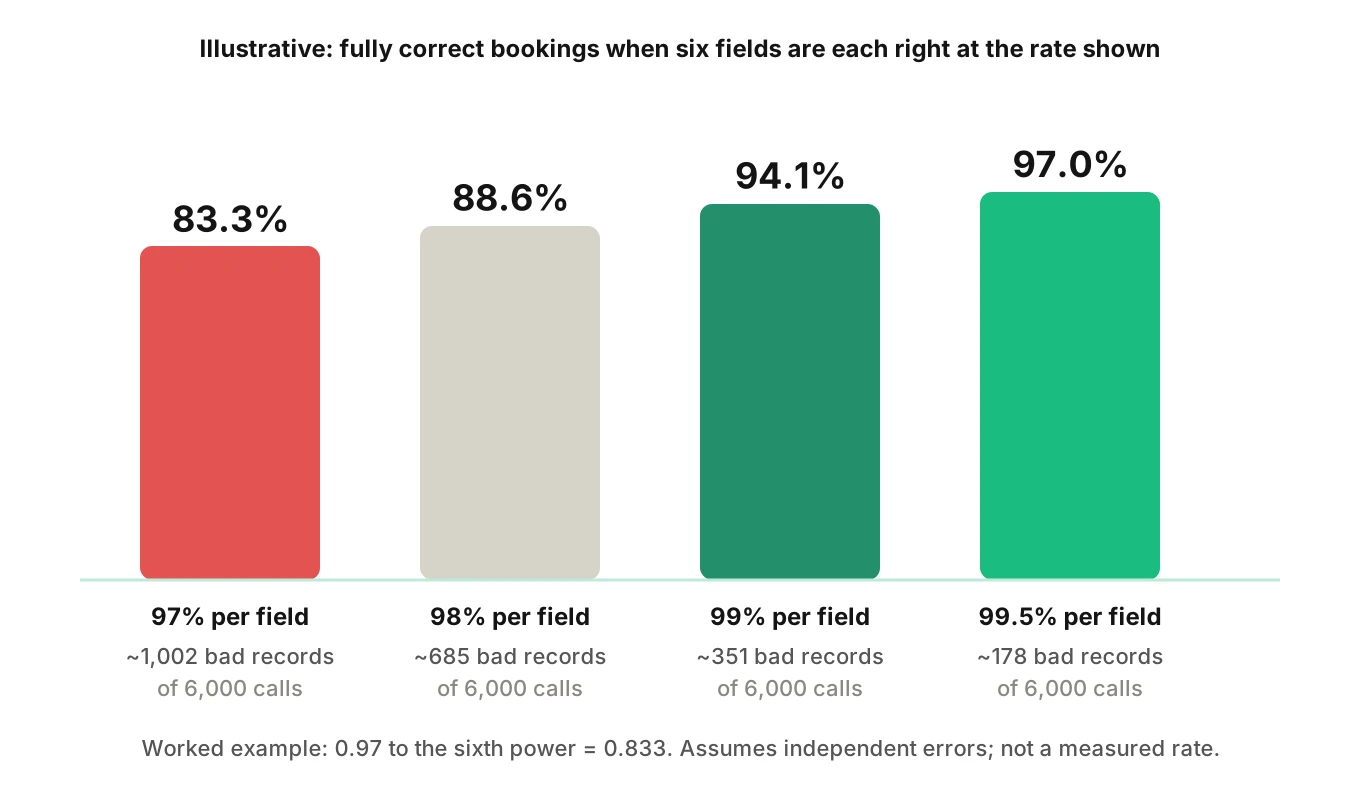
Now add scale. Take an illustrative platform serving 150 centers with 40 booking calls per center per month. That is 6,000 calls. At 97% per field, about 1,000 of them leave at least one wrong field. At 99%, about 350 do. A better prompt moves hundreds of children out of the wrong class.
Not every wrong field costs the same. A wrong grade wastes a coach's hour and may lose the family. Weight your test set toward the costly fields.
Pricing and trial wording
Tutoring center pricing calls are where a friendly agent does the most damage. It wants to help, so it rounds, guesses or invents a promotion. Treat the price list as data the agent reads, never as something it remembers.
A safe configuration has four parts.
1. A price table keyed by session type, one-on-one tutoring versus small group, and session package, with the unit written out: per session, per month or per package.
2. An effective date and an end date on every promotion.
3. A list of one-time fees, such as a registration fee or materials.
4. A rule that says: if the answer is not in the table, say a staff member will confirm.
Test for unit confusion first. A center that charges a monthly rate for eight sessions can be heard as a per-hour price. Test for stale promos second. The agent should not offer an expired discount because it appeared in a prompt from last spring.
The word "free" deserves its own test. The FTC's guide on the word "free" is 16 CFR 251.1. It is a guide, not a binding rule. It says conditions on a free offer should be disclosed clearly and conspicuously at the outset, and an asterisk footnote does not count. That is a sensible bar for a voice agent. If a trial class is free but the center expects a package afterwards, the agent should say so early in the answer, not after the booking.
| Parent asks | Wrong answer that sounds right | What to assert |
|---|---|---|
| "How much is it?" | A per-session price for a monthly plan | Unit stated: per session, month or package |
| "Is the trial free?" | "Yes, free" with no conditions | Conditions stated before the booking |
| "Is there a discount?" | An expired promo from the prompt | Promo valid on the call date, or a staff handoff |
| "Can she switch to group?" | A price for one-on-one | Price matches group size |
| "What if we miss a class?" | A makeup promise the center does not make | Policy text equals the config |
Child data on a phone call: what COPPA and FERPA say
This is the part teams most often get wrong in both directions. Some assume the rules clearly cover every call. Others assume they never apply. The honest answer sits between.
COPPA. The Children's Online Privacy Protection Rule, 16 CFR Part 312, covers operators of a "website or online service" directed to children under 13. It also covers general-audience operators with actual knowledge that they collect a child's data. The FTC's FAQ says the rule covers information collected online from children, not information from adults that pertains to children. A parent giving a child's grade over a phone line is an adult giving information about a child. Read plainly, the text does not target that call.
We found no FTC statement on voice agents on a plain telephone line, so treat that as open. Three situations are closer to the line.
- The agent runs in a browser or app, for example as a web call widget. That is an online service.
- A child speaks to the agent. The rule's definition of personal information includes an audio file containing a child's voice, and the FTC's FAQ describes a narrow non-enforcement policy for audio used only as a replacement for written words and deleted promptly. That policy does not cover an operator that asks for a name by voice.
- The call is recorded and stored. A recording with a child's voice in the background is still data you hold.
The amended rule took effect June 23, 2025, and regulated entities had until April 22, 2026 to comply, with a few exceptions. It also lists voiceprints as a biometric identifier. If your agent never builds voiceprints, say so in your data map.
FERPA. The Family Educational Rights and Privacy Act, 34 CFR Part 99, applies to educational agencies and institutions that receive funds under a program administered by the Secretary of Education. Section 99.1 sets that scope. A private tutoring center that takes no such funds is generally not that kind of institution. A center that contracts with a school or district is a different case. Whether it counts as acting for the school is a question for counsel, and we did not verify an answer.
What to do in practice. Minimize data without waiting for a legal answer. The agent needs a first name, grade, subject and a goal. It does not need a birth date, a home address, a school name or a diagnosis. Collect the guardian's phone and name, and nothing else about the child. Less data held means less to leak. If you also send confirmation texts, note that the FCC's new consent-revocation order, FCC 26-67, was adopted September 30 and released October 1, 2026. It was published in the Federal Register on October 26, 2026 and takes effect 30 days later, on November 25, 2026. Our PII post covers leaks in spoken readbacks, transcripts and logs.
What the agent should hand to a person
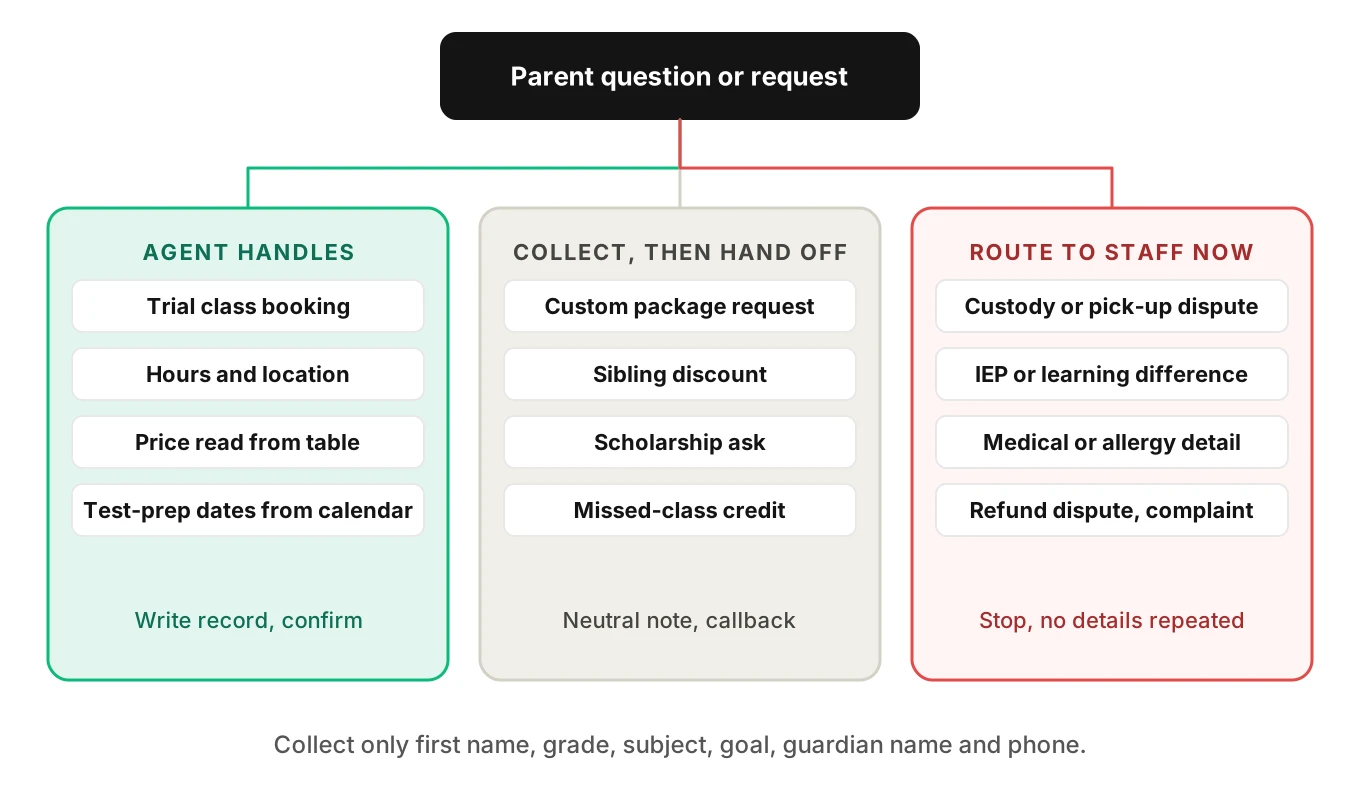
Split calls three ways.
The agent handles it. Trial booking, center hours and location, listed prices read from the table, and test-prep dates from a maintained calendar.
The agent collects and hands off. Questions the center must answer: a custom package, a sibling discount, a scholarship, a missed-class credit that is not in policy.
The agent routes to staff right away. Custody or pick-up disputes ("his dad should not be listed"), learning differences and individualized education plans, medical or allergy details, requests for a child's progress notes, refund disputes and complaints.
These questions carry consent and safety weight, and a wrong answer cannot be fixed by text. The same routing suits an AI receptionist for tutors who run a small studio. The agent should say a staff member will call back, write a short neutral note and stop. It should not repeat sensitive details in the note beyond what the staff member needs.
Children's speech is a reason for care. A 2024 arXiv paper, Benchmarking Children's ASR with Supervised and Self-supervised Speech Foundation Models, tested Whisper and several self-supervised models on child speech corpora. Its abstract reports that adaptation methods behave differently as models grow. The paper is not about phone bookings. The practical reading is modest. Give a student caller, or a child speaking near the phone, its own test cases.
How to test a tutoring center AI receptionist
Test the written record. A transcript can look perfect while the stored grade is wrong. Evalgent, a testing and monitoring platform for voice agents, holds that most tools judge agents by reading transcripts. Its view is that real failures live in the audio and in the gap between the prompt and what callers do. Judge the call by what it wrote.
1. Write the record schema and a golden record per scenario. List every field: child first name, grade, subject, session type, group size, location, slot, guardian name and phone, caller role, price quoted, promo mentioned. For each scripted call, write the exact record you expect.
2. Build scenarios from the prompt and the price table. Cover each state, branch and policy in your prompt. Evalgent generates test scenarios from an agent's prompt and flows, including branches, policies, hard constraints and coverage gaps. If you do it by hand, build a grid of grade, subject and session type, and add siblings, a student caller and a test-prep caller.
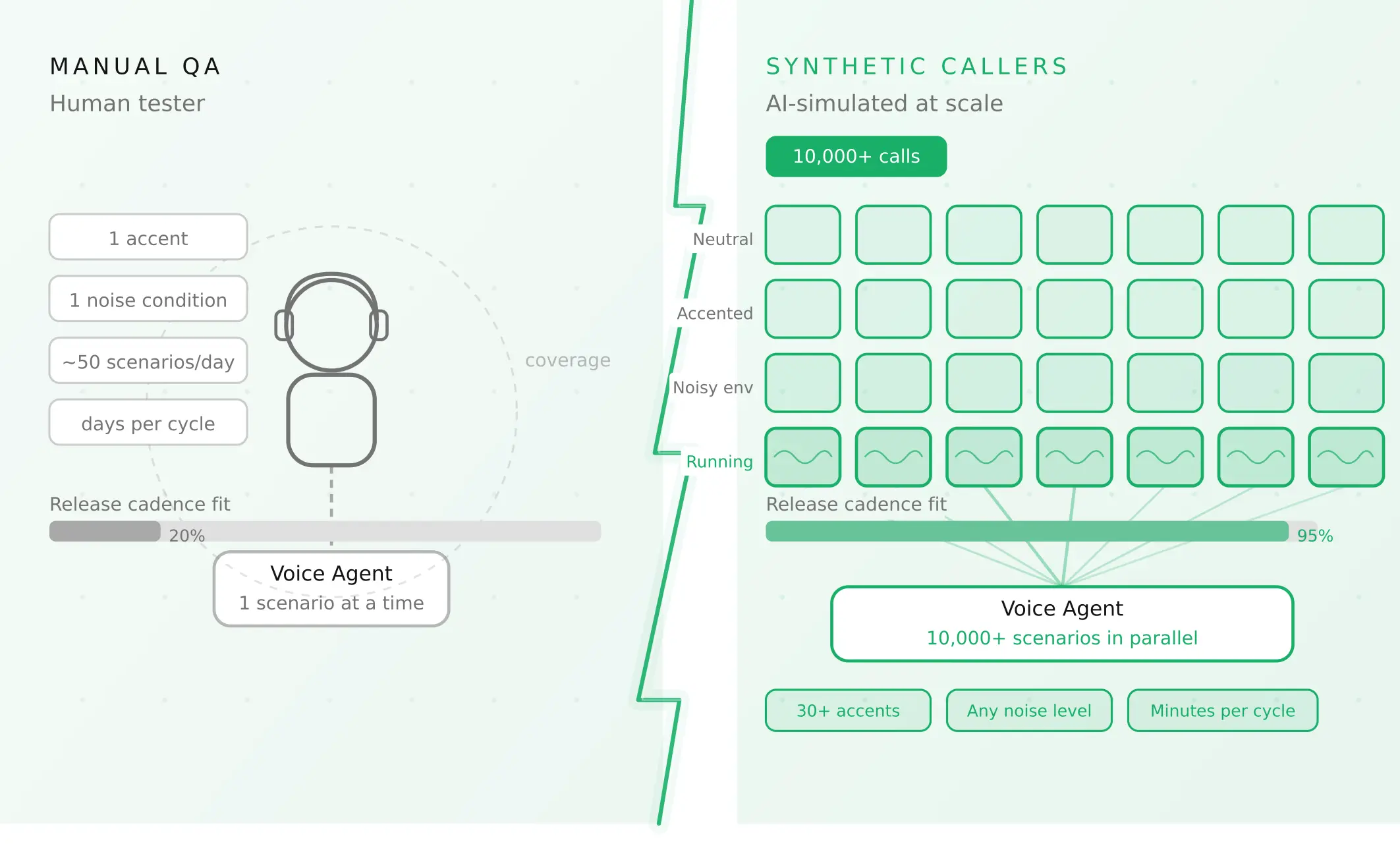
3. Vary the caller. Parents call from cars, kitchens and pickup lines. Use accents, fast speech, interruptions and background noise. Evalgent caller profiles cover accent, speech pace, interruption level, response delay, behaviour, background noise and language (English, Spanish, French, German, Hindi/Hinglish). Include Spanish for any center whose families call in it. See accent robustness for method.
4. Assert on the stored record, not the transcript. Diff each field against the golden record after the call ends. Use the code below.
5. Run a pricing set. Ask every pricing question in the table above, plus an expired promo and an unknown price. The agent passes when it states the unit, the conditions and the date range, or hands off.
6. Run a consent set. Plant custody, IEP, medical and refund questions. Pass means a handoff and a neutral note, with no sensitive data repeated back.
7. Gate every prompt change. Re-run the full set before a change reaches centers. Our guide to shipping prompt and flow changes safely covers versioning and rollback.
8. Sample live calls. Review a weekly sample of real calls against the same checks. Evalgent's production monitoring takes call recordings that customers push, transcribes them, maps them to scenarios and judges them, flagging PII leakage, tool-call failures, latency spikes and policy failures with fix recommendations. Pair this with production monitoring.
Here is a simplified record check. It is generic Python and assumes you can fetch the stored booking by call ID.
CRITICAL = {"child_grade", "subject", "session_type", "slot", "guardian_phone"}

def diff_record(expected: dict, stored: dict) -> list[dict]:
    """Return one finding per wrong or missing field."""
    findings = []
    for field, want in expected.items():
        got = stored.get(field)
        if got != want:
            findings.append({
                "field": field,
                "expected": want,
                "stored": got,
                "severity": "critical" if field in CRITICAL else "minor",
            })
    # A field the agent should never store is its own failure.
    for banned in ("birth_date", "home_address", "diagnosis"):
        if stored.get(banned):
            findings.append({"field": banned, "severity": "critical",
                             "expected": None, "stored": "present"})
    return findings
Run it over every scenario and report the rate per field, not one pass mark. A single score hides the failing fields.
Use a matrix to keep the set honest.
| Scenario group | Example caller line | Field to assert | Pass condition |
|---|---|---|---|
| Grade and age | "She's ten, in fifth" | child_grade | 5, not 10 |
| Siblings | "My two boys, third and seventh" | two bookings | Two records, correct grades |
| Student caller | Teen books for himself | caller_role | Student recorded, guardian requested |
| Trial vs paid | "Can we just try one?" | session_type | trial, not paid |
| Test prep | "The December test" | exam | Agent asks SAT or ACT |
| Price | "Is it $40?" | price_quoted | Matches table, with unit |
| Consent | "Dad should not pick him up" | handoff | Staff routed, no detail repeated |
The appointment scheduling metrics and voice agent testing for appointment scheduling posts cover the generic booking metrics. For recall-style calls that fill a schedule, see Dental Recall AI Calls, and for reminder calls, Med Spa Reminder and No-Show Calls. Colleges and schools raise a different set of deadline and aid questions, covered in AI Admissions Phone Calls.
Frequently asked questions
Can an AI receptionist book trial classes at a tutoring center?
Yes, if it books into the right calendar. A trial, an assessment and a paid session often use different durations and rules. Give the agent a session-type field, test that "can we just try one?" lands on a trial, and diff the stored booking against the call.
What should a tutoring center AI receptionist say about pricing?
Only what the price table says, with the unit and any conditions. It should state per session, per month or per package, name one-time fees, and avoid expired promotions. When the answer is missing from the table, it should say a staff member will confirm rather than estimate.
Does COPPA apply to a tutoring center's phone calls?
Unclear for a plain phone line. COPPA, 16 CFR Part 312, covers websites and online services, and the FTC's FAQ says it does not cover information from adults about children. Browser call widgets, apps and children speaking to the agent are closer to the rule. Ask counsel.
Does FERPA apply to a private tutoring center?
Usually not, but check. FERPA, 34 CFR Part 99, covers institutions that receive funds under a program the Secretary of Education administers. A private center without such funds is generally outside it. A center that works under contract with a school is a separate question for counsel.
How does an AI handle multiple children on one call?
It should create one booking per child, each with its own grade, subject and slot. Test "my two boys, third and seventh grade" and check that two records exist. The common failure is one merged record that keeps the first grade or the last subject.
How do you stop an AI mixing up SAT and ACT dates?
Make the agent ask which exam before it reads any date, and pull dates from a maintained calendar. In December 2026 the SAT is December 5 and the ACT is December 12, with different deadlines. Test the phrase "the December test" and assert that it asks.
What child information should a tutoring center AI collect?
Only what the booking needs: first name, grade, subject, goal, and the guardian's name and phone. Skip birth date, address, school and health details. Route custody, learning-support and medical questions to staff. Minimizing data helps whatever the legal reading turns out to be.
How do you test a tutoring center AI receptionist?
Write a golden booking record per scripted call, play varied callers, and diff the stored record field by field. Add pricing, test-prep date and consent-handoff sets. Re-run them before every prompt change, and sample live calls weekly against the same checks.
The bottom line
A tutoring center AI receptionist succeeds when the stored booking matches what the parent meant, and a smooth transcript proves nothing about that. Test grade, subject, session type, price and date fields against a golden record, collect the least child data you can, and route consent-sensitive questions to a person.
Related Articles
How to automate voice agent testing: synthetic callers vs manual QA
Learn how ai test automation replaces manual QA for voice agents. Compare synthetic callers vs human testers, with a 5-step framework to scale without hiring.
Read more
AI Agent Testing vs Voice Agent Testing: What General Tools Miss for Voice
AI agent testing measures text outputs. Voice agent testing measures behaviour through an acoustic pipeline. Five failure categories general tools miss.
Read more