Gym AI Receptionist: Class Bookings and Waitlists
On this page
Pricing, class rules and policy numbers in this post are illustrative. Legal status was checked on October 22, 2026. This is not legal advice.
A gym AI receptionist answers the phone for a gym, studio or boutique fitness brand. It books classes, handles waitlists and answers membership questions. Vendors pitch an AI receptionist for gyms as a cure for missed calls. If your team built that agent inside a studio product or runs it across many locations, the question is different: does a gym AI receptionist write the right thing? A fitness studio AI receptionist faces the same test. The call is the front door. Behind it sit a class roster, a credit balance and a billing record. A misheard word on the call changes all three, and nobody notices until a member disputes a charge.
What a gym call really writes to
Most gym calls look simple. A caller wants a class, a price or a pause. But each one ends in a write. The table shows what each call type touches and how it fails without a sound.
| Call type | System write | Silent failure |
|---|---|---|
| Book a class | Roster row, credit debit | Wrong class, wrong day, credit spent |
| Join waitlist | Waitlist row, auto-promote flag | Caller thinks they have a spot |
| Cancel a class | Roster delete, credit refund or fee | Late-cancel fee charged or waived wrongly |
| Intro offer or trial | Lead record, trial flag | Trial given twice to the same person |
| Freeze or hold | Billing pause, end date | Freeze logged, next bill still charged |
| Billing question | None, read only | Wrong date or amount spoken |
The pattern matches other booking lines, and a gym AI receptionist inherits all of it. If you have read our guides on appointment scheduling voice agents or salon rebooking calls, the shape is familiar. Gyms add three twists. Seats are scarce and shared. Credits are money. And members are on a recurring bill.
Our salon receptionist playbook covers one-to-one appointments. A class has many callers fighting over one resource at once. That is the angle here.
Class booking: how speech corrupts the roster
AI class booking is a five-slot problem. A class booking needs five slots: class, instructor, date, time and location. Callers rarely give them cleanly. They say "the 6 o'clock spin" or "Maria's Saturday class." Here are the failure modes, traced to the mechanism.
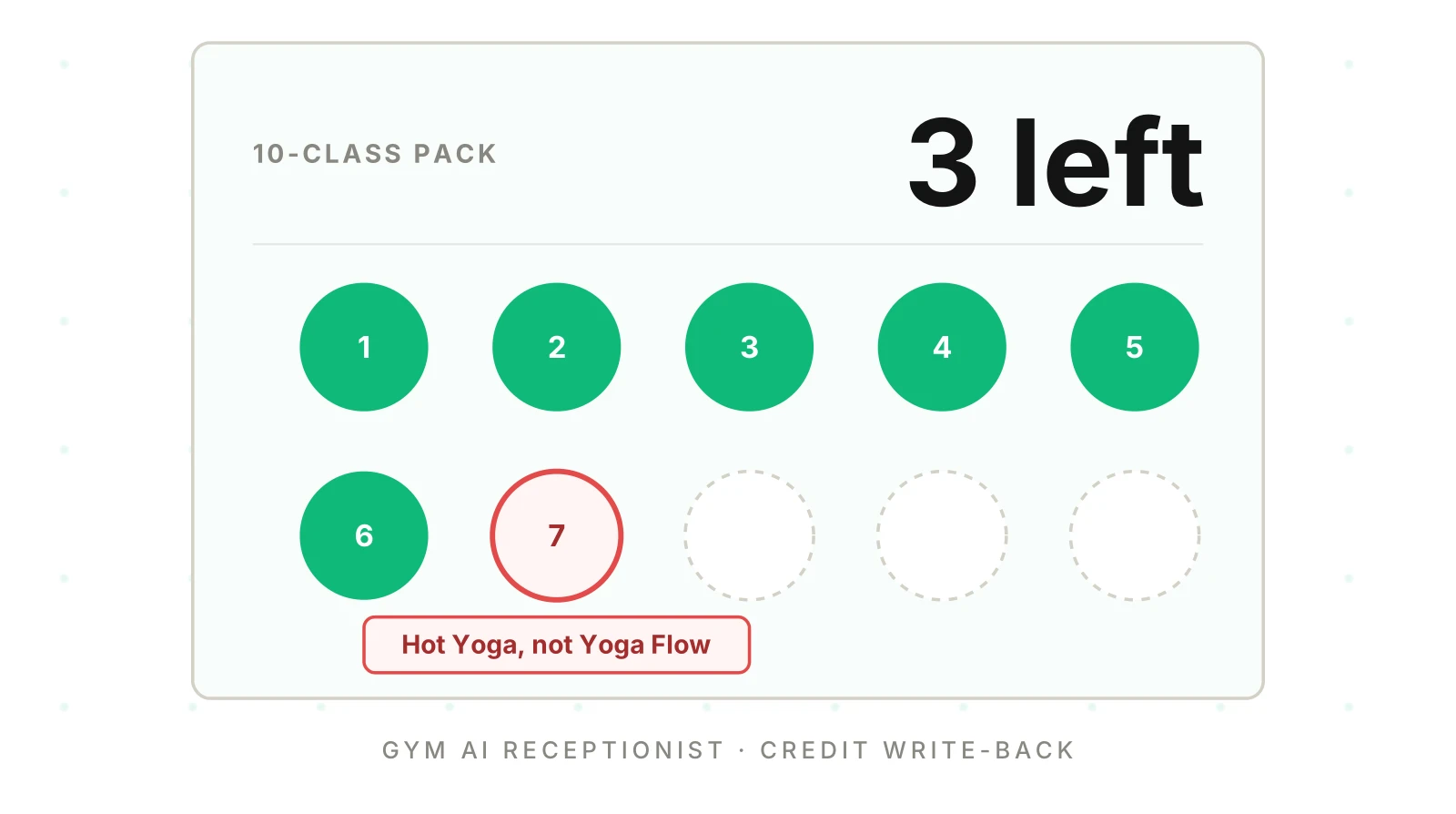
Similar class names. "Power Yoga", "Hot Yoga" and "Yoga Flow" differ by one word. "Pilates" and "Power Pilates" differ by one syllable. Speech-to-text often drops the modifier. The agent then books the base class. Treat the modifier as a high-risk entity. Our post on entity accuracy in speech-to-text explains why short modifiers fail first.
Instructor confusion. Names like "Sara", "Sarah" and "Zara" sound close on a phone line. Callers also say "the new girl" or "the guy with the beard." The agent must never guess an instructor name. If the instructor is part of the request and two matches exist, it should read both back.
Relative times. "This Saturday" on a Friday night is ambiguous. So is "tomorrow's class" after midnight. "Seven" could mean 7 a.m. or 7 p.m. in a studio with both slots. Always speak the full date and time back before writing.
Multi-location mix-ups. A chain with three studios often reuses class names. "Hot Yoga at 6" exists at all of them. If the caller does not name the location, the agent must ask. It should not default to the last one it served.
Wrong member on the account. Families share a phone number. A parent calls to book for a teen. The agent books it on the parent's credit. Some families want that. Others do not. Confirm who the class is for.
Each of these produces a valid booking row. The system says success. The only error is that the row is not what the caller meant. That is why a tool-call check on arguments matters more than a check on whether the tool ran.
Capacity and waitlist logic
Capacity is where a gym differs most from a salon. Gym waitlist automation adds a second hidden write: the promotion. The gym AI receptionist reads availability, speaks it, and the caller decides. But another member can book in between. That window is a race.
The last-spot race
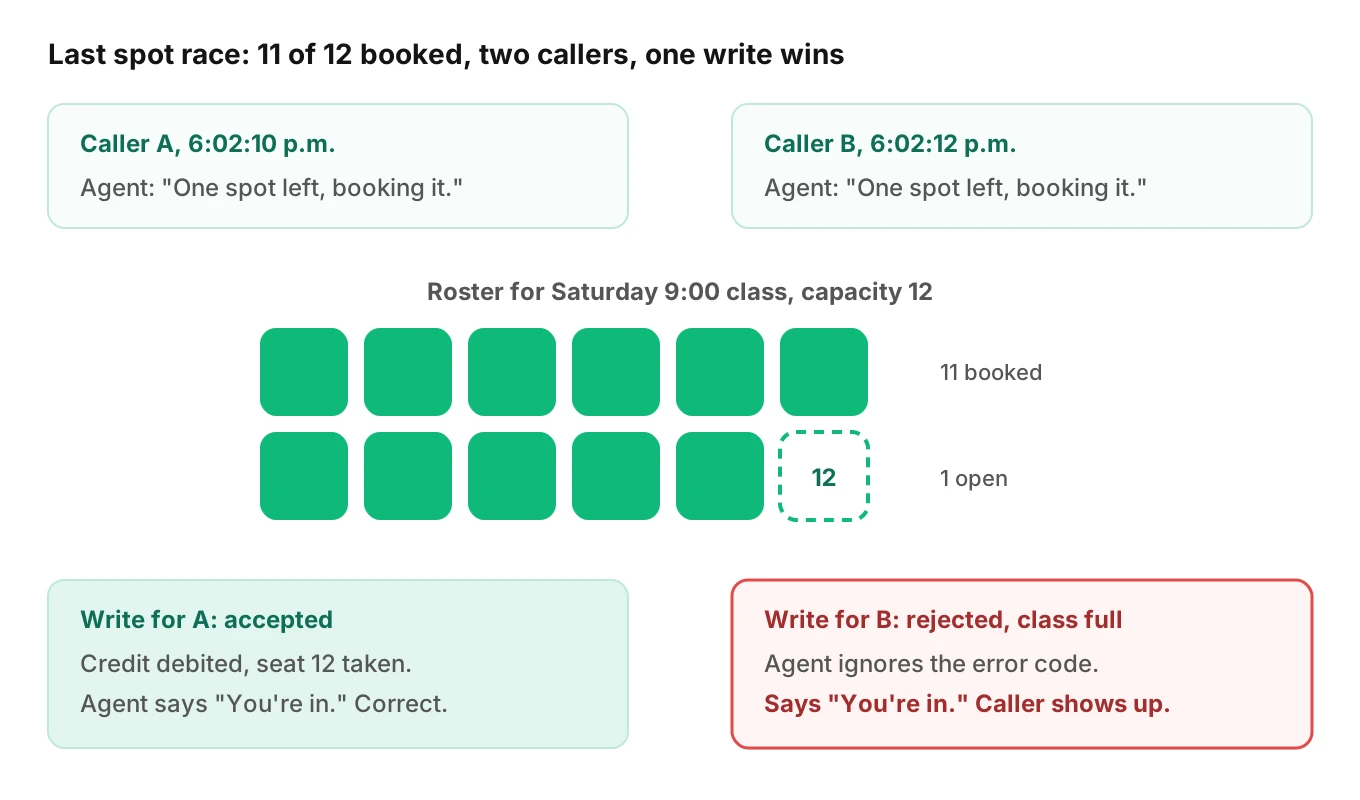
Here is a worked example. A class holds 12. Eleven are booked. Caller A and caller B ask at nearly the same time. The agent checks, sees one spot, and says "yes, I can book that." Both calls reach the write step. The system accepts one and rejects the other. If the agent ignores the error, it still tells caller B they are in.
The fix is plain. Read capacity at the moment of the write, not at the start of the call. Treat a rejected write as a stop. Say so out loud and offer the waitlist.
What "you're number three" really means
Agents often say "you're third on the waitlist, you'll probably get in." That sentence is a promise the agent cannot back. Here is the math, using an assumption you should replace with your own data.
Assume 12 booked members and a 10% chance each one cancels before the cutoff. This is an illustrative rate. The chance of at least k cancellations follows a binomial model.
| Waitlist position | Cancellations needed | Chance of a spot |
|---|---|---|
| 1 | 1 or more | about 72% |
| 2 | 2 or more | about 34% |
| 3 | 3 or more | about 11% |
So position three is a one in nine shot, not "probably." The agent should state the position and the rule, nothing more. Say "you are third. If two people cancel, you get a spot, and we text you." Never say "likely."
Auto-promotion and the credit
Many studios promote waitlisted members automatically and charge a credit at that moment. That means a waitlist call can end in a spend. Test three things:
1. The agent tells the caller whether promotion is automatic.
2. The agent states the cutoff after which promotion stops.
3. A caller who says "put me on the waitlist, but only if I can still cancel free" gets a correct answer or a handoff.
Our restaurant reservation post separates waitlist from booking in a dining room. The gym version has the same trap with money attached. A caller who hears "waitlist" and a caller who hears "booked" have different plans for the evening.
Drop-in, member pricing and intro offers
Prices on a gym line change by who is asking. A member pays with a credit. A drop-in pays a rate. A first-timer may get a free class. The agent has to know which one the caller is before quoting.
Identify before pricing. Look up the caller by phone number first. If no member matches, treat them as a prospect. A caller who says "I'm a member" but is not found should not receive member pricing.
Trial eligibility. Intro offers are usually one per person. The check is on phone, email or name. Callers retry with a different email. The agent should read the rule, apply the check in code, and hand off if the match is unclear. It should not decide eligibility by judgment.
Free trial that converts. If a trial turns into a paid recurring plan, the call becomes a sale with renewal terms. That moves from FAQ to legal ground, covered below. An agent that says "it is free, no strings" and then enrolls a card has a problem.
Pack and credit rules. A class credit expires. Packs differ by class type. A credit for "mat" may not cover "reformer". The agent should quote the rule from your policy data, not paraphrase from the prompt.
Membership questions: answer or route
Callers ask about freezes, holds and billing dates all the time. Gym phone answering AI that only reads hours is easy to test. A membership freeze is not. Some questions are safe to answer from a read-only source. Others change money or rights. The agent should know the line, and your tests should prove it.
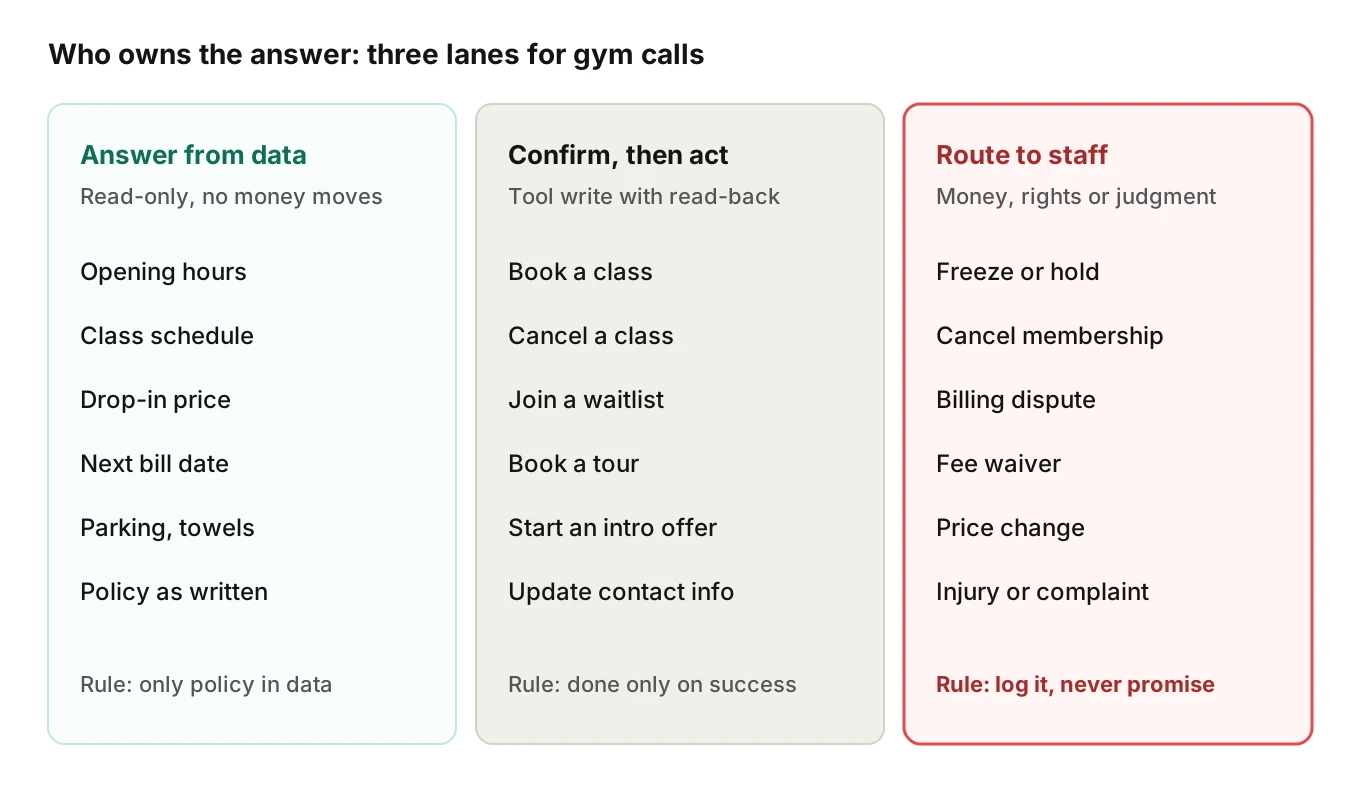
| Question | Agent may | Agent must |
|---|---|---|
| "What are your hours?" | Answer from data | Use the holiday calendar |
| "When does my next bill hit?" | Read the billing date from the record | Say it is read-only; no amount promises |
| "How much is a drop-in?" | Quote current price | Date-stamp promos |
| "Can I freeze my membership?" | Explain the policy as written | Route the request to staff unless a freeze tool exists |
| "Cancel my membership." | Take the request, confirm identity | Route to staff or the defined cancel flow |
| "I was charged twice." | Take details | Route; never promise a refund |
Two rules keep this table honest. First, the agent never states a policy that is not in your data. Second, it never says a request is done unless the write returned success. If a freeze tool exists, test that the bill date actually moves. Our write-up on silent tool failures shows how a tool can return OK while the record stays the same.
Cancellations, auto-renewal and what the law says
Cancellation by phone is regulated. The rules vary by state, so keep the agent out of legal claims. Here is the status as of October 22, 2026. This is not legal advice.
- FTC rule. The FTC's 2024 "click-to-cancel" amendments to the Negative Option Rule were vacated by the Eighth Circuit on July 8, 2025, in Custom Communications v. FTC. The court cited a missed regulatory analysis, not the merits.
- New rulemaking. On March 11, 2026, the FTC asked for public comment on whether to revive parts of that rule. It is an advance notice, the first step.
- ROSCA still applies. The Restore Online Shoppers' Confidence Act, 15 U.S.C. 8403, requires disclosure of material terms, express informed consent and a simple way to stop recurring charges for online sales. A law firm summary notes that the FTC still uses it.
- States add more. California's amended automatic renewal law took effect July 1, 2025. Cooley's summary says voicemail cancellations must be processed or returned within one business day, and that phone-enrolled services need a phone-friendly cancel path.
- Health club laws. New Jersey, for example, gives a three operating day cancel window and requires online cancellation for gyms that sell online. Other states have their own health club statutes.
What this means for the agent is simple. It should not interpret these rules. It should capture the cancel request, log time and channel, and route to the defined flow. A cancel request that sits in a voicemail queue is the risk. Test that a spoken "I want to cancel" always creates a tracked item.
Late cancels and no-shows
Every late cancel is a rule plus a clock. Late-cancel rules are the second-biggest source of disputes after billing. The agent has two jobs: state the rule correctly and apply the clock correctly.
The clock is the hard part. A class at 6:00 a.m. with a 12-hour cutoff closes at 6:00 p.m. the night before. A caller at 6:05 p.m. is late. The agent must compare against the class start in the studio's time zone, not the caller's. Test calls around the cutoff by one minute each way.
Also test the "ask for mercy" path. Callers say "I'm stuck in traffic, can you waive it?" The agent has no authority to waive. It should say so and route. An agent that says "no problem, I'll waive it" has made a promise your staff did not approve.
Finally, no-show and late-cancel often cost different amounts. A credit may be lost, or a fee may post. The spoken answer must match the posted result. Compare both in your audit.
A booking guard you can copy
Put the checks in code, not in the prompt. A gym AI receptionist should never rely on good manners alone. A prompt asks the model to be careful. A guard makes carelessness impossible. This is simplified pseudocode in Python. Adapt the names to your system.
def book_class(member_id, class_id, spoken_summary):
    cls = schedule.get(class_id)              # exact id, never a fuzzy name
    member = members.get(member_id)
    if cls is None or cls.status != "scheduled":
        return refuse("class_not_found")
    if cls.starts_at <= now(cls.tz):
        return refuse("class_started")
    if not member.can_use_credit(cls.class_type):
        return refuse("credit_type_mismatch")   # mat credit vs reformer
    if cls.spots_left() == 0:
        return offer_waitlist(member_id, class_id)
    result = roster.add(member_id, class_id, idempotency_key=call_id + class_id)
    if not result.ok:                           # read capacity at write time
        return refuse(result.reason)
    log_event(call_id, "booked", class_id, spoken_summary, result.credit_after)
    return confirm(cls, result.credit_after)
Three details matter. The tool takes a `class_id`, not text, so the model must resolve the name first and the code can verify it. The idempotency key stops a retry from spending two credits. And the log stores what the agent said next to what the system wrote, so an auditor can compare them.
Five invariants for a gym AI receptionist
Here is a named framework you can reuse for any gym AI receptionist. Call it the credit-safe booking check. Every call that touches a roster must satisfy all five.
1. Named match. The class, instructor and location read back equal the ids written.
2. Capacity truth. The spoken availability equals the capacity at write time.
3. Money match. The spoken price or credit use equals the debit posted.
4. Policy source. Every rule spoken exists in your policy data.
5. Routed, not promised. Anything outside the agent's authority creates a ticket and says so.
A gym AI receptionist call that fails one invariant is a defect, even if the caller sounded happy. The caller is happy because they believe the wrong thing.
How to test a gym AI receptionist before every release
Use this order. It takes a small team from zero to a repeatable gate.
1. List the writes. Name every tool the agent can call: book, cancel, waitlist, freeze, lead, transfer. Each one is a test target.
2. Build a scenario set per write. For booking, include similar class names, two instructors with similar names, relative dates, multiple locations and a full class. Aim for 10 to 20 per write.
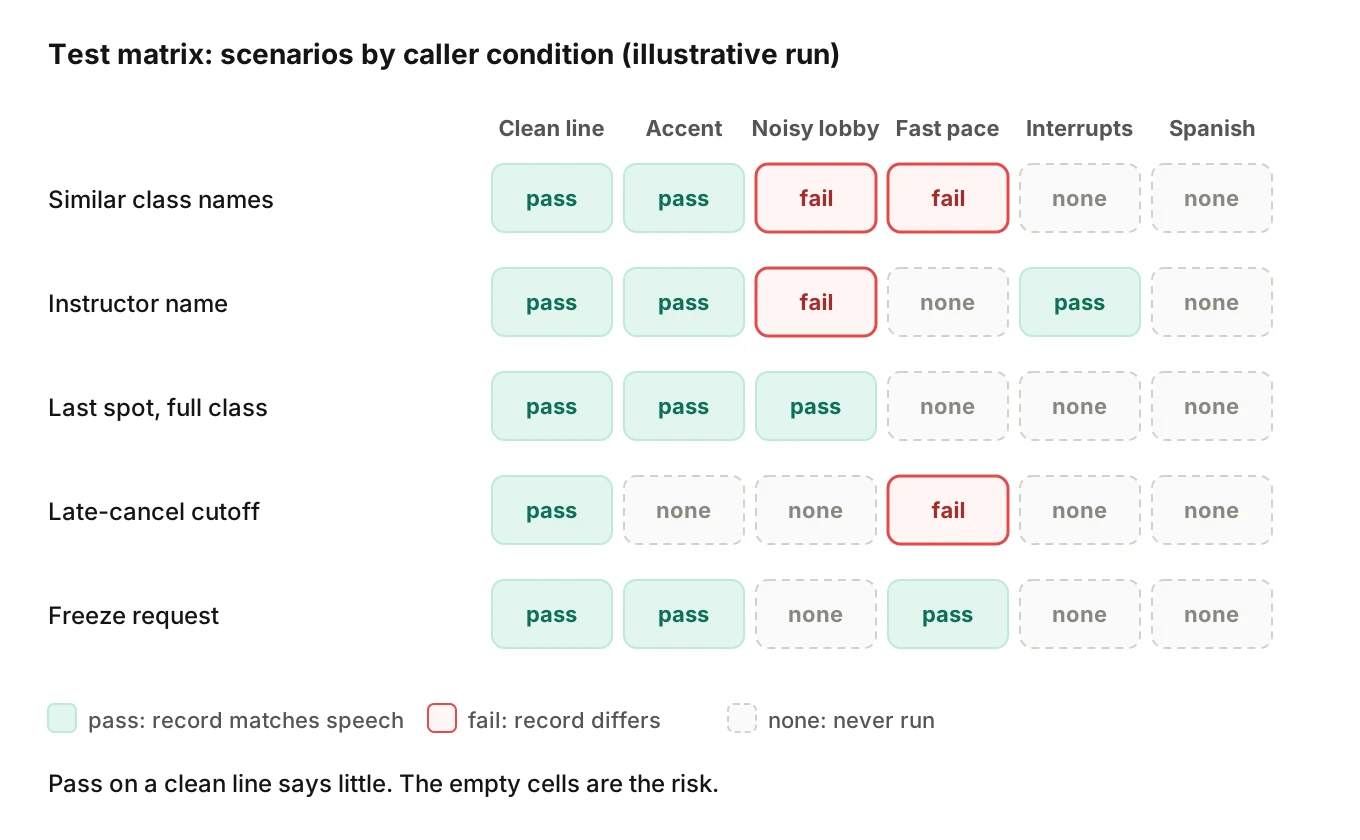
3. Add caller conditions. Build a caller profile for each: accent, pace, interruptions, background noise and language. A gym lobby has music, treadmills and children. Our guide on accent robustness covers how to build that grid.
4. Run on audio, not transcripts. Place calls over the phone path your members use. Read the transcript vs audio comparison for why a clean transcript can hide a misheard entity.
5. Compare to the record. After each call, read the roster, credit balance and billing record. Mark pass only if all five invariants hold.
6. Test the edges. Last spot races, calls one minute either side of a cutoff, a rejected write, a frozen account, a prior trial.
7. Gate the release. Set thresholds before the run. Zero tolerance for credit or billing writes that disagree with speech. A tolerance for low-risk misses, such as hours.
8. Re-run on every change. A prompt edit, a new class type or a new location can break an old case. Keep the set and grow it from real failures. Our go-live checklist lists what to check before launch.
If you run one agent for many studios, your test set must vary class names and policy per location. The multi-tenant testing guide explains why a pass at one tenant says little about the next.
Evalgent can generate test scenarios for a gym AI receptionist from its prompt and flows, including branches and policies. It then places calls with caller profiles you set, such as accent, pace, interruptions and noise. It judges the audio, with evidence for each verdict. That fits the similar-name and noisy-lobby cases above, where a transcript alone can look clean.
Metrics worth tracking
Booking rate alone hides errors. A gym AI receptionist needs more than a booking rate. Our post on appointment scheduling metrics lists the base set. For gyms, add these:
| Metric | Definition | Target to set |
|---|---|---|
| Booking match rate | Calls where spoken class equals written class | Near 100%, review every miss |
| Credit mismatch rate | Calls where debit differs from spoken cost | Zero |
| Waitlist honesty | Waitlist calls with no "likely" or "guaranteed" language | 100% |
| Route correctness | Freeze, cancel and dispute calls routed, not promised | 100% |
| Cutoff accuracy | Late-cancel decisions correct at plus or minus one minute | 100% |
Targets here are suggestions to tune, not benchmarks. Sample size matters for rare failures. If a miss happens in 1 call in 200, a 20-call test will usually not see it. That is why sampling hides defects. Production monitoring helps. Evalgent can take your call recordings, transcribe them, map them to scenarios and judge each one. It flags tool-call failures and policy failures with fix suggestions. Scoring every call catches the rare ones.
One more rule. If your agent texts or calls to offer a freed-up spot, check consent rules. The FCC adopted new consent revocation rules on September 30, 2026, and released them on October 1, 2026. Kelley Drye's summary says they take effect 30 days after Federal Register publication. Ask counsel how this affects waitlist offers.
Frequently asked questions
Can an AI receptionist book gym classes over the phone?
Yes, if it books against exact class ids and reads back the class, instructor, date, time and location before writing. The risk is not the booking tool. It is the name resolution before it. Test similar class names, instructors with close names and relative dates such as "this Saturday."
How does an AI handle a full gym class and a waitlist?
It should read capacity at the moment of the write, offer the waitlist if no spot remains, and state the position and the promotion rule. It should never say "you'll probably get in." Waitlist odds depend on cancellation rates, which a phone agent cannot know.
Can an AI receptionist freeze or cancel a gym membership?
Only if you give it a tested tool with identity checks, and only for the actions your policy allows. Many teams let the agent take the request and route it to staff. Either way, log the time and channel, because cancellation timing can matter legally.
What happens if the AI books the wrong class and charges a credit?
The member loses a credit and may miss the class. Prevent it with read-back before the write, ids instead of fuzzy names, and a log of speech next to the posted debit. Then audit by comparing both. Also give staff a clear reversal path.
How do I test a gym AI phone agent before launch?
List every write the agent can make, build scenarios for each, add caller conditions such as accent and noise, and place calls over your real phone path. After each call, compare the roster, credits and billing record to what the agent said. Gate release on zero money mismatches.
Can an AI receptionist tell a drop-in price from a member price?
Yes, if it identifies the caller first. Look up the phone number, treat unmatched callers as prospects, and quote prices from current data with promo dates. Test callers who claim to be members but are not found, and members calling from a new number.
How should a gym AI handle late cancels and no-shows?
State the written rule, compute the cutoff against the class start in the studio's time zone, and never waive fees without staff approval. Test calls one minute before and after the cutoff. Check that the spoken outcome matches the posted credit or fee.
Do cancellation laws change what a gym phone agent can do?
They can. The FTC's click-to-cancel rule was vacated in July 2025, but ROSCA and state laws such as California's renewal law and New Jersey's health club rules still apply. Keep the agent from giving legal advice, capture cancel requests reliably and ask counsel about your states. This is not legal advice.
The bottom line
A gym AI receptionist succeeds when every spoken promise matches a verified write to the roster, credit balance and billing record. Test class names, capacity, waitlists and routing on real audio, then compare each call to the system of record.
Related Articles
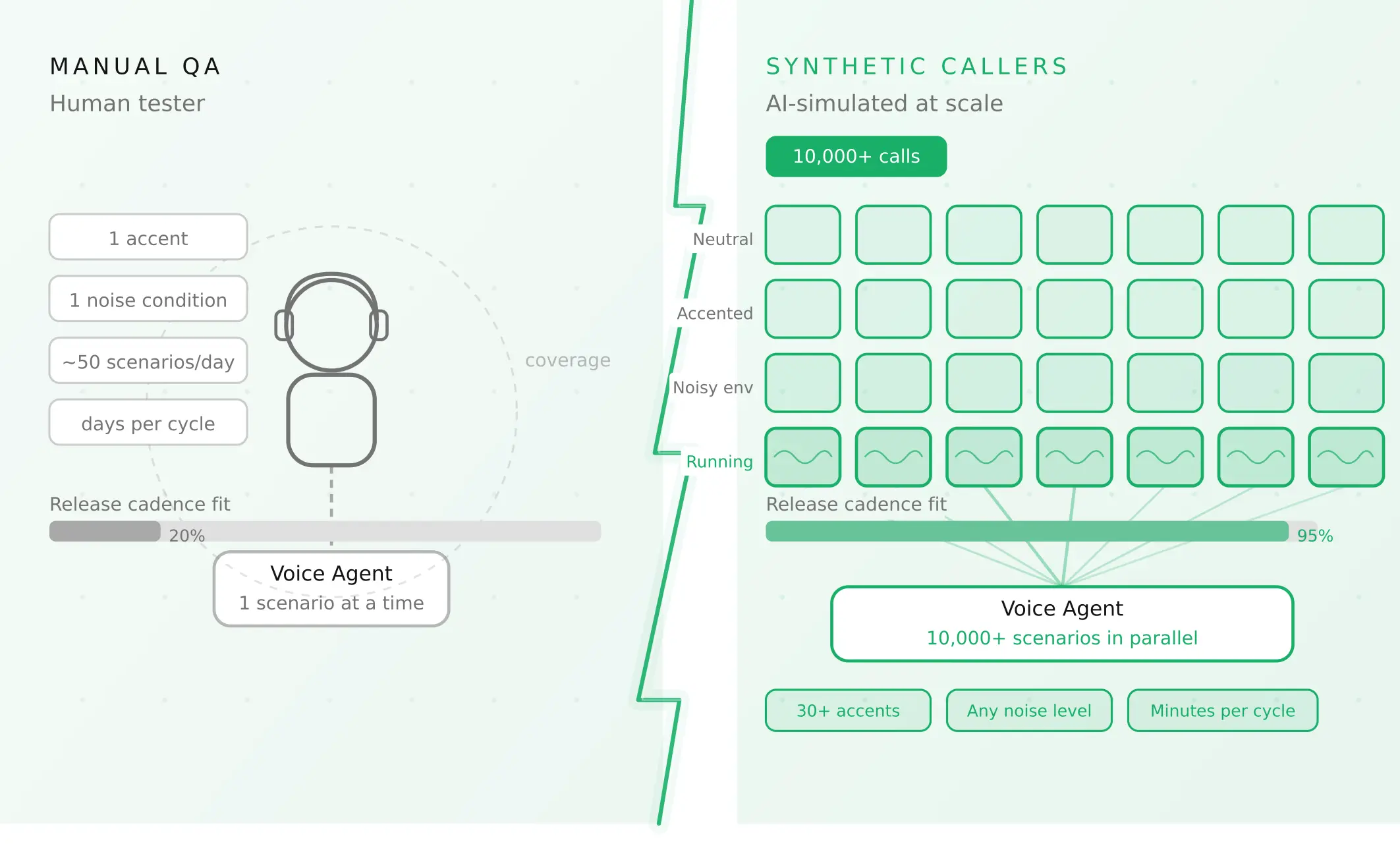
How to automate voice agent testing: synthetic callers vs manual QA
Learn how ai test automation replaces manual QA for voice agents. Compare synthetic callers vs human testers, with a 5-step framework to scale without hiring.
Read more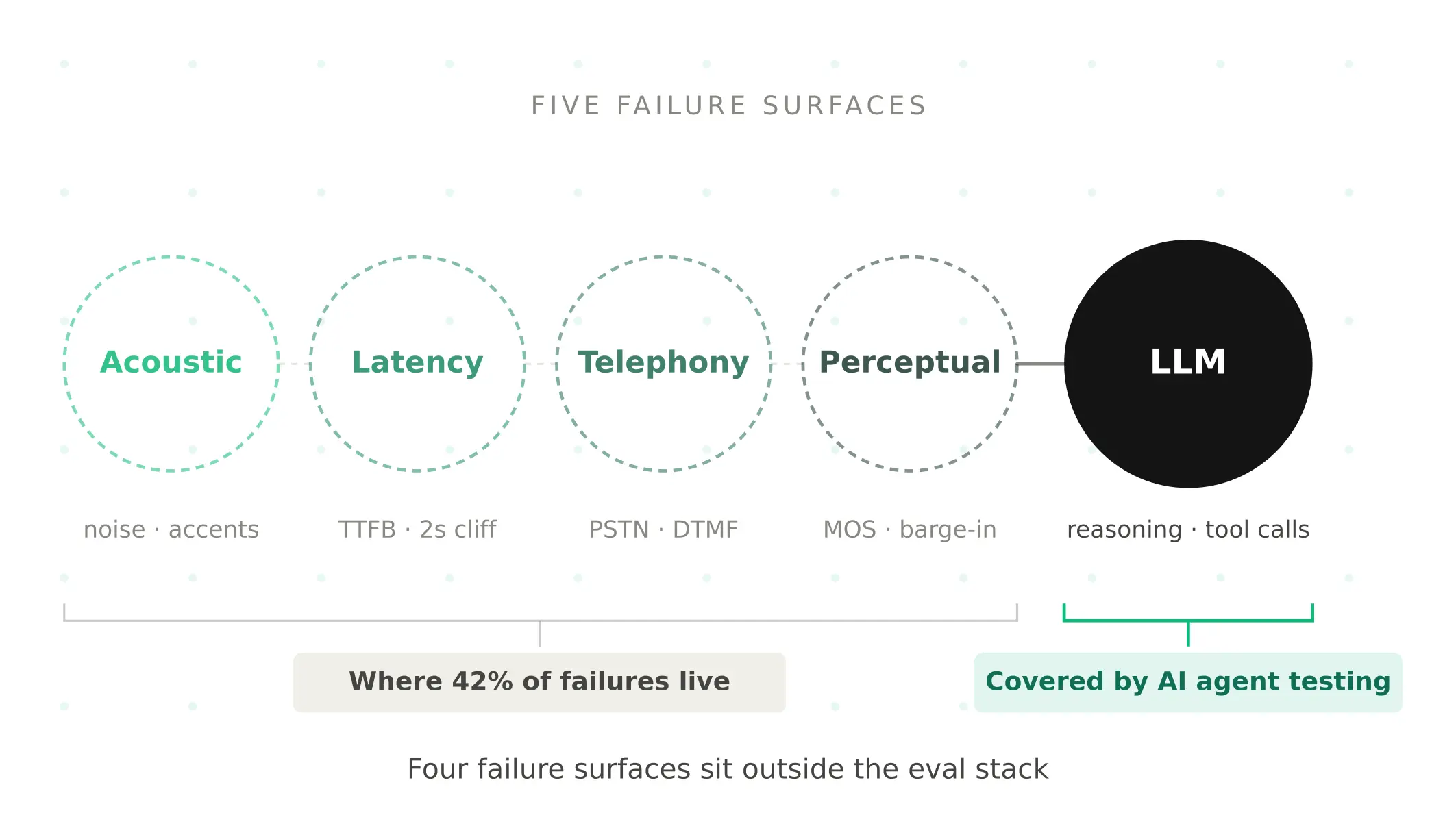
AI Agent Testing vs Voice Agent Testing: What General Tools Miss for Voice
AI agent testing measures text outputs. Voice agent testing measures behaviour through an acoustic pipeline. Five failure categories general tools miss.
Read more