Voice agent testing for appointment scheduling: booking, dates, and tools
On this page
Scheduling looks like the simplest voice agent task and hides some of the most error-prone. "Next Tuesday," "the same time as last time," and "sometime after lunch" all have to become an exact calendar entry, through a tool call, without double-booking anyone. A small parsing error becomes a missed appointment. Evalgent tests scheduling agents on exactly these details, and this guide explains how.
Appointment scheduling voice agent testing: verifying that a scheduling voice agent parses dates and times correctly, calls the calendar with the right values, avoids conflicts, and confirms the booking, reschedule, or cancellation the caller actually requested.
Why scheduling voice agents are error-prone
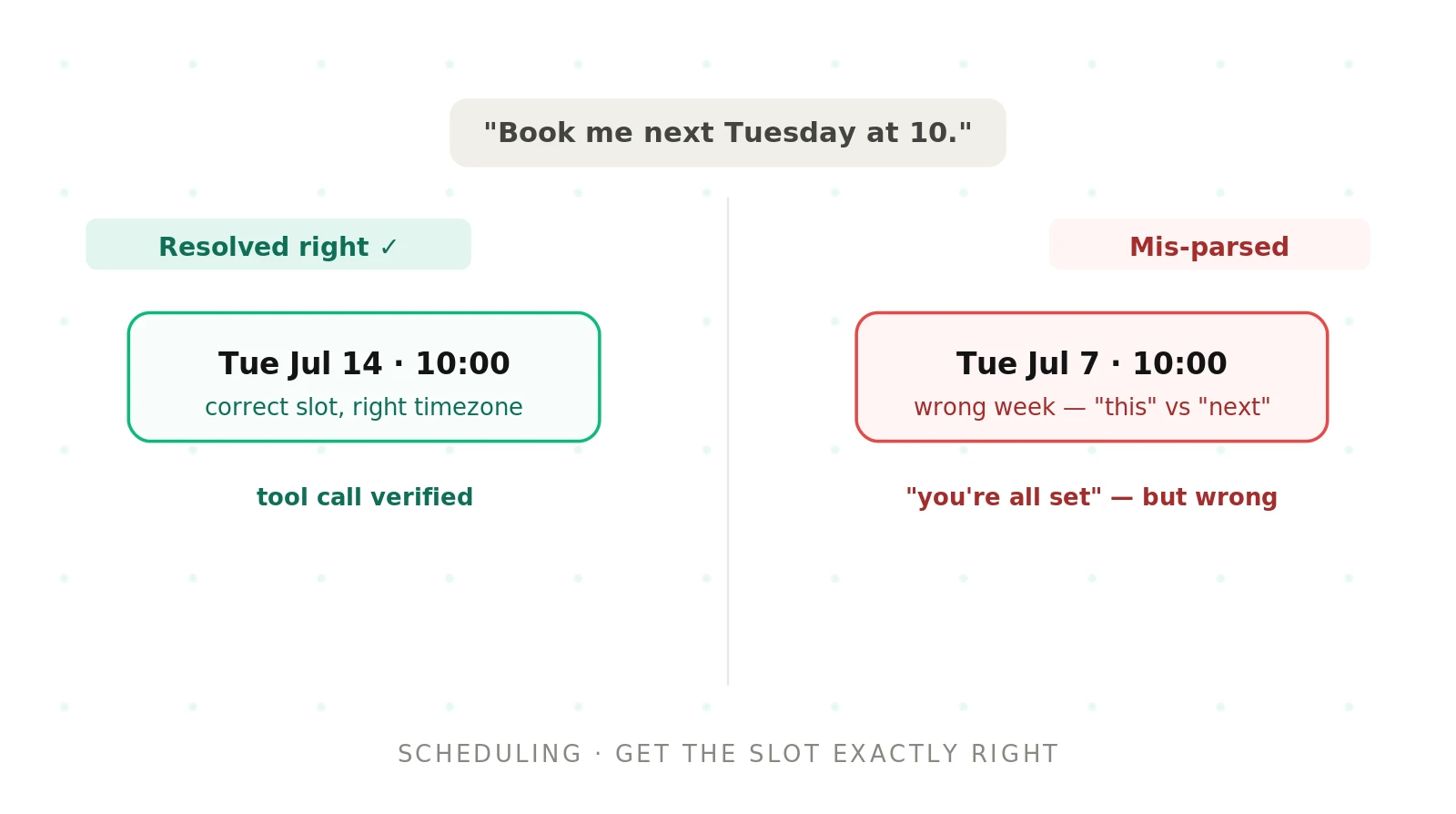
The difficulty in scheduling is turning natural, ambiguous language into a precise, structured action. People do not speak in ISO timestamps. They say "next Friday," "a week from now," or "the morning," and the agent has to resolve each into an exact slot, in the right timezone, and write it correctly.
That resolution is where errors hide. A misheard or mis-parsed date books the wrong day. A timezone mismatch books the right time in the wrong zone. A tool call with a stringified date the calendar rejects fails silently while the agent says "you're all set." None of these show up when a tester says "book me for 3pm tomorrow" in a quiet room. They show up on real calls, and testing has to reproduce them. Because so much rides on the tool call, our tool calling guide applies directly.
Date and time parsing: the core test
The heart of scheduling testing is verifying the agent resolves natural date and time expressions correctly. This is where most failures originate, so it deserves the most coverage.
Testing has to drive the full range of how callers express time: relative ("next Tuesday," "in two weeks"), partial ("the 15th," "the morning"), colloquial ("end of the month"), and ambiguous ("this weekend"). For each, the test asserts the resolved date and time match what the caller meant, normalized to a precise value — the kind of unambiguous format described by ISO 8601. Timezones are a category of their own: a caller in one zone booking with a provider in another is a classic source of off-by-hours errors, and testing has to assert the agent lands the right absolute time. Reading times back correctly matters too, which is where our pronunciation guide applies — "10:15" must be spoken as "ten fifteen," not "ten point one five."
Calendar tool accuracy and conflicts
Once the agent has the right date, it has to write it correctly. The calendar action runs through a tool call, and the test has to verify the call fired with the right values and actually took effect — not just that the agent claimed success.
This means asserting at the tool level: the booking created the correct slot, the reschedule moved the right existing appointment, the cancellation removed the right one. It also means testing conflicts. The agent must check availability and avoid double-booking, handle a requested slot that is taken by offering alternatives, and behave correctly when no availability exists. A booking agent that confidently books an occupied slot is worse than one that admits it is full.
Multi-turn and confirmation
Scheduling is a multi-turn negotiation. A caller proposes a time, the agent checks, offers alternatives, the caller picks one, and details accumulate along the way. The agent has to hold that context — the provider, the reason, the caller's constraints — without losing it mid-call. Our context retention guide covers this failure directly.
Confirmation is the safety net. Before finalizing, the agent should read back the exact date, time, and details, and testing asserts that read-back matches the action taken. A clear confirmation catches a mis-parse before it becomes a missed appointment.
The scheduling scenarios you must test
| Scenario | What it tests |
|---|---|
| Book with a relative date | Correct date parsing and slot |
| Reschedule an existing appointment | Right appointment moved, not duplicated |
| Cancel an appointment | Correct appointment removed |
| Requested slot is taken | Conflict handled, alternatives offered |
| Cross-timezone booking | Correct absolute time |
| Ambiguous date or time | Clarification, not a wrong guess |
| Confirmation read-back | Details match the action taken |
Metrics that matter in scheduling
Scheduling metrics are about correctness of the action. A pleasant call that booked the wrong day is a failure.
Track booking accuracy: did the calendar action match the caller's intent, down to the date, time, and provider. Track date-and-time resolution accuracy as its own metric, since it is the root of most errors. Track tool-call correctness: did the calendar write actually succeed with the right values. Track conflict handling: no double-bookings, graceful handling of full slots. And track confirmation accuracy, since a correct read-back is the last line of defense. These are correctness gates — a scheduling agent that is right most of the time still strands the callers it gets wrong.
Common failure modes in scheduling agents
| Failure | Why it hurts | Test for it |
|---|---|---|
| Mis-parsed date or time | Missed appointment | Assert resolved date matches intent |
| Timezone error | Right time, wrong zone | Assert correct absolute time |
| Silent tool-call failure | Agent says booked, nothing saved | Assert the calendar write took effect |
| Double-booking | Two callers, one slot | Assert availability check and conflict handling |
| No confirmation | Mis-parse reaches production | Assert read-back matches the action |
Reminders, no-shows, and the booking lifecycle
Booking is only the first half of scheduling. The lifecycle continues with reminders, confirmations, and the handling of no-shows and last-minute changes, and an agent that owns any of these has to be tested on them too.
Reminder and confirmation calls are outbound or follow-up interactions where the agent states an existing appointment and lets the caller confirm, reschedule, or cancel. Testing asserts the agent references the correct existing appointment and executes the resulting change accurately — the same date-and-tool precision that booking requires, applied to an entry that already exists. A reminder that points at the wrong appointment is worse than no reminder at all.
No-show and change handling is where lifecycle errors surface. A caller rescheduling a missed appointment, or canceling within a cutoff window, needs the agent to find the right appointment and apply the right policy. Testing these paths ensures the agent does not create duplicates, cancel the wrong entry, or lose track of which appointment is being discussed.
Waitlists add one more wrinkle. When a slot frees up, an agent that manages a waitlist has to offer it correctly and update two records — the cancellation and the new booking — without creating a conflict. Testing the full lifecycle, not just the initial booking, is what proves the agent manages a calendar over time rather than handling one clean request in isolation. It also means testing the unhappy sequences: a caller who cancels and immediately rebooks, a double reminder, or a change that arrives after a reminder already went out. These sequence-dependent cases are where calendar state quietly corrupts, and only end-to-end lifecycle testing, run across the whole journey, reliably surfaces them before a real caller hits one.
Testing appointment scheduling voice agents with Evalgent
Evalgent tests scheduling agents on the details that break them, on realistic calls. Scenarios cover relative and ambiguous dates, reschedules, cancellations, cross-timezone bookings, and taken slots, so the error-prone moments are exercised, not assumed. Profiles vary how callers express dates and times, plus accent and noise, since a misheard "fifteenth" becomes a wrong booking. Metrics assert booking accuracy, date-and-time resolution, tool-call correctness, and confirmation match, with thresholds you set. Evaluations run the suite as automated batches before every release. Reviews let you replay a mis-booked call and see the exact tool payload the agent sent.
The result is a scheduling agent that books what the caller actually asked for: right date, right zone, right slot, confirmed. For the wider method, see the AI voice agent testing pillar, and for model choice see best LLM for voice agents.
Conclusion
Appointment scheduling voice agent testing is precision testing. The whole task is turning ambiguous, natural language into an exact calendar action, and the failures live in dates, timezones, and silent tool calls.
Test date parsing, calendar tool accuracy, conflict handling, and confirmation on realistic calls, asserting at the level of the actual booking. A scheduling agent that sounds smooth but books the wrong day has failed the only test that matters.
Frequently asked questions
How do you test an appointment scheduling voice agent?
Build scenarios for booking, rescheduling, and canceling with relative, partial, and ambiguous dates, plus cross-timezone cases and taken slots. Assert the resolved date and time match the caller's intent, the calendar tool call fired with the right values and took effect, conflicts are handled without double-booking, and the confirmation read-back matches the action. Gate releases on booking accuracy.
How do you test date and time handling in a voice agent?
Drive the full range of expressions — "next Tuesday," "the 15th," "end of the month," "this weekend" — and assert each resolves to the exact intended date and time, normalized to a precise value. Include timezone cases, since booking the right time in the wrong zone is a classic error. Date and time parsing is the root of most scheduling failures, so cover it heavily.
How do you test a booking voice agent?
Assert at the level of the actual calendar action, not the transcript. Verify the booking created the correct slot, that a reschedule moved the right existing appointment, and that a cancellation removed the right one. Confirm the tool call took effect rather than trusting the agent's claim of success, and test conflicts so the agent never confidently books an occupied slot.
How do you test timezone handling in a voice agent?
Run scenarios where the caller and the provider, or the caller and the system, are in different timezones, and assert the agent books the correct absolute time. Timezone errors book the right clock time in the wrong zone, producing missed appointments that look correct in the transcript. Verify the final calendar entry matches the intended real-world moment, not just the spoken time.
How do you test calendar integration for a voice agent?
Test the calendar tool call directly: assert it fires with the correct date, time, and identifiers, that the write actually succeeds, and that failures surface rather than being reported as success. Include availability checks and conflict handling. A silent tool-call failure — where the agent says "you're booked" but nothing saved — is a common scheduling bug that only argument-level assertions catch.
What metrics matter for scheduling voice agents?
The key metrics are booking accuracy against the caller's intent, date-and-time resolution accuracy, tool-call correctness, conflict handling with no double-bookings, and confirmation accuracy. These are correctness gates rather than gradual targets, because a scheduling agent that is right most of the time still strands the callers whose appointments it gets wrong. Track them per scenario type to see where errors cluster.
How do you test rescheduling in a voice agent?
Run scenarios where a caller moves an existing appointment, including ambiguous references like "move it to next week." Assert the agent identifies the correct existing appointment, moves it to the right new slot, does not create a duplicate, and confirms the change. Rescheduling is error-prone because it involves both finding the right existing entry and writing a correct new one.
How do you stop a voice agent double-booking?
Ensure the agent checks availability before booking and handles a taken slot by offering alternatives rather than writing over it. Test this directly with scenarios where the requested slot is occupied, and assert the agent does not create a conflict. Double-booking usually comes from skipping the availability check or ignoring its result, so verify both the check and the agent's response to it.
Related Articles
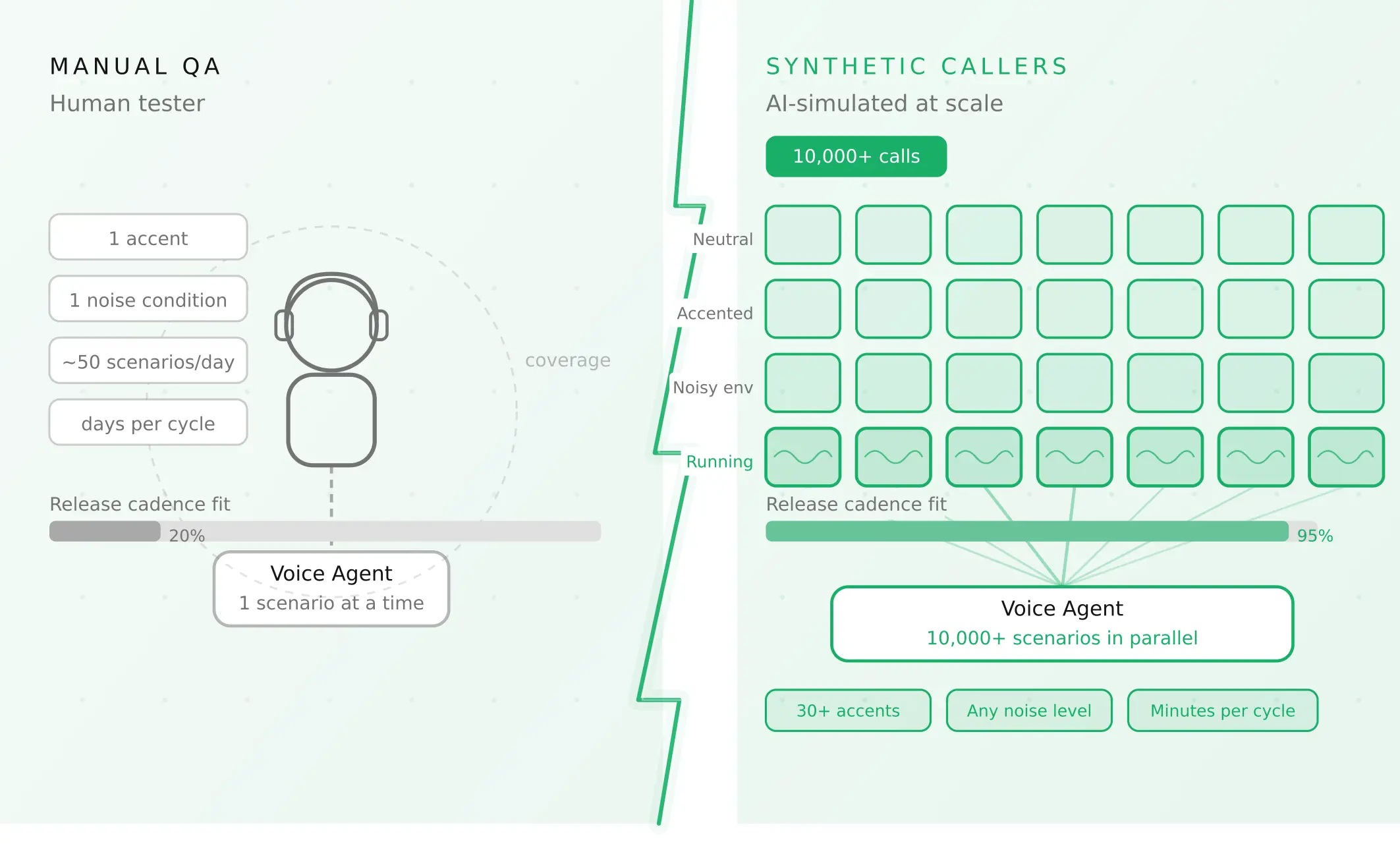
How to automate voice agent testing: synthetic callers vs manual QA
Learn how ai test automation replaces manual QA for voice agents. Compare synthetic callers vs human testers, with a 5-step framework to scale without hiring.
Read more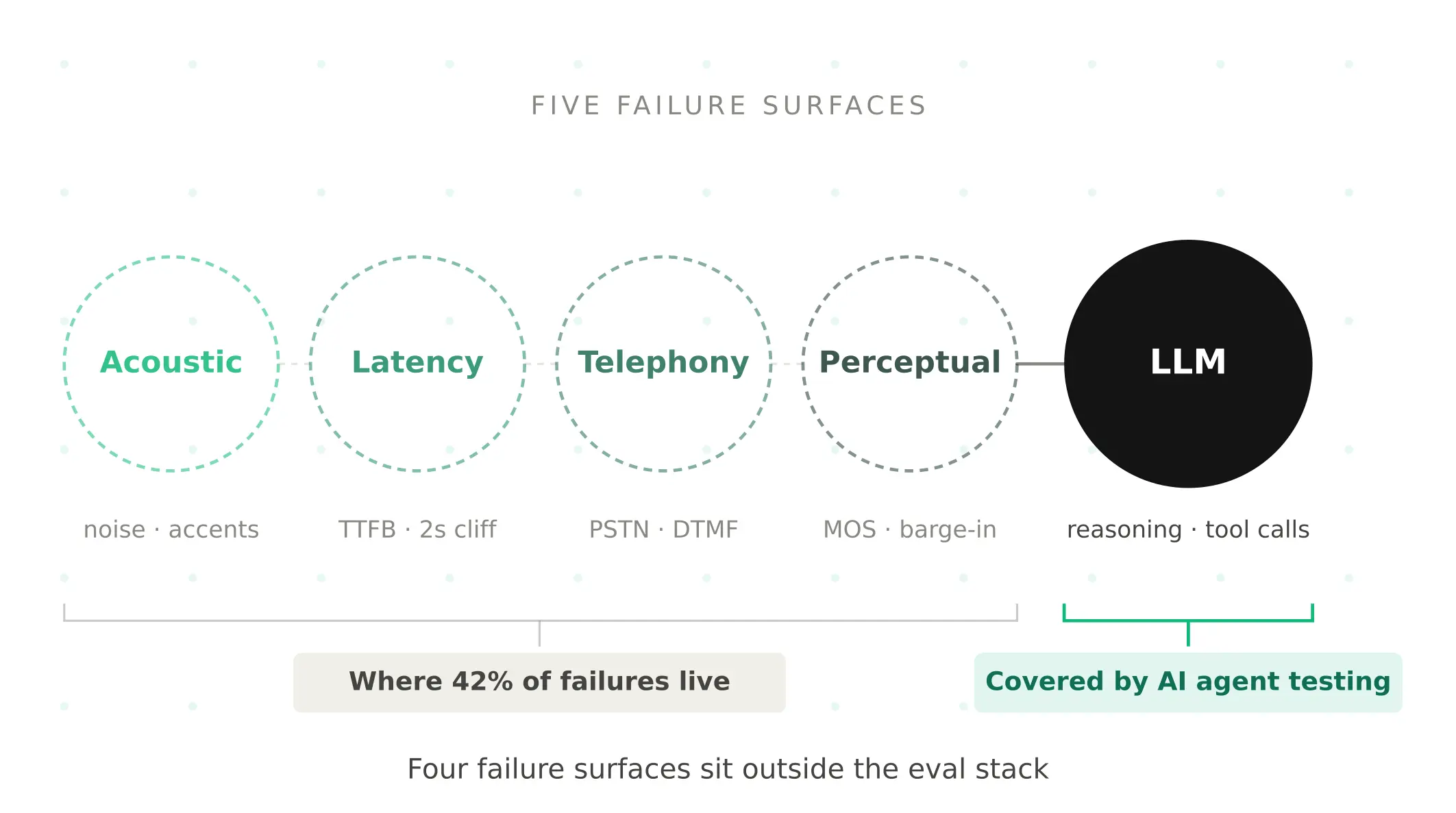
AI Agent Testing vs Voice Agent Testing: What General Tools Miss for Voice
AI agent testing measures text outputs. Voice agent testing measures behaviour through an acoustic pipeline. Five failure categories general tools miss.
Read more