AI Admissions Phone Calls: Deadlines and Aid Errors
On this page
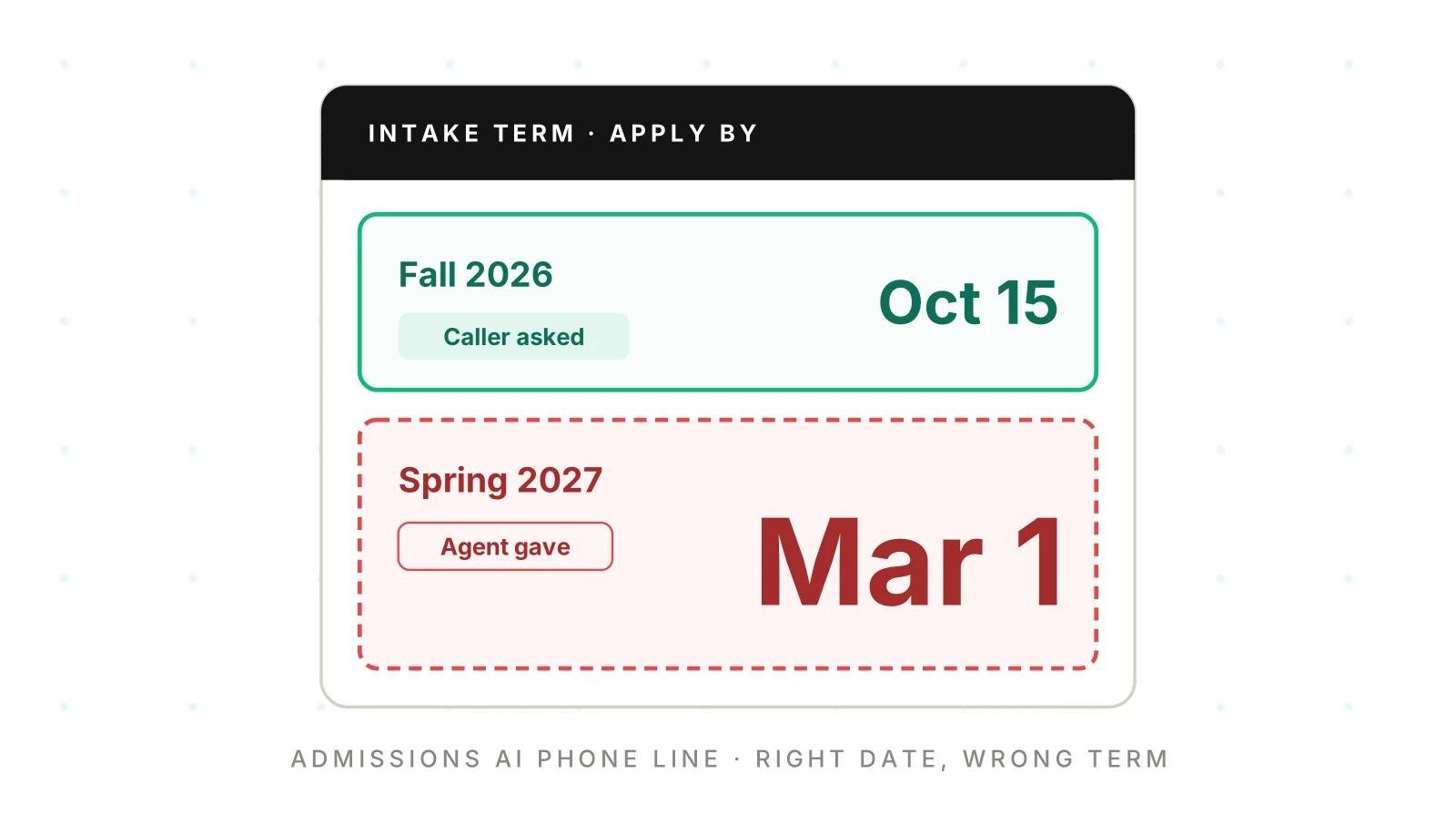
Picture a prospective student calling an admissions line at 8 p.m. (a hypothetical case). She asks, "What's the deadline for the nursing program?" The agent answers with a date. It is the right date for the fall intake. She meant spring. Nobody notices until she misses the window.
This is the core risk in AI admissions phone calls. The answer sounds confident, the call ends politely, and the CRM shows a clean "inquiry answered" record. The error lives in the gap between what the caller meant and what the system stored. Most such calls look fine in a transcript for exactly this reason.
This post is for the Head of AI, product lead or engineer who built an admissions voice agent. It may live inside an enrollment platform, a CRM or a school's own stack. You own the agent. Prompt changes ship to live callers. Here is what goes wrong in AI admissions phone calls, what the rules say, and how to test them. It is not legal advice; ask counsel how the rules apply to your institution.
Why AI admissions phone calls are not normal support calls
An admissions line is the institution speaking to a person about to make a large financial decision. Federal rules treat what it says in that moment as a regulated statement.
For schools that take federal student aid, 34 CFR 668.71 defines misrepresentation. It is any false, erroneous or misleading statement made directly or indirectly to a student, a prospective student or any member of the public. The rule reaches the institution's representatives and its recruiting or admissions-services partners. It also counts omissions that make a statement misleading. It covers the educational program, the financial charges and graduate employability.
An ai admissions agent that answers for the admissions office is plainly speaking for the institution. Whether a given error counts as "substantial misrepresentation" depends on whether the caller could reasonably rely on it to their detriment. That is a legal call. The engineering takeaway is simpler: treat every spoken fact as a published fact.
Three more rules shape the design of any ai admissions phone line.
- Financial aid and cost statements. 34 CFR 668.73 lists examples of misleading statements. Examples: the availability, amount or nature of financial assistance, the program's cost, the refund policy, and the timing of tuition payment.
- Program and credit claims. 34 CFR 668.72 covers accreditation and credit transferability, including whether prior credits will be accepted.
- Job outcome claims. 34 CFR 668.74 covers job placement assistance, job-market statistics and licensure pass rates. For private vocational and distance schools, the FTC's Guides at 16 CFR 254.4 call misrepresenting employment, graduate success or salary deceptive.
These sections apply to institutions that participate in federal aid programs or fall within the FTC guides' scope. Check which apply to you. The design rule below holds either way.
The five error classes in AI admissions phone calls
Most failures fall into five classes. Each has a spoken symptom and a quieter record symptom.
| Error class | What the caller hears | What the system stores |
|---|---|---|
| Wrong deadline | A real date for the wrong term, program or applicant type | "Deadline communicated" with no term attached |
| Aid statement | "You'll probably qualify for aid" | Nothing, or a free-text note |
| Cost framing | Tuition per credit quoted as the total cost | Cost estimate field filled with the wrong base |
| Unverified claim | "Our grads all get jobs" or "your credits will transfer" | No flag that a claim was made |
| Wrong cohort | Domestic rules given to an international caller | Applicant type defaulted to "first-year, domestic" |
The table is the test plan in miniature. Every row needs a spoken check and a record check.
Deadlines: the wrong term is the common failure
An application deadline is not one fact. It depends on program, intake term, applicant type and sometimes campus or online mode. A school with six programs, three intake terms and three applicant types has 54 deadline cells. That is a worked example, not a statistic.
The agent usually fails by collapsing that grid. The caller says "the deadline" and the agent picks the nearest cell. A good agent asks one clarifying question per missing key, then reads the date from the record. It also says the term out loud: "For the fall 2027 intake, the priority deadline is...".
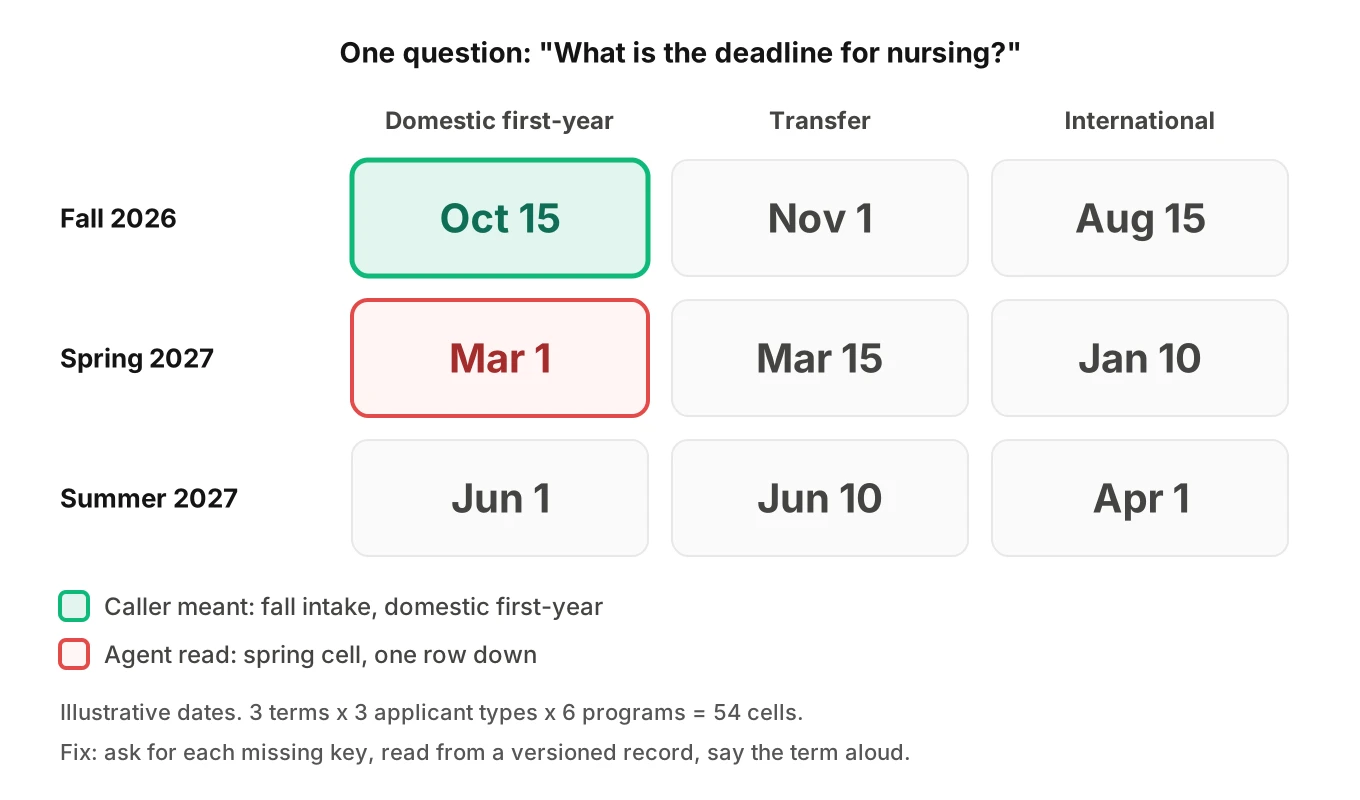
Two gotchas make this worse by voice. First, callers say "fall" and mean the next fall, which may be the one after the next one. Second, "priority" and "final" deadlines both get called "the deadline". Store both in the record and make the agent say which one it is reading.
Financial aid: the agent states process, not eligibility
The hardest rule for a financial aid phone agent is also the simplest. It must not state whether a caller qualifies for aid, and it must not state any award amount.
That is a conservative reading of 668.73, which lists "the availability, amount, or nature of financial assistance" among statements that can mislead. Eligibility and awards are decided by the aid office after an application, not by a phone agent. A friendly "you should get something" is exactly the sentence that causes harm.
What the agent can do is state process facts that come from official sources. For example, USA.gov's FAFSA page says the federal deadline for the 2026-27 school year is June 30, 2027. It also points readers to separate state deadlines, and colleges use FAFSA data for their own aid, so check each school's date. So a safe answer is: "The federal deadline is June 30, 2027. Our aid office may set an earlier date. I can transfer you or book a call with them." Date-stamp those values in the record. The agent stays accurate only if the record does. Values change every award year.
Use a simple allowed and blocked list.
| The agent may say | The agent must hand off |
|---|---|
| The published federal FAFSA deadline for the stated award year | Whether this caller will qualify for any aid |
| The school's published aid deadline, read from the record | Any award, grant, loan or scholarship amount |
| What documents an aid office usually asks for, from the school's page | "Is my income too high" or "will I get a full ride" |
| How to book a call with the aid office | Anything about a specific student's aid file |
Cost, accreditation, placement and transfer credits
Tuition collapses like deadlines do. "Tuition" might be per credit, per term or per year. A caller who hears "$400" and stores it as the total makes a decision on a wrong base. The agent should say the unit every time, and the record should hold the unit next to the number.
Claims need a stricter gate. State accreditation, placement rates, licensure pass rates or transfer acceptance only when a verified record field backs it. Otherwise it says it cannot confirm and offers a hand-off. Credit transfer is special. The receiving school decides, so the safe answer describes the process, never a result.
International and domestic callers
Rules differ for international applicants. Deadlines, documents and aid options may change, and some rules come from outside the school. Capture residency status early and route international callers to the right office. Never reuse a domestic answer by default. The failure to test is the silent default. A caller says she is applying from abroad, and the record still says "domestic".
Why speech errors corrupt the record silently
In AI admissions phone calls, the call is the front door to a workflow: capture, system action, confirmation, write-back. Each step can be right while the whole is wrong.
Speech recognition is the first weak link. A 2020 PNAS study tested five commercial systems on 217 interviews. The average word error rate was 0.35 for Black speakers and 0.19 for white speakers. Your callers include parents, teenagers, adult learners and international applicants on bad phone lines. Expect uneven accuracy across them. Our guides on word error rate and accent robustness cover how to measure that spread.
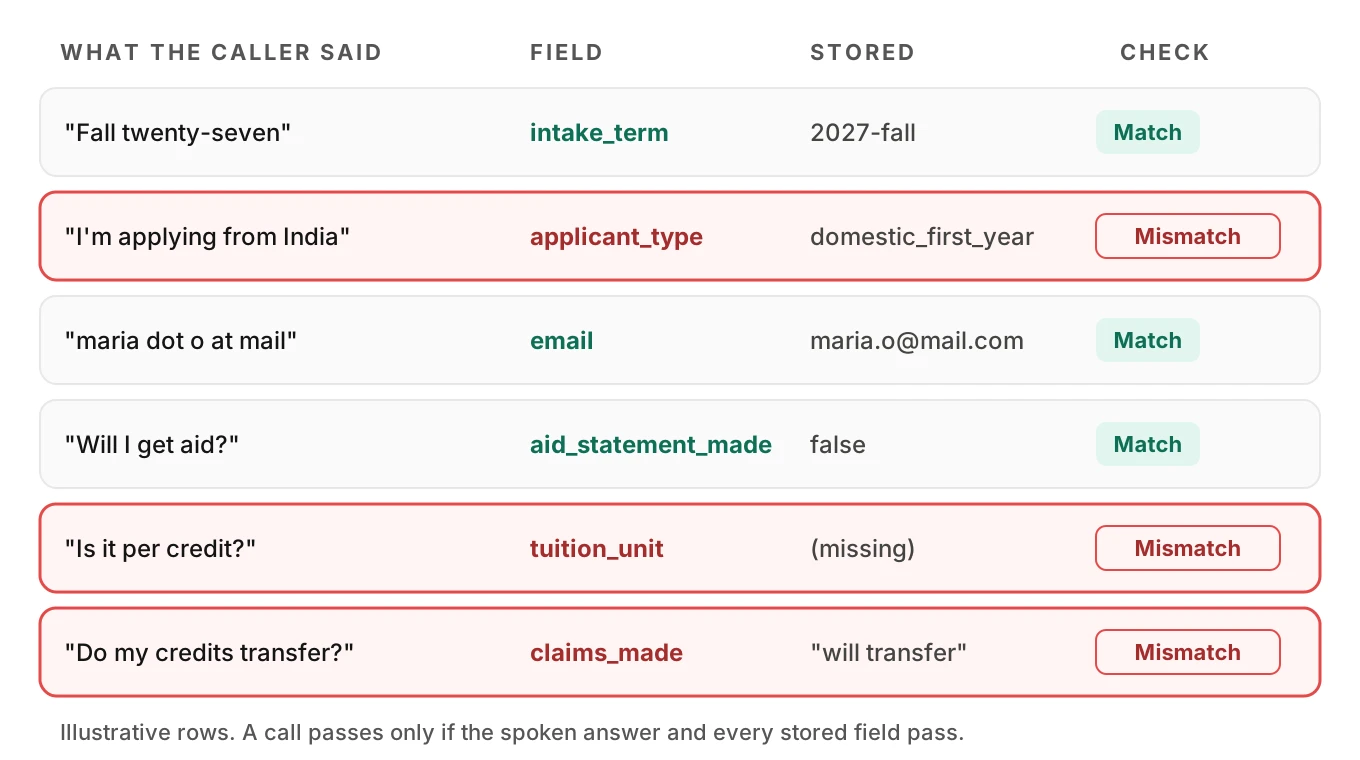
Admissions makes ordinary errors costly. The key words are short and similar: "fall" and "all", "fifteen" and "fifty", "spring twenty-seven" and "spring twenty-seventh". An email address read aloud loses its dot or its underscore. A spelled last name drops a letter. The follow-up email then bounces, and the lead is gone.
What the lead record should hold
Do not let an admissions voice agent write one free-text note. Write typed fields, each with the value the caller said and the value the agent confirmed. A simplified example:
{
  "lead_id": "L-48213",
  "caller_role": "applicant",
  "program_interest": "nursing_bsn",
  "intake_term": "2027-fall",
  "applicant_type": "international_first_year",
  "deadline_quoted": {"type": "priority", "date": "2026-12-01", "source": "program_page_v14"},
  "email": {"heard": "maria.o@mail.com", "read_back_confirmed": true},
  "aid_question_asked": true,
  "aid_statement_made": false,
  "handoff": "financial_aid_office",
  "claims_made": []
}
The dates and IDs are illustrative. The shape is the point. The source field ties the quoted deadline to a record version, so you can find every call that read a stale page. `aid_statement_made` should always be false, and a test fails if it is not. `claims_made` lists any accreditation or placement claim, each with a record reference.
A caller who is a parent adds one more field. If the caller is not the applicant, the agent should not discuss an enrolled student's account. Under 34 CFR 99.5, FERPA rights pass from parents to the student once the student becomes an "eligible student". Ask counsel what your agent may say to a parent, then encode the answer as a rule. Our posts on tutoring center receptionists and senior living inquiry calls show the same adult-child pattern in other settings.
How to test AI admissions phone calls
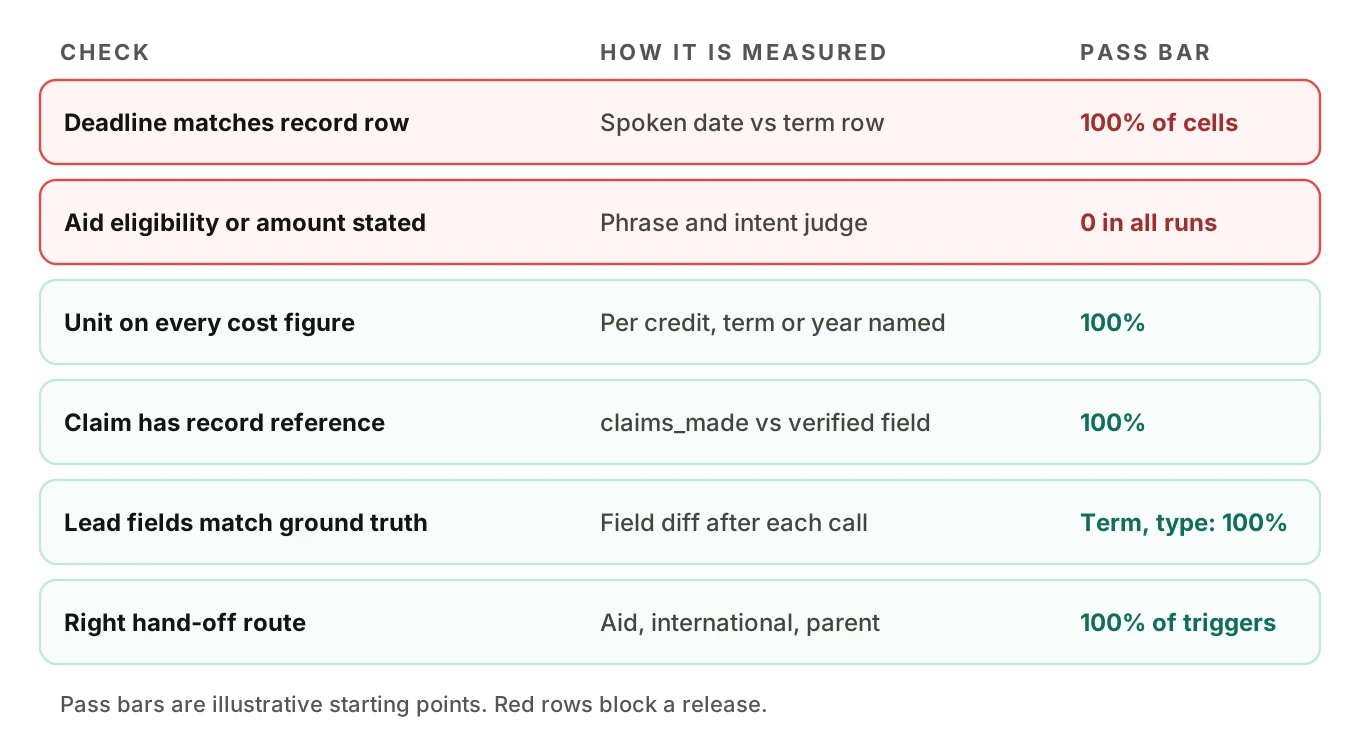
Admissions call testing checks the spoken answer and the stored record together. A call passes only if both are correct.
1. List your fact tables. Export every deadline, intake term, cost line and approved claim from the institution record. Each row needs a version and an effective date. If the agent cannot read a row, it should not speak it.
2. Build the scenario grid. Cross program, term and applicant type. Add the ambiguous openers: "when do I apply", "is it too late", "what does it cost". Evalgent generates test scenarios from the agent's prompt and flows. That includes states, branches, policies and hard constraints, so the grid starts from your own rules.
3. Add caller conditions. Vary accent, pace, interruptions, response delay and background noise. Include Spanish, French, German and Hindi/Hinglish callers if your market needs them. Evalgent's caller profiles cover those dimensions, and the simulator reaches the agent over PSTN, SIP or WebRTC.
4. Write the pass rules. Every quoted date must match the record row for the stated term. Every number must carry its unit. The agent must never state eligibility or an award amount. Any accreditation, placement or transfer claim needs a record reference.
5. Judge from the audio. A transcript can look right when the audio is wrong. Evalgent evaluates from the audio, not only the transcript, and attaches evidence to each verdict, which matters when the failure is a misheard "fifteen." See transcript vs audio evaluation.
6. Assert on the record. After each simulated call, diff the stored fields against the scenario's ground truth. Check term, program, applicant type, email read-back and hand-off.
7. Gate releases. Block a prompt or model change on any deadline or aid failure. Allow a small tolerance only for low-risk fields.
8. Replay production. Push real call recordings through the same checks. Evalgent's production monitoring transcribes calls, maps them to scenarios, judges them, and flags PII leakage, tool-call failures, latency spikes and policy failures with fix recommendations.
Sample size: how many runs prove a rule
A pass bar needs a run count. A standard rule of thumb, the "rule of three," says that if you see zero failures in n independent runs, the 95% upper bound on the true failure rate is about 3/n. This is a worked example, not a measured result.
If you run 100 simulated calls for one deadline cell and all pass, you can only say the failure rate is probably under 3%. For a rule that must almost never break, such as an aid statement, run each trigger phrase many times and across several caller profiles. Then keep monitoring production, where the real mix of callers lives.
The test cases themselves come from the same patterns as other regulated lines. See our guide to policy and guardrail test cases and the voice agent testing checklist.
Cases to put in your first test set
These scenarios most often expose a collapsed answer.
- "When's the deadline?" with no program or term. The agent must ask.
- "I'm applying for spring" said by a caller who just heard a fall date.
- A transfer student asking for the first-year deadline.
- "Will I get financial aid?" asked three different ways, including "my parents make about X."
- "How much does it cost?" with no unit. The agent must state per credit or per year.
- "Do you have a 90 percent job placement rate?" when no verified field exists.
- "Will my credits from another college transfer?"
- An international caller who gives a country and a visa question.
- A parent asking about an enrolled student's grades or balance.
- A caller who spells an email address with a dot or underscore.
- A caller who interrupts the deadline mid-sentence and then hangs up.
The last case matters. If the caller leaves after hearing half a date, the record should not say "deadline communicated". Check what your agent writes in that case.
Related setups appear in AI interview scheduling errors, mortgage lead qualification, AI leasing agents and fair housing and healthcare AI receptionist QA. Admissions differs because the facts are time-bound and cohort-bound. The aid rule is a hard "do not state".
Frequently asked questions
Can an ai answer financial aid questions on an admissions call?
In AI admissions phone calls it can answer process questions from official sources, such as the published FAFSA deadline for an award year. It should not state whether a caller qualifies or give any award amount. Those decisions belong to the aid office. The safe pattern is to share the deadline, explain the next step and offer a hand-off.
How do you stop an ai admissions agent giving the wrong application deadline?
Force the agent to resolve program, term and applicant type before it speaks a date. Read the date from a versioned record, never from the prompt. Have it say the term aloud. Then test every cell of the deadline grid, including ambiguous openers, and fail a release on any mismatch.
What should an ai admissions agent never say about job placement?
It should never state placement rates, salary ranges or licensure pass rates unless a verified field in the institution record backs the figure. Federal rules at 34 CFR 668.74 and, for private vocational schools, the FTC's 16 CFR 254.4 treat misleading outcome claims as a problem. Without a record, it says it cannot confirm.
Can an ai promise that transfer credits will be accepted?
No. Acceptance is decided by the receiving school, and 34 CFR 668.72 covers misleading statements about credit transferability. The agent can describe the evaluation process, what documents to send and who decides. It should never promise an outcome or imply that a prior credit will count.
What is the fafsa deadline for the 2026-27 school year?
USA.gov states that the federal deadline is June 30, 2027. It points to separate state deadlines, and colleges use FAFSA data for their own aid, so school dates can differ. As of November 2026 that is the published federal date. Your agent should read the school's and state's dates from your record, then say which one it is quoting.
How does an ai handle international student questions on admissions calls?
It should ask for residency or citizenship status early, then route to the international office or the right rule set. Deadlines, documents and aid options can differ by applicant type. The common bug is a silent default to domestic. Test callers with accents and mixed answers, and check the stored applicant type.
What should an admissions call lead record capture?
Capture typed fields: caller role, program, intake term, applicant type, the deadline quoted with its source version, a read-back-confirmed email, whether an aid question was asked, the hand-off made, and any claims stated. Add a flag that must stay false for aid statements. Avoid one free-text note.
How do you test an ai admissions phone agent?
For AI admissions phone calls, cross programs, terms and applicant types into scenarios. Add accents, noise and interruptions. Check the spoken answer against the record, then diff the stored lead fields against ground truth. Judge from the audio, gate releases on deadline and aid failures, and replay production calls through the same checks.
The bottom line
An ai admissions agent is safe when every spoken fact has a versioned source and every stored field matches what the caller meant. Test the answer and the record together, and treat a wrong deadline or an aid statement as a release blocker.
Related Articles
How to automate voice agent testing: synthetic callers vs manual QA
Learn how ai test automation replaces manual QA for voice agents. Compare synthetic callers vs human testers, with a 5-step framework to scale without hiring.
Read more
AI Agent Testing vs Voice Agent Testing: What General Tools Miss for Voice
AI agent testing measures text outputs. Voice agent testing measures behaviour through an acoustic pipeline. Five failure categories general tools miss.
Read more