Open door for builders.
How to Evaluate Emotional Tone in AI Voice Agents
# How to evaluate emotional tone in AI voice agents
> Quick answer: Emotional tone voice agent evaluation scores two things on real calls: whether the agent reads the caller's emotion correctly, and whether its own tone fits the moment. A good agent sounds calm and empathetic with an upset caller, not chirpy. Score it with a rubric, human raters, and a calibrated scorer.
Callers judge your voice agent on how it sounds, not just what it says. A correct answer in the wrong tone still fails. This guide covers emotional tone voice agent evaluation from both sides. First, does the agent read the caller's feelings? Second, does its own delivery match the situation?
Tone is measurable. You can score it with a clear rubric. You can track it across a whole call. You can tie a tone failure to an escalation. This post shows how to do that on your own audio, not on a vendor's demo reel.
What emotional tone voice agent evaluation actually measures
Emotional tone voice agent evaluation measures fit between feeling and delivery. It is not one number. It has two linked halves.
Emotional tone: the emotional quality a listener perceives in speech. It comes from word choice, warmth, pacing, and pitch. It signals empathy, calm, urgency, or indifference.
The first half reads the caller. Are they calm, confused, annoyed, or angry? The second half judges the agent. Given that caller state, was the agent's tone appropriate?
Appropriateness is the core idea. A warm, upbeat tone is great on a happy booking call. The same tone during a billing complaint feels tone-deaf. So tone is never scored in a vacuum. It is scored against context.
This work sits inside broader voice agent evaluation. Tone is one axis among many. But it is the axis callers feel first.
The two sides: reading the caller and scoring the agent
Keep the two sides separate when you score. They fail in different ways.
Side one is caller emotion. You detect the caller's sentiment and how it moves. This draws on sentiment analysis and emotion recognition. It answers a simple question. How did the caller feel, and did that feeling improve?
Side two is agent behavior. Given the caller's state, was the agent's tone right? This is voice agent tone appropriateness. It asks whether empathy showed up when it was needed.
An agent can read the caller well and still respond poorly. It can also stay pleasant while the caller spirals. Both are failures. You catch them only by scoring the two sides against each other.
Caller sentiment and the sentiment delta
Caller sentiment is the mood the caller shows. You can read it per turn. You can also read the whole arc.
The most useful signal is the caller sentiment delta. That is the change from the start of the call to the end. A caller who starts angry and ends calm is a win. A caller who starts neutral and ends furious is a loss, even if the task technically closed.
We keep the single-number view separate. For that, see our post on sentiment score for voice agents. This guide is about tone appropriateness, which is a richer judgment than one score.
Agent empathy and tone-context match
To evaluate voice agent empathy, you check the reply against the moment. A frustrated caller needs acknowledgment first. Did the agent acknowledge that frustration before jumping to steps? Did it slow down when the caller was confused?
Tone-context match is the pass or fail here. The agent's tone must fit the caller's state and the call type. Cheerful during a complaint fails the match. Cold during good news also fails. This is the heart of voice agent empathy scoring.
Text-level tone versus prosody and paralanguage
Tone lives in two layers. You must score both.
The first layer is text tone. This is word choice. "I'm sorry this happened, let me fix it" reads as empathetic. "Per policy, that is not eligible" reads as cold. You can score text sentiment from a transcript alone.
The second layer is delivery. This is prosody) and paralanguage. Prosody is pitch, rhythm, and stress. Paralanguage covers pace, pauses, and warmth. These live in the audio, not the words. This is acoustic sentiment.
The gap between the layers is where agents fail. The words can be perfect empathy. The delivery can still sound flat or rushed. A caller hears the flat delivery and feels unheard. Text tone vs prosody in voice agents is a real distinction, and it changes your test design.
> Text tone vs prosody: text tone is the empathy in the words. Prosody is the empathy in how the words are spoken. A scored empathy line can still fail if the voice sounds robotic.
Why transcript-only scoring misses prosody
Transcript-only scoring reads words. It cannot hear delivery. So it misses half of tone.
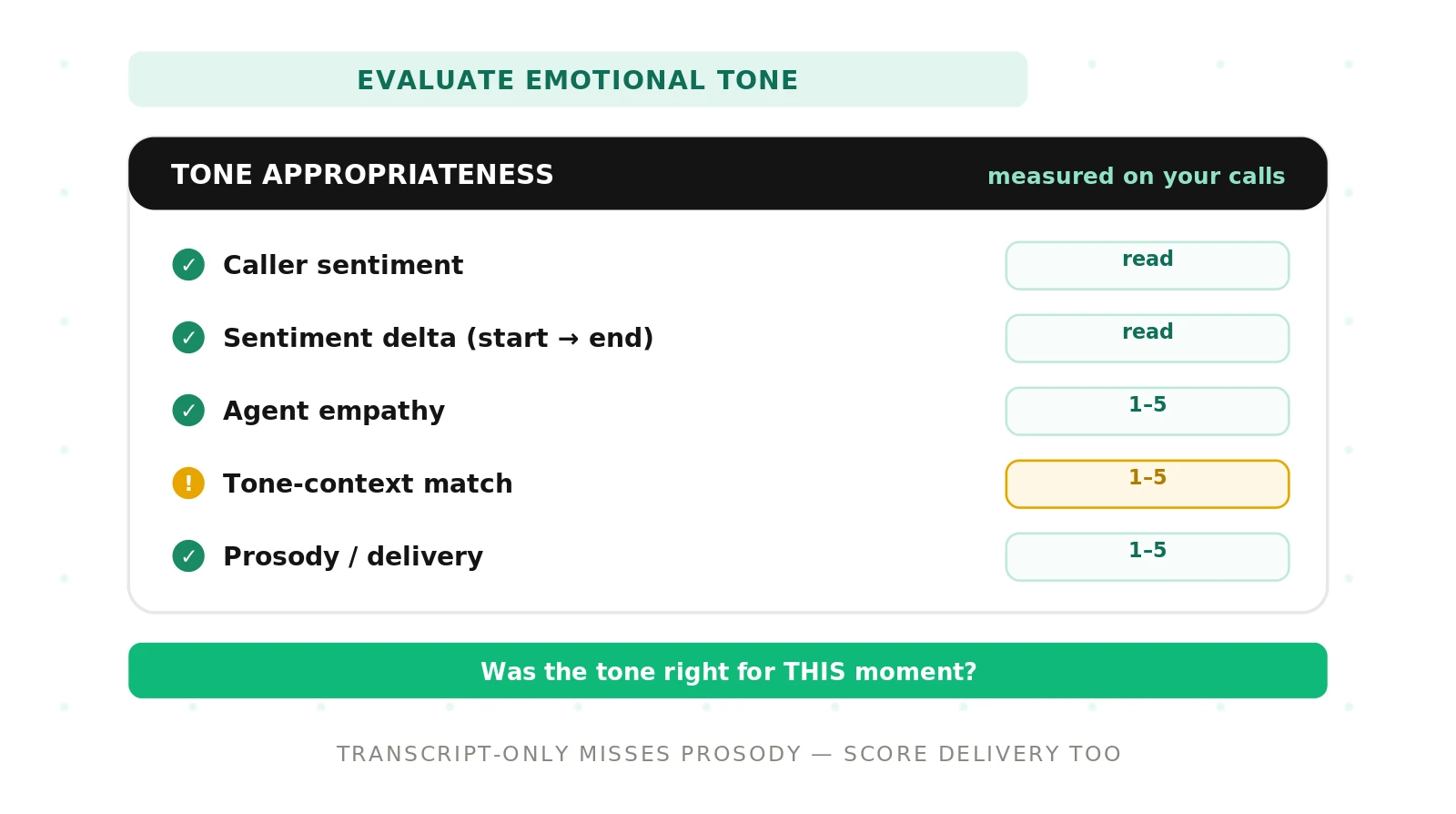
Can you score tone from a transcript only? Partly. You catch cold wording and missing acknowledgments. You do not catch a rushed, monotone, or clipped delivery. Those failures are audible, not written.
This matters most for text-to-speech agents. The same script can sound warm or robotic depending on the voice and its settings. Speech quality itself is often rated with a mean opinion score. Tone appropriateness is a different judgment, but it also needs the audio.
The lesson is simple. Score text tone from transcripts if you must. Score full emotional tone from the call audio. If your evaluation ignores audio, it will pass agents that sound wrong. This is one reason we favor audio in independent voice AI evaluation.
The tone dimensions to score
Break tone into five dimensions. Score each one. Do not collapse them into a single vague rating.
| Tone dimension | What to test | How to score | Failure signal |
|---|---|---|---|
| Caller sentiment | Read caller mood per turn on real calls | Sentiment label plus 1-5 intensity | Anger or confusion missed by the agent |
| Sentiment delta | Compare caller mood at start versus end | Delta from opening to closing turns | Caller ends more upset than they began |
| Agent empathy | Check for acknowledgment before problem-solving | 1-5 empathy rubric, human plus scorer | Agent skips the caller's feelings |
| Tone-context match | Compare agent tone to caller state and call type | Pass or fail with a short reason | Chirpy tone during a complaint |
| Prosody and delivery | Judge pace, pauses, and warmth in the audio | 1-5 delivery rubric on audio | Flat, rushed, or robotic voice |
Each row is a distinct test. Together they give you a full tone profile. A single call can pass empathy and fail delivery. Scoring the rows separately shows you exactly where to fix the agent.
How to evaluate emotional tone in a voice agent
Here is a repeatable process for how to evaluate emotional tone in a voice agent. Run it on your own calls, not on scripted demos. This is how to score agent tone on real calls at scale.
1. Gather emotionally varied calls. Pull real calls that cover calm, confused, frustrated, and angry callers. Include complaints and good-news calls. Tone only shows under emotional load.
2. Write a tone rubric. Define 1-5 scales for caller sentiment, agent empathy, and delivery. Add a pass or fail for tone-context match. Write anchor examples for each level.
3. Label caller sentiment per turn. Mark the caller's mood across the call. Record the opening and closing states so you can compute the caller sentiment delta.
4. Score text tone from the transcript. Check word choice for empathy and acknowledgment. Flag cold or dismissive phrasing.
5. Score prosody from the audio. Listen for pace, pauses, and warmth. Rate whether delivery matched the words and the moment.
6. Judge tone-context match. For each key turn, decide if the tone fit the caller's state. Note chirpy replies during complaints as fails.
7. Have humans rate a sample. Use trained human raters on a subset. Check their agreement to keep the rubric consistent.
8. Calibrate a scorer to the humans. Align an automated scorer to the human labels. Then run it across every call, not just the sample.
9. Wire failures to escalation. When tone fails on an upset caller, that call should have handed off. Track those misses as a separate metric.
This process turns a fuzzy impression into a scored result. It also scales, because the calibrated scorer handles volume.
Scoring tone appropriateness: rubric, raters, and a calibrated scorer
Three tools work together. Each covers a weakness in the others.
The rubric is the shared definition. Without it, "empathetic" means something different to every reviewer. Write anchors. Level 1 empathy might be "ignored the caller's frustration." Level 5 might be "acknowledged the feeling, then acted." This is how you produce a real tone appropriateness score.
Human raters set the ground truth. People hear warmth and sarcasm that models miss. But humans are slow and expensive. So you rate a sample, then measure their agreement. Low agreement means the rubric needs work.
A calibrated scorer scales the judgment. You align it to the human labels first. Then it scores every call. A calibrated scorer like Jev Score can rate tone appropriateness with a confidence value attached. That lets you route low-confidence calls back to humans.
The order matters. Rubric first, humans second, scorer last. Skip the rubric and your scorer learns noise. This is standard practice in trustworthy measurement, echoed in the NIST AI Risk Management Framework.
When to use each, and when not to
Use human raters when the stakes are high or the rubric is new. Do not rely on them for full-volume scoring. They cannot keep up.
Use a calibrated scorer for coverage across all calls. Do not deploy it before it agrees with your humans. An uncalibrated scorer gives confident but wrong tone ratings.
Tone failure as an escalation trigger
Tone and escalation are linked. A tone failure on an upset caller is exactly when a human should step in.
Does emotional tone affect escalation? It should. If the caller sentiment delta is negative and getting worse, the agent is losing the call. A rising anger signal is a strong escalation trigger. Waiting for the caller to demand a human is too late.
Build this into scoring. Flag every call where tone failed and no handoff happened. Those are your most damaging misses. For the design of these handoffs, see our guide on escalation for voice agents.
Good de-escalation is the reverse pattern. The caller starts hot. The agent stays calm and warm. The sentiment delta turns positive. That is a tone win worth rewarding in your scores.
Tone evaluation versus a single sentiment score
These two are related but not the same. Keep them apart.
A single sentiment score gives one number for caller mood. It is useful as a dashboard signal and an early warning. We cover it fully in sentiment score for voice agents.
Emotional tone voice agent evaluation is broader. It scores the agent's behavior, not just the caller's mood. It asks if empathy and delivery fit the moment. Sentiment tells you the caller got angry. Tone appropriateness tells you the agent's chirpy reply made it worse.
Post-call surveys add a third view. Perceived tone shows up in CSAT for voice agents. Combine all three for a complete picture. Use tone scoring to explain why a survey score dropped. Testing and evaluation are distinct steps here, as our testing versus evaluation guide explains.
Why an independent evaluator should score tone
Tone scoring is easy to grade generously when you built the agent. An independent evaluator removes that bias.
Emotional tone voice agent evaluation works best on your real, emotionally varied calls. Vendor demos rarely include an angry caller mid-complaint. Those are the calls where tone matters most. An independent evaluator like Evalgent scores tone appropriateness on those exact calls.
Evalgent is a neutral third party. It applies the same rubric across every vendor and every call. It reports empathy, delivery, and tone-context match with a defensible score. You can track this over time, as described in our view of independent evaluation.
The result is a tone profile you can act on. It fits into a wider voice agent metrics scorecard alongside accuracy and resolution. Tone stops being a gut feeling. It becomes a number you can compare and defend. Book a demo to score tone on your own calls.
Frequently asked questions
How to evaluate emotional tone in a voice agent?
Gather real, emotionally varied calls. Write a 1-5 rubric for caller sentiment, agent empathy, and delivery. Score text tone from transcripts and prosody from audio. Judge whether the tone matched the moment. Have humans rate a sample, then calibrate a scorer to them and run it on every call.
What is voice agent tone appropriateness?
Voice agent tone appropriateness is whether the agent's tone fits the situation. A calm, empathetic tone suits an upset caller. A cheerful tone suits good news but fails during a complaint. It is scored against the caller's emotional state and the call type, not judged on its own.
How to evaluate voice agent empathy?
To evaluate voice agent empathy, check whether the agent acknowledged the caller's feelings before solving the problem. Score it on a 1-5 rubric with clear anchors. Level 1 ignores the emotion. Level 5 acknowledges it, then acts. Rate both the words and the delivery, since flat audio undercuts empathetic wording.
Can you score tone from a transcript only?
Only partly. A transcript shows word choice, so you catch cold phrasing and missing acknowledgments. It cannot capture prosody, pace, or warmth, which live in the audio. Transcript-only scoring will pass an agent that reads the right words in a flat or robotic voice. Score full tone from the call audio.
How do you measure caller sentiment delta?
Label the caller's sentiment at the start of the call and at the end. The caller sentiment delta is the change between them. A move from angry to calm is a positive delta and a good outcome. A move toward anger is negative. It reflects whether the agent's tone helped or hurt.
Does emotional tone affect escalation?
Yes. A tone failure on an upset caller is a strong escalation trigger. If caller sentiment is negative and worsening, the agent is losing the call and a human should take over. Waiting for the caller to demand a person is too late. Wire negative sentiment deltas to your handoff logic.
What is the difference between text tone and prosody?
Text tone is the emotional quality of the words, like an apology or an acknowledgment. Prosody is the delivery, including pitch, rhythm, and pace. Paralanguage adds pauses and warmth. A reply can have empathetic words but robotic prosody. Scoring both is why audio matters more than the transcript.
How do you score agent tone on real calls?
Use your own calls that span calm, confused, and angry callers. Apply a shared rubric so scores are consistent. Have trained raters label a sample and measure their agreement. Calibrate an automated scorer to those labels, then score every call. An independent evaluator keeps the grading honest and comparable across vendors.
The bottom line
Emotional tone voice agent evaluation scores two things: whether the agent reads the caller's emotion and whether its own tone fits the moment. Score it with a rubric, human raters, and a calibrated scorer on your own real calls, and tie tone failures on upset callers straight to escalation.
Related Articles
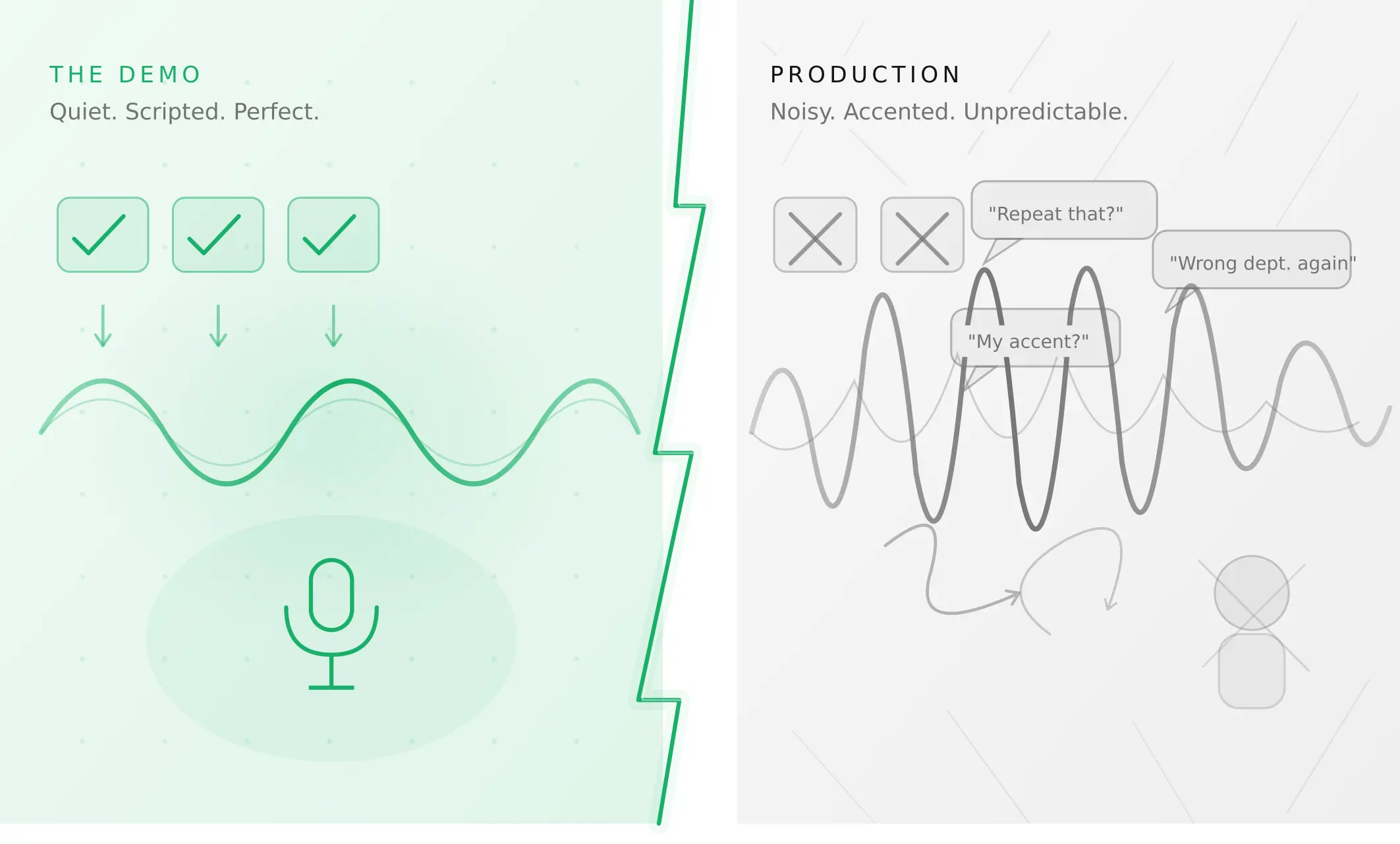
Why AI voice agents fail in production (and how to prevent it)
AI voice agents that ace demos still break in production. Learn the 5 root causes, how to test for each, and what production readiness actually means.
Read more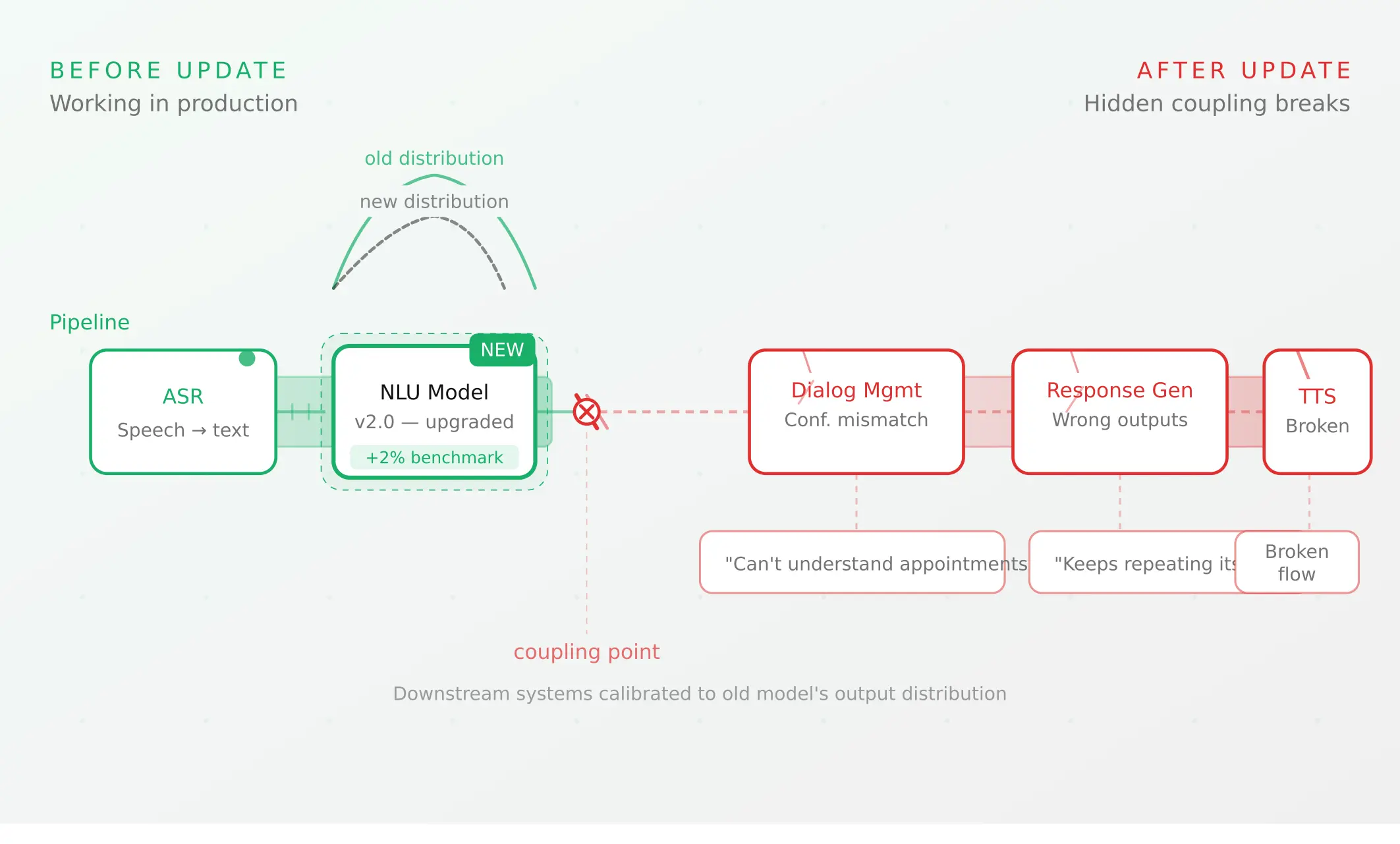
Voice agent regression testing: why LLM updates break production
LLM updates improve benchmarks but break voice agents in 5 predictable ways. How to detect and prevent regressions after every model or prompt change.
Read more