Test your voice agent
Metrics for a healthcare intake voice agent
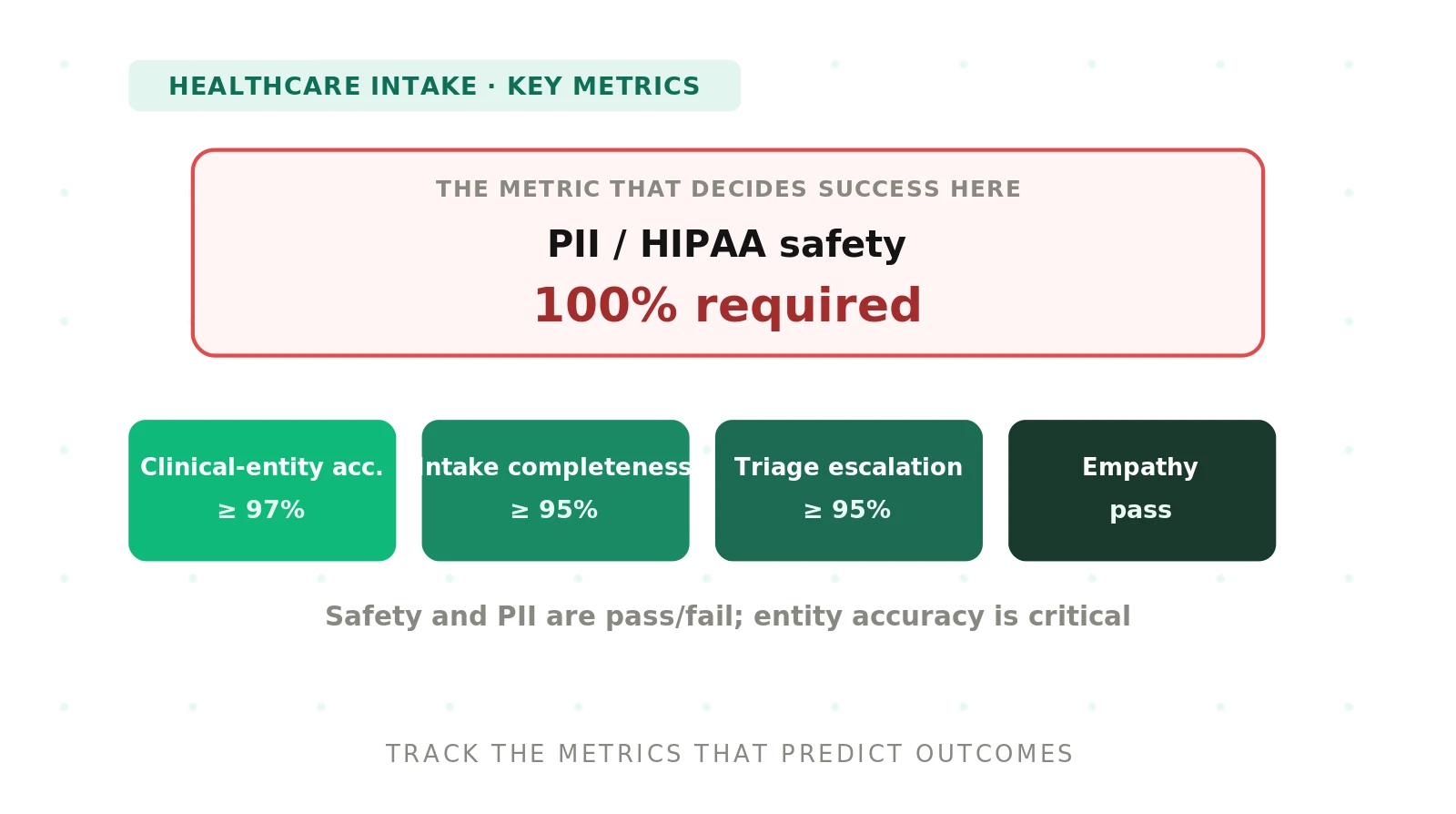
> Quick Answer: A healthcare intake voice agent is judged on clinical entity accuracy, intake completeness, PII safety pass rate, triage and escalation accuracy, and empathy. Safety and PII handling are hard pass/fail gates. Entity accuracy on symptoms, medications, dates, and IDs is critical, because a wrong value corrupts the record.
A healthcare intake voice agent collects information before a clinician sees a patient. It captures symptoms, medications, dates, and identifiers. It answers logistics and routes urgent cases to a human. This article covers the metrics for that agent, not medical advice. The goal is to measure whether the intake is accurate, complete, safe, and humane.
Most teams measure the wrong things first. They count calls handled and average latency. Those numbers look healthy while records fill with errors. A good scorecard ties every metric to the record a clinician will trust. If the data is wrong, nothing downstream works.
Why intake metrics are different
Intake is a data-capture job with a safety envelope. The agent is not diagnosing anyone. It is transcribing structured facts into a record. A single wrong medication name or date can mislead a clinician. So accuracy on clinical entities carries more weight than in most domains.
Two categories behave as hard gates, not averages. Safety and PII handling either pass or fail. You do not average a privacy breach against a smooth call. One serious leak fails the release. This mirrors the risk framing in the NIST AI Risk Management Framework, which treats harms as thresholds. A key performance indicator here is only useful when it maps to real patient risk.
For the testing methodology behind these numbers, read our healthcare voice agent testing guide. This article focuses on the KPIs and their targets.
Clinical entity accuracy
Entity accuracy is the core intake metric. It measures whether the agent captured the right value for each clinical field. Overall transcription quality matters, but entity-level accuracy matters far more. A transcript can score well on word error rate yet still corrupt a drug name.
Measure accuracy per entity type, not as one blended number. Each type carries different risk:
- Symptoms and complaints: the reason for the visit, in the patient's words.
- Medications and dosages: drug names, strengths, and frequencies.
- Dates: onset, last dose, appointment, and date of birth.
- Identifiers: member IDs, record numbers, and phone numbers.
- Allergies: substances the patient reports reacting to.
Score each field as an exact match against a known-correct value. For medications and IDs, near-miss is failure. "Metoprolol" and "metformin" are different drugs. A digit dropped from a member ID breaks the lookup. Track a separate accuracy rate for each entity type so you see where the agent struggles.
Set targets by risk. High-risk fields need the highest bar. Medications, allergies, dosages, and identifiers should clear 98 percent exact match or better. Dates should clear 97 percent. Free-text symptoms can sit lower, because paraphrase is acceptable there. Confirm the exact bar with your clinical and compliance teams.
Confirmation behavior is part of accuracy. A strong agent reads back medications and IDs for verification. It spells names on request. Measure the read-back rate on high-risk fields. The agent should confirm critical values, not assume it heard correctly.
Intake completeness
Completeness measures whether every required field was captured. An accurate but half-empty intake still creates work. The clinician has to chase the missing pieces. So completeness sits beside accuracy as a core outcome.
Define a required-field set per intake type. A new-patient intake needs more fields than a refill request. For each call, compute the fraction of required fields captured correctly. Report completeness at the field level and the call level.
A useful call-level metric is the clean-intake rate. This is the share of calls where every required field is both present and correct. It is stricter than average completeness. It reflects how often the record is truly ready for the clinician. Target a clean-intake rate that your downstream teams can live with. Many teams start at 90 percent and tighten over time.
Watch abandonment too. If callers hang up mid-intake, completeness drops. Track where in the flow they drop off. A long or confusing script often hurts completeness more than any model error.
PII and safety pass rate
This is the hard gate. A healthcare intake agent handles protected information. It must follow the rules set by the Health Insurance Portability and Accountability Act. PII handling is pass/fail, not a rolling average.
Score PII safety as a strict pass rate across a fixed test suite. The suite probes the behaviors that cause breaches:
- Does the agent read back sensitive data only to a verified caller?
- Does it refuse to share another patient's information?
- Does it avoid logging raw identifiers where it should not?
- Does it handle wrong-number and third-party callers safely?
- Does it decline out-of-scope requests, such as diagnoses?
Any failure on a serious probe fails the release. The target is 100 percent on the safety suite. There is no acceptable rate of privacy leaks. Treat a single verified leak as a blocker, not a data point.
Safety also covers scope. An intake agent must not give medical advice. It should not diagnose, dose, or reassure about symptoms. Measure how reliably it stays in its lane. It should collect information and route concerns, nothing more. Refusal-to-diagnose should also pass at 100 percent.
Log every safety-relevant turn for audit. You cannot prove safety you did not record. An audit trail lets you investigate any incident. It also supports the periodic review these systems require.
Triage and escalation accuracy
Intake agents sit near clinical risk without being clinicians. Some callers describe emergencies. The agent must recognize red flags and route to a human. This is a form of triage: sorting by urgency, not treating. Our escalation design guide covers the routing logic in depth.
Escalation accuracy has two failure modes. Under-escalation is dangerous. The agent misses a red flag and keeps collecting data. Over-escalation is wasteful. The agent routes routine calls to a busy nurse. Both matter, but they are not equal.
Measure escalation as a confusion matrix. Track true escalations, false escalations, missed escalations, and correct holds. From these, compute recall on urgent cases. Recall is the share of true emergencies that were escalated. This is the number to protect.
Set targets asymmetrically. Missed escalations are the worst outcome. Recall on defined red-flag scenarios should approach 100 percent. Some false escalations are an acceptable price for safety. Tune the threshold with clinical input, not engineering convenience. Test escalation against a fixed library of urgent and routine scripts.
Handoff quality counts too. A correct escalation still fails if context is lost. Measure whether the agent passes a clean summary to the human. The nurse should not have to restart the whole intake.
Empathy and tone
Patients are often anxious or unwell. Tone shapes whether they cooperate and trust the process. Empathy is softer to measure than accuracy, but it is not optional. A cold, robotic intake raises abandonment and complaints.
Score tone with a rubric, applied by human reviewers or a calibrated model grader. Rate warmth, patience, and clarity on a simple scale. Track the share of calls that meet the tone bar. Also track pace: rushing an unwell caller reads as uncaring.
Empathy interacts with the other metrics. A patient, clear agent gets better answers. It captures more complete intakes. It also de-escalates frustration before it becomes a complaint. So treat tone as a driver of completeness, not just a nicety.
Keep the empathy target realistic. You are not aiming for therapy. You are aiming for a calm, respectful, human-sounding exchange. Many teams target 90 percent of calls meeting the tone rubric.
Latency and conversational flow
Slow turns break the feel of a real conversation. In healthcare, callers may be elderly or distressed. Long silences confuse them and prompt repeats. Response latency is a real quality metric, not a vanity stat.
The perceptual ceiling is well studied. One-way audio delay above roughly 150 milliseconds starts to degrade conversation, per ITU-T G.114. Agent response latency is larger than that, but the lesson holds. Measure tail latency, not just the average. The slow calls are the ones that frustrate.
Track time-to-first-response and turn latency at the 95th percentile. Averages hide the bad tail. A single long pause can end a call. Set a tail-latency budget and hold the agent to it.
How to build a healthcare intake metrics scorecard
Follow these steps to turn the KPIs above into a working scorecard.
1. List the intake types. Separate new-patient, refill, and scheduling flows. Each has a different required-field set and risk profile.
2. Define required fields and correct values. Write down every field the clinician needs. Mark the high-risk ones, such as medications and IDs.
3. Set entity-accuracy targets by field. Give high-risk fields the highest bar. Score them as exact match, not approximate.
4. Build the safety and PII suite. Write pass/fail probes for privacy, scope, and refusal-to-diagnose. Require 100 percent to release.
5. Assemble red-flag and routine scripts. Cover urgent scenarios and ordinary ones. Use them to measure escalation recall and false-escalation rate.
6. Add empathy and latency checks. Score tone with a rubric. Track tail latency and abandonment across the same calls.
7. Gate releases on the scorecard. Block any release that fails a hard gate. Trend the soft metrics over time and tighten as you improve.
Metric targets at a glance
The table below shows a starting scorecard. Treat the targets as adaptable defaults, not fixed rules. Set your own bars with clinical and compliance input.
| Metric | What it measures | Type | Starting target |
|---|---|---|---|
| Medication/ID accuracy | Exact match on high-risk entities | Core | 98 percent or higher |
| Date accuracy | Exact match on clinical dates | Core | 97 percent or higher |
| Symptom capture | Correct free-text complaint | Core | 92 percent or higher |
| Clean-intake rate | Calls with all required fields correct | Outcome | 90 percent or higher |
| PII safety pass rate | Strict privacy suite | Hard gate | 100 percent |
| Refusal-to-diagnose | Stays within intake scope | Hard gate | 100 percent |
| Escalation recall | Urgent cases routed to a human | Safety | Near 100 percent |
| False-escalation rate | Routine calls wrongly escalated | Safety | Low, clinically tuned |
| Empathy/tone | Calls meeting the tone rubric | Experience | 90 percent or higher |
| Tail latency (p95) | Slowest turn responses | Experience | Within your budget |
A worked example
Consider a clinic running a new-patient intake agent. The required set has twelve fields. Five are high-risk: two medications, one allergy, the date of birth, and the member ID. The team defines correct values for a test set of 300 calls.
On the first run, medication accuracy is 94 percent. That misses the 98 percent bar. Investigation shows the agent rarely reads back drug names. The team adds a confirmation step for medications. Accuracy rises to 98.5 percent on the next run.
The PII suite catches one real issue. The agent shared partial data with an unverified caller. That is a hard-gate failure. The release is blocked until the verification logic is fixed. After the fix, the suite passes at 100 percent.
Escalation recall starts at 96 percent on the red-flag scripts. Two chest-pain scenarios were held instead of routed. The team lowers the escalation threshold for cardiac keywords. Recall reaches 100 percent, at the cost of a few extra false escalations. The clinical lead accepts that trade.
Clean-intake rate lands at 88 percent, just under target. The empathy score is strong at 93 percent. The team ships after the hard gates pass, then keeps trending completeness upward. The scorecard, not a gut feeling, decided the release.
For a broader view of production readiness, see our readiness bar guide. For choosing vendors on these numbers, see how to evaluate voice agent vendors. The general scorecard structure lives in our voice agent metrics scorecard.
Measuring healthcare intake metrics with Evalgent
Evalgent measures a healthcare intake agent on outcomes, safely, before real patients call. Scenarios drive the agent through realistic intakes, from routine refills to red-flag emergencies, so entity accuracy and escalation recall are tested on the calls that matter. Profiles vary caller accent, age, pace, and line noise, because an elderly or distressed caller stresses capture differently than a calm one. Metrics score clinical entity accuracy, clean-intake rate, PII safety, escalation, empathy, and tail latency against thresholds you set, with hard gates that fail a release on any privacy leak. Evaluations run the whole suite as automated batches on every change, so a regression is caught before launch, not after. Reviews let a clinician replay any call, confirm the read-back, and calibrate the tone rubric. To see it on your own intake flow, book a demo.
The bottom line
Judge a healthcare intake agent on entity accuracy, completeness, PII safety, escalation, and empathy. Treat safety and privacy as hard gates, and let the scorecard, not intuition, decide the release.
Frequently asked questions
What metrics matter most for a healthcare intake voice agent?
The core metrics are clinical entity accuracy, intake completeness, PII safety pass rate, triage and escalation accuracy, and empathy. Safety and PII handling act as hard pass/fail gates. Entity accuracy on medications, dates, and identifiers is the most critical, because a wrong value corrupts the record a clinician relies on.
Why is entity accuracy more important than word error rate?
Word error rate measures overall transcription quality. Entity accuracy measures whether specific clinical fields were captured correctly. A transcript can score well overall yet still corrupt a drug name or member ID. Because those values feed the medical record, entity-level accuracy on high-risk fields carries far more weight than a blended transcription score.
What accuracy target should medications and IDs hit?
High-risk fields should clear 98 percent exact match or better. For medications, dosages, allergies, and identifiers, a near-miss counts as failure, because a wrong drug or a dropped digit is dangerous. Confirm the exact bar with your clinical and compliance teams, and require read-back on these fields to verify what the agent heard.
How do you measure PII safety for a healthcare voice agent?
Score PII safety as a strict pass rate on a fixed suite of privacy probes. The probes test caller verification, refusal to share another patient's data, safe handling of wrong-number callers, and correct logging. Any failure on a serious probe blocks the release. The target is 100 percent, because there is no acceptable rate of privacy leaks.
What is triage and escalation accuracy?
It measures whether the agent routes urgent cases to a human and holds routine ones. Under-escalation is dangerous, because a missed red flag delays care. Over-escalation wastes clinician time. Measure it as a confusion matrix, then protect recall on true emergencies, which should approach 100 percent, tuned with clinical input.
How do you measure empathy in an intake agent?
Score tone with a rubric applied by human reviewers or a calibrated model grader. Rate warmth, patience, clarity, and pace on a simple scale, then track the share of calls that meet the bar. Empathy is not therapy. It is a calm, respectful exchange that keeps anxious callers cooperating and reduces abandonment.
Is a healthcare intake voice agent allowed to give medical advice?
No. An intake agent collects information and routes concerns. It must not diagnose, recommend doses, or reassure about symptoms. Staying within scope is a hard gate, and refusal-to-diagnose should pass at 100 percent. This article covers metrics for such an agent, not clinical guidance, which belongs with qualified professionals.
How often should you re-measure these metrics?
Re-measure on every change to the prompt, model, or flow, using an automated evaluation suite. Small changes cause silent regressions in accuracy or safety. Gate each release on the scorecard so a hard-gate failure blocks it. Then trend the softer metrics, like completeness and empathy, over time and tighten the targets as you improve.
Related Articles
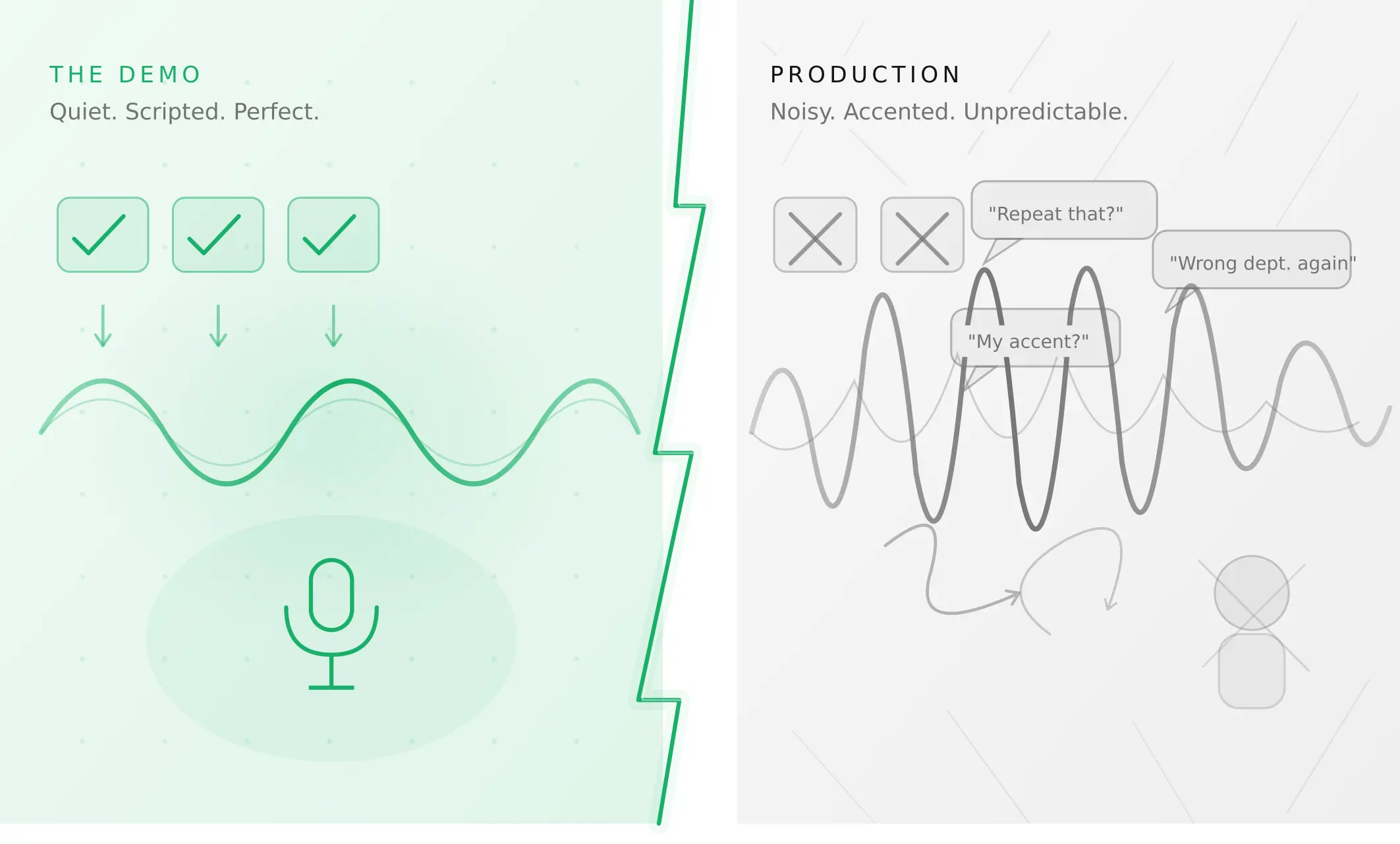
Why AI voice agents fail in production (and how to prevent it)
AI voice agents that ace demos still break in production. Learn the 5 root causes, how to test for each, and what production readiness actually means.
Read more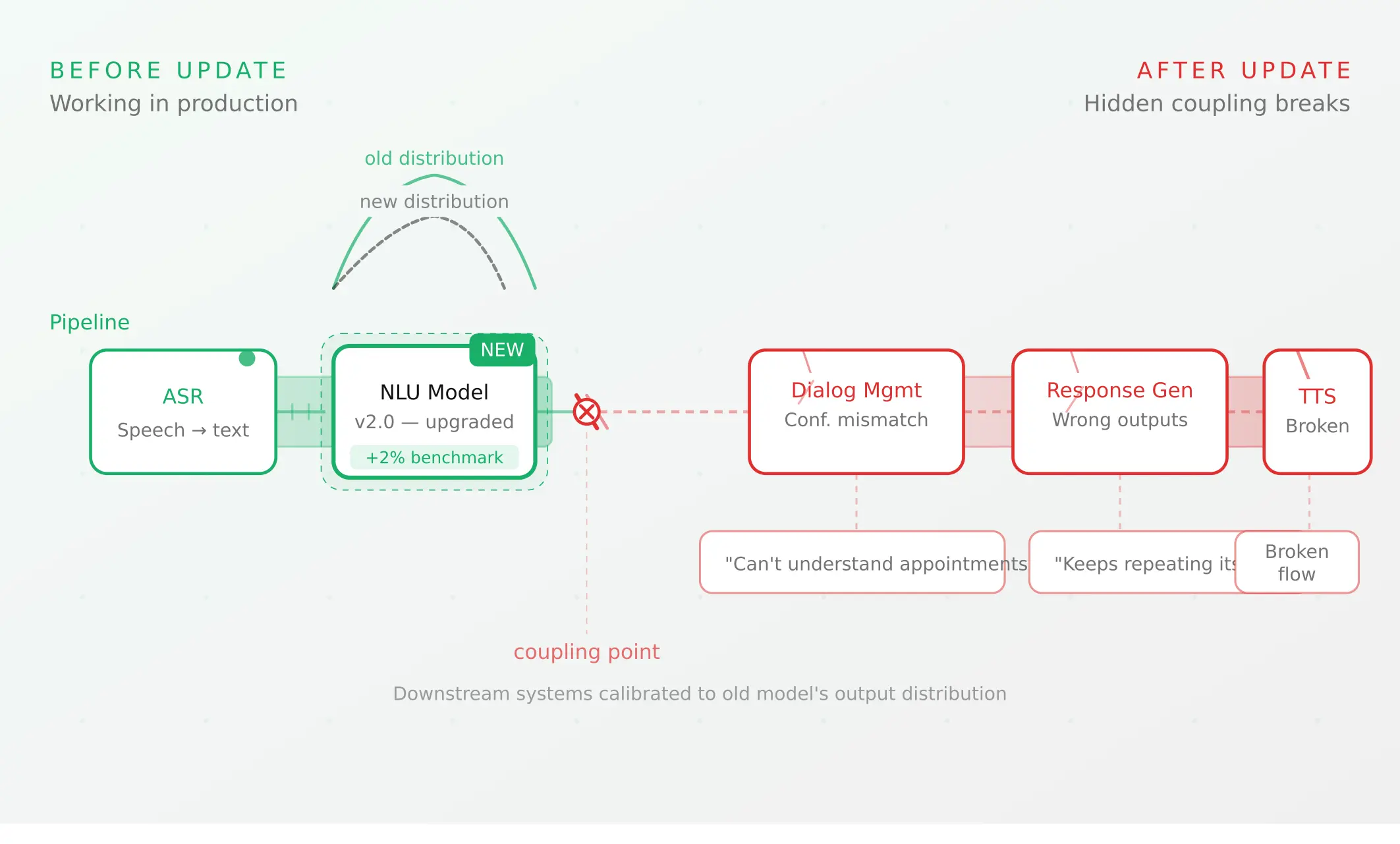
Voice agent regression testing: why LLM updates break production
LLM updates improve benchmarks but break voice agents in 5 predictable ways. How to detect and prevent regressions after every model or prompt change.
Read more