Open door for builders.
How to Evaluate a Travel Booking Voice Agent Vendor
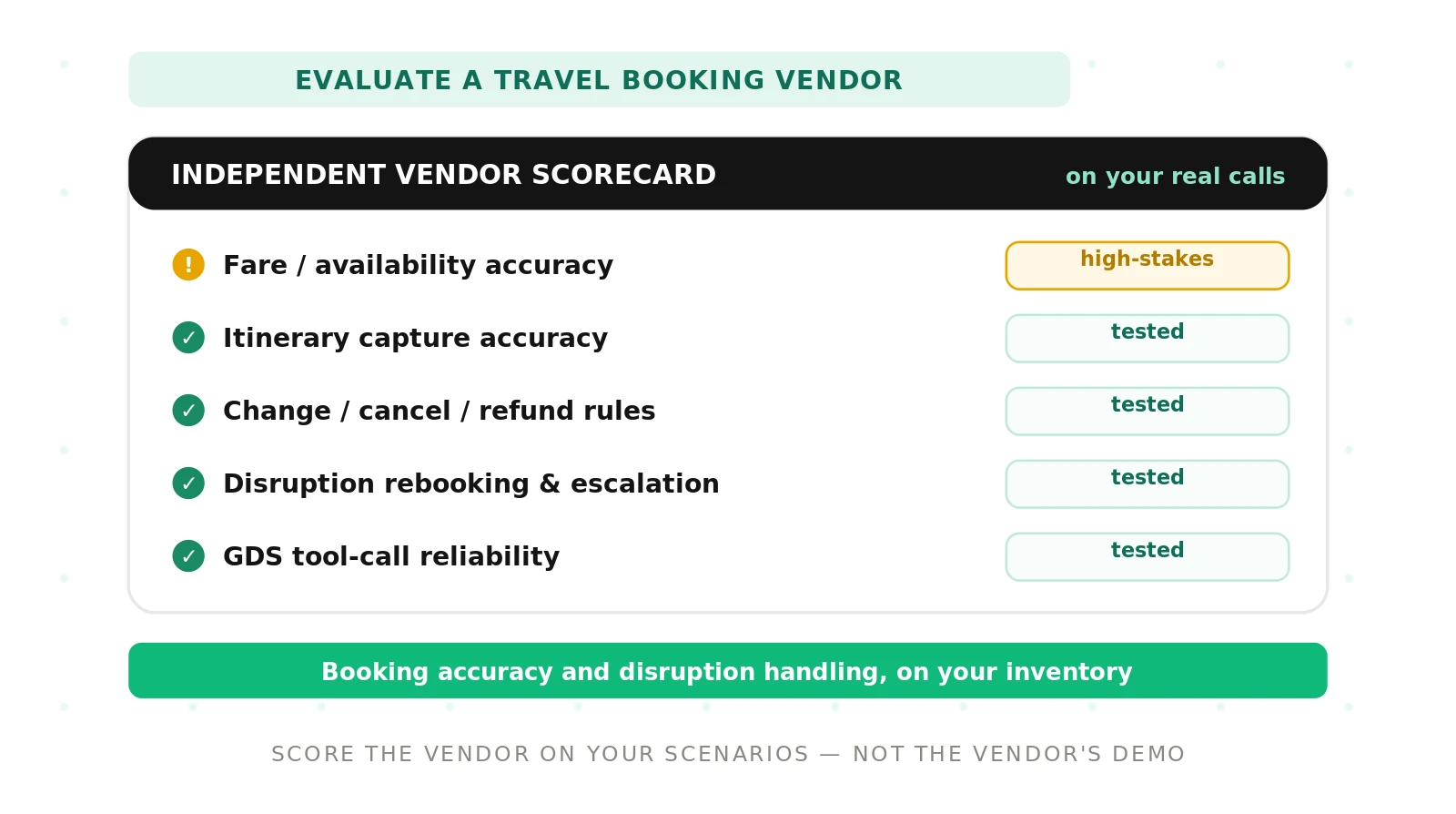
# How to evaluate a travel booking voice agent vendor
> Quick answer: To evaluate a travel booking voice agent vendor, run your own booking scenarios against each one. Score fare accuracy, itinerary capture, change and cancel rules, disruption rebooking, tool-call reliability, and PCI handling as pass-or-fail gates. Test against your live inventory, and have an independent auditor verify accuracy before you sign.
A travel booking voice agent stands between a caller and a real purchase. It quotes fares, holds seats, and touches a ticket that must match a passport. That makes booking accuracy the first thing you measure. A confident agent that invents a flight is worse than a slow one. To evaluate travel booking voice agent vendor options well, you test each one against your own inventory. A polished demo will not show which agent stays grounded. Your own scenarios will. Sound travel booking voice agent evaluation starts there.
This guide is for airlines, hotels, car-rental firms, and online travel agencies choosing a booking voice agent. It treats travel booking voice agent vendor selection as a repeatable process. It covers the six dimensions that decide the vendor. It covers the pass bars to set for each. Every check is one you can defend to operations and legal. It builds on our pillar guide, how to evaluate voice agent vendors, narrowed to travel.
> Travel booking voice agent: an AI phone agent that searches, quotes, and books air, hotel, or car travel. It must read live inventory correctly and capture a full itinerary before it books anything.
Why travel booking raises the accuracy bar
Most voice agents are judged on whether they sound helpful. A booking agent must first be judged on whether it tells the truth about inventory. The order matters. A warm agent that quotes a fare no longer available creates a broken booking and an angry caller.
Travel calls carry two kinds of risk at once. There is commercial risk. A wrong fare, a missed fare rule, or a duplicate segment costs money to fix. There is trust risk too. A ticket booked under the wrong name fails at the gate. A global distribution system holds the real inventory and fares, and the agent must reflect it exactly. The GDS does not care whether a human or a bot read the wrong row.
So the evaluation cannot lean on vendor marketing. Vendor-reported accuracy is measured by the vendor. It uses clean audio and cases the vendor chose. Our guide on independent voice AI evaluation explains why those numbers rarely transfer. For travel, trust only the result you produce yourself. Use your own scenarios, your own inventory feed, and score every vendor the same way. That discipline is how you evaluate travel booking voice agent vendor options without guessing.
The six dimensions that decide a travel vendor
Score every vendor on the same six dimensions. They map to the ways a booking call can go wrong. The weights are yours to set. Accuracy and grounding should outweigh charm in any transactional deployment.
Fare and availability accuracy is the first gate. Itinerary capture checks whether the agent records what the caller actually wants. Change, cancel, and refund rules test the fine print, including the 24-hour rule. Disruption rebooking covers cancellations and delays, and when to hand off to a human. GDS tool-call reliability tests the plumbing to your booking system. PCI and PII handling covers card and identity data. Our appointment scheduling voice agent metrics guide shows how to turn booking behavior into measurable signals.
| Dimension | What to test | Pass bar | Red flag |
|---|---|---|---|
| Fare and availability accuracy and grounding | Fares, seats, and rooms quoted against live inventory and known ground truth | Every quote matches the GDS row exactly; agent says "let me check" when unsure | A hallucinated flight, price, or availability stated with confidence |
| Itinerary capture accuracy | Multi-city trips, dates, passenger counts, loyalty numbers, name as on ID | Full itinerary read back and confirmed before booking; name matches the ID | A dropped segment, wrong date, or a name that will not match the passport |
| Change, cancel, and refund rules | Fare rules, change fees, refundability, and the 24-hour rule | Agent states the correct rule and fee, or defers to a human when unsure | Agent invents a refund policy or misses a non-refundable fare rule |
| Disruption rebooking and escalation | Cancellations, delays, missed connections, and stranded-traveler cases | Correct rebooking options offered; clean handoff to a human when needed | Agent loops, strands the caller, or rebooks onto an invalid connection |
| GDS tool-call reliability | Correct calls to search, price, and book; behavior when the API fails | Correct parameters every time; graceful degradation and a safe fallback on failure | Silent tool failure, a booking on stale data, or a crash with no recovery |
| PCI and PII handling | Card capture, passenger identity, and loyalty data across the call and logs | Card never read aloud; PII disclosed only to the verified traveler; logs clean | Full card number spoken or written to a transcript or log |
Fare and availability accuracy and grounding
Accuracy against live inventory is where a booking agent stands or falls. Voice agent booking accuracy testing has to compare each quote to ground truth. Do not accept a fluent answer as a correct one. Pull a known fare, seat map, or room rate from your feed. Ask the agent the same question. The spoken figure must match the row exactly.
The agent should quote only what the inventory shows. It should never fill a gap with a plausible guess. When it cannot confirm, it should say so and check. A hallucinated flight is the most dangerous failure in travel. It reads as helpful and books as fraud. Test sold-out dates, sale fares, and edge routes where a model is tempted to improvise.
Itinerary capture accuracy
A booking is only as good as the itinerary behind it. Complex trips break weak agents. Test a multi-city routing with mixed cabins. Test odd passenger counts, infants, and unaccompanied minors. Test loyalty numbers read aloud with digits that sound alike. The agent must capture each field and read the whole itinerary back.
Name capture deserves its own test. A ticket must carry the passenger name as on the ID. "Jon" versus "Jonathan" can fail at the gate. Confirm the agent spells and confirms the legal name. Ancillaries such as seats and bags belong in this check too. A missed bag fee is a broken promise at the counter.
Change, cancel, and refund rules
Fare rules are the fine print that ruins a call when ignored. The agent must handle changes, cancellations, and refunds by the actual rule. In the United States, the 24-hour rule lets many travelers cancel within a day for a refund. Test whether the agent applies it correctly. Test a non-refundable fare, a change fee, and a partial refund case.
The pass bar is strict. The agent states the correct rule and fee, or defers to a human. It never invents a policy to sound helpful. An agent that promises a refund the fare does not allow creates a dispute you will pay for. Precision here protects both the traveler and the margin.
Disruption rebooking and escalation
Disruption is where travel agents earn their keep. Cancellations and delays arrive at the worst moment. Test a canceled flight with a tight connection. Test a stranded traveler at midnight in a foreign airport. The agent should offer valid rebooking options grounded in live inventory. It should never rebook onto a connection that cannot be made.
Escalation is part of this dimension, not a footnote. Some cases belong with a human. The agent should recognize them and hand off cleanly. Our escalation guide covers how to test that handoff. The transfer should carry full context and never drop the caller into a loop. A calm, correct escalation beats a confident wrong rebooking every time.
GDS tool-call reliability
Behind every quote sits a tool call to your booking system. If that call is wrong, the answer is wrong. Test the parameters the agent sends to search, price, and book. Confirm dates, city codes, and passenger counts arrive intact. Our tool-calling guide covers how to test these calls in depth. Schema mistakes are a common, quiet failure, and our schema validation work catches them.
Then break the plumbing on purpose. Make the inventory API time out or return an error. The agent should degrade gracefully. It should tell the caller it cannot confirm right now. It should offer a safe fallback, such as a callback or a human. A silent tool failure that books on stale data is a critical red flag.
PCI and PII handling
Payment and identity data raise the stakes on every travel call. The safe rule is simple. The agent should not read a full card number aloud by voice. It should not store one in a transcript. This aligns with the intent of PCI DSS for cardholder data. Route payment to a compliant, tokenized flow instead.
Test the moments that tempt a leak. Ask the agent to confirm a card or read it back. Confirm it never speaks or logs the full value. Passenger identity data needs the same care. The agent should disclose itinerary and PII only to the verified traveler. Check the logs, not just the audio. A number captured in a log is still exposed.
How to run a travel booking voice agent vendor evaluation
To evaluate travel booking voice agent vendor choices fairly, run the same process for every vendor. Write it down before you start. Share it with operations, legal, and revenue management.
1. Define the booking types and the "booked correctly" bar. List the trips the agent must handle, from a simple one-way to a multi-city itinerary. State what a correct booking looks like for each.
2. Wire up your live inventory or a faithful sandbox. Connect each vendor to the same GDS feed or a mirror of it. Grounding tests only mean something against real availability and fares.
3. Build one shared scenario set. Assemble fixed scenarios and caller profiles. Include accents, background noise, disruptions, and multilingual and international cases. Every vendor faces them identically.
4. Set pass-or-fail gates for accuracy dimensions. Treat fare accuracy, itinerary capture, and full-card handling as hard gates. A vendor that fails a gate is out, whatever its price or polish.
5. Run identical calls on every vendor. Put each agent through the same scenarios. Differences then come from the agent, not the test.
6. Break the tools and force disruptions. Fail the inventory API and cancel flights mid-call. Record whether each agent degrades gracefully or books on stale data.
7. Score against ground truth and weights. Compare every quote to the record, then apply your weights. Use a consistent scorecard so the result is defensible.
8. Check behavior against a framework, then set terms. Map results to the NIST AI Risk Management Framework. Tie the pass bars into your service-level agreement and RFP.
Where an independent auditor fits
A vendor grading its own agent has every reason to score generously. An independent evaluator has none. That is the case for a third-party audit before you pick a travel voice ai vendor.
Evalgent is that independent evaluator. We do not sell a voice agent, so we have no agent to flatter. We build your booking scenarios first, then test each agent against your live inventory. We check whether it quotes real fares, captures a full itinerary, and rebooks correctly when a flight cancels. We report where it hallucinates, where it drops a segment, and where it holds. For travel, that neutral view separates a good demo from an agent that survives a real disruption day.
The point is not to replace your judgment. It is to give operations, revenue, and procurement one honest scorecard. When the evidence is neutral, the vendor decision stops being a matter of taste.
When to weight each dimension higher
Not every travel operator weights the six dimensions the same way. A leisure online travel agency may weight customer satisfaction and itinerary capture higher. Its callers plan complex trips and value a smooth, accurate quote. It still keeps fare grounding as a hard gate.
A network airline weights disruption rebooking and tool-call reliability at the top. Irregular operations drive its call volume, and a wrong rebooking cascades fast. A corporate travel provider leans harder on fare rules and change handling. Its travelers change plans often, and policy compliance matters. Weight total cost of ownership into the final call too, since a cheap agent that mis-books is expensive. Write your weights down, tie them to your risk profile, and keep them in the record. Rigorous airline voice agent testing keeps those weights honest.
The bottom line
A travel booking voice agent must quote real inventory before it earns credit for being helpful. Evaluate every vendor on the same scenarios against your live feed, decide on evidence rather than a demo, and book a demo to see how independent evaluation scores your travel agent.
Frequently asked questions
How do you evaluate a travel booking voice agent vendor?
Run your own booking scenarios against each vendor and score six dimensions: fare and availability accuracy, itinerary capture, change and cancel rules, disruption rebooking, tool-call reliability, and PCI handling. Test against your live inventory, and treat accuracy dimensions as pass-or-fail gates. Decide on measured results, not the vendor's own numbers or a scripted demo.
What should you test in a travel voice ai vendor?
Test the ways a booking call can go wrong. Check that the agent quotes only live fares, captures a full itinerary with the name as on the ID, applies fare and refund rules correctly, rebooks valid options during disruptions, calls your booking system correctly, and never reads a full card number aloud. Run each check identically across every vendor.
How do you test a travel booking voice agent against live inventory?
Connect each vendor to the same GDS feed or a faithful mirror. Pull known fares, seat maps, and room rates as ground truth. Ask the agent the same questions and compare the spoken figure to the record exactly. Include sold-out dates and sale fares. The agent passes only when every quote matches the row or it defers to a check.
How do you stop a travel voice agent from hallucinating flights and fares?
Ground every answer in your live inventory and forbid guessing. Test edge routes, sold-out dates, and sale fares where a model is tempted to improvise. Confirm the agent quotes only what the feed shows and says "let me check" when unsure. A hallucinated flight reads as helpful and books as fraud, so treat any invented quote as an automatic fail.
Should a travel booking voice agent read credit card numbers by voice?
No. The agent should never read a full card number aloud or store one in a transcript, in line with the intent of PCI DSS. Route payment to a compliant, tokenized flow instead. Test the moments that tempt a leak, confirm the agent never speaks or logs the full value, and check the logs, since a number saved in a log is still exposed.
How do you test disruption and rebooking in a voice agent?
Run realistic disruptions: a canceled flight with a tight connection, a delay, and a stranded traveler abroad. The agent should offer valid rebooking options grounded in live inventory and never rebook onto a connection that cannot be made. It should recognize cases that need a human and hand off cleanly with full context, rather than looping or stranding the caller.
What pass bar should you set for GDS tool calls?
Set the agent to send correct parameters on every search, price, and book call, with dates, city codes, and passenger counts intact. Then break the inventory API on purpose. The agent should degrade gracefully, tell the caller it cannot confirm, and offer a safe fallback like a callback or a human. Treat a silent tool failure or a booking on stale data as a fail.
Who should audit a travel booking voice agent vendor?
An independent evaluator with no voice agent to sell. A vendor grading its own agent has an incentive to score generously, and internal teams can lack the depth to break booking flows. A neutral third party builds your scenarios, tests each agent against your live inventory, forces disruptions, and reports hallucinations and dropped segments honestly, giving procurement a single defensible scorecard.
Related Articles

Why AI voice agents fail in production (and how to prevent it)
AI voice agents that ace demos still break in production. Learn the 5 root causes, how to test for each, and what production readiness actually means.
Read more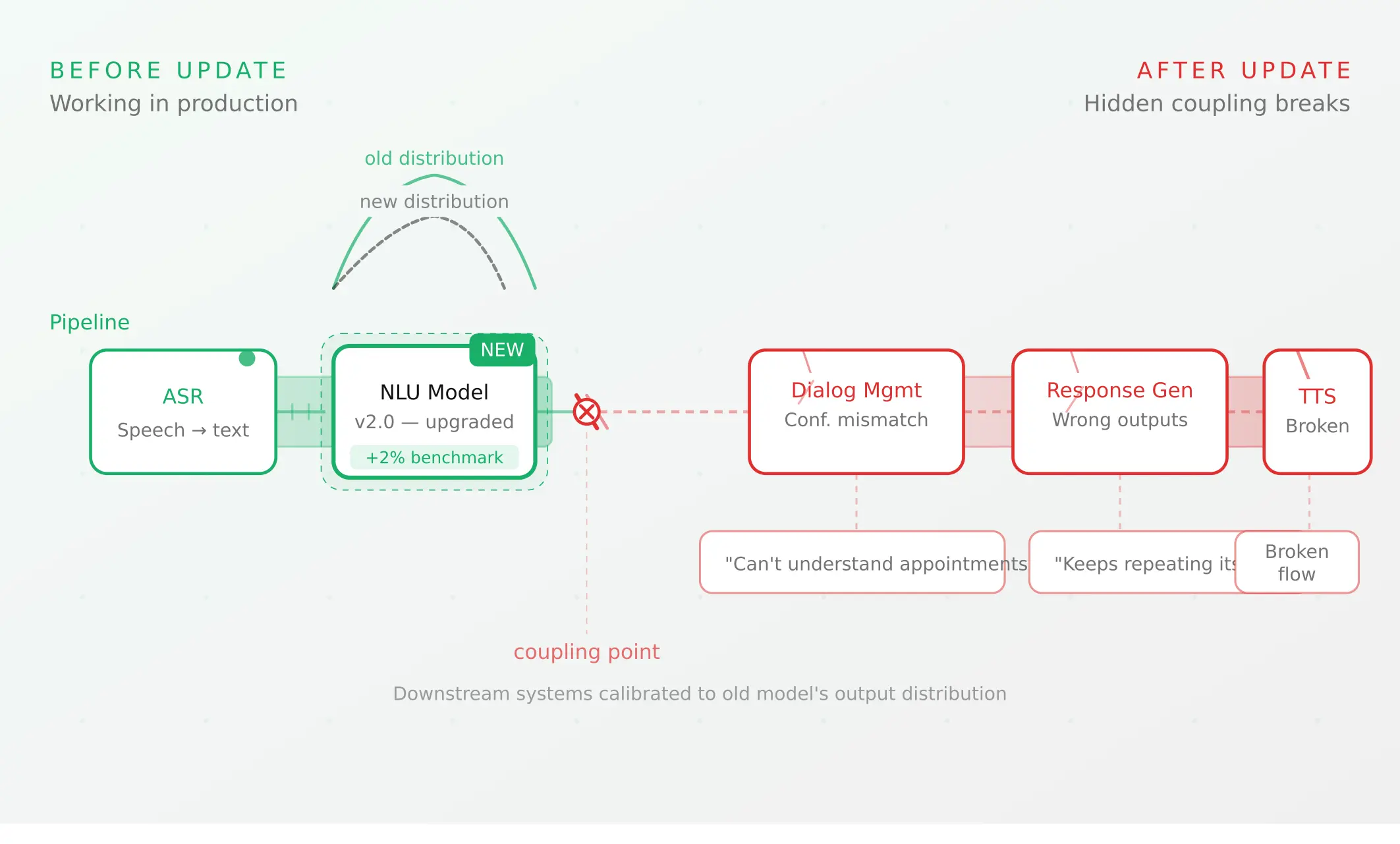
Voice agent regression testing: why LLM updates break production
LLM updates improve benchmarks but break voice agents in 5 predictable ways. How to detect and prevent regressions after every model or prompt change.
Read more