AI Voice Agent for Hotels: A Step-by-Step QA Guide
On this page
This guide is for the product and engineering team behind a hotel PMS, guest messaging tool, booking engine, vacation-rental platform or travel app. You built a voice agent into your product. It now answers phones for dozens or hundreds of properties. Every prompt change ships to all of them at once. Most testing is still a few people making calls by hand.
Buying a voice vendor instead? Read our guides to evaluating a reservations voice agent vendor and evaluating a travel booking voice agent vendor. This post is the builder's side. It covers what each call must capture, what a speech error corrupts downstream, and how to test it before your customers' guests find out.
What an AI voice agent for hotels actually has to get right
Hospitality voice AI: a phone agent that answers or places calls for lodging, travel or venue businesses, and turns what a caller says into a record in a system of record. That record is a reservation, a folio charge, a work order or a ticket.
The category is real and moving fast. Canary Technologies announced its AI Voice platform in February 2025, bundling front desk, concierge and central reservations assistants. Cloudbeds unveiled Engage, an AI voice concierge that books rooms using live PMS data, in April 2025. Many smaller PMS and rental platforms are building their own AI voice agent for hotels, often with an AI concierge phone line for guests already on property.
Whoever builds it, the call has the same shape. It is the front door to an agentic workflow with four steps:
1. Capture. The agent hears dates, a name, a room type, a guest count and a loyalty number.
2. System action. It calls availability, rate and booking tools in the property management system (PMS), booking engine or channel manager.
3. Confirmation. It reads the result back and the caller agrees.
4. Write-back. The reservation, charge or task lands in the record that staff and billing trust.
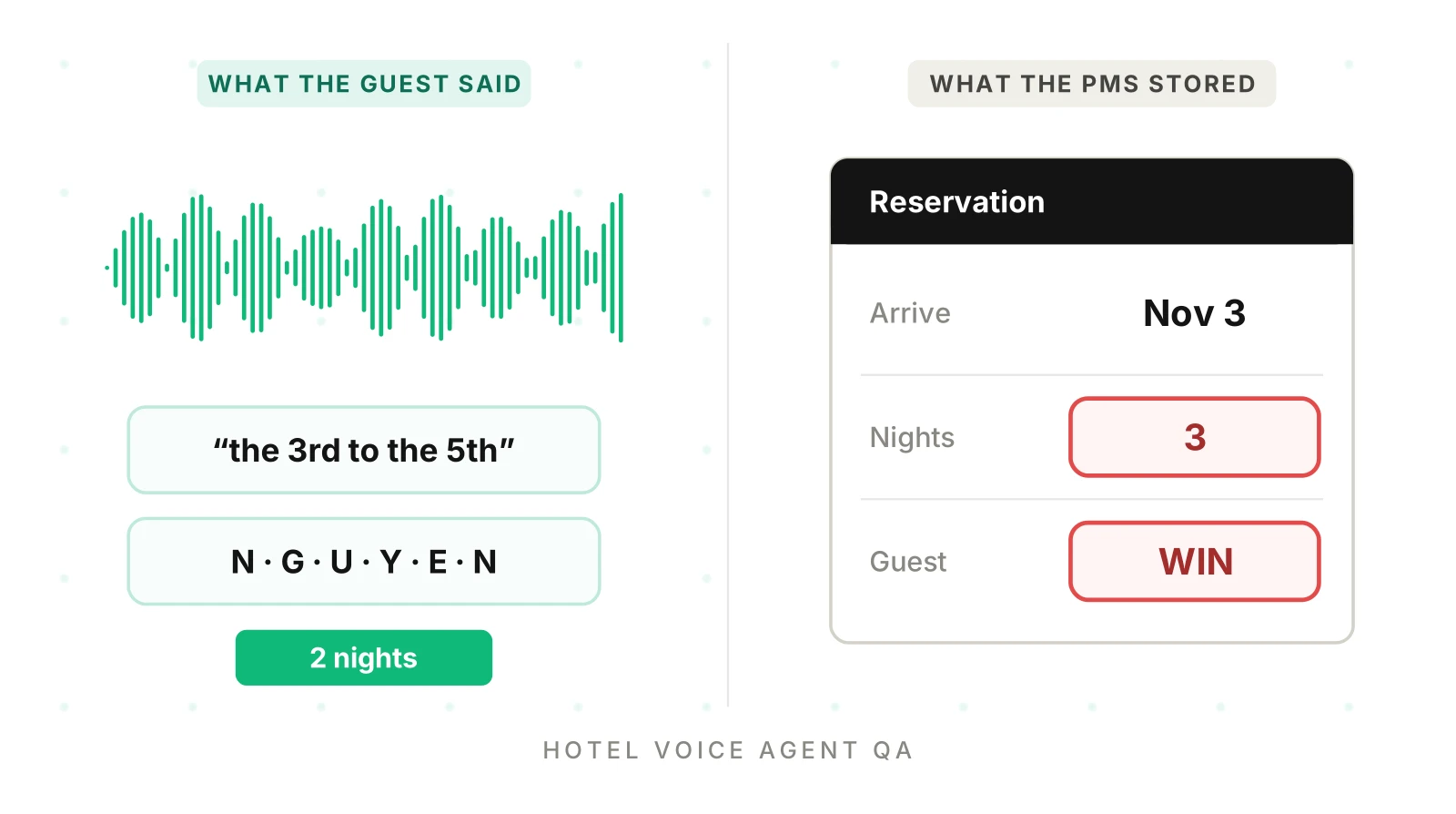
The dangerous failures happen between steps 1 and 4. The conversation sounds fine. The transcript reads fine. But the PMS now holds a stay that ends one night early, under a misspelled name, at a rate the guest was never quoted. Nobody notices until the guest is standing at the desk.
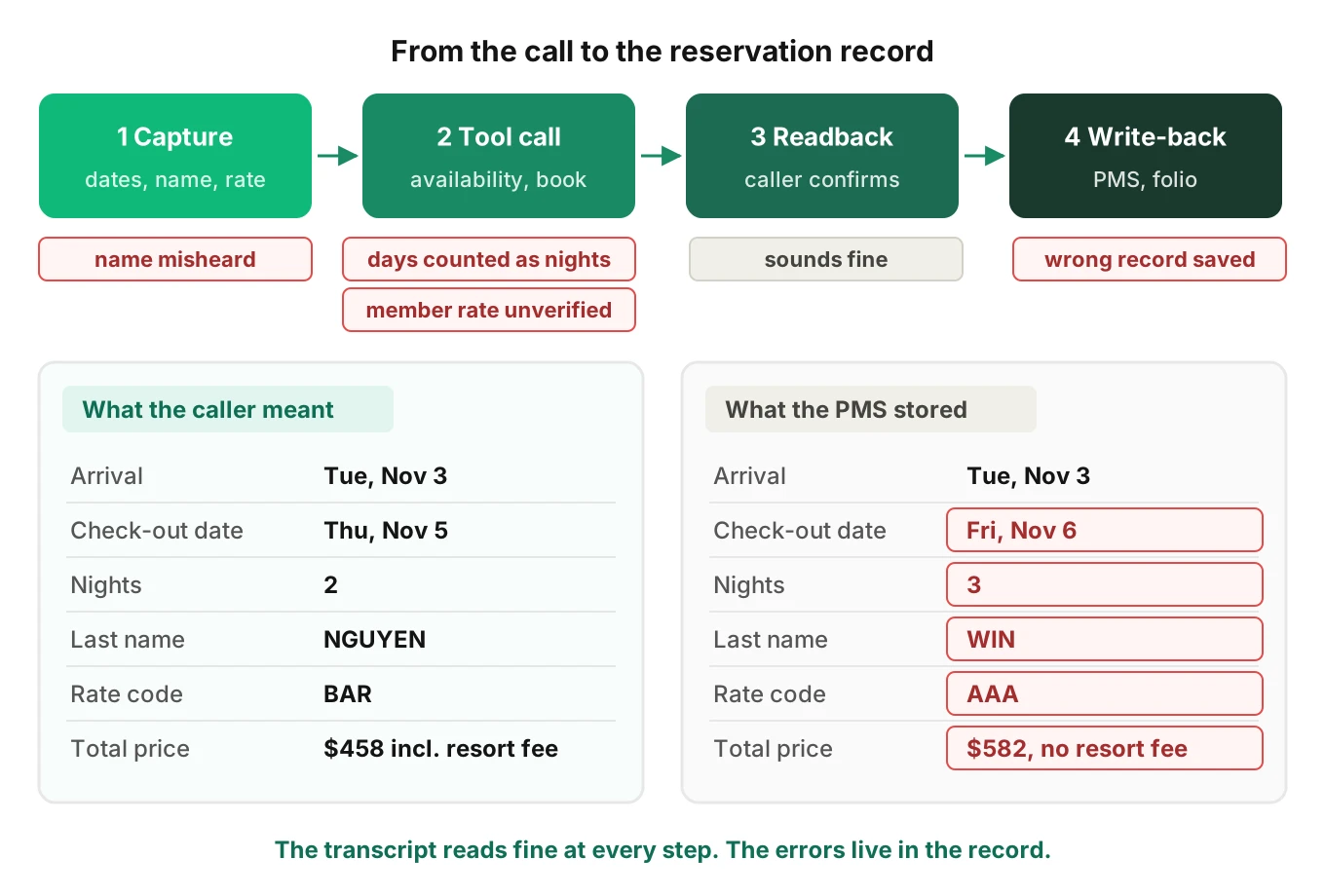
That is why QA for a hotel AI phone agent scores the written record. It checks it against what the caller meant. Scoring how polite the call sounded is not enough. Our guide to tool-argument accuracy from speech covers the general method. This post applies it to hospitality.
The trade and use-case map
Hospitality is not one use case. Picture a hotel AI receptionist, a vacation rental AI phone line, a travel disruption desk and a fun center's party line. They share a stack. They fail in different places. An AI voice agent for hotels alone covers three distinct call types. Use this map to decide what each test suite must cover.
| Trade and call type | What the call must capture | What a speech error corrupts | How to test it |
|---|---|---|---|
| Hotels: reservations | Arrival and departure dates, nights, room type, rate code, adults and children, loyalty number, guest name, total price | PMS reservation, rate plan, folio, loyalty credit | Date-phrase sets, spelled names, rate-code edge cases, total-price assertions |
| Hotels: guest requests | Room number, request type, urgency, time window | Housekeeping or maintenance work order, front desk queue | Room-number confusions, routing assertions, urgent-versus-routine triage |
| Hotels: lookups and changes | Confirmation number, name, new dates, late check-out time | Existing reservation, folio charges, departure time | Lookup by partial data, change-versus-new-booking checks |
| Vacation rentals: guest support | Property, booking, issue (door code, Wi-Fi, appliances, noise, leak) | Access log, owner incident record, emergency dispatch | Identity checks before codes, after-hours escalation paths |
| Vacation rentals: direct bookings | Dates, guests, pets, property rules, minimum stay, total price | Booking, house-rules acceptance, cleaning and security deposit | Minimum-stay and pet-policy traps, fee disclosure checks |
| Leisure and corporate travel | Traveler names, dates, flight or segment, fare rules, change fees | PNR or itinerary, ticket reissue, refund or credit | Name-order and spelling sets, fare-rule readback, disruption flows |
| Attractions and venues | Date, time slot, ticket types, party size, add-ons | Ticket order, party booking, deposit | Slot-capacity edge cases, add-on and total-price checks |
Hotels: reservations, requests and lookups
Reservations carry the most money per call. Each one sets the length of stay, the rate and the folio. An AI reservation agent must capture at least eight fields correctly at once. One wrong field is a wrong booking.
Rate codes are a quiet trap. "AAA rate," "government rate" and "the corporate rate for Acme" each map to a rate plan code with eligibility rules. The agent must not attach a member rate it cannot verify. It must also say when ID is needed at check-in, if the property's policy says so. Test every rate code a property offers, plus invented ones like "the friends-and-family rate."
A guest request looks easy and routes badly. "The AC in 412 is making a noise" is maintenance. "We need more towels in 412" is housekeeping. "Someone is banging on 414" is security or the front desk now. A misheard room number sends a technician to the wrong door. Test room numbers that sound alike: 412 versus 420, 1413 versus 1430, "fourteen-oh-two."
Lookups and changes break when the agent books a new stay instead of modifying the old one. Then the guest holds two reservations and gets a no-show charge. A late check-out request must also change the departure time on the record. A promise made on the phone means nothing to the desk if it never reaches the PMS.
Vacation rentals: support at 2 a.m.
A vacation rental AI phone line often has no staff behind it at night. That changes the stakes. A lockout at 2 a.m., a leak or a noise complaint needs the right answer the first time.
The hard question is when to give out a door code. The agent must check that the caller is the booked guest, inside the stay window, for that exact property. Codes for the wrong unit are a security incident, not a support miss. Direct bookings add property rules: pet limits, minimum stays, party bans and cleaning fees. Our companion post on vacation rental AI phone support goes deep on door codes, Wi-Fi and appliance calls. Use it for that trade's test library.
Leisure and corporate travel
Travel calls handle itinerary changes and disruptions. They need traveler names exactly as ticketed, dates, segments and fare rules. A one-letter name error can make a ticket unusable. Reading back fare rules matters because change fees and credits differ by fare.
Some travel products now point the agent the other way. The AI calls an airline or hotel for the traveler, waits on hold and negotiates a change. That needs outbound testing: hold music, IVR menus, human agents who interrupt, and voicemail. Our outbound voice agent testing guide covers those mechanics. If your agent calls travelers instead, note that the FCC ruled in FCC 24-17 (February 2024) that AI-generated voices count as "artificial" voices under the TCPA. Consent rules then apply.
Attractions and venues
Ticketing and party bookings look simple: a date, a time slot, ticket types and add-ons. The failures are capacity and money. Booking 14 kids into a slot that holds 12 creates a problem on the day. Pizza, socks, a private room and a deposit all add to the total. Live-event tickets are also covered by the same FTC fee rule as lodging, covered below.
The six hazards that break hospitality calls
These six hazards account for most silent record errors in hospitality voice AI. Each one gets its own test set.
Dates: nights are not days
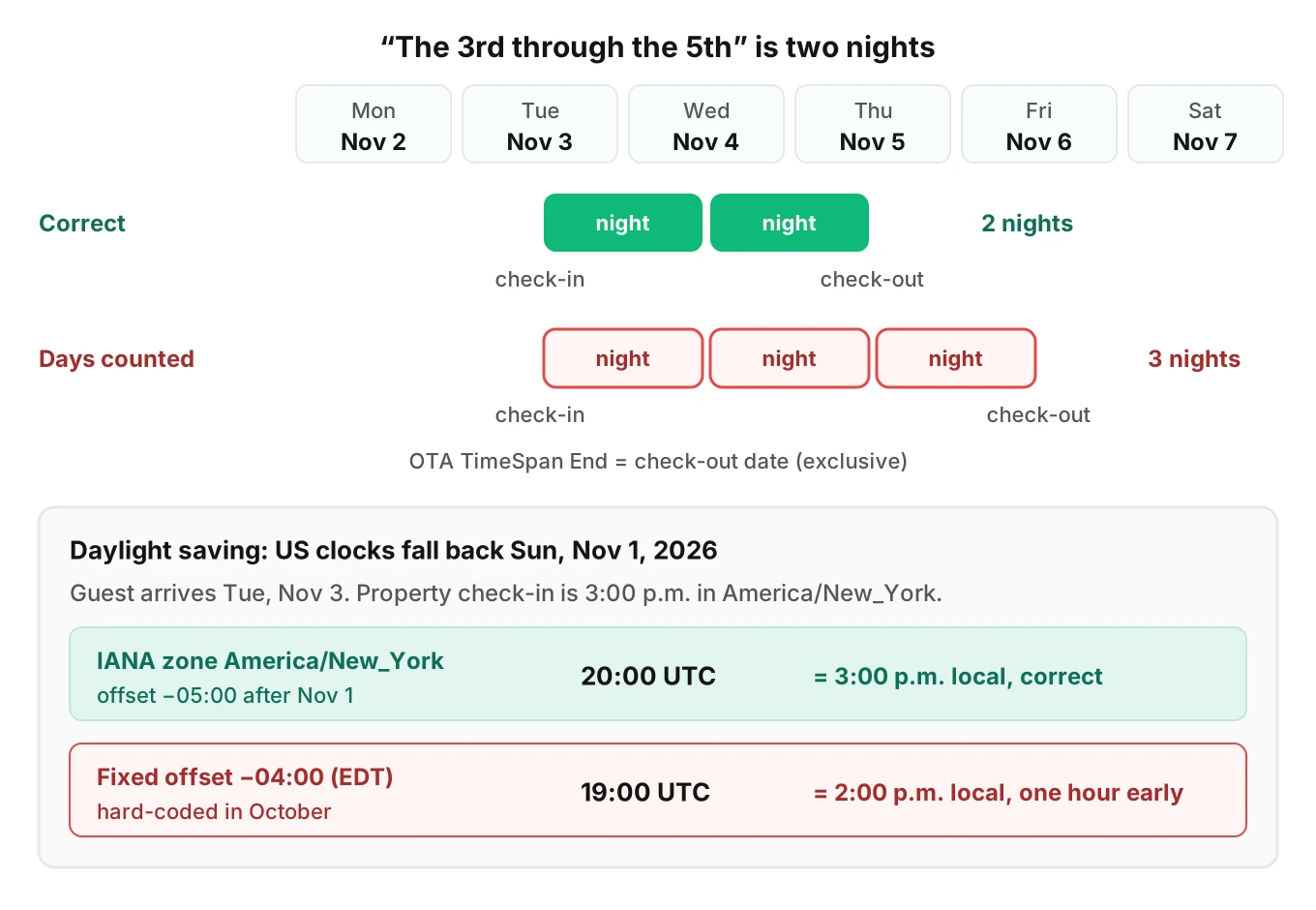
"The 3rd through the 5th" means two nights. The guest arrives on the 3rd and checks out on the 5th. A model that counts days gets three. A model that treats "through the 5th" as "staying the night of the 5th" books three nights and checks out on the 6th. Both are plausible readings. Only one matches the guest.
Systems encode this too. In the widely used OpenTravel message `OTA_HotelResNotifRQ`, a room stay's `TimeSpan` `End` is the check-out date, per the SiteMinder reservation API spec. The same spec says a rate's `ExpireDate` is "the first day after the applicable period." End dates are exclusive in some fields and labelled loosely in others. Your tool layer must convert the caller's words into exactly that convention. Your tests must check the converted value, not the words.
Research backs the worry. Google's Test of Time benchmark (ICLR 2025) found that GPT-4, Gemini 1.5 Pro and Claude 3 Sonnet scored only 13.5–16% on duration questions. About 21–25% of their wrong duration answers were off by just one day. Those are older models, so re-measure on yours. But off-by-one is exactly the nights-versus-days error.
Speech recognition is usually not the culprit here. In the Earnings-21 benchmark (Interspeech 2021), commercial ASR systems had roughly 5–10% word error rate on DATE spans. The words come through. The interpretation goes wrong. So date tests belong at the reasoning and tool-argument layer, not only at speech-to-text.
| Caller says (call on Oct 30, 2026) | Arrival | Check-out date | Nights | Trap |
|---|---|---|---|---|
| "The 3rd through the 5th" | Tue, Nov 3 | Thu, Nov 5 | 2 | Counting days gives 3 |
| "Three nights starting Friday" | Fri, Oct 30 | Mon, Nov 2 | 3 | "This Friday" is today |
| "Next weekend" | Fri, Nov 6 | Sun, Nov 8 | 2 | Some callers mean Sat–Sun only |
| "The 5th to the 7th of March" (UK guest) | Fri, Mar 5, 2027 | Sun, Mar 7, 2027 | 2 | "03/05" means May 3 elsewhere |
| "Checking out the morning of the 2nd" | Earlier booked date | Mon, Nov 2 | Varies | Agent must not add a night |
The worked table above assumes a call on Friday, October 30, 2026. Pin "today" in every test. Relative dates such as "this Friday" and "next weekend" change meaning with the call date. A test that passes on Monday can fail on Friday.
Time zones and daylight saving
"Today," "tonight" and "check-in at 3" all mean property local time, not caller local time. A guest in Los Angeles calling a hotel in New York at 10 p.m. is calling at 1 a.m. property time. "Can I check in tonight?" now refers to a different date. The agent must take the time zone from the property's config, using an IANA time zone name such as `America/New_York`.
Daylight saving adds a second trap. US clocks fall back on Sunday, November 1, 2026. An agent that converts with a fixed UTC offset will be an hour off for any arrival after that. Flights make it worse, because departures are local to the airport. Test calls that cross a time zone and calls that book across a DST change.
Guest names and loyalty numbers
Names are where speech recognition fails hardest. In Earnings-21, word error rate on PERSON spans ran about 42–52% across the commercial systems tested. It was the hardest entity class for every system. An ACL 2023 study on spontaneous speech went further. A named entity model recognized only about 18% of entities correctly when the ASR had substituted a word inside the span. Neither study used hotel calls. But both point the same way: names need their own capture path.
That path is spelling and readback. When a caller says "Nguyen, N as in Nancy, G, U, Y, E, N," the agent must keep the letters, not the first-pass transcript. It must read back the spelling in the same letter-by-letter form. Loyalty numbers and confirmation codes are alphanumeric and suffer the same way. B, D, E, G, P, T, V and Z sound alike on an 8 kHz phone line. Our guide to evaluating STT for names and entities has a full entity test method.
Rates, taxes and the total price
Since May 12, 2025, the FTC's Rule on Unfair or Deceptive Fees (16 CFR Part 464) has covered short-term lodging. That includes hotels, motels, inns, short-term rentals and vacation rentals. It also covers live-event tickets.
Three parts of the rule matter for a voice agent:
1. Total price first. A business may not quote a price "without clearly and conspicuously disclosing the total price." The total includes mandatory fees, such as a resort fee. It may exclude government charges and optional add-ons.
2. Before consent, disclose the rest. Before the guest agrees to pay, the business must disclose "the nature, purpose, and amount" of any excluded charge, plus "the final amount of payment."
3. Audible means audible. The rule's definition of clear and conspicuous covers phone calls directly. An audible disclosure "including by telephone" must be delivered "in a volume, speed, and cadence sufficient for ordinary consumers to easily hear and understand it."
That third point is a voice-specific test. A TTS voice that rushes the fee sentence at 1.3x speed, or that gets cut off by barge-in, may fail the standard even if the transcript is perfect. You can only check that from the audio. The FTC's Federal Register notice explains the rule's scope in full. This section is not legal advice. Have counsel confirm how the rule applies to your customers.
Test it with assertions, not vibes. For every quote, the total price must be the first price spoken. It must include each mandatory fee in that property's config. Taxes, if excluded, must be named before the booking is confirmed. The final amount must be stated before the agent books.
Card capture by phone
Many properties want the agent to take a card to guarantee the room. PCI DSS makes that the riskiest part of the call.
PCI DSS Requirement 3.3.1 bars storing sensitive authentication data, such as the card security code, after authorization. The PCI SSC's FAQ 1210 (June 2025) applies that to audio. Storing security codes in recordings after authorization "is therefore a violation," even if encrypted. It says "every effort must be made to prevent the data from being recorded." The council's telephone payments supplement adds guidance on VoIP scope and call recording.
A voice agent makes more copies than a human agent does. The card number can land in the call recording and the streaming STT transcript. It can also land in the LLM context, tool-call logs, your observability traces and your eval dataset. Each copy is in scope. The safer pattern is to keep card digits out of the speech pipeline. Hand off to DTMF entry with masking, or text a secure payment link.
Then test the leak paths. Have synthetic callers read a test card number out loud, even when told to use the keypad. Assert that no 13–19 digit sequence or three-digit security code survives in any transcript, log or recording. Our post on PII leakage detection has the redaction test set. This is not legal or compliance advice. Your QSA has the final word on scope.
Multilingual guests
Hotels serve international guests. Many will switch languages mid-call or use their own date format. "Del 3 al 5" in Spanish and "du 3 au 5" in French carry the same nights-versus-days trap as English. A German guest may say "Dreizehnter" for the 13th. A UK guest may read "03/05" as the 3rd of May.
Test each language a property advertises, with the same date, name and fee assertions as English. Check that the readback and fee disclosure happen in the caller's language. Our guide to testing multilingual handling covers language detection and switching.
A validator for the reservation record
Every test call should end with a check of the written record, not the transcript. The code below is a simplified sketch. It checks a captured reservation against what the test caller intended and against the property's config. It uses only Python's standard library.
# Simplified: validate a reservation written by the voice agent.
from dataclasses import dataclass
from datetime import date, datetime
from zoneinfo import ZoneInfo

@dataclass
class Property:
    tz: str                     # IANA name, e.g. "America/New_York"
    mandatory_fees: dict        # {"resort_fee": 35.00} per night
    rate_codes: set             # codes this property actually sells

@dataclass
class Expected:                 # what the synthetic caller meant
    arrival: date
    departure: date             # check-out date, exclusive
    last_name: str
    rate_code: str

def validate(rec: dict, exp: Expected, prop: Property, spoken: str) -> list:
    errors = []
    arr = date.fromisoformat(rec["arrival"])
    dep = date.fromisoformat(rec["departure"])
    nights = (dep - arr).days
    if (arr, dep) != (exp.arrival, exp.departure):
        errors.append(f"dates {arr}->{dep}, expected {exp.arrival}->{exp.departure}")
    if rec.get("nights") != nights:
        errors.append(f"nights field {rec.get('nights')} != {nights}")
    today = datetime.now(ZoneInfo(prop.tz)).date()   # property time, not server time
    if arr < today:
        errors.append("arrival is in the past in property time")
    if rec["last_name"].casefold() != exp.last_name.casefold():
        errors.append(f"name {rec['last_name']!r} != {exp.last_name!r}")
    if rec["rate_code"] not in prop.rate_codes or rec["rate_code"] != exp.rate_code:
        errors.append(f"rate code {rec['rate_code']!r} invalid or unexpected")
    fees = sum(prop.mandatory_fees.values()) * nights
    if abs(rec["quoted_total"] - (rec["room_total"] + fees)) > 0.01:
        errors.append("quoted total excludes a mandatory fee")
    if f"{nights} night" not in spoken.lower():
        errors.append("readback never stated the number of nights")
    return errors
Three details matter. "Today" comes from the property's time zone, never the server's. The nights field is checked against the dates, because some tools accept both and trust whichever came last. And the readback check runs on what the agent actually said, so a correct record behind a confusing readback still fails.
Testing across many properties' configurations
Here is the multi-property problem. You do not ship one agent. You ship one agent plus hundreds of configs. Each property has its own rates, policies, amenities, fees, hours, languages and time zone. A prompt change that works for a downtown hotel can break a beach resort with a resort fee, a pet policy and a 4 p.m. check-in.
This is the same shape as a restaurant brand rolling a voice agent to hundreds of stores. Our post on drive-thru voice AI QA across 500 stores covers the general approach. For hospitality, start by grouping properties into archetypes by config features that change the agent's behavior:
- Fees: no mandatory fee, resort or destination fee, cleaning fee.
- Policies: pets, minimum stay, age to book, deposit, cancellation window.
- Rates: public only, member and AAA rates, corporate codes, packages.
- Hours and staffing: 24-hour desk, limited desk, no on-site staff.
- Geography: time zone, DST rules, languages offered.
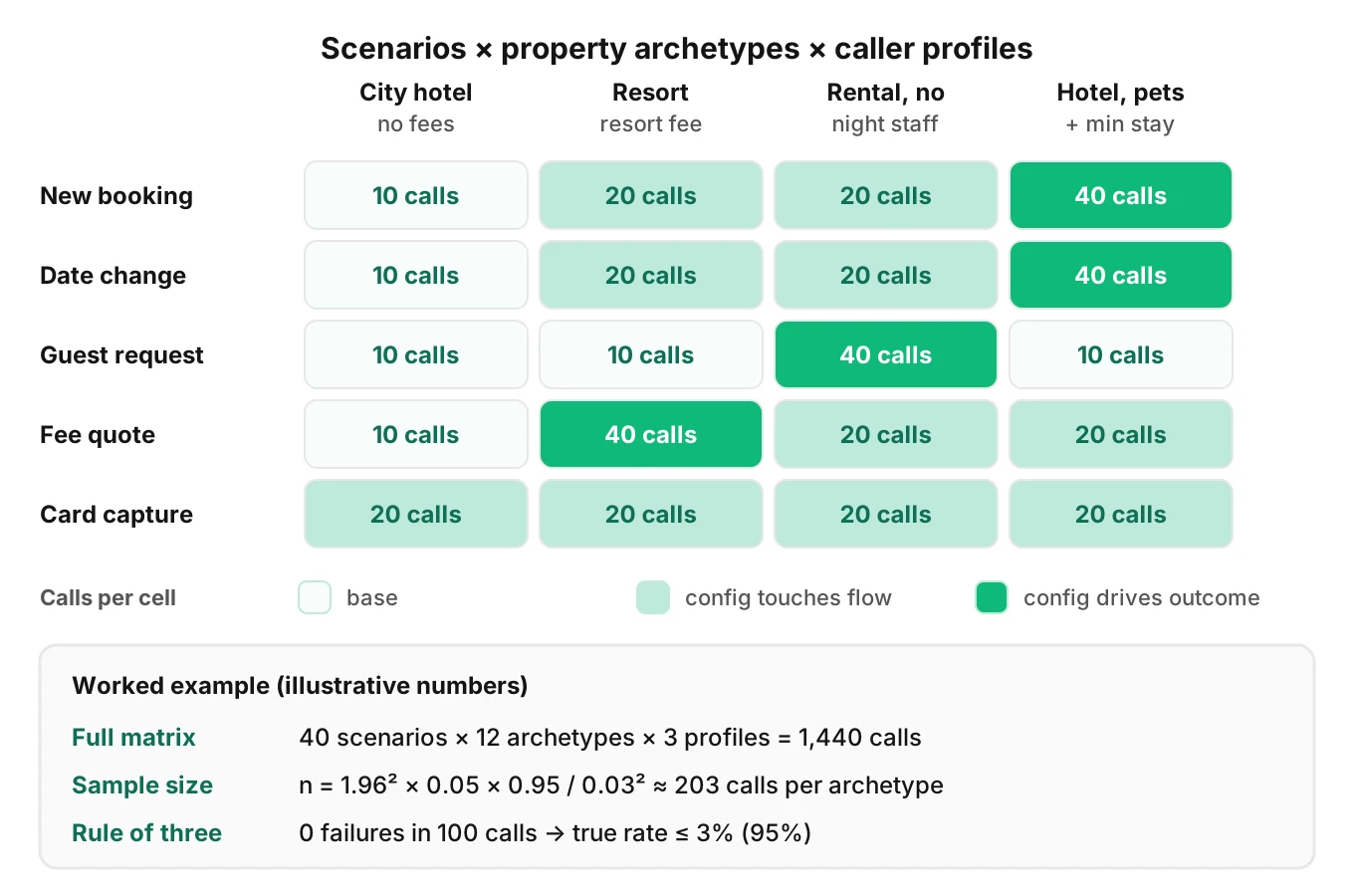
Then build a test matrix of scenarios × property archetypes × caller profiles.
The worked math
The numbers below are an illustrative worked example, not data from any customer.
Say you have 40 scenarios, 12 property archetypes and 3 caller profiles. A full matrix is 40 × 12 × 3 = 1,440 calls. That is too many to run by hand on every release. It is easy for an automated caller.
How many calls do you need per archetype to trust an error rate? Use the normal approximation: n = z² × p × (1 − p) / E². For a 5% expected booking-error rate, a ±3-point margin and 95% confidence (z = 1.96), n = 3.8416 × 0.05 × 0.95 / 0.0009 ≈ 203 calls.
For a release gate, the rule of three is simpler. If you run n calls with zero failures, the 95% upper bound on the true failure rate is about 3/n. So 100 clean calls on an archetype bounds its error rate at about 3%. 300 clean calls bounds it at about 1%.
Spend calls where config changes behavior. Archetypes with resort fees, pets or no night staff get more calls than plain ones. Every config change for a single property should also trigger a small re-test of that property, because a typo in a fee table is a release too. Our guide to shipping prompt changes safely covers versioning and rollback.
How to QA an AI voice agent for hotels, step by step
1. Write down the record schema. List every field each call type writes: arrival, check-out date, nights, room type, rate code, guests, loyalty number, name, total price, work order type, room number. These fields are what you will score.
2. Map trades and call types. Use the table above. Mark which call types your product handles today and which it must refuse or transfer.
3. Generate scenarios from the prompt and flows. Turn each state, branch and policy into scenarios, including the ones callers break: changing dates mid-call, two rooms with different guest counts, a rate the guest is not eligible for. Evalgent generates scenarios from an agent's prompt and flows, including policies, hard constraints and coverage gaps. That helps when one engineer owns the whole suite.
4. Build the hazard sets. Add date phrases with a pinned call date, cross-time-zone and DST calls, spelled names and loyalty numbers, fee-heavy properties, card-number attempts and each advertised language.
5. Pick property archetypes. Group your properties by fee, policy, rate, staffing and geography, as above. Load real configs, or close copies, into a staging tenant.
6. Vary the callers. Real guests call from airports, cars and lobbies. Run each scenario with caller profiles that differ in accent, pace, interruptions and background noise. Evalgent's caller profiles cover accent, speech pace, interruption level, response delay, behavior, background noise and language. Its simulator calls over PSTN, SIP or WebRTC, so the audio passes through the same phone path real guests use.
7. Score the record and the audio. Run the validator on every written reservation, charge and work order. Then judge the audio for fee disclosure pace, readback completeness and whether a barge-in cut off a required sentence. A transcript-only judge cannot hear a rushed disclosure.
8. Gate releases. Set pass bars per archetype using the rule of three. Block a release if any archetype misses its bar or any PCI leak test fails. The go-live checklist for each new customer's phone agent covers onboarding a new property.
9. Monitor production and feed failures back. Reconcile live call recordings against the records they wrote. Every mismatch becomes a new regression scenario.
What to monitor after go-live
Pre-release tests catch known failures. Production shows you the rest. Hotel calls bring accents, noise, group bookings and odd requests no test suite predicted.
Track these per property and per archetype:
- Readback-to-record mismatch rate. The dates, name or total the agent read back differ from what it wrote.
- Tool-call failures. Availability or booking calls that errored or timed out while the agent kept talking. See how to detect silent tool failures.
- Modification-versus-new-booking errors. Duplicate reservations created during change calls.
- Card data exposure. Any card-like digit run in a transcript or log.
- Escalations by hour. After-hours calls that should have reached a human but did not.
- Latency spikes. Long pauses while PMS or booking-engine lookups run.
Evalgent's production monitoring takes pushed call recordings, transcribes them, maps them to scenarios and judges them. It flags PII leakage, tool-call failures, latency spikes and policy failures with fix recommendations. Whatever tool you use, score every call rather than a sample. Our guide to monitoring voice agents in production covers the dashboard. The appointment-booking patterns in our scheduling test guide also transfer well to table, spa and tour bookings.
Frequently asked questions
How do you test an AI voice agent for hotel reservations?
To test an AI voice agent for hotel reservations, score the written reservation, not the transcript. Run synthetic calls with known intended dates, names, room types and rate codes. Then check the PMS record for exact matches, correct nights, a valid rate code and a total price that includes mandatory fees. Repeat across property archetypes, caller accents and background noise.
Can a hotel AI phone agent take credit card payments?
A hotel AI phone agent can take credit card payments, but PCI DSS makes speech capture risky. Requirement 3.3.1 bars storing card security codes after authorization, and PCI SSC FAQ 1210 applies this to call recordings. Safer designs keep digits out of STT and LLM logs. They use masked DTMF entry or a secure payment link sent by text.
Does the FTC junk fee rule apply to hotel phone bookings?
The FTC junk fee rule applies to hotel phone bookings. 16 CFR Part 464 covers short-term lodging and defines clear disclosure to include audible disclosures "by telephone." The total price, including mandatory fees, must come first. Excluded charges and the final amount must be disclosed before the guest agrees to pay. Confirm specifics with counsel; this is not legal advice.
How should an AI receptionist handle check-in and check-out dates?
An AI receptionist should convert check-in and check-out dates into an arrival date, an exclusive check-out date and a night count. "The 3rd through the 5th" means two nights, checking out on the 5th. The agent should read back weekday names and the night count. It should resolve "today" in the property's time zone, not the caller's.
How do you test a voice agent across hundreds of properties?
To test a voice agent across hundreds of properties, group them into archetypes by fees, policies, rate codes, staffing and time zone. Run a scenario matrix against each archetype with several caller profiles. Use sample-size math or the rule of three to set pass bars. Re-test any single property whose configuration changes, since a config edit is a release.
What should a vacation rental AI phone agent do at 2 a.m.?
A vacation rental AI phone agent at 2 a.m. must handle lockouts, leaks and noise with no staff on site. It should verify the caller is the booked guest for that property and stay window before sharing a door code. Emergencies such as active leaks should escalate to an on-call human or vendor, not end in a callback promise.
How accurate is speech recognition on guest names?
Speech recognition on guest names is weak. In the Earnings-21 benchmark, commercial ASR systems showed roughly 42–52% word error rate on person names, the hardest entity class tested. Dates scored far better, near 5–10%. Hotel voice agents should ask guests to spell names and read them back letter by letter before writing the reservation.
Can hospitality voice AI handle multilingual guests?
Hospitality voice AI can handle multilingual guests if each language is tested like English. Date phrases such as "del 3 al 5" carry the same nights-versus-days trap, and date formats like 03/05 differ by country. Test readback, fee disclosure and name spelling in every language a property advertises, including guests who switch languages mid-call.
The bottom line
An AI voice agent for hotels is only as good as the reservation, charge or work order it writes. Test that record across dates, names, fees, card handling and every property configuration before each release, then score every live call against it.
Related Articles

How to automate voice agent testing: synthetic callers vs manual QA
Learn how ai test automation replaces manual QA for voice agents. Compare synthetic callers vs human testers, with a 5-step framework to scale without hiring.
Read more
AI Agent Testing vs Voice Agent Testing: What General Tools Miss for Voice
AI agent testing measures text outputs. Voice agent testing measures behaviour through an acoustic pipeline. Five failure categories general tools miss.
Read more