Direct Booking AI for Vacation Rentals: Rule Errors to Test
On this page
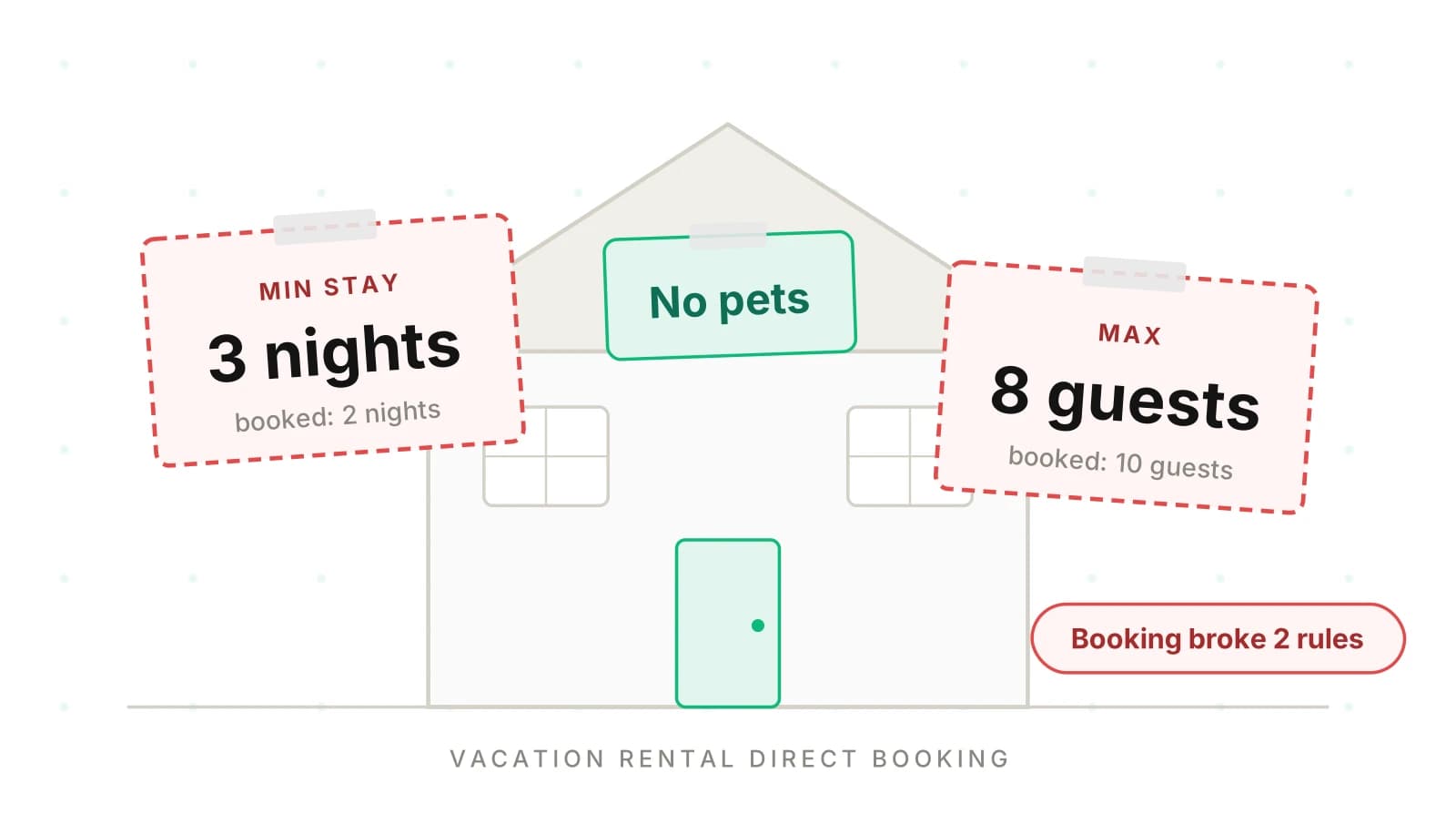
A caller wants the lake house for Labor Day weekend. She asks for Saturday to Monday, two nights. There will be ten of them, plus the dog. Your agent checks the calendar, finds the dates open and reads back a nightly rate. It sends a payment link. The reservation lands in the PMS a minute later.
Every part of that booking can be wrong. The house needs three nights on holiday weekends. It takes Friday arrivals only. It sleeps eight. It allows no pets. The quote left out the cleaning fee. None of this shows up as an error. The PMS stores a valid-looking reservation, and the manager finds out when the guests arrive.
This guide is for product and engineering teams at vacation rental software companies that ship vacation rental direct booking AI. You run one voice agent that takes direct bookings for many managers and thousands of homes. Direct booking calls differ from guest support calls, which our vacation rental AI phone support guide covers. Here the call creates revenue and a legal record. You will get a rule-error taxonomy, the fee-rule math, a sync race model, a Python rule oracle and a release gate.
What a direct booking call writes downstream
A direct booking call is not a chat. It is the front door to a transaction. The agent captures dates, guests and pets. It looks up availability and rules. It quotes a total. It creates a hold or reservation, sends a payment link and a rental agreement, and writes back to the PMS. The PMS or its channel manager then pushes the blocked dates to Airbnb, Vrbo and Booking.com. An AI booking agent for vacation rentals has to get every step right.
Vacation rental direct booking AI vendors now describe that loop openly. SendSquared, for example, describes a "real-time PMS availability lookup across the full portfolio mid-call" on its AI voice for vacation rentals page. Its voice AI guide for property managers says the agent quotes nightly rates with cleaning fees and taxes. Once an agent quotes and books, every rule becomes a test case.
Rule oracle: a deterministic function that takes a property's rules and a requested stay and returns the violations and the correct total. It never listens to the call. It only judges what the agent wrote and said.
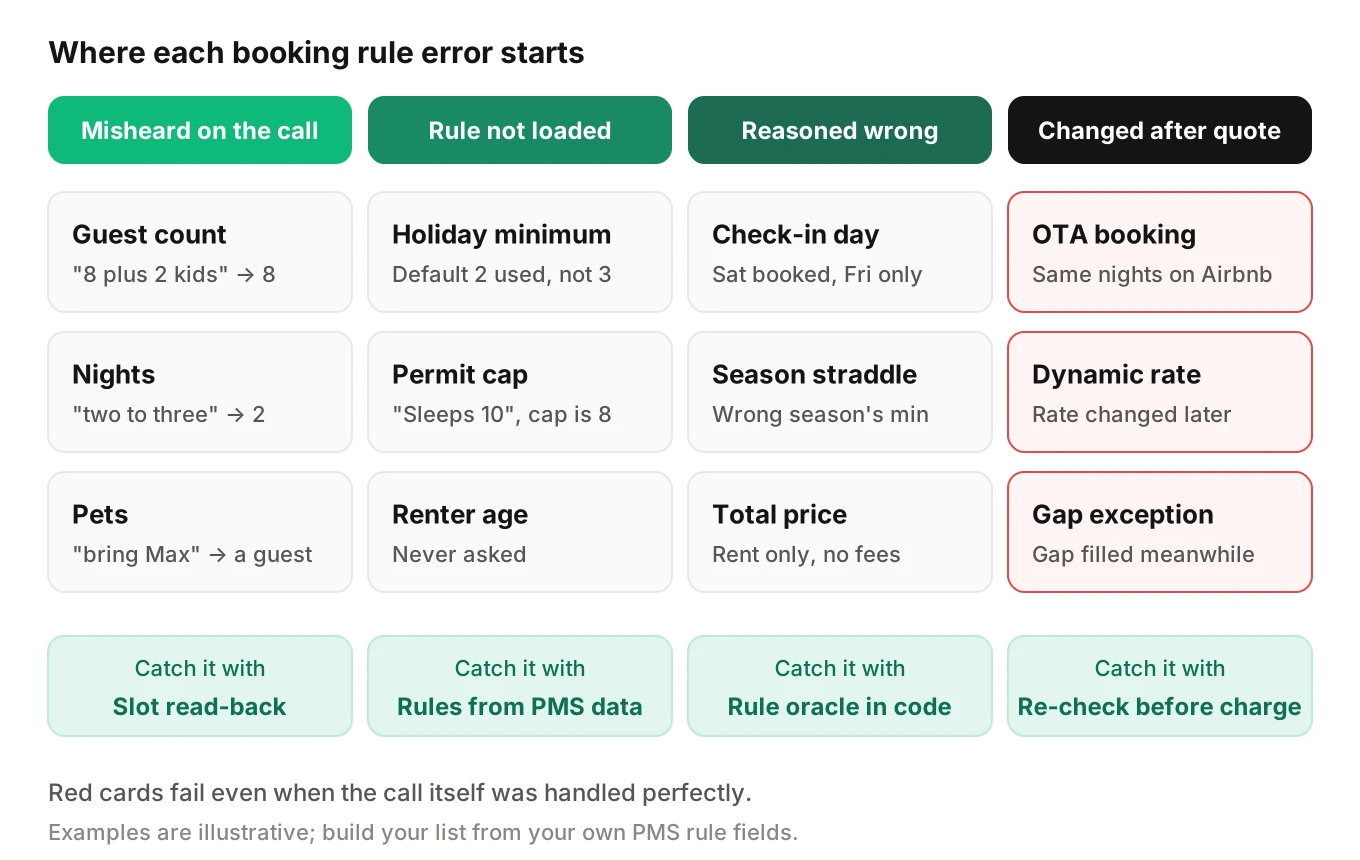
Speech errors enter at capture and travel silently. "Two to three nights" can become `nights=2`. "Eight adults, two kids" can become `guests=8`. "Ten" and "then" are close on an 8 kHz phone line. A wrong slot value produces a valid tool call, so nothing throws. Our guide to tool-argument accuracy from speech covers how to score these fields.
The rule errors that ship
Vacation rental rules live per property, per season and sometimes per date. A hotel has one rate plan table. A portfolio of 3,000 homes has 3,000 small policy documents. The table below lists the rules a booking agent must enforce and how each one breaks.
| Rule | Example | How the agent breaks it | What the PMS shows |
|---|---|---|---|
| Minimum stay | 3 nights on holidays, 7 in July | Applies the default 2-night minimum | A valid 2-night stay |
| Check-in day | Friday or Saturday only in summer | Books any open arrival day | Sunday check-in, orphaned week |
| Max occupancy | Sleeps 8, infants excluded | Counts adults only, or misses "plus kids" | 8 guests, 10 arrive |
| Pet policy | No pets, or 2 dogs max with fee | Takes "we're bringing Max" as a person | No pet fee, no pet flag |
| Age of renter | Primary renter 25 or older | Never asks, or accepts "I'm 23" | Unqualified lead guest |
| Gap nights | 2-night stays allowed only to fill a gap | Applies the exception to any dates | New orphan nights |
| Total price | Rent plus mandatory fees | Quotes rent only | Payment link higher than quote |
| Deposit and waiver | Waiver mandatory, deposit refundable | Skips or misdescribes both | Disputed charge later |
| Local permit cap | City occupancy limit below house capacity | Uses the listing's "sleeps" field | Booking over the permit limit |
The last row is local and varies widely. Some towns cap occupancy in short-term rental rules. Dillon, Colorado, approved a cap of "two people per bedroom plus two additional occupants," per the Summit Daily. Your agent should read the stricter of the permit cap and the house cap from data, never from the listing description.
Why language models miss these rules
These are classic hard constraints, and models are weak at them. The TravelPlanner benchmark lists "No pets" and "No children under 10" as room rules. It checks that stays "meet the corresponding required minimum number of nights' stay." With 1,225 planning intents, GPT-4 reached a final pass rate of 0.6% (Xie et al., 2024). The authors note that agents struggle to keep track of multiple constraints.
Policy-following agents are also inconsistent across repeated runs. In tau-bench, gpt-4o succeeded on fewer than 50% of tasks. Its pass^8 in the retail domain was under 25% (Yao et al., 2024). A booking flow that passes once in a manual test may fail on the third identical call.
Three mechanisms make it worse for vacation rentals:
- Rules arrive as prose. "3-night min, 4 over July 4th, Sat-Sat in peak" is often a free-text field. The model must parse dates, holidays and weekdays on the fly.
- Stays straddle seasons. A June 28 to July 3 stay touches two seasons. PMSs differ on which season's minimum governs. Your oracle must copy your PMS convention, not guess.
- Context is crowded. A multi-property call may load several homes' rules. The model can apply House A's pet policy to House B. Our multi-tenant voice agent testing guide covers that bleed.
The fix is architectural. Let the model collect slots and talk. Let code decide validity. Then test that the model actually calls that code and respects its answer.
Quoting the total price under the FTC fee rule
The FTC's Rule on Unfair or Deceptive Fees covers short-term lodging. Its definition of covered goods includes stays at a "short-term rental, vacation rental, or other place of lodging" (16 CFR 464.1). The rule took effect May 12, 2025, per the FTC's business FAQ.
Three parts matter for a phone agent:
1. Total price. It is "the maximum total of all fees or charges a consumer must pay." Government charges and optional add-ons may be excluded. A mandatory cleaning fee may not. The FTC FAQ says plainly: "The cleaning fee must be included in the total price."
2. Prominence. Under 16 CFR 464.2(b), the total price must be disclosed "more prominently than any other pricing information."
3. Before payment. Under 464.2(c), excluded charges and the final amount must be disclosed before the consumer consents to pay.
Phone calls are named in the rule. An audible disclosure, "including by telephone," must come "in a volume, speed, and cadence sufficient for ordinary consumers to easily hear and understand it." A TTS voice that rushes through fees at the end of a long turn is a test target.
Here is a worked example with illustrative numbers. Three nights at $289 is $867 of rent. Mandatory fees are a $195 cleaning fee and a $59 damage waiver. The guest brings a dog, so a $75 pet fee applies.
| Line | Amount | In total price? |
|---|---|---|
| Rent, 3 nights x $289 | $867.00 | Yes |
| Cleaning fee (mandatory) | $195.00 | Yes |
| Damage waiver (mandatory here) | $59.00 | Yes |
| Pet fee (applies to this booking) | $75.00 | Yes |
| Total price | $1,196.00 | Lead with this |
| Lodging tax, illustrative 11% | $131.56 | May be excluded, must be disclosed |
| Final amount before payment | $1,327.56 | Disclose before the link |
The failing agent says "$867 for three nights" and sends the link. The compliant agent leads with $1,196, names the tax, and states $1,327.56 before payment. How a refundable security deposit should be described is a question for your counsel. This section is not legal advice.
Make the oracle compute these numbers. Never let the model add them up. Then score two things on every call: the tool-call quote and the spoken quote from the audio.
Sync races: the double booking you cannot hear
The phone agent and the OTAs sell the same nights. Nothing makes those writes atomic across channels. Two races matter.
Race one: stale availability inside the call. The agent reads the calendar at minute 1. The caller talks for eight minutes, then pays the link 20 minutes later. An Airbnb guest can book the same dates in between. If the agent never re-checks before charging, the PMS now holds two reservations.
Race two: slow propagation after the booking. The direct booking is written to the PMS. The channels learn about it later. Airbnb's help center says imported calendars "automatically update every 3 hours" (Airbnb Help). Hostaway's Vrbo iCal article says updates are "not a continuous real-time feed" and advises manual blocking until the next sync (Hostaway support). API-connected channels are faster, but they are still asynchronous.
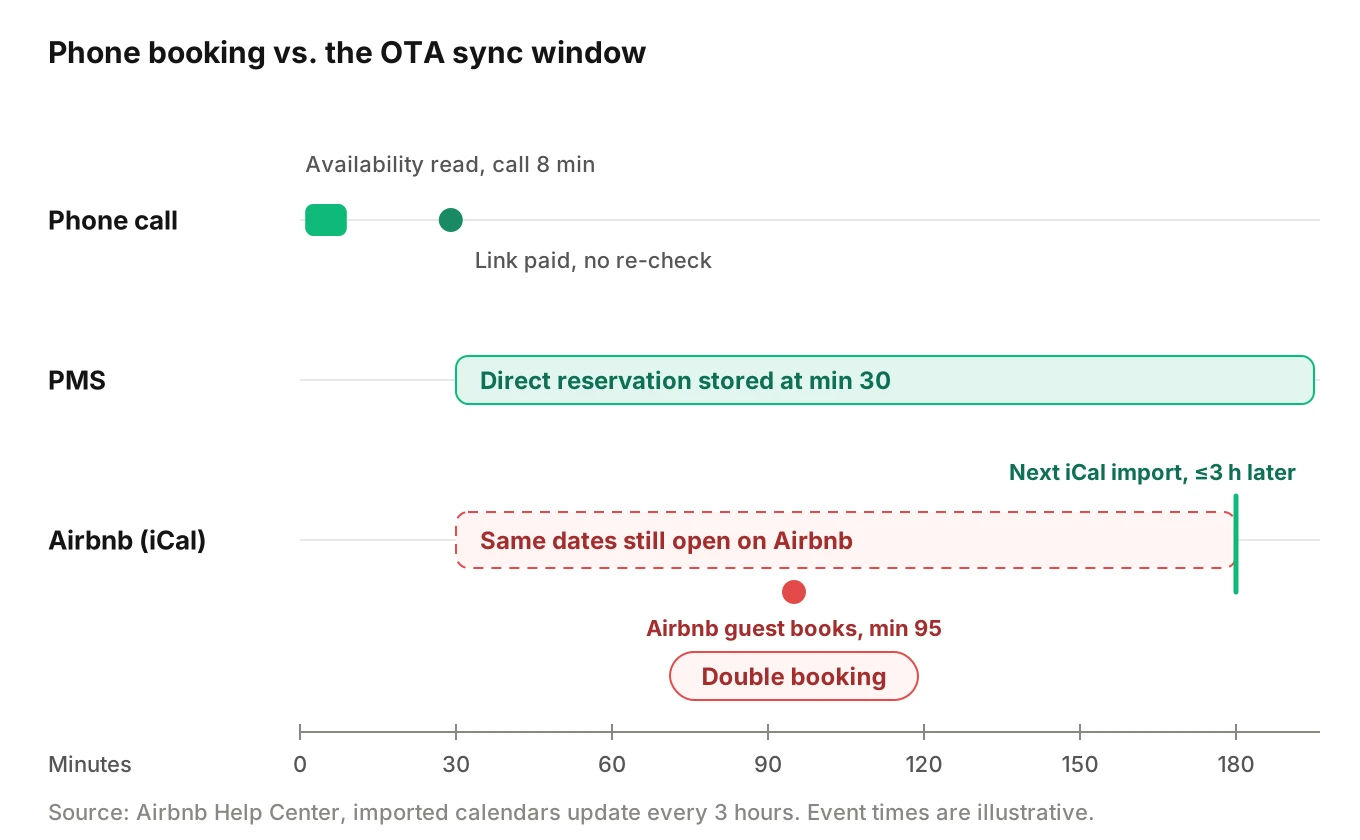
Here is the exposure math, with illustrative rates. Assume a booked listing still looks open on one OTA for a window W. Assume OTA bookings for those exact nights arrive at rate λ per hour. The chance of a collision is:
P(collision) = 1 - exp(-λ × W)

iCal, average W = 1.5 h, λ = 0.02/h  ->  1 - e^-0.03   ≈ 2.96%
API,  W = 2 min (0.033 h), λ = 0.02/h ->  1 - e^-0.00067 ≈ 0.07%
At 1,000 phone bookings a month on iCal-only listings, 2.96% is about 30 double bookings. Change the numbers to your own channel mix. The point is that the window, not the agent's speech, drives this failure.
Three controls close most of it:
- Hold on acceptance. Create a short PMS hold when the caller accepts the quote. Release it if the link expires.
- Re-check before charging. The payment step must re-query availability and fail closed.
- Use an idempotency key. A retried `create_reservation` must not create two bookings.
Dynamic pricing adds a third race. The nightly rate can change between the quote and the payment. Lock the quoted rate inside the hold, or re-quote out loud.
Your agent's speech still matters at the edges. When the re-check fails, the agent must say so clearly and offer alternatives. It must not confirm a stay it cannot hold.
A per-property rule oracle in Python
The oracle below is simplified. It handles seasons, check-in days, occupancy, pets, renter age, gap nights and the total. Load real rules from your vacation rental PMS export, not from listing text.
from dataclasses import dataclass, field
from datetime import date, timedelta

@dataclass
class Season:
    start: date
    end: date
    min_nights: int
    checkin_days: set[int]          # 0=Mon ... 6=Sun

@dataclass
class Rules:
    max_guests: int                 # min(house cap, permit cap)
    pets_allowed: bool
    min_renter_age: int
    default_min: int
    gap_min: int                    # shorter stay allowed only to fill a gap
    seasons: list[Season]
    nightly: dict[date, float]
    mandatory_fees: dict[str, float]
    pet_fee: float = 0.0

@dataclass
class Request:
    checkin: date
    checkout: date
    guests: int                     # count per the manager's infant policy
    pets: int = 0
    service_animal: bool = False
    renter_age: int = 0

def nights(r: Request) -> list[date]:
    return [r.checkin + timedelta(i) for i in range((r.checkout - r.checkin).days)]

def violations(rules: Rules, req: Request, booked: set[date]) -> list[str]:
    v, n = [], nights(req)
    if set(n) & booked:
        v.append("overlap")
    season = next((s for s in rules.seasons if s.start <= req.checkin <= s.end), None)
    min_n = season.min_nights if season else rules.default_min
    fills_gap = (req.checkin - timedelta(1)) in booked and req.checkout in booked
    if len(n) < (rules.gap_min if fills_gap else min_n):
        v.append(f"min_stay:{len(n)}<{min_n}")
    if season and req.checkin.weekday() not in season.checkin_days:
        v.append("checkin_day")
    if req.guests > rules.max_guests:
        v.append(f"occupancy:{req.guests}>{rules.max_guests}")
    if req.pets and not rules.pets_allowed and not req.service_animal:
        v.append("pets")
    if req.renter_age < rules.min_renter_age:
        v.append("renter_age")
    return v

def total_price(rules: Rules, req: Request) -> float:
    rent = sum(rules.nightly[d] for d in nights(req))
    fees = sum(rules.mandatory_fees.values())
    if req.pets and not req.service_animal:
        fees += rules.pet_fee
    return round(rent + fees, 2)
Score each call by comparing the agent's `create_reservation` arguments with `violations()`. Any booking with a non-empty list is a hard failure. Then compare the spoken total with `total_price()`, to the cent.
The `service_animal` flag is deliberate. A "no pets" rule does not settle every animal question. Airbnb's own policy, for bookings made on Airbnb, says a service animal is "not a pet" and hosts may not charge pet fees for one (Airbnb Help). Direct bookings follow the manager's policy and local law. The safe agent behavior is to route those calls to a human, not decline them.
How to test vacation rental direct booking AI before every release
Run this before any prompt, model, tool or rules-sync change reaches live callers. It builds on our prompt change shipping guide.
1. Export rules as data. Pull minimum stays, check-in days, caps, pet rules, ages, gap rules and fees per property. Flag any rule that exists only as free text.
2. Pick a property sample. Cover each PMS, each season type and each rule shape. Include strict homes, pet-friendly homes and permit-capped homes.
3. Generate boundary cases. For each rule, test the limit and one step past it. Use min stay minus one, max guests plus one, a wrong arrival day, age 24, a season straddle and a true gap.
4. Vary how callers say it. "Eight adults and two little ones." "Friday through Sunday, well, maybe Monday." Add accents, background noise, fast speech and interruptions.
5. Call over the phone. Use real PSTN or SIP so the audio matches production. Record every call.
6. Score against the oracle. Check tool-call arguments, spoken quotes from the audio and the final PMS record. Transcripts alone miss a fee read too fast to hear.
7. Inject sync races. Book the same dates through a test OTA channel during the call and after payment. Expect a clean refusal, not a double booking.
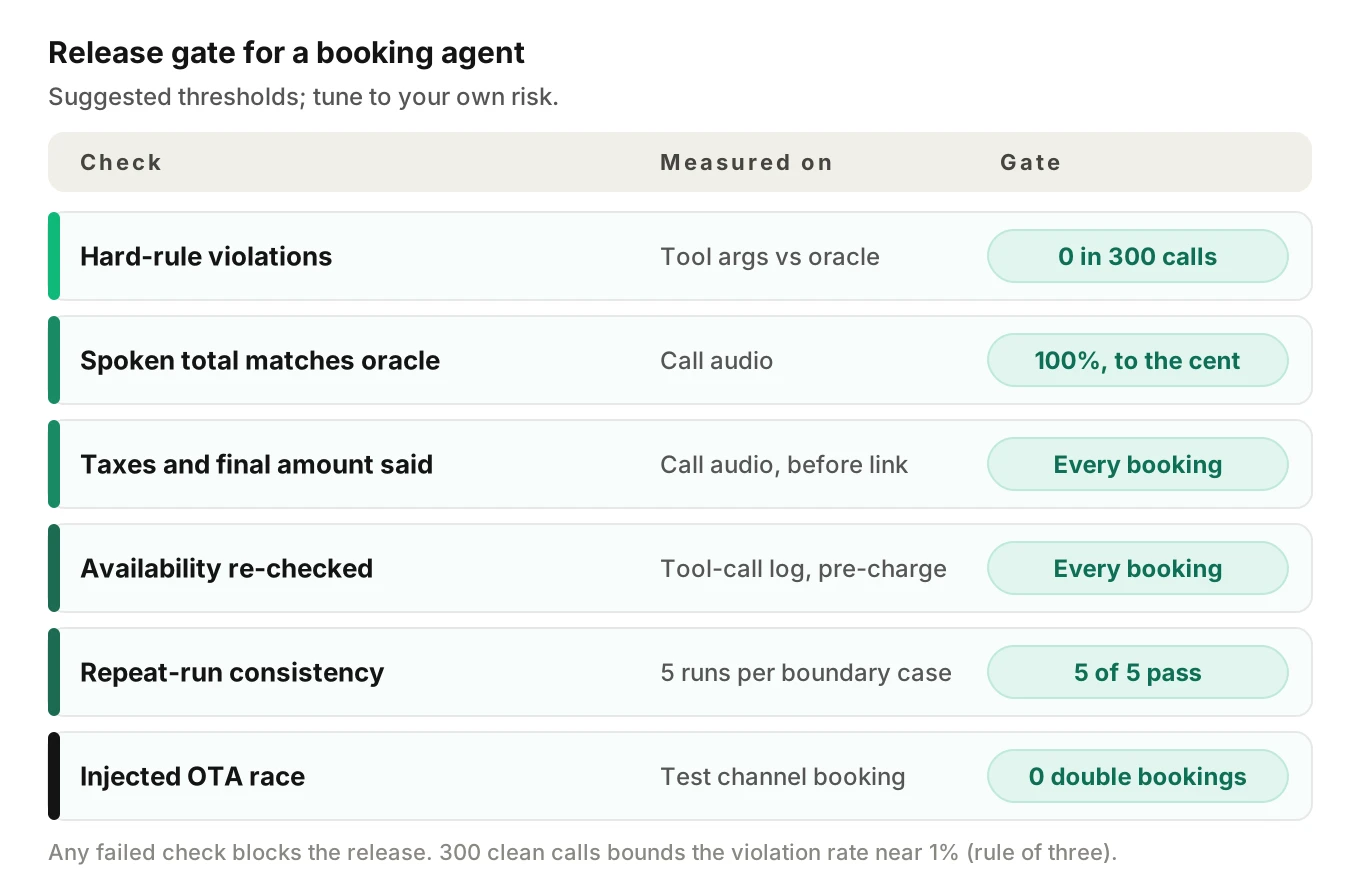
8. Repeat and gate. Run each boundary case five times. Ship only if hard-rule violations are zero.
Evalgent helps with steps 3 to 6. It generates test scenarios from the agent's prompt and flows, including policies, hard constraints and coverage gaps. It also runs caller profiles over PSTN, SIP or WebRTC. Its judge works from the audio, not just the transcript, and backs each verdict with evidence.
How many calls make a release gate
Zero failures in a small run proves little. The rule of three gives a quick bound. If you see zero violations in n independent calls, the 95% upper bound on the true rate is about 3/n.
| Zero-failure calls | 95% upper bound on violation rate |
|---|---|
| 50 | 6.0% |
| 100 | 3.0% |
| 300 | 1.0% |
| 600 | 0.5% |
So 300 clean calls supports a claim under 1%. That is a reasonable bar for hard rules on a release. Spread the calls across rule types so one easy rule does not carry the count.
Monitoring live booking calls
Pre-release tests cover the rules you thought of. Production shows the rest. Reconcile every agent-created booking against the oracle daily. Join three records: the call, the tool calls and the final PMS reservation.
Watch these signals:
- Oracle violations on live bookings. Each one is a real stay that broke a rule. Alert on the first, not the trend.
- Quote versus charge gaps. Compare the spoken total with the payment amount.
- Manager overrides and cancellations. A spike after a release points to a rule the agent now misses.
- Double-booking alerts. Tag each with the channel and the sync window.
- Per-manager drift. One manager's new holiday minimum may never have reached the agent.
Evalgent's production monitoring fits here. Teams push call recordings. Calls are transcribed, mapped to scenarios and judged. It flags tool-call failures, policy failures, PII leakage and latency spikes, with fix recommendations. For the hotel side of the same problem, see our hotel AI reservation errors guide. The broader hotel AI voice agent QA guide covers the full stay lifecycle.
Payment links carry their own risk. Never let the agent read card numbers back, and check that logs mask them. Our PII leakage guide shows how to test spoken readbacks. Before onboarding each new manager, run the go-live checklist.
Frequently asked questions
Can an AI agent take direct bookings for vacation rentals?
An AI agent can take direct bookings for vacation rentals when it reads live PMS availability, applies each property's rules in code, and quotes the full total. Some products stop at availability and hand off to a human to close. Either way, test the rules, the quote and the PMS record before letting the agent create reservations on its own.
How do you test minimum stay rules in an AI booking agent?
Minimum stay rules are tested with boundary cases per property. Request the minimum, one night less, a holiday weekend and a stay that straddles two seasons. Compare the agent's reservation arguments with a rule oracle built from PMS data. Run each case several times, because language models can pass a rule once and miss it on the next identical call.
Why do vacation rentals get double booked?
Vacation rentals get double booked because channels sync asynchronously. A phone booking may take hours to block dates on an OTA that imports calendars by iCal. A call can also read availability, then charge after an OTA booking lands. Holds on acceptance, an availability re-check before payment and idempotent reservation calls close most of the gap.
How often does Airbnb sync imported calendars?
Airbnb says imported calendars automatically update every 3 hours, and several connected calendars may update at different times. Hosts can trigger a manual refresh, which is rate-limited. API-connected PMS channels update faster than iCal. Any direct booking on an iCal-only listing should be treated as exposed until the next import.
Does the FTC junk fee rule apply to vacation rentals?
The FTC Rule on Unfair or Deceptive Fees, 16 CFR Part 464, covers short-term lodging, including vacation rentals. It took effect May 12, 2025. Offers must show a total price with all mandatory fees, such as cleaning fees. Government charges may be excluded but must be disclosed before payment. This is not legal advice.
Should the AI quote taxes and fees on the phone?
A vacation rental booking agent should quote the total price, including mandatory fees, before any rent-only figure. It should name taxes and state the final amount before sending a payment link. The FTC rule says telephone disclosures must be easy for ordinary consumers to hear and understand. Pace and clarity of the spoken quote are worth testing.
How should an AI agent handle a service animal in a no-pet rental?
A booking agent should not decline a caller who mentions a service animal at a no-pet rental. Airbnb's policy, for Airbnb bookings, treats service animals as not pets and bars pet fees for them. Direct bookings follow the manager's policy and local law, so the safest design routes these calls to a trained human.
How many test calls do you need before launching a booking agent?
A booking agent needs enough clean calls to bound its failure rate. By the rule of three, zero violations in 300 calls puts the 95% upper bound near 1%. Spread those calls across rule types, properties and caller profiles. Rerun the same set after every prompt, model or rules-sync change.
The bottom line
Vacation rental direct booking AI is only correct when every reservation passes the property's rules and every quote matches the full total. Put the rules in code, test each boundary over real phone audio, close the sync races, and reconcile every live booking against the oracle.
Related Articles

How to automate voice agent testing: synthetic callers vs manual QA
Learn how ai test automation replaces manual QA for voice agents. Compare synthetic callers vs human testers, with a 5-step framework to scale without hiring.
Read more
AI Agent Testing vs Voice Agent Testing: What General Tools Miss for Voice
AI agent testing measures text outputs. Voice agent testing measures behaviour through an acoustic pipeline. Five failure categories general tools miss.
Read more