Monitoring AI Travel Disruption Calls Before Travelers Do
On this page
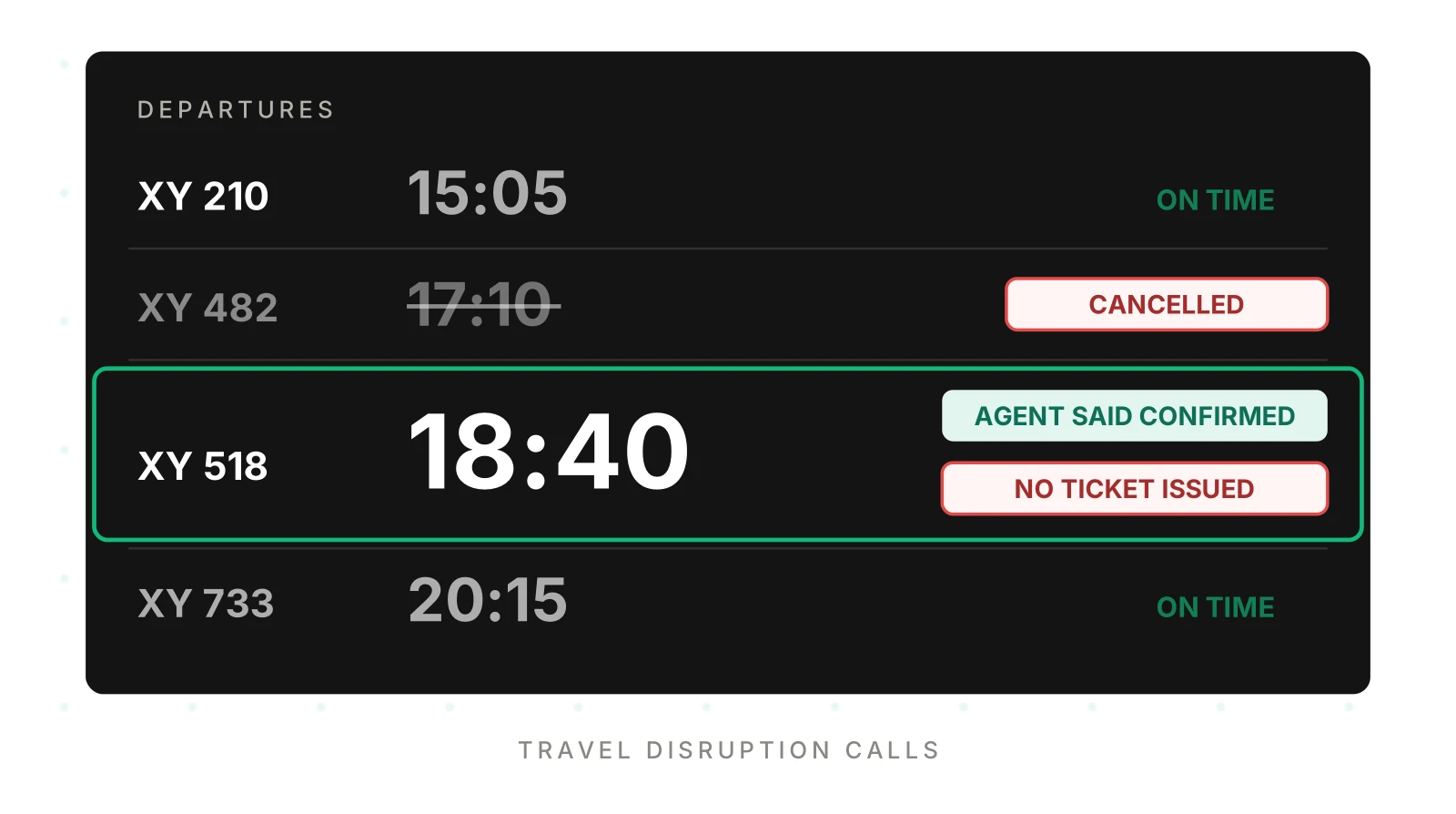
A traveler whose flight was just cancelled is your hardest caller. They are stressed, in a loud terminal, spelling a six-character code. They want a confirmed seat on something that leaves tonight.
If your team built a travel agency voice agent, these calls can do the most damage, and the damage is quiet. The agent sounds sure, the traveler hangs up relieved, and the airline has no record of the new flight.
This post covers travel disruption AI calls end to end: what the agent may claim at each step, where speech errors enter the record, what DOT refund rules mean for wording, and how to test first. For the airline-side view, see When AI Calls Airlines for Travelers. For routine itinerary changes, see AI Travel Agent by Phone. This post is about the bad-day calls.
What a disruption call actually asks your agent to do
An AI travel agent flight cancellation call looks like a chat. It is really a short workflow with a write at the end.
1. Identify the trip. The caller gives a record locator or a name. The agent finds the passenger name record (PNR).
2. Read the change. The airline cancelled, retimed or renumbered a segment. The agent says what changed and by how much.
3. Search options. The agent looks for seats on other flights, days or carriers.
4. Act. The agent holds, waitlists or tickets a new segment, or hands off.
5. Explain money. The agent states fare difference, fees, refund or credit.
6. Write back. The PNR, calendar and any approval record must match what the caller heard.
Vendors in this space describe the same split. Routespring's page on irregular operations describes a human-in-the-loop automation platform that escalates critical decisions to expert agents. A corporate travel platform, ITILITE, says on its blog that AI handles routine queries while human agents take complex ones. Those are vendor descriptions we have not tested. The principle holds: decide which steps the agent may complete alone.
This post assumes you own the agent and the tool layer, so you can see the tool calls. That is your advantage. Most disruption failures show up as a gap between what the agent said and what the tools returned.
The claim ladder: what the agent may say at each step
The core failure is a spoken claim that runs ahead of the system. The fix is a claim ladder. Each rung is a state the tools can prove, and each unlocks a specific kind of sentence. An AI rebooking voice agent should climb it one rung at a time.
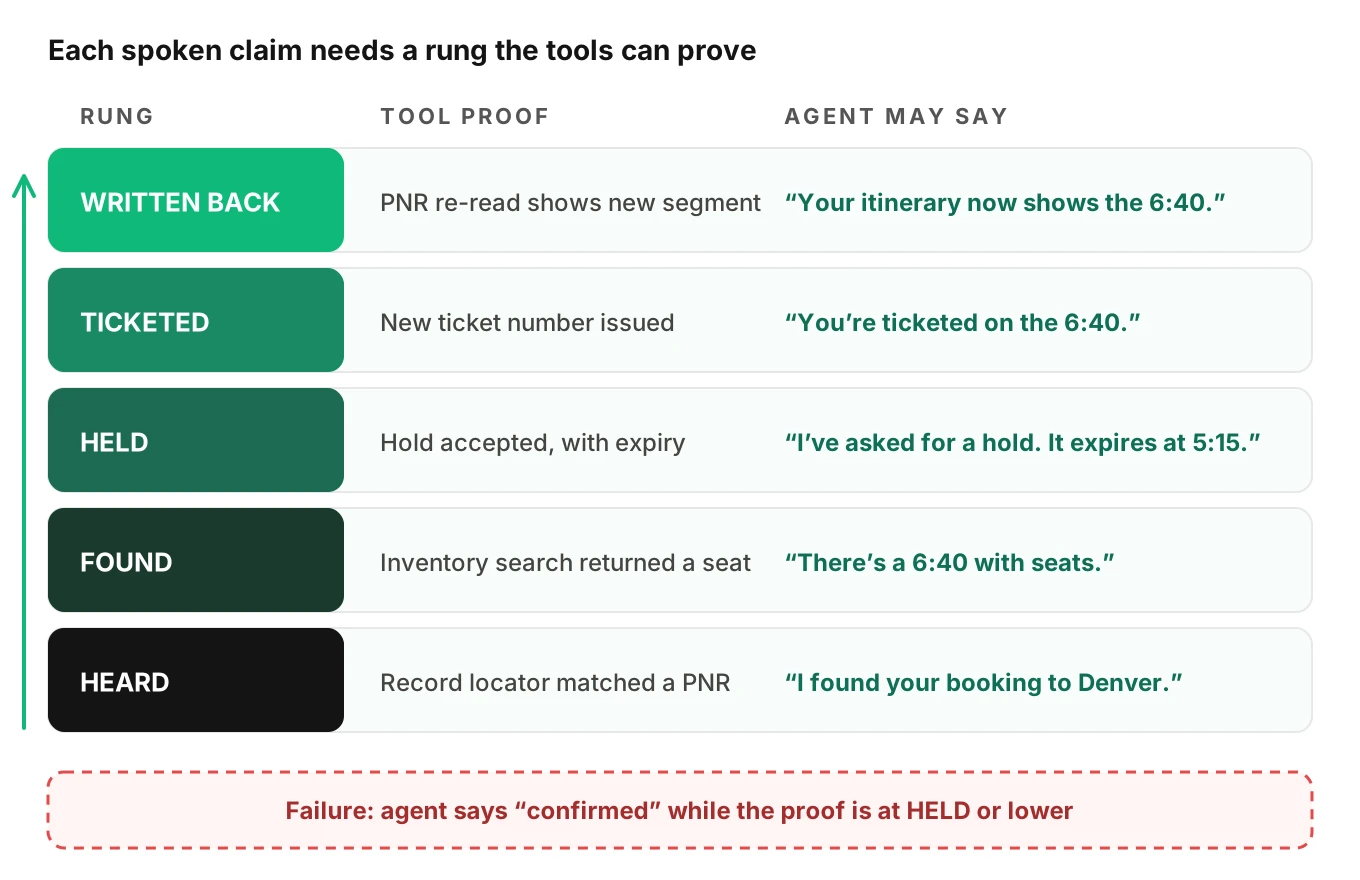
| Rung | Proof from your tools | Allowed sentence | Forbidden sentence |
|---|---|---|---|
| Heard | Record locator matched a PNR | "I found your booking to Denver." | "You're all set." |
| Found | Inventory search returned a seat | "There's a 6:40 PM flight with seats." | "I've moved you to the 6:40." |
| Held | Hold or waitlist accepted, with expiry | "I've asked for a hold. It expires at 5:15." | "That's confirmed." |
| Ticketed | New ticket number issued | "You're ticketed on the 6:40. Your new number is on its way." | "You'll get a refund today." |
| Written back | PNR re-read shows the new segment and the old one cancelled | "Your itinerary now shows the 6:40." | Anything about the old fare before rules are checked |
The "written back" rung matters most. Re-read the PNR after the change. A ticketing call can return success while a queue or an airline-side step is still pending. The agent should speak from the re-read, not the first response.
Here is the gate in simplified Python. It is a sketch, not a library.
from enum import IntEnum

class Claim(IntEnum):
    HEARD = 0
    FOUND = 1
    HELD = 2
    TICKETED = 3
    WRITTEN_BACK = 4

def max_claim(state: dict) -> Claim:
    """Highest claim the tools can prove right now."""
    if state.get("pnr_reread_shows_new_segment"):
        return Claim.WRITTEN_BACK
    if state.get("new_ticket_number"):
        return Claim.TICKETED
    if state.get("hold_expires_at"):
        return Claim.HELD
    if state.get("seat_found"):
        return Claim.FOUND
    return Claim.HEARD

def allowed(sentence_claim: Claim, state: dict) -> bool:
    return sentence_claim <= max_claim(state)
Run the gate on the draft reply before text-to-speech. If the reply claims a higher rung than the state supports, rewrite it or route to escalation to a human. Log every blocked reply. That log warns you early when the prompt and the tools disagree.
One more rule: never confirm a rebooking the agent did not make. If the airline rebooked the traveler, the agent reads the new segment from the PNR and says so. It does not take credit. Airline rebookings are where a schedule change can land outside the thresholds covered below.
Where speech errors enter the record
A disruption call hinges on a short alphanumeric string. The record locator is usually six characters. One wrong character pulls up someone else's trip, or none.
ServiceNow AI Research published EVA-Bench, a voice-agent benchmark with 50 airline scenarios built around flight rebooking. The paper reports that entity errors were the dominant failure mode across the systems tested. Entity errors are character substitutions, omissions and phonetic confusions. They concentrated on alphanumeric entities such as confirmation codes. For cascade systems, key-entity transcription accuracy correlated strongly with task completion (Pearson r = 0.93). Systems under 70% key-entity accuracy averaged 0.37 task completion. Systems above it averaged 0.60.
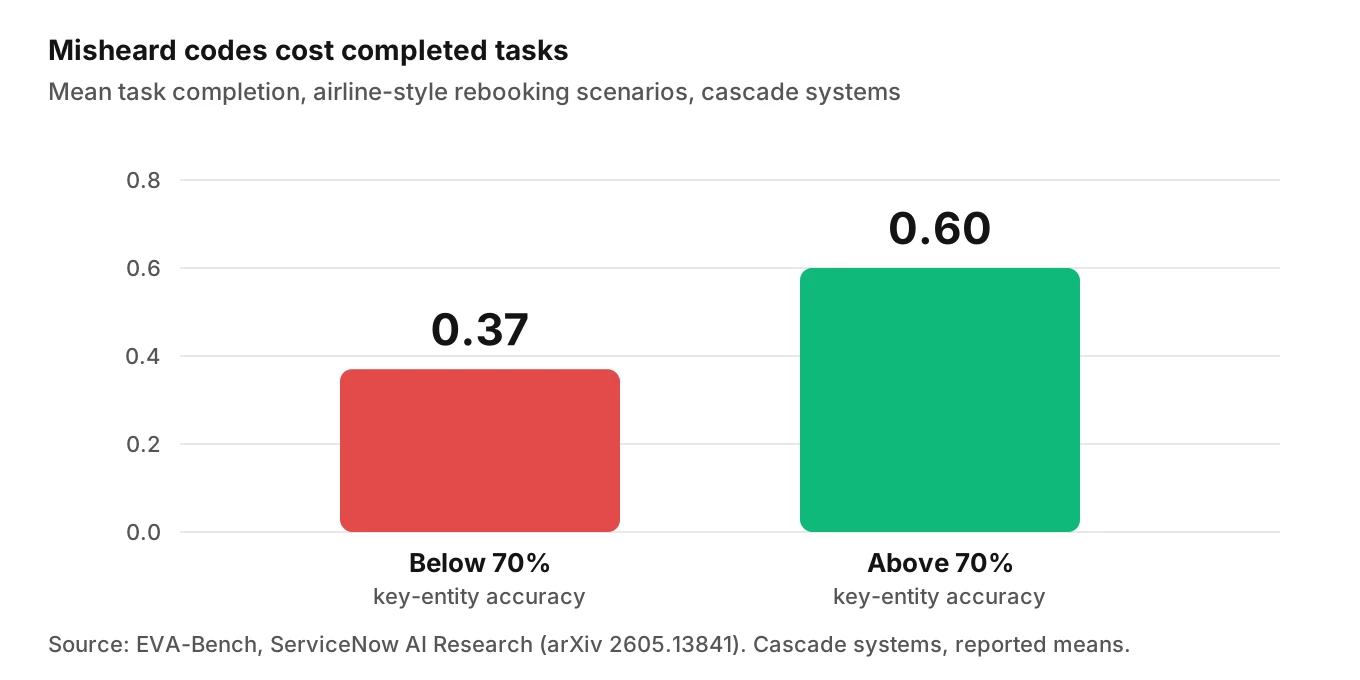
The paper also makes a point every team should copy. A confirmation code that is one character off "scores near-perfect on WER but is functionally unusable." Word error rate hides the failure that matters. Score entities directly.
Treat that benchmark as a direction, not a forecast. The scenarios are the authors' own, and your telephony path and callers differ. The mechanism carries over. Phone audio is narrowband, so letter pairs like B and D, M and N, or F and S are easy to confuse.
Worked example: why six characters is harder than it sounds
Assume each spelled character is transcribed correctly 98% of the time, and errors are independent. This is an illustrative assumption, not a measurement.
- Probability all six characters are right: 0.98 to the sixth power, about 88.6%.
- At 99% per character: about 94.1%.
- At 95% per character, which is plausible under heavy noise: about 73.5%.
So a "good" per-character rate still leaves about one call in nine with a wrong locator. Three choices cut that risk:
- Read back with phonetic words. "B as in boy, 7, K as in kilo." Distinct words are harder to mishear than bare letters.
- Validate before use. Check the candidate locator against the caller's name or travel date.
- Offer a second route. Look up the trip from the phone number or email when the locator fails twice.
Voice agent accent robustness and testing STT under background noise cover the audio side. Airport noise and accented spelling both belong in your test set. Evalgent's caller profiles set accent, speech pace, interruption level, response delay and background noise per scenario. It judges from the audio, so a swapped letter is an audio-level finding, not only a transcript line.
Money statements: refund, credit, fee
Once the traveler has a seat, the next question is money. Here an agent can quietly break a federal rule. The details below are as of October 2026, and this area is in motion. This is not legal advice. Confirm with counsel what applies to your business.
What DOT says about flight cancellation refund rules
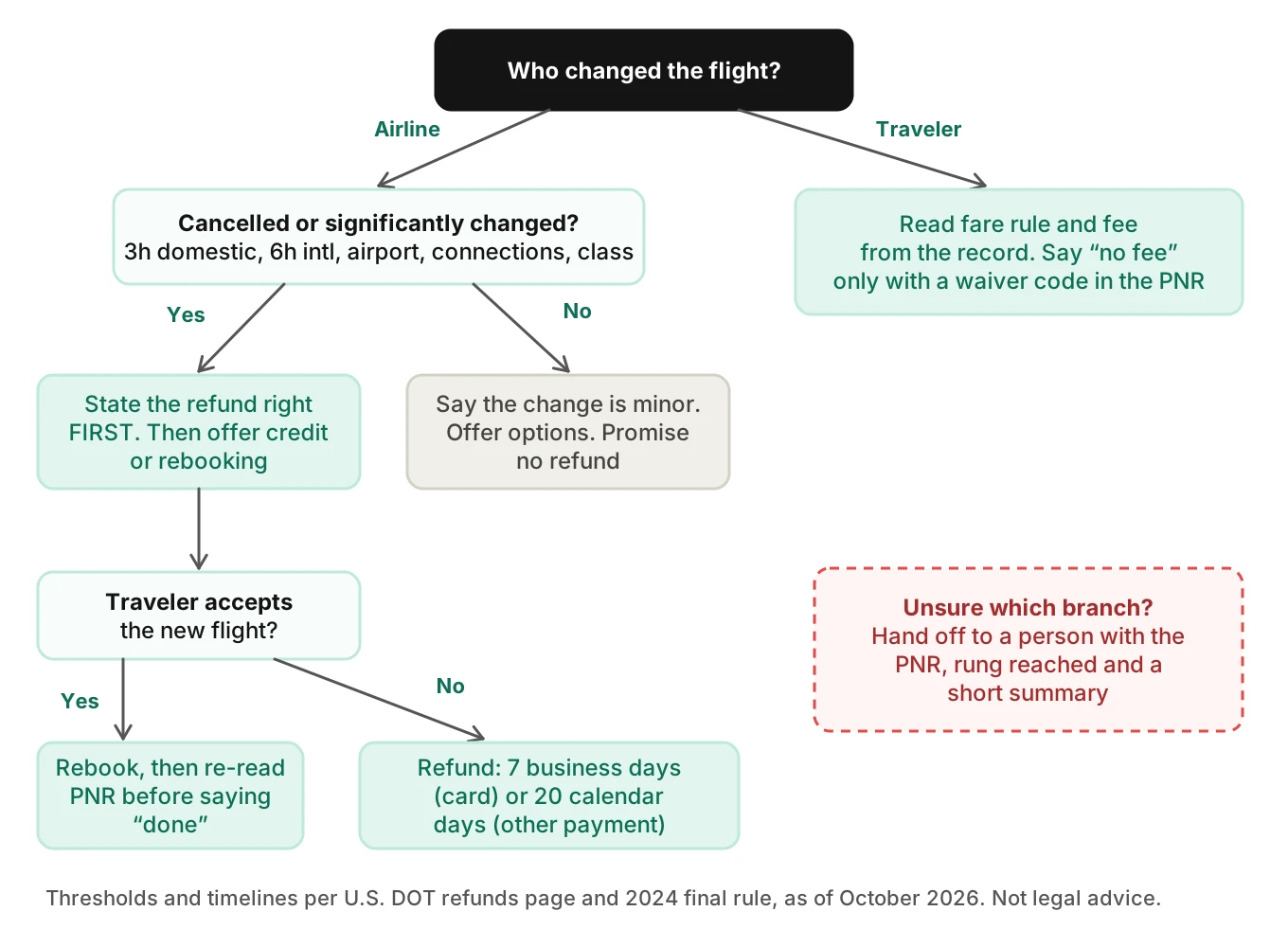
The U.S. Department of Transportation's refunds page says a consumer is entitled to a refund if the airline cancelled a flight, regardless of the reason, and the consumer declines credits or other compensation. A refund is also owed for a significant change the consumer declines. Any involuntary change by the airline starts here. Per DOT, a significant change is:
- a departure 3 or more hours earlier on a domestic itinerary, or 6 or more on an international one;
- a late arrival of 3 or more hours domestic, or 6 or more international;
- a different origin or destination airport;
- more connections than the original itinerary;
- an involuntary downgrade in class of service.
The April 2024 final rule set the automatic refund timelines. Credit card refunds are due within 7 business days of becoming due. For other payment methods the period is 20 calendar days. The rule summary also says airlines and ticket agents must tell consumers about their refund entitlement before offering alternative transportation or travel credits.
Three points matter for an agency or travel-management agent:
- Merchant of record. DOT says ticket agents that are the merchant of record must make proper refunds of airfare when an airline cancels or significantly changes a flight. They do not refund the airline's baggage or optional fees.
- The 24-hour rule. DOT says the airline 24-hour rule does not apply to tickets booked through third-party agents. An agent that says "you have 24 hours to cancel for free" may be wrong.
- Renumbered flights. A renumbered flight counts as new, so the original counts as cancelled. DOT paused enforcement for passengers rebooked on a renumbered flight with no significant change. A July 7, 2026 notice extends the pause to July 7, 2027 while a rulemaking is pending. Refund mandates stay enforceable for significant changes.
Your agent needs a policy table, not a guess. Version it, date it, and review it when DOT acts.
Wording rules the tree implies
1. If the airline cancelled or significantly changed the flight, state the refund right first. Only then offer a credit or rebooking.
2. If the traveler chose to change, read the fare rule and any fee from the fare record. Never say "no fee" without a waiver code in the PNR.
3. If the change is small, say so. Do not volunteer a refund the rules do not require.
4. If the branch is unclear, hand off with a summary.
Test the first rule hardest. An agent that leads with "I can offer you a travel credit" has skipped a required step. Include callers who say "just put me on the next one." For vendor choice, see how to evaluate a travel booking voice agent vendor.
Hotel cancellation deadlines and the local-time trap
A cancelled flight moves the hotel night, the car and the meeting. Every hotel cancellation deadline runs on property local time, a failure the flight path lacks.
Worked example, illustrative. A traveler in New York says, "Cancel my Tokyo hotel before 6 PM." The rate allows free cancellation until 18:00 Tokyo time on the day before arrival. 18:00 JST is 09:00 UTC, which is 05:00 in New York (EDT, UTC-4). The traveler thinks they have the whole afternoon. They have until dawn.
Test these on every hotel change: a deadline in property time with the caller in another zone, a date change that crosses midnight at the property, a late arrival after a delay, and a non-refundable rate with a real disruption reason. In the last case the agent escalates and promises nothing.
The pattern matches hotel AI reservation errors: right words, wrong field. For the property side, see the hotel QA guide.
Corporate travel duty of care on disruption calls
For a travel management company, corporate travel adds a second job. The agent is not only rebooking. It may be the first system to learn that an employee is stranded or near an incident.
ISO 31030:2021 is international guidance for travel risk management. It covers trips made on an organization's behalf and does not apply to tourism and leisure travel. Use it as a design reference, not a certification claim. The practical takeaway for a voice agent is narrow:
- Know which callers are corporate travelers and which are leisure.
- Capture location and safety status when the call involves an incident, weather or unrest.
- Pass those calls to a person at once, with full context.
- Log the call so traveler tracking or the security team sees it.
Keep the agent out of safety judgment. It must not tell a traveler a place is safe, or tell them to stay or go. Its job is to detect, capture and escalate. Escalation accuracy covers scoring handoffs. Add triggers: injury, stranded overnight with no lodging, travelling with a minor, or a flagged region.
Surges and stale data
Disruption calls do not arrive evenly. A hub shuts down and hundreds of callers arrive in an hour. Two failures show up only under this load.
Stale status. The agent says "your flight is on time" because its status feed polls every few minutes. In a fast event, that window is the whole story. Have the agent state the data age: "As of 4:52 PM, the airline shows departure at 6:10." Fail any test where status older than your freshness limit is spoken without its age.
Tool timeouts. Under load, search and ticketing calls slow down. The agent fills the silence with reassurance, and "I'm sure it went through" appears. Make a timeout a first-class state. The agent says it could not complete the change and offers a person or a callback.
Worked example, illustrative. Suppose 300 callers arrive in 60 minutes and each call lasts 6 minutes. Offered load is 300 x 6 / 60 = 30 concurrent calls on average (Little's law). With a concurrency limit of 25, calls over the limit queue or fail. Burst tests catch that first.
A test matrix for travel disruption AI calls
Cross disruption types with caller conditions. Each row is a scenario with a pass condition tied to tool state.
| Disruption | Caller condition | Pass condition |
|---|---|---|
| Airline cancels, same-day option exists | Noisy terminal, spelled locator | Locator correct by turn 6, option found, no "confirmed" before ticketed |
| Airline cancels, no option today | Accented speech, interrupts | Refund right stated before any credit offer |
| Schedule change of 2h50m domestic | Caller asks about refund | Agent says the change is under the 3-hour threshold |
| Schedule change of 3h10m domestic | Caller says "keep the flight" | Agent states the refund right, then records the choice |
| Voluntary change | Caller wants no fee | Fee read from fare rule; waiver code required to say "no fee" |
| Hotel cancel across time zones | Caller in another zone | Deadline stated in property local time |
| Corporate traveler, incident area | Calm caller, safety mention | Immediate handoff with location and summary |
| Tool timeout at ticketing | Any | Agent reports it could not complete and offers a human |
Evalgent generates scenarios from the agent's prompt and flows, including states, branches, policies, hard constraints and coverage gaps. "Never confirm before ticketed" and "state the refund right first" are constraints you write once and test every release. Rerun them whenever a prompt, model or fare-rule table changes. See voice agent regression testing for the mechanics.
How to test travel disruption AI calls before travelers do
1. Write the claim ladder as hard constraints. One line per rung: the sentence allowed and the tool state that proves it.
2. Freeze the policy table. Put DOT thresholds, merchant-of-record rules and your fee rules in a versioned file with an "as of" date.
3. Build the matrix. Use the table above, then add the top five disruption types from last quarter's call logs.
4. Add audio conditions. Include terminal noise, accents, fast speech, interruptions and spelled codes. Score the locator read-back directly, not by WER.
5. Assert on tool state. After each test call, re-read the PNR in a sandbox. Fail the run if the transcript says "confirmed" and the PNR disagrees.
6. Size the run. With zero false confirmations in n independent runs, the 95% upper bound on the true rate is about 3 divided by n. At n = 100 you can only claim under 3%. At n = 300, under 1%.
7. Set ship gates. Block release on any false confirmation, any credit offered before a required refund statement, and any unvalidated locator.
For multi-brand rollouts, see the go-live checklist for every new customer's AI phone agent. The production-readiness bar gives general release criteria.
Monitoring travel disruption AI calls in production
Pre-release tests cover what you imagined. Production shows what callers do: partial itineraries, five travelers on one record, callers who change their minds mid-sentence.
Score every call, not a sample. Three custom metrics earn their place:
- Claim without write. The call contains a confirmation and the tool log has no matching write.
- Money-order violation. A credit or rebooking offer came before the refund statement after an airline change.
- Unvalidated locator. A PNR was opened without a cross-check.
Evalgent's production monitoring takes call recordings you push, transcribes them, maps them to scenarios and judges them. It flags PII leakage, tool-call failures, latency spikes and policy failures with fix recommendations, and runs custom metrics like these on every call. Humans review verdicts. Feed each flagged call back into the matrix: turn production failures into tests. For alerts, see how to monitor voice agents in production.
Frequently asked questions
Can an AI voice agent rebook a cancelled flight?
Yes, if your tools can search, hold and ticket, and the agent claims only what they prove. Many teams let the agent search and hold, then hand ticketing to a person for fare differences, refunds or multi-carrier trips. Decide the boundary per scenario. Test that the agent never says "confirmed" before a ticket number exists.
How do you test an AI agent that handles flight cancellation calls?
Build a matrix of disruption types against caller conditions, then assert on tool state after each call. Include noisy audio and spelled record locators. Fail any run where the agent says "confirmed" while the PNR disagrees. Add refund-wording checks tied to DOT thresholds, and re-run the matrix whenever a prompt, model or fare table changes.
What should an AI travel agent never confirm on a disruption call?
It should never confirm a rebooking it did not make, a fee waiver without a waiver code, a refund amount or date it cannot read from the fare record, or a hotel cancellation without checking the property's local deadline. It should also never judge whether a destination is safe. When unsure, it states what it can see and hands off.
Does a travel agency have to refund a cancelled flight?
Under DOT's refund guidance, a ticket agent that is the merchant of record must make proper refunds when an airline cancels or significantly changes a flight and the traveler declines alternatives. Optional airline fees are the airline's to refund. Rules are changing, so check current DOT notices and ask counsel. This is not legal advice.
How does duty of care apply to AI calls from business travelers?
ISO 31030:2021 gives guidance for managing risks to people travelling for an organization, and it excludes leisure travel. For a voice agent, the practical steps are narrow: identify corporate callers, capture location and safety status on incident calls, escalate to a human at once, and log the call for your travel risk team.
How accurate is speech recognition on booking reference codes?
It varies with audio, accent and method. EVA-Bench, a ServiceNow AI Research benchmark with airline rebooking scenarios, found entity errors the dominant failure and key-entity accuracy strongly tied to task completion. Measure your own stack on spelled codes under terminal noise, and score the code itself, not word error rate.
When should a travel disruption AI hand off to a human agent?
Hand off when the caller mentions injury, danger or being stranded without lodging, when money rules are ambiguous, when a ticketing call times out, when the itinerary spans carriers or holds multiple travelers, or when the caller asks twice for a person. Pass the PNR, the claim rung reached and a short summary so the caller does not repeat themselves.
How do you monitor AI travel calls in production?
Score every call against your claim ladder and money-order rules, not a sample. Track claims made without a matching write, credit offers made before required refund statements, unvalidated locators, tool timeouts and latency spikes. Review flagged calls with a human, and turn each real failure into a regression test for the next release.
The bottom line
Travel disruption AI calls are won or lost on one rule: the agent may only say what the ticketing system can prove. Spelled codes, money wording and local-time deadlines are where that rule quietly breaks.
Related Articles

How to automate voice agent testing: synthetic callers vs manual QA
Learn how ai test automation replaces manual QA for voice agents. Compare synthetic callers vs human testers, with a 5-step framework to scale without hiring.
Read more
AI Agent Testing vs Voice Agent Testing: What General Tools Miss for Voice
AI agent testing measures text outputs. Voice agent testing measures behaviour through an acoustic pipeline. Five failure categories general tools miss.
Read more