Party Booking AI for Venues: Testing Add-Ons and Dates
On this page
A parent calls a trampoline park at 8 pm. The phone is the only channel open at that hour. She wants a Saturday party for fourteen kids, two pizzas and the glow add-on. She hangs up sure it is booked. Your agent heard "forty." Nobody finds out until the deposit email shows a number that is far too big. Or worse, until the host sets up one room for 14 and 40 kids show up.
This post is for teams that built a party booking AI phone feature into venue software used by many parks, bowling centers and entertainment venues. It shows how a call becomes a booking record, where speech errors enter, and how to test each field. This guide fits any AI phone agent for entertainment venues, from a trampoline park booking line to a bowling or family entertainment center. Hotels, tours and restaurants have their own pages (hotel reservation errors, tour booking, restaurant ordering). Parties differ in one way: a single call sets a date, a room, a headcount and a price at the same time.
Why a party call is harder than a table booking
A table booking has a date, a time and a party size. A birthday party has all three, plus a package, optional add-ons, a deposit and a waiver. Each value changes the others.
Headcount picks the package tier. The tier sets the room. The room and the start time set when the next party can begin. Add-ons raise the total, and the total sets the deposit. Change one value mid-call and four others must change with it.
Booking software encodes these links. ROLLER's support documentation is a useful public example of the rules involved. Its party packages price per guest or per party, with minimum and maximum guest counts. It states that once saved, "per-guest or per-party package pricing can't be changed." Rooms are assigned by guest count, and per-guest pricing sits beside per-party pricing, and "ROLLER picks the smallest one that fits the guest count" when several resources share a row. A post-party buffer stays hidden from guests and holds the party room for cleanup. This describes one product's documented rules, not its performance. Your platform has its own rules, and the voice agent must obey them.
The party booking AI phone call is the front door to an agentic workflow:
1. Capture. The agent collects the values from speech.
2. System action. It checks availability and builds a cart.
3. Confirmation. It reads the quote back and takes a deposit.
4. Write-back. The booking, the room hold and the follow-up messages are written to your system.
Speech errors enter at step one. They are silent because every later step accepts a valid-looking value. The booking system does not know the caller said fourteen.
Where a spoken party becomes a wrong record
One public vendor case study describes a nine-step voice flow for a trampoline park operator. The agent matches the caller to a park, presents packages, captures the guest of honor and the counts, checks slots, builds a cart and takes a deposit. Call recording pauses during payment. The vendor reports its own pilot numbers, with no sample size or method published, and says the pilot focused on the standard successful path (case study). Treat those figures as unverified.
Every step in that flow can turn a misheard value into a clean-looking record. Here are the fields, ordered by damage.
| Field | Typical speech error | What breaks downstream |
|---|---|---|
| Headcount | "fourteen" heard as "forty"; kids and adults merged | Wrong tier, wrong room, wrong food count, wrong price |
| Date | "the 15th" heard as "the 50th" or "the 5th"; "this Saturday" resolved to the wrong week | Party on an empty day, or no hold at all |
| Start time | "twelve" vs "two"; AM and PM dropped | Room double-booked or buffer overlap |
| Package | Caller names the old tier; agent maps to the wrong one | Included items and per-guest price differ |
| Add-ons | Agent adds an add-on the caller only asked about | Surprise charge on the receipt |
| Deposit | Computed on the package only, not the total | Short deposit, dispute later |
| Waiver contact | Wrong phone number or email for the guardian | Waiver link goes to a stranger |
Notice that most of these are numbers. That matters for how you test a party booking AI phone agent.
What the speech research says about numbers
Standard speech recognition scoring is word error rate. It averages mistakes across all words. A party call is mostly a few critical values wrapped in small talk.
A September 2026 benchmark, VoiceCodeBench, measured exactly this gap. It scored 19 speech recognition setups on whether transcripts preserved identifiers, paths and other structured values. WER and entity recovery barely agreed on rankings (Spearman rho of -0.28 and -0.22 against two entity metrics). The system with the lowest WER, 4.3%, ranked twelfth at recovering exact values. Even the strongest setup left about 31% of recordings with at least one unrecovered critical value (arXiv 2608.28916).
Read the limits first. The recordings are English workplace dictation with synthetic values, not party calls with kids in the background. Numeric and measurement values scored higher (93.7% entity match) than codes or addresses. The lesson is not "numbers fail 31% of the time." It is that a good WER does not tell you a critical value survived.
A second paper shows how fragile number scoring is. A study of number normalization found that whether you write "fourteen" or "14" can shift WER by more than two percentage points, which is often more than the gap between systems on common benchmarks (arXiv 2609.21084). If your eval compares transcript strings, a normalization choice can hide or invent a headcount error. Score the parsed value instead: did the stored headcount equal 14?
Two mechanisms expose parties. First, teens and tens: "fifteen" and "fifty" differ mainly in syllable stress, and that cue thins on an 8 kHz phone leg. Second, self-correction: "twelve kids, no wait, fourteen, plus my sister's two." The agent must apply the correction and not add all three numbers.
See also our accent robustness post.
The party quote ledger: a framework you can copy
The ledger is one record per call, built from the audio, with a pass or fail for each field. It has three columns for each field: what the caller said, what the agent said back, and what the system stored. A call passes only if all three agree.
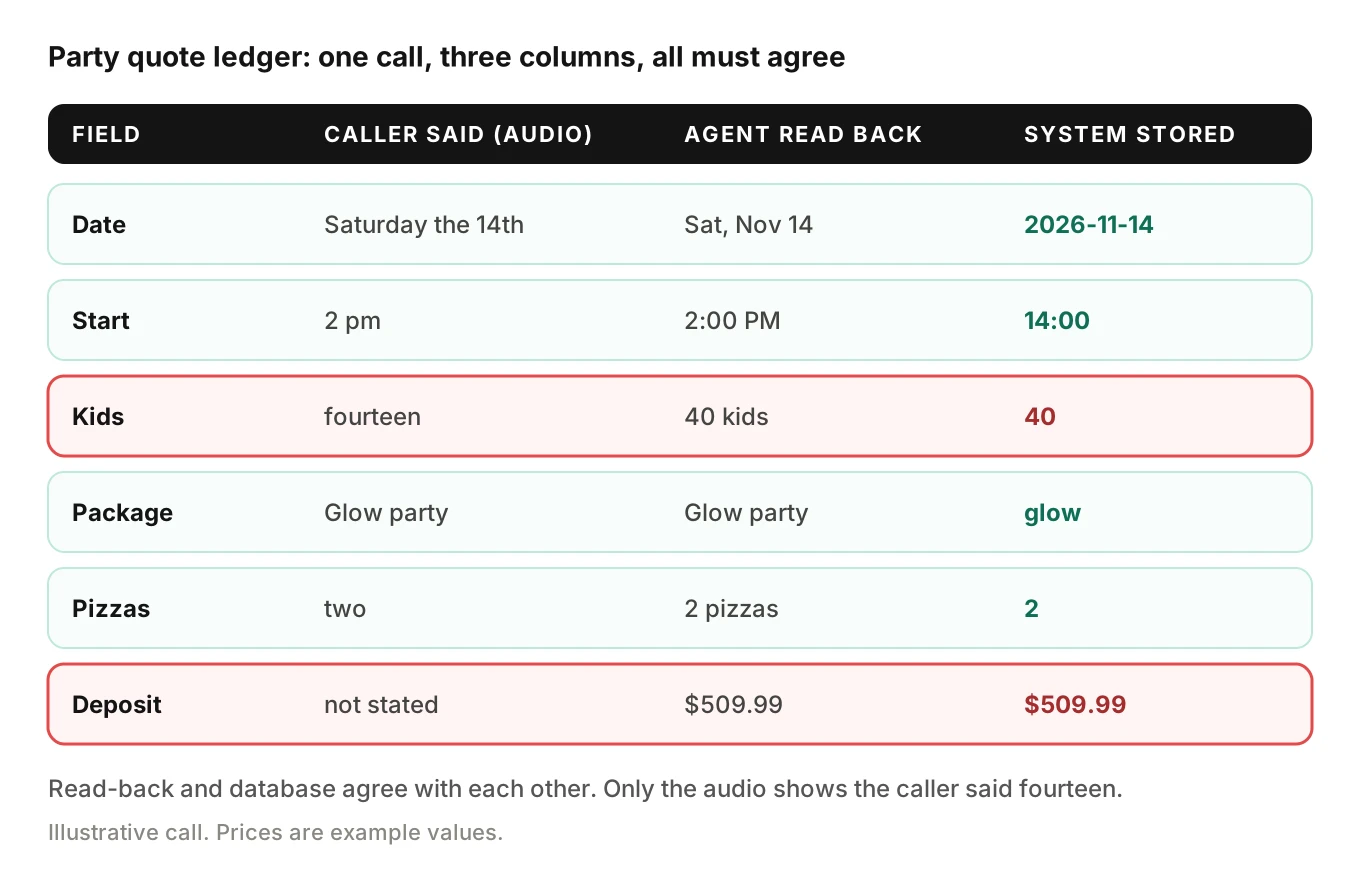
Three checks sit on top of the ledger:
- Read-back check. Did the agent read every value back before taking money?
- Arithmetic check. Does the stored total equal the rule-based total?
- Constraint check. Does the booking respect room capacity, buffer and cutoff rules?
The transcript alone cannot do this. If the transcript says "forty" and the stored value is 40, a transcript judge sees consistency. Only the audio shows the caller said fourteen. That is the idea behind evaluating from the audio. Evalgent's judge works from the call audio, not only the transcript, and attaches evidence to each verdict. A custom metric such as "stored headcount equals spoken headcount" can run on every call.
Quote math: how one number changes the deposit
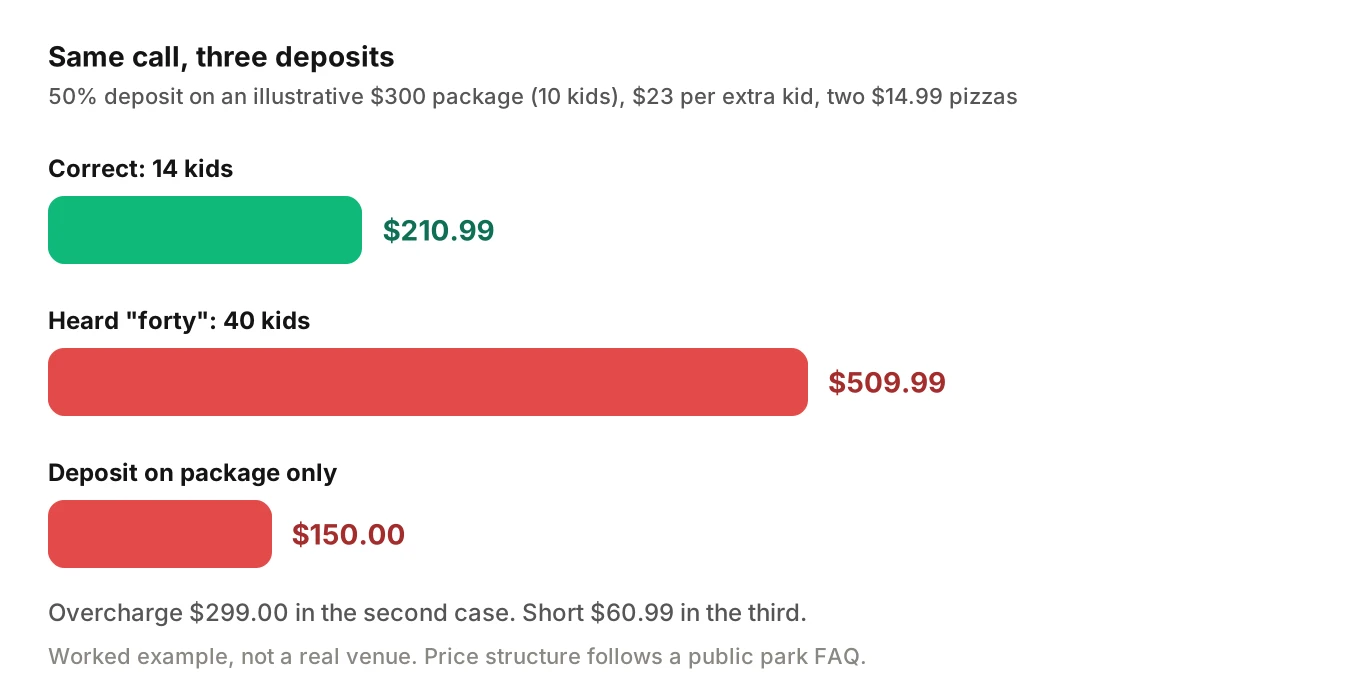
Work an example. These prices are illustrative, not from any real venue. The structure follows a public park FAQ that sets a base group size, charges per extra jumper, and takes 50% of the total value at booking (Above All FAQ).
Assume a package covers 10 kids for $300. Each extra kid costs $23. Pizzas cost $14.99 each. The deposit is 50% of the total, add-ons included.
| Case | Headcount | Extras | Add-ons | Total | Deposit (50%) |
|---|---|---|---|---|---|
| Correct | 14 | 4 x $23 = $92 | 2 pizzas = $29.98 | $421.98 | $210.99 |
| Heard "forty" | 40 | 30 x $23 = $690 | $29.98 | $1,019.98 | $509.99 |
| Deposit on package only | 14 | $92 | $29.98 | $421.98 | $150.00 |
The "forty" error overcharges the deposit by $299. The package-only error leaves the deposit $60.99 short, and nobody notices until the family arrives. Both look fine on the call because the agent states a total confidently.
The arithmetic belongs in code, not in the model. Let the model collect values. Let a function compute the quote. Then test that the function's output matches what the agent says out loud. Here is a simplified check you can adapt. It is a sketch with no vendor API, and your field names will differ.
from dataclasses import dataclass

@dataclass
class PartyRules:
    base_kids: int = 10
    base_price: float = 300.00      # illustrative
    extra_kid: float = 23.00        # illustrative
    deposit_pct: float = 0.50       # applies to total incl. add-ons
    duration_min: int = 120
    buffer_min: int = 30            # hidden cleanup buffer
    room_caps: tuple = (("A", 12), ("B", 16), ("C", 45))

def expected_quote(kids, addons, rules):
    extras = max(0, kids - rules.base_kids) * rules.extra_kid
    total = rules.base_price + extras + sum(addons)
    return round(total, 2), round(total * rules.deposit_pct, 2)

def smallest_room(kids, rules):
    fits = [(cap, name) for name, cap in rules.room_caps if cap >= kids]
    return min(fits)[1] if fits else None

def check_booking(spoken, stored, rules):
    """spoken: values from the audio; stored: what the system saved."""
    errors = []
    total, deposit = expected_quote(spoken["kids"], spoken["addons"], rules)
    if stored["kids"] != spoken["kids"]:
        errors.append("headcount")
    if round(stored["total"], 2) != total:
        errors.append("total")
    if round(stored["deposit"], 2) != deposit:
        errors.append("deposit")
    if stored["room"] != smallest_room(spoken["kids"], rules):
        errors.append("room")
    return errors

# Illustrative run: agent heard 40, caller said 14
rules = PartyRules()
spoken = {"kids": 14, "addons": [14.99, 14.99]}
stored = {"kids": 40, "total": 1019.98, "deposit": 509.99, "room": "C"}
print(check_booking(spoken, stored, rules))
# ['headcount', 'total', 'deposit', 'room']
One wrong number produced four failed fields. That is why headcount tests come first.
Dates, slots and the hidden buffer
Time slot logic is the second silent failure, and double booking is its worst result. Most party venues keep a cleanup buffer that guests never see. ROLLER's documentation describes this as post-party buffer time that "keeps the room unavailable for cleanup and reset." If your agent offers times from a plain "is the room free" check, it will offer slots that the buffer should block.
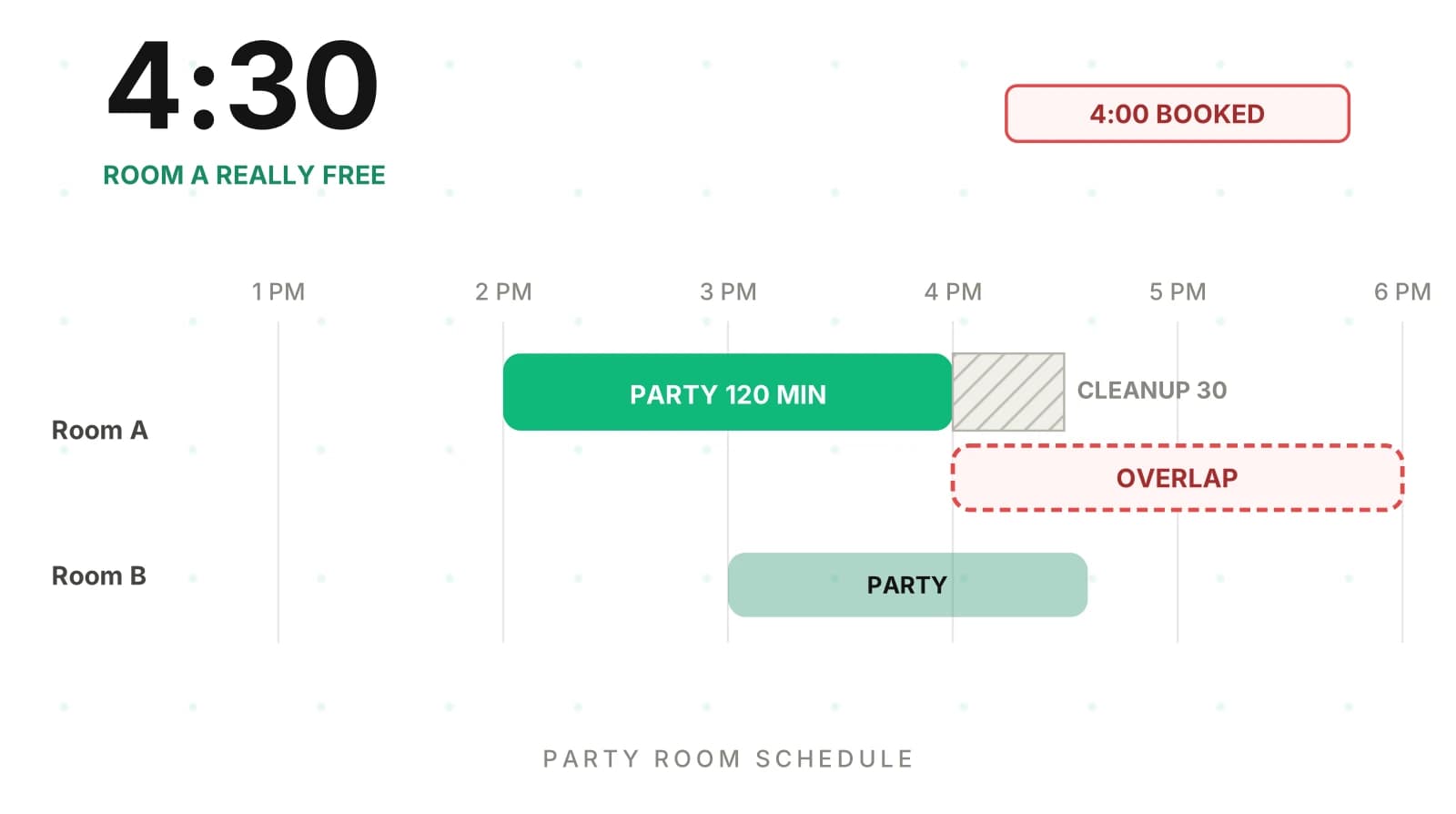
The rule is simple. The next party in a room can start no earlier than start plus program length plus buffer. For a 2:00 pm start, 120 minutes and a 30-minute buffer, the room frees at 4:30 pm. A 4:00 pm request in the same room must fail, or move to another room.
Test these date and slot cases:
1. Back-to-back request. Caller asks for 4:00 pm after a 2:00 pm party. The agent offers 4:30 or another room.
2. Relative dates. "This Saturday," "next Saturday" and "the Saturday after Thanksgiving" resolve to the right date, on a Tuesday and on a Saturday.
3. Cutoff rule. ROLLER's default is to stop online sales one hour before a session. Phone rules are your call, but they must be explicit and tested.
4. Capacity shift. A caller moves from 14 to 18 kids after the room is held. The room must change, or the agent must say it cannot.
The generic mechanics of slot offering are covered in our appointment scheduling testing guide and scheduling metrics post. Party calls add the room and buffer on top.
Add-ons: the upsell that must not become a charge
A venue wants add-ons offered. ROLLER's own advice is to present them during booking rather than as required extras. That is a sound rule for a voice agent too. Add-ons fail in three ways on a call, and the booking confirmation repeats the error:
- Phantom add-on. The caller asks "how much is the glow package?" and the agent adds it to the cart.
- Stock mismatch. The agent sells an add-on that is restricted to certain time periods or already sold out. ROLLER describes restricted add-ons that appear only at set times.
- Deadline miss. One park's FAQ says changes are due 24 hours ahead, with only cheese and pepperoni pizza available at short notice. A caller booking for tomorrow must not be offered a supreme pizza.
Ask one question of every add-on test: did the caller say yes? Make the agent ask for a clear yes before adding an item, and have the read-back list each item. Then score from the audio whether a yes was ever spoken.
Deposits, card data and recordings
Most venues take a party package deposit to hold the date. Typical ranges are 25% to 50% of the total, according to ROLLER's blog, and one park above requires 50% including add-ons. Three failure types matter.
Wrong amount. The quote math above. Test the stated amount against the charged amount.
Wrong promise. Your cancellation policy lives in the prompt, and the agent says "fully refundable" when your policy says the deposit moves to another date or becomes credit. Put the exact refund and reschedule wording in the prompt and test callers who ask about it. One park's FAQ, for example, moves the deposit to a new date or returns it as a non-expiring gift card.
Card data in the recording. If the agent takes a card number by voice, the audio may contain card data. The PCI Security Standards Council FAQ says storing card validation codes in any form of digital audio recording violates PCI DSS Requirement 3.3.1. It advises preventing the codes from being recorded where possible, and deleting them right after authorization if not (PCI SSC FAQ 1210). The case study above pauses recording during payment for this reason. Whether your pause works is a test, not an assumption. Evalgent's production monitoring takes customer-submitted call recordings and flags PII leakage, so a recording that kept a card code gets caught.
Not legal or compliance advice. Check card handling with your payment provider and assessor.
Pricing disclosure and the fees question
The FTC's Rule on Unfair or Deceptive Fees, 16 C.F.R. Part 464, took effect May 12, 2025. It covers businesses that offer live-event tickets or short-term lodging and requires the total price up front, including mandatory fees (FTC FAQ). The FTC's page does not name party venues. Whether a party package falls inside it is a question for counsel, and state rules may differ. You can test the behavior anyway: does the agent quote the all-in price, mandatory room or service fees included, before asking for a deposit? This is not legal advice.
Waivers and the right guardian
Many venues require a signed waiver before play, usually sent by text or email after the booking confirmation. Two failures follow. The link goes to the wrong number because a digit was misheard. Or the agent says "you can sign at the door" when the venue's rule differs. One park's FAQ only points parents to an online waiver page, so your agent must state your venue's rule and never guess. Read the number back digit by digit. If the text carries marketing content, check consent in our TCPA post. This is not legal advice.
How to test a party booking AI phone agent before every venue goes live
Run this sequence for each tenant venue, whether a bowling center or any other entertainment center. Package names, party room sizes, buffers and prices differ by venue, so a pass at one park proves little about another. Our multi-tenant testing post covers that structure.
1. Load the venue's rules. Export packages, tiers, room capacities, buffers, add-ons, cutoffs and deposit percent into a rules file. This is your oracle. It must not come from the prompt.
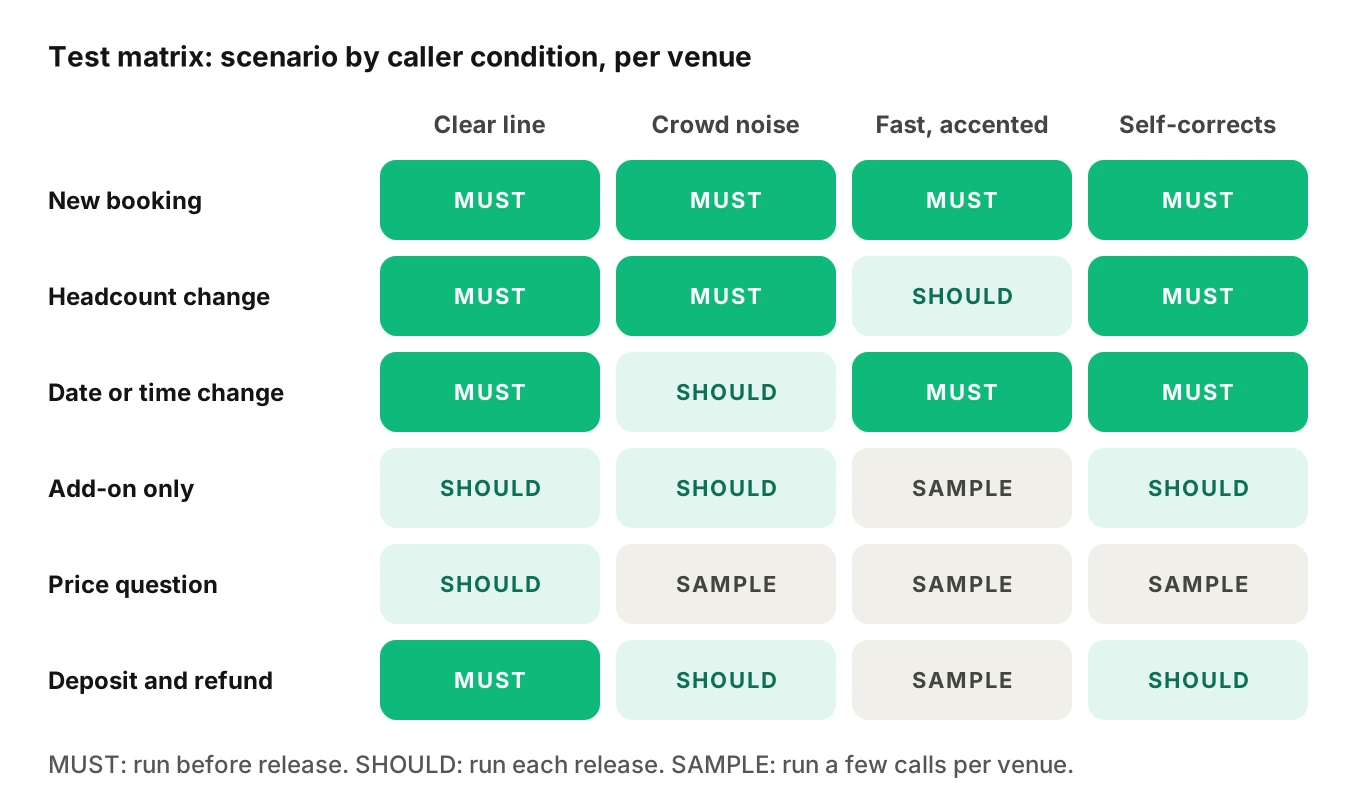
2. List the scenarios. Cover new booking, change of headcount, change of date, add-on only, price question without booking, cancel, and "just checking availability." Include a caller who corrects themselves twice.
3. Cross with conditions. Use fast speech, accents, background noise like a bouncy-house crowd, a caller on speaker in a car, long silences and talk-over. Evalgent's caller profiles cover accent, pace, interruption level, response delay, behavior, background noise and language, and its scenarios can be generated from your prompt and flows.
4. Place the calls. Call the live agent over PSTN, SIP or WebRTC, the way parents do. Record each call.
5. Build the ledger. For every call, extract spoken values from the audio, read-back values from the agent, and stored values from your database.
6. Score with the rules file. Run `check_booking`-style functions for math, room, buffer and cutoff. Add custom metrics: read-back present, yes spoken for each add-on, recording paused during payment.
7. Review and gate. Have a person review every failed call. Set the release rule before you look at results: zero critical-field errors in the sample.
How many calls is enough?
Use the rule of three. If you run n independent test calls and see zero failures, the 95% upper bound on the true failure rate is about 3/n. Sixty clean calls bounds the rate near 5%. Three hundred clean calls bounds it near 1%. This is a statistical approximation, and it assumes the calls are independent and represent real traffic. Fix a failure, then re-run the whole set, because a prompt change can break an unrelated field.
Do this per venue for the first release, and re-run a smaller core set when a venue changes a package or price. For a broader release checklist, see the go-live checklist.
What to monitor after launch
Pre-launch tests miss calls you did not imagine, and a party booking AI phone line meets new ones weekly. Watch live calls for four signals: stored headcount, date or total that differs from the audio; availability or payment tool errors hidden by a confident answer; refund, waiver or deadline statements that differ from the venue's rule; and cart items added with no spoken yes. With Evalgent, customers push call recordings. Calls are transcribed, mapped to scenarios and judged. The platform flags tool-call failures, latency spikes, PII leakage and policy failures with fix recommendations. A weekly review of flagged calls keeps the rules file honest. The reservations vendor guide and the hotel agent QA guide show the same pattern for rooms and rates.
Frequently asked questions
Can AI take birthday party bookings over the phone?
Yes. Birthday party booking AI exists, and public case studies show full flows. The harder question is accuracy, because one call sets date, room, headcount, package, add-ons and deposit at once. Vendor numbers are unverified. Judge your own agent by checking stored bookings against recorded audio, venue by venue.
How do you test an AI that books parties?
Build a rules file per venue, then place recorded calls across scenarios and caller conditions. Compare three things for each call: what the caller said, what the agent read back and what the system stored. Score math, room, buffer and cutoff rules in code. Review every failure by ear.
What happens if the AI books the wrong headcount?
Several fields change at once. The tier, the price, the deposit and the room can all be wrong, as the worked example shows. Food counts and staffing may follow. Because the booking looks valid, the error often surfaces only on arrival. Always read back kids and adults separately.
Should an AI collect a party deposit by phone?
Only if the amount, the refund wording and the card handling are tested. The agent must state the right amount and the venue's real reschedule rule. Card data must stay out of stored audio, per PCI DSS Requirement 3.3.1. Many teams send a secure payment link instead.
How does AI avoid double-booking party rooms?
It checks availability against start time, program length and the hidden cleanup buffer, not just an empty slot. Then it holds the room at booking. Test back-to-back requests, capacity changes after a hold and two callers asking for the same slot within minutes.
Can AI upsell party add-ons without misquoting?
Yes, if each add-on needs a spoken yes and appears in the read-back. Prices come from code, not from the model. Test phantom adds, restricted or sold-out items and short-notice limits. Score from the audio whether the caller agreed.
How should the AI handle waivers for a party?
State the venue's actual rule, then send the link to a read-back number or email. Never say waivers are not needed unless the venue says so. Test misheard digits and callers who want to sign for several guests. Check text consent rules separately.
How many test calls before launching a party booking AI?
Sixty clean, independent calls per venue bounds the failure rate near 5% at 95% confidence, by the rule of three. Three hundred bounds it near 1%. Cover every scenario and condition first. Re-run the set after any prompt, package or price change.
The bottom line
A party booking AI phone agent passes only when the spoken values, the read-back and the stored record all match. Test headcount, date, room and deposit math first, from the audio and against a rules file you control.
Related Articles
How to automate voice agent testing: synthetic callers vs manual QA
Learn how ai test automation replaces manual QA for voice agents. Compare synthetic callers vs human testers, with a 5-step framework to scale without hiring.
Read more
AI Agent Testing vs Voice Agent Testing: What General Tools Miss for Voice
AI agent testing measures text outputs. Voice agent testing measures behaviour through an acoustic pipeline. Five failure categories general tools miss.
Read more