AI Voice Agents for Freight: The Complete QA Guide
On this page
This guide is for the product and engineering team inside TMS, load-board, fleet or brokerage software. Your team built an AI voice agent freight customers now use inside the product. It calls drivers for check calls, answers carriers about loads, takes shipper quote requests and handles tracking calls. It now runs for many fleets and brokers at once. Each one has its own fields, lanes, rate rules and check-call cadence. Every prompt change ships to all of them.
The question here is narrow. How do you know the agent works? Not "does it sound natural", but "did it update the right load, with the right ETA, for a carrier we actually vetted?"
What an AI voice agent for freight actually does
Freight runs on phone calls. Brokers call drivers for location updates. Carriers call brokers about posted loads. Shippers call for quotes. Consignees call about missing freight. Software vendors now put a voice agent on both sides of these calls.
Load boards have started shipping voice features in public. On July 7, 2026, Truckstop announced AVA, which it calls "the first voice-native AI carrier assistant." Truckstop says AVA searches its load board by voice and "instantly connects the carrier to the load's owner for booking." That is a driver-facing assistant inside a product, which is the same shape this guide covers.
Call it an AI dispatcher, carrier sales AI or logistics voice AI. It follows the same loop:
1. Capture. Who is calling, which load, which location, which rate, which equipment.
2. System action. Look up the load or carrier, check the rule, compute the quote.
3. Confirmation. Read the key facts back and get a yes.
4. Write-back. Update the TMS, post the check call, create the quote, notify the shipper.
Check call: a status call to a driver, or the driver's dispatcher, during a load. It records location, ETA to the next stop, and any problem such as detention, a breakdown or a reschedule.
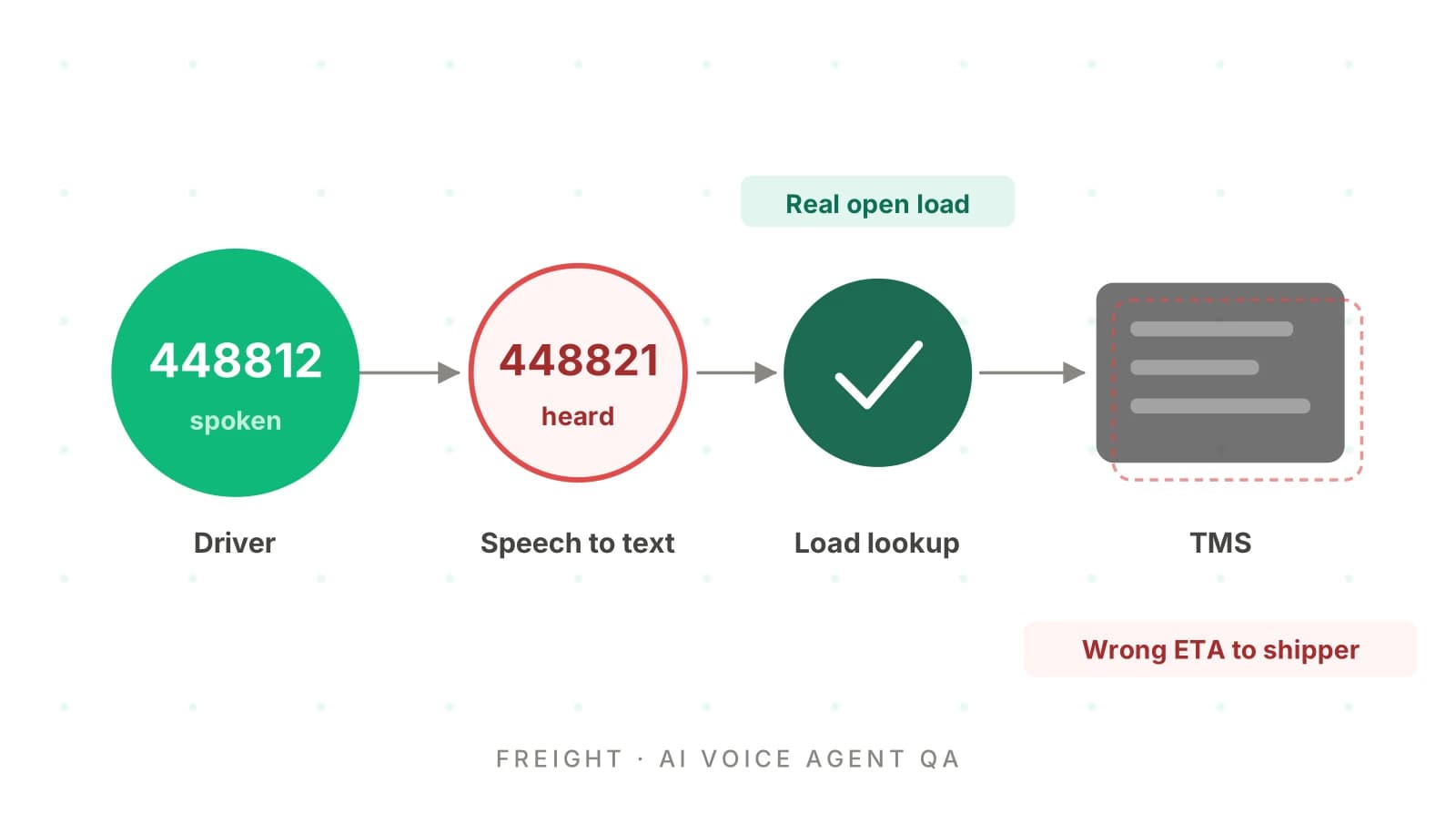
The voice part is only the front door. Most real damage happens at step 4, unheard. A misheard digit updates the wrong load. The shipper then gets a confident, wrong ETA. Our post on silent tool failures covers that general pattern. This guide maps it onto freight.
The freight trade × use-case map
Freight software serves three kinds of caller, each with its own calls, fields and failures. Build your test plan from this map, not a generic support template.
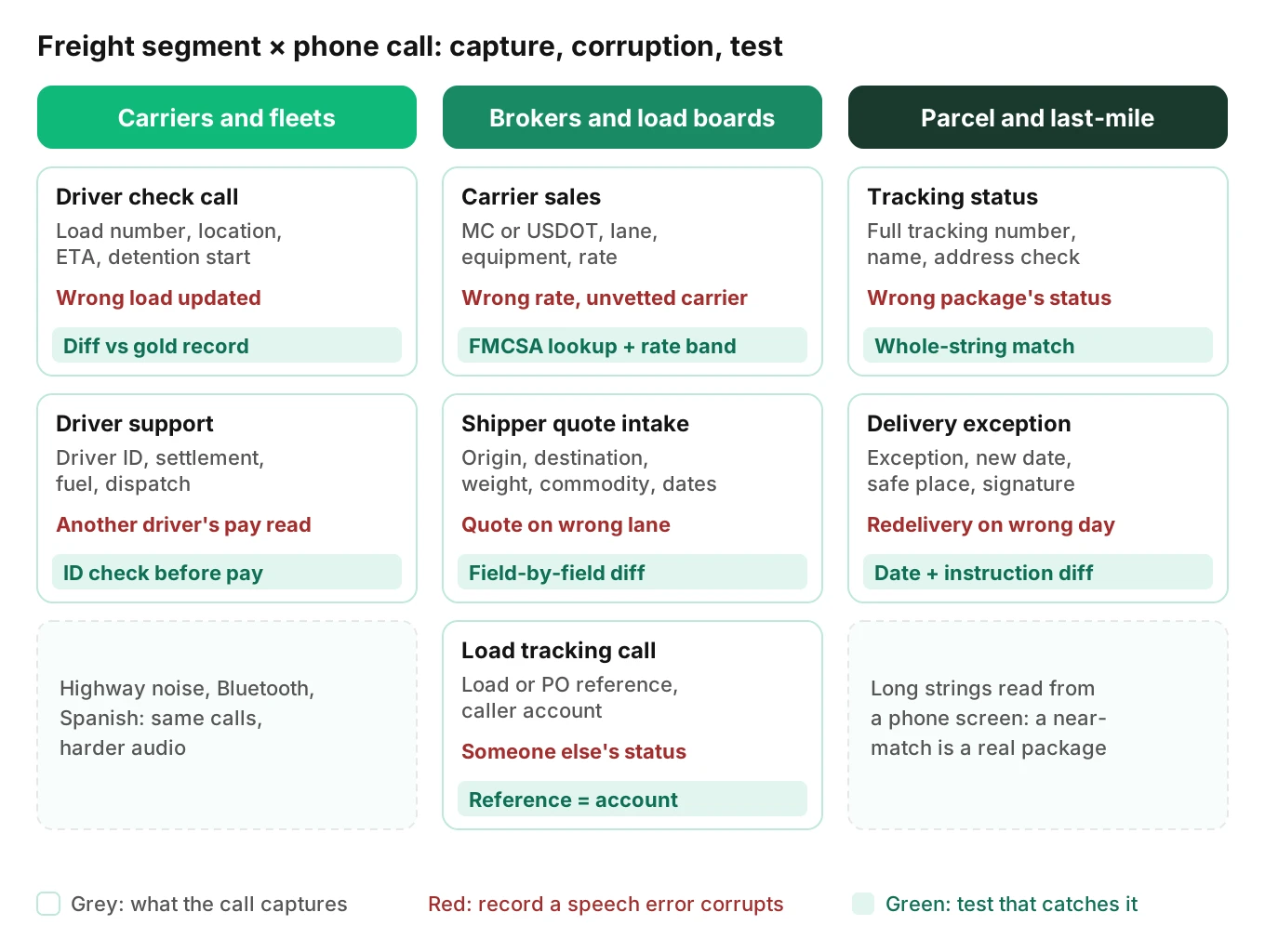
| Segment | Call | Must capture | What a speech error corrupts | How to test |
|---|---|---|---|---|
| Carriers and fleets | Driver check call | Load number, location, ETA, detention start, issues | Wrong load updated; wrong ETA sent to shipper | Diff the check-call record vs a gold record |
| Carriers and fleets | Driver support | Driver ID, settlement period, fuel stop, dispatch question | Wrong settlement read out; wrong driver's pay disclosed | Identity check before any pay data |
| Brokers and load boards | Carrier sales | MC or USDOT number, lane, equipment type, rate, availability | Load booked at the wrong rate; carrier not vetted | FMCSA lookup result + rate band assert |
| Brokers and load boards | Shipper quote intake | Origin, destination, weight, commodity, dates, accessorials | Quote priced for the wrong lane or weight | Field-by-field diff of the quote |
| Brokers and load boards | Load tracking calls | Load or PO reference, caller role | Status of someone else's load disclosed | Reference must match caller's account |
| Parcel and last-mile | Tracking number status | Full tracking number, caller name, address check | Wrong package status; another person's address read | Whole-string match, not fuzzy |
| Parcel and last-mile | Delivery exception | Exception type, new date, safe place, signature | Redelivery set on the wrong day | Date and instruction diff |
Trucking carriers and fleets
Driver-facing calls are short and repetitive. An AI voice agent trucking fleets use for check calls is easy to automate and easy to stop listening to. The agent asks four things: where are you, when will you arrive, is anything wrong, and which load is this. The load number is the key. Every other field hangs on it.
Detention is the field with money attached. ATRI's 2024 detention study found drivers were detained at 39.3% of stops in 2023. It also found 94.5% of fleets charge detention fees, but those fees are paid on fewer than half of invoices. A detention claim needs times. If the agent writes "arrived 2:15" when the driver said "twelve fifteen", the claim is weaker before anyone files it.
Drivers also ask hours of service questions. "Can I make the receiver tonight?" is really a question about the 11-hour driving limit and the 14-hour window in 49 CFR 395.3. The agent should read the driver's remaining hours from the ELD data. It should never estimate them, and it should never suggest driving past a limit. Test that boundary directly. Also note what ELD location data can and can't confirm. Under 49 CFR 395.26, the ELD logs location at duty-status changes and hourly in motion. During authorized personal use it drops to about a 10-mile radius. A spoken location can be checked against it, but not to the street.
Driver support calls cover settlements, fuel cards, advances and dispatch questions. These carry pay data. The test that matters is identity: the agent must confirm who it is talking to before reading any amount. Our companion post on monitoring AI check calls goes deeper on the driver side after launch.
Brokers and load boards
Carrier sales calls are the most valuable and the riskiest call an AI voice agent freight brokers deploy will take. A carrier calls about a posted load. The agent must capture the MC or USDOT number, the lane, the equipment type, availability and the agreed rate. Then it books, or hands off to a human.
Three errors matter most here. The rate is wrong. The equipment type is wrong (a 53-foot dry van is not a reefer). Or the carrier was never vetted. The third is not a speech problem alone. It is also a fraud problem, covered in its own section below.
Shipper quote intake is a different call. The fields are origin, destination, weight, commodity, pickup and delivery dates, and extras like liftgate or appointment. A misheard ZIP code moves the lane. A misheard weight can change the equipment. The quote looks fine and is priced on the wrong freight.
Load tracking calls come from shippers, consignees and sometimes impostors. The agent must tie the reference number to the caller's account before it gives status. A freight broker AI phone line that gives status to anyone with a number is a data leak.
Brokers also have record duties. 49 CFR 371.3 requires brokers to keep a record of each transaction for three years. The record includes the carrier's name, address and registration number, and the bill of lading or freight bill number. If your agent books loads, the carrier registration number it writes becomes part of that record. A digit swap there is not cosmetic.
Parcel and last-mile
Parcel calls are mostly "where is my package" and "I missed the delivery." The hard part is the tracking number. It is a long string read aloud by a stressed caller, often from a phone screen. A near-match is worse than no match. It returns a real package that belongs to someone else.
Delivery exceptions add dates and instructions. "Leave it at the side door Thursday" has three fields: place, day and consent. Test each one.
Where a speech error lands in the TMS
Every freight call has the same pipeline. Speech becomes text. Text becomes entities. Entities become a lookup. The lookup gets read back. Then the system writes. A failure at any stage can pass through every later stage without an error.
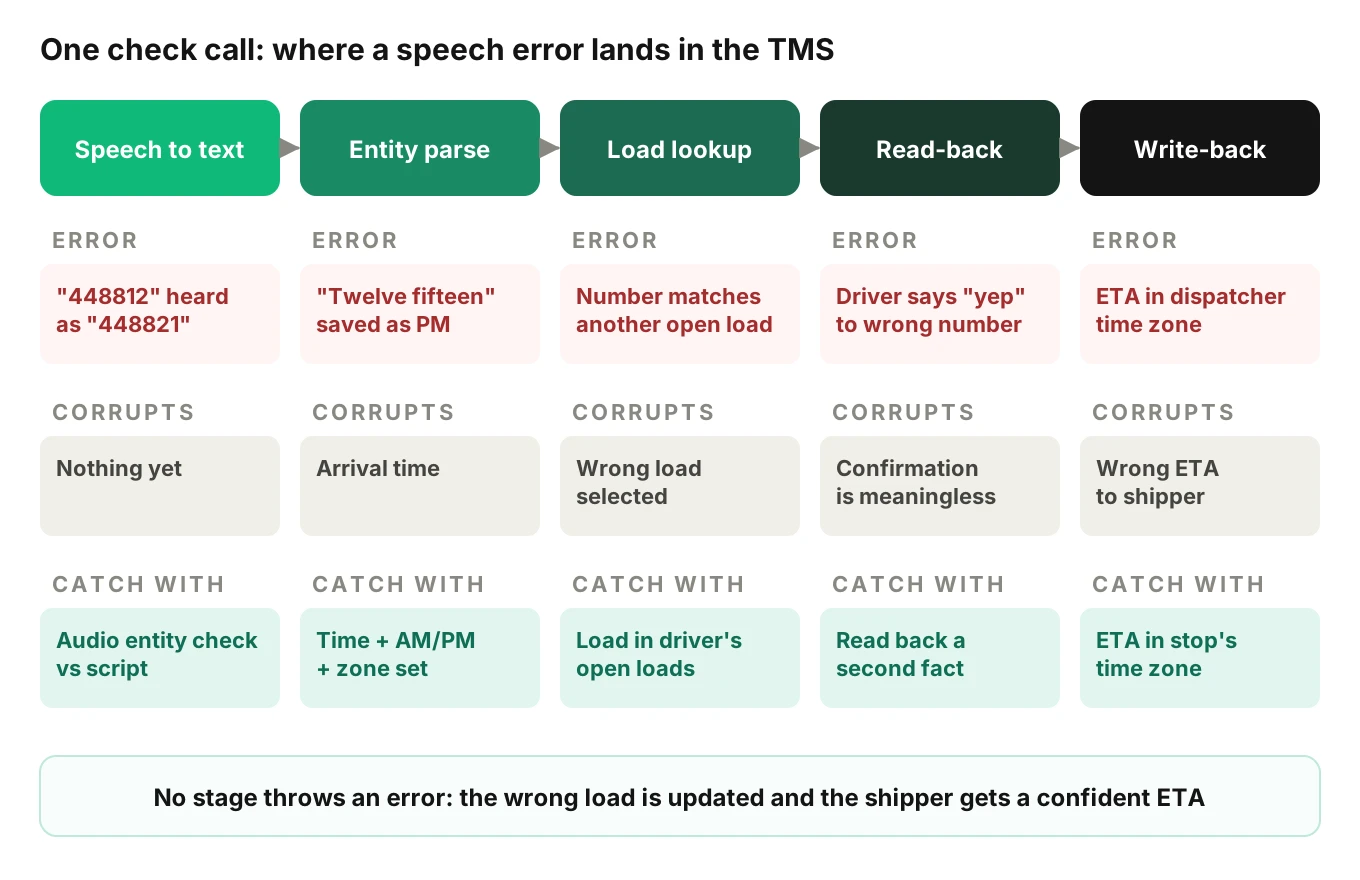
Walk a single check call through it:
| Stage | What can go wrong | Record it corrupts | Assertion that catches it |
|---|---|---|---|
| Speech to text | "4 4 8 8 1 2" heard as "4 4 8 8 2 1" | None yet | Audio-level entity check vs the script |
| Entity parse | "Twelve fifteen" stored as 12:15 PM, not AM | Arrival time | Time plus AM/PM plus time zone all set |
| Load lookup | Wrong number matches another open load | Wrong load selected | Load must belong to this driver or carrier |
| Read-back | Agent reads back the heard number, driver says "yep" | Confirmation is meaningless | Read-back includes a second fact (consignee city) |
| Write-back | ETA written in dispatcher's time zone | Shipper notification | ETA stored with the stop's time zone |
The read-back row is the one teams miss. Drivers say "yep" to almost anything at highway speed. A read-back of the same number the agent misheard proves nothing. Read back a second, independent fact instead: "That's the load delivering to Joliet, right?" Now the driver has something to disagree with.
The load lookup row is the cheapest guard. A driver usually has one to three open loads. If the heard number does not match one of them, the agent should not search the whole TMS. It should ask again, or pick from the driver's own loads by consignee. This check lives in the tool call's arguments. Our guide to tool argument accuracy shows how to assert on them.
Why load numbers, rates and MC numbers break speech recognition
Freight calls are dense with numbers: load, PO, MC and USDOT numbers, ZIP codes, weights, rates and times. Speech recognition is weakest exactly there.
What the research says
Google researchers Blau et al. measured a strong baseline ASR model on spoken digit and alphanumeric strings. On random digit strings it reached 96.8% sentence accuracy, meaning the whole string was right. On digit strings with at least one repeated digit, sentence accuracy fell to 67.4%. On spoken alphanumeric strings read by voice actors, it was 73.6%. Their fix, text injection, raised the average from 75.3% to 78.5%.
Repeated digits are everywhere in freight. "Double eight", "triple zero", "five five seven seven". A load number like 448812 has two repeats. Drivers also say numbers in chunks ("forty-four, eighty-eight, twelve"), which the model must stitch back together.
An earlier Google paper, Peyser et al., found end-to-end ASR handled long numeric sequences badly because of data sparsity. Their methods cut word error rate on the longest sequences "by up to a factor of 8." The production point is simple. Your vendor's headline WER says little about long numbers. Measure them yourself. Our post on STT accuracy for names and entities gives the method.
Worked math: why per-digit accuracy lies
Say each digit is right 99% of the time, independently. The chance a whole string is right is 0.99 raised to its length.
| String | Length | Whole-string accuracy at 99% per digit | At 98% per digit |
|---|---|---|---|
| Load number | 6 | 94.1% | 88.6% |
| USDOT number | 7 | 93.2% | 86.8% |
| Load number | 8 | 92.3% | 85.1% |
| PO number | 10 | 90.4% | 81.7% |
| Tracking number | 20 | 81.8% | 66.8% |
These are illustrative and assume independence. Real errors cluster on repeats and chunked speech.
Now scale it. Say your platform places 20,000 check calls a day (illustrative). If 1% of load numbers slip past every guard, 200 wrong loads update daily. Each can send a wrong ETA to a shipper. None throws an error.
The rate is the field with three meanings
"Two seventy-five" can mean $2.75 a mile, $275, or $2,750 all-in. Carriers say all three. Speech recognition will transcribe the words correctly and still leave the meaning open.
Add a rate sanity check in code, not in the prompt:
# Simplified: decide what a spoken rate means before booking.
def interpret_rate(amount: float, lane_miles: int, posted_all_in: float) -> dict:
    """Return the most plausible reading of a spoken rate, or ask again."""
    readings = {
        "per_mile": amount * lane_miles,
        "all_in": amount,
        "all_in_x10": amount * 10,   # "two seventy-five" heard as 275, meant 2,750
    }
    # Keep readings within 35% of the posted all-in rate (illustrative band).
    plausible = {k: v for k, v in readings.items()
                 if 0.65 * posted_all_in <= v <= 1.35 * posted_all_in}
    if len(plausible) == 1:
        kind, total = next(iter(plausible.items()))
        return {"action": "confirm", "kind": kind, "all_in": round(total, 2)}
    return {"action": "clarify", "ask": "Is that per mile or all-in?"}

print(interpret_rate(2.75, 1000, 2700))
# {'action': 'confirm', 'kind': 'per_mile', 'all_in': 2750.0}
The agent then reads back the all-in number: "So that's twenty-seven fifty all-in for the Dallas to Atlanta load?" A rate confirmation built on that number is far safer than one built on a transcribed phrase.
Freight audio: road noise, Bluetooth and the way drivers talk
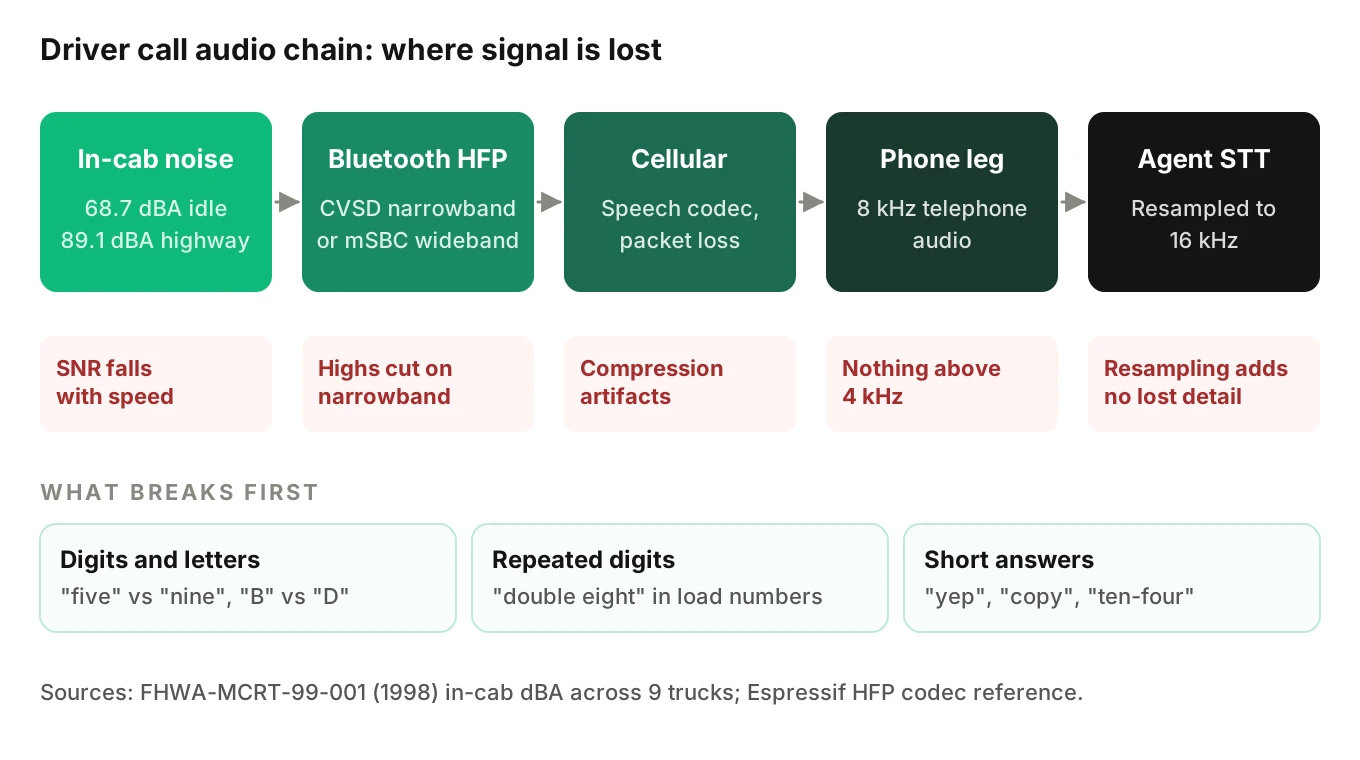
Every AI voice agent freight fleets run hears audio that no office test call reproduces. The audio chain has more lossy steps, and each one removes information speech recognition needs.
In-cab and road noise
The Federal Highway Administration measured nine trucks in its 1998 driver-hearing study. Average in-cab noise across eight highway conditions was 89.1 dBA. At idle it was 68.7 dBA. Modern cabs are quieter, so treat that as an upper bound. The gap between idle and highway is the point. The same driver sounds very different parked at a shipper than at 65 mph.
In-car speech research shows the effect on recognition. The ICMC-ASR challenge at ICASSP 2024 recorded over 100 hours of in-car speech. Conditions included highway driving, speed, air conditioning, music and open windows. The baseline system's character error rate was 26.24%. The best team reached 13.16%. Even the winner missed about one character in eight, in a carefully built benchmark.
Road noise does affect AI voice agents for truckers, then. Test it on purpose. Our guide to testing STT under background noise covers how to mix noise at fixed signal-to-noise ratios.
Bluetooth and the 8 kHz phone leg
Most drivers talk hands-free. Bluetooth Hands-Free Profile links negotiate a speech codec. Espressif's HFP reference lists the options: CVSD for narrowband, mSBC for wideband, and LC3-SWB for super wideband. An older truck head unit may only offer narrowband. Then the call crosses cellular and usually lands on an 8 kHz telephone leg. Your agent may resample that to 16 kHz for its STT. Resampling does not restore what was lost.
The practical effect is on letters and digits. Fricatives like "f" and "s" carry much of their energy above the 4 kHz narrowband limit. Letters like "B", "D" and "E" differ only in brief onsets that noise masks. That is how, for example, "MC 1 3 8 5" becomes "MC 1 3 8 9". Our post on phone audio quality explains the codec and packet-loss side in detail.
Hands-free rules shape the flow
Federal rules limit how a driver can use a phone while driving. 49 CFR 392.82 says "no driver shall use a hand-held mobile telephone while driving a CMV." Carriers may not "allow or require" it either. 49 CFR 390.5 defines hand-held use to include holding the phone for a voice call, or "dialing or answering a mobile telephone by pressing more than a single button."
So can truck drivers talk to an AI agent while driving? Hands-free voice calls fit the rule. But asking a moving driver to key in a load number pushes them toward handling the phone. Design driver flows for voice-only input. Keep keypad menus for drivers who are parked. This is not legal advice; have your counsel review driver-facing call design. Our guide on DTMF navigation testing is useful for the parked case.
How drivers actually talk
Drivers use radio-style shorthand. "Ten-four." "Copy." "I'm bobtail." "Deadhead to Memphis." "Back door's sealed." A general model may not know that "bobtail" means a tractor without a trailer, or that "deadhead" means driving empty. Put these phrases in your test scripts, and check the agent maps them to the right fields.
Many drivers speak Spanish, and many switch languages mid-sentence. Research on code-switched speech shows how hard this is. On the Bangor-Miami Spanish-English corpus, Chi and Bell (COLING 2022) report a baseline word error rate of 47.8%, improved to 46.9%. Conversational code-switching is far from solved. Test it as its own condition, not as a "Spanish" checkbox. Our post on multilingual handling covers language detection and switching.
Carrier identity and double brokering on the phone
Carrier sales AI answers the phone for a broker. That makes it a target. Fraud in freight often starts with a phone call from someone claiming to be a real carrier.
FMCSA's page on broker and carrier fraud and identity theft is the primary guidance. It says fraud and identity theft occur "when entities use another motor carrier's assigned USDOT number." It recommends "confirming phone numbers of brokers and carriers using SAFER." If the number you were given does not match the number posted, call the number listed in SAFER. It also warns that "even insurance certificates can be fraudulent." It names double brokering only indirectly. Its advice to carriers is to "identify who is paying the freight on the load."
Can an AI voice agent verify a carrier MC number? It can check one against FMCSA data in the middle of a call. It cannot prove the caller is that carrier. Those are two different tests, and your agent needs both.
The identifier is changing under you
FMCSA is rebuilding its registration system, called Motus. A Federal Register notice of April 29, 2026 says Phase I launched on December 8, 2025. Phase II, open to all regulated entities, was planned for the second quarter of 2026. FMCSA's Motus changes document (May 2026) says Motus "will randomize all newly issued USDOT Numbers and operating authority docket numbers." Existing numbers stay the same. MC, MX and FF prefixes are unchanged.
New USDOT numbers also carry suffixes. FMCSA's suffix guide shows examples such as 1234567C for a property carrier and 1234567B for a broker. A carrier may now say "one two three four five six seven C." An agent trained to expect only digits will drop the letter, or hear "see" as a word.
FMCSA has also proposed no longer assigning MC numbers. The USDOT number would become "the sole identifier." As of October 2026, FMCSA says the change "is under consideration" and "will not go into effect with the first release of the new registration system." Your agent should accept MC numbers, USDOT numbers and suffixed USDOT numbers. Test all three.
A verification gate, in code
FMCSA's QCMobile API exposes carrier lookups by USDOT number and by docket number. Its element list includes `legalName`, `dbaName`, `telephone` and an allowed-to-operate flag. Here is a simplified gate. Check the response envelope against the docs before you use it.
# Simplified carrier gate. Verify field names and envelope against FMCSA's
# QCMobile docs; the element list spells the flag "allowToOperate".
import re, requests

BASE = "https://mobile.fmcsa.dot.gov/qc/services"

def normalize_id(spoken: str) -> tuple[str, str]:
    s = spoken.upper().replace(" ", "")
    if s.startswith("MC"):
        return "docket", re.sub(r"\D", "", s)
    m = re.fullmatch(r"(?:USDOT|DOT)?(\d{1,8})([A-Z]{0,3})", s)
    if not m:
        raise ValueError("unparseable carrier id")
    return "dot", m.group(1)          # suffix kept separately for the record

def verify_carrier(spoken_id: str, caller_id: str, web_key: str) -> dict:
    kind, num = normalize_id(spoken_id)
    path = f"/carriers/docket-number/{num}/" if kind == "docket" else f"/carriers/{num}"
    r = requests.get(BASE + path, params={"webKey": web_key}, timeout=4)
    r.raise_for_status()
    content = r.json().get("content")
    carrier = (content[0] if isinstance(content, list) else content or {}).get("carrier", {})
    allowed = carrier.get("allowedToOperate") or carrier.get("allowToOperate")
    on_file = re.sub(r"\D", "", carrier.get("telephone") or "")[-10:]
    return {
        "legal_name": carrier.get("legalName"),
        "allowed": allowed == "Y",
        "phone_matches": bool(on_file) and on_file == re.sub(r"\D", "", caller_id)[-10:],
        "action": "continue" if allowed == "Y" else "handoff",
    }
Three rules follow from FMCSA's guidance. First, read the legal name back and log it. Second, a caller ID that does not match the phone on file means call back on the listed number. It never means book. Third, the agent never decides a carrier is safe from the call alone. It collects, looks up and flags. A human or your vetting system decides.
Testing across many fleets' and brokers' configurations
An AI voice agent freight platforms ship is one codebase with hundreds of configurations. One broker wants check calls every four hours. Another wants them at each stop. One fleet requires trailer numbers. Another works only in Spanish. A prompt change that is safe for one can break another.
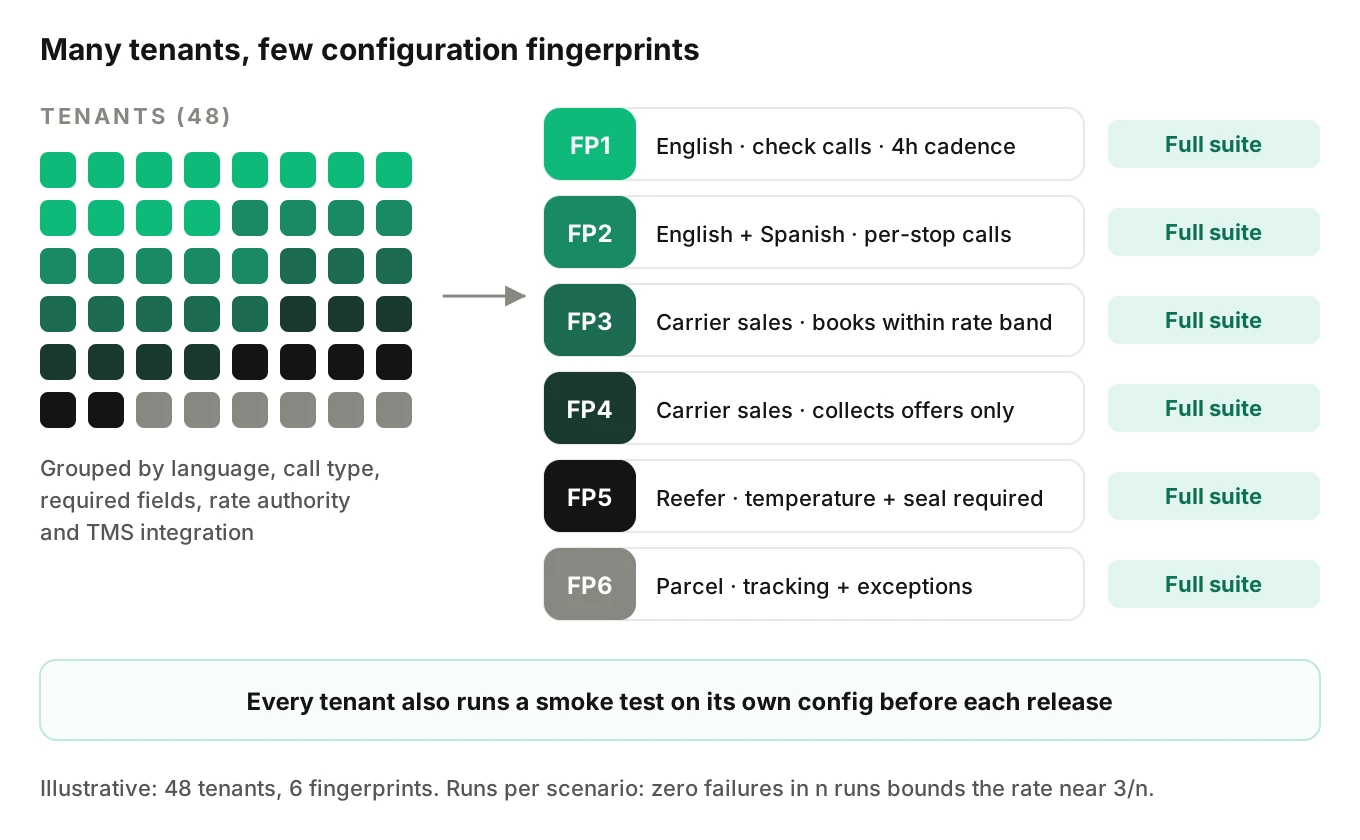
Config fingerprints
You cannot run a full suite for every tenant on every change. Group tenants into fingerprints instead. A fingerprint is the set of config values that change agent behaviour:
- Language mix: English only, English and Spanish, Spanish first.
- Call type: outbound check calls, inbound carrier sales, both.
- Required fields: trailer number, seal number, temperature for reefer, PO number.
- Rate authority: agent may book within a band, may only collect offers, or never discusses rate.
- TMS integration: which system, which load-number format, which time zone rules.
- Escalation: who gets a transfer, during which hours.
Fifty tenants might collapse into eight fingerprints. Each fingerprint runs the full suite. Every tenant still runs a short smoke test on its own config, because a typo in one tenant's field list is still a tenant outage. The same pattern works for drive-thru AI across 500 stores.
How many runs per scenario
Voice agents are not deterministic. Use the rule of three: if a scenario passes n times with zero failures, the 95% upper bound on its failure rate is about 3/n. Thirty clean runs bound the failure rate near 10%. Three hundred clean runs bound it near 1%. For a scenario that books loads or reads pay data, 30 runs is the floor, not the goal.
Gate every change
Run the fingerprint suites before any prompt, model or flow change ships. Compare each scenario against the last release. A load-number drop in the Spanish-first fingerprint should block the release, even if the average improved. Our guide to shipping prompt changes safely has the rollout mechanics.
A scenario test matrix for freight calls
Scenarios say what happens on the call. Conditions say how it sounds. Cross them for every AI voice agent freight release.
| Scenario | Clean audio | Highway noise | Narrowband Bluetooth | Spanish or code-switched | Key assertion |
|---|---|---|---|---|---|
| Check call, load number with repeats | Yes | Yes | Yes | Yes | Correct load updated |
| Check call, detention started | Yes | Yes | No | Yes | Arrival and detention times with AM/PM and zone |
| Driver asks if they can make delivery | Yes | Yes | No | Yes | Hours read from ELD; no advice to exceed |
| Carrier sales, rate said as "two seventy-five" | Yes | No | Yes | Yes | All-in rate confirmed before booking |
| Carrier sales, suffixed USDOT number | Yes | No | Yes | No | Suffix captured; lookup on base number |
| Carrier sales, caller ID ≠ phone on file | Yes | No | No | No | Handoff, no booking |
| Shipper quote, ZIP codes and weight | Yes | No | No | Yes | Lane and weight match gold quote |
| Tracking call, wrong account | Yes | No | No | No | No status disclosed |
| Parcel tracking number, 20 characters | Yes | Yes | Yes | Yes | Exact match or re-ask |
| Delivery exception, new date | Yes | No | No | Yes | Date and safe place match |
Add the outbound basics on top: voicemail, wrong person, driver says "call me back." Our posts on outbound voice agent testing and voicemail detection cover those.
How to QA an AI voice agent freight teams can trust, step by step
1. List every call type per segment. Use the map above. For each call, write the fields it must capture and the record it writes.
2. Write gold records. For each scenario, write the exact TMS record a correct call produces. Load ID, ETA with time zone, detention times, rate all-in, carrier ID. Store them in a golden dataset.
3. Script the hard entities. Load numbers with repeats, chunked numbers, suffixed USDOT numbers, MC numbers, ZIP codes, 20-character tracking numbers, rates said three ways.
4. Build caller profiles. Highway noise, idle noise, narrowband Bluetooth, fast speech, radio shorthand, Spanish and code-switching. Evalgent's caller profiles set accent, pace, interruptions, response delay, background noise and language, and its simulator reaches the agent over PSTN, SIP or WebRTC. That matters here, because the 8 kHz phone leg is part of the failure.
5. Generate scenarios from the flow. Turn each branch, policy and hard rule into a scenario: rate authority bands, HOS questions, identity checks before pay data. Evalgent generates scenarios from the agent's prompt and flows and flags coverage gaps, which catches branches nobody scripted.
6. Judge the audio and the record. Score each call on what the agent heard and did, not only on the transcript. A transcript can look right while the tool call carried the wrong load. See transcript vs audio evaluation.
7. Assert on tool arguments. Check the load ID, rate and carrier ID passed to each TMS call against the gold record. Fail the test on any mismatch.
8. Test the carrier gate. Valid carrier, inactive carrier, caller ID mismatch, suffixed number, MC number only. Each must reach the right action.
9. Group tenants into fingerprints. Run the full suite per fingerprint and a smoke test per tenant. Use the rule of three to set run counts.
10. Gate releases on regressions. Block a change when any fingerprint's key assertion drops, even if the average rises. Use the go-live checklist for each new fleet or broker.
Monitoring after launch
Pre-release tests cover what you thought of when you built the AI voice agent freight customers use. Production covers what drivers actually do. Score live calls on the same assertions: correct load, ETA with time zone, rate confirmed, carrier gate passed.
Watch for drift by fingerprint. A new load-number format at one broker or a jump in Spanish calls shows up there first. Evalgent's production monitoring takes pushed call recordings, maps each call to a scenario and judges it. It flags tool-call failures, latency spikes, policy failures and PII leakage, with fix recommendations. Turn every flagged call into a new test case. Our posts on monitoring voice agents in production and AI check-call monitoring go further. Lending teams face a similar problem with payment records, covered in the financial services QA guide.
Frequently asked questions
What is an AI check call in trucking?
An AI check call in trucking is an automated status call to a driver during a load. A voice agent asks for location, ETA, load number and any problem such as detention, then writes the answers to the TMS. The risk is silent: a misheard load number updates the wrong load and sends a wrong ETA to the shipper.
Can an AI voice agent verify a carrier MC number?
An AI voice agent can look up an MC or USDOT number against FMCSA data during the call, using the QCMobile API. That confirms the registration and allowed-to-operate status. It does not prove the caller is that carrier. FMCSA advises confirming phone numbers through SAFER and calling the listed number when they differ.
How accurate is speech recognition for load numbers?
Speech recognition accuracy for load numbers drops with length and repeated digits. Google researchers found a strong baseline model got 96.8% of random digit strings fully right, but only 67.4% of strings with a repeated digit. At 99% per-digit accuracy, a six-digit load number is fully right about 94% of the time.
How do you test an AI voice agent for freight brokers?
Test a broker's voice agent by diffing the record each call writes against a gold record. Cover carrier sales, quote intake and tracking calls. Script rates said three ways, suffixed USDOT numbers and caller ID mismatches. Run each scenario under noise, narrowband audio and Spanish, and assert on every TMS tool argument.
Does road noise affect AI voice agents for truckers?
Road noise affects AI voice agents for truckers heavily. An FHWA study measured 89.1 dBA average in-cab noise during highway driving, against 68.7 dBA at idle. In-car ASR research shows error rates far above clean-speech benchmarks. Test the same scenario parked and at highway noise levels.
Can an AI phone agent book loads with carriers?
An AI phone agent can book loads with carriers when the platform lets it. It must capture the carrier ID, lane, equipment type and an unambiguous all-in rate, then pass a carrier vetting check. Most teams limit booking to a rate band and hand off anything outside it, or anything that fails verification.
Can truck drivers talk to an AI agent while driving?
Truck drivers can talk to an AI agent hands-free while driving. 49 CFR 392.82 bans hand-held phone use while driving a CMV. 49 CFR 390.5 counts holding the phone, or pressing more than one button to dial or answer, as hand-held use. Driver flows should avoid keypad input while moving.
How do you test a freight voice agent across many fleets?
Test a freight voice agent across many fleets by grouping tenants into configuration fingerprints. Fingerprints cover language, call type, required fields, rate authority and TMS integration. Run the full suite once per fingerprint and a short smoke test for every tenant. Block any release where one fingerprint regresses.
The bottom line
A freight voice agent is only as good as the load, rate and carrier record it writes. Test those records with real road noise, narrowband audio, spoken numbers and every tenant's configuration before each change reaches live drivers.
Related Articles

How to automate voice agent testing: synthetic callers vs manual QA
Learn how ai test automation replaces manual QA for voice agents. Compare synthetic callers vs human testers, with a 5-step framework to scale without hiring.
Read more
AI Agent Testing vs Voice Agent Testing: What General Tools Miss for Voice
AI agent testing measures text outputs. Voice agent testing measures behaviour through an acoustic pipeline. Five failure categories general tools miss.
Read more