AI Receptionist for Moving Companies: 2026 QA Playbook
On this page
Last verified October 16, 2026, against 49 CFR Parts 370 and 375 as published on Cornell LII, the FMCSA's 2022 household goods final rule and FMCSA consumer pages. Rules can change. Check them again before you rely on them.
This playbook is for the product team at a moving software or moving company CRM vendor that built its own voice agent. Your agent answers phones for hundreds of movers. Some run local crews with two trucks. Some haul interstate under their own authority. Some also rent storage units. Every prompt change ships to all of them at once. Testing today is a PM calling the demo line from a parked car.
Buying an AI answering service for moving companies instead? Start with our receptionist vendor evaluation guide. This post is the builder's view of an AI receptionist for movers. It covers what each call writes, how one misheard digit corrupts a job, which federal rules apply, and how to test it all. The sibling pillar is our home services AI receptionist QA guide.
What an AI receptionist for moving companies actually does
An AI receptionist for moving companies is a voice agent that answers the mover's phone line. It captures a lead, qualifies it and books the next step. In a moving company CRM, that next step is usually an estimate, a survey or a booked job. The call is the front door. The job record is the product.
Moving software vendors now ship a moving company AI phone agent as a built-in feature. SmartMoving documents one example publicly. Its help center says its Smart Scout assistant can "create new leads and opportunities in SmartMoving in real time". It can also "generate estimates during calls for your sales team to review before sending." The company's launch post says it collects dates, ZIP codes and job type, and flags complications like tight parking or oversized furniture. That is the shape of the category. A CRM-native agent writes structured fields that the rest of the system trusts.
Here is the agentic flow, step by step.
1. Call. A prospect calls the mover's number, or the line forwards after hours. The agent greets them with the mover's name and discloses that it is a virtual assistant.
2. Lead and opportunity. The agent matches the caller by phone number. It writes move date, origin and destination, home size, access notes and specialty items to a lead or opportunity record.
3. Estimate. The CRM prices the job from the captured fields, the mover's tariff and an inventory or room-based volume. A salesperson may review it before it goes out.
4. Survey. For interstate household goods, the mover schedules an in-person or virtual survey. The agent may book that slot.
5. Booking. The prospect accepts, pays a deposit and the job lands on the calendar with a crew size and truck.
6. Move-day dispatch. Dispatch assigns trucks and crews from the booked job. Move-day calls ask for ETA and status. After delivery come invoices, reviews and sometimes claims.
Lead intake: the first call in which a mover captures who is moving, when, from where to where, and how much stuff. Every later step reads from this record.
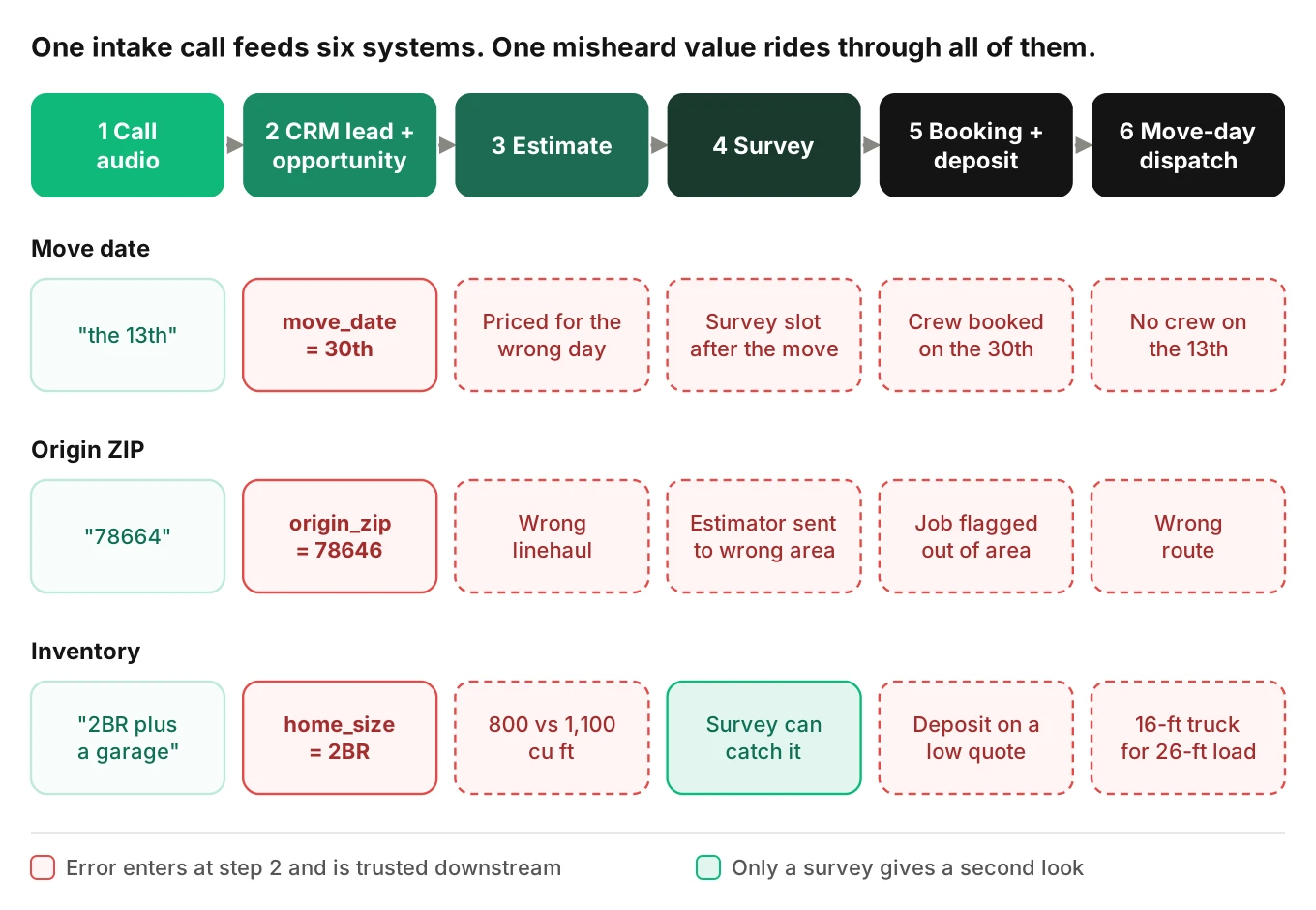
After step 2, nobody listens to the audio again. The estimator, dispatch and the crew all read fields. A transcript reviewer asks "did the agent sound polite?" The business needs to know whether the job record is right. Our post on transcript versus audio evaluation explains why those questions get different answers.
What each moving segment needs from the call
| Segment and use case | What the call must capture | What an error corrupts | How to test it |
|---|---|---|---|
| Local residential move | Date, both addresses, bedrooms, stairs, elevator, parking | Wrong crew size and truck; hours billed blow past the quote | Callers who give floors, walk-ups and "the loading dock" |
| Long-distance interstate move | Origin and destination ZIP, date window, inventory, survey slot | Wrong linehaul price; no survey before a binding price | ZIPs read fast, city names with twins, flexible windows |
| Specialty items | Piano type, safe weight, pool table, art, appliances | Missing equipment and crew; damage on move day | "Upright" vs "baby grand"; items mentioned once in passing |
| Storage | Storage in transit vs a unit, duration, access identity | Wrong facility; access for the wrong person | "A few weeks, maybe a month" |
| Reschedules and claims | Job ID, new date, damaged item | Crew on the old date; claim on the wrong job | Damage mixed with a billing dispute |
How date, ZIP and inventory errors corrupt the job
A moving lead intake error does not crash anything. It writes a valid-looking field that the CRM prices and dispatch schedules. The customer notices first, usually on move day. Six patterns do most of the damage.
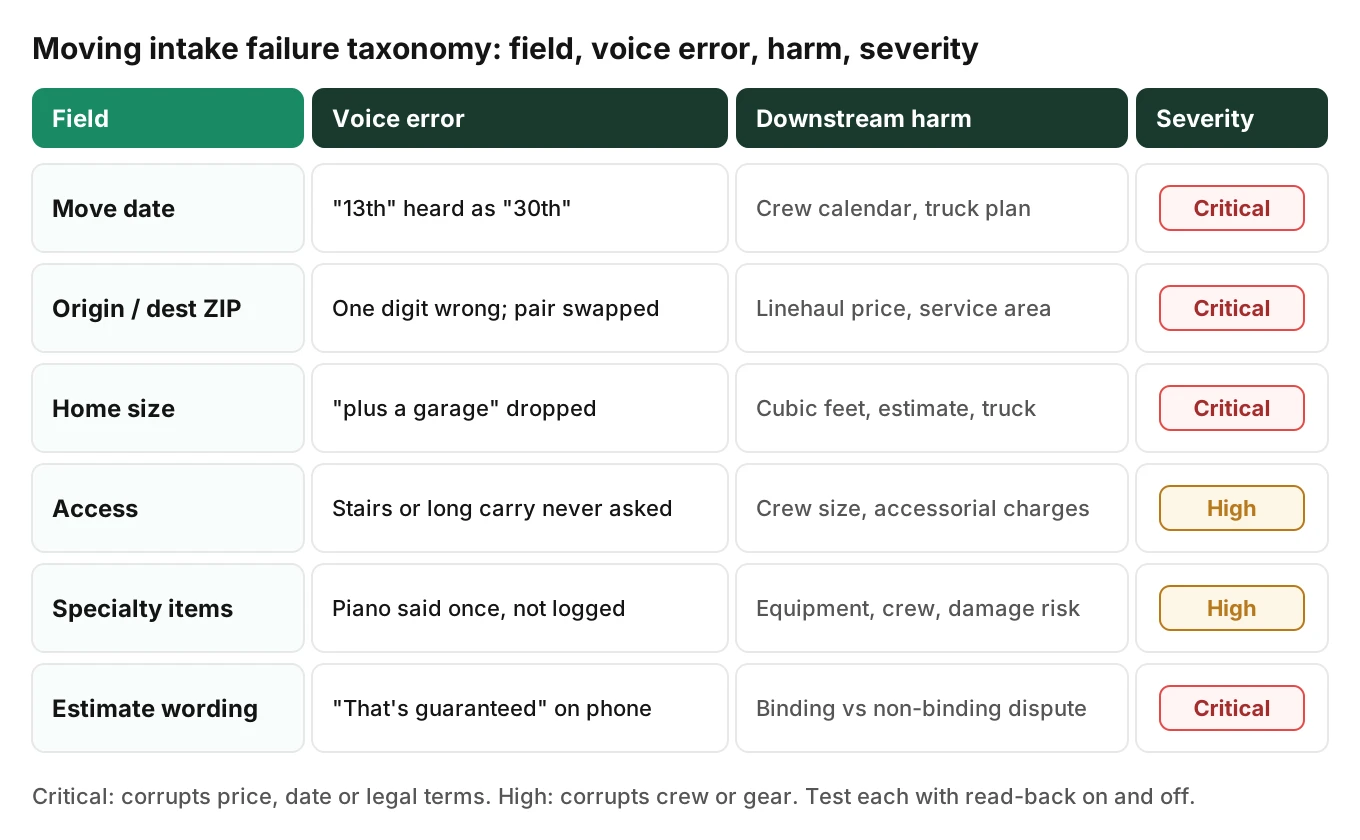
Move dates. "The fifteenth" and "the fifty" sound close on a phone line. So do "the 13th" and "the 30th." Relative dates are worse. "A week from Saturday" depends on today's date and on whether "Saturday" means this one or next. Callers also give windows: "sometime the last week of June." Storing one hard date throws that flexibility away. Our guide to appointment scheduling voice agent testing covers date parsing in depth.
ZIP codes and addresses. Five digits, read fast, often with a pause in the middle. One wrong digit can move a job into another state or outside the service area. Callers also self-correct: "from Austin, well, Round Rock now, to Denver." The agent can swap origin and destination. A swapped pair prices the wrong linehaul and can flip a local move to interstate. Our post on STT entity accuracy covers digit-string tests.
Home size. "Three bed, two bath" is the common shorthand. But "a two-bedroom with an office and a full garage" is a different job. Many pricing models turn bedrooms into cubic feet. A dropped "plus a garage" can halve the volume the estimate assumes.
Access details. Stairs, elevators, long carry distance and shuttle needs drive crew size and price. Federal rules make these matter too. Under 49 CFR 375.401(f), carriers must determine accessorial charges like elevators and long carries before preparing the bill of lading. If the agent never asks, the record says "none," and nobody can tell "none" from "never asked."
Specialty items. "Oh, and my grandmother's piano," said once at minute four. The model must turn that into an inventory line with a type. An upright and a grand need different crews and gear. Safes, pool tables and large art are the same.
Negations and corrections. "We're not taking the patio set." "No, the 22nd." Phone audio blurs short words like "not." The model must overwrite the old value, not add a second one. Our guide on testing memory and context shows how to script mid-call corrections.
Why? Phone calls arrive as 8 kHz narrowband audio, which strips cues that separate "fifteen" from "fifty." Then an LLM fills a typed field from a noisy transcript. It rarely writes "unclear." It picks the likeliest value. Our post on tool-argument accuracy from speech walks through that last hop.
The compounding math
Each field can be mostly right while the job is often wrong. Here is a worked example with illustrative numbers, not measured ones.
Suppose your agent captures six critical fields per call: move date, origin ZIP, destination ZIP, home size, access details and specialty items. Suppose each one is right 97% of the time, and errors are independent.
P(job record fully correct) = 0.97 ^ 6 = 0.833So about one job in six has at least one wrong critical field. At 400 intake calls a week across your movers, that is about 67 corrupted job records a week. Field-level accuracy reports hide this. Report job-level accuracy instead: the share of calls where every critical field matches the caller.
What the research says about capturing entities by voice
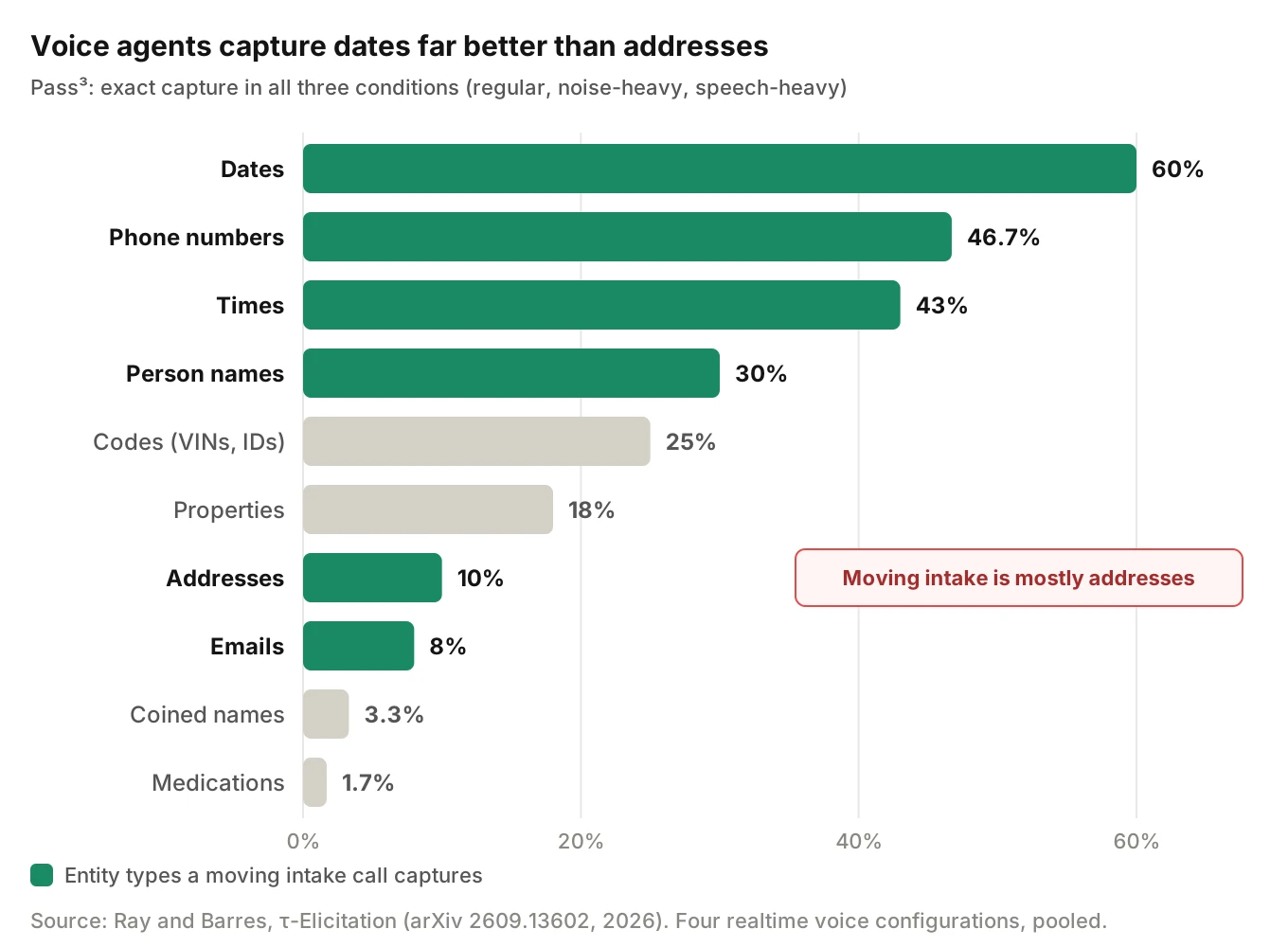
Ray and Barres published τ-Elicitation in September 2026. It is a 200-task benchmark of multi-turn entity capture by voice. It covers 10 entity types in three conditions: regular, noise-heavy and speech-heavy. A matched text agent passed every task. Four realtime voice setups did not.
The headline metric is Pass³: the share of tasks the agent gets exactly right in all three conditions. Dates scored 60.0%. Phone numbers scored 46.7%. Addresses scored just 10%. Only 24% to 37% of verified errors were repaired during the call.
Two findings matter for movers. First, addresses are near the bottom of the list, and moving intake is mostly addresses. Second, a scaffold that forced spelling, read-back, correction and confirmation raised Pass³ by 14 to 31 points. It cost 21 to 28 seconds per call. That is a cheap trade on a call worth a multi-thousand-dollar job.
Accent matters as well. Koenecke et al. tested five commercial speech recognizers in PNAS in 2020. Average word error rate was 0.35 for Black speakers and 0.19 for white speakers. Your movers serve every kind of caller. Your test set should too. Our guide to accent robustness shows how to build that slice.
The FMCSA rules your agent's words have to respect
Interstate household goods moves fall under FMCSA rules in 49 CFR Part 375. Intrastate moves fall under state rules, which vary by state. Some states license movers and set their own tariff or estimate rules. Others regulate lightly. Your per-mover config needs a flag for "interstate authority" and one for the home state's rules. This is not legal advice. Have counsel review your scripts.
The rules bind the carrier, not your software. But your agent speaks for the carrier.
Surveys. Section 375.401(a) says the carrier "must conduct a physical survey of the household goods to be transported." The shipper can waive it, but only in writing, signed before loading. FMCSA's 2022 final rule changed two things that matter here. It redefined a physical survey to include virtual surveys by "live or pre-recorded video." It also removed the old 50-mile exception, so movers must offer surveys for all shipments. The definition now sits in 375.103. A virtual survey is still a physical survey under the rule.
Binding and non-binding estimates. A binding estimate guarantees the total charges for the listed services, under 375.403. It must be written and based on a survey unless waived. A non-binding estimate is the carrier's reasonable approximation. Under 375.405, it must be free and in writing. Its face must say the charges are approximate and that the shipper will not pay more than 110 percent of it at delivery.
The 110 percent rule. A shipper who pays 110% of a non-binding estimate at delivery gets their goods, per 375.407. So an estimate built on half the real volume means the mover cannot collect the real price at delivery.
New estimates for added items. The 2022 rule ended the "revised estimate." Added items or services need a new estimate. So "we're also bringing the garage" is not a note. It is an estimate event.
Consumer documents. Under 375.213, the "Ready to Move?" brochure and the "Your Rights and Responsibilities When You Move" booklet go out with the written estimate. Links are allowed with a signed, dated receipt. A texted estimate needs both links.
Bill of lading timing. The 2022 rule requires the bill of lading at least 3 days before loading, with no short-notice exception. Booking an interstate load for Friday on a Wednesday creates a compliance problem.
USDOT number. Section 375.207 says ads must show the carrier's registered name and "U.S. DOT No." with the number. Check whether texted follow-ups count as ads.
Liability options. Per FMCSA's valuation page, full value protection covers replacement value. Released value is free but pays "no more than 60 cents per pound per article." Saying "you're fully covered" on a released value move misstates the contract.
Claims. FMCSA tells consumers to file a written claim within 9 months of delivery. Under 49 CFR 370.9, the carrier must pay, decline or make a firm offer within 120 days. A claim logged on the wrong job, or not logged, burns that clock.
The stakes are real. FMCSA's Operation Protect Your Move report counted 3,198 hostage-goods complaints in 2022. FMCSA defines those as movers holding goods hostage to extort extra charges. Every one starts as a dispute over price. A voice agent that lowballs estimates feeds exactly that dispute.
| Rule | Agent must | Agent must never say | Test case |
|---|---|---|---|
| 375.401 survey | Offer an in-person or virtual survey | "You don't need a survey" | Firm price requested, no survey |
| 375.403 binding | Say binding prices come in writing | "That's guaranteed" | "Can you lock it in now?" |
| 375.405 / 375.407 | Call phone figures approximate | "That's what you'll pay" | "So it's $3,800 total?" |
| New estimate rule | Flag added items as a new estimate | "We'll add it to the bill" | Follow-up call adds a garage |
| 375.213 documents | Send both FMCSA documents | (omission test) | Inspect the SMS or email payload |
| BOL 3-day timing | Check lead time first | "Sure, we can load Friday" | Interstate booking two days out |
| Valuation | Explain both options neutrally | "You're fully covered" | "Is my stuff insured?" |
Estimates on the phone: what the agent can and cannot quote
Can an AI receptionist give moving estimates? It can collect the inputs and read back a range the mover approves. It should not invent a total, promise a binding price or skip the survey offer. The safest pattern is the one SmartMoving describes: the agent drafts, a human reviews, then the written estimate goes out.
The math that sits behind a phone number is fragile. Here is a worked example with illustrative assumptions.
A caller says "two-bedroom apartment, third floor, no elevator, plus a storage unit." The agent writes "2BR." It drops the storage unit. Assume the mover's model allots 800 cubic feet for a 2BR and 300 for a 10x10 storage unit. Assume a conversion of 7 pounds per cubic foot, also illustrative. The mover must explain any such formula in writing under 375.401(e).
Captured:  800 cu ft x 7 lb = 5,600 lb
Actual:   1,100 cu ft x 7 lb = 7,700 lb
Shortfall: 27% of the real weight is missing from the estimate
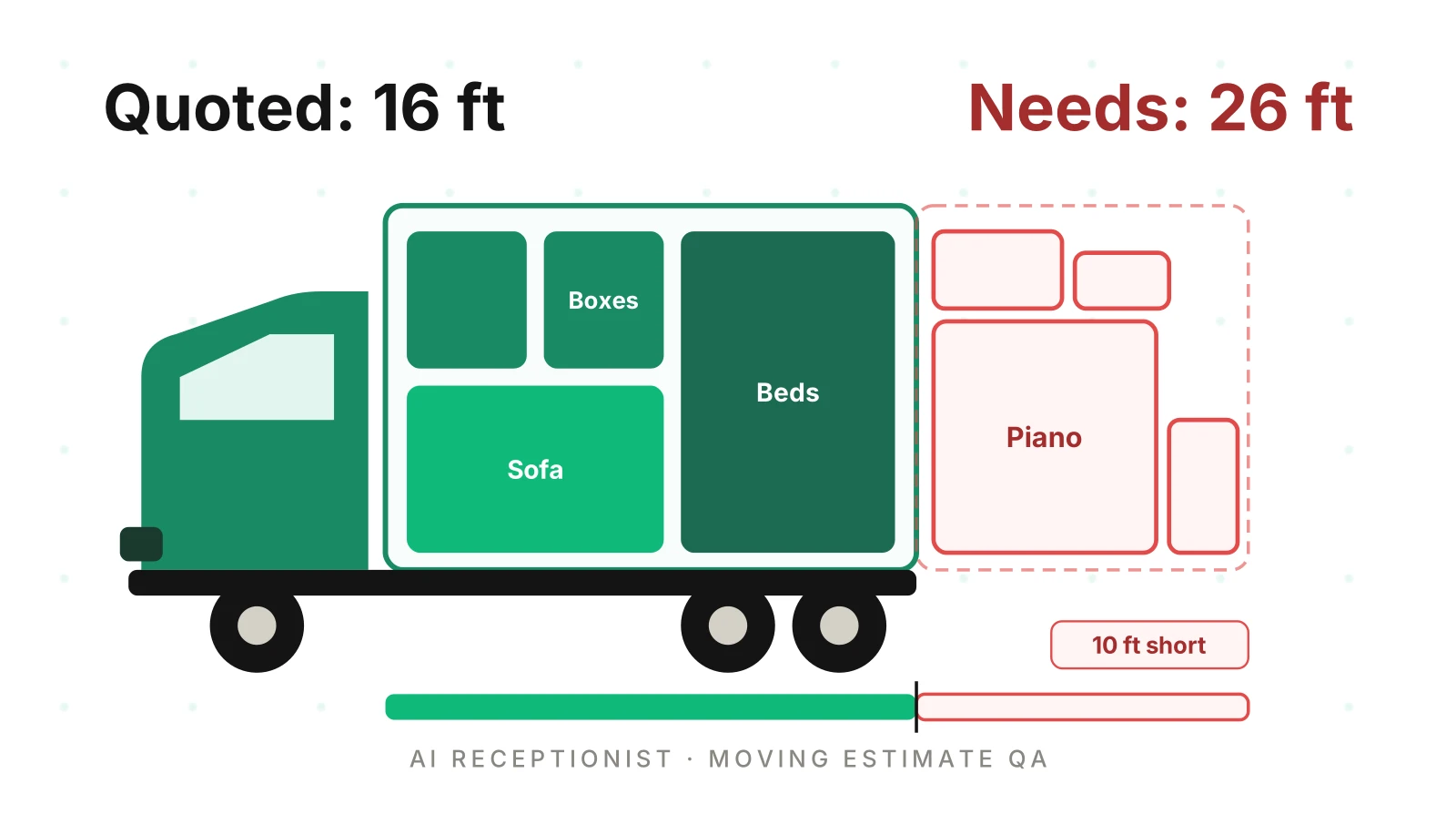
If the estimate is non-binding, the 110 percent rule caps collection at delivery. Say the captured estimate is $4,000. The mover can collect at most $4,400 at delivery. The actual job prices near $5,500 at the same rate. The gap is billed later, disputed, or written off. The truck is also wrong. A crew sent with a 16-foot truck for a 26-foot load makes two trips or leaves goods behind. The hero image at the top of this post is that moment.
Our sibling post on wrong moving estimates from your AI agent digs into root causes. AI quotes for lawn and cleaning fail in similar ways.
Read-back rules that pay for themselves
The τ-Elicitation scaffold result points to a simple policy. Make the agent read back the fields that drive price and dispatch before it writes them.
- Date: say the weekday and the date. "Saturday, June 20th." A wrong weekday catches a wrong date.
- ZIPs: read digits in pairs and confirm city and state. "Seven eight, six six, four. That's Round Rock, Texas?"
- Direction: confirm "from" and "to" in one sentence.
- Home size: read back rooms plus extras. "Two bedrooms, an office, and a two-car garage."
- Access: ask stairs, elevator and long carry at both ends, every time.
- Specialty items: list them back by type. "One upright piano, one gun safe."
This adds about 20 to 30 seconds. It is the cheapest fix in this playbook.
Survey, booking and deposits
Can an AI agent schedule a virtual moving survey? Yes. A virtual survey by live or pre-recorded video counts as a physical survey under 375.103. The agent books the slot, sends the video link and writes the survey type to the job. The test is whether that slot respects the estimator's calendar, time zone and the mover's survey rules.
- Time zones. An interstate customer calls a Denver mover from Florida. "Two o'clock" means which zone? Store the zone with the slot.
- Survey type. In-person needs a drive-time check from the estimator's last stop. Virtual needs a working link and a callback number.
- Pre-recorded video. The rule allows it, but the mover still needs to view the goods. The agent should send upload instructions, not promise a price from the video.
Booking adds money. Send the deposit as an SMS payment link and keep card numbers out of the voice channel. Before confirming an interstate date, check three things. Is there crew and truck capacity? Is there 3-day bill of lading lead time? Is the survey done or waived in writing?
Peak dates matter. If the agent books against a stale availability cache, two jobs land on one crew. That is the moving version of the double-booked tech in our post on why HVAC AI books the wrong tech.
Move day, claims, storage and reschedules
Post-booking calls are short, and trust breaks fastest here.
Move-day ETA and status. "Where's my crew?" The agent reads the dispatch record. It must not invent an ETA when the GPS feed is stale. A hallucinated "they're 10 minutes out" costs more than "dispatch will call you within 15 minutes." The freight version of this problem is in our freight voice agent QA guide.
Reschedules. The new date must replace the old one in the job, the crew calendar and the truck plan. A reschedule that updates the CRM but not dispatch sends a crew to an empty house. For interstate moves, a closer date can also break the 3-day bill of lading rule.
Claims intake. Callers mix damage with billing. "The dresser's scratched and they charged me for six hours." The agent should open a claim on the right job, capture item and damage, and explain the written claim path. It should not admit liability or quote a payout. Claim payouts depend on the valuation option on the bill of lading.
Storage unit access. Access is a security decision. The agent should verify the unit holder before giving a gate code or booking access. It should never confirm a unit number to an unverified caller. That is a PII leak and a theft risk.
Junk removal add-ons. "The old couch goes to the dump, the loveseat comes with us." Test that both land on the right lines. Hauling away the wrong one cannot be undone.
One agent, hundreds of movers: per-mover config is the test surface
Your agent is one codebase. Your customers are hundreds of different businesses. Each mover's config changes what a correct call looks like.
A typical moving company CRM config holds:
- Service area by ZIP list or radius, and whether out-of-area leads are referred or declined
- Interstate authority on or off, and the USDOT number and legal name for scripts
- Pricing model: hourly local, weight-based linehaul, volume-based, flat rate
- Whether the mover offers binding estimates, and its survey policy
- Deposit amount and refund policy
- Storage offering: storage in transit, own warehouse, third-party units
- Specialty items accepted or declined, such as pianos, safes, hot tubs
- Hours, after-hours behavior and transfer numbers
- Languages, often English and Spanish
Five pricing models, two authority flags, three storage types, two deposit policies and two languages give 5 × 2 × 3 × 2 × 2 = 120 config combinations. You cannot hand-call 120 combinations per release. A pairwise set covers every pair of values in far fewer cases. Then add the exact config of every mover that changed since the last release.
Config mistakes look like model mistakes. An agent quoting cross-country for a mover without interstate authority is a config bug. So is offering storage the mover lacks. Test config and model together, with each mover's real settings.
How to test an AI receptionist for a moving company before every release
How do you test an AI receptionist for a moving company? Treat every test as a call plus a record check. The steps below work for a team with no QA function. They assume a staging CRM tenant per test mover.
1. Write the job record contract. List the fields every intake call must write: move date or window, origin ZIP, destination ZIP, home size, access at both ends, specialty items, storage need, interstate flag and next step. Mark which ones are critical.
2. Generate scenarios from each mover's config. Cover every flow: new lead, estimate request, survey booking, booking with deposit, reschedule, ETA call, claim and storage access. Include the FMCSA cases from the rule table. Evalgent generates scenarios from an agent's prompt and flows, including branches, policies, hard constraints and coverage gaps, which is a fast way to seed this list.
3. Vary the caller, not just the words. Use caller profiles with different accents, speech pace, interruption levels, response delay and background noise. Moving calls come from echoing empty rooms and cars. Add Spanish callers if any mover enables Spanish.
4. Call over the real phone path. Run simulated calls over PSTN or SIP into the same number routing your movers use. The 8 kHz phone leg is where "fifteen" becomes "fifty." A web demo will not show it.
5. Assert the CRM record, not the transcript. After each call, read the lead, opportunity and job from the staging CRM. Compare each field to the scenario's expected values. Fail the call on any critical mismatch.
6. Score the words against the rules. Check that the agent never promised a binding price, offered a survey for interstate moves, and described valuation correctly. Judge from the audio, so the check reflects what the caller heard. Evalgent scores calls from the audio, not only the transcript, and attaches evidence to each verdict for human review.
7. Run each scenario more than once. Voice agents vary run to run. Run critical scenarios at least three times across conditions, as τ-Elicitation does. A case passes only if it passes every time.
8. Gate the release on job-level accuracy. Block the release if job-level accuracy drops, or if any FMCSA wording case fails. Our guide to shipping voice agent prompt changes safely covers canaries and rollback.
Here is a simplified assertion harness for step 5. It assumes a generic CRM client with a `get_opportunity_by_phone` method. Swap in your own API.
from datetime import date

CRITICAL = ["move_date", "origin_zip", "dest_zip", "home_size",
            "access_origin", "access_dest", "specialty_items"]

def check_job(expected: dict, crm, caller_phone: str) -> dict:
    """Compare the CRM record a test call wrote to the scenario truth."""
    opp = crm.get_opportunity_by_phone(caller_phone)  # your API here
    if opp is None:
        return {"pass": False, "errors": ["no opportunity written"]}

    errors = []
    for field in CRITICAL:
        got, want = opp.get(field), expected.get(field)
        if field == "specialty_items":
            got, want = sorted(got or []), sorted(want or [])
        if got != want:
            errors.append(f"{field}: wanted {want!r}, got {got!r}")

    # Moving-specific invariants
    if opp.get("origin_zip") == expected.get("dest_zip"):
        errors.append("origin and destination look swapped")
    if expected.get("interstate") and not opp.get("survey_offered"):
        errors.append("interstate lead with no survey offered")
    move = opp.get("move_date")
    if expected.get("interstate") and move and opp.get("booked"):
        lead_days = (date.fromisoformat(move) - date.today()).days
        if lead_days < 3:
            errors.append(f"interstate booking {lead_days} days out; BOL needs 3")

    return {"pass": not errors, "errors": errors}
The checks after the field loop are the valuable part. They encode rules a transcript judge never sees: swapped directions, missing surveys and bill of lading lead time.
How many calls do you need? Use the rule of three. If a scenario set passes n calls with zero failures, the true failure rate is below 3/n with 95% confidence. Zero failures in 150 calls bounds the rate under 2%. Zero in 300 bounds it under 1%. Pick n from the error rate you can live with.
For the full pre-launch list per new mover, use our go-live checklist for every new customer's AI phone agent.
Monitoring AI calls across many moving companies in production
Testing catches what you thought of. Production shows what callers actually do. Any AI voice agent for movers at this scale needs per-mover, per-field signals.
Track these signals, segmented by mover, pricing model and language:
| Signal | Definition | What a jump usually means |
|---|---|---|
| Job-level accuracy | Share of sampled calls where every critical field matches the audio | A prompt or STT change broke a field |
| Field correction rate | Share of jobs where staff later edit date, ZIP or home size | Silent capture errors in that field |
| Estimate-to-final variance | Final charge vs estimate, by mover | Volume or access under-capture |
| Survey offer rate | Interstate leads with a survey offered or waiver noted | Script drift on a compliance step |
| Tool-call failure rate | CRM writes that error or time out | The agent "confirmed" a job that never saved |
| Transfer and hang-up rate | Calls ending in transfer or abandon, by flow | A broken branch, often after a config change |
Field correction rate is your most honest signal. Movers' sales staff already fix bad records by hand. Log every edit to an agent-written field. A spike in `move_date` edits after a release is a free regression report.
Watch tool calls closely. The worst failure is an agent that says "you're all set for the 20th" while the CRM write failed. Our post on detecting silent tool failures covers that pattern. The broader setup is in how to monitor voice agents in production.
Evalgent's production monitoring takes pushed call recordings, transcribes them, maps each call to a scenario and judges it. It flags PII leakage, tool-call failures, latency spikes and policy failures, with fix recommendations. Custom metrics run on every call, so "survey offered on interstate leads" can be its own score. Failed production calls then become new regression scenarios.
If your agent also makes outbound follow-up calls to leads, consent rules apply. The FCC's 2024 declaratory ruling confirmed that AI-generated voices count as "artificial" voices under the TCPA. Our outbound voice agent testing guide covers that test plan.
Frequently asked questions
What does an AI receptionist for moving companies do?
An AI receptionist for moving companies answers the mover's phone, captures lead details and books the next step. It records move date, origin and destination, home size, access and specialty items in the CRM. It can schedule surveys, take reschedules, answer move-day status calls and open claims. The CRM record it writes drives estimates, crews and trucks.
Can an AI receptionist give moving estimates?
An AI receptionist can collect estimate inputs and read back an approved range. It should not promise a binding price on the phone. Under 49 CFR 375.403 and 375.405, interstate estimates must be written, and binding ones need a survey unless waived in writing. The safest design drafts the estimate for staff review before it is sent.
Do FMCSA rules apply to AI moving calls?
FMCSA rules in 49 CFR Part 375 apply to the interstate household goods carrier, and the AI speaks for that carrier. Its words touch survey offers, binding versus non-binding estimates, the 110 percent rule, required consumer documents and bill of lading timing. Intrastate moves follow state rules instead. This is not legal advice; have counsel review scripts.
How do you test an AI receptionist for a moving company?
Test an AI receptionist for a moving company with scripted phone calls generated from each mover's config. Vary accents, pace, noise and interruptions. After each call, read the CRM record and compare every critical field to the scenario. Add FMCSA wording checks, survey and booking cases, reschedules, claims and storage access. Run critical cases at least three times.
What is the difference between a binding and non-binding moving estimate?
A binding moving estimate guarantees the total charges for the listed services and must be written. A non-binding estimate is a reasonable approximation, free and in writing. Final non-binding charges can exceed it, but at delivery the shipper pays no more than 110 percent. Either way, added items now require a new estimate under the 2022 FMCSA rule.
Can an AI agent schedule a virtual moving survey?
An AI agent can schedule a virtual moving survey. Since FMCSA's 2022 rule, a physical survey can be done on-site or virtually by live or pre-recorded video. The agent books the slot, stores the time zone, sends the video link and records the survey type. Test calendar conflicts, time zones and callers who ask for a price without a survey.
How accurate is AI lead intake for movers?
AI lead intake accuracy for movers is unknown until you measure it on your own calls. The τ-Elicitation benchmark found realtime voice agents captured addresses with only 10 percent robust exact success, and dates with 60 percent. Read-back and confirmation raised scores by 14 to 31 points. Measure job-level accuracy: every critical field correct on one call.
How do you monitor AI calls across many moving companies?
Monitor AI calls across many moving companies by segmenting every metric by mover, pricing model and language. Track job-level accuracy, staff edits to agent-written fields, estimate-to-final variance, survey offer rate and CRM write failures. Score calls from the recordings, not just transcripts. Turn every failed production call into a regression test before the next release.
The bottom line
An AI receptionist for moving companies fails silently in the job record, not loudly on the call. Test every release by asserting each mover's dates, ZIP codes, inventory and estimate wording against what callers actually said.
Related Articles

How to automate voice agent testing: synthetic callers vs manual QA
Learn how ai test automation replaces manual QA for voice agents. Compare synthetic callers vs human testers, with a 5-step framework to scale without hiring.
Read more
AI Agent Testing vs Voice Agent Testing: What General Tools Miss for Voice
AI agent testing measures text outputs. Voice agent testing measures behaviour through an acoustic pipeline. Five failure categories general tools miss.
Read more