Open door for builders.
How to Evaluate a Receptionist Voice Agent Vendor
# How to Evaluate a Receptionist Voice Agent Vendor
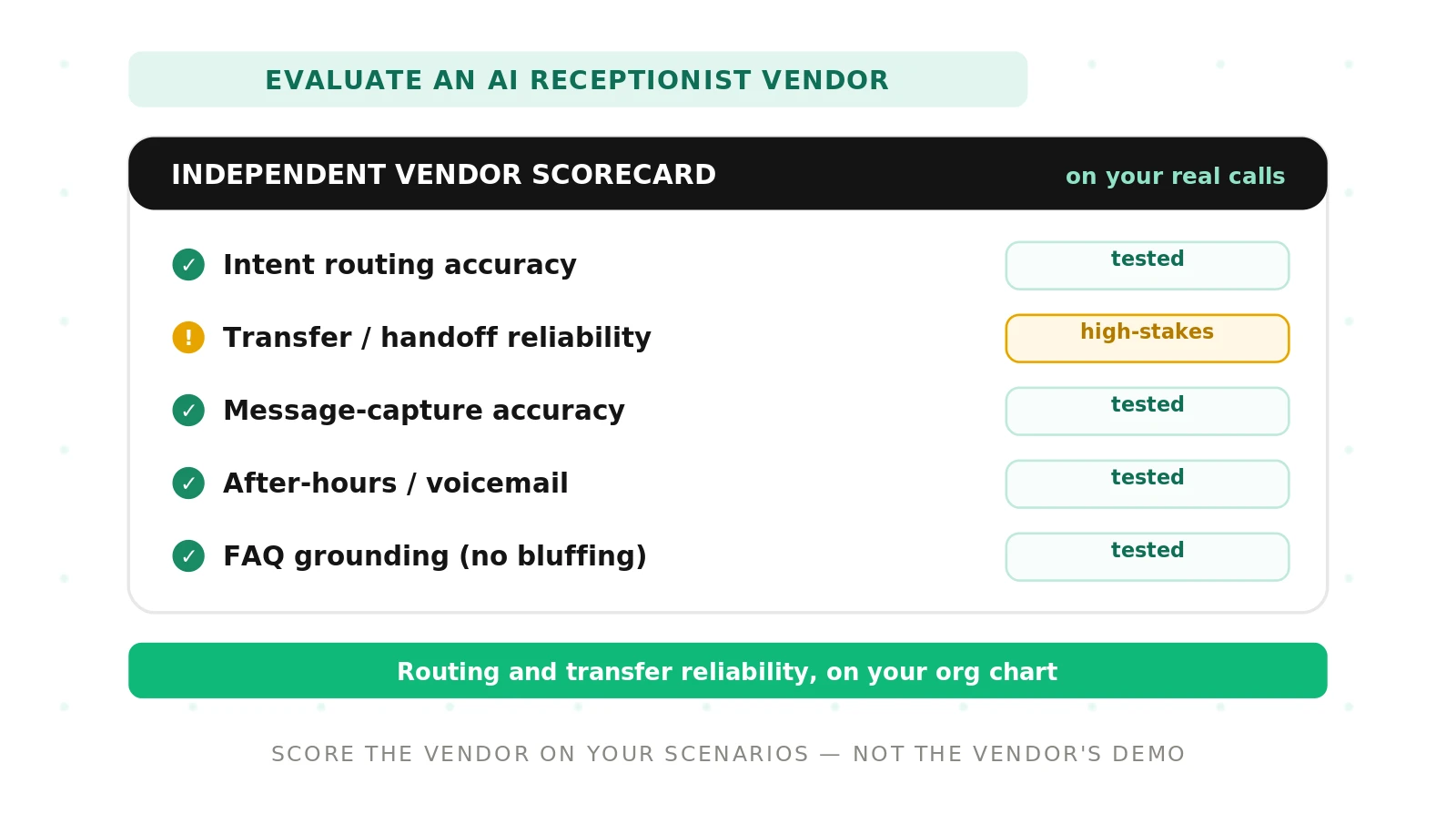
> Quick answer: To evaluate a receptionist voice agent vendor, test the core front-desk jobs on your own scenarios: intent routing, warm transfers, message capture, after-hours behavior, and grounded FAQs. Score each against a pass bar and a red-flag list before you sign.
An AI receptionist is the first voice a caller hears. It has to route, transfer, take messages, and answer basics without inventing facts. Vendor demos rarely stress those jobs. This guide shows how to evaluate a receptionist voice agent vendor against your real org chart and call mix.
The stakes are simple. A missed transfer sends a patient to voicemail. A wrong route makes a new customer repeat themselves. A hallucinated address sends someone to the wrong building. These failures are cheap to catch before a contract and expensive to catch after.
What an AI receptionist actually has to do
A receptionist does triage, not conversation. The job is to understand who is calling, why, and where they should go. Everything else supports that.
For an AI front desk, the core tasks are narrow and testable:
- Understand caller intent and route to the right person or department.
- Transfer the call reliably, warm or cold, without dropping it.
- Take an accurate message: name, number, and reason.
- Handle callbacks and confirm the details back to the caller.
- Answer simple FAQs like hours, location, and directions.
- Behave correctly after hours and route to voicemail.
- Capture a basic appointment or booking request.
- Hand off to a human when it is stuck.
- Deal with spam, robocalls, and dead air.
Notice what is missing. Long, open-ended conversation is not the point. A receptionist agent that talks well but routes badly is a liability. So your evaluation should center on routing and transfer, not eloquence.
Virtual receptionist voice AI vendor: a provider that sells a voice agent to answer, screen, route, and message-take on a business phone line. The best fit depends on your org chart and call mix, not on demo polish.
Why vendor demos hide the real risks
Vendor demos are built to look good. They use clean audio, one caller intent, and a happy path. Your callers are messier. They talk over the agent, change their minds, and give partial names.
Self-reported vendor metrics carry the same bias. A vendor grades its own agent on its own test set. That is why independent voice AI evaluation matters for a buying decision. You want a neutral party testing the failure modes the demo skipped.
The NIST AI Risk Management Framework makes the same point in a broader way. Systems should be measured against risks in their real context of use. For a front desk, the context is your departments, your hours, and your callers.
Three risks matter most, and none show up in a scripted demo. Routing to the wrong department. Transfers that fail or loop. FAQ answers that sound confident but are wrong. Build your evaluation around those.
The six dimensions that decide a receptionist agent
Score every vendor on the same six dimensions. Use the same scenarios for each vendor so the comparison is fair. This is the heart of how to evaluate voice agent vendors for front-desk work.
The table below gives each dimension a test, a pass bar, and a red flag. Treat the pass bars as a starting point and tighten them for high-stakes lines like clinics or legal intake.
| Dimension | What to test | Pass bar | Red flag |
|---|---|---|---|
| Intent routing accuracy | 30+ calls across every department, plus vague and mixed intents | Correct route on 95%+ of clear intents; asks a clarifying question on vague ones | Silent misroute, or routing "sales" and "billing" to the same place |
| Transfer and handoff reliability | Warm and cold transfers to busy, no-answer, and voicemail targets | Transfer connects or falls back cleanly on 98%+ of attempts | Dropped calls, or a handoff loop that bounces the caller in circles |
| Message-capture accuracy | Names, phone numbers, and reasons at speed, with spelling | Name and number correct on 95%+ of messages; reason captured | Wrong digits, dropped callbacks, or no readback to the caller |
| After-hours and voicemail behavior | Calls placed outside stated business hours | States hours, offers voicemail or callback, sets expectations | Claims the office is open, or promises a same-day callback at 2am |
| FAQ grounding | Hours, address, directions, parking, and services | Answers only from approved sources; says "I'm not sure" otherwise | Invented address, made-up hours, or a confident wrong answer |
| Barge-in and interruption | Callers who talk over the agent or change intent mid-sentence | Stops promptly and follows the new intent | Talks over the caller, or ignores the interruption entirely |
Each row is a scorecard line. For a reusable format, see the voice agent metrics scorecard. Fill it in per vendor, then compare side by side.
Intent routing is the make-or-break dimension
Routing is where most receptionist agents fail quietly. The agent picks a department and sounds sure. The caller only learns it was wrong after a long hold.
Test routing with your actual menu. Include the messy cases. "I got a bill but also want to book" is two intents in one sentence. A good agent handles the primary one and captures the second.
Transfer reliability decides whether calls survive
A call transfer can be warm or cold. A warm transfer announces the caller to the receiving person first. A cold transfer passes the call straight through.
Test both. More importantly, test what happens when the target is busy or does not pick up. The agent should fall back gracefully, not drop the call. Handoff loops are a specific danger, so probe them directly using a handoff-loop test.
Message capture is a data-quality problem
A message is only useful if the callback works. So the digits matter more than the phrasing. Test phone-number capture with fast talkers, accents, and background noise.
The agent should read the number back. It should confirm the name spelling. A missed digit is a lost customer, and it looks fine on a transcript.
How to run an AI receptionist voice agent vendor evaluation
Run the same process for every vendor on your shortlist. Keep the scenarios and scoring identical. That is what makes the results comparable and defensible.
1. Map your call reality. List your departments, common intents, and after-hours rules. Pull a week of real call reasons. This becomes your scenario source, grounded in your org chart, not a generic script.
2. Write 30 to 50 scenarios. Cover every route, plus vague, mixed, and adversarial calls. Add spam, dead air, and callers who interrupt. Include at least five after-hours cases.
3. Define pass bars up front. Set a target for each of the six dimensions before testing. Writing the bar first stops you from grading on the curve later.
4. Run each scenario blind across vendors. Use the same caller scripts and the same audio conditions. Do not tell the graders which vendor is which. Blind scoring removes brand bias.
5. Score routing and transfers strictly. Mark every misroute and every failed transfer. Note whether the failure was silent or announced. Silent failures are worse.
6. Check FAQ grounding for hallucination. Ask for hours, address, and services. Confirm each answer against your approved source. Any invented fact is an automatic fail for that scenario.
7. Stress the human handoff. Force the agent into confusion. It should say it will connect a person, then do so cleanly. Review your escalation paths here.
8. Test interruptions and barge-in. Talk over the agent mid-sentence. It should stop and adapt. Use a structured barge-in check for consistency.
9. Tally, weight, and decide. Weight the dimensions by your risk. A clinic weights transfers and messages high. Pick the vendor that clears your bars, not the smoothest demo.
This process doubles as procurement evidence. Attach the scorecards to your request for proposal so vendors compete on the same tests.
Multi-location and industry-specific wrinkles
Single-site rules break at scale. A multi-location business needs the agent to route by location first, then department. Test a caller who names the wrong branch. The agent should confirm the location before routing.
Clinics, law firms, and property managers each carry their own stakes. A clinic needs accurate intake and clean escalation. A property manager needs after-hours emergencies routed to on-call staff, not voicemail. Build these into your scenarios, since they rarely appear in a demo.
Appointment capture deserves its own scenarios too. Test whether the agent collects the right fields and confirms them. The appointment-scheduling metrics guide lists what to measure. For broader front-desk quality, the customer support metrics guide maps the rest.
Where Evalgent fits
Evalgent is an independent, third-party evaluator for AI voice agents. We do not sell a receptionist agent. We test the ones you are considering.
Our value is neutrality and your context. We build scenarios from your org chart, your departments, and your hours. Then we test routing and transfer reliability on those scenarios, blind, across every vendor on your shortlist.
You get a scorecard per vendor across all six dimensions. You see the misroutes, the dropped transfers, and the hallucinated facts that demos hide. That evidence turns a vendor pitch into a measured decision.
We also track containment rate honestly. High containment is only good if the contained calls were handled correctly. A receptionist that "contains" by refusing to transfer is failing, not succeeding. Independent measurement catches that gap.
Good routing raises customer satisfaction because callers reach the right person the first time. And a clear service-level agreement is only enforceable if someone neutral measures against it. That is the role Evalgent plays.
Frequently asked questions
How do you evaluate a receptionist voice agent vendor?
Evaluate a receptionist voice agent vendor on six dimensions: intent routing, transfer reliability, message capture, after-hours behavior, FAQ grounding, and barge-in. Build scenarios from your own departments and hours. Score each vendor blind against the same tests, using pass bars you set before testing begins.
What should I test in an AI receptionist before buying?
Test the front-desk jobs, not conversation quality. Check whether the agent routes to the right department, transfers without dropping calls, captures names and numbers correctly, answers FAQs from approved sources, and behaves right after hours. Include vague, mixed, and adversarial calls, since those expose the failures that demos hide.
What is the difference between a warm transfer and a cold transfer?
A warm transfer announces the caller to the receiving person before connecting them. A cold transfer passes the call straight through with no announcement. Warm transfers feel smoother but take longer. For an AI receptionist, test both, and confirm the agent falls back cleanly when the target is busy or does not answer.
How accurate is AI receptionist message taking?
Accuracy varies by vendor and by call conditions, so measure it directly. Test name and phone-number capture with fast talkers, accents, and background noise. A good agent reads the number back and confirms the spelling. Treat any wrong digit as a failure, because a missed digit means a lost callback.
What should an AI receptionist do after hours?
After hours, the agent should state that the office is closed, give the hours, and offer voicemail or a scheduled callback. It should not claim the office is open or promise a same-day callback at night. Test this with calls placed outside your stated business hours to confirm the behavior.
How do you stop an AI receptionist from hallucinating hours or directions?
Ground FAQ answers in an approved source and test for hallucination. Ask for hours, address, parking, and services, then check each answer against your records. The agent should say it is unsure rather than guess. Any invented fact should fail that scenario. Grounding and honest fallback matter more than fluent phrasing.
How do you run a receptionist voice agent bake-off?
Run a bake-off by testing every shortlisted vendor on identical scenarios. Map your call reality, write 30 to 50 scenarios, and set pass bars first. Score routing and transfers strictly and blind. Tally results, weight by your risk, and pick the vendor that clears your bars rather than the best demo.
Why use an independent evaluator instead of vendor metrics?
Vendors grade their own agents on their own test sets, which favors the happy path. An independent evaluator tests your scenarios, blind, across vendors, and reports misroutes, dropped transfers, and hallucinations that demos skip. Neutral measurement gives you comparable evidence for procurement and a fair basis to enforce a service-level agreement.
The bottom line
A receptionist voice agent lives or dies on routing and transfers, not conversation. Evalgent tests both independently on your own front-desk scenarios, across every vendor on your shortlist, so Book a demo to see each one scored side by side.
Related Articles
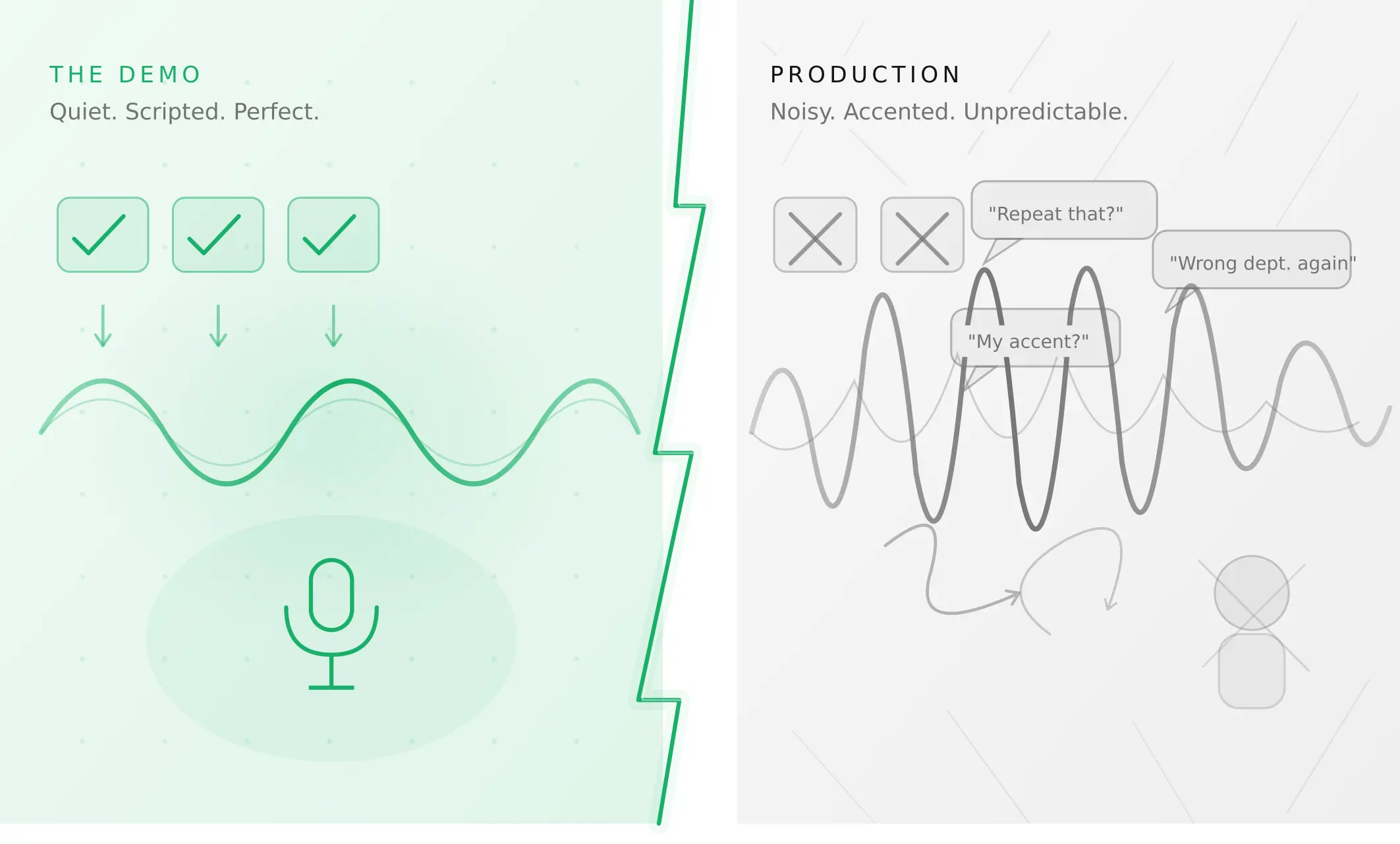
Why AI voice agents fail in production (and how to prevent it)
AI voice agents that ace demos still break in production. Learn the 5 root causes, how to test for each, and what production readiness actually means.
Read more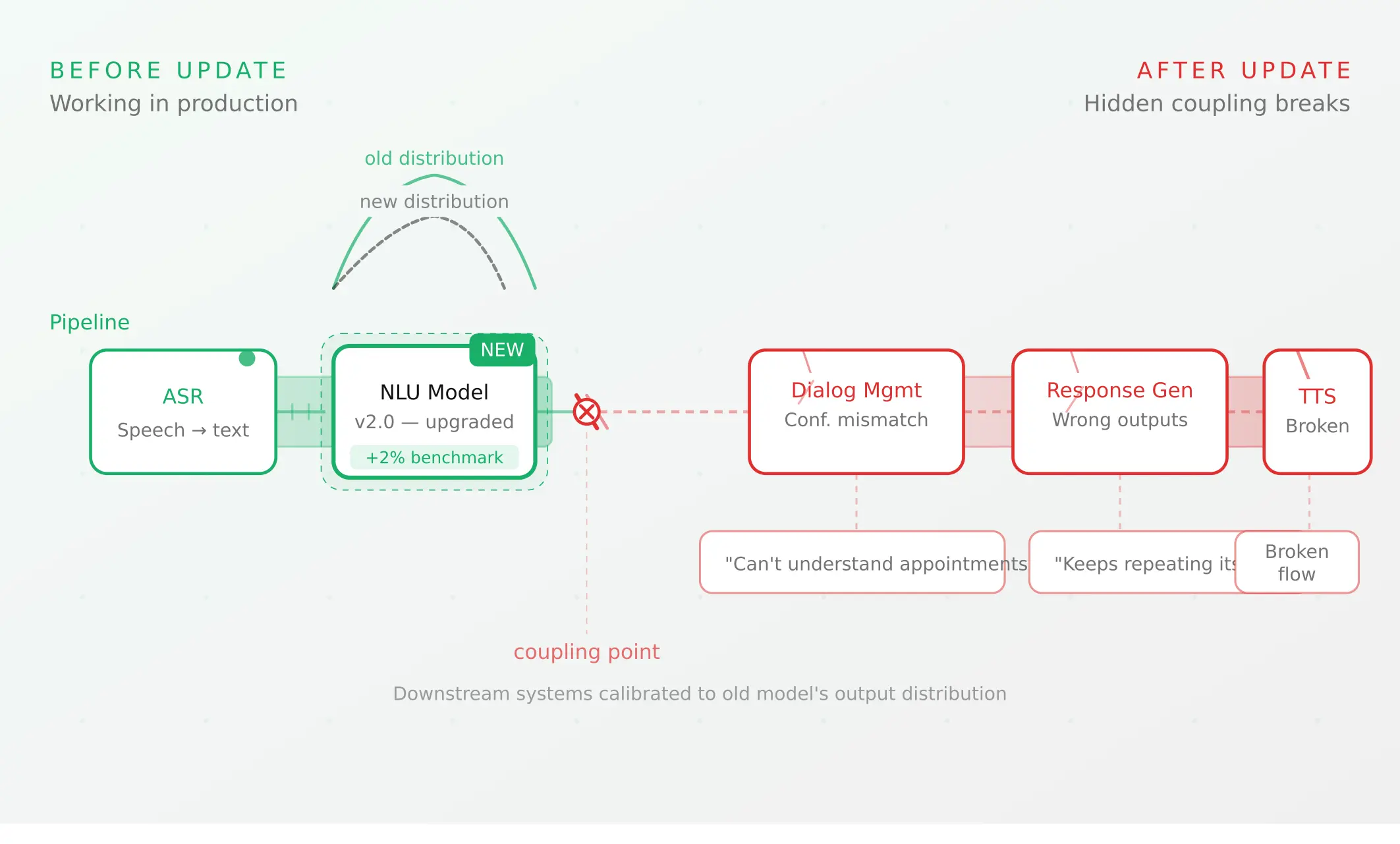
Voice agent regression testing: why LLM updates break production
LLM updates improve benchmarks but break voice agents in 5 predictable ways. How to detect and prevent regressions after every model or prompt change.
Read more