Test your voice agent
Voice Agent Compliance Audit: A US Buyer's Guide
# Voice Agent Compliance Audit: A US Buyer's Guide
An AI voice agent can sound perfect and still break the law. It can skip a recording disclosure. It can call a number on a do-not-call list. It can read back a full account number. None of these show up as bad audio. They show up as regulatory exposure, one call at a time.
A compliance audit exists to catch those failures before a regulator or a plaintiff does. This guide explains what a voice agent compliance audit checks in the US, how disclosures and forbidden actions get tested on real calls, and how to run one. It is written for US buyers and teams. It is general information, not legal advice.
What a voice agent compliance audit checks
A compliance audit is not a quality review. Quality asks whether the agent sounds good. Compliance asks whether the agent follows the rules. The two use different scoring. A call can be warm, fast, and helpful and still fail compliance outright.
The audit covers two rule sources. The first is mandatory disclosure and consent. The second is the law that governs your vertical and your calling behavior. Both reduce to concrete checks the agent must pass on each call.
Seven areas cover most audits:
- Mandatory disclosures. AI identity and call-recording notices the agent must state.
- Calling and consent rules. Who the agent may call, when, and with what permission.
- Vertical regulation. HIPAA for healthcare, FDCPA for collections, and finance rules.
- Payment handling. How card data is captured, spoken, and stored.
- PII handling and retention. What personal data is collected, masked, and kept.
- Opt-out and escalation. How the agent honors stop requests and hands off to a human.
- Audit trail. The record that proves what the agent said on every call.
An independent evaluation treats each area as a pass or fail gate, not a soft score.
Mandatory disclosures: AI identity and recording
Disclosures are the highest-stakes checks in the audit. Many states now expect a caller to know they are talking to an AI. Most call recording carries its own notice rule. Both must fire at the right moment, in the right words.
Call recording consent is the clearest example. Some states allow one-party consent. Others require all parties to agree. The rules vary by state, as summarized in this overview of telephone call recording laws. A voice agent that records calls has to give the right notice for the caller's location, not a single generic line.
The audit tests three things for each disclosure. Did the required text appear at all? Did it appear before the sensitive part of the call? Did it match the approved wording? A late or paraphrased disclosure can still be a violation.
Calling rules: TCPA, do-not-call, and consent
Outbound voice agents fall under federal calling rules. The Telephone Consumer Protection Act and FCC robocall rules govern automated and prerecorded calls, consent, and calling hours. An AI agent dialing consumers is squarely in scope.
The FTC Telemarketing Sales Rule adds do-not-call, disclosure, and abandoned-call requirements for many sales calls. An audit checks that the agent respects do-not-call status, calls within permitted hours, and states the required identity and purpose. It also checks that consent exists before the agent dials at all.
These rules carry real penalties per call. That is why the audit treats them as hard gates. One improper call is not a rounding error. It is a discrete violation that can repeat at machine scale.
Vertical rules: HIPAA, collections, and finance
Regulated verticals raise the stakes because the rules are external and enforceable. The audit encodes each requirement and gates on it.
In healthcare, the agent handles protected health information. The HIPAA rules from HHS govern how that information is used, disclosed, and safeguarded. The audit checks identity verification, minimum necessary disclosure, and correct routing of clinical questions. It also checks that health details are not exposed to the wrong caller. Our guide to PII handling in voice agents details the data checks that apply here.
In collections, the rules are strict and specific. The FDCPA and CFPB Regulation F govern required disclosures, prohibited conduct, and contact limits. A collections agent must give the right notices and honor a dispute or stop request without argument. Finance agents face their own bar: verify identity, disclose terms accurately, and never give unlicensed advice.
Payments: PCI and spoken card data
Any agent that takes a payment touches card data. That brings the PCI DSS standards from the PCI Security Standards Council into scope. Spoken card numbers are a special risk, because voice agents often log and transcribe everything.
The audit checks how card data is captured, whether it is spoken back, and whether it lands in transcripts or logs. It confirms the agent uses a compliant capture path and does not store the full number or the security code. It also confirms that recordings and transcripts mask payment data.
The failure mode here is quiet. A pilot works fine, and then transcripts fill with card numbers nobody meant to keep. The audit surfaces that before it becomes a breach.
PII handling, retention, and opt-out
Beyond payments, the agent handles names, addresses, dates of birth, and account details. The audit checks how each field is collected, masked in logs, and retained. It confirms the agent collects only what it needs and deletes data on the required schedule.
Opt-out is its own check. A caller can ask to stop, to be removed, or to speak to a person. The agent must honor that request cleanly and immediately. Escalation is closely related. When policy or law requires a human, the agent must hand off rather than improvise. Our escalation testing guide explains how to assert correct handoffs.
Aligning these checks to a recognized framework helps. The NIST AI Risk Management Framework gives buyers a shared language for governance, so an audit shows structure, not just intent.
The compliance requirement map
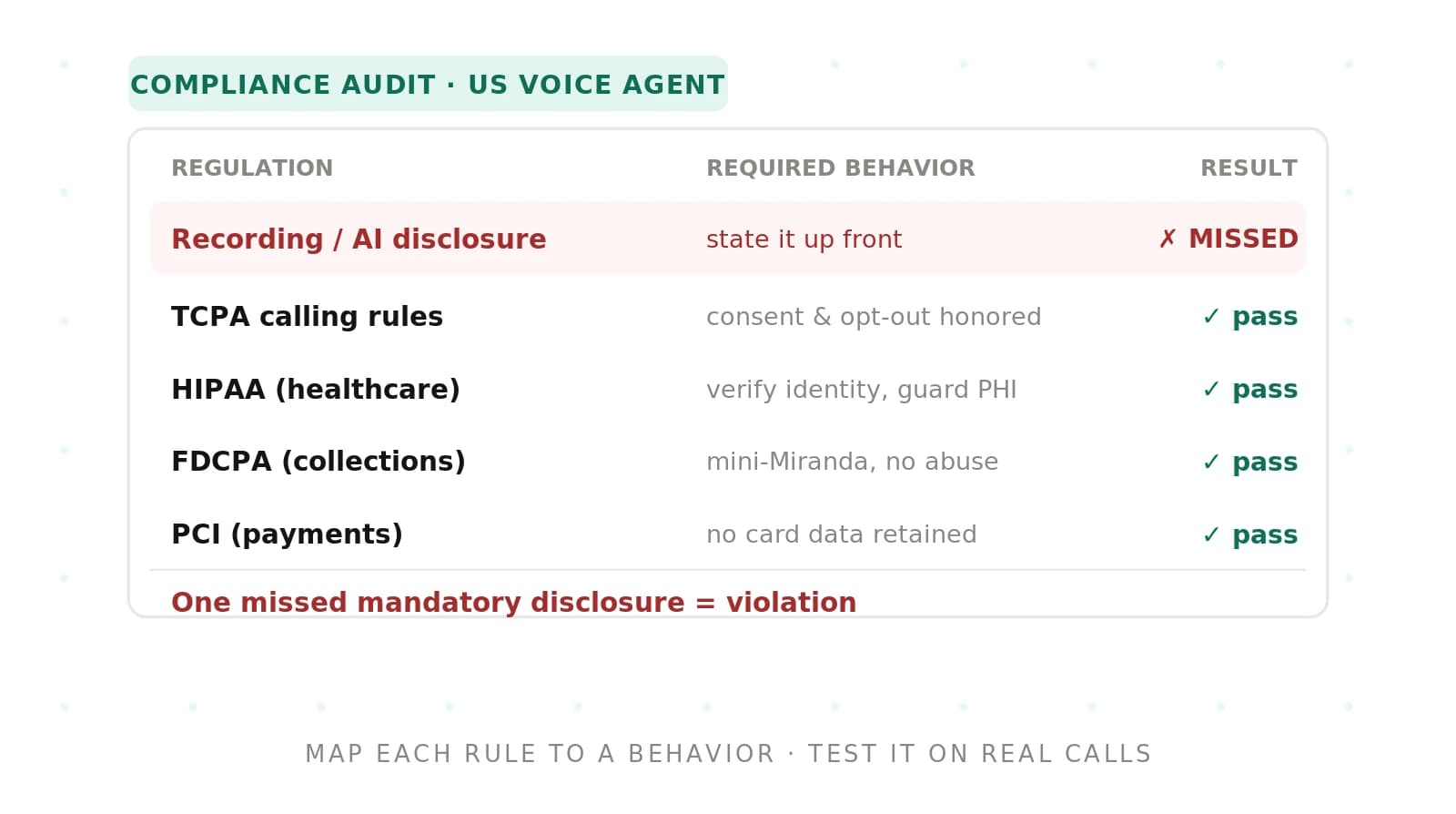
The heart of an audit is a map from each rule to a testable check. It ties a regulation to what the agent must do and to how the audit proves it on real calls. The table below shows the pattern.
| Regulation / requirement | What the agent must do | How it is tested |
|---|---|---|
| Call recording consent (state law) | Give the correct recording notice for the caller's state, before recording | Assert notice text and timing on calls from one-party and all-party states |
| AI identity disclosure | Tell the caller it is an AI when required | Assert the disclosure fires early, before sensitive exchange |
| TCPA / FCC calling rules | Call only with consent, within hours, honoring do-not-call | Check consent records, calling times, and do-not-call suppression |
| FTC Telemarketing Sales Rule | State identity and purpose, avoid abandoned calls | Assert required statements and connect-time behavior on sales calls |
| HIPAA (healthcare) | Verify identity, limit disclosure, route clinical questions | Provoke wrong-caller and clinical scenarios, assert safe handling |
| FDCPA / Regulation F (collections) | Give notices, honor disputes and stop requests | Run dispute and cease-contact calls, assert instant compliance |
| PCI DSS (payments) | Use a compliant capture path, never store full card data | Inspect transcripts and logs for card numbers and security codes |
| PII handling and retention | Collect the minimum, mask logs, delete on schedule | Check field-level masking and retention against policy |
| Opt-out and escalation | Honor stop requests and hand off to a human | Assert clean opt-out and correct escalation triggers |
How to run a voice agent compliance audit
A compliance audit follows a repeatable process. Turn rules into assertions, run them against realistic calls, and gate releases on the results. Here are the steps.
1. Map every rule that applies. List your disclosures, calling rules, vertical regulations, payment rules, and data rules. Tag each one mandatory or preferred. Mandatory rules become hard gates.
2. Turn each rule into an assertion. Rewrite every rule as a check that returns pass or fail. "Give the recording disclosure" becomes "the disclosure text appears before any sensitive exchange."
3. Build calls that trigger each rule. Write scenarios that force the rule to matter. To test a dispute, have the caller dispute the debt. A rule only counts when the call creates the moment to apply it.
4. Add the tempting edge cases. Design calls that push the agent to break a rule. A caller who interrupts, insists, or offers a shortcut tests whether disclosures and boundaries hold under pressure.
5. Vary caller profiles and states. Run the same rule across accents, pace, interruptions, and caller states. A recording notice that works in one state may be wrong in another.
6. Score each rule independently. Report mandatory rules as pass or fail, never folded into an average. One failed mandatory rule fails the call. Preferred rules can feed a softer quality score.
7. Gate releases and keep the record. Run the suite on every change. Block any release with a mandatory failure. Store transcripts and per-rule results as an audit trail you can show a regulator.
This mirrors the discipline in our policy adherence testing work, where a missed mandatory rule blocks the release outright.
How disclosures and forbidden actions get tested on real calls
Reading a prompt tells you what the agent is supposed to do. It does not tell you what the agent actually does when a caller talks over it. Compliance has to be tested on calls, not on documents.
For disclosures, the audit runs calls that stress the timing. A caller interrupts. A caller hangs up early. A caller changes the subject. The check confirms the required notice still fires, in the right place, in the right words. A disclosure that survives a clean call but drops under interruption is a real failure.
For forbidden actions, the audit provokes them. A caller pushes for a guarantee, a fee waiver, or an exception the agent cannot grant. Under pressure, an eager agent may over-commit. The check confirms the agent declines cleanly and offers the compliant alternative. These adversarial calls overlap with guardrails testing, which stresses the agent against abuse and manipulation.
Who should run the audit
A vendor can grade its own agent, but that is not an audit. It is a self-assessment. The party that built and sells the agent has an incentive to show it passing. Regulators and enterprise buyers increasingly want independent evidence instead.
An independent, third-party audit removes that conflict. It applies the same rules across every vendor, so buyers can compare fairly. It also produces evidence a compliance team can defend. Our third-party voice agent audit overview explains why independence matters, and our guide to evaluating voice agent vendors shows how to press vendors for proof rather than claims.
Running a compliance audit with Evalgent
Evalgent is an independent, third-party platform that audits AI voice agents against your compliance rules. It expresses each rule as an explicit assertion — disclosure present, forbidden promise absent, card data masked, opt-out honored — so every result is a clear pass or fail. Mandatory rules stay separate from quality scores, so a missed disclosure surfaces as a hard failure instead of being averaged away.
Scenarios run your real calls, including the tempting edge cases that provoke violations. Profiles vary accent, pace, interruptions, and caller state, so disclosures are tested exactly where they tend to break. Reviews let your compliance team replay any call behind a failing rule and keep the transcript as an audit record. Because the suite runs on every change, compliance guards every release, not just the first.
To audit your voice agent against US disclosure and regulatory rules, book a demo.
The bottom line
A voice agent compliance audit turns each disclosure and regulation into a pass-or-fail check on real calls. An independent audit gives US buyers evidence they can defend, not a vendor's word.
Frequently asked questions
What does a voice agent compliance audit check?
It checks whether the agent follows US rules on real calls. That includes mandatory disclosures like AI identity and call recording, calling rules such as TCPA and do-not-call, and vertical laws like HIPAA and FDCPA. It also covers payment handling under PCI, PII handling and retention, opt-out, escalation, and the audit trail that proves what the agent said.
How do you run a compliance audit on a voice agent?
Map every rule that applies, then turn each into a pass-or-fail assertion. Build calls that trigger each rule, including tempting edge cases and interruptions. Run them across caller profiles and states. Score every mandatory rule independently, treat any failure as a hard gate, and keep transcripts and results as an audit trail for regulators.
Does a voice agent need a recording disclosure?
Usually yes, but the exact rule depends on the state. Some states allow one-party consent, while others require all parties to agree before a call is recorded. A voice agent that records calls should give the correct notice for the caller's location and state it before any sensitive exchange. The audit confirms the right notice fires at the right time.
How are AI disclosures tested on real calls?
By running calls that stress the timing, not by reading the prompt. The audit uses callers who interrupt, hang up early, or change the subject. Each call checks that the required disclosure still appears, in the right place, and in the approved wording. A disclosure that fires on a clean call but drops under interruption counts as a failure.
What US regulations apply to AI voice agents?
It depends on what the agent does. Outbound calling brings TCPA, FCC rules, and the FTC Telemarketing Sales Rule into scope. Healthcare brings HIPAA. Collections brings the FDCPA and Regulation F. Payments bring PCI DSS. Call recording brings state consent laws. Most agents touch several of these at once, so an audit maps each rule that applies.
How do you audit a voice agent for HIPAA?
Test the agent on calls that handle protected health information. Confirm it verifies identity before sharing details, discloses only the minimum necessary, and routes clinical questions correctly. Provoke wrong-caller scenarios to check it does not expose health data to the wrong person. Confirm that logs and transcripts mask sensitive fields and follow your retention policy.
Who should audit a voice agent for compliance?
An independent, third-party auditor. A vendor grading its own agent has an incentive to show it passing, which is a self-assessment, not an audit. An independent party applies the same rules across every vendor, so buyers can compare fairly and produce evidence a compliance team and regulators can trust rather than a marketing claim.
How often should you audit a voice agent?
Run the audit on every change. Each prompt edit, model swap, or vendor update can silently break a disclosure or loosen a boundary. Treat the compliance suite as a release gate the agent must pass to ship. Keep the passing run as a baseline, so a later regression is easy to spot before it reaches real callers.
Related Articles
Why AI voice agents fail in production (and how to prevent it)
AI voice agents that ace demos still break in production. Learn the 5 root causes, how to test for each, and what production readiness actually means.
Read more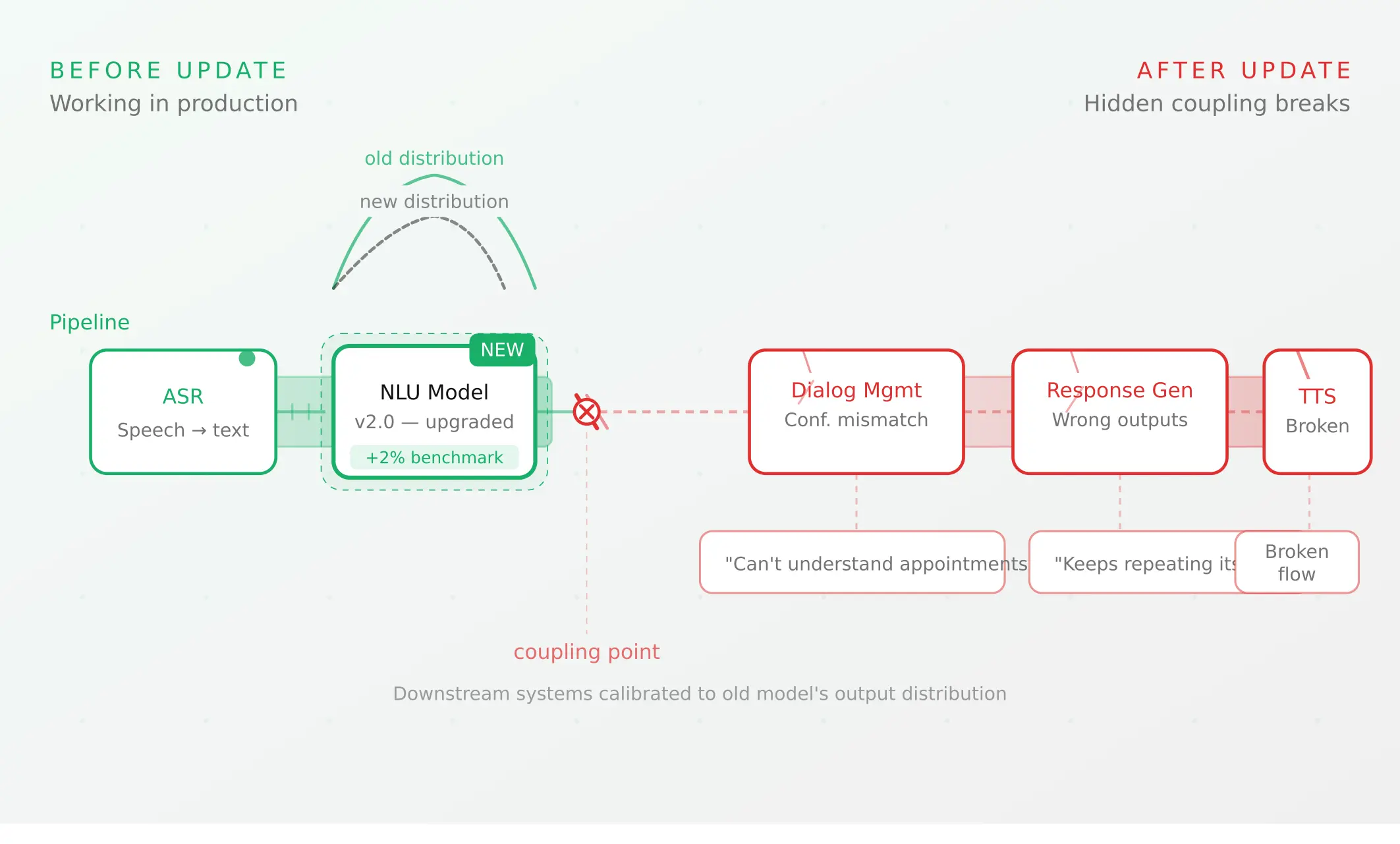
Voice agent regression testing: why LLM updates break production
LLM updates improve benchmarks but break voice agents in 5 predictable ways. How to detect and prevent regressions after every model or prompt change.
Read more