Test your voice agent
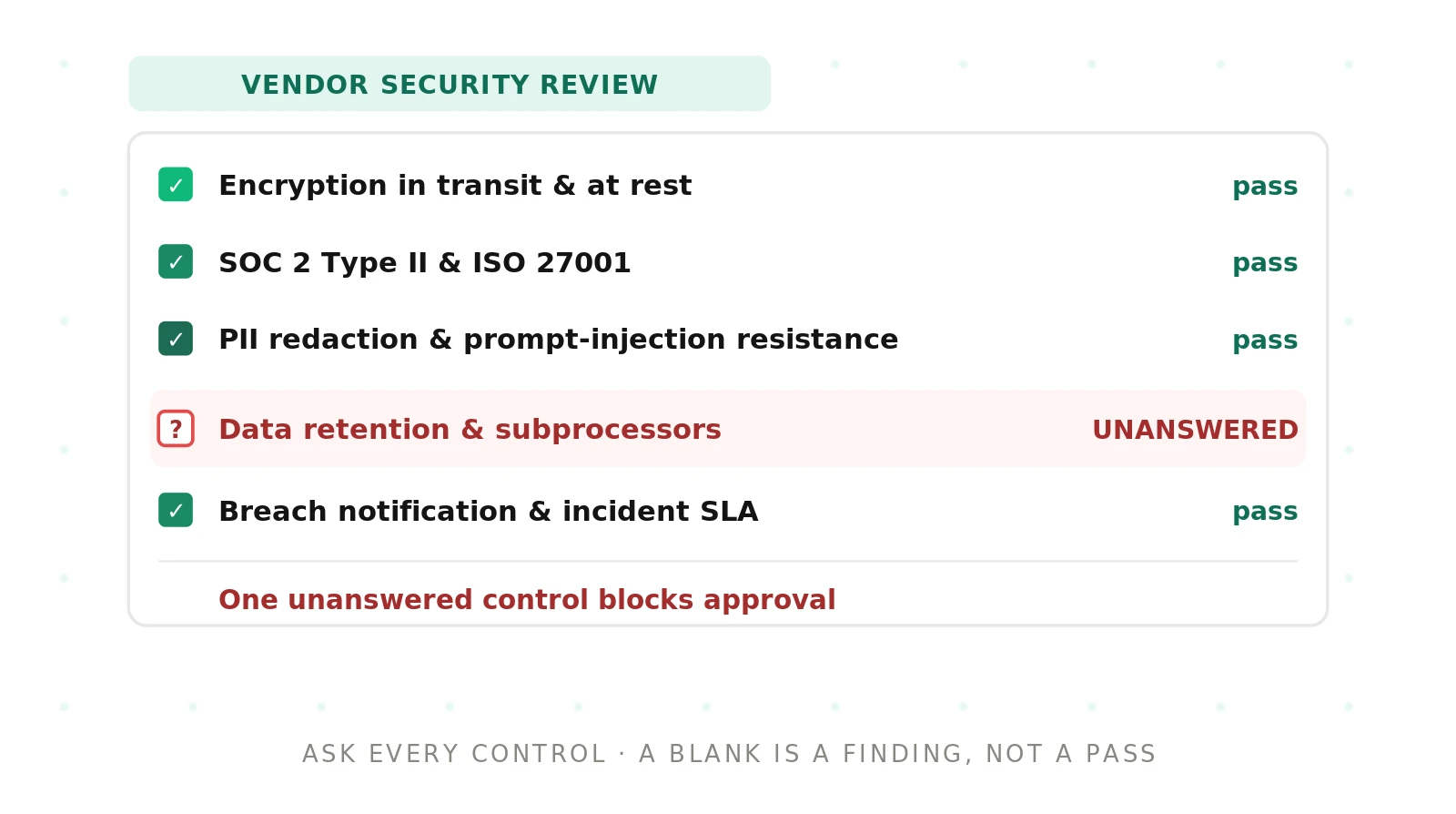
Security review checklist for voice agent vendors
# Security review checklist for voice agent vendors
Quick answer
A voice agent vendor security review checks how a provider handles your call data, secures it, and proves compliance before you buy. It covers data residency, encryption, SOC 2 or ISO 27001, HIPAA or PCI scope, PII redaction, prompt-injection resistance, subprocessors, retention, and breach response. Ask for evidence, not assurances.
A voice agent hears everything a caller says. Names, account numbers, medical details, card data. That audio and its transcript move through a vendor's models, storage, and third parties. So the security review is not a formality. It is how you decide whether a stranger's system can hold your customers' most sensitive moments.
This is a buyer's checklist. It is written for the person doing due diligence on a voice AI provider before signing. That could be a security engineer, a procurement lead, or a founder wearing both hats. The goal is simple. Turn vague vendor promises into a list of things you can verify.
Voice adds risk that text chat does not. Raw audio is biometric-adjacent. It is hard to redact in real time. And a spoken instruction can carry an attack the same way a typed one can. A serious review treats all of this as testable, not as marketing copy.
Why voice agents raise the security stakes
Every voice call creates two sensitive artifacts. The audio recording, and the transcript. Both can contain regulated data. A caller reads a card number aloud. A patient describes a symptom. That data now lives wherever the vendor puts it.
Text chatbots share some of this exposure. Voice makes it worse in three ways.
First, redaction is harder. In text, a card number is a clean string. In audio, it is a spoken sequence spread across a noisy waveform. Redacting it reliably takes real engineering.
Second, the data is richer. A voiceprint can identify a speaker. That raises questions text never does.
Third, the attack surface is wider. A voice agent takes instructions from whoever is talking. A caller can try to talk the agent into leaking data or breaking policy. This is prompt injection by voice.
So the review has to cover both the plumbing and the behavior. Plumbing means encryption, storage, and access. Behavior means whether the agent leaks data when someone tries to make it. Most security reviews only check the plumbing. The behavior half is where voice agents actually fail.
What a voice agent vendor security review covers
A complete review spans ten control areas. Each maps to a specific question and a specific piece of evidence. Skip one, and you inherit a blind spot.
> Data residency: the physical or legal location where your data is stored and processed. It matters for regulatory and contractual obligations.
Data handling and residency. Know where your audio and transcripts live. Ask which regions store the data and which process it. Data residency is not a preference. For many regulated buyers, it is a legal requirement. Confirm you can pin data to a region if you need to.
Encryption. Data must be protected in transit and at rest. Ask for the specifics. Encryption in transit should use current TLS. Encryption at rest should use a strong standard. Cryptographic modules validated against NIST FIPS 140-3 are a strong signal in regulated settings.
SOC 2 and ISO 27001. These are the baseline trust reports. A SOC 2 Type 2 report shows controls that held over time. ISO/IEC 27001 certifies a managed security program. Ask for the actual report, not a logo on a website.
HIPAA and PCI where relevant. Scope these to your use case. If callers share health data, the vendor must support HIPAA and sign a business associate agreement. If callers read card numbers, ask how the vendor limits PCI DSS scope. The cleanest answer keeps card data out of the transcript entirely.
PII redaction. The agent should strip sensitive fields from stored audio and transcripts. Ask what it redacts, when, and how accurately. Our guide on PII handling in voice agents breaks down what good redaction looks like.
Prompt-injection resistance. A caller can embed instructions in what they say. The agent should refuse to leak data or break policy. Map this to the OWASP Top 10 for LLM applications. Our prompt-injection guide covers the voice-specific attacks.
Model-update notification. Voice agents change when their models change. A silent update can alter behavior overnight. Ask for a notification policy. You need warning before a model shift touches production.
Subprocessors. Vendors rely on other vendors. Speech-to-text, hosting, and model APIs are often third parties. Ask for the full subprocessor list. Each one is a place your data goes.
Data retention. Data you keep is data you can lose. Ask how long the vendor keeps audio and transcripts. Ask whether you control that window. Shorter defaults are safer.
Breach notification SLA. Breaches happen. Ask how fast the vendor tells you, and what they commit to in writing. A vague policy is a red flag. A firm data breach notification window belongs in the contract.
For regulated buyers, these controls map cleanly to the NIST AI Risk Management Framework. That mapping helps the result survive an internal security review.
The security control checklist
Use this matrix as your working document. For each control, note what you asked, what the vendor said, and what evidence they produced. The "what good looks like" column is your bar.
| Control area | What to ask the vendor | What "good" looks like |
|---|---|---|
| Data residency | Where is audio stored and processed? | Named regions, and the option to pin data to one |
| Encryption | How is data protected in transit and at rest? | Current TLS in transit, strong at-rest cipher, documented key management |
| SOC 2 / ISO 27001 | Can we see your current report or certificate? | A recent SOC 2 Type 2 report or valid ISO 27001 certificate, shared under NDA |
| HIPAA / PCI | Do you sign a BAA, and how do you limit PCI scope? | Signed BAA when health data applies; card data kept out of transcripts |
| PII redaction | What is redacted, when, and how accurately? | Redaction before storage, with measured accuracy on your own calls |
| Prompt-injection resistance | How does the agent handle malicious caller instructions? | Documented defenses and independent adversarial test results |
| Model-update notification | How and when are we told about model changes? | Advance notice in writing, with a change log |
| Subprocessors | Who are your subprocessors, and where are they? | A complete, current list with locations and a change-notice policy |
| Data retention | How long is data kept, and who controls it? | Configurable retention with a short, documented default |
| Breach notification | How fast do you notify us, and is it contractual? | A firm notification window written into the contract |
The evidence column is the whole point. A vendor can claim any control. Only a report, a test result, or a contract clause proves it.
How to run a voice agent vendor security review
Work through these steps in order. Each one produces a document or a test result you can keep.
1. Scope the data the agent will touch. List every sensitive field a caller might share. Card numbers, health details, account data. This scope decides which controls matter most.
2. Request the vendor's compliance evidence. Ask for the SOC 2 report, ISO 27001 certificate, and any HIPAA or PCI documentation. Read them. Do not accept a trust-page badge as proof.
3. Map data residency and subprocessors. Get the full list of where data lives and who touches it. Confirm every location fits your regulatory needs.
4. Verify encryption in transit and at rest. Ask for the specific protocols and key management approach. Confirm nothing sensitive travels or rests unencrypted.
5. Test PII redaction on your own calls. Do not trust a demo. Run representative calls with real sensitive fields. Check whether the agent actually strips them from stored audio and transcripts.
6. Probe prompt-injection resistance. Run adversarial calls that try to extract data or break policy. Score whether the agent holds. Weak defenses here can undo every other control.
7. Pin down retention and deletion. Confirm how long data is kept and how deletion works. Get the default window and your ability to change it in writing.
8. Read the breach notification SLA. Confirm the notification window and get it into the contract. A promise that is not written down is not a commitment.
9. Re-review after every model update. A model change can reopen a closed risk. Schedule a re-test whenever the vendor ships a new model.
For the wider buying process, this checklist slots into a full voice agent vendor evaluation. Security is one axis. Accuracy, latency, and task success are the others.
Where an independent audit fits
You can run this review yourself. Many teams do. But there is a limit to self-service due diligence. You are asking a vendor to grade its own homework, then checking the answers with the tools you have.
Two problems follow. First, redaction and prompt-injection resistance are hard to test well. They need adversarial call design and honest scoring. Second, a vendor's own numbers are not neutral. A provider will present its security in the best light. That is not dishonesty. It is sales.
This is where an independent, third-party review earns its place. Evalgent audits voice agents against a scope you define, on your own calls, and produces a scored report you can hand to procurement, security, or your board. We run the adversarial tests, measure redaction accuracy on real audio, and check controls against a recognized framework. Because we have no stake in which vendor wins, the result travels.
An independent audit does not replace your review. It backs it. Our writeups on independent voice AI evaluation and the third-party voice agent audit explain how a neutral engagement works and what lands in the report. If you run several providers, the same standard lets you compare their security head to head, as covered in running multiple voice agent vendors.
One more control deserves testing, not just asking about. When the agent hits a request it should not handle, does it escalate safely? Our escalation guide covers how to verify that a handoff actually protects the caller and the data.
Frequently asked questions
What is a voice agent vendor security review?
A voice agent vendor security review is a structured due-diligence check on how a provider handles, secures, and governs your call data. It covers data residency, encryption, certifications, PII redaction, prompt-injection resistance, subprocessors, retention, and breach response. The review turns vendor claims into verifiable evidence you can rely on before signing a contract.
What security certifications should a voice agent vendor have?
A voice agent vendor should hold, at minimum, a current SOC 2 Type 2 report or ISO 27001 certification. SOC 2 shows controls that operated over time. ISO 27001 certifies a managed security program. Ask for the actual report or certificate under NDA. A logo on a marketing page is not proof of a real certification.
Do voice agent vendors need to be HIPAA compliant?
Voice agent vendors need HIPAA support only when callers share protected health information. If your agent handles health data, the vendor must follow HIPAA safeguards and sign a business associate agreement. If no health data is involved, HIPAA does not apply. Scope the requirement to your actual use case rather than demanding it by default.
How do you check where a voice agent vendor stores call data?
Ask the vendor to name every region where audio and transcripts are stored and processed. Request the full subprocessor list, since third parties often hold data too. Confirm in writing whether you can pin data to a specific region. Data residency is a legal requirement for many regulated buyers, not just a preference.
What is PII redaction in a voice agent?
PII redaction in a voice agent is the automatic removal of sensitive fields from stored audio and transcripts. Examples include card numbers, account details, and health information. Good redaction happens before storage and is measured for accuracy on real calls. Ask what the agent redacts, when it runs, and how well it performs on your own audio.
How do you test a voice agent vendor for prompt injection?
Test prompt-injection resistance by running adversarial calls that try to make the agent leak data or break policy. Embed malicious instructions in what the caller says. Score whether the agent refuses and stays in role. Map the tests to the OWASP Top 10 for LLM applications. Weak resistance here can undo every other security control.
How long should a voice agent vendor keep call recordings?
A voice agent vendor should keep call recordings only as long as you need them, with a short documented default. Confirm the retention window and whether you control it. Data you keep is data you can lose in a breach. Prefer vendors that offer configurable retention and reliable deletion over those with long or vague defaults.
What should a voice agent vendor breach notification SLA include?
A breach notification SLA should state how fast the vendor tells you after discovering an incident, and commit to it in the contract. Look for a firm window measured in hours or days, not a vague promise. It should also cover what information you receive. An unwritten notification policy is a red flag during any security review.
The bottom line
A voice agent vendor security review turns marketing promises into evidence you can verify. Ask for reports, test the redaction and prompt-injection defenses yourself, and put the breach window in the contract.
Ready to see how your voice agent vendors hold up under an independent security review? Book a demo and we will audit them against your scope, on your own calls.
Related Articles
Why AI voice agents fail in production (and how to prevent it)
AI voice agents that ace demos still break in production. Learn the 5 root causes, how to test for each, and what production readiness actually means.
Read more
Voice agent regression testing: why LLM updates break production
LLM updates improve benchmarks but break voice agents in 5 predictable ways. How to detect and prevent regressions after every model or prompt change.
Read more