Test your voice agent
On-Prem vs Cloud STT for Regulated Voice Agents
# On-prem vs cloud STT for regulated voice agents
Quick answer
On prem STT voice agents run speech-to-text inside your own network, so caller audio and PHI never leave it. Cloud STT sends that audio to a provider's API, trading data control for speed and easy scaling. Regulated teams weigh residency, latency, and cost, then verify accuracy with an independent evaluator.
Speech-to-text is the ear of a voice agent. It turns the caller's audio into words. Every downstream step depends on it. If the transcript is wrong, the agent answers the wrong question.
For a regulated team, one choice shapes the rest. Do you run that ear yourself, or rent it? On-prem keeps the audio in your building. Cloud sends it to a provider. This post is about that single decision.
This is general information, not legal advice. Confirm your obligations with counsel before you deploy.
What on-prem STT means for a voice agent
The terms get used loosely. Let us pin them down.
> On-prem STT: speech-to-text that runs on hardware you own and control. The audio and the transcript stay inside your network the whole time.
Self-hosted is the broader idea. It covers software you operate yourself, on your servers or your cloud account. On-prem is the strictest form, on your own metal. You can read the general pattern in on-premises software.
A VPC deployment sits in the middle. The engine runs in your virtual private cloud. It uses cloud hardware, but it stays isolated from the public internet and other tenants. Many teams treat a VPC as the practical version of self-hosted.
Cloud STT is the other end. You send audio to a provider's API. They run the model and return text. The line between these options is where your data lives and who touches it.
Where the caller's audio actually goes
Follow the audio. That is the whole compliance question.
With on-prem STT, the audio never leaves your network. The microphone feeds your server. Your server returns the transcript. No third party sees the raw call.
With cloud STT, the audio takes a trip. It leaves your network. It crosses the public internet. It lands on a provider's servers. It is processed there, then the text comes back. That trip is where residency and PHI rules bite.
> Data residency: the requirement that data stay within a defined location or boundary. That can mean a country, a region, or your own hardware.
Some contracts and laws set a hard boundary. The data must stay in place. See data residency for the general concept. If your boundary is your own network, a shared cloud API is a poor fit. On-prem or VPC keeps you inside the line.
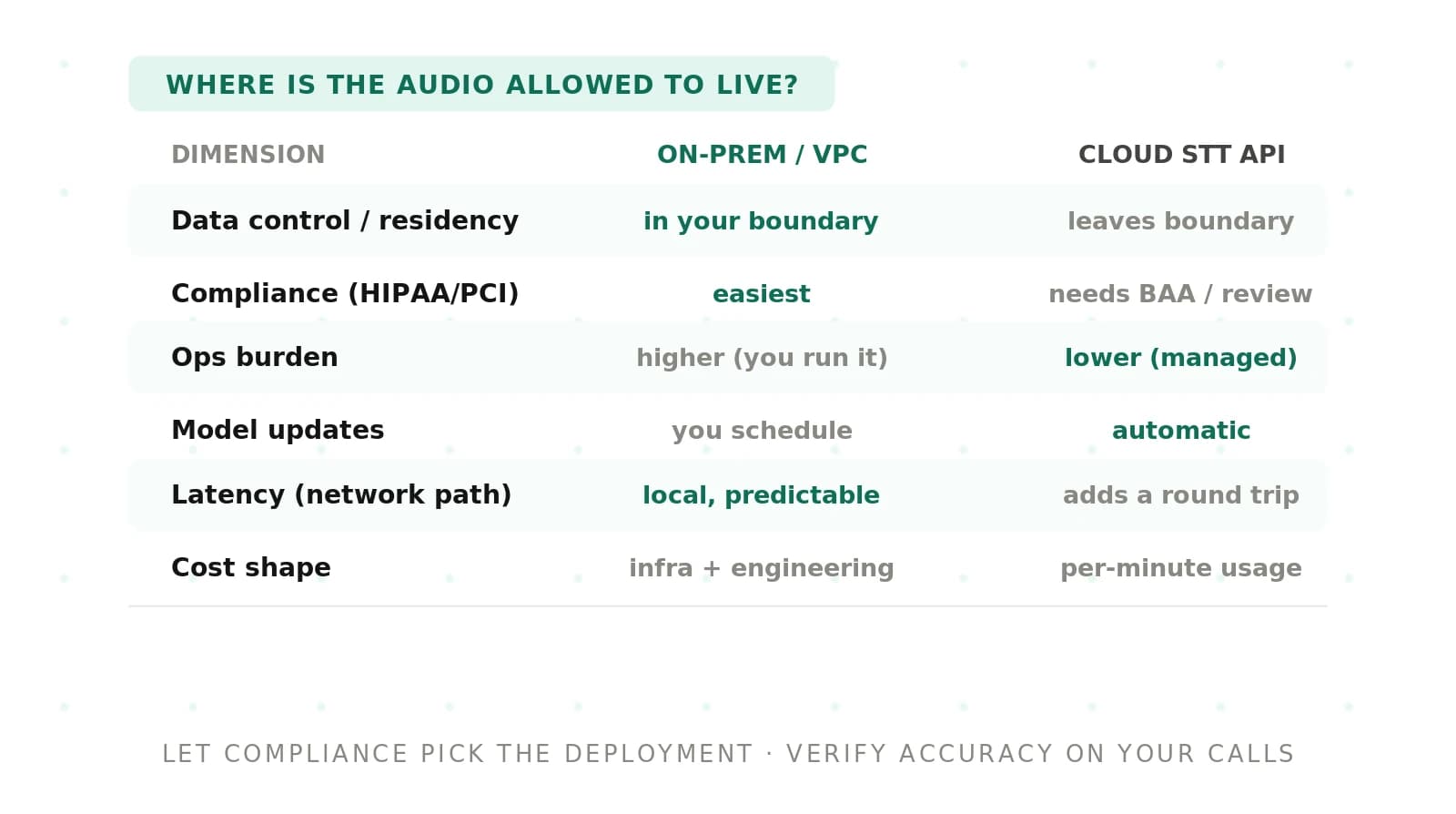
On-prem vs cloud STT: the trade-offs at a glance
Here is the decision in one view. Read it as a set of trade-offs, not a winner.
| Factor | On-prem / self-hosted / VPC STT | Cloud STT API |
|---|---|---|
| Data control and compliance | Audio and PHI stay in your network. Simpler residency and audit story. | Audio leaves your network. Needs a signed BAA and careful handling. |
| Latency | No public internet hop. Lower and steadier round trips. | Adds a network hop. Fast, but more variable under load. |
| Accuracy | Depends on the model you deploy. You own the tuning. | Often strong out of the box. Improves as the provider retrains. |
| Cost | High fixed cost up front. Cheaper per minute at large scale. | Low upfront cost. Pay per minute, which grows with volume. |
| Ops burden | You patch, scale, secure, and monitor it. | The provider runs the infrastructure for you. |
| Update cadence | You choose when to upgrade the model. | Continuous, sometimes without notice. |
No cell in that table is free. A win in one column is usually a cost in another. The rest of this post walks each row.
Data control and HIPAA compliance
This is the row most regulated teams start with. It is also the most misunderstood.
On-prem STT shrinks your exposure. The PHI never crosses your boundary. That makes your HIPAA audit scope smaller. Fewer parties touch the data, so there is less to prove.
But location alone does not equal compliance. Cloud STT can be HIPAA compliant too. The provider signs a business associate agreement, or BAA. That contract makes them legally accountable for the PHI they process. The official rules live at HHS.
> Business associate agreement: a HIPAA contract that binds a vendor handling PHI on your behalf to specific safeguards and liability.
So the real question is not on-prem versus cloud. It is whether your controls hold either way. Encryption, access limits, retention, and logging still sit with you. A signed BAA does not remove your side of the work.
For a fuller checklist, see our voice agent compliance audit guide. If a vendor is in the loop, run a vendor security review before any real audio flows.
Latency and the network path
Callers feel delay. A slow ear makes an agent feel slow.
On-prem STT skips the public internet. The audio travels a short, local path. Round trips are shorter. They are also steadier, because they avoid public congestion. For a real-time voice agent, steady matters as much as fast.
Cloud STT adds a hop. The audio has to reach the provider and come back. That can still be quick. But distance and shared load add jitter. On a bad day, the tail latency spikes.
> Latency: the delay between an input and its response. In a voice agent, it is the gap between the caller finishing a word and the transcript arriving.
The general idea is covered under latency). What matters is your own path, not a brochure number. Measure the round trip on the network your callers actually use. Our latency for voice agents guide shows where the budget gets spent.
Accuracy trade-offs
Deployment does not decide accuracy. The model does.
On-prem accuracy depends on what you install. A strong model, tuned to your audio, can do very well. A stale model will drift. You own that tuning, for better or worse.
Cloud STT often ships a strong general model. It handles many accents and domains on day one. It also improves quietly as the provider retrains. You get upgrades without lifting a finger.
Neither path wins by default. The only honest test is your own audio. Word error rate on clean demo clips tells you little. Word error rate on your noisy, accented, real calls tells you a lot. Note the difference between the plain engine and the whole pipeline in our STT vs ASR guide.
Watch the words that carry risk. Names, dates, dollar amounts, and drug names. An engine can post a good average score and still miss those. Our STT evaluation for voice agents post breaks down how to score the words that matter.
Cost and operational burden
Cost splits into two shapes. Fixed and variable.
On-prem STT is heavy up front. You buy or reserve hardware. You size it for peak, not average. At small volume, that cost per call looks steep. At very large scale, the fixed cost spreads out. Then per-minute economics can beat a metered API.
Cloud STT flips the shape. There is almost no upfront cost. You pay per minute of audio. That is friendly at first. But the bill climbs with every call. High volume can make the meter expensive.
Ops burden follows the same split. On-prem means you run everything. You patch the servers. You scale for traffic. You answer the pager at 2am. Cloud hands most of that to the provider. The trade between renting and running mirrors our managed vs self-hosted orchestration analysis. The reference model for these cloud service shapes is NIST SP 800-145.
Model updates and scaling
Updates cut both ways. Control has a price.
With on-prem, you decide when to upgrade. Nothing changes under you without warning. That is good for stability and for validation. It is also more work. You have to schedule, test, and ship each new model yourself.
Cloud STT updates on its own cadence. New models roll out continuously. Sometimes the change is silent. That can raise accuracy overnight. It can also shift behavior you had already validated. A quiet update can break a script that used to pass.
Scaling has the same shape. Cloud absorbs a traffic spike for you. On-prem holds a ceiling you provisioned. Go past it and calls queue or drop. Plan headroom before a busy season, not during it.
The lesson is the same on both paths. A change you did not measure is a risk you did not manage. Re-test after any update, whoever shipped it.
How to choose STT deployment for your regulatory profile
Work from your obligations, not from a preference. Here is a repeatable path.
1. Map your data. List every field the agent hears. Flag PHI, PII, and cardholder data.
2. Name the rules that apply. HIPAA, PCI DSS, state privacy laws, or contract terms.
3. Check your residency needs. Some contracts require data to stay in a region or on your hardware.
4. Set a latency budget. Measure the round trip your callers will actually tolerate.
5. Price both paths at real volume. Compare fixed on-prem cost against per-minute cloud cost.
6. Weigh your ops capacity. Be honest about who patches, scales, and monitors the system.
7. Decide the split. Use on-prem or VPC for strict calls. Send the rest to cloud.
8. Verify before you commit. Test accuracy and latency on your own audio, on the deployment you chose.
Most regulated teams land on a mix. Sensitive calls stay in-house. Everyday calls use a cloud API under a BAA. The point is to match each call type to the right boundary.
Where an independent evaluator fits
Deployment is only half the job. Proof is the other half.
Evalgent is an independent, third-party evaluator for voice agents. We measure accuracy and latency on your own data. We do that whether your STT runs on-prem, in a VPC, or through a cloud API. The scoring does not change with the deployment.
That neutrality matters in a regulated buy. A provider grading its own engine has an incentive. An outside evaluator does not. We run the same audio through each option and report the gaps. For the wider case, see independent voice AI evaluation.
We focus on the numbers that decide safety. Word error rate on risk words. Tail latency under load. Behavior after a silent model update. Those are the results that survive an audit.
Frequently asked questions
What is the difference between on-prem and cloud STT?
On-prem STT runs the speech engine on hardware you control, so audio never leaves your network. Cloud STT sends audio to a provider's API over the internet. On-prem favors data control and steady latency. Cloud favors fast setup, easy scaling, and frequent model updates. Many regulated teams run a mix of both.
Is on-prem STT better for HIPAA compliance?
On-prem STT can simplify HIPAA compliance because protected health information stays inside your network. That shrinks your exposure and your audit scope. But cloud STT can also be HIPAA compliant with a signed business associate agreement and proper safeguards. Compliance depends on your controls and contracts, not on location alone.
Can cloud STT be HIPAA compliant?
Yes. Cloud STT can be HIPAA compliant when the provider signs a business associate agreement and applies required safeguards. You still control encryption, access, retention, and logging on your side. The BAA makes the provider legally accountable for the PHI it processes. Review the terms before you send any real call audio.
Does on-prem STT reduce latency for voice agents?
Often, yes. On-prem STT removes the public internet hop, so transcription round trips are shorter and steadier. That helps a voice agent feel responsive. Cloud STT can still be fast, but it adds network distance and can vary under load. Measure both on your own network before you decide.
What is a VPC deployment for speech-to-text?
A VPC deployment runs the STT engine inside your virtual private cloud. It uses cloud hardware but stays isolated from the public internet and other tenants. This blends cloud scaling with tighter data control. Many regulated teams use a VPC as a middle ground between full on-prem and a shared cloud API.
How do you keep PHI out of a cloud STT API?
Keep PHI out of a cloud STT API by running transcription on-prem or in a VPC for sensitive calls. If you must use a cloud API, sign a BAA, encrypt audio in transit, and redact fields you do not need. Route only non-sensitive calls to shared endpoints. Then verify the routing with real test calls.
Is on-prem STT more accurate than cloud STT?
Not automatically. On-prem accuracy depends on the model you deploy and how well it fits your audio. Cloud STT often ships strong general models and improves as the provider retrains. The honest answer is to measure both on your own recordings. Word error rate on your calls beats any vendor claim.
How do you evaluate on-prem vs cloud STT for a voice agent?
Run the same audio through both deployments. Measure word error rate, latency, and errors on the words that matter, like names and dollar amounts. Test noisy and accented calls, not just clean ones. An independent evaluator like Evalgent scores accuracy and latency on your data, whichever way the engine is deployed.
The bottom line
On-prem and cloud STT are a trade between control and convenience, not a ranking. Pick by your data and rules, then prove accuracy and latency on your own audio.
Ready to see how your STT holds up, on-prem or in the cloud? Book a demo and we will benchmark it on your data.
Related Articles
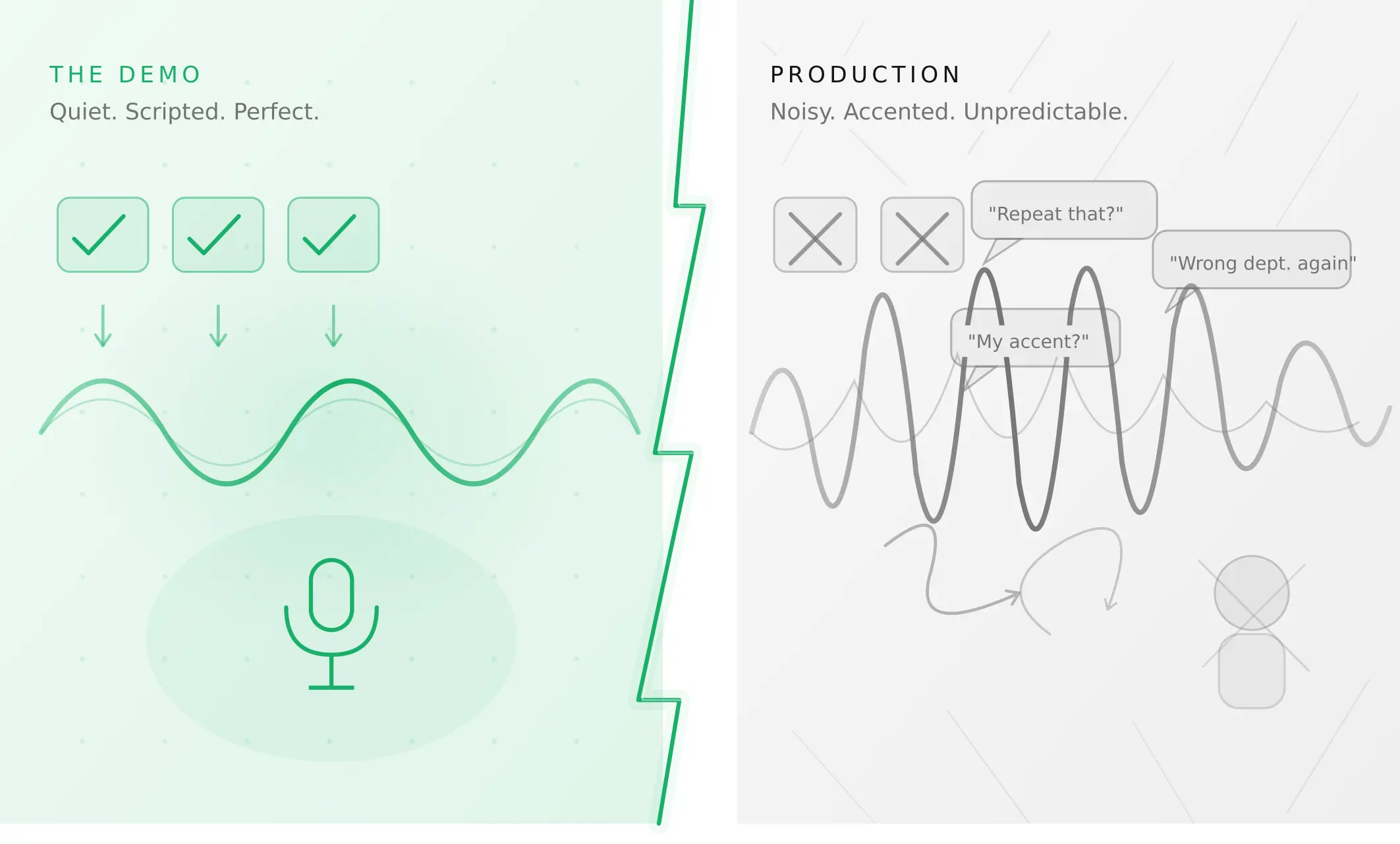
Why AI voice agents fail in production (and how to prevent it)
AI voice agents that ace demos still break in production. Learn the 5 root causes, how to test for each, and what production readiness actually means.
Read more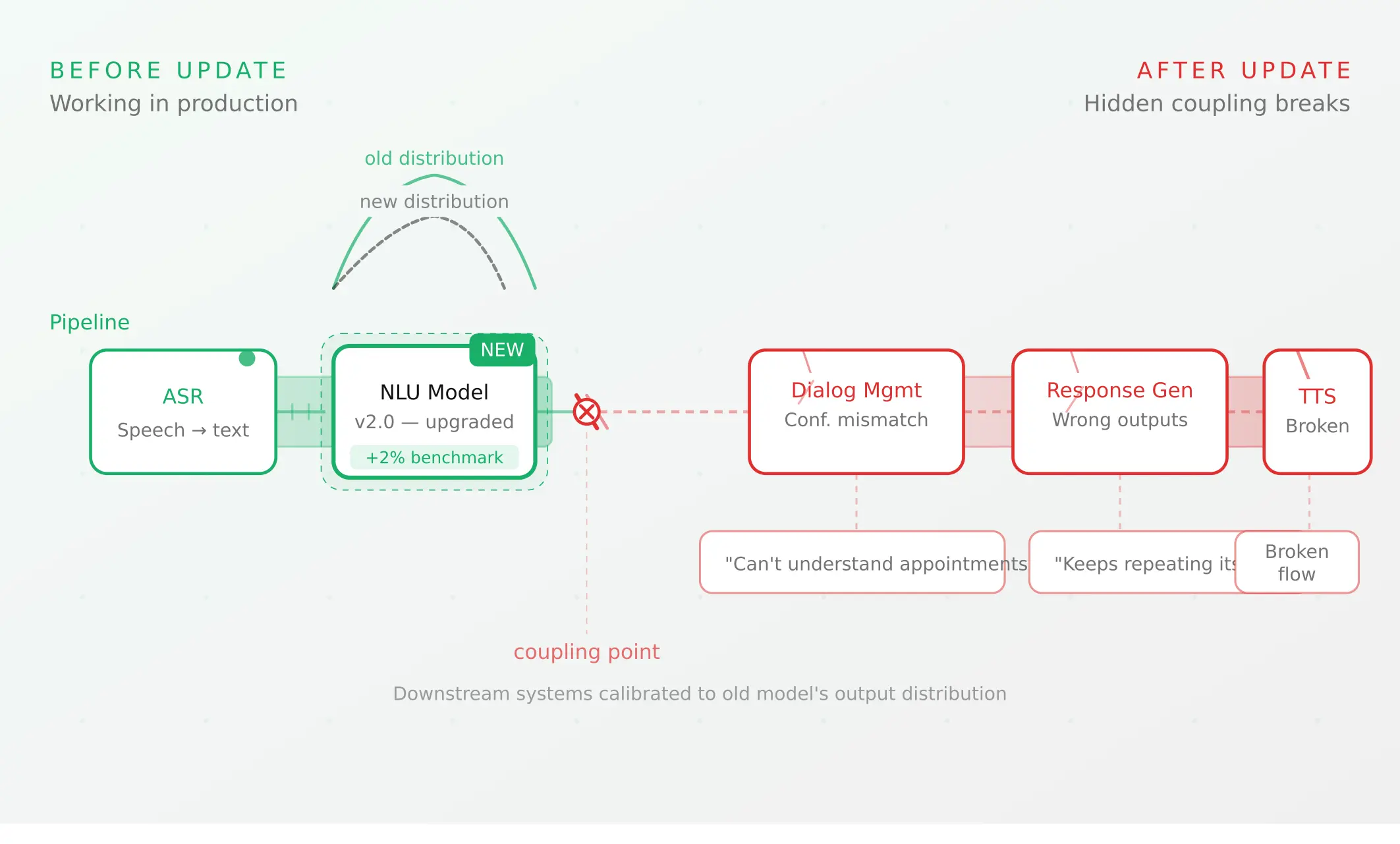
Voice agent regression testing: why LLM updates break production
LLM updates improve benchmarks but break voice agents in 5 predictable ways. How to detect and prevent regressions after every model or prompt change.
Read more