Test your voice agent
Avoiding Voice AI Vendor Lock-In
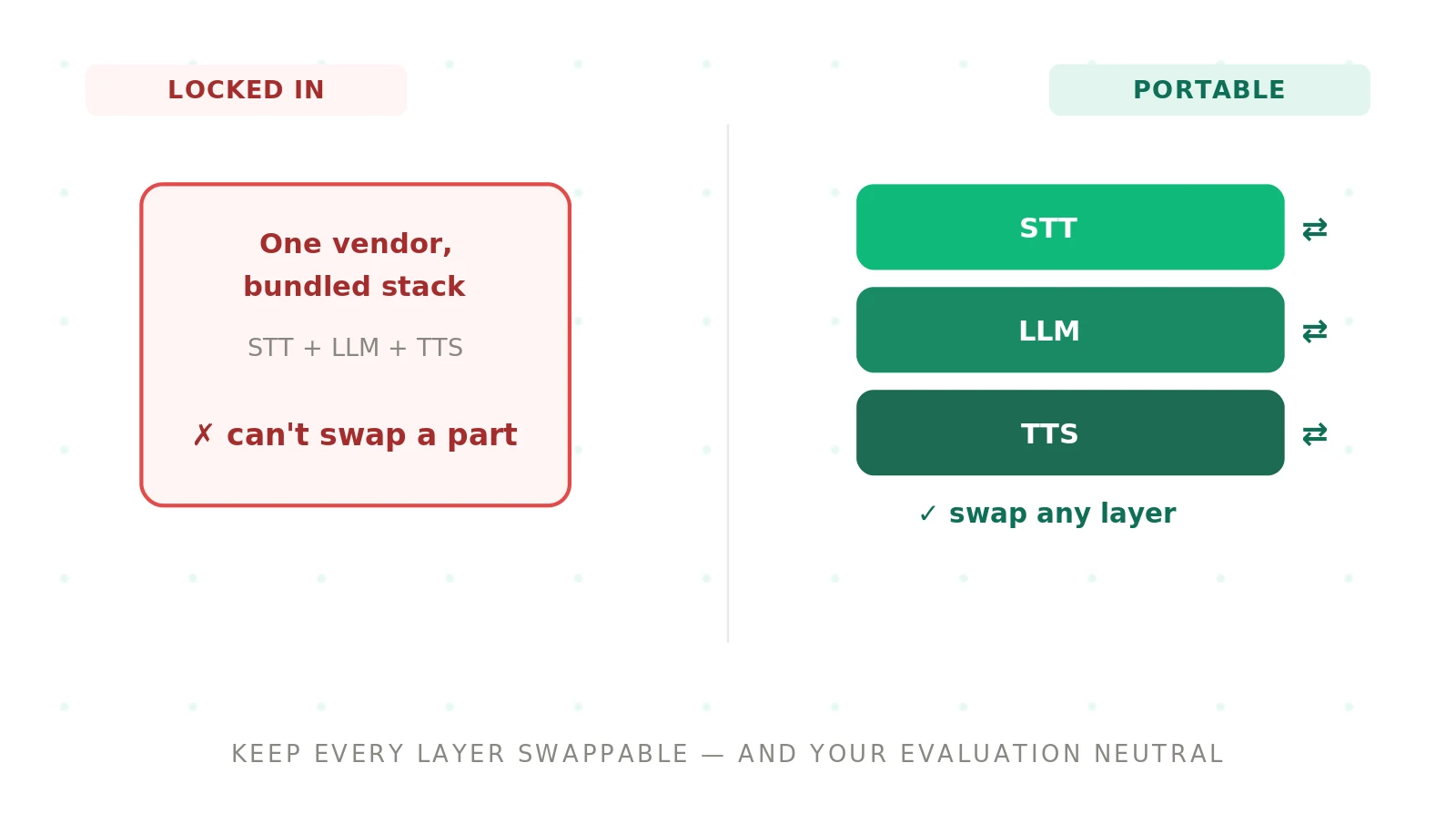
Lock-in rarely arrives as a decision. It accumulates. You pick one platform for speed, wire your prompts and call logic into its console, let your transcripts pile up in its storage, and eighteen months later the cost of leaving quietly exceeds the cost of staying — even when a better, cheaper option is sitting right there. That gap is the lock-in tax, and you pay it every renewal.
The good news: lock-in is not a law of physics. It is the sum of specific architecture and contract choices, and every one of them has a portable alternative. This guide is about preventing lock-in before it sets — how to build a stack no single vendor can hold hostage, how to keep your data and your judgment yours, and how to preserve the ability to leave. It is not about running several vendors in production at once, and it is not the procurement checklist. It is about staying free to move.
What voice AI lock-in actually is
Vendor lock-in is the state where switching away from a supplier is so costly, slow, or risky that you stay against your own interest. In voice AI the trap has a particular shape, because a voice agent is not one product. It is a pipeline: speech-to-text turns audio into words, a language model decides what to do and say, and text-to-speech turns the reply back into a voice. Orchestration, telephony, and turn-taking glue it together.
Each of those layers is a place lock-in can take hold. A platform that bundles all of them behind one console is convenient on day one and expensive to leave on day five hundred. Your prompts live in its format. Your call flows use its primitives. Your recordings sit in its buckets. Your team knows its dashboard and nothing else. None of that transfers, and the vendor knows it.
The deeper trap is silent: you lose the ability to evaluate alternatives. Once your only measure of quality is the incumbent's own dashboard, you cannot tell whether a competitor is better, because you have no neutral yardstick to hold them both against. Portability of infrastructure means little if you cannot judge what you would be switching to.
The five surfaces where lock-in forms
Lock-in is not one thing. It forms on five distinct surfaces, and a portability strategy has to address each.
The model stack. If your speech-to-text, language model, and text-to-speech are welded into a single proprietary bundle, you cannot swap one weak component without replacing the whole system. A swappable stack treats each stage as an interchangeable part.
Your data. Calls, transcripts, prompts, evaluation results, and configuration are the record of everything you have learned. If they only exist inside a vendor's platform, leaving means abandoning your own history.
The integration surface. Every place your code touches a vendor's specific API is a thread tying you to it. The more threads, and the more vendor-specific they are, the harder the knot is to cut.
The contract. Auto-renewal, data-deletion-on-exit, minimum commitments, and export fees decide what leaving actually costs. Terms written for the vendor's convenience become your cage.
Your evaluation. If quality is defined only by the incumbent's tooling, you cannot compare it to anything. This is the surface most teams forget, and the one that quietly makes all the others irreplaceable.
Locked-in vs portable: a side-by-side
The difference between a trap and a portable system is visible in how each surface is built. Here is the contrast, layer by layer.
| Surface | Locked-in setup | Portable setup |
|---|---|---|
| Model stack | STT, LLM, and TTS fused into one proprietary bundle | Each stage behind a shared interface, swappable independently |
| Data | Calls and transcripts only inside the vendor's storage | Continuous export to storage you own, in open formats |
| Prompts and configs | Authored in a vendor-specific console format | Version-controlled in your own repo, vendor-agnostic |
| Integration | App code calls each vendor's proprietary API directly | Code calls your orchestration layer, not any vendor |
| Contract | Auto-renew, export fees, data deleted on exit | Fixed term, guaranteed export, deletion on your schedule |
| Evaluation | Quality measured only by the incumbent's dashboard | Neutral test suite you own, run against any vendor |
| Cost of leaving | Rewrite, re-integrate, lose history, fly blind | Re-point the abstraction layer, replay your own suite |
Read down the right column and a pattern appears: in a portable system, no single vendor is load-bearing. Any one can be removed and replaced without collapsing the rest. That is the whole objective.
How to build a lock-in-resistant voice stack
Portability is designed in, not bolted on later. These seven steps, taken in order, keep every vendor replaceable.
1. Separate the three model layers. Treat speech-to-text, the language model, and text-to-speech as three independent choices, not one bundle. Even if one platform provides all three today, wire them so each can be swapped alone. A weak TTS voice should never force you to replace a strong STT engine.
2. Put an abstraction layer between your app and every vendor. Your application should call your own interface, never a vendor's API directly. An abstraction layer means switching a provider is a change in one adapter, not a rewrite across your codebase. This is the single highest-leverage move against lock-in.
3. Own your data, continuously. Export calls, transcripts, prompts, configs, and evaluation results to storage you control, on a schedule — not as a panic-download the week you leave. Insist on open, documented formats so the export is usable, which is the practical meaning of data portability. Your history is your most valuable asset; keep it where you can reach it.
4. Keep prompts and configuration in your own repo. The logic of your agent — its instructions, its call flows, its escalation rules — belongs in version control you own, not in a vendor's console. Treat the vendor as a runtime that executes your configuration, not the place your configuration lives.
5. Favor open standards at every seam. Where a documented, open standard exists for audio formats, transcript structure, telemetry, or observability, use it. Standardized signals travel between vendors; proprietary ones do not. Instrument your pipeline with vendor-neutral tracing so you can see behavior the same way no matter who runs the model.
6. Write exit rights into the contract. Before you sign, negotiate the terms that decide what leaving costs: a defined export format, no fee to retrieve your own data, a deletion timeline you control, and no auto-renewal that quietly relocks you. Tie these to a clear service-level agreement so obligations are enforceable, not aspirational. Governance frameworks like the NIST AI Risk Management Framework give you neutral language for these requirements.
7. Hold a vendor-neutral evaluation. Build one test suite you own — your scenarios, your caller profiles, your scoring — and keep it independent of any vendor's dashboard. It is what lets you measure a challenger against the incumbent on equal terms, so switching is an informed decision rather than a leap. Our guide to independent voice AI evaluation covers how to keep that yardstick neutral.
Why the evaluation is the real key
Every step above protects your infrastructure. The seventh protects your judgment — and judgment is what actually enables a switch. You can have a perfectly swappable stack and still be stuck, because you have no trustworthy way to know whether the alternative is better.
Consider the trap. If the only quality numbers you have come from the incumbent's console, you are comparing a known score to an unknown. The challenger's own numbers are not comparable — they were produced on a different test, scored by different rules. So you either take a blind leap or stay put. Most teams stay put. That is lock-in produced entirely by missing measurement, no matter how clean the architecture underneath.
A vendor-neutral evaluation breaks it. When you own the test set — the same scenarios, the same caller profiles, the same scoring rules — you can run it against any vendor and read the results on one scale. A switch stops being a gamble and becomes a decision with evidence. This is why an owned evaluation is not a nice-to-have alongside portable architecture; it is the piece that makes the architecture usable. The mechanics of building that shared set live in our piece on comparing agents on identical test cases.
Portability of infrastructure without portability of judgment is a car with no windshield. You can steer, but you cannot see where you are going.
The contract is where lock-in is won or lost
Architecture keeps you technically free; the contract keeps you legally and financially free. The two have to match, because a swappable stack means nothing if the terms make leaving ruinous.
Watch four clauses in particular. Data export: you should be able to retrieve everything — calls, transcripts, configs — in an open format at no charge, on demand. Data deletion: on exit, deletion should happen on a defined timeline you control, not silently the moment your subscription lapses. Renewal: prefer fixed terms with explicit renewal over auto-renew clauses that relock you before you have re-evaluated. Portability of results: your evaluation data and quality history are yours; make that explicit.
Negotiate these before signing, when you have leverage, not at renewal, when you have none. A short exit clause written on day one is worth more than any discount, because it caps the price of leaving for the life of the relationship. Our voice AI procurement checklist turns these into concrete questions to put in front of a vendor.
Common mistakes that quietly relock you
Even teams that start portable drift back into lock-in through small conveniences. A few patterns recur.
Building call logic directly in a vendor's console because it is faster than wiring an adapter. It is faster — until you have a hundred flows there and no way to move them. Letting transcripts accumulate only in the platform because export is a chore you will "do later." Later is the week you are trying to leave, under time pressure, discovering the format is undocumented. Adopting a vendor's proprietary observability because it is bundled, then losing the ability to compare behavior across providers.
The throughline: each shortcut trades a small amount of effort now for a large amount of dependency later. The discipline is to pay the small tax up front — the adapter, the scheduled export, the neutral instrumentation — so you never owe the large one. If you already run more than one provider, our note on operating multiple voice agent vendors covers the day-to-day mechanics.
Frequently asked questions
What is voice AI vendor lock-in and why does it matter?
It is when switching voice AI providers becomes so costly, slow, or risky that you stay against your interest. It matters because voice pricing and quality move fast. If leaving is prohibitive, you cannot capture better options, and you pay a hidden premium at every renewal for staying stuck.
How do I keep my voice AI stack swappable?
Treat speech-to-text, the language model, and text-to-speech as three independent choices rather than one bundle, and place an abstraction layer between your app and every vendor. Then switching a provider is a change in one adapter, not a rewrite. No single component should be able to hold the rest hostage.
What data should I make sure I can export from a voice AI vendor?
All of it: raw call recordings, transcripts, prompts, call-flow configuration, and evaluation results. Export continuously to storage you own, in open documented formats, on a schedule. A one-time panic download the week you leave usually arrives too late and in a format you cannot actually reuse.
Does an abstraction layer really prevent vendor lock-in?
It prevents the most expensive form. When your application calls your own interface instead of a vendor's API, swapping providers touches one adapter rather than your whole codebase. It does not solve data or contract lock-in on its own, but it removes the integration cost that usually makes switching unthinkable.
What contract terms protect me from voice AI lock-in?
Four matter most: free on-demand export of your data in an open format, deletion on a timeline you control, fixed terms instead of auto-renewal, and explicit ownership of your evaluation and quality history. Negotiate them before signing, while you still have leverage, not at renewal when you have none.
Why does evaluation matter for avoiding lock-in?
Because portable infrastructure is useless if you cannot judge alternatives. If quality is defined only by the incumbent's dashboard, you have no neutral way to compare a challenger, so switching becomes a blind leap. A test suite you own lets you measure any vendor on one scale and switch on evidence.
Can open standards reduce voice AI lock-in?
Yes, at every seam. Standardized audio formats, transcript structures, and vendor-neutral observability travel between providers, while proprietary equivalents do not. Using open, documented formats wherever they exist means your data, telemetry, and integrations stay readable and reusable no matter which vendor is running the model underneath.
How is preventing lock-in different from running multiple vendors?
Running several vendors in production is an operational choice about redundancy and routing. Preventing lock-in is a design choice about staying free to move, even if you only ever use one vendor. You can be single-vendor and fully portable, or multi-vendor and still trapped by data and contract terms.
Avoiding lock-in with Evalgent
A vendor-neutral evaluation is what lets you switch vendors safely — it makes your judgment portable, not just your infrastructure. Evalgent gives you that yardstick, owned by you and independent of any provider. Scenarios capture your real calls — happy paths, edge cases, interruptions, adversarial callers — as a fixed, versioned suite you keep. Profiles vary caller accent, pace, and line quality, so every vendor faces the same range. Metrics score each against pre-defined expected outcomes on one fixed definition, making results directly comparable across providers. Evaluations replay the identical suite against any vendor or version at concurrency, so a challenger and the incumbent meet on equal terms. Reviews let your team hear the call behind any score. Because the suite is yours and runs against anyone, your ability to judge quality never lives inside a vendor's dashboard — which is exactly what keeps you free to leave. To put a neutral evaluation between you and every vendor, book a demo. Our vendor benchmarking guide and vendor scorecard show the approach in more detail.
The bottom line
Lock-in is a set of choices, and every one has a portable alternative. Design the stack, the data, the contract, and the evaluation to keep you free — and you always have somewhere else to go.
Related Articles
Why AI voice agents fail in production (and how to prevent it)
AI voice agents that ace demos still break in production. Learn the 5 root causes, how to test for each, and what production readiness actually means.
Read more
Voice agent regression testing: why LLM updates break production
LLM updates improve benchmarks but break voice agents in 5 predictable ways. How to detect and prevent regressions after every model or prompt change.
Read more