Voice Agent Audit Trail: Evidence for Disclosure, Consent and Regulated Calls
On this page
A customer disputes a call from four months ago. Counsel asks what the agent said, in which version, and whether the caller was told it was an AI. You have a transcript, a recording and a guess. That gap is what a voice agent audit trail closes.
This post is for the engineer or product owner of a live voice agent. It covers the record, not the watching. My post on compliance monitoring covers how to watch live calls. The compliance audit guide covers a point-in-time review. Disclosure and recording consent cover what to say. This post covers the evidence that you said it. Your own counsel decides which rules apply to your calls.
The questions an auditor or counsel will ask
Start from the questions, because they decide what you must store.
1. What was said, and when?
2. Which script, prompt or release was live on that call?
3. Was the AI disclosure given, and at what point?
4. Was consent captured before recording began?
5. Who or what ended the call, and was a human involved?
6. What data was accessed, and which system received it?
A seventh follows: who has viewed this call since? A transcript answers the first. It rarely answers the rest.
The evidence record for one call
An audit trail is a set of events tied to one call ID. Each event carries a turn, a time, a source and a status. NIST defines a log as "a record of the events occurring within an organization's systems and networks" (NIST SP 800-92). That guide dates from 2006.
The record needs ten parts.
- Call ID. One stable key on every system. See call ID correlation.
- Timestamps with a clock source. Say which clock stamped each event.
- Release and prompt version ID. The exact build that ran.
- Disclosure event. Turn index, exact text and play time.
- Consent event. What was asked, the answer and the time.
- Tool calls. Name, time, result and the system that received data.
- Handoff. Target, reason and time.
- End reason. Hangup, agent end, transfer or error.
- Access log. Who viewed or exported the call, and when.
- Gaps. Which events are missing.
My event schema reference and the what to log guide list candidate fields.
A worked evidence record, illustrative
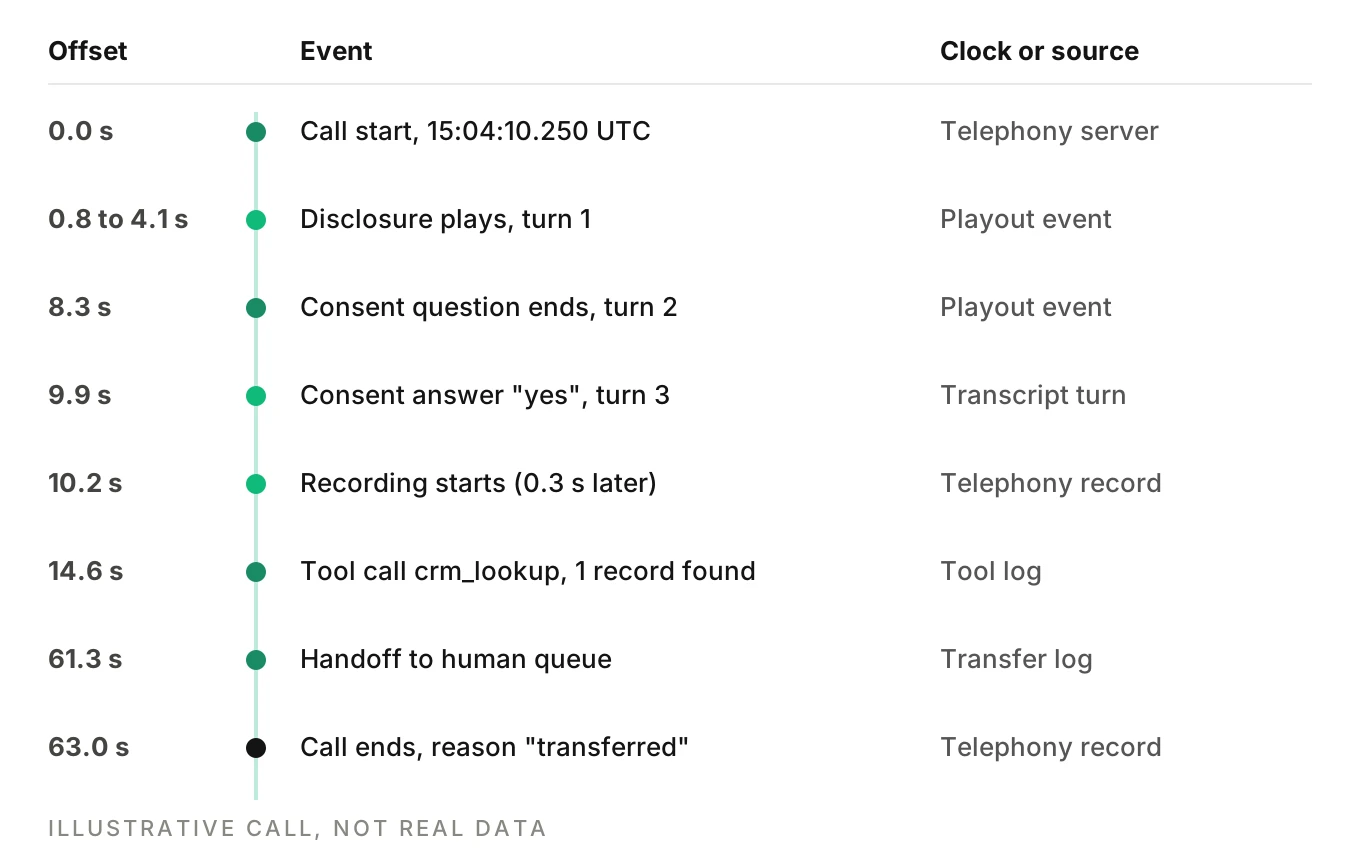
This is one invented call, not a schema or a product output. Offsets count from the start time.
| Item | Illustrative value | Clock or source |
|---|---|---|
| Call ID | call-0417 | Assigned at call setup |
| Call start | 2026-03-12 15:04:10.250 UTC | Telephony server, NTP-synced |
| Release and prompt | rel-0311.2, prompt pv-318 | Deploy record, copied at call start |
| Disclosure | Turn 1, plays 0.8 s to 4.1 s, "This is an AI assistant for Acme." | Playout event |
| Disclosure wall time | 15:04:11.050 to 15:04:14.350 UTC | Start plus offset |
| Consent asked | Turn 2, ends 8.3 s | Playout event |
| Consent answer | Turn 3, "yes", at 9.9 s (15:04:20.150 UTC) | Transcript turn |
| Recording start | 10.2 s (15:04:20.450 UTC) | Telephony record |
| Tool call | crm_lookup at 14.6 s, result "1 record found" | Tool log |
| Handoff | Human queue at 61.3 s, reason "caller asked" | Transfer log |
| End | 63.0 s (15:05:13.250 UTC), reason "transferred" | Telephony record |
| Access log | Reviewer viewed transcript 2026-03-14; export 2026-03-20 | Access service |
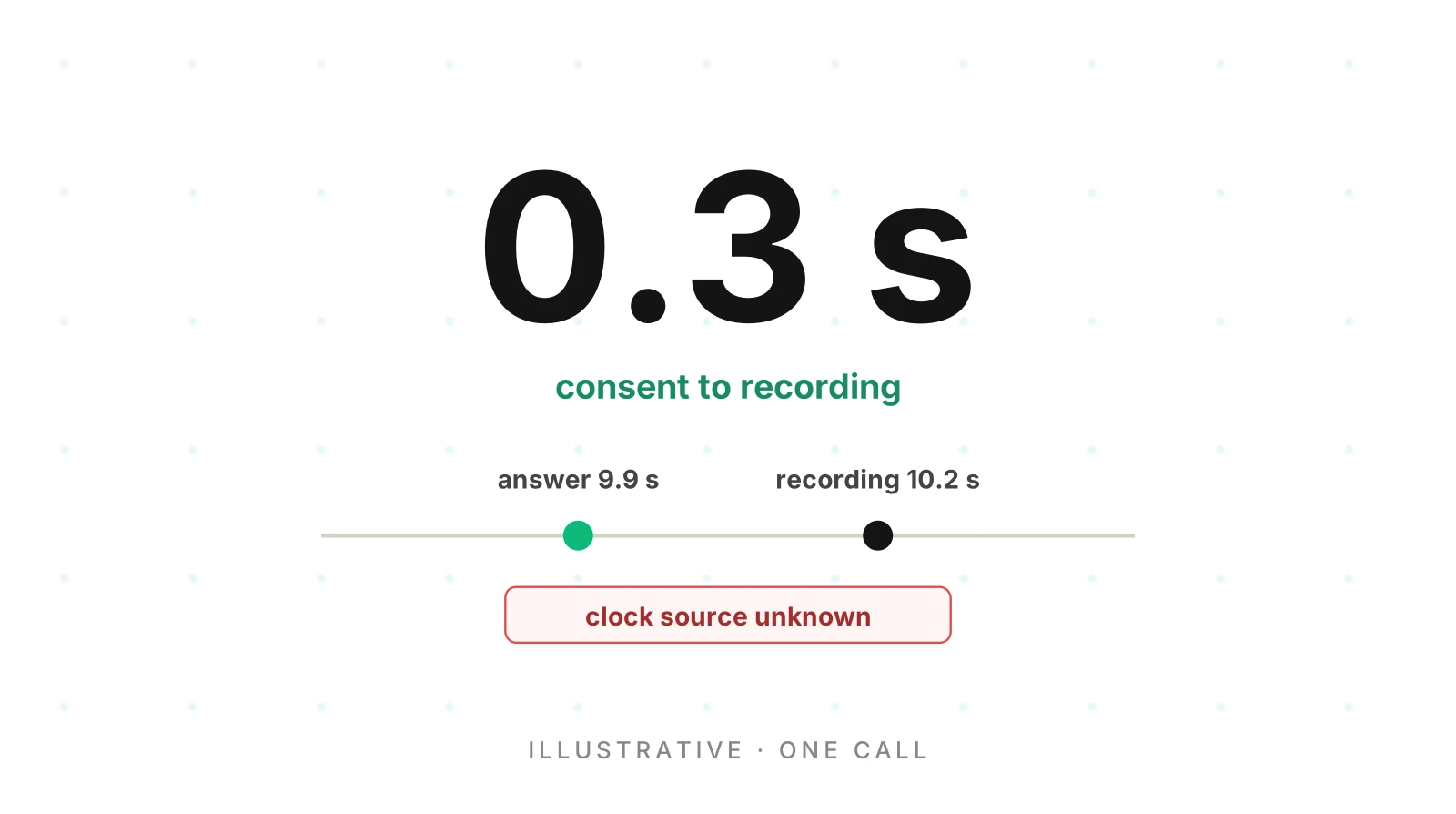
Consent at 9.9 s precedes recording at 10.2 s, a gap of 0.3 s. If the stamps came from different clocks, that margin would prove little. So every row names its clock.
Time: say which clock stamped each event
Two events are comparable only if you know their clocks. OpenTelemetry's log model separates two times. Timestamp is the "time when the event occurred measured by the origin clock." ObservedTimestamp is the "time when the event was observed by the collection system" (OpenTelemetry log data model). The spec says the source timestamp "may be missing if the source timestamp is unknown."
Keep both. A late observed time is not a late event. NIST advises that "organizations should use time synchronization technologies such as Network Time Protocol (NTP) servers whenever possible" (SP 800-92, section 3.2). Store the clock source, whether the stamp is event or receive time, and the offset from call start.
My timestamp alignment post covers why spans disagree with the recording. Store the raw stamp and its source. Never fix a time silently. Store any skew correction as its own event.
Tamper evidence: three design options
An audit trail is only as good as your ability to show nobody edited it. NIST notes that "ensuring that the original logs are not altered supports their use for evidentiary purposes" (SP 800-92, section 3.2, footnote 23). These are design options, not requirements.
Append-only storage. The store accepts new records and refuses updates and deletes through the application. This is cheap. It stops accidents and casual edits. A database administrator can still change rows.
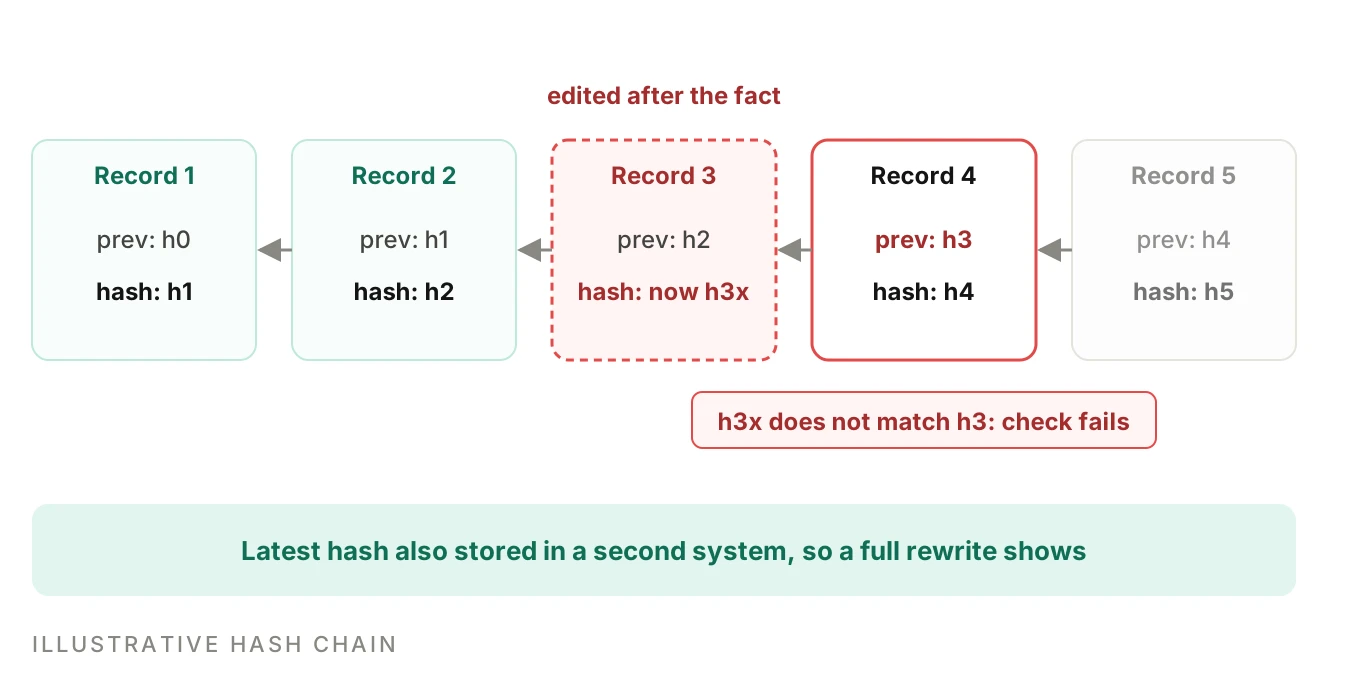
Hash chaining. Each record stores a hash of the previous record plus its own content. Edit record 3 and its hash changes. Record 4 still holds the old hash, so the check fails there. To hide the edit, someone must rewrite every later record. Keep the latest hash in a second system, and the rewrite shows. RFC 6962 uses a related idea for certificate logs. It says "the append-only property of each log is technically achieved using Merkle Trees" (RFC 6962). A simple chain is a lighter relative.
Write-once object storage. Amazon S3 Object Lock "uses a write-once-read-many (WORM) model." In compliance mode, "a protected object version can't be overwritten or deleted by any user, including the root user" (AWS docs). Azure describes similar storage where "data can't be modified or deleted for a user-specified interval" (Microsoft docs). I name these only as examples. Read current vendor terms first.
The options stack. They show a record has not changed since. They do not make it true. A wrong clock stays wrong.
What to keep and what to mask
Here the trail collides with privacy. A call holds names and account numbers. Redaction removes them. An auditor wants proof. Keep the proof of the event, not the personal data around it.
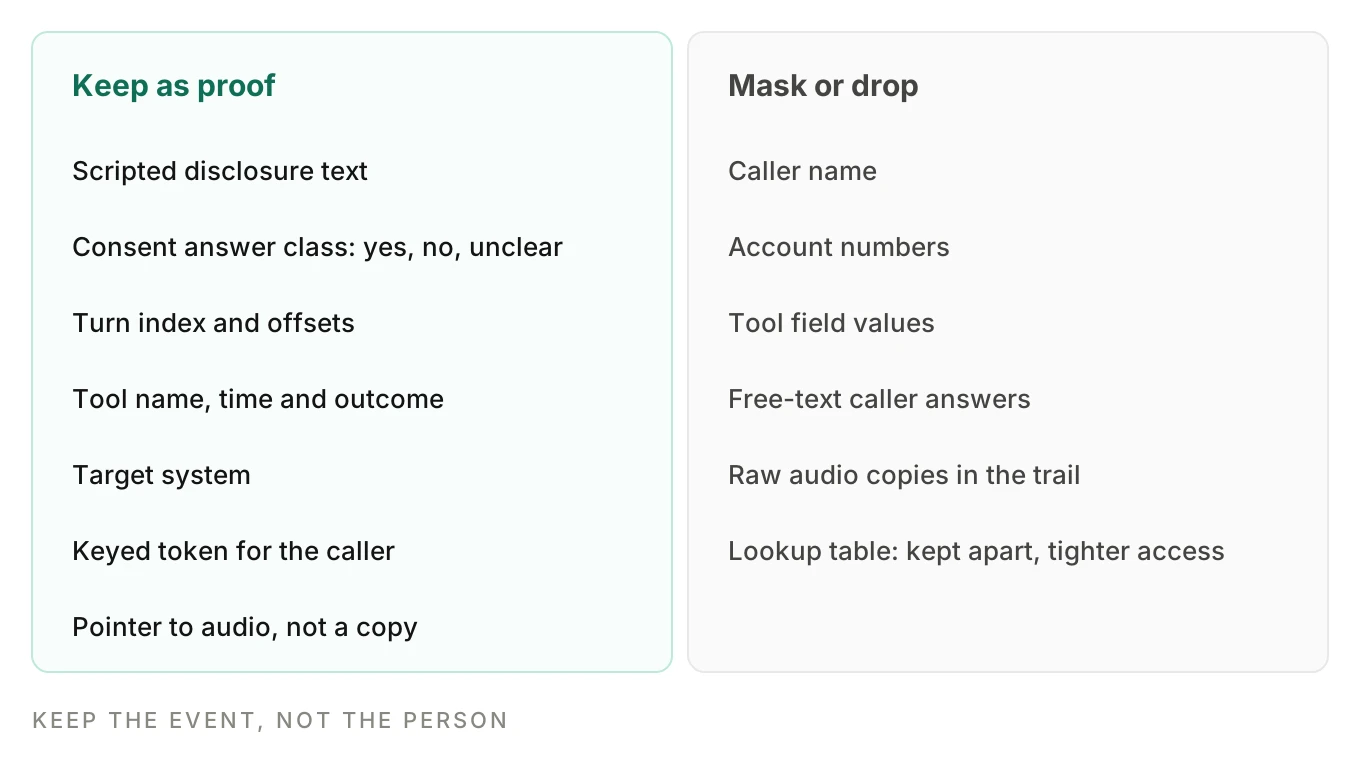
- Disclosure. The agent's sentence is scripted. Keep it whole.
- Consent. Keep the question, the answer class (yes, no, unclear), the turn and the time. Drop the name.
- Tool calls. Keep tool name, time, outcome and target system. Mask field values.
- Caller identity. Store a keyed token. Keep the lookup table in a separate, tighter store.
- Audio and transcript. Keep a pointer and an offset, not a copy.
A plain hash of a short answer like "yes" is easy to guess, so use a keyed hash for low-entropy values. My PII redaction post covers where to mask and why the call ID must survive. If you analyse the caller's voice, read voiceprints and BIPA first.
Retention and legal hold
Give the trail its own retention clock. How long is for counsel and your contracts. My data retention post sets clocks by data type and covers holds.
Two points matter here. First, deletion must not break the chain. Log a deletion as an event and keep the hash. Second, a hold must stop deletion of the trail, transcript, recording and vendor copies together. AWS says a legal hold "has no expiration date" and "remains in place until you explicitly remove it." Azure says a hold stores data "until the legal hold is explicitly cleared." Log who set each hold and who cleared it.
Access control and access logging
Viewing a call is an event. NIST says logs need protection "from breaches of their confidentiality and integrity" (SP 800-92, section 2.3.2). The trail is both evidence and sensitive data.
- Least access. Most reviewers need masked events.
- Log every view and export. Record who, what, when and why.
- Separate duties. Those who read the trail should not be the only ones who can alter it.
Protect the access log like the rest of the trail.
Exporting for an auditor
Plan the export before the request arrives. Select by call ID, date range or caller token. Include the record, version details and chain proof. State clock sources and known gaps in a cover note. Mask what the request does not need. Log the export. Then rebuild a three-month-old call from the export alone. If you cannot answer the six questions, neither can an auditor.
What the trail cannot prove
Name the limits in the record, not in a footnote after a dispute. Mark such a question "undetermined" and say why.
- Missing events. The disclosure was never logged, so you cannot say it did or did not happen.
- Sampled-out calls. Calls you did not store have no trail. See trace sampling.
- Unreliable clocks. Unsynced hosts cannot order events 0.3 s apart.
- No audio retained. A transcript is a model output. Without audio you cannot check what the caller heard.
- Generated, not played. A barge-in may have cut the sentence short.
A missing event is a gap, not proof the act did not happen.
Common failures
- Logs rewritten after the fact. A backfill job "cleans" old records, and the trail no longer shows what was stored then.
- Versions not recorded. The call has a transcript but no prompt ID. See release attribution.
- Consent in another system with no join key. The consent tool and call log share no ID.
- Masking that destroys proof. The disclosure text was redacted along with names.
- No gap markers. Missing data reads as clean data.
The audit table: question, evidence, location, what is missing
| Question an auditor asks | Evidence needed | Where it usually lives | What is often missing |
|---|---|---|---|
| What was said, and when? | Turn text with offsets and wall times | Transcript store, call log | Playout time, clock source |
| Which script or prompt version ran? | Release and prompt ID on the call | Deploy tool, prompt repo | The ID copied onto the call record |
| Was the AI disclosure given, and when? | Turn index, exact text, play time | Transcript, playout events | Proof it was played, not only generated |
| Was consent captured before recording? | Prompt end, answer, recording start | Consent tool, telephony log | A join key between the two systems |
| Who or what ended the call? | End reason, handoff target and time | Telephony record, transfer log | Reason for a transfer |
| What data was accessed or sent where? | Tool name, time, result, target system | Tool log, backend logs | Result and receiving system |
| Who has viewed the call since? | Viewer, action, time | Access service | A log at all, or one that can be edited |
| Has the record changed? | Hash chain or storage lock proof | Storage layer | Any tamper evidence |
The regulated policy test cases show how to turn the middle rows into pre-release checks.
The rules I opened
I opened two rule texts on November 23, 2026 and quote only what I read. Counsel decides whether either applies. I left out rules I could not open in a quotable form.
FCC Declaratory Ruling FCC 24-17. Adopted February 2 and released February 8, 2024. Paragraph 2 says the TCPA's restrictions on "artificial or prerecorded voice" "encompass current AI technologies that generate human voices." Such calls "require the prior express consent of the called party to initiate such calls absent an emergency purpose or exemption" (FCC 24-17). Evidence consequence: a consent record you can point to at dial time, joined to the call.
47 CFR 64.1200(b)(1). The text I read says: "At the beginning of the message, state clearly the identity of the business, individual, or other entity that is responsible for initiating the call" (Cornell LII). Evidence consequence: store the exact opening text and its play time.
Neither rule tells you how to build a trail. This is general information, not legal advice.
Where Evalgent fits
Evalgent is a testing, evaluation and monitoring platform for voice agents. Monitor is live. It works on production call data your team sends, through OpenTelemetry or an upload path. It flags problems such as tool-call failures, latency spikes and policy failures, with fix recommendations. Observe is launching. It works with any stack, clusters failures into root causes, and uses traces to explain why. It shows undetermined results and coverage gaps. Evalgent stays out of the media path.
At headline level, privacy controls include personal data masked on arrival, a metrics-only mode, access logging, retention you control and a data region you choose. I am not claiming an audit-trail feature. Evalgent does not make anyone compliant, and it does not replace the record your own stack must keep.
For testing, Reviews replay test calls with audio and transcript together and show exact tool payloads, which helps check a disclosure or consent flow before release. To see how that fits your agent, book a demo.
How to build a voice agent audit trail
Start with one agent and one flow.
1. List the questions - Write the six auditor questions, plus access and integrity.
2. Pick one call ID - Make it appear in the telephony, agent, tool and consent systems.
3. Stamp every event - Store time, clock source, event or receive time, and offset.
4. Copy the version onto the call - Write release and prompt IDs at call start.
5. Record disclosure and consent as events - Store turn, exact text, play time and answer class.
6. Decide what to keep and mask - Keep proof of each event. Tokenise the caller.
7. Add tamper evidence - Choose append-only storage, a hash chain, locked storage, or a stack.
8. Set retention, holds and access - Log every view, export and hold.
9. Test an export - Rebuild an old call from the export alone. Mark gaps undetermined.
Frequently asked questions
What is a voice agent audit trail?
A voice agent audit trail is the per-call record that shows what the agent said and did. It holds a call ID, clock-stamped events, release and prompt version, disclosure and consent events, tool calls, handoff, end reason and an access log. It is built so edits are detectable.
What should a voice agent audit trail contain?
It should contain the call ID, timestamps with a clock source, release and prompt version, disclosure and consent events, tool calls with results, any handoff, the end reason and who viewed the call.
How do you prove an AI disclosure was given?
Store a disclosure event with turn index, exact text and play time. Prefer a playout event over model output, because generated text may never reach the caller. If the playout event is missing, mark the question undetermined rather than assuming it happened.
How do you make voice agent logs tamper-evident?
Common design options are append-only storage, hash chaining, where each record stores the previous record's hash, and write-once object storage. Keep the latest hash in a second system. These show a record changed. They do not show it was accurate.
How do you keep proof without keeping personal data?
Keep the event, not the person. Store the scripted disclosure text, the consent answer class, offsets, tool name and outcome, and a keyed token for the caller. Mask names, account numbers and field values. Keep the lookup table separate.
How long should audit trail records be kept?
Counsel and your contracts decide that. Give the trail its own clock, and let a legal hold stop deletion of the trail, transcripts, recordings and vendor copies together.
What can a voice agent audit trail not prove?
It cannot prove what it did not record. Missing events, sampled-out calls, unsynced clocks and discarded audio leave questions undetermined. It also cannot show a logged event was true when written. Say so in the export cover note.
Should the audit trail include the call audio?
Not necessarily. Audio is heavy personal data, and a pointer with an offset may be enough. If audio is not retained, record that as a known limit, because you cannot check what the caller heard.
The bottom line
A voice agent audit trail is the clock-stamped, version-stamped, tamper-evident record of what each call said and did, with its gaps marked undetermined. Build it before anyone asks, because it cannot be rebuilt afterwards, and this is general information, not legal advice.
Related Articles
How to automate voice agent testing: synthetic callers vs manual QA
Learn how ai test automation replaces manual QA for voice agents. Compare synthetic callers vs human testers, with a 5-step framework to scale without hiring.
Read more
AI Agent Testing vs Voice Agent Testing: What General Tools Miss for Voice
AI agent testing measures text outputs. Voice agent testing measures behaviour through an acoustic pipeline. Five failure categories general tools miss.
Read more