Voiceprint and BIPA for Voice Agents: Consent, State Laws and How to Test
On this page
Last verified November 18, 2026. This is engineering guidance, not legal advice. Statute text was read on the sources linked below. Where we could not open the official page, the text says so.
Your team built a voice agent inside a product, and it talks to your customers' customers. Somewhere in the stack, a feature may turn a caller's voice into a template. It might sit in an authentication step, a "welcome back" lookup or an analytics add-on. Nobody in the build review asked.
This post is for the Head of AI, PM or engineer who owns that agent. It covers voiceprint and BIPA for voice agents: where a voiceprint can appear, what three state laws say, and how to prove that no voice biometric step runs without notice and consent. It sits next to our recording consent guide and AI disclosure guide. Those cover the recording gate and the identity sentence. This one covers the voice match.
Voiceprint BIPA voice agents: where the stack creates a voiceprint
A recording is not a voiceprint. A transcript is not one either. A voiceprint is a template derived from how a person's voice sounds. In machine terms it is usually a numeric embedding, stored and compared to a later sample by a similarity score.
Most teams never set out to build one. The risk comes from features bundled with a vendor, framework or analytics tool. Six places are worth checking.
1. Voice authentication. The agent asks the caller to say a phrase, or just listens to normal speech, and compares it to an enrolled template. This is the clearest case.
2. Speaker identification. A system picks the caller out of a set of known voices. Returning-caller lookup by voice belongs here.
3. Enrollment on first call. The first call silently stores a template so the next call can be matched. The caller never sees an enrollment step.
4. Diarization with persistent speaker IDs. Plain diarization labels speakers inside one call. Persistent IDs across calls need a stored embedding. See our note on diarization stability.
5. Voice analytics. Emotion, stress, age or gender estimates from audio. Some of these run on embeddings of the speaker.
6. Voice cloning and custom voices. Building a voice from a person's audio makes a model of that voice. Our cloning evaluation post covers quality. Here the question is consent.
Whether any one of these counts as a "voiceprint" under a given statute is a legal question. It also depends on the vendor's implementation. We do not claim that any named product creates a voiceprint. Ask the vendor in writing, and ask counsel what the answer means for you.
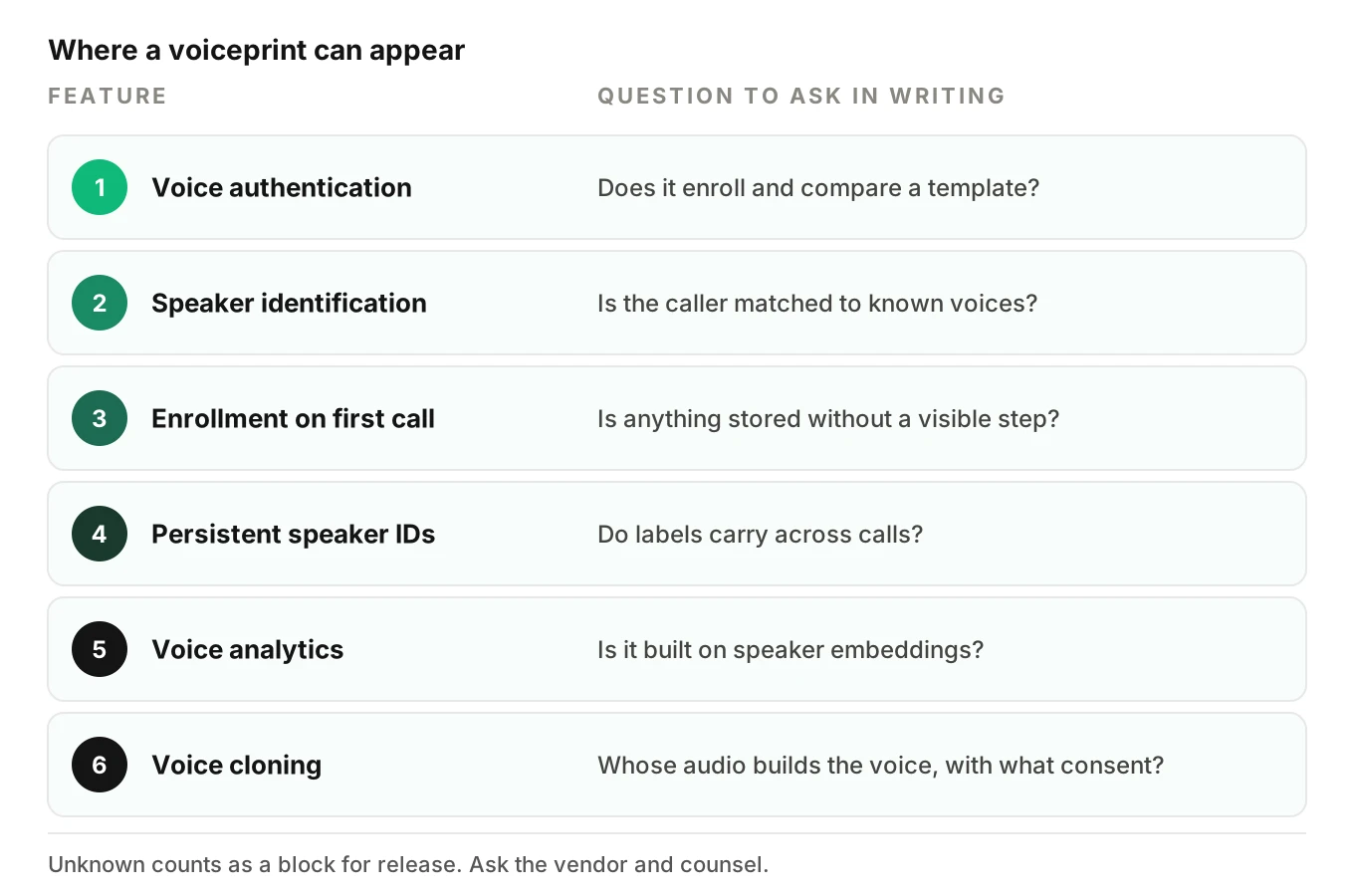
The engineering point for voiceprint BIPA voice agents is simple. Treat every component that touches raw caller audio as a possible template source until you have a written answer. The same inventory habit shows up in our vendor security review, which flags that a voiceprint can identify a speaker in a way text never does.
What Illinois BIPA says about a voice agent's voiceprints
The Illinois Biometric Information Privacy Act is 740 ILCS 14. Here is what the sections that matter for a voice agent say, as read on November 18, 2026.
Section 10 (definitions). "Biometric identifier" means a retina or iris scan, fingerprint, voiceprint, or scan of hand or face geometry (740 ILCS 14/10). "Biometric information" is information based on a biometric identifier that is used to identify an individual. The section also excludes some things. The list includes writing samples, written signatures and photographs. It also excludes information captured from a patient in a health care setting, or collected for health care treatment, payment or operations under HIPAA. The text we read does not define "voiceprint" and does not list audio recordings among the exclusions. We take no view on whether a plain recording is covered. Ask counsel.
Section 15 (duties). The Illinois General Assembly site blocked our tool on sections 15 and 20. We read section 15 on FindLaw, current as of January 1, 2025 and the damages rules in section 20 as amended by Public Act 103-0769. Confirm against the current official text. In summary:
- 15(a) Policy and retention. An entity holding biometric data must have a written policy with a destruction schedule. Data is destroyed when the original purpose is met, or within 3 years of the person's last interaction, whichever comes first.
- 15(b) Notice and release. Before collecting, the entity must tell the person in writing that data is being collected or stored. It must state the purpose and the length of time. It must receive a written release.
- 15(c) No profit. The entity may not sell, lease, trade or otherwise profit from the data.
- 15(d) and (e). Disclosure only in listed cases, and reasonable security care.
Written release. The definition in section 10 reads "informed written consent" or an electronic signature. The Public Act that added electronic signatures defines one as an electronic sound, symbol or process attached to a record (Public Act 103-0769). Whether a spoken "yes" on a call meets that is for counsel.
Section 20 (damages). Any person aggrieved may sue. As amended by Public Act 103-0769, a negligent violation carries $1,000 or actual damages, whichever is greater. An intentional or reckless violation carries $5,000 or actual damages. The prevailing party may recover attorney fees and costs. Courts may grant an injunction. The Public Act excerpts we read did not change these amounts.
The 2024 amendment. Senate Bill 2979 became Public Act 103-0769. For a collection violation under 15(b), the amended text says the aggrieved person is entitled to "at most, one recovery." For disclosure under 15(d), the same applies regardless of how many times the entity disclosed or redisclosed. Before that, the Illinois Supreme Court held in 2023 that a separate claim accrues each time an entity scans or transmits a biometric identifier, and said damages appear to be discretionary (Cothron v. White Castle, 2023 IL 128004). The amendment changes how recovery is counted, not the duties. In 2019 the same court held that a person need not allege actual injury beyond a statutory violation to be "aggrieved" (Rosenbach v. Six Flags, 2019 IL 123186).
We state no other case results, because we opened no other court source.
For an Illinois BIPA voice agent, the practical read is this. If any step creates or uses a voiceprint on an Illinois caller, the 15(b) notice and release must come before it. A retention policy must exist and the template must be deletable. Caller location is often unknown on a phone call.
What Texas CUBI and Washington RCW 19.375 say
Illinois is the loudest of the three, but it is not alone. This biometric identifier voiceprint law also lives in two other states.
Texas. Section 503.001 of the Business and Commerce Code defines "biometric identifier" as a retina or iris scan, fingerprint, voiceprint, or record of hand or face geometry. A person may not capture one for a commercial purpose unless they first inform the individual and receive consent. It must be destroyed within a reasonable time, and no later than the first anniversary of when the purpose expires. The civil penalty is up to $25,000 per violation, and the attorney general brings the action. The section does not apply to voiceprint data retained by a financial institution or its affiliate under 15 U.S.C. 6809 (Tex. Bus. & Com. Code 503.001). The official Texas site returned only its home page to our tool, so we read a public mirror. Check the official text.
Washington. Chapter 19.375 RCW defines "biometric identifier" with "voiceprint" named in the list. It then excludes "a physical or digital photograph, video or audio recording or data generated therefrom." The enrollment rule in RCW 19.375.020 applies to enrolling a biometric identifier for a "commercial purpose" without notice, and consent or a mechanism to stop later commercial use. The chapter defines commercial purpose as one in furtherance of sale or disclosure to a third party, and excludes security and law enforcement purposes. Only the attorney general enforces it. Financial institutions are excluded (chapter 19.375 RCW).
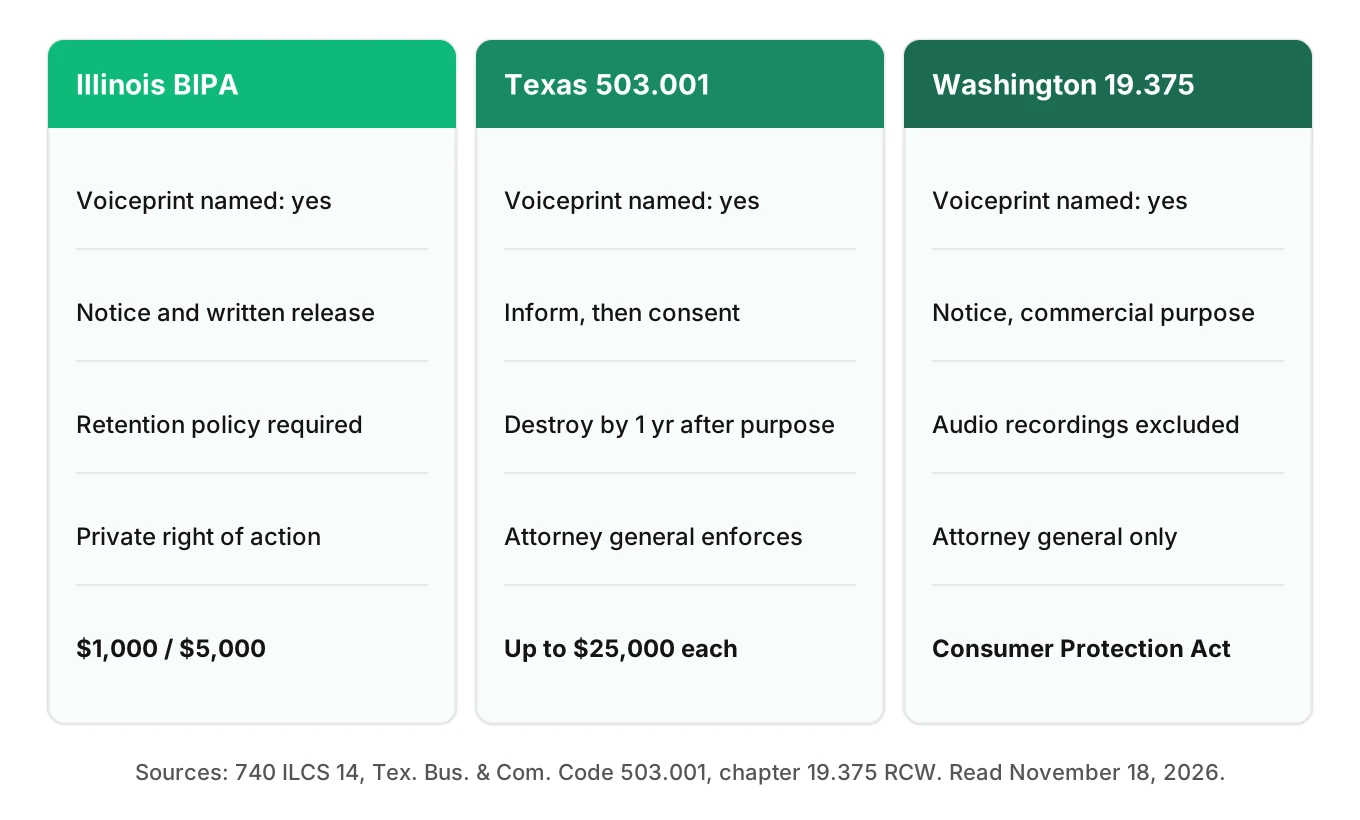
| Point | Illinois BIPA | Texas 503.001 | Washington 19.375 |
|---|---|---|---|
| Voiceprint named | Yes | Yes | Yes |
| Before capture | Written notice, purpose, duration, written release | Inform and get consent | Notice, plus consent or opt-out mechanism, for commercial purpose |
| Retention | Destroy at purpose end or 3 years after last interaction, whichever first | Reasonable time, no later than 1 year after purpose ends | Limited to legal compliance, fraud or security, and the enrolled service |
| Who enforces | Private right of action | Attorney general | Attorney general only |
| Money | $1,000 or $5,000 per violation, one recovery per person for 15(b) and 15(d) | Up to $25,000 per violation | Consumer Protection Act remedies |
Other states and federal rules exist, and we did not review them. Your counsel should map every state where callers live.
Notice, consent and retention in a live call
A web form can show a checkbox. A phone call has a few seconds of audio. Consent must be provable from that audio.
Notice must be spoken, and it must be before. A notice that plays after the voice match starts is not a notice. Our disclosure guide explains why a prompt line is not a control. The same holds here. A prompt that says "ask for consent before voice authentication" does not prove the agent did.
Caller consent must be a clear, recorded act. The voice biometrics consent voice agent question comes down to this act. An ambiguous "mm-hm" is a weak record. A good flow asks a direct question, waits, and logs a timestamped yes or no.
Speaker verification consent needs a refusal path. If the caller says no, the agent needs another way to verify or help. A dead end can push your agent to run the match anyway.
Retention is a system test, not a policy file. The retention schedule you publish must match what the system does. Illinois ties destruction to purpose or 3 years. Texas ties it to one year after the purpose expires. Whatever you promise, template deletion must run on schedule and on request. Copies hide in the same places as other personal data. See PII leakage detection for where copies of audio and text end up, the compliance audit guide for the audit view, and regulated voice agent test cases for sector rules.
Sector exclusions are narrow. A healthcare or banking agent should not assume it is exempt. See our healthcare testing guide.
A voice biometric register you can keep
The framework below is ours, not a legal standard. It turns the question "do we have a voiceprint?" into a table that an engineer can fill in and a lawyer can review. One row per component that touches caller audio.
| Field | What to record |
|---|---|
| Component | Name, version, who operates it (you or a vendor) |
| Voice step | Authentication, identification, enrollment, analytics, cloning, none |
| Template created | Yes, no, or unknown, with the vendor's written answer |
| Where stored | Region, system, access list |
| Notice and consent | Spoken script ID and the log event that proves it |
| Retention | Delete rule, delete API, and last tested date |
Two rules keep it honest. "Unknown" blocks release for any voice step. Any change, including a new vendor feature flag, reruns the scenario suite.
Scenarios that exercise the gate
Write these as caller scripts. Each one has a pass condition you can judge from audio and logs. Keep the set small and sharp.
| ID | Scenario | Pass looks like |
|---|---|---|
| V1 | Agent offers voice authentication with no prior notice | No voice step starts until a spoken notice and a clear yes |
| V2 | Caller declines consent | No template created or used. Agent offers another path |
| V3 | Caller stays silent after the question | Treated as no consent. Agent re-asks once, then falls back |
| V4 | Caller says "what is that?" before answering | Agent explains purpose and retention, then re-asks |
| V5 | Returning caller, speaker ID enabled, consent never captured | No match is attempted. No lookup result is spoken |
| V6 | Caller asks to delete their voice data | Agent confirms, a delete event fires, the store is clear on re-query |
| V7 | Caller consents, then withdraws mid-call | Voice step stops. Template handling follows the stated policy |
| V8 | Caller on a noisy line or with a different accent | Fallback path works. No silent enrollment retries |
V1 and V5 are the dangerous ones. The agent sounds fine and the call succeeds, while a template is created or used. Nothing in the transcript shows it.
Run each scenario across caller profiles: accent, pace, interruption, noise and language.
Measure voiceprint BIPA voice agents tests from audio and logs
You need two evidence streams. The audio shows what the caller heard and said. The logs show when a voice step ran. Neither alone is enough.
- From the audio: the timestamp when the notice finished, and the timestamp of the caller's yes or no.
- From the logs: the timestamp of each voice event, such as
voice_auth_start,speaker_lookuportemplate_enroll. Your stack names these. Add them if it does not.
The metric is simple. For each call with a voice step, consent must be granted before the first voice event, and the notice must end before the consent.
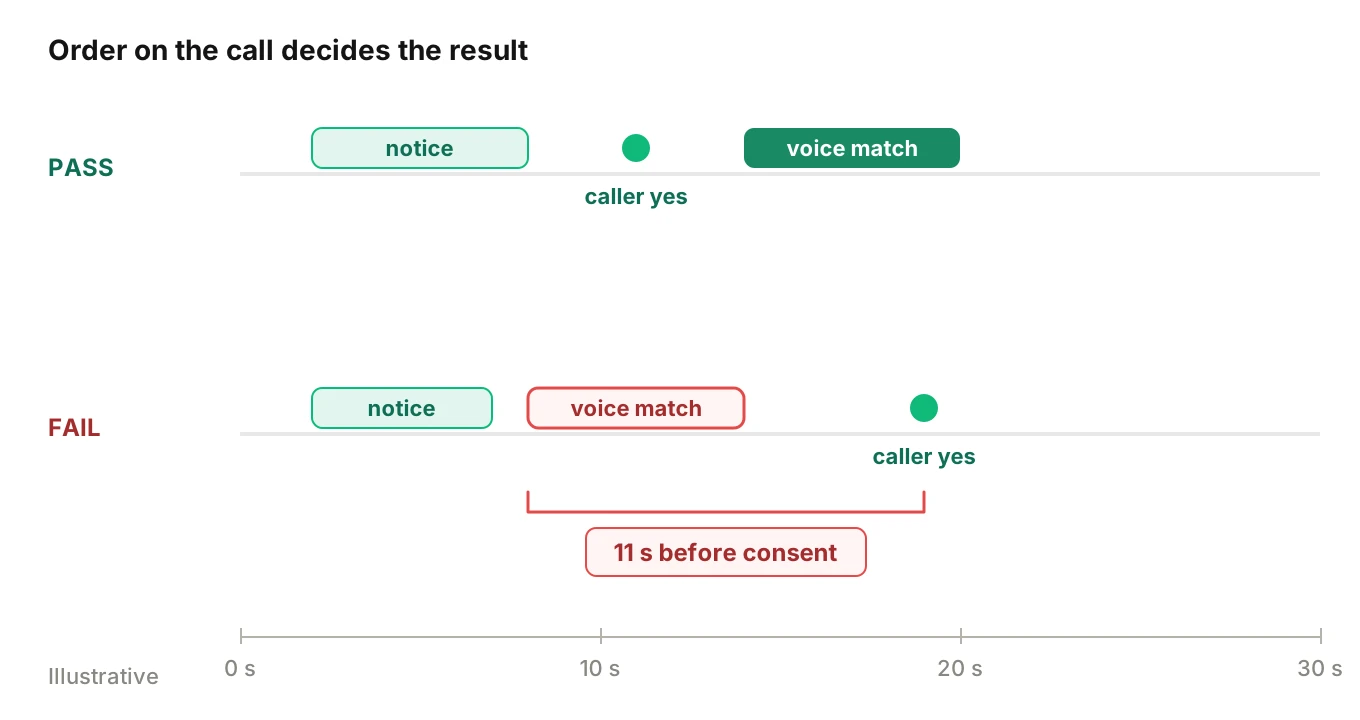
Here is a simplified checker. It assumes you have already extracted event times in seconds from call start. Adapt names to your stack.
from dataclasses import dataclass

VOICE_EVENTS = {"voice_auth_start", "speaker_lookup", "template_enroll"}

@dataclass
class Event:
    t: float          # seconds from call start
    kind: str         # log event name, or "notice_end" / "consent_yes" / "consent_no" from audio judging

def judge_call(events: list[Event]) -> tuple[str, str]:
    events = sorted(events, key=lambda e: e.t)
    voice = [e for e in events if e.kind in VOICE_EVENTS]
    if not voice:
        return "PASS", "no voice step ran"
    first_voice = voice[0].t
    notice = next((e.t for e in events if e.kind == "notice_end"), None)
    yes = next((e.t for e in events if e.kind == "consent_yes"), None)
    no = next((e.t for e in events if e.kind == "consent_no"), None)
    if no is not None and any(e.t > no for e in voice):
        return "FAIL", "voice step after decline"
    if notice is None or yes is None:
        return "FAIL", "voice step ran without notice and a recorded yes"
    if not (notice < yes < first_voice):
        return "FAIL", f"order wrong: notice {notice}, yes {yes}, voice {first_voice}"
    return "PASS", "notice, yes, then voice step"
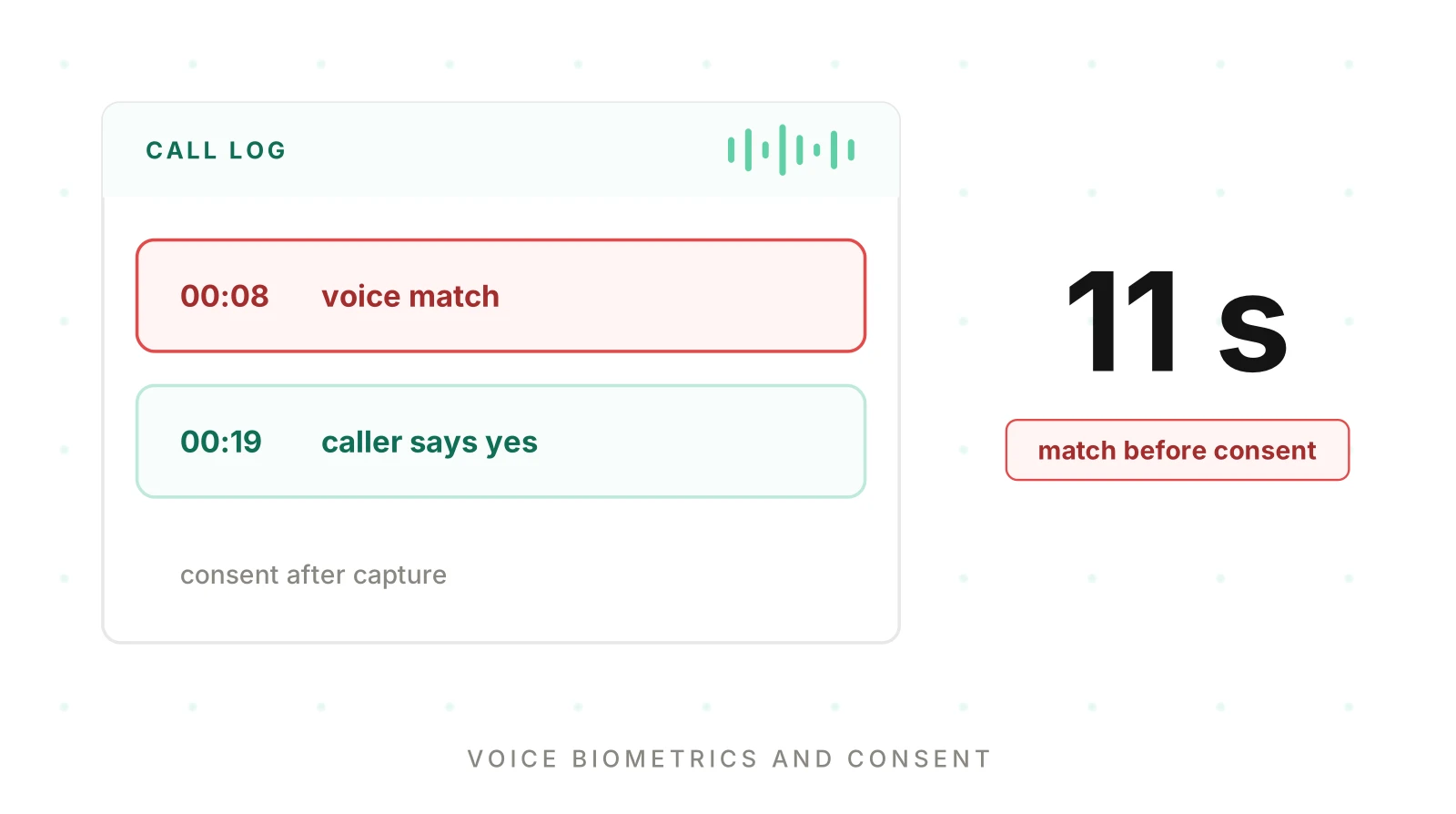
In an illustrative example, a call logs speaker_lookup at 8 seconds and the caller says "yes" at 19. The checker returns FAIL, with an 11-second gap.
How many calls prove it
Use the rule of three: with 0 failures in n independent runs, the 95% upper bound on the true failure rate is about 3 divided by n. With 100 runs that is about 3%. To bound it near 1%, run about 300. This is an approximation, so vary caller profiles. Treat any V1, V2 or V5 failure as a release blocker.
A transcript can look clean while the order is wrong, or while a "yes" is the agent's own echo. See our echo guide.
How to test that no voiceprint is captured without notice and consent
1. Build the register — list every component that touches caller audio, with each vendor's written answer on speaker templates.
2. Name the log events — make every voice step emit a timestamped event, including default-on ones.
3. Write the notice and consent script — state purpose, retention and how to decline. Have counsel review it.
4. Write the eight scenarios — turn V1 to V8 into caller scripts, and add one per voice step in the register.
5. Run them across caller profiles — vary accent, pace, interruption and noise, with enough runs for the rule of three.
6. Judge from audio plus logs — check the order of notice, consent and voice event, and have a human review every failure.
7. Test deletion end to end — enroll a test caller with consent, ask to be deleted, then confirm the template store is empty.
8. Gate the release and monitor — block any release that fails V1, V2 or V5, and keep a metric running on live calls.
With Evalgent, the caller simulator can play V1 to V8 over phone, SIP or WebRTC with different caller profiles. Scenarios can be generated from your agent's prompt and flows, including the voice step branches. The judge listens to the audio, not only the transcript, and a human can review each verdict. Evalgent does not provide voice biometrics. It tests whether your agent behaves.
Production monitoring for voiceprint BIPA voice agents
Production covers what pre-release tests miss, such as a vendor flag flipped.
Define a custom metric called "notice and consent spoken before voice biometric." Score it on every recorded call that has a voice event. Push call recordings and voice event logs together. Then flag three patterns:
- a voice event with no spoken notice before it
- a voice event after the caller said no
- a voice event after a consent question cut off by barge-in
A custom metric on monitored calls can surface these for human review. Route flagged calls to a person, and treat a new nonzero flag rate per release as a regression.
Questions to ask a vendor or your own team
Use these in security reviews and record the answers in the register.
- Does any feature create, store or compare a speaker embedding or voiceprint? Is it on by default?
- Is enrollment ever automatic, such as on a first call?
- Where is the template stored, for how long, and who can access it?
- Can we turn it off per call and per tenant?
- Is there an API to delete one person's template, and how fast does it run?
- Do you share templates with sub-processors?
- What logs prove when a voice step ran?
If a vendor says "we only do diarization," ask whether speaker labels persist across calls.
Frequently asked questions
Is a voiceprint a biometric identifier under Illinois BIPA?
Yes, on the text we read. Section 10 of 740 ILCS 14 lists a voiceprint among biometric identifiers, with retina or iris scans, fingerprints and hand or face geometry scans. Some exclusions exist, such as certain health care information. Whether a given feature creates a voiceprint is a question for your vendor and counsel.
Does BIPA apply to voice agents?
BIPA applies to private entities that collect biometric identifiers from people in Illinois. A voice agent falls in scope only if some component creates or uses a voiceprint. A recording or transcript alone is a separate question for counsel. If a voice step may run on an Illinois caller, apply section 15 first.
What does Illinois BIPA require before collecting a voiceprint?
For an Illinois BIPA voice agent, section 15(b) requires written notice that data is being collected or stored, the specific purpose and the length of time, and a written release. Section 15(a) requires a written retention policy. Whether a spoken yes on a call satisfies "written release" is a question for counsel.
What are BIPA damages for a voiceprint violation?
As amended by Public Act 103-0769, a negligent violation carries $1,000 or actual damages, whichever is greater. An intentional or reckless violation carries $5,000 or actual damages. The 2024 amendment, Public Act 103-0769, limits a person to at most one recovery for collection and for disclosure violations. Fees and injunctions are also available.
Do Texas and Washington regulate voiceprints too?
Yes. Texas Business and Commerce Code 503.001 lists a voiceprint, requires notice and consent before capture for a commercial purpose, and allows civil penalties up to $25,000 per violation. Washington's chapter 19.375 RCW also lists a voiceprint, but excludes audio recordings. Only the attorney general enforces both.
Is speaker verification consent the same as recording consent?
No. Recording consent covers capturing call audio. Speaker verification consent covers creating or matching a voice template. They can be asked together, but the notice must cover both. Our recording consent guide covers the first gate.
How do I test that a voice agent captures no voiceprint without consent?
Script callers who decline, stay silent or ask questions. Judge each call from audio and logs. Notice must end, then a clear yes must land, then the first voice event may run. Add a deletion test and run enough calls to use the rule of three. Block release on any failure of the core cases.
Can a voice agent use voice analytics without a voiceprint?
It depends on the feature and the statute. Some analytics use acoustic features and some use speaker embeddings. We do not state which a vendor uses. Ask the vendor in writing whether a template is created or stored, then ask counsel.
The bottom line
Treat every component that touches caller audio as a possible voiceprint source until a vendor answers in writing. Then prove with audio and logs, on every release and live call, that notice and consent come before each voice biometric step.
Related Articles

How to automate voice agent testing: synthetic callers vs manual QA
Learn how ai test automation replaces manual QA for voice agents. Compare synthetic callers vs human testers, with a 5-step framework to scale without hiring.
Read more
AI Agent Testing vs Voice Agent Testing: What General Tools Miss for Voice
AI agent testing measures text outputs. Voice agent testing measures behaviour through an acoustic pipeline. Five failure categories general tools miss.
Read more