Monitoring Live Calls for Compliance: Disclosure, Consent and Required Scripts
On this page
Your agent has a disclosure line, a consent line and an opt-out flow. They passed testing. Three weeks later a prompt edit moves one of them, and nobody notices. The call still sounds fine.
This post is for the Head of AI, PM or engineer who owns that agent. It covers voice agent compliance monitoring: how to watch live calls for behaviours your team is obliged, or has chosen, to perform. That includes AI disclosure monitoring, opt-out monitoring and escalation to a human on request. It is a monitoring method. It does not say what the law requires. This is general information, not legal advice. Where I name a rule, I opened its text on November 23, 2026 and quote only what I read.
Neighbouring posts: AI disclosure for voice agents covers what to say and how to test it. Recording consent covers the gate before recording. A compliance audit is a point-in-time review. This post covers the ongoing watch.
Monitoring is not testing, and not an audit
Testing asks whether the agent can do the right thing in a scripted call. Monitoring asks whether it did the right thing on this caller's call, today. Your policy adherence tests and regulated test cases define what a pass looks like. Monitoring reuses those definitions. In production a check may not run, because a field is missing, so the output has three states, not two.
Turn each obligation into an event on the call record
An obligation is a sentence in a policy. A monitor cannot read a sentence. It can read an event: a fact with a turn, a text and a time. Write each obligation as a question the call record can answer.
Every event needs five fields.
- Turn. Which turn, counted from the first agent word.
- Text. What was said, or the tool payload, as logged.
- Time. An offset from call start, plus wall-clock time with a zone.
- Source. Model output, playout event, telephony record or tool log.
- Status. Present, absent or undetermined.
Source matters most. Text the model generated is not text the caller heard. A barge-in can cut playback while the transcript shows the full sentence. The source field says which kind of proof you hold.
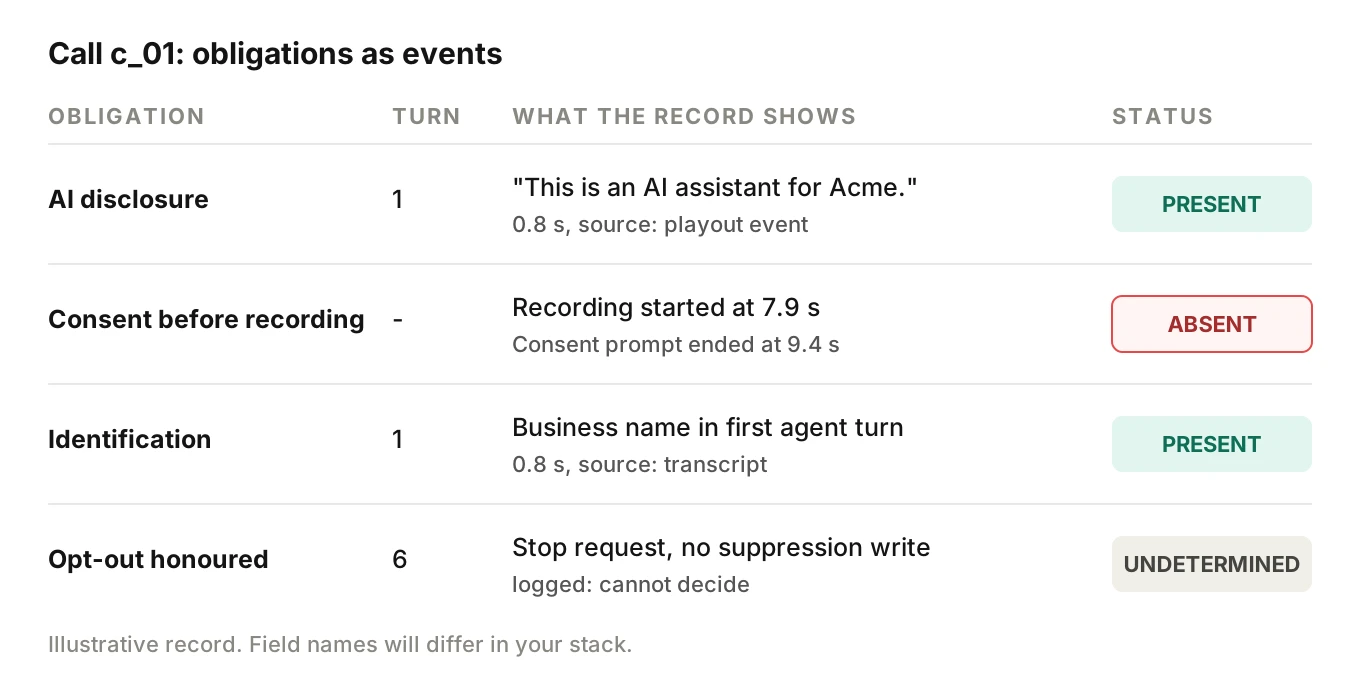
Here is the shape of one record. Field names are illustrative.
{
  "call_id": "c_01",
  "events": [
    { "obligation": "ai_disclosure", "turn": 1, "text": "This is an AI assistant for Acme.",
      "t_ms": 800, "source": "tts_playout", "status": "present" },
    { "obligation": "consent_before_recording", "consent_end_ms": 9400,
      "recording_start_ms": 7900, "source": "telephony", "status": "absent" },
    { "obligation": "opt_out_honoured", "status": "undetermined",
      "reason": "no suppression-list write logged" }
  ]
}
The second event shows the point. Recording began at 7.9 seconds and the consent prompt ended at 9.4. The monitor does not need to understand the law to flag the order. It compares two timestamps.
The rules I opened, and what they add to the event list
Some obligations are your policy. Some come from rules. I list only what I could read on the day. Counsel decides whether a rule applies to your calls.
FCC Declaratory Ruling FCC 24-17. Adopted February 2 and released February 8, 2024. It states that the TCPA's restrictions on "artificial or prerecorded voice" "encompass current AI technologies that generate human voices." It adds that such calls "require the prior express consent of the called party to initiate such calls absent an emergency purpose or exemption" (FCC 24-17). Monitoring consequence: an outbound call needs a consent record you can point to at dial time. If the record is not in the data, the answer is undetermined.
47 CFR 64.1200(b)(1). The text I read says "At the beginning of the message, state clearly the identity of the business, individual, or other entity" responsible for initiating the call (2024 edition on GovInfo; current text on Cornell LII). Monitoring consequence: an identification event in the first agent turn, with the business name as text.
47 CFR 64.1200(c)(1). The same section limits telephone solicitations to residential subscribers to times that are not "before the hour of 8 a.m. or after 9 p.m. (local time at the called party's location)." Monitoring consequence: compare the dial time with the callee's local time. That needs the callee's time zone on the record.
California Business and Professions Code 17941. The safe-harbor wording asks that a bot disclosure be "clear, conspicuous, and reasonably designed to inform persons" (section 17941 text). I read this on a public copy of the code, because the legislature's site refused my request. Monitoring consequence: a disclosure the caller could not hear is a weak match for that wording, so log what was played, not only what was generated.
I did not rely on the do-not-call timing rules or on any state recording-consent statute here. I could not open those texts in a form I could quote exactly on the day. For recording consent, my earlier post lists the statutes I opened. This is general information, not legal advice.
The monitoring table: obligation, evidence, alert
This is the working core. Each row is one obligation, the evidence that shows it happened, and the alert when it did not. Adapt the rows to your policy. Rows marked "policy" are choices, not citations.
| Obligation | Event on the call record | Evidence source | Alert when |
|---|---|---|---|
| AI disclosure at the start | Disclosure text in turn 1, with start time | Playout event, else model output | Absent; or text present but playout absent |
| Consent before recording | Consent prompt end time earlier than recording start | Telephony recording timestamp | Recording starts first; or either time missing |
| Identification statement (see 64.1200(b)(1)) | Business name in first agent turn | Transcript turn | Absent from turn 1 |
| Required script or notice (policy, as counsel advises) | Approved wording present before the regulated step | Transcript plus step marker | Step reached with no notice before it |
| Opt-out honoured (policy) | Stop request detected, then suppression write, then call end | Tool log | Request with no write; or later dial to that number |
| Allowed hours (see 64.1200(c)(1)) | Dial time in callee local time | Dialer log, callee zone | Outside window; or zone missing |
| Consent on file before dial (see FCC 24-17) | Consent record ID at dial time | Consent store | No ID; or store unreachable |
| Escalation when requested (policy) | Human request detected, then transfer event | Transcript plus transfer log | Request with no transfer, or a delayed one |
The opt-out row has a second half: a later call. Monitoring must look across calls, not only inside one. On the allowed-hours row, a missing callee zone means the honest status is undetermined.
The coverage view: present, absent, undetermined
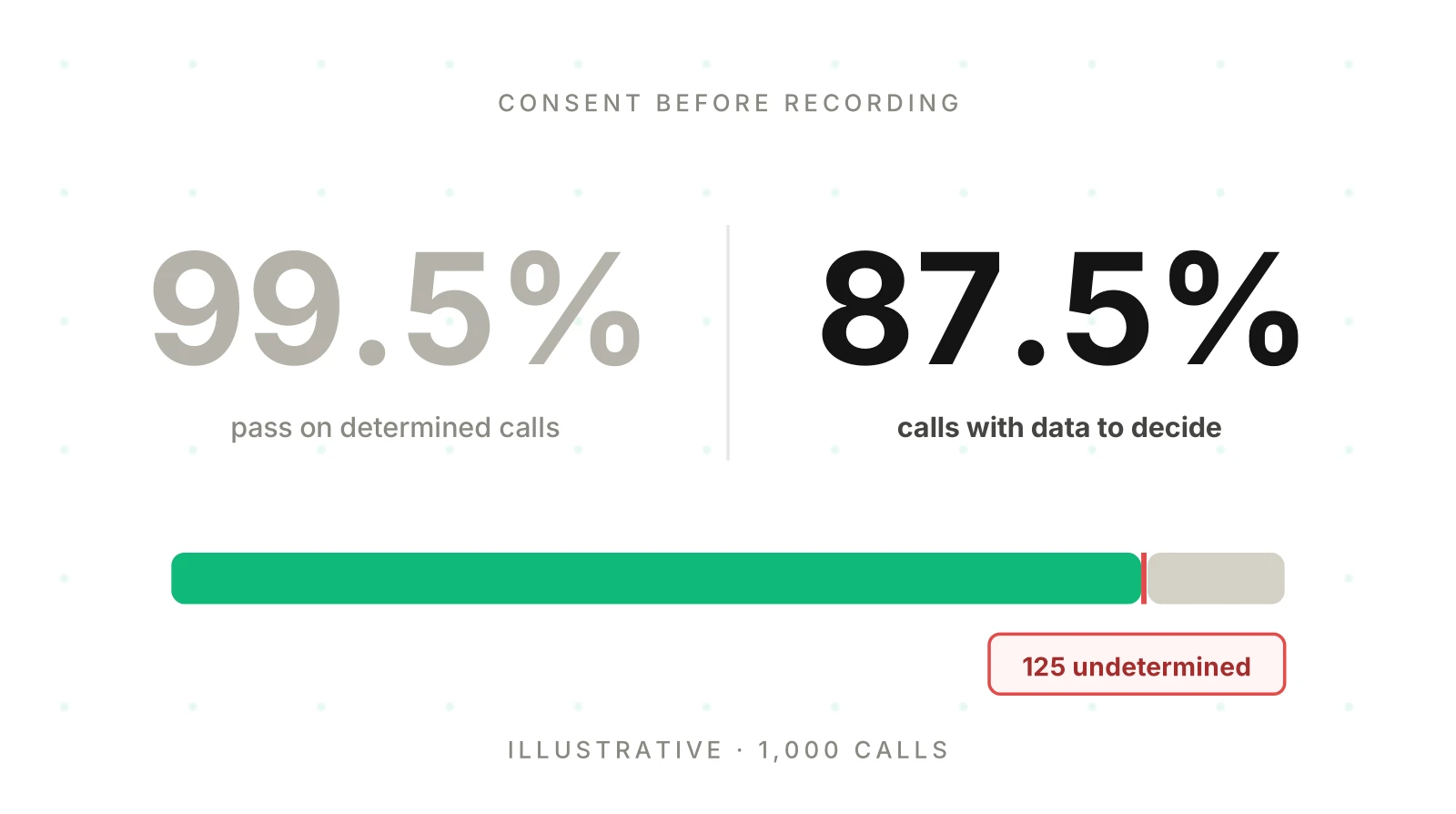
A pass rate alone lies. If 125 of 1,000 calls have no recording timestamp, a 99.5% pass rate describes only 875 calls. The coverage view shows all three states for every obligation.
Define this compliance coverage view per obligation, over the calls where the obligation applies. Call recording consent monitoring and required script monitoring both use it.
- Present: the event exists and passes.
- Absent: the data is there and the event is missing or wrong.
- Undetermined: the data needed to decide is missing.
- Coverage: (present + absent) divided by all calls.
- Pass rate on determined calls: present divided by (present + absent).
- Worst-case pass rate: present divided by all calls.
Here is an illustrative table for 1,000 outbound calls. The numbers are invented for the example.
| Obligation | Present | Absent | Undetermined | Coverage | Pass on determined | Worst case |
|---|---|---|---|---|---|---|
| AI disclosure | 902 | 21 | 77 | 92.3% | 97.7% | 90.2% |
| Consent before recording | 871 | 4 | 125 | 87.5% | 99.5% | 87.1% |
| Identification statement | 948 | 12 | 40 | 96.0% | 98.8% | 94.8% |
| Dialled inside allowed hours | 977 | 3 | 20 | 98.0% | 99.7% | 97.7% |
| Suppression list checked | 990 | 2 | 8 | 99.2% | 99.8% | 99.0% |
Check the consent row. 871 plus 4 plus 125 is 1,000. Coverage is 875 divided by 1,000, or 87.5%. The pass rate on determined calls is 871 divided by 875, or 99.5%. The worst case is 871 divided by 1,000, or 87.1%.
That row looks strong on pass rate and weak on coverage. Its 125 undetermined calls might all be fine. They might hide a route that never logs the recording start. You cannot tell, so treat the undetermined count as a finding in its own right.
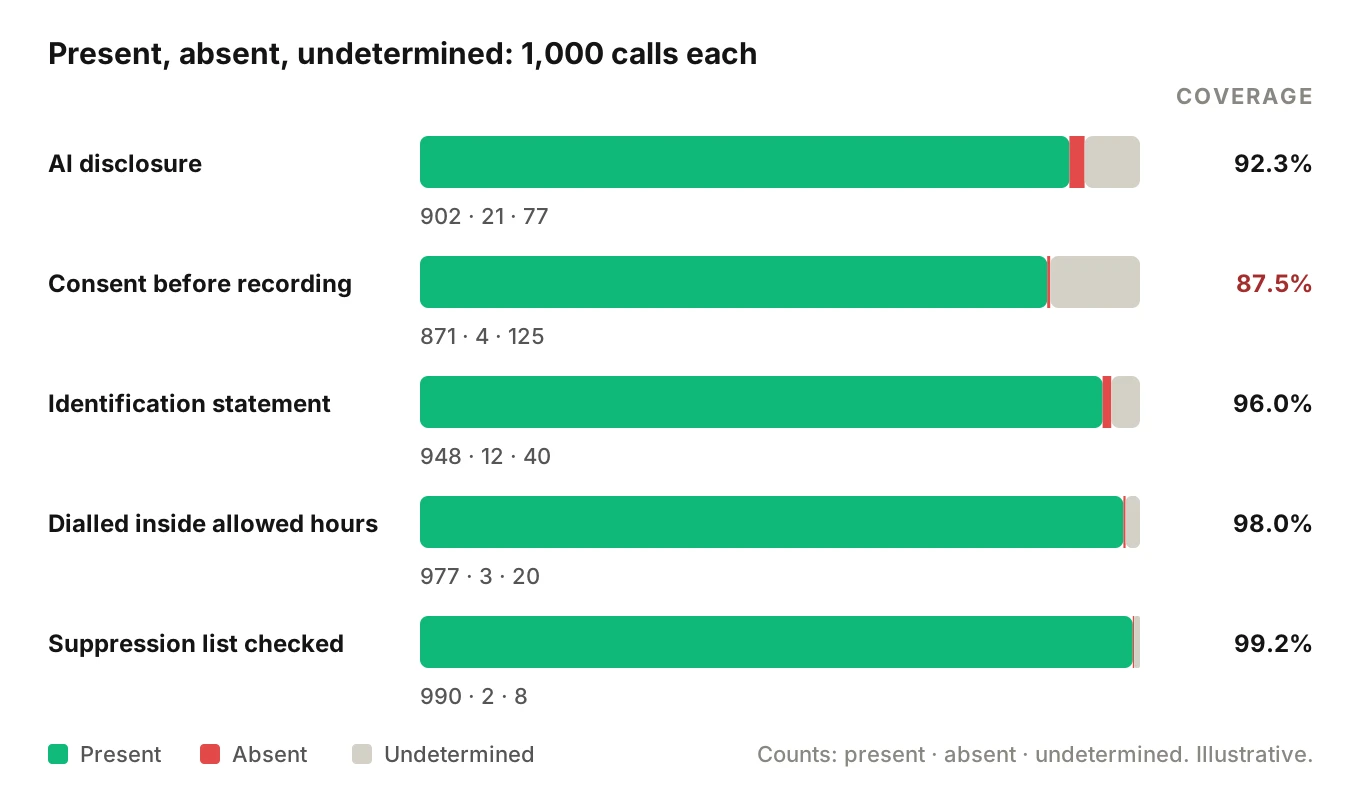
Set a coverage floor per obligation. If coverage drops below it, alert on compliance gaps before you read the pass rate. A jump in undetermined usually means a logging change or a new route.
Every call or a sample
Event checks are cheap. Comparing two timestamps costs almost nothing, so run them on every call. Judged checks, where a model or a person decides whether wording meets a script, cost more. Run those on every call if you can afford it, or on a sample.
Sampling has a hard limit for rare misses. Say the true miss rate is 0.4%, or 4 in 1,000 calls. A reviewer samples 50 calls. The chance the sample contains zero misses is 0.996 to the power 50, which is about 82%. Most samples of that size find nothing.
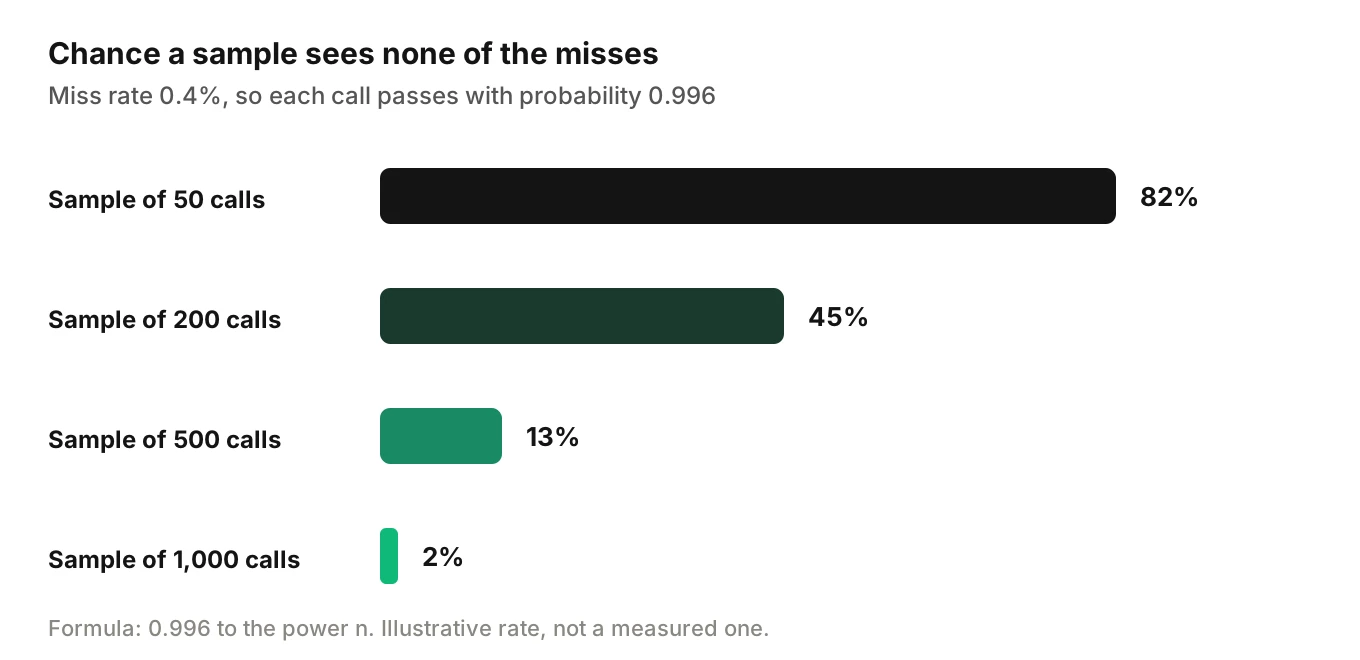
At 200 calls it is about 45%, at 500 about 13%, at 1,000 about 2%. A miss that matters needs the full population. My posts on scoring every call and sampling live calls cover the cost and the design. The split I recommend is simple. Every call gets the event checks. A sample gets human review of the judged verdicts, to keep the judge honest.
Alert routing and who owns a miss
An alert with no owner is a log line, so compliance alerts need names. Name one owner for each obligation, and a second for undetermined. The owners differ, because a missing event and a missing field are different faults.
| Signal | First owner | Tier | First action |
|---|---|---|---|
| Disclosure or consent miss | Agent owner | Ticket the same day; page if it repeats on a regulated flow | Check the last prompt, voice and route change |
| Opt-out or suppression miss | Compliance contact and dialer owner | Page | Pause the affected campaign, keep call IDs |
| Calling-hours miss | Dialer owner | Page | Stop dialing that list; check zone data |
| Required script missing | Agent owner | Ticket | Compare the flow with the approved wording |
| Escalation miss | Agent owner | Ticket; page on repeats | Review the trigger phrases and the transfer path |
| Undetermined spike | Data or platform owner | Ticket | Find the missing field and the route that drops it |
The tiers follow voice agent alerting. Google's SRE book gives the reason: "Every page should be actionable," and "If a page merely merits a robotic response, it shouldn't be a page" (Monitoring Distributed Systems). A miss with a known first action earns a page. A one-off with no pattern earns a ticket.
Low volume needs care. The SRE Workbook says "It's harder to automatically distinguish unimportant events in low-traffic services" (Alerting on SLOs). Use a minimum count, and send small windows to tickets. For incidents, use the first 15 minutes runbook and name the compliance contact in advance.
Evidence preservation
When a customer or your counsel asks, the event is your answer. Keep the event, turn text, timestamps, source and a pointer to the clip or transcript. Keep the policy version live on that call.
Evidence is personal data. Apply masking before it reaches the review tool. My post on PII leakage detection covers where leaks hide. Set a retention clock for each evidence type, and plan for legal holds. See voice agent data retention. If any check analyses a caller's voice to identify them, read voiceprints and BIPA first.
Avoiding false confidence
A green dashboard is only as good as the check behind it. Five traps recur.
Text matching against meaning. A regex for "this call may be recorded" also matches "this call may not be recorded." A regex for "AI" misses "I'm a virtual assistant." Use phrase checks for exact required wording. Use a judged check for meaning, and sample human review of its verdicts.
Transcription errors. The transcript is itself a model output. The Careless Whisper study found "roughly 1% of audio transcriptions contained entire hallucinated phrases or sentences" in one widely used system (Koenecke et al., 2024). That is one system and one study. The lesson is general. A phrase can appear that was never said, or vanish when it was. Do not let a transcript alone prove a disclosure.
Generated is not played. The model wrote the sentence. The caller barged in. The transcript shows all of it. Log the playout event, and compare played duration with expected duration.
State not logged. No callee zone, no consent record ID, no recording start time. Each gap forces "undetermined." The fix is to log the field, not to guess a default. A default hides the gap.
A check that never runs. If the monitor silently skips unusual calls, coverage falls and nothing alerts. Alert on coverage itself.
Test the monitor too. Seed known-bad calls into staging: a late disclosure, a missing opt-out write, a call at 9:30 pm callee time. Confirm each alerts, and a missing field shows as undetermined.
Where Evalgent fits
Evalgent is a testing, evaluation and monitoring platform for voice agents. Monitor is live. It works on production call data your team sends, through OpenTelemetry or an upload path. It flags problems such as tool-call failures, latency spikes, PII leakage and policy failures, with fix recommendations. Findings come from traces and call data, and Evalgent stays out of the media path. Coverage gaps and "undetermined" are shown, not hidden, which matches the three-state view above.
I am not claiming a built-in disclosure, consent or script check. Whether an obligation can be checked depends on the events and fields in the data you send.
On the testing side, Evalgent generates scenarios from the agent's prompt and flows, and Reviews replay test calls with audio and transcript together. Pre-release scenarios and live monitoring then share one definition of each obligation. To see how that fits your agent, book a demo.
How to set up voice agent compliance monitoring
Start with one agent and four obligations. Add more after the first alert has an owner and a tested first action.
1. List the obligations - Mark each as a rule counsel confirmed applies, or as your own policy.
2. Write each as an event - Give it a turn, text, time, source and status.
3. Log the missing state - Add callee zone, consent record ID, recording start, playout events and suppression writes.
4. Compute coverage - Report present, absent and undetermined per obligation. Set a coverage floor and alert below it.
5. Choose every call or a sample - Run event checks on every call. Sample judged verdicts for human review.
6. Name an owner and a first action - One owner for misses, one for undetermined. Write the first action next to each alert.
7. Keep evidence - Store event, text, time, source, policy version and a clip pointer. Mask it and set a retention clock.
8. Test the monitor - Seed known-bad and missing-field calls. Review alerts monthly.
Frequently asked questions
What is voice agent compliance monitoring?
It is the ongoing check that live calls contain the behaviours your policy requires, such as AI disclosure, consent before recording, a required statement, a honoured opt-out and a transfer on request. Each becomes an event with a turn, text, time and status.
How do you monitor AI disclosure on live calls?
Log a disclosure event in the first agent turn, with text, start time and source. Prefer a playout event over model output, because generated text may never reach the caller. Alert when it is absent, late or cut short. Mark missing data undetermined.
How do you check that consent came before recording?
Compare two timestamps: when the consent prompt finished and when recording started. Flag any call where recording starts first. If either is missing, mark the call undetermined and alert on that count. Check inbound, transfer, callback and voicemail paths separately.
What does undetermined mean in a compliance coverage view?
It means the data needed to decide is missing, so the call is neither a pass nor a fail. Examples are no recording timestamp or no callee time zone. A rising count usually points to a logging change or a route that drops a field.
Should you monitor every call or sample?
Run cheap event checks on every call, because rare misses hide in samples. At a 0.4% miss rate, a 50-call sample finds none about 82% of the time. Judged checks can run on a sample if cost matters, with human review of the verdicts.
How do you monitor opt-out and do-not-call requests?
Detect the stop request, then check that a suppression write follows and the call ends. Then look across calls: no later dial to that number. A request with no write is an immediate alert. Treat the timing and scope of the duty as a question for counsel.
Who should own a compliance alert?
Name one owner per obligation and a second for undetermined. The agent owner usually takes disclosure and script misses. The dialer owner takes calling-hours and suppression misses, with a compliance contact. A data owner takes coverage drops.
Can a transcript prove a disclosure was made?
Not by itself. The transcript may show text the model generated but the caller never heard, and transcription can add or drop words. Combine it with playout events and duration checks. Treat transcript-only evidence as weaker, and say so in the record.
The bottom line
Voice agent compliance monitoring works when each obligation becomes an event on the call record, every result is present, absent or undetermined, and every miss has an owner and a first action. This is general information, not legal advice.
Related Articles
How to automate voice agent testing: synthetic callers vs manual QA
Learn how ai test automation replaces manual QA for voice agents. Compare synthetic callers vs human testers, with a 5-step framework to scale without hiring.
Read more
AI Agent Testing vs Voice Agent Testing: What General Tools Miss for Voice
AI agent testing measures text outputs. Voice agent testing measures behaviour through an acoustic pipeline. Five failure categories general tools miss.
Read more