Test your voice agent
Continuous Auditing vs One-Time Benchmarking for Voice Agents
# Continuous auditing vs one-time benchmarking for voice agents
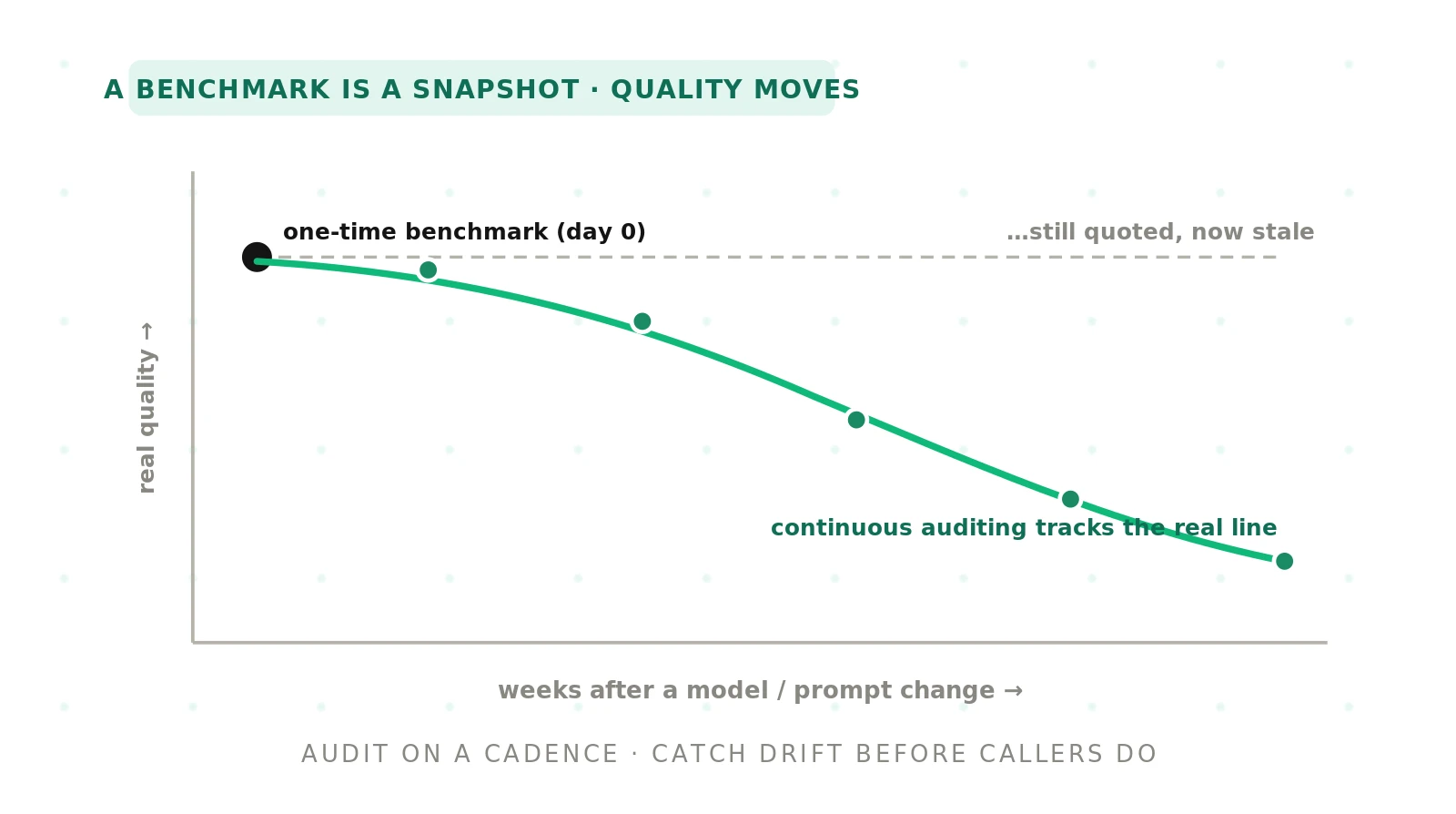
Quick answer: Continuous voice agent auditing is the repeated, independent testing of a production voice agent on your own calls, so drift and silent regressions get caught as they happen. A one-time benchmark scores the agent on one day. It decays the moment a model, prompt, or dataset changes underneath it.
A benchmark is a photograph. A continuous audit is a heart monitor. Both have a place, but they answer different questions. The photograph tells you how the agent looked the day you tested it. The monitor tells you whether it is still safe right now.
Most teams buy the photograph and assume it lasts. It does not. A voice agent is a stack of moving parts, and every part can shift without warning. The model provider ships an update. Someone edits a prompt. Your call mix changes with a new campaign. The number you signed off on last quarter no longer describes the agent your callers reach today.
This piece explains why point-in-time benchmarks decay, what changes underneath them, and how to stand up a continuous auditing program. If you are still deciding whether to test at all, start with our guide on voice agent evaluation, then come back here for the cadence question.
Why a one-time benchmark decays
A benchmark measures a system at a fixed point in time against fixed inputs. That is its strength and its expiry date. The score is only valid while nothing that produced it changes. In a voice agent, something almost always changes within weeks.
> Point-in-time benchmark: a single evaluation run that scores an agent on a fixed test set on a fixed date. It describes that snapshot only, not future behavior.
The core problem is concept drift. The relationship between inputs and correct outputs shifts over time, so a model that scored well on old data degrades on new data without anyone touching the model. Your callers ask new questions. Products change. Seasonal traffic reshapes the call mix. The agent did not get worse in code, but it got worse in the field.
Then there are the changes you can see but rarely re-test after. A prompt edit to fix one edge case can quietly break three others. A knowledge-base update can change what the agent tells callers. A swapped speech model can shift accuracy on your specific accents. Each change invalidates the last benchmark, yet the report on the shelf still reads "passed."
The result is a slow, invisible gap between the number you trust and the behavior callers get. Nobody decides to ship a worse agent. It happens between measurements.
What changes underneath a voice agent between benchmarks
To understand why cadence matters, look at what actually moves. A production voice agent has at least five layers, and each drifts on its own schedule.
The underlying model. Foundation model providers update weights, deprecate versions, and adjust behavior. A managed model can change under you with little notice. Even a version pin expires when the provider retires it. Our piece on independent voice AI evaluation covers why vendor-reported stability claims need outside checking.
The prompt and orchestration logic. Teams edit prompts constantly. Each edit is a code change to the agent's behavior, but few are re-tested against the full suite. This is where silent regressions live. A fix for one intent degrades another, and no alarm fires.
The retrieved data. Agents that pull from a knowledge base inherit every change to that base. A reworded policy or a stale document changes answers directly. Testing policy adherence once does not cover the version shipped three edits later.
The caller population. Your traffic is not static. New markets bring new accents. New campaigns bring new questions. The benchmark's test set stops resembling live calls, so the score stops predicting live performance.
The guardrails and safety layer. Refusals, disclosures, and escalation paths interact with everything above. A change anywhere can weaken a guardrail without touching the guardrail itself. Continuous checks on guardrails catch this; a one-time pass cannot.
Five layers, five clocks. A single benchmark freezes all five on one date. Reality does not cooperate.
One-time benchmarking vs continuous auditing
Both approaches produce evidence. They differ in what they catch, how often they run, and how much confidence the result carries after the ink dries. The table below contrasts them on the dimensions that decide procurement and go-live calls.
| Dimension | One-time benchmarking | Continuous auditing |
|---|---|---|
| What it catches | Baseline accuracy, latency, and task success on a fixed test set at one moment | Drift, silent regressions, and safety gaps introduced after the baseline, on live-representative calls |
| Cadence | Once, or ad hoc before a major decision | Scheduled and event-triggered (on model, prompt, or data changes) |
| Drift coverage | None after the run date; the score ages immediately | Ongoing; degradation surfaces between releases, not after an incident |
| Cost profile | Lower upfront, higher hidden cost when an undetected regression reaches callers | Higher ongoing spend, lower cost of failure and faster detection |
| Decision confidence | High on test day, decaying steadily thereafter | Sustained; the latest report reflects the agent callers reach today |
Read the table as a trade, not a verdict. Benchmarking buys a cheap, sharp snapshot. Continuous auditing buys sustained confidence at a running cost. The right choice depends on how often your agent changes and how much a silent failure costs you.
What continuous auditing catches that a benchmark cannot
Continuous auditing borrows its logic from two mature disciplines. In accounting, continuous auditing replaced annual sampling with automated, ongoing checks. In manufacturing, statistical process control watches a process over time and flags when it drifts out of bounds. Both assume the same truth: a process that was fine yesterday can fail today, and you only know if you keep looking.
Applied to a voice agent, continuous auditing catches three things a benchmark structurally cannot.
Drift between releases. Slow degradation from changing traffic or a quietly updated model shows up in the trend line, not in a single score. You see the slope before callers feel the drop.
Silent regressions from routine changes. A prompt edit or knowledge-base update triggers a re-audit, so the break is caught in hours, not in a quarterly review or a customer complaint.
Safety and compliance drift. Refusals and disclosures are re-checked on every material change. For regulated buyers, this maps to the "measure" and "manage" functions of the NIST AI Risk Management Framework, which treat monitoring as continuous rather than one-off. It also mirrors the ongoing controls in ISO/IEC 42001, the AI management-system standard.
The through-line is time. A benchmark answers "was it good then." Continuous auditing answers "is it good now," which is the only question a caller on the line actually cares about.
How to set up a continuous voice agent auditing program
Standing up continuous auditing is a process, not a purchase. Here is how to build one that survives audits and scales with your agent.
1. Define the baseline scope and thresholds. Write down what you test and the pass bars for accuracy, latency, task success, safety, and compliance. This is the fixed reference every later run compares against. Fix it before the first audit, the way our third-party voice agent audit engagement letter does.
2. Assemble a living test set from your own calls. Build the suite from real production traffic, not a demo script. Refresh it on a schedule so it keeps resembling live calls. Our guide to benchmarking on your own data explains why provenance of the audio decides whether the result is trustworthy.
3. Set a scheduled cadence. Run the full suite on a fixed interval, such as weekly or monthly, tuned to how fast your traffic shifts. This catches slow drift that no single event announces.
4. Add event triggers. Fire a targeted re-audit automatically on any model version change, prompt edit, or knowledge-base update. Event triggers are what catch silent regressions before they reach callers.
5. Instrument stress and load conditions. Include high-concurrency and adversarial cases so tail failures surface under pressure, not in production. See stress testing voice AI for the failure modes worth exercising.
6. Route results to owners with thresholds. Send every run to the team that owns the agent, with clear pass and fail bars. A report nobody reads is not a control. Alert on threshold breaches, not on every run.
7. Keep an independent party in the loop. Have a neutral evaluator run or sign the audits, so the evidence holds up in procurement and security review. Evalgent runs this loop as an independent, third-party service, which is the point of continuous auditing: the party grading the agent has no stake in the grade.
8. Version and archive every report. Store each run with its date, scope, and the agent version it tested. The archive is your drift history and your compliance trail.
Start with steps one through four. They deliver most of the value. Add stress testing and the independent sign-off as the program matures.
When a one-time benchmark is still the right call
Continuous auditing is not always warranted. Match the method to the stakes and the rate of change.
A one-time benchmark is enough for a short bake-off between vendors, where you need a clean, comparable score on the same test cases and the decision is made in weeks. For that, our guide to comparing voice agents on the same test cases is the right tool. It also fits a low-stakes internal agent that rarely changes and touches no regulated workflow.
Continuous auditing earns its cost when the agent runs in production, changes often, and carries risk. That means anything handling payments, health, or compliance-sensitive calls; anything under a model you do not control; and anything where a silent regression would reach thousands of callers before a human noticed. If a bad day costs you a customer or a fine, the running cost of auditing is cheaper than the incident. Our breakdown of the ROI of voice agent testing puts numbers to that trade.
The honest framing: benchmark to choose, audit to keep. The first decision is a snapshot. Living with the agent is a subscription to the truth.
Frequently asked questions
What is continuous voice agent auditing?
Continuous voice agent auditing is the repeated, scheduled, and event-triggered testing of a production voice agent against fixed thresholds, on calls that represent live traffic. Unlike a one-time benchmark, it tracks the agent over time, so drift, silent regressions, and safety gaps surface as they emerge rather than after an incident or a customer complaint.
How is continuous auditing different from a one-time benchmark?
A one-time benchmark scores an agent on a fixed test set on a fixed date, then ages immediately. Continuous auditing re-runs the checks on a cadence and on every material change, so the latest result reflects the agent callers reach today. The benchmark answers "was it good then." Auditing answers "is it good now."
Why does a voice agent benchmark decay over time?
A benchmark decays because the agent's inputs change. Concept drift shifts caller behavior, providers update models, teams edit prompts, and knowledge bases change. Each shift invalidates the score without anyone touching the code. The report still reads "passed," but it describes a version of the agent that no longer exists in production.
What are silent regressions in voice agents?
Silent regressions are behavior failures introduced by routine changes that trigger no error and no alarm. A prompt edit that fixes one intent can break another. A knowledge-base update can change answers. Nothing crashes, so the break stays invisible until a caller hits it or a re-audit catches it. Event-triggered auditing exists to catch them.
How often should you audit a production voice agent?
Audit on a fixed cadence and on every material change. A weekly or monthly full run catches slow drift, while event triggers on model, prompt, or data changes catch sudden regressions. Tune the interval to how fast your traffic and stack move. High-change, high-risk agents warrant tighter cadences than stable, low-stakes ones.
Does continuous auditing replace production monitoring?
Continuous auditing does not replace monitoring; the two work together. Monitoring watches live calls for anomalies as they happen. Auditing runs a defined test suite against fixed thresholds to produce comparable, signed evidence over time. NIST SP 800-137 frames this as ongoing assessment, and voice agents need both the live signal and the scored trail.
Can we run continuous auditing ourselves or do we need a third party?
You can run the mechanics in-house, but the evidence carries more weight when a neutral party runs or signs it. An independent auditor has no stake in the result, so procurement, security, and boards can rely on it. The trade is speed and control against credibility; regulated buyers usually need the outside signature.
How does continuous auditing map to AI risk frameworks?
Continuous auditing implements the ongoing "measure" and "manage" functions of the NIST AI Risk Management Framework and the monitoring controls in ISO/IEC 42001. Both treat AI risk as continuous rather than one-off. Scheduled and event-triggered audits give you the recurring evidence these frameworks expect, rather than a single dated report that ages out.
The bottom line
A one-time benchmark tells you how a voice agent looked on test day, and that answer expires the moment a model, prompt, or dataset changes. Continuous auditing keeps the answer current, catching drift and silent regressions before callers do.
Ready to see what your agent scores today, and keep scoring it as it changes? Book a demo with Evalgent, the independent third party that audits voice agents on your own calls.
Related Articles
Why AI voice agents fail in production (and how to prevent it)
AI voice agents that ace demos still break in production. Learn the 5 root causes, how to test for each, and what production readiness actually means.
Read more
Voice agent regression testing: why LLM updates break production
LLM updates improve benchmarks but break voice agents in 5 predictable ways. How to detect and prevent regressions after every model or prompt change.
Read more