Test your voice agent
How to Measure Containment Rate for Voice Agents
# How to measure containment rate for voice agents
Quick answer
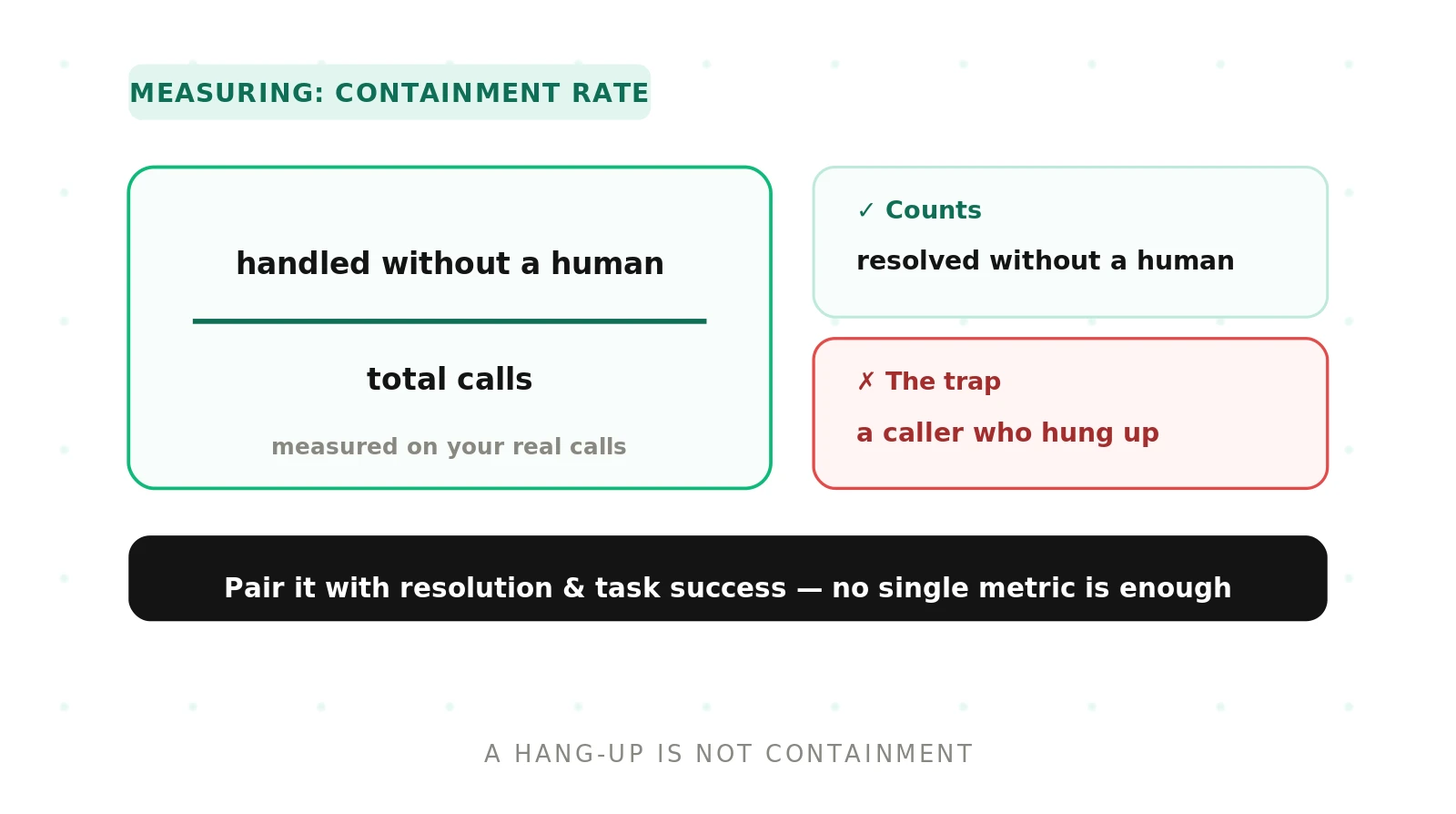
> Quick answer: Containment rate for voice agents is the share of qualifying calls the agent handles to the end without a human. Measure it by dividing contained calls by qualifying calls, count only genuine resolutions as contained, exclude hang-ups and dead ends, and always report it beside resolution rate.
Containment rate is the number every voice agent dashboard leads with. It is also the number teams get wrong most often. A hang-up gets counted as a win. A trapped caller looks like a success. The rate climbs while satisfaction falls.
This post is about measuring containment rate correctly. It is not about defining the concept. Our containment versus deflection guide draws that line and explains why neither number proves the issue was solved. Here we focus on the mechanics: the formula, what counts as contained, and how to keep the metric honest.
Evalgent is an independent evaluator. We measure containment on your own call data, using rules you can defend to finance and compliance at the same time.
What containment rate actually measures
> Containment rate: the share of voice agent calls handled to the end without a human, expressed as a percentage of qualifying calls. It counts only calls the agent finished, not calls the caller abandoned.
Containment rate answers one question. Did the agent handle this call alone? It belongs to the family of automation metrics that a call center uses to track how much work stays off human queues.
The word "handled" is where teams disagree. Some count any call that did not transfer. That definition is too generous. It rewards an agent for keeping a caller on the line, even when nothing was solved. A correct definition counts only calls the agent actually finished.
Containment is close to a self-service rate. The caller served themselves through the agent, with no live person involved. But self-service only counts when the service happened. A caller who abandons did not serve themselves. They left.
The containment rate formula
The formula looks simple. Contained calls divided by qualifying calls, times one hundred. The difficulty is in the two inputs. Both the numerator and the denominator hide choices that change the result.
Choosing the denominator
The denominator is the set of calls the agent had a fair chance to handle. Get this wrong and the rate becomes meaningless. Start with total inbound calls, then remove the calls that were never real attempts.
Remove wrong numbers and misdials. Remove silent or dropped connections with no speech. Remove calls that reached the agent by mistake during an outage. These are not failures of the agent. Leaving them in drags the rate down for no reason.
Keep every call where a caller stated a real intent. A caller who asked for something and left is still a qualifying call. Removing abandonments from the denominator is the most common way teams inflate containment.
Choosing the numerator
The numerator is contained calls. A call is contained only when the agent carried it to a genuine end without a human. The caller's task was completed, or the agent correctly told the caller nothing more could be done.
A transfer to a human is not contained. A hang-up is not contained. A caller who gave up and switched channels is not contained. We spell out each case in the table below, because this is where most measurement errors live.
What counts as a contained call?
Every call ends in one of a few states. The state decides whether the call counts as contained. The table sorts the common outcomes, with the answer and the reason.
| Call scenario | Counts as contained? | Why |
|---|---|---|
| Caller's task resolved by the agent | Yes | The agent finished the job with no human. This is true containment. |
| Agent correctly says it cannot help, ends cleanly | Yes | An honest, complete answer is a real outcome, even when negative. |
| Escalated or transferred to a human | No | A person handled the call. It left the automated channel. |
| Caller hung up mid-task, issue unresolved | No | Abandonment is not success. Counting it inflates the rate. |
| Caller gave up and used another channel | No | The issue moved elsewhere. The agent did not resolve it. |
| Caller stuck in a loop with no exit offered | No | A trapped caller is a failure, even with no transfer. |
| Wrong number, misdial, or silent call | Excluded | Not a real attempt. Remove it from the denominator. |
The line that trips teams up is the hang-up. A hang-up is silence, not consent. The agent did not solve anything. The caller left. Counting a hang-up as contained is the single largest source of a falsely high rate.
The second trap is the dead-end loop. The caller never transferred, so the raw log shows no escalation. But the caller was trapped. Escalation should have happened and did not. Our guide to escalation for voice agents covers when a clean handoff beats a forced containment.
Why raw containment is a vanity metric
A vanity metric moves in the right direction while the reality behind it gets worse. Raw containment is the textbook case. It is easy to count and flattering to report. It also rewards the wrong behavior.
Push an agent to maximize containment alone and you teach it to avoid transfers. Hide the escalation path. Answer vaguely and hope the caller stops asking. Keep the caller on the line at any cost. The rate goes up. The callers suffer.
This is Goodhart's law in a call flow. When a measure becomes a target, it stops being a good measure. Containment as a lone target stops measuring good service and starts measuring caller entrapment.
The fix is not to drop containment. It is a useful key performance indicator when read honestly. The fix is to pair it with an outcome number that cannot be gamed by trapping people. That number is resolution, and task success sits right beside it.
How to measure containment rate for voice agents correctly
Here is the process we use when we audit containment for a client. Each step removes a specific way the number gets distorted.
1. Define a qualifying call. Decide which inbound calls the agent had a fair chance to handle. Write the rule down. This becomes your denominator base.
2. Clean the denominator. Remove wrong numbers, misdials, silent connections, and outage misroutes. Keep every call with a stated caller intent, including abandonments.
3. Define contained precisely. A call is contained only if the agent finished it without a human. Completed task, or an honest "cannot help" that ends cleanly. Nothing else.
4. Classify every call outcome. Tag each call as resolved, escalated, abandoned, gave-up, or dead-end. Use the table above as your rulebook so tagging stays consistent.
5. Exclude hang-ups from the numerator. A hang-up is not containment. It stays in the denominator as a qualifying call, but never counts as contained.
6. Compute the rate. Divide contained calls by qualifying calls, then multiply by one hundred. Report the raw counts too, so reviewers can check your math.
7. Pair it with resolution. Report resolution rate and task success next to containment. A high pair is genuine. A gap between them signals trapped callers.
8. Audit a sample by ear. Listen to a random set of "contained" calls each week. Confirm the caller actually got helped. Machine tags miss the frustrated goodbye.
Run this monthly at minimum. Containment drifts as prompts, models, and call mix change. A number that was honest in March can quietly rot by June. When you listen, score each call against the caller's goal, as we describe in our guide to scoring a voice agent conversation.
Pairing containment with resolution and task success
Containment tells you the agent kept the call. Resolution tells you the caller's problem got solved. The two are not the same, and the gap between them is the real signal.
Resolution rate, often measured as first-call resolution, asks whether the issue was solved without a repeat contact. A caller who calls back the next day was not resolved. Their first call was contained but useless.
Task success is stricter still. Define the caller's goal for each scenario. Then measure the fraction of calls that reached it. Booking made. Balance given. Address changed. Task success ignores effort and counts only the result.
Read the three together. High containment with high resolution is a working agent. High containment with low resolution is a trap. That pattern means callers cannot escape and are not getting helped. Our voice agent metrics scorecard shows how to group these numbers so no single metric can hide the truth.
When high containment is the right goal
Containment is not always the north star. The right target depends on the call type, the stakes, and the caller. Frame the goal for each situation rather than chasing one number across the board.
For a high-volume, low-stakes line like store hours or balance checks, high containment is a fine goal. The task is simple. A clean self-service answer serves the caller and saves a queue slot. Push containment here.
For a sensitive line like a billing dispute or a safety issue, containment is the wrong target. A fast, correct escalation beats a contained call that leaves the caller angry. Here you want low forced containment and high escalation accuracy.
For a mixed support line, split the metric by intent. Measure containment per scenario, not as one blended average. A blended rate hides a great FAQ agent sitting next to a broken refund flow. Segmenting is how you find the flow that needs work.
Common mistakes when measuring containment
Teams repeat the same errors. Each one bends the number away from the truth. Watch for these before you trust a containment figure.
Counting hang-ups as contained is the first and worst. Excluding abandonments from the denominator is the mirror image of it. Both inflate the rate by treating a lost caller as a solved one.
Blending all intents into one rate is the third. The average looks stable while individual flows swing wildly. Reporting containment with no resolution number beside it is the fourth. That is the setup that lets a trapped-caller problem hide for months.
An independent check catches these. When the team that builds the agent also grades it, the definitions drift toward flattering ones. We evaluate containment on your own calls, with fixed rules, so the number means the same thing every quarter. See our note on why independent voice AI evaluation matters for the full case.
Frequently asked questions
How do you measure containment rate for voice agents?
Divide contained calls by qualifying calls, then multiply by one hundred. A call is contained only when the agent finishes it without a human. Clean the denominator of wrong numbers and silent calls. Keep abandonments in the denominator, but never count a hang-up as contained. Report the raw counts beside the percentage.
Is a hang-up counted as containment?
No. A hang-up is not containment. The caller left before the agent solved anything. Silence is not consent, and abandonment is not success. A hang-up stays in the denominator as a qualifying call, but it never counts in the numerator. Counting hang-ups as contained is the top cause of a falsely high rate.
What is the difference between containment rate and resolution rate?
Containment rate measures whether the agent kept the call without a human. Resolution rate measures whether the caller's problem got solved. A call can be contained but unresolved when the caller gives up. Read them together. High containment with low resolution signals trapped callers, not good service.
What is the numerator and denominator for containment rate?
The numerator is contained calls, meaning calls the agent finished alone with a genuine outcome. The denominator is qualifying calls, meaning inbound calls the agent had a fair chance to handle. Remove wrong numbers, misdials, and silent calls from the denominator. Keep abandonments in it, since they were real attempts.
Why is containment rate considered a vanity metric?
Raw containment is easy to count and flattering to report, so teams chase it alone. That rewards hiding the escalation path and keeping callers trapped. The rate rises while satisfaction falls. It becomes a vanity metric when used without a resolution number beside it to confirm callers were actually helped.
Should abandoned calls be excluded from containment rate?
Abandoned calls stay in the denominator, because the caller made a real attempt. They must not count in the numerator, because nothing was resolved. Removing abandonments from the denominator inflates the rate by erasing failures. The only calls you exclude entirely are non-attempts: wrong numbers, misdials, and silent connections.
How often should containment rate be measured?
Measure it monthly at minimum, and weekly for high-volume lines. Containment drifts as prompts, models, and call mix change. A rate that was honest last quarter can quietly rot. Pair the recurring measurement with a listen-through of a random sample of contained calls, so machine tags do not hide frustrated goodbyes.
Can containment rate be measured per call type?
Yes, and it should be. A single blended rate hides a strong FAQ flow sitting next to a broken refund flow. Segment containment by intent or scenario. This shows exactly which flow needs work. It also stops a simple line from masking a complex one, which is common on mixed support numbers.
The bottom line
Containment rate is the share of qualifying calls a voice agent finishes without a human, and a hang-up never counts. Measured alone it rewards trapping callers, so always report it beside resolution and task success.
Ready to see what your real containment rate is? Book a demo and Evalgent will measure it on your own call data with fixed, defensible rules.
Related Articles
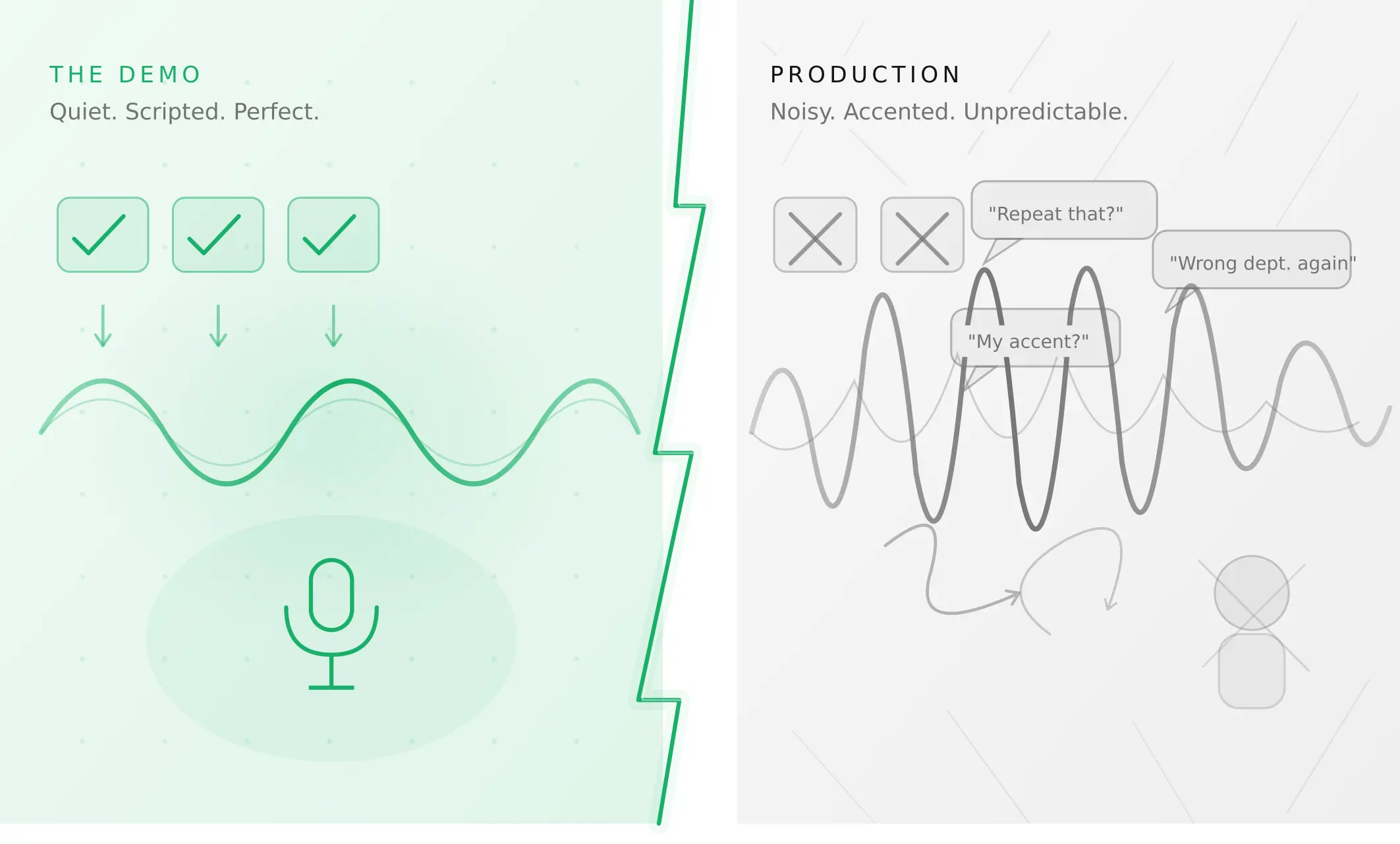
Why AI voice agents fail in production (and how to prevent it)
AI voice agents that ace demos still break in production. Learn the 5 root causes, how to test for each, and what production readiness actually means.
Read more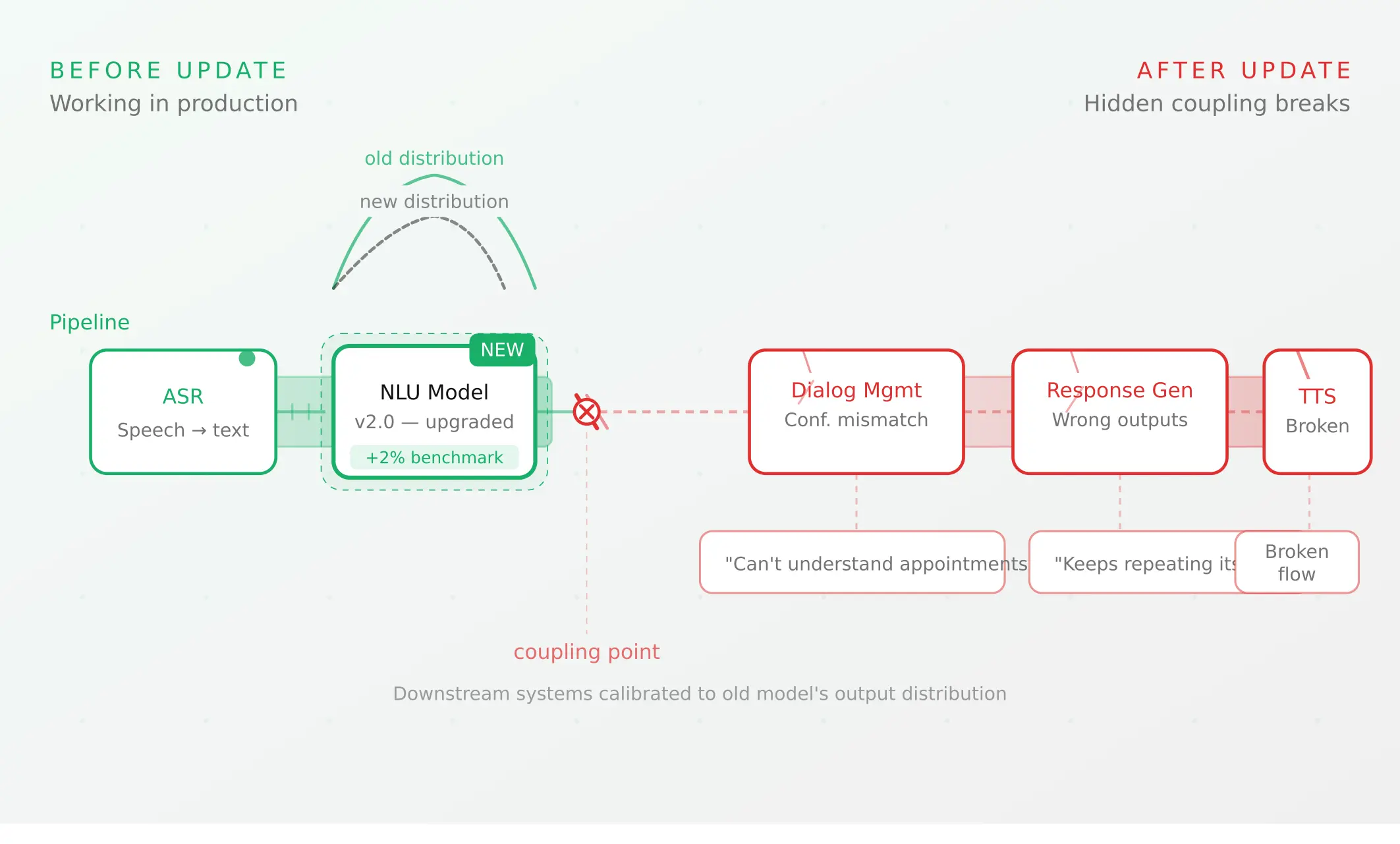
Voice agent regression testing: why LLM updates break production
LLM updates improve benchmarks but break voice agents in 5 predictable ways. How to detect and prevent regressions after every model or prompt change.
Read more