Test your voice agent
Third-Party Voice Agent Audit: What It Covers
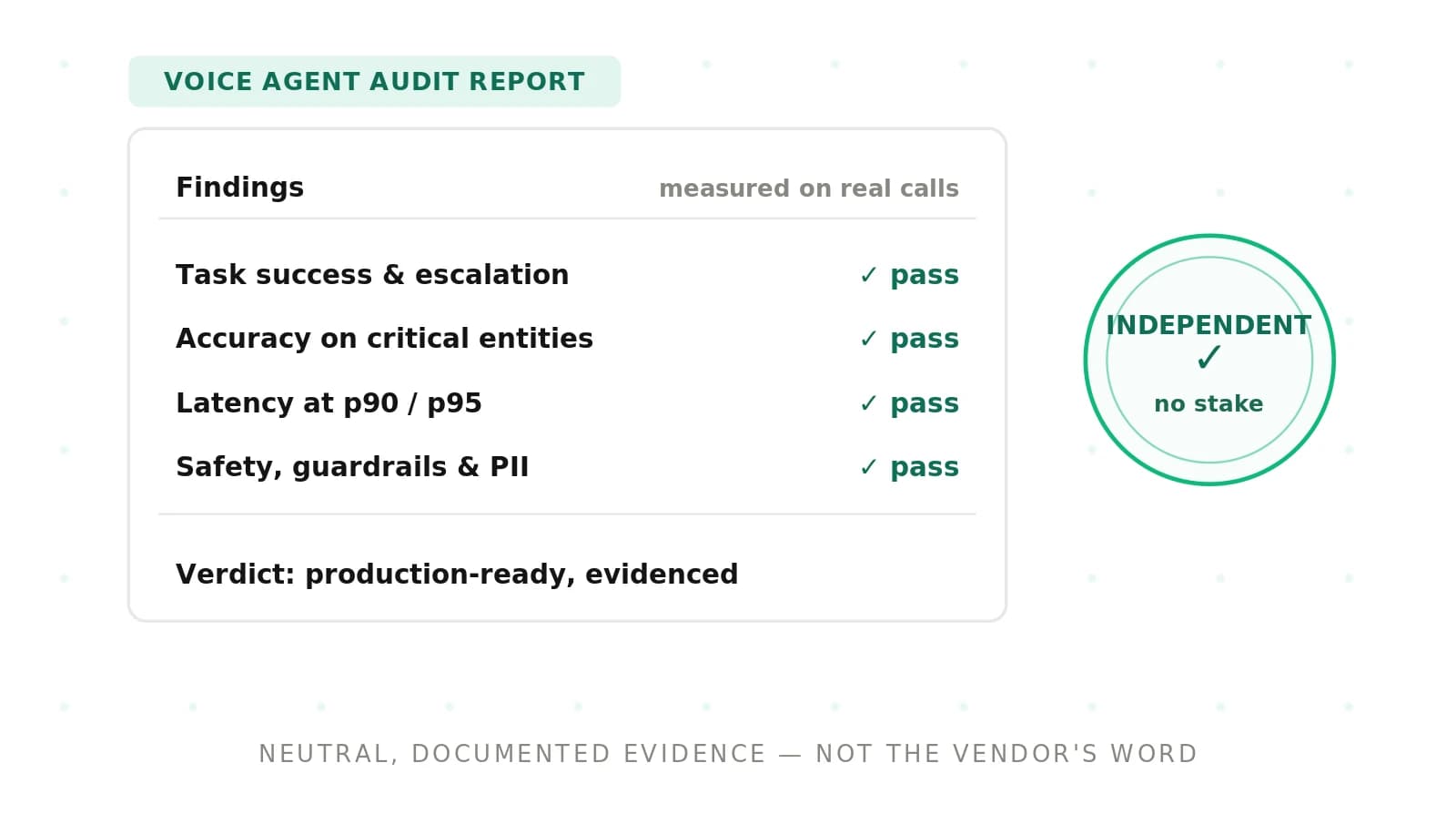
An internal test tells your team whether an agent works. A third-party audit tells everyone else. When a customer, a regulator, or your own board asks "how do you know this agent is safe to run," the honest answer is not a dashboard your team built and grades. It is a report from a party with no stake in the result, scoped in advance, run on your calls, and signed.
This guide is about the audit as a formal engagement, not the general idea of a neutral opinion. If you want the concept, our piece on independent voice AI evaluation covers what "independent" means and why it matters. Here we describe the engagement itself: what an audit covers, how the process runs, what lands in the deliverable, who commissions it, how it differs from an internal review, and how often to repeat it.
What a third-party audit actually is
An audit is a formal, evidence-based examination of a system against a defined standard, performed by someone independent of the thing being examined. The word carries weight from financial and security practice, and it should. An audit is not a casual review. It has a fixed scope agreed before work starts, a documented method, a body of collected evidence, and a written opinion that a named party stands behind.
Apply that to a voice agent and three things follow. The auditor is an external auditor with no commercial interest in whether the agent passes. The scope is written down and signed before testing begins, so no one moves the goalposts afterward. And the output is a report, not a conversation. Someone who was not in the room should be able to read it, understand what was tested and how, and rely on the conclusion.
That last property is what makes an audit useful to procurement and compliance. A demo persuades the person watching it. An audit persuades people who will never watch anything, because the evidence travels with the document.
What the audit covers
A credible voice agent audit measures the whole agent under production-like conditions, not one headline number. The scope is written into the engagement letter, but the substance is consistent across serious audits.
Speech recognition accuracy on your audio. The agent is scored on real calls with your callers, accents, and background noise, weighted for the entities that matter, rather than a clean-audio word error rate that flatters everyone.
Latency at the tail. The audit reports end-to-end response time under load, focused on the slow calls callers actually feel. The comfortable one-way limit in the ITU-T G.114 telephony standard is 150ms, and the tail is where agents break down.
Task success and recovery. Did the agent complete the caller's actual goal, and when it went wrong, did it recover or escalate cleanly? This is measured against defined outcomes, not vibes.
Safety and compliance. The audit checks refusals, disclosures, data handling, and behavior on sensitive requests. For regulated buyers, these checks map to a recognized framework such as the NIST AI Risk Management Framework, so the result survives a security review.
Behavior under load. The agent is exercised at realistic concurrency, because latency and accuracy that hold at one call often collapse at a thousand.
Our voice AI vendor metrics guide breaks down each of these measures and why vendor-reported versions of them can't be trusted at face value.
What the audit does not cover
An audit is bounded, and saying what falls outside the scope protects everyone. It is not an endorsement of the vendor's roadmap or company. It does not certify that the agent will stay compliant after a model update, which is why audits are repeated rather than issued once. It is not a substitute for continuous voice agent observability in production; an audit is a point-in-time examination, and monitoring is what catches drift between audits.
It is also not the same as procurement. An audit produces evidence that a buying decision can rest on, but choosing a vendor, negotiating terms, and running the voice AI procurement checklist are separate activities. The audit informs them; it does not replace them.
How a third-party voice agent audit runs
Here is how a formal audit engagement proceeds from first contact to signed report.
1. Define the scope and standard. The auditor and the requesting party agree in writing what is being tested, against which thresholds, on whose data. This engagement letter fixes the accuracy, latency, safety, and load targets before any call is placed. Nothing gets added or removed later without a written amendment.
2. Collect representative call data. The audit runs on real production traffic or a representative sample of it — your callers, your accents, your noise, your tasks. A curated demo dataset invalidates the result, so provenance of the audio is documented.
3. Build the test suite. The auditor turns the scoped scenarios into repeatable test cases, each with a defined pass condition. The same suite will be run identically against every agent or version in scope, which is what makes the numbers comparable.
4. Execute and capture evidence. Tests run at realistic concurrency. Every call, transcript, timing measurement, and score is captured and stored, because an audit conclusion is only as good as the evidence behind it. This mirrors the discipline of due diligence in any serious examination.
5. Score against the thresholds. Results are graded against the pre-agreed targets, not adjusted to fit a desired outcome. Each metric gets a score, and the agent gets an overall verdict against the production readiness bar.
6. Write and review the report. The auditor drafts the deliverable, cross-checks findings against captured evidence, and issues a written opinion a named party stands behind. Material findings are flagged with severity.
7. Deliver and debrief. The report goes to the requesting party, followed by a walkthrough for procurement, security, or the board. Remediation items are logged, and a re-audit date is set.
What lands in the deliverable
The report is the product. A weak audit hands over a spreadsheet; a strong one hands over a document that a reviewer who was not present can read and rely on.
A complete audit report contains an executive summary with the overall verdict, the scope and method as agreed in the engagement letter, per-metric scores against thresholds, and — critically — the evidence trail. That means the actual calls, transcripts, timings, and scores that support each finding, so a skeptical reviewer can spot-check any conclusion. It also flags material findings by severity, lists limitations and assumptions, and states a re-audit cadence. Recommendations are separated from findings, so the neutral record of what was measured is not tangled up with advice.
If a report cannot show its evidence, it is an opinion, not an audit. The evidence trail is what lets a security team or a customer trust the verdict without redoing the work.
Internal review versus third-party audit
Both have a place. They answer different questions for different audiences.
| Dimension | Internal review | Third-party audit |
|---|---|---|
| Who runs it | Your own team | Independent external party |
| Primary audience | Engineering and product | Procurement, security, compliance, board, customers |
| Scope | Flexible, evolves as you learn | Fixed and signed before testing |
| Independence | None — same team that built it | No stake in the result |
| Output | Dashboards and internal notes | Signed report with evidence trail |
| Frequency | Continuous | Point-in-time, repeated on a cadence |
| Standing as proof | Low outside the company | High — travels to external parties |
| Best for | Iterating and catching regressions early | Contracts, go-live sign-off, external assurance |
An internal review is faster, cheaper, and runs constantly, and it should. But it cannot serve as external proof, because the party grading the agent is the party that built it. That conflict is exactly what a third-party audit removes. The two are complementary: internal review keeps the agent honest day to day, and the audit produces evidence others can rely on. Our guide on how to evaluate voice agent vendors shows where each fits in a selection process.
Who requests an audit, and why
Audits are commissioned by people who need to hand proof to someone else.
Procurement requests an audit before signing a contract, because a purchase of this size cannot rest on vendor marketing. The audit is the evidence that survives a challenge from finance or legal.
Security teams require an audit to satisfy a review, often mapping findings to a control framework such as ISO/IEC 27001. They need to know how the agent handles data and refuses unsafe requests, in writing, from a neutral party.
Compliance and legal commission audits in regulated industries where an examiner may ask how the organization validated an automated system before deploying it. A signed report is the answer.
The board asks for an audit when a voice agent becomes material to the business. Directors want independent assurance, not a demo from the team that owns the project.
Customers increasingly require an audit as a condition of a deal. A large buyer will not put a voice agent in front of its own users on the strength of your say-so; it wants third-party proof.
In every case the pattern is the same. The requester is not the person who will use the agent day to day. They are the person who must vouch for it to someone with authority, and an audit is what lets them do that.
How often to run one
An audit is point-in-time, and voice agents change, so a single audit expires the moment the underlying model or prompt does. Run a full audit before any go-live and before any contract renewal. Repeat it on a fixed cadence — many regulated buyers settle on annual, with a lighter re-audit after any material change to the model, the vendor, or the call flows.
Between audits, continuous monitoring fills the gap. A model update can silently regress an agent that passed cleanly, so the cadence exists precisely because the verdict has a shelf life. Treat the re-audit date in the report as a hard deadline, not a suggestion.
Auditing voice agents with Evalgent
Evalgent is built to run third-party voice agent audits end to end, producing the scored, evidence-backed report an external party can rely on. Five primitives make that possible.
- Scenarios encode the scoped test cases from the engagement letter, so every agent or version faces an identical, repeatable suite.
- Profiles model your real callers — accents, noise, and behavior — so the audit runs on production-like conditions rather than a curated demo.
- Metrics score accuracy, tail latency, task success, safety, and behavior under load against pre-agreed thresholds.
- Evaluations execute the suite at realistic concurrency and capture every call, transcript, timing, and score as the evidence trail.
- Reviews turn that evidence into the signed report — verdict, per-metric scores, and material findings a procurement, security, or board reviewer can trust.
To see how an audit engagement would work on your own calls, book a demo.
The bottom line
A third-party voice agent audit is a formal engagement that ends in a signed, evidence-backed report. Internal reviews keep an agent honest; an audit is what lets you prove it to everyone else.
Frequently asked questions
What is a third-party voice agent audit?
It is a formal engagement in which an independent party tests a voice agent against a scope agreed in advance, on your own calls, and delivers a written report with per-metric scores and an evidence trail. The output is proof a named party stands behind, not a casual review or a demo.
How is a third-party audit different from an internal evaluation?
An internal evaluation is run by the team that built the agent, evolves as you learn, and stays inside the company. A third-party audit has a fixed scope, is run by a party with no stake in the result, and produces a signed report that external parties like procurement and customers can rely on.
What does a voice agent audit report include?
A complete report includes an executive summary and verdict, the agreed scope and method, per-metric scores against thresholds, and an evidence trail — the actual calls, transcripts, timings, and scores. It also flags findings by severity, lists limitations, and states a re-audit date.
Who requests a third-party voice agent audit?
Procurement requests one before signing, security teams to pass a review, compliance and legal in regulated industries, and boards when an agent becomes material. Customers increasingly require an audit as a deal condition. The requester is usually vouching for the agent to someone else.
How often should we run a voice agent audit?
Run a full audit before any go-live and before contract renewal, then on a fixed cadence — often annual — with a lighter re-audit after any material change to the model, vendor, or call flows. Continuous monitoring fills the gap between audits, since a model update can silently regress a passing agent.
What does a third-party audit cover?
It covers speech recognition accuracy on your audio, latency at the tail under load, task success and recovery, safety and compliance, and behavior at realistic concurrency. Each measure is scored against thresholds written into the engagement letter before testing begins, so no one can move the goalposts.
Can an internal review replace a third-party audit?
No. An internal review is valuable for iterating and catching regressions, but it cannot serve as external proof, because the party grading the agent is the party that built it. That conflict of interest is exactly what a third-party audit removes for procurement, security, and customers.
How long does a voice agent audit take?
It depends on scope, but a typical engagement runs a few weeks from signed engagement letter to delivered report. The bulk of the time goes to collecting representative call data, running the suite at realistic concurrency, and cross-checking every finding against captured evidence before the report is issued.
Related Articles
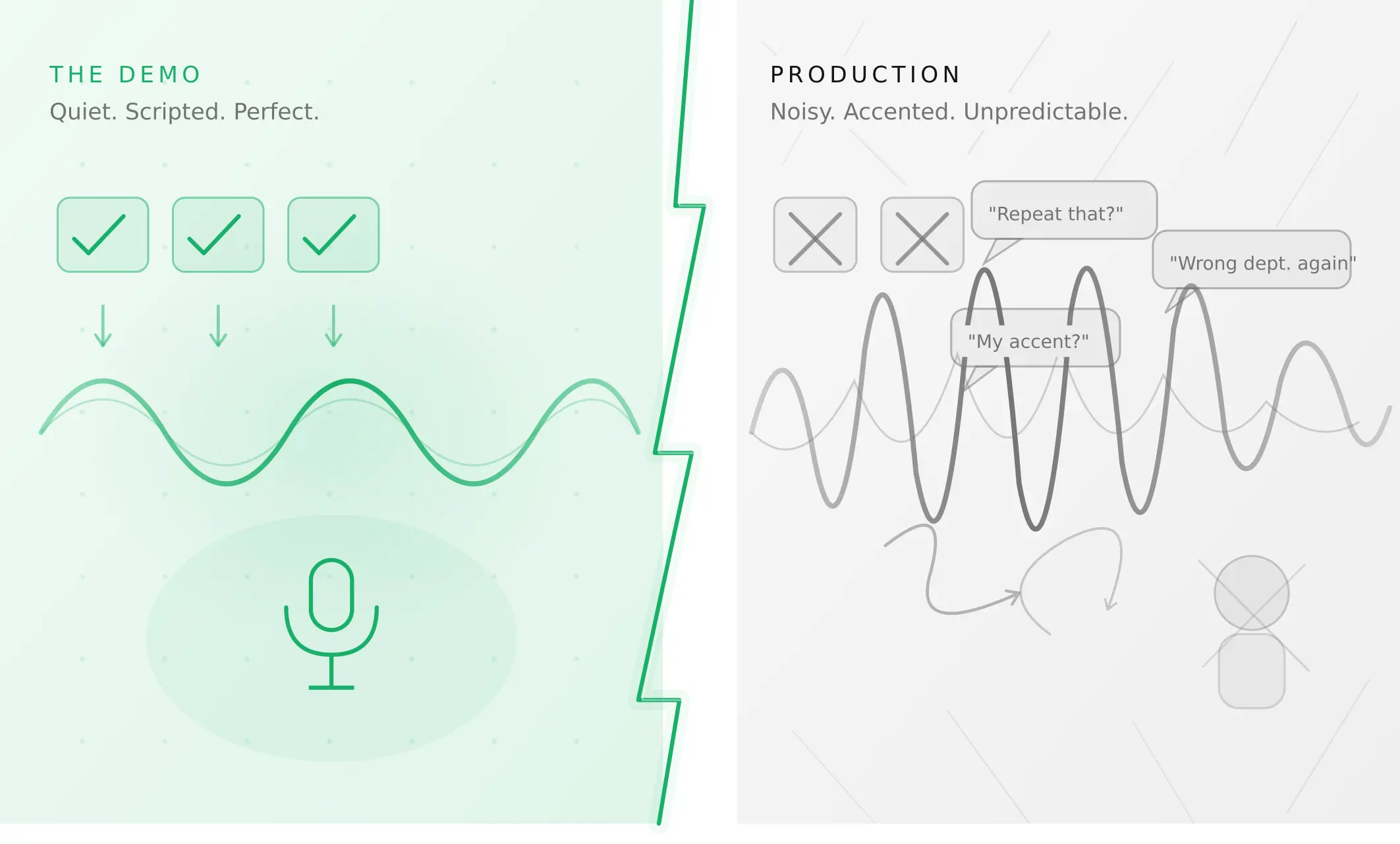
Why AI voice agents fail in production (and how to prevent it)
AI voice agents that ace demos still break in production. Learn the 5 root causes, how to test for each, and what production readiness actually means.
Read more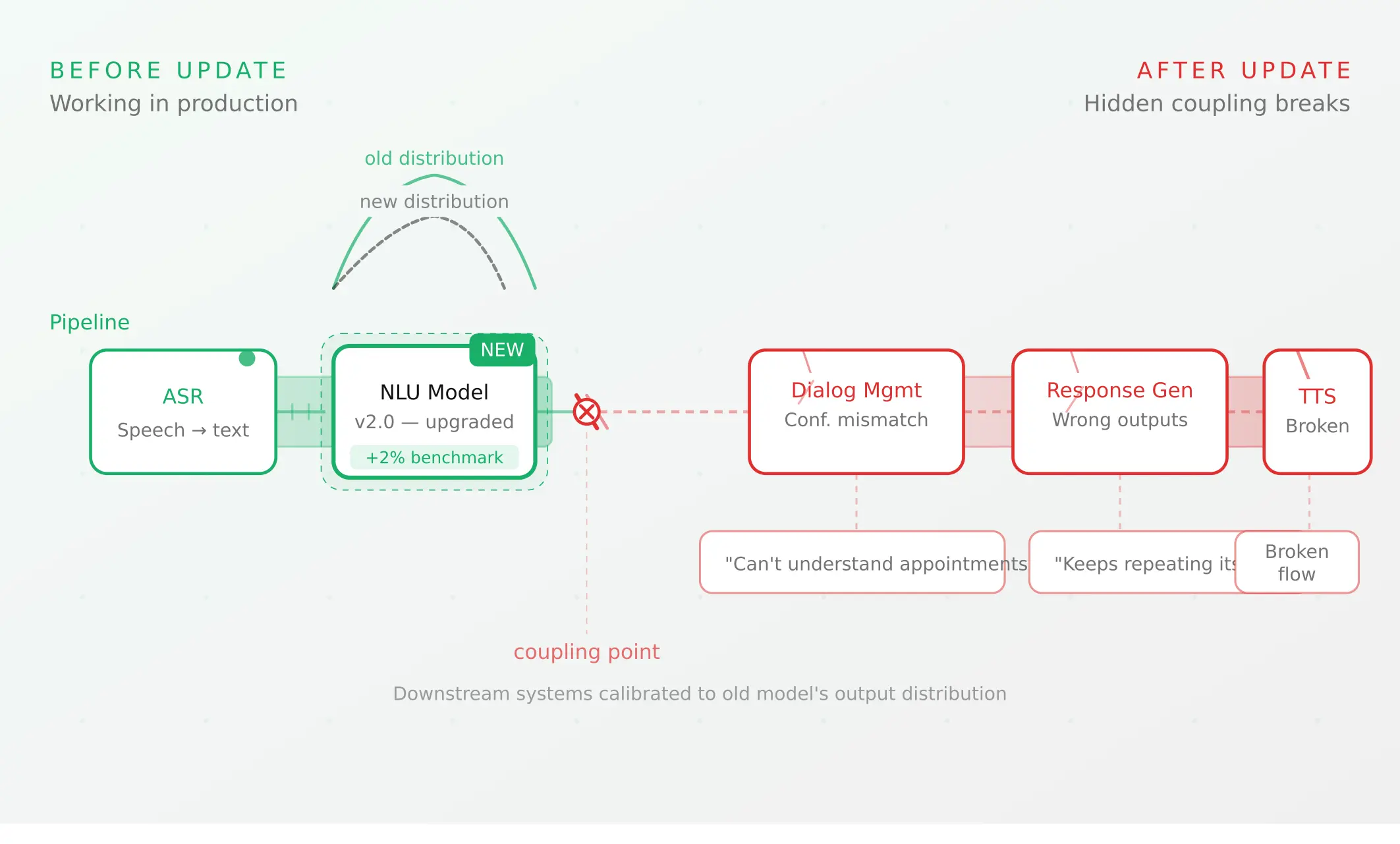
Voice agent regression testing: why LLM updates break production
LLM updates improve benchmarks but break voice agents in 5 predictable ways. How to detect and prevent regressions after every model or prompt change.
Read more